Saved Bookmarks
This section includes 7 InterviewSolutions, each offering curated multiple-choice questions to sharpen your Current Affairs knowledge and support exam preparation. Choose a topic below to get started.
| 1. |
Tritium is an isotope of hydrogen whose nucleus Triton contains 2 neutrons and 1 proton. Free neutrons decay into p+bare+barv. If one of the neutrons in Triton decays, it would transform into He^(3) nucleus. This does not happen. This is because |
|
Answer» TRITON energy is less than that of a `He^(3)` nucleus |
|
| 2. |
Explain why photoelectric effect cannot be explained on the basis of wave nature of light. |
|
Answer» Solution :Failures of classical wave theory : From Maxwell.s theory, light is an electromagnetic wave consisting of coupled electric and magnetic oscillations that MOVE with the speed of light and exhibit typical wave behaviour. Let us try to explain the experimental observations of photoelectric effect using wave picture of light. When light is incident on the target, there is a continuous supply of energy to the electrons. ACCORDING to wave theory, light of greater INTENSITY should impart greater kinetic energy to the liberated electrons (Here, Intensity of light is the energy delivered PER unit area per unit time). But this does not happen. The experiments show that maximum kinetic energy of the photoelectrons does not depend on the intensity of the incident light. According to wave theory, if a SUFFICIENTLY intense beam of light is incident on the surface, electrons will be liberated from the surface of the target, however low the frequency of the radiation is. From the experiments, we know that photoelectric emission is not possible below a certain minimum frequency. Therefore, the wave theory fails to explain the existence of threshold frequency. Since the energy of light is spread across the wavefront, the electrons which receive energy from it are large in number. Each electron needs considerable amount of time (a few hours) to get energy sufficient to overcome the work function and to get liberated from the surface. But experiments show that photoelectric emission is almost instantaneous process (the time lag is less than `10^(-9)`s after the surface is illuminated) which could not be explained by wave theory. |
|
| 3. |
Find the stretch in the springs shown in figure. The respective data are given in the figure. The friction and masses in pulleys are negligible. Find the extension in spring? |
|
Answer» Solution :a) As mass M is in equilibrium, the tension in the string with which it is hanging will be Mg. As pulley is massless the tension in the upper string must be half of the lower string, Mg/2. The stretch in the spring must be such that the restoring FORCE in the string is equal to the tension in it. Thus we have `k_1 x =(Mg)/(2) or x_1=(Mg)/(2k_1)` (b) Here again mass M is in equilibrium, thus the tension in the string connected to it must be equal to Mg and hence the restoring force in the lower spring will also be Mg. If `x_1` be the extension in this spring, we have `k_1x_1= Mg or x_1=(Mg)/(k_1)` 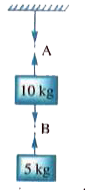 As pulley is light, the tension in upper string must be twice that of the lower srting, 2Mg which is equal to restoring force in the upper spring. If `x_1` is the extension in the upper spring, we have `k_2x_2=Mg or x_2=(2Mg)/(k_2)` Wherever a body is in equilibrium, due to inertia it is maintained in a state of rest. If any of the supporting force a body is removed, body start from rest with some acceleration in the direction opposite to the force APPLIED by the support, as all other forces acting on body will have a resultant in that direction. We discuss the situation with an example shown in figure. Two masses 5 kg and 10 kg are hanging in equilibrium with the strings A and B. If tensions in the strings A and B are `T_1 and T_2` respectively, then we have `T_1 = 5 g= 50N, T_2=15g = 150N` If at some instant we break string B. tension `T_1` becomes zero instantane-ously and block will start falling from rest under gravity and 10 kg block, as it is still in equilibrium, `T_2` will instantly change to 10 N to balance its weight. If instead of string B, we break the string A, tension `T_2` becomes zero and both the blocks will start falling with acceleration g. Now `T_1` is just an internal force for the system of two blocks and as there is no interaction between the two blocks and both are falling under gravity `T_1` will also instantly become zero. Now to understand the concept in a better way we slightly modify the situation of previous example. Instead of strings, we use springs as shown in figure. Initially the blocks are in equilibrium . If spring B breaks, its tension will instantly become zero as we are using ideal springs (massless/ inertialess),but due to inertia initially 10kg mass will not move from its initial position, so tension in upper spring will not change instantly hence it will ACCELERATE in upward direction with acceleration given as ` a=(150-100)/(10)=5m//s^(2)` If spring A breaks tension in spring A will instantly become zero, but as due to inertia 5 kg and 10 kg blocks will start moving from rest. As initally just after breaking of spring A the two masses are at rest, tension in spring B will not change at this instant which is T = 5g =50 N, Thus at this instant (just after spring A is cut) acceleration of 10 kg mass is ` a_1 = (10 g + kx)/( 10) = (100 + 50)/(10) = 15 m//s^(2)` and that of 5 kg mass is ` a_2=(5g-kx)/(5) = (50-50)/(5) =0m//sec^(2)` 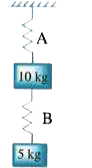
|
|
| 4. |
Statement-1 : When light enters a prism and deviates from its normal path. The deviation of violet colour is less than that of red colour. Statement-2 : The velocity of the violet colour is less than the velocity of red colour. |
|
Answer» Statement-1 is FALSE, Statement-2 is TRUE. |
|
| 5. |
Find the de Broglie wavelength corresponding to the root-mean-square velocity of hydrogen molecules at room temperature (20^(@)C). |
|
Answer» |
|
| 6. |
The example of employing electromagnetic wave, with a range of frequency from 30 MHz to very high 300 MHz, as carrier wave is |
|
Answer» RADIO TRANSMISSION of SHORT DISTANCE |
|
| 7. |
What is meant by plane polarised light ? Can sound waves be polarised ? Briefly discuss polarisation by scattering. |
|
Answer» Solution :Plane polarised light. The phenomenon of restricting the vibrations of light (electric vector) in a particular plane is called POLARISATION of light. And the light in which the vibrations of light (electric vector) are restricted to a particular plane is called plane polarised light. No. Sound waves cannot be polarised because sound waves are LONGITUDINAL waves and polarisation is possible only in TRANSVERSE waves. Polarisation by scattering When unpolarised light [travelling along X-axis (say)] is made to pass through a medium containing particles of size comparable to wavelength of light, the light gets SCATTERED. If the observation is made perpendicular to the direction of incident waves (say along Y-axis or Z-axis), the light is found to be plane polarised. 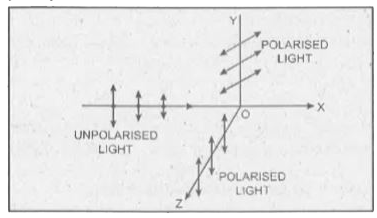 If the observer is looking along Z-axis, then the polarised light has plane of vibrations parallel to Y axis, and if the observer is looking along Y-axis, then the polarised light has plane of vibration parallel to Z-axis as shown in the FIGURE. This is the method of polarising light by scattering. |
|
| 8. |
A block of mass M is at rest on a rough horizontal surface. The coefficient of friction between the block and the surface is mu. A force F = Mg acting at an angle theta with the vertical side of the block pulls it. In which of the following cases, the block can be pulled along the surface? |
|
Answer» `tan theta GE MU` |
|
| 9. |
If the speed of light in a medium is 200 xx 10^6" m"//"s" , then refractive index of medium is ...... [C = 3 xx 10^8" m"//"s"] |
|
Answer» 1 `THEREFORE` n = 1.5 |
|
| 10. |
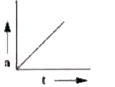
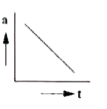
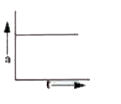
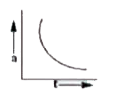
The distance travelled by a body moving along a line in time t is proportional to t^(3).The acceleration -time (a,t) graph for the motion of the body will be |
|
Answer»
|
|
| 11. |
A compass needle of magnetic moment60 A-m^(2) , pointing towards geographical north at a certain place where the horizontal component of earth's magnetic fieldis40 mu Wb//m^(2) experiences a torque of1.2 xx 10^(-3)Nm . Find the distance declination at that place. |
|
Answer» Solution :If ` theta ` is the declination of the place , then the TORQUE acting on the needle is ` tau = M B_H sin theta ` ` implies sin theta = (tau)/(MB_H) = (1.2 xx 10^(-3))/(60 xx 40 xx 10^(-6)) =(1)/(2)` `implies :. theta = 30^(@)` |
|
| 12. |
Explain diamagnetism and diamagneticsubstance. |
Answer» Solution :Diamagnetic substance are those which have tendency to move from stronger to the weaker part of the external magnetic field. These substance are repel by MAGNET.  Figure shows a bar of diamagnetic material placed in an external magnetic field. The field lines are repelled or expelled and the field inside the material is reduced. When placed in a non-uniform magnetic field, the bar will tend to move from high to low field. The simplest EXPLANATION for diamagnetism is as follows. Electrons in an atom orbiting around nucleus POSSESS orbital angular momentum. These orbiting electrons are equivalent to current carrying loop and thus possess orbital magnetic moment. Diamagnetic substance are the ones in which resultant magnetic moment in an atom is zero. When magnetic field is applied those electrons having orbital magnetic moment in the same DIRECTION slow down and those in the opposite direction speed up. Thus, the substance develops a net magnetic moment in direction opposite to that of the applied field and hence repulsion. Some diamagnetic materials are bismuth, copper, lead, silicon, nitrogen (at STP), water and sodium chloride. Diamagnetism is present in all the substance but the effect is so weak. The susceptibility of diamagnetic substance is small and negative. |
|
| 13. |
A body is projected with a velocity 60 ms^(-1) at 30^(@) to horizontal. Its initial velocity vector is |
|
Answer» `10 HATI+10 sqrt(3) hatj` |
|
| 14. |
Which principle could be used to help calculate the amount of radiation emitted by a star? |
|
Answer» NEWTON's LAW of universal gravitation |
|
| 15. |
The wave number of energy emitted when electron jumbs from fourth orbit to second orbit in hydrogen in 20,497 cm^(-1). The wave number of energy for the same transition in He^(+) is |
|
Answer» `5,099 CM^(-1)` |
|
| 16. |
Two conducting spheres of radius r_(1) =8 cm and r_(2) =2 cm are separated by a distance much larger than 8 cm and are connected by a thin conducting wire as shown in the figure . A total charge of Q=+100 nC is placed on one of the spheres . After a fraction of a second the charge Q is redistributed and both the spheres attain electrostatic equilibrium . (a) Calculate the charge and surface charge density on each sphere. (b) Calculate the potential at the surface of each sphere . |
|
Answer» Solution :( a) The electrostatic potential on the surface of the sphere A is `V_(A)=(1)/(4piepsillon_(0))(q_(1))/(r_(1))` The electrostatic potential on the surface of the sphere A is `V_(B) = (1)/(4piepsilon_(0))(q_(2))/(r_(2))` Since `V_(A)=V_(B)`. We have `(q_(1))/(r_(1))=(q_(2))/(r_(2))implies q_(1)=((r_(1))/(r_(2)))q_(2)` But from the conservation of total charge Q`=q_(1)+q_(2)` we get `q_(1)=Q-q_(2).` By substituting this in the above equation , `Q-q_(2)=((r_(1))/(r_(2)))q_(2)" " "so that" " "q_(2)=Q((r_(2))/(r_(1)+r_(2)))` Therefore `q_(2)=100xx10^(-9)xx((2)/(10))=20nC` and `q_(1)=Q-q_(2)=80nC` The electric charge density for sphere A is `sigma_(1)=(q_(1))/(4pir_(1)^(2))` The electric charge density for sphere B is `sigma_(2)=(q_(2))/(4pir_(2)^(2))` Therefore`sigma_(1)=(80xx10^(-9))/(4xx64xx10^(-4))=0.99xx10^(-6)CM^(-2)` and `sigma_(2)=(20xx10^(-9))/(4pixx4xx10^(-4))=3.9XX10^(-6)cm^(-2)` Note that the surface charge density is greater on the smaller sphere compared to the largersphere `(sigma_(2)~~4sigma_(1)) ` which confirms the result `(sigma_(1))/(sigma_(2))=(r_(2))/(r_(1))` . The potential on both sphere is the same . So we can calculate the potential on any on of the spheres . `V_(A)=(1)/(4piepsilon_(0))(q_(1))/(r_(1))=(9xx10^(9)xx80xx10^(-9))/(8xx10^(-2))=9kV` |
|
| 17. |
A block of mass m in the equilib rium on a rough inclined plane with inclination alpha and coefficient of friction as shown in the figure (mu < tan alpha). A force F is applied on the block which makes an angle theta with the horizontal as shown in diagram. |
|
Answer» Normal FORCE on the block `mg COS alpha+ F sin theta`. |
|
| 18. |
For a certain light, there are 2 xx 10^3 waves in 1.5 mm in air. The wavelength of light is : |
|
Answer» 750 MM |
|
| 19. |
The alpha-decay of Po^(210) nuclei (in the ground state) is accompanied by emission of two groups of two groups of alpha-particles with kinetic energies 5.30 and 4.50MeV. Following the emission of these particles the daughter nuclei are found in the ground and excited states. Find the energy of gamms-quanta emitted by the excited nuclei. |
Answer» Solution :We neglect all RECOIL EFFECTS. Then the FOLLOWING diagram gives the energy of the gamma ray 
|
|
| 20. |
A mica strip and a polystyrene strip are fitted on the two slits apparatus . The thickness of the strips is 0.50 mm and the separation between the slitsis 0.12 cm . The refractive index of mica and polystyrene are 1.58 respectivelyfor the light of wavelenght 590nm whichis usedin the experiment . The interference is observed on a screen at a distance one meter away . What would be the fringe -width ? |
|
Answer» `2.45xx10^(-4)`m |
|
| 21. |
The height of the Antenna (a) limits the population covered by the transmission (b) limits the ground wave propagation (c) effectively used in line of sight communication |
|
Answer» a & B are true |
|
| 22. |
A change of 0.8 mA in the anode current of a triode occurs when the anode potential is changed by 0 V. If mu = 8 for the triode, then what change in the grid voltage would be required to produce a change of 4 mA in the anode current |
|
Answer» `6.25 V` |
|
| 23. |
Mutual inductance for a pair of two coils is 1.5 mH. If the current in one coil is raised by 5 A in 1m s after closing the circuit, the magnitude of emf induced in the other coil is ______. |
|
Answer» |
|
| 24. |
Prove that the magnitude of the hydrostatic pressure is proportional to the height of the column of liquid (or gas) and is independent of the vessel's shape. |
|
Answer» <P> Solution :No matter what the shape of the vessel is, one can always imagine it to be made up of SMALL vertical columns of liquid for which the formula `p = RHO gh` was derived (see Fig.). But since the pressure at all points at a given DEPTH is the same (a corollary of Pascal.s law), to compute the pressure at the depth h one should add up the pressures of all the upper LAYERS:`p = p_1 + p_2 + p_3 + … =rho g(h_1 + h_2 + h_3 + ….) = rho gh` 
|
|
| 25. |
In the following circuit, the resultant capacitance between A and B is muF . Find the value of C. |
|
Answer» `(32)/(23)MUF` |
|
| 26. |
What conclusion can you draw from the following observations on a resistor made of alloy manganin ? |
|
Answer» SOLUTION :The resistance for various observations (in ohm), is as follows: `R = (3.94)/(0.2) ,(7.87)/(0.4) , (11.8)/(0.6) ,(15.7)/(0.8) , (19.7)/(1.0) , (39.4)/(2.0) , (59.2)/(3.0) , (78.8)/(4.0) , (98.6)/(5.0),(118.5)/(6.0) , (138.2)/(7.0) , (158.0)/(8.0) = 19.7 OMEGA ` Since resistance is constant, it means manganin alloy obeys Ohm.s law and the RESISTIVITY of thealloy manganin is INDEPENDENT of temperature. |
|
| 27. |
An astronomical telescope in normal adjustment has a tube length of 93 cm and magnification (angular) of 30. If eye-piece is to be drawn out by 3 cm to focus a near object, with the final image at infinity, find how far away is the object and the magnification (angular) is this case. |
|
Answer» |
|
| 28. |
Two wires that are made up of different materials have their specific resistance, lengths and area of cross-section in the ratio 2:3, 3:4 and 4:5 respectively. The ratio of their resistance is : |
|
Answer» 6:5 |
|
| 29. |
In a potentiometer arrangement shown in fig. The balancing length for p.d. across xy points is found to be 45.5cm. Then the balancing length for p.d. across (Y) and (Z) would be (##MOT_CON_NEET_PHY_C22_E02_010_Q01.png" width="80%"> |
|
Answer» ` 45.50 CM` |
|
| 30. |
Explain qualitatively on the basis of domain picture the lireversibility in the magnetisation curve of a ferromagnet. |
| Answer» Solution :(a) When a ferromagnetic SUBSTANCE is subjected to external uniform magnetic field, magnetic dipole moment in each domain tends to align, PARALLEL to magnetic field because of torque EXERTED on it. Some energy is spent for doing this work out of which some part is stored in the dipoles in the form of magnetostatic potential energy and remaining part is WASTED in the form of heat (which is called hysterisis loss). Now, though magnetic field is removed organised orientation of all the dipoles remain unchanged. They do not come back to their random orientations (because in the absence of magnetic field, no torque is exerted on the dipoles to change their orientations). Thus, MAGNETISING process is irreversible. | |
| 31. |
(a) Show that the normal component of electrostatic field has a discontinuity from one side of a charged surface to another given by: (vecE_(2)-vecE_(1)).hatn =(sigma)/(epsilon_(0)) where hatn is a unit vector normal to the surface of a point and sigma is the surface charge density at that point. (The direction of hatn is from side 1 to side 2). Hence, show that just outside a conductor, the electric field is (sigma hatn)/(epsilon_(0)). (b) Show that the tangential component of electrostatic field is continuous from one side of a charged surface to another. |
|
Answer» Solution :(a) The electric field due to a charged surface having surface charge density `sigma` is given by: `vecE=(sigma)/(2epsilon_(0)) hatn` Let us consider a charged surface carrying surface charge density `sigma` as shown in thefigure.  The electric field intensity at the side-2 is given by: `vecE_(2)=(sigma)/(2epsilon_(0))hatn` The electric field intensity at side-1 is given by: `vecE_(1)=(sigma)/(2epsilon_(0))hatn` There will be discontinuity in the electric field due the charged surface as the directions of the `vecE_(1) and vecE_(2)` will be opposite. Thus, the discontinuity in the electric field is given by, `vecE_(2)-vecE_(1)=(sigma)/(2epsilon_(0))hatn-(-(sigma)/(2epsilon_(0)))hatn=(sigma)/(epsilon_(0)) hatn` `rArr (vecE_(2)-vecE_(1))hatn=((sigma)/(epsilon_(0))hatn)hatn=(sigma)/(epsilon_(0))` Since the difference of the electric field intensities on the two sides of the surface is non-zero, the two electric fields are unequal. So, there is a discontinuity. In case of the surface is conducting the electric field will be zero at its one side because that lies inside the conductor.s volume. Thus, on substituting `vecE_(1)=0` `vecE_(2)-vecE_(1)=(sigma)/(epsilon_(0)) hatn` `vecE_(2)=(sigma)/(epsilon_(0))hatn` (b) 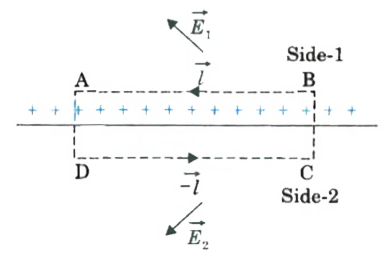 Let `vecE_(1) and vecE_(2)` be the electric fields on both sides of the charged surface. Let us assume a rectangular loop of negligible width and LENGTH `l` as shown in above figure. Side AB of the loop is on side-1 of the charged surface and the side CD is on the side-2 of the charged surface. As we KNOW the net work done in moving a charged particle in a closed loop is zero inside electrostatic field. Thus, work done in moving a unit charged particle along ABCD must be zero. `vecE_(1)*vecl+vecE_(2). (-vecl)=0` [The width of the loop AD and BC is neglected] Thus, `E_(1)l cos theta_(1)-E_(2)l cos theta_(2)=0` `rArr E_(1)cos theta_(1)=E_(2)cos theta_(2)` Here, `theta_(1) and theta_(2)` are the angles made by `vecE_(1)` and `vecE_(2)` with the charged surface. `E_(1) cos theta_(1) and E_(2)cos theta_(2)` are the TANGENTIAL components of the electric field on two sides of the surface and we have proved them to be equal. Hence, the tangential component of electric field (if it exists) will be same on both sides. |
|
| 32. |
Find the derivative of the following function: f(x) = x ^2 + 6x + 9 |
|
Answer» `2X + 6 + 9` |
|
| 33. |
The half-life of ""_(38)^(90)Sr is 28 years. What is the disintegration rate of 15 mg of this isotope? |
|
Answer» Solution :`T_(1//2) = 28 "YEARS" = 28 XX 365 xx 24 xx 60 xx 60 s = 8.83 xx 10^8 s` `(dN)/(DT) = lambda N = (0.693)/(T_(1//2)) xx N = (0.693 xx 15 xx 6.023 xx 10^(23))/(8.83 xx 10^8 xx 90)` `= 7.877 xx 10^(10) BQ = (7.877 xx 10^(10))/(3.7 xx 10^(10)) = 2.1289 Ci`. |
|
| 34. |
.(A): The value of dimensionless constants or proportionality constants cannot be found by dimensional methods. (b) : The equations containing trigonometrical, exponential and logarithmic functions cannot be analysed by dimensional methods. |
|
Answer» Both A &B are TRUE |
|
| 35. |
Two sound waves y_1= 3sin100 pit and y_2=4 sin102 pit superimpose upon each other find ratio of maximum to minimum intensity of sound? |
|
Answer» SOLUTION :`a_1= 3` `a_2= 4I_max/I_min = (a_1 + a_2)^2/(a_1 - a_2)^2 = (3 + 4)^2/(4 - 3)^2 = 49/1` |
|
| 36. |
A spherical liquid drop of radius R is divided into eight equal droplets . If surface tension is T, then the work done in this processwill be |
|
Answer» `2 piR^2T` |
|
| 37. |
A body is projected at an angle of 45° with K.E. ‘E’. The K.E. at the highest point is : |
| Answer» Solution :K.E. at highest point =`Ecos^(2)theta=Ecos^(2)45^@=E/2` | |
| 38. |
The force of repulsion between two electrons at a certain distance is F. The force between two protons separated by the same distance is (m_p= 1836 m_e) |
| Answer» ANSWER :B | |
| 39. |
What was the meaning of the slogans raised by three revolutionaries? |
|
Answer» Inqualab Murdabad |
|
| 40. |
When a ray of lightentersfrom one medium to another, then which of the following does not change? |
|
Answer» FREQUENCY |
|
| 41. |
A step down transformer has turns ratio 40:1. (i) If the primary voltage is 240V, calculate the secondary voltage. (ii) If the secondary current is 4A, calculate the primary current. |
| Answer» SOLUTION :(i) 6V, (II) 0.1A | |
| 42. |
What is the amount of work done in moving a point charge q_0 around a circular arc of radius 'r' at the centre of which another point charge q is located ? |
| Answer» Solution :WORK done is zero because electric potential at all points of the circular ARC is same `[V = Q/(4PI epsi_0r)]`. | |
| 43. |
Awhistle of frequency 540 Hz rotates in a circle of radius 2 m at a linear speed of 30 m/s. What is the lowest and highest frequency heard by an observer a long distance away at rest with respect to the centre of circle. Take speed of sound in air as 330 m/s. Can the apparent frequency be ever equal to actual? |
Answer» Solution :Apparentfrequency will be MINIMUM whenthe source is at N and moving AWAY from the observer. `f_("min") + (v/(v +v_s)) f =(330/(330 +30)) xx 540 = 495 Hz` FREQUENCY will be maximum when source is at L and approachign the observer. `f_(max) =(v/(v-v_s)) f = (330/(330 -30)) (540) = 594 Hz` Further when source is at M and K, angle between velocity of source and line joining source and observer is `90^@" or " v_s cos theta =v_s cos 90^@ =0`. So, there will be no change in the apparent frequency. i.e., no Doppler effect. |
|
| 44. |
State with reason where the balance point will be shifted when cell P is replaced by another cell whose emf is lower than that odf the cell Q. |
| Answer» Solution :no change the VARIATION is S will not AFFECT the current through the PRIMARY circuit and HENCE the pd across the wire AB. | |
| 45. |
If the radius of outside cylinder is eta times the inside one for a cable consisting of two thin walled co- axial metallic cylinders, the inductance per unit length is |
|
Answer» |
|
| 46. |
Consider a source of sound S, and an observer P. The source emits sound of frequency N_(0). The frequency observed by P is found to be. |
|
Answer» `N_(1) =N_(2) =N_(3)` `N_(2)=(v_(0))/(v_(0)-v)N_(0)` `N_(3)=(v_(0)+(v)/(2))/(v_(0)-(v)/(2))N_(0)` |
|
| 47. |
प्लास्मिड (Plasmid) है : |
|
Answer» विषाणु |
|
| 48. |
consider a uniform electric fieldoversetto E =3xx 10^(3) hatiN//CWhat is the flux of this field througha square of 10cm on a side whose plane is parallel to the yzplane? (b) What is the flux through the same square if if the normal to its plane makes a 60^(@)angle with the x-axis? |
|
Answer» Solution :Here ` oversetto E =3xx 10^(3)hat I N//C ` As SIDEOF square =10 cm =0.1m, hence surface area `S= ( 0.1 ) ^(2)=0.01 m^(2) `. The plane of surface area being PARALLEL to y= plane, hence `oversetto S = 0.01 hati m^(2) ` ` therefore ` Electric flux of the field ` phi_E = oversetto E. oversetto S= (3xx10 ^(3)hati) .(0.01 hati ) =30 N m^(2)C^(-1) ` (b) When normal to the plane of surface area makesan ANGLE of ` 60^(@) `with the x-axis flux is given by `phi_E=oversetto.oversettoS =E S cos theta =3xx 10^(3)xx 0.01 xx cos 60^(@) ` ` "" =15 Nm^(2)C^(-1) ` |
|
| 49. |
Statement - I : When two charged spheres are touched, then total charge is always devides equally. Statement - II : Induced charge always equal to inducing charge. |
|
Answer» If both Statement-I and Statement-II are TRUE, and Statement-II is the correct EXPLANATION of Statement -I. |
|
| 50. |
A curved ection of a road in banked for a speed upsilon. If there is no friction between te road and the tures than |
|
Answer» a car moving with speed `UPSILON` will not slip on the ROAD |
|