

Saved Bookmarks
This section includes 7 InterviewSolutions, each offering curated multiple-choice questions to sharpen your Current Affairs knowledge and support exam preparation. Choose a topic below to get started.
| 1. |
Draw energy banddiagram of p and n type semiconductors. Also write two difference between p and n type semiconductors. |
Answer» SOLUTION :ENERGY BAND DIAGRAMS are SHOWN here : 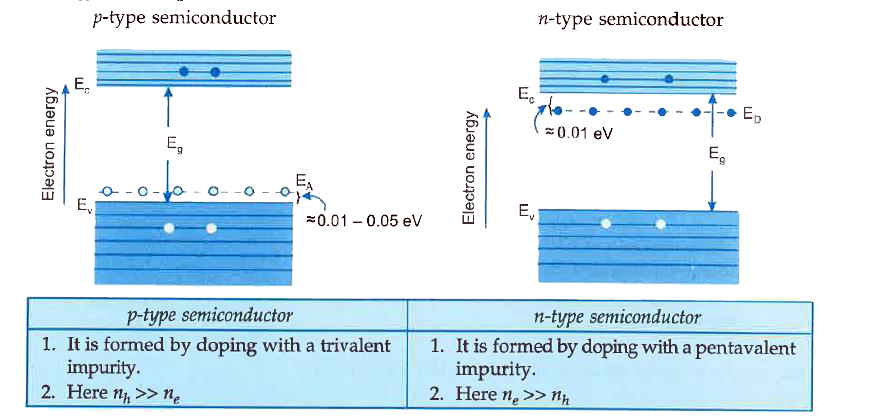
|
|
| 2. |
The speed of electromagnetic wave in vacuum depends upon the source of radiation |
|
Answer» Increases as we move from `GAMMA`-rays to radio WAVES = constant |
|
| 3. |
A standard coil marked 3 Omega is found to have a true resistance of 3.115 Omega at 300 K. Calculate the temperature at which marking is correct. Temperature coefficient of resistance of the material of the coil is 4.2xx10^(-3) .^(@)C^(-1). |
|
Answer» |
|
| 4. |
The tuning forks, A and B , produce notes of frequencies 258 Hz and 262 Hz. An unknown note sounded with a produces certain beats . When the same note is sounded with B, the beat frequency gets double. The unknown frequency is : |
|
Answer» 250 Hz `therefore (258 - v)/(262 - v) = (1)/(2) ` 512 - 2v = 262 - v 516 - 2v = v `rArr "" ` v = 254 Hz. So, correct choice is c. |
|
| 5. |
Magnetic field and magnetic intensity are 1 T and 150 "Am"^(-1) respectively in a iron core, then its relative permeability is ....... (Take mu_(0) = 4pi xx 10^(-7) mu m^(-1) ) |
|
Answer» `(10^(6) )/(4pi)` `therefore B = mu_(0) mu_(r) H` `therefore _(r) = (B)/( mu_(0) H)` `= (1)/( 4 XX pi xx 10^(-7)xx 150) ` `= (10^5)/( 6 pi) mu m^(-1)` |
|
| 6. |
The radiation corresponding to 3 to 2 transition of hydrogen atom falls on a metal surface to produce photoelectrons.These electrons are made to enter a magnetic field of 3xx10^(-4)T.If the radius of the largest circular path followed by these electrons is 10.0 mm the work function of the metal is close to: |
|
Answer» 1.1 EV The energy in n=2 orbit `E_(2)=-(13.6)/(4)=-3.4eV` The energy in n=1 orbit `E_(1)=-13.6eV` The energy of EMITTED PHOTONS during the transition `3to2` of electron, `hf=E_(3)-E_(2)` `=-1.51-(-3.4)=3.4-1.51` A moving electron moves in a circle in a magnetic FIELD, `:.(mv^(2))/(r)=Bqv` `:.mv=Bqr` `:.p=Bqr` and `K_(max)=(p^(2))/(2m)=((Bqr)^(2))/(2m)` in joule `:.K_(max)=((Bqr)^(2))/(2mxx1.6xx10^(-19))eV` `=((3xx10^(-4)xx1.6xx10^(-19)xx10^(-2))^(2))/(2xx9.1xx10^(-31)xx1.6xx10^(-19))` `=(2304)/(29.12)xx10^(-2)` `=0.791eV"".......(2)` Now, from photoelectric equation of Einstein, `K_(max)=hf-phi` `:.phi=hf-K_(max)` `=1.89-0.791""` [From equ. (1) and (2) ] `=1.099 eV` `:.phi~~1.1eV` |
|
| 7. |
A unifrom chain of mass m hannges from a light pulley ,with unequal lenghts hanging from the two sides of the pulley.Theforce exerted by the moving chain on the pulley is |
|
Answer» `MG` |
|
| 8. |
Reverse bias applied to a junction diode |
|
Answer» INCREASES the POTENTIAL barrier |
|
| 9. |
A person with a defective sight is using a lens having a power of +2D. The lens he is using is |
|
Answer» CONCAVE lens of FOCAL LENGTH` 0.5` m |
|
| 10. |
A beam of light converges at a point P. Now a lens is placed in the path of the convergent beam 12cm from P. At what point does the beam converge if the lens is (a) a convex lens of focal length 20cm, and (b) a concave lens of focal length 16cm? |
|
Answer» Solution :Here the object is virtual and the image is real. `u = +12CM` (object on RIGHT, virtual) (a) `F = +20CM`. Image is real and at 7.5 cm from the LENS on its right side. (b) `f = -16 cm`. Image is real and at 48cm from the lens on its right side. |
|
| 11. |
The maximum error in calculation of Young's modulus of elasticity of the wire is |
|
Answer» `56xx 10^(8) NM^(-2)` |
|
| 12. |
The set which repesents the isotope , isobar and isotone respectively is |
|
Answer» `(._1^2H, ._1^3H),(._79^197Au, ._80^198Hg) and (._2^3He, ._1^2H)` `._1H^2` and `._1H^3` are isotopes `._2He^3` and `._1H^3` are isobars. `._79Au^197` and `._80Hg^198` are isotones. |
|
| 13. |
Explain emission of electron from metal.Define work function .Write its unit,work function of metal depend on which factors? |
|
Answer» Solution :Normally electron cannot escape from the surface of metal. When temperature of metals is INCREASED,kinetic energy due to oscillation increases.When this energy due to oscillation increases.When this energy exceed binding energy,electron will positively charged. But due to attractive force between positive ion and NEGATIVE ion,surface and it will become positively charged. But due to attractive force between positive ion and negative ion,electron again attracted tometal surface. If energy of electron is more than energy due to attractive force,then only it can escape from metal surface. Work function:minimum energy required to make an electron escape from the metal surface is called work function of the metal. Work function is DENOTED by `phi_(o)` Its SI unit is eV (electron VOLT). Work function of metal DEPENDS on type of metal and surface. |
|
| 14. |
Use the assumptions of the previous question. An object weighed by a spring balance at the equator gives the same reading as a taken at a depth d below the earth's surface at a pole (d lt lt R). The value d is |
|
Answer» `(omega^(2)R^(2))/(G)` |
|
| 15. |
At two points of the reference frame K two events occurred separated by a time interval Deltat. Demonstrate that if these events obey the cause-and-effect relationship in the frame K (e.g. a shot fired and a bullet hitting a target), they obey that relationship in any other inertial reference frame K^'. |
|
Answer» SOLUTION :We can take the COORDINATES of the two EVENTS to be `A:(0,0,0,0) B: (DELTAT, a, 0, 0)` For B to be the effect and A to be cause we must have `Deltat gt (|a|)/(c)`. In the moving frame the coordinates of A and B become `A: (0,0,0,0), B: [gamma(Deltat-(aV)/(c^2)), gamma(a-VDeltat), 0, 0]` where `gamma=(1)/(sqrt(1-((V^2)/(c^2))))` Since `(Deltat^')^2-(a^('^2))/(c^2)=gamma^2[(Deltat-(aV)/(c^2))^2-1/c^2(a-VDeltat)^2)=(Deltat)^2-a^2/c^2 gt 0` we must have `Deltat^' gt (|a^'|)/(c)` |
|
| 16. |
When a potential difference is applied across the current passing through a) an insulator at 0 K is zero b) a semiconductor at 0 K is zero c) a metal at 0 K is finite d) a p-n junction at 300 K is finite, if it is reverse biased |
|
Answer» only a and B are CORRECT |
|
| 17. |
In Fig., particle 1 of charge +q and particle 2 of charge +9.00 q are held at separation L = 8.00 cm on an x axis. If particle 3 of charge q_(3) is to be located such that the three particles remain in place when released, what must be the(a) x and (b) y coordinates of particle 3, and (c ) the ratio q_(3)//q ? |
| Answer» SOLUTION :(a) 2.00 CM, (B) 0, (C ) -0.563 | |
| 18. |
The number of turns in primary and secondary coils of a transformer is 50 and 200. If the current in the primary coil is 4A, then the current in the secondary coil is |
| Answer» ANSWER :A | |
| 19. |
A ball is approaching a convex mirror of focal length 30 cm with speed 20 m//s. Calculate the speed of its image when the ball was at 5 m from the mirror? |
|
Answer» Solution :We have mirror equation `1/f=1/u+1/v` `1/v=1/f-1/u` `v=(fu)/(u-f)` Differentiate w.r.t .t. `(DV)/(dt)=(f)/((u-f))(du)/(dt)-(fu)/((u-f)^2)(du)/(dt)` `(dv)/(dt)=(du)/(dt)[(f)/(u-f)-(fu)/((u-f)^2)]` Here: `(du)/(dt)= 20ms^(-1)`, f = 30cm=0.3m u = -5m `(dv)/(dt)=20[(0.3)/(-5-0.3)-(0.3(-5))/((-5-0.3)^2)]` `=20[(90.3)/(-5.3)+(1.5)/((-5.3)^2)]` = 20[-0.0566 + 0.0534] `(dv)/(dt)=20[-0.0032]= -0.064 ms^(-1)` |
|
| 20. |
A stone is dropped from the 25 storey of a building and it reaches the ground in 5 second . In the first second, it passes through how many storeys ? |
|
Answer» 1 |
|
| 21. |
In a circuit made up of inductor, resistance, ammeter, battery, and switch in series, at which of the following times after the switch is closed is the rate of increase of current greatest? |
|
Answer» The RATE of CURRENT INCREASE does not change in TIME |
|
| 22. |
A copper ring is held horizontally and a bar magnet is dropped through the ring with its length along the axis of the ring. The acceleration of the falling magnet, while it is passing through the ring is |
|
Answer» g |
|
| 23. |
The perfect gas equation for 4 g of hydrogen gas is |
|
Answer» `PV=RT` `n=(m)/(M)=(4)/(2)=2 therefore PV=2RT` |
|
| 24. |
A total of 6.0xx10^(16) electrons pass through any cross - section of a conducting wire per second. Find the current. |
|
Answer» SOLUTION :The total charge crossing the cross section in one second is, `DeltaQ = "NE" = 6.0 XX 10^(16) xx 1.6 xx 10^(-19) C` `=9.6 xx 10^(-3) C` The value of current `I = (DeltaQ)/(DELTAT) = (9.6xx 10^(-3)C)/(1s) = 9.6 xx 10^(-3) A` |
|
| 25. |
^amu_bxx^bmu_c= _____ |
| Answer» SOLUTION :`^2mu_c` | |
| 26. |
The breakdown voltage of a zener diode is V_(Z). It is connected to the supply of V volts, so which of the following options for diode will act as regulated voltage? |
|
Answer» `V LT V_(Z)` After the zener diode breaks down, the voltage between the TWO ends REMAINS constant and ACTS as a voltage regulatorof voltage. `THEREFORE V gt V_(Z)` |
|
| 27. |
A pendulum is formed by pivoting a long thin rod about a point on the rod. In a series of experiments, the period is measured as a function of the distance x between the pivot point and the rod's center. (a) If the rod's length is L= 2.20 m and its mass is m= 22.1g, what is the minimum period? (b) If x is chosen to minimize the period and then L is increased does the period increase, decrease, or remain the same? (c ) If, instead, m is increased without L increasing does the period increase, decrease or remain the same? |
| Answer» SOLUTION :2.26s (B) INCREASES (C ) same | |
| 28. |
A certain flint glass block has a refractive index of sqrt3. The polarising angle for this block is ______. |
| Answer» SOLUTION :`60^(@)`. | |
| 29. |
A message signal A_(1) sin omega_(1) t is usedto modulate the amplitude of acarrier wave A_(2) sin omega_(2) t, where A_(1) lt A_(2) and omega_(2) gt gt omega_(1). What is themodulation index of the modulated waye ? |
| Answer» SOLUTION :MODULATION index, ` mu = A_(1)/A_(2)` | |
| 30. |
Heavy radioactive nucleus decay through alpha-decay also. Consider a radioactive nucleus x. It spontaneously undergoes decay at rest resulting in the formationof a daughter nucleus y and the emission of an alpha- particle. The radioactivereaction can be given by x rarr y + alpha However , the nucleus y and the alpha- particle will be in motion. Then a natural question arises that what provides kinetic energy to the radioactive products. In fact, the difference of masses of the decaying nucleus and the decay products provides for the energy that is shared by the daughter nucleus and the alpha- particle as kinetic energy . We know that Einstein's mass-energy equivalence relation E = m c^(2). Let m_(x), m_(y) and m_(alpha) be the masses of the parent nucleus x, the daughter nucleus y and alpha- particle respectively. Also the kinetic energy of alpha- particle just after the decay is E_(0). Assuming all motion of to be non-relativistic. Just after the decy , if the speed of alpha- particle is v, then the speed of the centre of mass of the system of the daughter nucleud y and the alpha- particle will be |
|
Answer» V |
|
| 31. |
_____________ is the intrinsic property of every material and it is generated due to mutual interaction between the applied magnetic field and orbital motion of electrons. |
| Answer» SOLUTION :DIAMAGNETISM | |
| 32. |
Heavy radioactive nucleus decay through alpha-decay also. Consider a radioactive nucleus x. It spontaneously undergoes decay at rest resulting in the formationof a daughter nucleus y and the emission of an alpha- particle. The radioactivereaction can be given by x rarr y + alpha However , the nucleus y and the alpha- particle will be in motion. Then a natural question arises that what provides kinetic energy to the radioactive products. In fact, the difference of masses of the decaying nucleus and the decay products provides for the energy that is shared by the daughter nucleus and the alpha- particle as kinetic energy . We know that Einstein's mass-energy equivalence relation E = m c^(2). Let m_(x), m_(y) and m_(alpha) be the masses of the parent nucleus x, the daughter nucleus y and alpha- particle respectively. Also the kinetic energy of alpha- particle just after the decay is E_(0). Assuming all motion of to be non-relativistic. Which of the following is correct ? |
|
Answer» `m_(X) = m_(y) + m _(alpha)` |
|
| 33. |
In a hydrogen atom, the electron revolving in the fourth orbit, has angular momentum equal to |
|
Answer» H According to Bohr atom MODEL, Angular momentum of an electron mvr = `(nh)/(2pi)` `N = 4^(th)` orbit= `(4h)/(2pi)` mvr = `(2h)/(pi)` |
|
| 34. |
There is sufficient friction between long plank of mass 2m and cylinder of mass m and radius R to prevent slipping. Whole system is placed on the smooth inclined surface. Now, force F=3mgsintheta is applied on the ideal string wrapped over the cylinder as shown in figure. Choose correct option: |
|
Answer» If the plank MOVES down a distance of `S m`, work done by the applied force `F` on the string is `5mg sintheta S` `V_(c)=Romega` (`V_(c)` is the speed of cylinder w.R.t plank) `a_(c)+3a_(P)=0` `V_(c)+3V_(P)=0` `S_(c)+3S_(p)=0` 
|
|
| 35. |
The magnetic field at the centre of the current carrying coil is |
|
Answer» DIRECTED NORMAL to PLANE of the coil |
|
| 36. |
Two identical current carrying coaxial loops, carry current I in an opposite sense. A simple amperian loop passes through both of them once. Calling the loop as C, |
|
Answer» `oint_(c)vecB*vec(dl)=pm2mu_(0)I` `ointvecB*vec(dl)=mu_(0)sumI` = `mu_(0)(I-I)=0` As the MAGNETIC field inside the loop is perpendicular to the direction of plane of loop, so, `ointBdl=0or|vecB*vec(dl)|cos90^(@)=0` |
|
| 37. |
Discuss common-base configuration in amplifier using n-p-n transistor. Calculate its current gain and voltage gain. |
|
Answer» Solution :Concept of an amplifier. It is a device by which we can increase the amplitude of variation of alternating voltage and current. Circuit for n-p-n common base amlifier is as SHOWN in the diagram. Forward biasing is applied to E-B and reverse biasing is applied to B-C circuit. Input is fed at a and b while ouput is TAKEN from c and d.  Working and amplification action. When input a.c. SIGNAL is zero and emitter base circuit is closed, the currents `I_(e)`, `I_(b)` and `I_(c)` flow as the emitter, base and collector current. From Kirchhoff.s first law , `I_(e)=I_(b)+I_(c)` If `I_(b)=5%`, `I_(e)=0.05I_(e)` and `I_(c)=0.95I_(e)` The collector voltage `V_(c)` is given by `V_(c)=V_(cb)-I_(c)R_(L)`............`(i)` When signal is fed to `E-B` circuit, there is a CHANGE in forward bias resulting in change of `I_(e)`, `I_(c)` and consequenctly, `V_(c)` which appears as amplified output. Phase relationship between input and output voltage. When positive half of signal (a.c.) is fed to E-B circuit, it decreases forward bias which in turn decreases `I_(e)` and `I_(c)`. Decrease in `I_(c)` means an increase of `V_(c)` [Eq. `(i)`]. Thus during positive half cycle of input a.c. signal voltage, the output signal voltage at collector also varies through positive half cycle. When negative half cycle of input a.c. signal voltage is fed, it SUPPORTS forward biasing of the emitter base circuit. The results in increase in `I_(e)` and hence `I_(c)`. From equation `(i)`, `V_(c)` decreases i.e. it becomes lesser positive or more negative. Thus during negative half cycle of input a.c.signal voltage the output signal voltage at the collector also varies through negative half of the cycle. Thus in common base amlifier output is in phase with input. Advantage of common base amplifier over common emitter amplifier. The only advantgae ofcommon base or common emitter is that input and output are in phase otherwise in all other respects common emitter amplifier is preferred. Current aimplification factor (or current gain) a is defined as the ratio of collector current to the emitter current at constant collector voltage. i.e. `a=((I_(c))/(I_(e)))_(E_(cb))` Voltage gain `(A_(v))`. The ratio of change of output voltage to the change in input voltage iscalled voltage gain. Hence `A_(v)=(DeltaV_(0))/(DeltaV_(i))=(I_(c)R_(L))/(I_(e)R_(i))=alpha(R_(L))/(R_(i))` So `A_(v)=alpha` (Resistance gain) Since `R_(L) gt gt R_(i)` so `A_(v)` is quite high although `alpha lt 1`. to the change in input power is called power gain. `P=(DeltaP_(0))/(DeltaP_(i))=(I_(c)DeltaV_(0))/(I_(e)Deltav_(i))=alphaA_(v)` |
|
| 38. |
A rocket is launched upward from the earth surface whose velocity time graph shown in figure. Then maximum height attained by the rocket is :- |
|
Answer» 1 km |
|
| 39. |
Where did the author go to study in the city? |
|
Answer» ENGLISH SCHOOL in MOTOR bus |
|
| 40. |
A metallic sheet is placed in a magnetic field. If we pull it is out of the field or want to push it into the field, we experience an opposing force. |
| Answer» Solution :True - We EXPERIENCE an opposing force on ACCOUNT of INDUCED (BACK) emf developed in METALLIC sheet. | |
| 41. |
Explain how Corpuscular theory predicts the speed of light in a medium, say, water, to be greater than the speed of light in vacuum. Is the prediction confirmed by experimental determination of the speed of light in water? If not, which alternative picture of light is consistent with experiment? |
|
Answer» Solution :In corpuscular (particle) picture of REFRACTION, particles of light incident from a rarer to a denser medium EXPERIENCE a force of attraction normal to the surface. This results in an INCREASE in the normal component of the VELOCITY but the component along the surface is unchanged. This means `c sin i=v sin r or (v)/(c)=(sini)/(sinr)=n`. since `n gt 1, v gt c`. The prediction is opposite to the experimental results `(v lt c )`. The WAVE picture of light is consistent with the experiment. |
|
| 42. |
Statement I: If a carrier wave is frequency modulated for transmission, the rate of dissipated energy remains unchanged at transmitting antenna. Statement II: If a carrier wave is frequency modulated, there is no change in its amplitude only its frequency undergoes a slow, periodic change. |
|
Answer» STATEMENT I is true, statement II is true, statement II is a correct EXPLANATION for statement I. |
|
| 43. |
A transparent plastic bag filled with air form a concave lens. Now, if this bag is completel immersed in water, then it behaves as ...... |
|
Answer» DIVERGENT LENS |
|
| 44. |
A gyromagnetic ratio of the electron revolving in a circular orbit of hydrogen atom is 8.8xx10^(10)C kg^(-1). What is the mass of the electron? Given charge of the electron =1.6xx10^(-19)C. |
|
Answer» `1 xx 10^(-29)kg` `m = (e)/(2(mu//L)) = (1.6 xx 10^(-19))/(2 xx 8.8 xx 10^(10)) = (1)/(11) xx 10^(-29) kg` |
|
| 45. |
A ring is made of a wire having a resistance R_(0)=12Omega. Find the points A and B, as shown in the figure, at which a current carrying conductor should be connected so that the resistance R of the subcircuit between these points is equal to (8)/(3)Omega |
|
Answer» `(l_(1))/(l_(2))=(1)/(2)` |
|
| 46. |
Assertion : Cyclotron is a device which is used to accelerate the positive ion. Reason : Cyclotron frequency depends upon the velocity. |
|
Answer» If both ASSERTION and REASON are true and reason is the correct explanation of assertion. Explanation : cyclotron is utilised to ACCELERATE the positive ion. And cyclotron frequency is GIVEN by v = `(Be )/( 2 pi m) `. It means cyclotron frequency doesn.t DEPENDS upon velocity. |
|
| 47. |
A potentiomete circuithas beenset upfor findingthe internal resistanceof a given cell. The mainbattery, usedacross the potentiometerwire ,has an emf of 2.0 v and anegligibleinternalresistance .The potentiometer wireitselfis 4 m long . Whenthe resistance , Rconnected across the givencell,hasvaluesof (i)Infinity , (ii) 9.5 Omegathebalancinglength'son the potentiometer wireare foundto be3 mand 2.85 m , respectively . Thevalueof internalresistanceof the cell is . |
|
Answer» `0.25 OMEGA` |
|
| 48. |
Two bodies of different masses are dropped simultaneously from the top of a tower.If air resistance is same on both of them. |
|
Answer» The hevier BODY REACHES the GROUND earlier |
|
| 49. |
Draw a neat diagram of amplitude modulated waveform. Write down the expression of 'modulation index' and show each term in the diagram. |
Answer» Solution :  Modulation index, `BETA = K (v_(0))/(V_(0)) "" `[k = constant] |
|