Saved Bookmarks
This section includes 7 InterviewSolutions, each offering curated multiple-choice questions to sharpen your Current Affairs knowledge and support exam preparation. Choose a topic below to get started.
| 1. |
In an experiment, a magnet with its magnetic moment along the axis of circular coil and directed towards the coil, is withdrawn away from the coil and parallel to itself. The current in the coil, as seen by the withdrawing magnet, is |
| Answer» Answer :B | |
| 2. |
The mean radius of earth is R and its angular speed about its own axis is omega and accelerationdue to gravity is 'g'. The cube of the radius of the orbit of geostationary satellite is : |
|
Answer» `(R^(2)g)/(omega)` `T=2PI sqrt((r^(3))/(GM))` `therefore (T)/(2pi)=sqrt((r^(3))/(GM)) or (1)/(omega)=sqrt((r^(3))/(GR^(2)))` `(1)/(omega^(2)) = (r^(3))/(gR^(2)) or r^(3)=(gR^(2))/(omega^(2))`. Correct choice is (d). |
|
| 3. |
The refractive indices of glycerine and diamond with respect to air are 1.4 and 2.4 respectively. Calculate the speed of light in glycerine and diamond. From these results, calculate the refractive index of diamong with respect to glycerine. (c=3xx10^(8)m//s) |
|
Answer» `2.143xx10^(8)m//s, 1.250xx10^(8)m//s, 1.714` |
|
| 4. |
In a hypothetical hydrogen atom the electrostatic potential energy of interaction of proton and electron is given by U = U_(0)ln((r)/(r_(0))) where U_(0) and r_(0) are constants and r is radius of circular orbit of electron. For such hydrogen atom the energy difference between n^(th) and m^(th) state is represented by DeltaE_(nm). Calculate the ratio DeltaE_(12) : DeltaE_(24) Assume Bohr’s assumption of angular momentum quantization to hold. |
|
Answer» |
|
| 5. |
A 3.0 cm wire carrying current of 10A is placed inside a solenoid perpendicular to its axis. The magnetic field inside the solenoid is given to be 0.27T. The magnetic force on the wire is |
|
Answer» `8.1 XX 10^(-2) N` |
|
| 6. |
A dipole is placed in the field of a point charge, the distance between the dipole and the field source being much greater than the dipole separation. Find the force acting on the dipole and the torque, if the dipole is arranged: In the direction of the line of force. |
|
Answer» Solution :It is evident from Fig. 24.8bthat in this CASE two forces act on the dipole in the direction of the radius vector. Hence it is clear that in the LATTER case the torque is zero, and the resultant acts in the direction of the radius to the source. The resultant can be found by two methods. One may use the Coulomb LAW: `F=F_(-)+F_(+)=-(Qq)/(4pi epsi_(0)(r-l//2)^(2))+(Qq)/(4pi epsi_(0)(r+l//2)^(2))` `=-(2Qrql)/(4pi epsi_(0)(r^(2)-l^(2)//4)^(2))`  NOTING that the problem stipulates that `l lt lt r`,we obtain `F=0(2Qrql)/(4pi epsi_(0)r^(4))=-(2Q p_(0))/(4pi epsi_(0)r^(3))` The same result may be obtained from formula (37.15), if the derivative is substituted for the ratio of INCREMENTS. We have `F=p_(e)=(dE)/(dr)=Pe(d)/(dr)((Q)/(4pi epsi_(0)r^(2)))=-(2Qp_(e))/(4pi epsi_(0)r^(3))` |
|
| 7. |
The velocity of a particle is given by v = 3+6 (a_1 + a_2 t) where a, and an are constants and t is time. The acc. of particle is: |
|
Answer» `a_1 +a_2` |
|
| 8. |
___________ can be easily detected with the help of point contact diodes. |
| Answer» SOLUTION :MICROWAVES | |
| 9. |
Explain with the help of a circuit diagram, the working of a photodiode. Write briefly how it is used to detect the optical signals. |
Answer» Solution :A photodiode is invariably used in reverse bias and conducts only when INCIDENT light photons having energy greater than the energy band gap of photodiode `(hv gtE_(g) )` are incident on it. The circuit diagram showing the biasing of photodiode and the CHARACTERISTIC 1-V curves have been shown in (a), (b) and (0) RESPECTIVELY. The normal current in the reverse bias is extremely small (of the order of micro AMPERE) and is of no practical use. When photodiode is illuminated with light photons having energy (E = hv) greater than the energy gap `'E_(g)'` of the semiconductor, electron-hole pairs are generated near the depletion region of the diode. Due to the direction of the electric FIELD applied at the junction, generated electrons are collected on n-side and holes on p-side. If circuit is complete, a photocurrent flows. The magnitude of this photocurrent is directly proportional to the intensity I of incident light. Thus, photocurrent is a measure of incident light intensity.
|
|
| 10. |
A : It is very difficult to open or close a door if force is applied near the hinge.R : The moment of applied force is minimum near the hinge. |
|
Answer» If both ASSERTION & Reason are TRUE and the reason is the CORRECT explanation of the assertion, |
|
| 11. |
A neutral particle at rest at A decays into two charged particles of different mass.Which can be ignore any gravitational and electrostatic force? |
|
Answer»
|
|
| 12. |
A loop, carrying a current i, lying in the plane of the paper, is in the field of a long straight wire with constant current i_0 (inward) as shown in fig. Find the torque acting on the loop. |
|
Answer» Solution :The field due to current carrying wire is tangential to every point on the circular PORTION of the loop and hence the forces ACTING on these segments are zero. Now consider two small ELEMENTS of length dr at a DISTANCE r from the axis symmetrically as shown in fig. The magnitude of the force experienced by each element is `dF = B i dr = ((mu_0 i_0)/(2pi r )) ` idr  On element 1 it is into the page and on 2 it is out or the page `d tau = dF xx 2 r sin theta = ((mu_0i_0i)/(2pi r)) xx 2 r sin theta` Now total TORQUE, `tau = (mu_0i_0 sin theta)/(pi) int_a^b dr = (mu_0 i_0i)/(pi) sin theta (b-a)` |
|
| 13. |
The length of a fish is 12 cm. The fish is advancing forward to the front glass face of an aquarium. When the fish is at a distance of 36 cm from the face, what will be the apparent length of the fish if it is viewed through the glass face? Refractive index of water relative to air = (4)/(3). |
|
Answer» |
|
| 14. |
(A): lf you look out of the window of a fast moving train, the nearby trees, houses etc., Seem to move rapidly in a direction opposite to the train is motion, but the distant objects (hill tops, the Moon, the stars etc.) seem to be stationary. (R): When a train moves rapidly, line of sight changes its direction rapidly. On the other hand, in the case of far off objects, the line of sight changes its direction extremely slowly. |
|
Answer» Both (A) and (R) are true and (R) is the CORRECT EXPLANATION of (A) |
|
| 15. |
Two lines of force dueto a bar magnet |
|
Answer» |
|
| 16. |
A spherical solid ball of volume V is made of a material of density p1 It is falling through a liquid of density p_(2) (p_(2) lt p_(1)). Assume the that the liquid applies a viscous force on the ball that is proportional to the square of its speed v, i.e., F_("viscous") = - kv^(2)(k gt 0). The terminal speed of the ball is |
|
Answer» <P>`dqrt((Vg(p_(1)-p_(2)))/k)` Weight = Buoyant FORCE + Viscous force `thereforeVp_(1)g=Vp_(2)g+kv_(t)^(2)` `thereforev_(t)=sqrt((V_(g)(p_(1)-p_(2)))/k)` So Correct CHOICE is (a). 
|
|
| 17. |
Why do clouds appear floating in sky? |
| Answer» Solution :CLOUDS CONSIST of a COLLECTION of very small droplets of WATER. Their weight are very small, they possess small terminal velocity. Hence , they float in air. | |
| 18. |
A He-atom is de-excited from and energy level "n" to ground state to emit two consecutive photons of wavelength 1085Å. Then n will be- |
|
Answer» 3 in coming to ground state `DeltaE=E_(0) -E_(i)` `=((-54.5)/(n^(2))) -((-54.4)/(1))` `=54.4 (1-(1)/n^(2)) eV` But `DeltaE =E_(PB) =(HC)/(lambda_(1)) +(hc)/(lambda_(2))` `=12400 ((1)/(1085) +(1)/(304)) eV` From (1) & (2) `54.4(1-(1)/(n^(2))) =52.08` `rArr 1-(-1)/(n^(2)) =0.96 rArr n=5` |
|
| 19. |
Figure shown circular region of radius R = sqrt(3)m in which upper half has uniform magnetic fieldvec(B)=0.2(-hat(K))T and lower half has uniform magnitic field vec(B)=0.2hat(K)T. A very thin parallel beam of point charges each having mass m = 2gm, speed v = 0.3m//sec and charge4 q= +1mC are projected along the diameter as shown in figure. A screen is placed perpendicular to initial velocity of charges as shown. If the distance between the point on screen where charges will strike is 4X meters, then calculate X. |
Answer» SOLUTION : REQUIRED `d=4R TAN 60^@=4(SQRT3)sqrt3=12` |
|
| 20. |
Choose the correct option (S)? |
|
Answer» When a source of sound move towards a stationary observer the wavelength of the sound asheard by the observer is LESS than the original wavelength of the source. |
|
| 21. |
In the circuit diagram shown, R = 10 omega, L = 5 mH, E = 10 V and i = 1 A. The current is decreasing at the reate of 10^(3) A//S. Then (V_(A) - V_(B))at this instant is : |
| Answer» ANSWER :B | |
| 22. |
A vehicle of mass 120kg is moving with avelocity of 90kmph. What force should be applied on the vehicle to stop it in 5s. |
| Answer» ANSWER :C | |
| 23. |
What are electronics devices? And state is basic types. |
|
Answer» Solution :One of the basic basic BUILDING blocks of the circuit is electrons and DEVICE in which FLOW of electrons can be obtained is then such type of d evice is called electronic DEVICES. There are two basics types of electronic devices. (1) Vacuum VALVE (Valve) (2) Solid state semiconductor |
|
| 24. |
A circular coil of radius 5 cm has 500 turns of a wire. The approximate value of the efficient of self-induction of the coil will be …… |
|
Answer» 25 MH `B=(mu_0 NI)/(2a)`,where a is the radius of a coil. `therefore` The flux LINKED with coil `phi`=ABN `therefore phi=(mu_0N^2AI)/(2a)=(mu_0N^2 xx pia^2I)/(2a)` `therefore phi=(mu_0N^2 piaI)/2` `therefore L=phi/I=(mu_0N^2pia)/2` `=(4xxpixx10^(-7)xx(500)^2xxpixx5xx10^(-2))/2` `=pi^2 xx 250000xx10^(-8)` `=10xx250000xx10^(-8)` [`because` taking `pi^2`=10] `=25xx10^(5-8)` `=25xx10^(-3)` `therefore` L=25 mH |
|
| 25. |
A long solenoid has 1000 turns. When a current of 4A flows through it, the magnetic flux linked with the each turn of the solenoid is 4 xx 10^(-3) Wb. The self inductance of the solenoid is |
|
Answer» 4H |
|
| 26. |
Platinum wire rings of radius 2.5 cm floats horizontally on the surface of water. A vertical force of 0.022 N is required to detach the ring from the surface of water. Find the surface tension of water |
|
Answer» 0.7 N/m |
|
| 27. |
What is meant by radioactivity? |
| Answer» Solution :The phenomenon of SPONTANEOUS emission of highly penetrating RADIATIONS such as `alpha, beta and GAMMA` rays by an element is CALLED radioactivity. | |
| 28. |
Resistance or coil at 100^(@)C is 4.2 Omega. If temperature co-efficient of resistance of material is 0.004 (""^(@)C)^(-1) so what will be its resistance at 0^(@)C ? |
|
Answer» `5 Omega` `R_(t)= R_(0) [ 1 + alpha t]` ` therefore R_(0) = (R_(t))/(1 + alpha t)= (4.2)/(1 + 0.004 xx 100) = 3 Omega` |
|
| 29. |
Let us list some of the factors, which could possible influence the speed of wave propagation: (i) Nature of the source. (ii) Direction of propagation. (iii) Motion of the source and/or observer. (iv) wavelength. (v) Intensity of the wave. On which of these factos, if any, does. |
|
Answer» Solution :The SPEED of LIGHT in vacuum is a universal constant. It is INDEPENDENT of all the factors MENTIONED here. This is a basic axiom of Einstein.s special theory of relativity. The speed of light in a medium DEPENDS only on the wavelength of light and is independent of all other factors. |
|
| 30. |
State with reason why light nuclei usually undergo nuclear fusion. |
| Answer» Solution :Binding ENERGY PER nucleon of LIGHT nuclei is less and these are unstable. The binding energy per nucleon of the nucleus formed, as a result of fusion, is COMPARATIVELY higher and nucleus is stable. | |
| 31. |
A body of mass 3 kg is moving along a straight line with a velocity of 24 ms^(-1). When it is at a point 'P' a force of 9 N acts on the body in a direction opposite to its motion. The time after which it will be at 'P' again is |
|
Answer» 8s |
|
| 32. |
Derive an expression for the axial field of a solenoid of radius ''a'', containing ''n'' turns per unit length and carrying current ''I''. |
|
Answer» Solution :(1) Consider a solenoid of length '2l' and radius 'a' having 'n' turns per unit length. (2) Let 'I' be the current in the solenoid. (3) We have to calculate magnetic field at any point P on the axis of solenoid, where OP = r. (4) Consider a small element of thickness DX of the solenoid, at a distance 'x' from 'O'. (5) Number of turns in the element = ndx. (6) Magnitude of magnetic field at P due to this current element is `dB = (mu_(0) ndx Ia^(2))/(2[(r-x)^(2)+a^(2)]^(3//2))`. (7) If P LIES at a very large distance from 0, i.e., `r gt gt a` and `r gt gt x`, then `[(r-x)^(2)+a^(2)]^(3//2) ~~ r^(3)`. `rArr dB = (mu_(0) n dx I a^(2))/(2r^(3))` 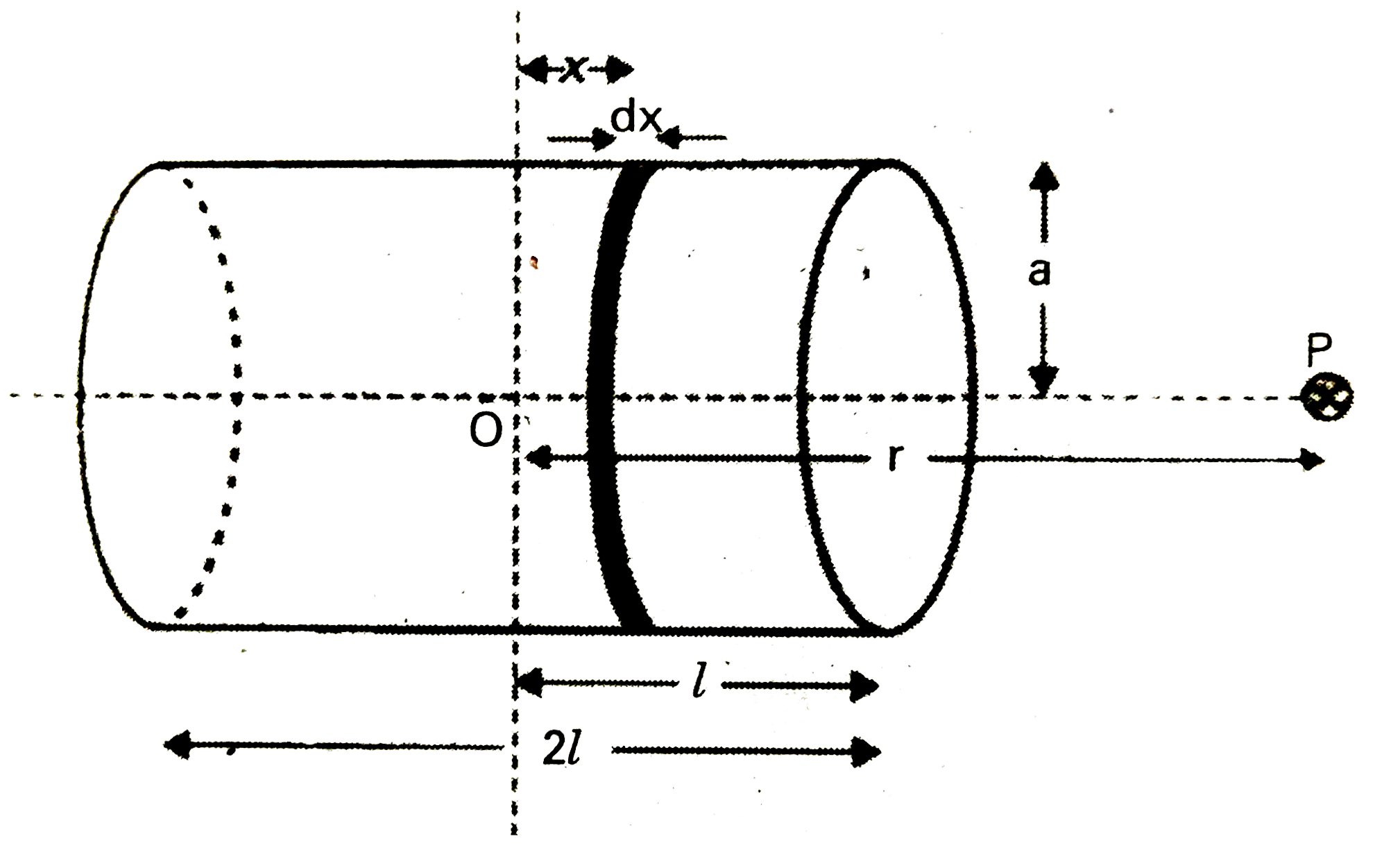 (8) To get total magnetic field, integrating the above equation between the limites from `x = -l` to `x = +l`. i.e., `B = UNDERSET(-l)overset(+l)int dB = underset(-l)overset(+l)int (mu_(0) I a^(2) n dx)/(2r^(3)) = (mu_(0) n I a^(2))/(2r^(3))[x]_(-l)^(+l)` `:. B = (mu_(0) n I 2l)/(2) (a^(2))/(r^(3))(2l) = (mu_(0))/(4pi)(2n(2l) I pi a^(2))/(r^(3))` (9) The magnitude of the magnetic moment of the solenoid is, `m = n(2l) I (pi a^(2))`. `:. B = (mu_(0))/(4pi) (2m)/(r^(3))` (10) Therefore, magnetic moment of a bar magnetic is equal to magnetic moment of an equivalent solenoid that produces the same magnetic field. |
|
| 33. |
An ellipsoidal cavity is carved with in a perfect conductor. A positive charge q is placed at the centre of the cavity. The points A and B are on the cavity surface as shown in the figure then a) Electric field near A in the cavity = Electric field near B in the cavity b) Charge density at A = Charge density at B c) Potential at A = Potential at B d) Total electric flux through the surface of the cavity is q//epsilon_0. |
|
Answer» a, B, C, d are CORRECT |
|
| 34. |
A proton beam in an accelerator moves at a speed of 0.990c relative to the accelerator. Compare the force of interaction between the protons with the Coulomb force. |
|
Answer» |
|
| 35. |
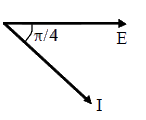
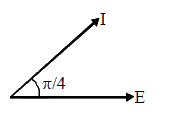
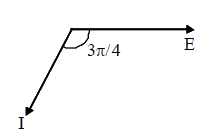
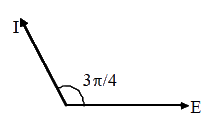
In a certain circuit E = 200 cos (314t) and I= sin (314t + pi//4). Their vector representation is |
|
Answer»
|
|
| 36. |
The heat can be transferred from a point of higher temperature to the point of lower temperature in the form of |
|
Answer» conduction |
|
| 37. |
Derive the expression for magnetic force on a conductor carrying current keptin a magnetic field. |
Answer» Solution : Consider a conducting rod of LENGTH l and uniform area of cross-section A in an EXTERNAL magnetic field `vecB`as SHOWN in fig. When a steady current .I.flows in the rod, the TOTAL charge of mobile charge carriers is Q=n A l a The magnetic force on these charge carriers is `vecF = Q (vecV_d xx vecB) "" V_d to ` drift velocity `vecF = nAl q(vecV_d xx vecB) `.....(1) But `I = n q A V_d`......(2) Equation (2) in (1) we get `vecF = I(VECL xx vecB)` |
|
| 38. |
Cathode rays are produced when the pressure is of the order of |
|
Answer» 2cm of HG |
|
| 39. |
A sinusoidal electromagnetic plane wave travels through empty space in the x-direction. The electric wave is polarized (plane of vibration in single plane) in the y-direction. Frequency of wave is 1.5 GHz. At a certain point P in space, the oscillating electric field E_yattains a maximum magnitude E_0= 63 V/m.What is the maximum magnitude B_0of the magnetic field at the same point? What is the direction of B? |
| Answer» Solution :`2.1 XX 10^(-7) T,Z -` AXIS | |
| 40. |
A small bulb is placed at the bottom of a tank containing water to a depth of 1m. Find the criticalangle for water air interface ,also calculate the diameter of the circular bright patch of light formed on the surface of water.[ R.I of water =4/3] |
|
Answer» SOLUTION :Given : `n=4//3` , C=? , d=1m , `n=1//sinC` `sin C=1//n rArr sin C=1/(4//3)=3/4 rArr C = sin^(-1) (3//4)` `C=48.6^@` W.K.T. `r/h`=tan C tan C x h =r tan `48.6^@` x 1 m =2 r=1.1343 x 1 r=1.1343 d=2r=2 x 1.1343 d=2.2686 m 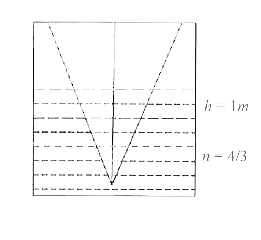
|
|
| 41. |
Assertion :- Voltage across L (see figure) at t=0 is E Reason:- Because E=V_(L)+V_(R) and at t=0, i=0 |
|
Answer» If the ASSERTION & REASON are True& the Reason is a CORRECT explanation of the Assertion . |
|
| 42. |
20 MeV energy is released per fusion reaction ""_1H^2 +""_1H^2 to ""_2He^4 +""_0n^1 Calculate the mass of ""_1H^2 consumed in a fusion reactor of power 1 MW in 1 day . |
|
Answer» Solution :`P =1 MW =10^6 W=10^6Js^(-1)` `t=1 "DAYS" =24xx60xx60=86400 s` `therefore` Energy released in one DAY `=pt=86400xx10^6J` Energyreleased per fusion =20 MeV `=20 xx1.6 xx10^(-13)=3.2 xx10^(-12)J` Mass of `""_1H^2` consumed in one fusion `(""_1H^2+""_1H^2)` =4u `=4xx1/66 xx10^(-27)` kg `=6.64 xx10^(-27)` kg `=(6.64xx10^(-27))/(3.2 xx10^(-12))xx86400xx10^6` `=1.79 xx10^(-4)` kg |
|
| 43. |
The significant figures of 0.007 is |
|
Answer» 1 |
|
| 44. |
At a certain heigh, a body at rest explodes into two equal fragments with one fragment receiving a horizontal velocity of 10sqrt(3) ms^(-1) . The horizontal distance between the two fragments, when their displacement vectors are inclined at 60° relative to each other is |
|
Answer» `40sqrt(3)m` |
|
| 45. |
A spherical ball contracts in volume by 0.5% when subjected to a normal uniform pressure of 120 atmosphere. The bulk modulus of elasticity is |
|
Answer» `2.431 XX 10^11 N/m^2` |
|
| 47. |
The ratio of nuclear density of two nuclei having mass numberA_1=12 and A_2=14 is |
|
Answer» `6:7` |
|
| 48. |
The radius of gyration of a square plate of side length l about a diagonal is |
| Answer» Answer :C | |
| 49. |
A 250 N force is directed horizontally as shown in the figure to push a 29 kg box up an inclined plane at a constant speed. Determine the magnitude of the normal force, F_(N) and the coefficient of kinetic friction, mu_(2) |
|
Answer» `{:(F_(N),mu_(K)),(330N ,0.31):}` |
|
| 50. |
A sample of radioactive material has an alpha emitter (X) and a beta emitter (D). The energy of decay reactions are Q_(1) and Q_(2) respectively. ._(Z)^(A)Xrarr._(Z-2)^(A-4)Y+._(2)^(4)He+Q_(1) ._(Z')^(A')Drarr._(Z'+1)^(A')B+._(-1)^(0)e+vecv+Q_(2) The radiation coming out from the sample is passed through two parallel slits S_(1)and S_(2) to get a narrow parallel beam to alpha and beta particles. This beam is allowed to enter perpendicularly into a region of inform magnetic field. The particles after taking a semicircular path strike the screen at a point a above the line L and, below the line L particles are found to strike the screen everwhere from O to b. the distance Oa and Ob and r_(1) and r_(2) respectively. Find the ratio (r_(1))/(r_(2)). Take (Q_(1))/(Q_(2))=k and assume that mass of alpha particles is 4 time the mass of a proton which is eta times the mass of an electron. |
|
Answer» |
|