

Saved Bookmarks
This section includes 7 InterviewSolutions, each offering curated multiple-choice questions to sharpen your Current Affairs knowledge and support exam preparation. Choose a topic below to get started.
| 1. |
Three chargers +q, -q and + q are kept at the corners of an equilateral triangle of side d. Find the resultant electric force on a charge to placed at the centroid O of the triangle. |
|
Answer» Solution :Let the FORCE acting on +q charge at O due to +q at A be `F_1, +q` at B be `F_2` and `-q` at C be `F_3` Here `AO = OB = OC = d/(sqrt(3))`  In magnitude `F_1 = F_2 = F_3 = 1/(4 pi epsilon_0) (3q^2)/(d^2)` Resultant of `F_1` and `F_2` is `F_4 = 1/(4 pi epsilon_0) (3q^2)/(d^2)` (as angle between `F_1 and F_2` is `120^@`) Direction of `F_4` is ALONG the direction of `F_3`. Hence the resultant force on +q at O is `F = F_3 + F_4 = (3 q^2)/(2 pi epsilon_0 d^2)` . |
|
| 2. |
A magnetising field of 1600 Am^(-1) produces a magnetic flux of2.4 xx 10^(-5) weber in a bar of iron of cross section 0.2 cm^(2) . Calculate permeability and susceptibility of the bar . |
|
Answer» Solution :MAGNETIC induction `, B = (phi)/(A) = (2.4 xx 10^(-5))/(0.2 xx 10^(-4))` ` =1.2 Wb//m^(2)` i) Permeability , `mu=(B)/(H) = (1.2)/(1600) = 7.5 xx 10^(-4) TA^(-1)m` II)As `mu=mu_0(1+ chi_m) ` then Susceptibility , ` chi_m =(mu)/(mu_0)-1 =(7.5 xx 10^(-4))/( 4 pi xx 10^(-7)) -1` `=596.1 ` |
|
| 3. |
Three identical balls are thrown from top of a cliff and some time later land at the base of the cliff. Ball A is thrown upwards with speed V_(A), ball B is thrown downwards with speed V_(B), and ball C is thrown at speed V_(C ) and at an angle of 45^(@) above horizontal. Comparing the speeds V_(A),V_(B) and V_(C ) with which balls hit the ground at the base of the cliff (and ignoring air resistance), you find, |
|
Answer» `V_(A)=V_(B) GT V_(C )` |
|
| 4. |
Answer the following questions: (c) When a tiny circular obstacle is placed in the path of light from a distant source, a bright spot is seen at the centre of the shadow of the obstacle. Explain why? |
|
Answer» Solution :(i) Reflection between DIFFRACTION from each slit to the INTERFERENCE pattern in a double slit experiment : (ii) Waves diffracted from the edge of the circular OBSTACLE interfere constructively at the centre of the shadow PRODUCING a bright spot. |
|
| 5. |
Obtain the expression for electric field due to an charged infinite plane sheet . |
Answer» Solution :Electric field due to charged infinite plane sheet : Consider an infinite plane sheet of charge with uniform surface charge density `sigma` . Let P be a POINT at a distance of r from the sheet . Since the plane is infinitely large the electric field should be same at all points equidistant from the same at all points equidistant from the plane and radially directed at all points . A cylindrical shaped Gaussian surface of length 2r and area A of the FLAT surfaces is chosen such that the infinite plane sheet passes perpendicularly through the middle part of the Gaussian surface. Applying Gauss law for this cylindrical surface 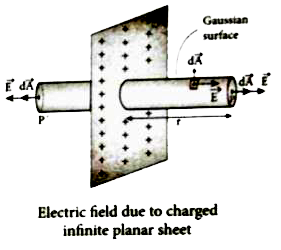 `Phi_(E)= oint vecE. dvecA` `Phi_(E)= underset("Curved surface ")(int) vecE.dvecA + underset("P")(int) vecE.dvecA +underset("P")(int) vecE.dvecA=(Q_("encl"))/(epsilon_(0))` The electric field is perpendicular to the are a element at all point on the curved surface and is parallel to the surface areas at P and P . Then , `Phi_(E)=int_(P)EdA + underset("P")(int) EdA = (Q_("encl"))/(epsilon_(0))` Since the magnitude of the electric field at these equalsurface is uniform E is taken out of the integration and `Q_("encl") ` is given by `Q_("encl") = sigma` A we get `2E underset("P")(int) d A = (sigmaA)/(epsilon_(0))` The total are of surface either at P or P `underset("P")(int)dA = A` Hence 2 E A = `(sigmaA)/(epsilon_(0))` or ` E =(sigma)/(2epsilon_(0))` Hence `2EA = (sigmaA)/(epsilon_(0)) ` or ` E = (sigma )/(2 epsilon_(0))` In vector form `E = (sigma )/(2epsilon_(0)) hatn` Here `hatn` is the outward unit vector normal to the plane . Note that the electric field due TOAN infinite plane sheet of charge depends on the surface charge density and is independent of the distance r . The electric field will be the same at any point farther away from the charged plane . Equation ( 4) implies that if `sigma gt 0` the electric field at any point P is outward perpendicular `hatn` to the plane and if `sigma lt 0` the electric field points inward perpendicularly `(-hatn)` to the plane . For a FINITE charged plane sheet equation (4) is approximately true only in the middle region of the plane and at points far away from ENDS . |
|
| 6. |
The frequency of X-rays, gamma-rays and ultraviolet rays are respectively a, b and c, then: |
|
Answer» `a lt B, b GT C` |
|
| 7. |
Find the particles closet to x=0.1 having same velocity as a particle at x=0.1at t=0. |
|
Answer» |
|
| 8. |
A parallel plate capacitor of plate area A and plate separation d is charged to a potential V and disconnected. A slab of dielectric constant K is then inserted between the plates of the capacitor so as to fill the space between the plates. The work done on the system during the process of inserting the slab is : |
|
Answer» `(epsilon_(0)AV^2)/d(1-1/K)` |
|
| 9. |
Who ran in Madison Square? |
|
Answer» BURT Dubin |
|
| 10. |
The mass of a block of wood is 87.2g and its volume is 25cm^(3) . Its density with due regard to significant figures is |
|
Answer» `3.488g CM^(-3)` |
|
| 11. |
The graph plotted between phase angle (omega t) and displacement of a particle from equilibrium position (y) is a sinusoidal curve as shown below. Then the best matching is |
|
Answer» <P>`{:(P,Q,R,S),(1,4,3,2):}` |
|
| 12. |
Draw a graph showing variation of resistivity with temperature for nichrome. Which property of nichrome is used to make standard resistance coils ? |
Answer» Solution :Graphical variation of resistivity `rho_T`of NICHROME with TEMPERATURE T hasbeen shown in adjoining Fig. Nichrome is USED to make standard resistance coils because its temperaturecoefficient of resistivity is EXTREMELY small and the resistivity is high. 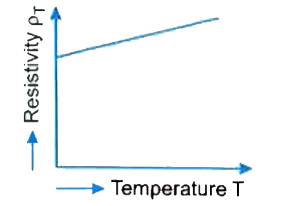
|
|
| 13. |
Find the period of revolution of an electron having a kinetic energy of 1.5 MeV in a magnetic field with induction 0.02 T. The electron moves in a plane perpendicular to the lines of force. |
|
Answer» We obtain from `mu^2//R= euB` `T=(2piR)/(u)=(2pim)/(E B)=(2pi epsi)/(e Bc^2)` |
|
| 14. |
When a current of 4 A through primary give rise to a flux ofmagnitude 1.35 Wb through secondary. What is the coefficient off mutual induction (M)? |
|
Answer» 2.96 H |
|
| 15. |
Asci are not organized into ascocarps in |
| Answer» Answer :A | |
| 16. |
The work function of two metals metal A and metal B are 6.5 eV and 4.5 eV respectively. If the threshold wavelength of metal A is 2500 A, the threshold wavelength on metal B will be approximately equal to |
|
Answer» 3611A |
|
| 17. |
If the electronic charge is 1.6xx10^(-19)C, then the numberof electrons passing through a section of wire per second, when the wire carries a current of 1A, is |
|
Answer» `0.625xx10^(19)` `I=(n E)/(t)` `:.n=(It)/(e)=(1xx1)/(1.6xx10^(-19))=0.625xx10^(19)` |
|
| 18. |
Considering theta=pi//2 as the zero-energy position of a current loopof magnetic moment m placed in a magnetic field of strength B,find the minimum potential energy. In what position is the potential energy minimum? Is this an equilibrium position ? What will be the work done in turning it through alpha from this position ? Examine whether you getthe dame position for equilibrium and same value for work if theta=0 is taken as the zero-energy position. |
|
Answer» |
|
| 19. |
Find the binding energy of a nucleus consisting of equal numbers of protons and neutrons and having the radius one and a half time smaller than of Al^(27) nucleus. |
|
Answer» where `DELTA m =` mass defect If `m_(n)=` mass of neutron, `m_(p)=` mass of proton, `m_(N)=` mass of formed nucleus For binding energy of `._(z)X^(A)`, Here the number of proton `=Z`, The number of neutron `=A-Z` `:. DELTAM =Zm_(p)+(A-Z)m_(n)-m_(N)` If atomic masses of the neucleus is given, then `:. Delta m=Zm_(p)+Zm_(e )+(A-Z)m_(n)-(m_(N)+Zm_(e ))` `=Z(m_(p)+m_(e ))+(A-Z)m_(n)-M_(N)` `=ZM_(H)+(A-Z)m_(n)-M_(N)` Here `M_(H)=` atomic mass of hydrogen `M_(N)=` atomic mass of formed atom. `:.""R=R_(0)A^(1//3)` `R_(AL)=R_(0)(27)^(1//3)` `R=R_(0)A^(1//3)` But `R=(R_(Al))/((3)/(2))=(2)/(3)R_(Al)` or `R_(0)A^(1//3)=(2)/(3)R_(0)(27)^(1//3)` `:. "" A=((2)/(3))^(3)=27=(8)/(27)xx27=8` From periodic table, the element is `Be^(8)` Atomic masses are `1.007825` for hydrogen, `1.008665` for nuetron, `8.00531` for `Be` `Deltam=(4m_(H)+4m_(n)-M_(N))"AMU"` `=(4xx1.007825+4xx1.008665-8.00531)"amu"` `=(4.0313+4.034660-8.00531)"amu"` `E_(b)=Delta mc^(2)=0.06065xx931 MeV` `=56.4651 MeV=56.5 MeV` |
|
| 20. |
A vessel of depth d is half filled with liquid of refractive index mu_1, and half filled with liquid of refractive index mu_2. Bottom will be at depth ..... when viewed from top and perpendicularly to surface. |
|
Answer» `2D(mu_2)/(mu_1)`  `(h_i)/(h_0)=(1)/(mu_2)` `therefore h_i=(h_0)/(mu_2)=(d)/(mu_2)` and `(h._i)/(h._0)=(1)/(mu_1)` `therefore h._i=(h_i^1)/(mu_1)=(d)/(mu_2)` VIEWED DEPTH of bottom, `h_i+h._i=d/mu_2+d/mu_1=d[1/mu_1+1/mu_2]` |
|
| 21. |
A ray incident at angleof incident 60^(@) enters a glass sphere of refractive indec mu=sqrt(3). This ray is reflected and refracted at the farther surface of the sphere. The angle between reflected and refracted rays at this surface is |
|
Answer» `90^(@)` |
|
| 22. |
Tpical backyard ants often create a network of chemical trails for guidance. Extending out ward from the nest, a trail branches (bifurcates) repeatedly, with 60^(@) between the branches. If a roaming an chances upon a trail, it can tell the way to the nest at any branch point: If it is moving away from the nest, it has two choice of path requiring a small turn in its travel direction, either 30^(@) leftward or 30^(@) rightward. If it is moving toward the nest, it has only one such choice. shows a typical ant trail, with lettered straight sections of 2.0cm length and symmetric bifurcation of 60^(@). Path v is parallel to the y axis. What are the (a) magnitude and (b) angle (relative to the positive direction of the superimposed x axis) of an ant's displacement from the nest (find it in the figure) if the ant enters the trail at point A ? What are the (c ) magnitude and (d) angle if it enters at point B ? |
| Answer» SOLUTION :`(a) 7.5cm (B) 90^(@),©8.6cm, (d) 48^(@)` | |
| 23. |
What do you mean by eddy current? |
| Answer» Solution :When magnetic FLUX in a METAL block changes,induced currents are produced.This CURRENT is called eddy current. | |
| 24. |
Two coherent fight sources A and B with separation 2lambda are placed on the x-axis symme-trically about the origion. They emit light of wavelength lambda. Obtain the positions of maxima on a circle of large radius, lying in the x-y plane and with centre at the origion. |
|
Answer» SOLUTION :For P to have maximum INTENSITY, `d cos theta= n lambda` `2lambda cos theta = n lambda ""cos theta = (n)/(2)` where n is integer For `n=0, theta = 90^(@), 270^(@)` `n= pm1, theta= 60^(@), 120^(@), 240^(@), 300^(@)` `n= pm2, theta = 0^(@), 180^(@)` So, position of maxima are at `theta= 0^(@), 60^(@), 120^(@), 180^(@), 240^(@), 270^(@)" and "300^(@)` i.e., 8 positions will be obtained. Short cut : In `d= n lambda` then number ofmaximum on the circle is 4n. |
|
| 25. |
A ball starts falling with zero initial velocity on a smooth inclined plane forming an angle a with the horizontal. Having fallen the distance h, the ball rebounds elastically off the inclined plane. At what distance from the impact point will the ball rebound for the second time? |
|
Answer» SOLUTION :The situation is shown in Fig. Let the ball rebound from POINT A and return to the plane at point B, moving along the TRAJECTORY shown in diagram. Let, AB=l Velocity of rebound at point `A, v = sqrt(2gh)` Velocity component perpendicular to plane = `v cos alpha` Velocity component along the plane `= v sin alpah` Retardation perpendicular to plane = g sin`alpha` Acceleration along the plane = g sin `alpha` If the ball comes to REST at this highest point after time t, then `(v cos alpha g cos alpha.t)` = 0 or `t=(v)/(g)` Time of flight of the ball, `T = 2t =(2v)/(g)` Range of the ball along the plane, `l (v sin alpha) T + (1)/(2)` . g sin alpha `(4v^(2))/(g^(2))` ` = (2v^(2))/(g) sin alpha + (2v^(2))/(g) sin alpha` `(becuae v = sqrt(2gh)) ""therefore l=8 h sin alpha` 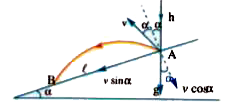
|
|
| 26. |
For proton and alpha-particle,de-Broglie wavelength is same .For them……..will be equal . |
|
Answer» velocity `therefore p_("proton")=p_(alpha)` Momentum of proton and `alpha`-PARTICLE will be EQUAL. |
|
| 27. |
Intensity of magnetic field means ...... |
|
Answer» magnetic dipole MOMENT per unit volume. |
|
| 28. |
A metallic sphere is placed in a uniform electric field. The lines of force follow the path shown in the figures as |
|
Answer» 1 |
|
| 29. |
Mirages are observed on some day when |
|
Answer» DENSITY of air DECREASES with height |
|
| 30. |
If n(A) = m and n(B) = n then number of subsetsAxxB has- |
|
Answer» `2^m` |
|
| 31. |
A square plate of glass of each side 4cm and thickness of surface tension 20 dyne/cm. The increase of weight due to force of S.T. will be |
|
Answer» 168 dyne |
|
| 32. |
Are the paths of electrons straight line between successive collisions (with the positive ions of the metal) in the (i) absence of electric field (ii) presnece of electric field? |
| Answer» Solution :In the ABSENCE of electric field, the PATHS are STRAIGHT lines, in the PRESNECE of electric field, the paths are in general curved. | |
| 33. |
When a Iow fIying aircraft passes overhead , sometimes a sIight shaking of the pictures on our TV screen is observed . Why? |
| Answer» SOLUTION :The metaIIic body of the Iow fIying AIRCRAFT refIects the TV signaI. Inteference takesbetweenplace between these reflected RAYS and the direct rays TRANSMITTED by the TV. Hence slight SHAKING of the pictures is observed. | |
| 34. |
The correct energy band responsible of intrinsic semiconductor at temperature 0 k is |
|
Answer»
|
|
| 35. |
What is the nature of force between two parallel wires carrying current in same direction? |
| Answer» SOLUTION :ATTRACTIVE FORCE. | |
| 36. |
(A ): Coulomb force is a long range force. (R ): Coulomb force acts between two charged particles. |
|
Answer» Both .A. and .R. are true and .R. is the correct EXPLANATION of .A. |
|
| 37. |
निम्न चित्र में किसी गतिशील कण का v-t ग्राफ दिया गया है। प्रथम 4 सैकण्ड में कण द्वारा चली गई दूरी होगी |
|
Answer» 12m |
|
| 38. |
Stray magnetic field does not affect the deflection of a coil of M.C.G. because |
|
Answer» magnetic FIELD of M.C.G. is strong |
|
| 39. |
(a) Draw a labelled ray diagram showing the formation of a final image by a compound microscope at least distance of distinct vision. (b) The total magnification produced by a compound microscope is 20. The magnification produced by the eyepiece is 5. The microscope is focussed on a certain object. The distance between the objective and eyepiece is observed to be 14 cm. If least distance of distinct vision is 20 cm, calculate the focal length of the objective and the eyepiece. |
|
Answer» SOLUTION :(a) N/A (b) (b) Here total magnification m = 20, magnification of EYEPIECE me = 5, distance between objective and eyepiece L = 14 CM, least distance of distinct vision D = 20 cm. magnificationof eyepiece `m_(e) =v_(e)/u_(e) =D/u_(e) rArr u_(e) =D/m_( e) = (20 cm)/5 = 4 cm` `therefore` Focal length of eyepiece `1/f_(e) =1/v_(e)-1/u_(e) =1/(-20) -1/(-4) =1/4 -1/20 =1/5 rArr f_(e) = 5 cm` `therefore` Focal length of objective `1/f_(0) =1/v_(0) -1/u_(0) =1/10-1/(-2.5) = 1/2 rArr f_(0)=+ 2cm` |
|
| 40. |
Calculate the equivalent resistance between the points A and B of the net-work shown in Fig. MTP 2.1. |
| Answer» SOLUTION :`(R(3R+r))/(R+3r)` | |
| 41. |
The least count of a stop watch is 1//5 second. The time of 20 oscillations of a pendulum is measured to be 25 seconds. The minimum percentage error in the measurement of time will be : |
|
Answer» `0*1%` `:.(DeltaT)/(T)XX100=(1/5)/(25)xx100=0*8%` So the correct choice is `(b)`. |
|
| 42. |
Using Bohr's atomic model, derive an equation of the radius of the nth orbit of an electron. |
Answer» Solution :The atomic model of Bohr is shown in the figure.  Let mass of an electron m, charge e, LINEAR speed in `n^(th)` ORBIT` v_(n)` and orbit with radius `r_(n)` and charge on nucleus Ze, where Ze = atomic number of an element. The necessary centripetal force is provided Colombian ATTRACTIVE force between electron and nucleus. Thus. `:. (mv_(n)^(2))/(r_(n))=(1)/(4pi epsi_(0))*((Ze)(e))/(r_(n)^(2))=(ze^(2))/(4pi epsi_(0)r_(n)^(2))` where `epsi_(0)`= permittivity of medium From Bohr hypothesis 2, if the anguli momentum of electron in `n^(th)` orbit is `L_(nm)` `L_(n)=(nh)` `:. mv_(n)r_(n)=(nh)/(pi) ""...(2)` From equation (1), `v_(n)(mv_(n)r_(n))=(Ze^(2))/(4pi epsi_(0))` Putting the vlaue of equation (2), `v_(n)-(nh)(2pi)-(Ze^(2))/(4pi epsi_(0))` [ From equation (2)] `:.v_(n)=(Ze^(2))/(4pi epsi_(0))*(1)/((nh)/(2pi))` `:.v_(n)=(1)/(n)*(Ze^(2))/(2h epsi_(0)) ""...(3)` `:.v_(n) prop(Z)/(n)` where `e, 2h,epsi_(0)` constant Hence orbital velocity in `n^(th)` orbit velocity decreases by a factor of n. For hydrogen atom Z = 1, `v_(n) prop (1)/(n)` Now from equation (2). `r_(n)=(nh)/(2pi mv_(n))` Putting the value of eqution (3). `r_(n)=(nhxxnxx2h epsi_(0))/(2pi mxxZe^(2))` `:. r_(n)=(n^(2)h^(2) epsi_(0))/(pi mZe^(2))` `:.r_(n) prop (n^(2))/(Z)[ :.` all other terms are contant] For hydrogen Z=1 `:. r_(n)=(n^(2)h^(2) epsi_(0))/(pi me^(2))""...(4)` `:. r_(n) prop n^(2)` [ `:.`All other terms are constant] The SIZE of the INNERMOST orbit (n = 1) is called Bohr radius, represented by the symbol `a_(0)` thus Putting n = 1 in equation (4), `r_(1)=a_(0)=n^(2)((h^(2) epsi_(0))/(pi me^(2)))` putting the values of `hepsi_(0),pi` and. `a_(0)=5.29xx10^(-11)m` or approximately `0.53Å` |
|
| 43. |
A particle A with a mass m_(A) is moving a velocity v and hits a particle B(mass m_(B))at rest (one dimensional motion).Find the change in the de-Broglie wavelength of the particle A.Treat the collision as elastic. |
|
Answer» Solution :initial de-Broglie wavelength (before collision)for particle A, `lambda_(i)=(h)/(m_(A)v_(i))=(h)/(m_(A)v)`(`because v_(i)=v)`……(1) Now ,final velocity of particle A ACCORDING to formula, `v_(f)=((m_(A)-m_(B))/(m_(A)+m_(B)))v_(i)=((m_(A)-m_(B))/(m_(A)+m_(B)))v(becausev_(i)=v)` ......(2) `implies`final de-Broglie wavelength for particle A, `lambda_(f)=(h)/(m_(A)v_(f))=(h)/(m_(A))xx((m_(A)+m_(b)))/(m_(A)-m_(B)v)` .....(3) From equations (1) and (3) ,REQUIRED change is ,`lambda_(f)-lambda_(i)=(h)/(m_(A)v)((m_(A)+m_(B))/(m_(A)-m_(B))-1)` `(h)/(m_(A)v)((m_(A)+m_(B)-m_(A)+m_(B))/(m_(A)-m_(B)))` `(2hm_(B))/(m_(A)(m_(A)-m_(B))v)`. |
|
| 44. |
A motor car is fitted with a convex driving mirror of focal length 20 cm. A second motor car 2 cm broad and 1.6 m high is 6 m away from the first car. Then position of second car as seen from the first car is : |
|
Answer» 10.2 CM `-(1)/(600) + (1)/(v) = (1)/(20), v = 19.4 cm`. |
|
| 45. |
The relaxation time tauIs nearly independent of applied E field whereas it changes significantly with temperature T. First fact is (in part) responsible for Ohnl's law whereas the second fact leads to variation of p with temperature. Elaborate why ? |
|
Answer» Solution :Relaxation time is inversely proportional to velocity of electron and ions. Due to external electric field drift velocity changes by order of 1 mm/sec where as due to change in temperature drift velocity changes in order of `10^(2)` m/s . With increase in drift velocity relaxation time `(tau)` DECREASES. Hence, by EQUATION `RHO = (1)/(SIGMA) = (m)/("ne"^(2) tau) ` resistivity INCREASES. |
|
| 46. |
A horizontal straight wire 10 m long extending from east to west is falling with a speed of 5 m . s^(-1), at right angles to the horizontal component of earth's magnetic field, 0.30xx10^(-4)Wb.m^(-2). what is the emf induced in the wire. Which end of the wire is at higher electrical potential? |
| Answer» SOLUTION :The WEST END is at a HIGHER POTENTIAL. | |
| 47. |
Distinguish between a pure inductor and a pure resistor. |
Answer» SOLUTION :
|
|
| 48. |
A jet plane is travelling west at the speed of 1800km/h. What is the voltage difference developed between the ends of the wing 25m long if the earth's magnetic field at the location has a magnitude of 5.0 xx 10^(-4) Tesla and the dip angle is 30^(@)? |
|
Answer» |
|
| 49. |
Suppose the loop in Exercies.4 is stationary but the current feeding the electromagnetic net that produces the magnetic field is gradually reduced so that the field decreases from its initial value of 0.3 T at the rate of 0.02 T s^(-1). If the cut is joined and the loop has a resistance of 1.6Omega, how much power is dissipated by the loop as heat? What is the source of this power? |
|
Answer» Solution :Here ν = 0.5 Hz, N =100, A = 0.1 `m^2`and B = 0.01 T. Employing EQ. Eq. (6.21) `epsi_0 = NBA (2PI V)` `=100xx 0.01xx0.1xx2xx3.14xx0.5` `=0.314V` The maximum voltage is 0.314 V We URGE you to explore such alternative possibilities for power generation. |
|
| 50. |
An electron is accelerated through a potential difference of 81V. What is the de Broglie wavelength associated with it? To which part of electromagnetic spectrum does this wavelength corresspond ? |
|
Answer» Solution :de-Broglie wavelength of an ELECTRON beam accelerated through a POTENTIAL difference of V volts is `lambda = (h)/(SQRT(2meV)) = (1.23)/(sqrt(V)) nm` V = 81 V, so `lambda = (1.23)/(sqrt(81)) xx 10^(-9)m = 0.1366 xx 10^(-9)m` `lambda = 1.36 Å` X-ray is the part of ELECTROMAGNETIC spectrum does this wavelength corresponds. X-ray has the wavelengths ranging from about `10^(-8)` to `10^(-12)` m. |
|


