

Saved Bookmarks
This section includes 7 InterviewSolutions, each offering curated multiple-choice questions to sharpen your Current Affairs knowledge and support exam preparation. Choose a topic below to get started.
| 1. |
A bomb of mass 1 kg is thrown vertically upwards with a speed of 100 ms^(-1) After 5 sec. it explodes into two fragments. One of mass 400 g is found to go down with a speed of 25 ms6(-1) what happens to the second justafter the explosion ? |
|
Answer» Goes UPWARDS with `40 ms^(-1)` `upsilon = 100` - `10 xx 5 = 50 ms^( -1)` Applying conservation of momentum `1xx50=-(400)/(1000)xx25+(600)/(1000)xxV` `60=(600)/(1000)V` or `V=100ms^(-1)`(upwards) (B) is the choice. |
|
| 2. |
An empty wagon of mass m0 is stationary & is filled with sand at rate of mu kg/sec. from a stationary hopper ? find - Force F as a function of time that has to be applied on wagon to maintain its all constant ? |
|
Answer» `aM_(0) – 2amut` |
|
| 3. |
A rational number in its decimal expansion is 327.7081. What would be the prime factors of q when the number is expressed in the p/q form? |
|
Answer» 2 and 3 |
|
| 4. |
A uniform current is flowing along the length of an infinite, straight, thin, hollow cylinder of radius R. The magnetic field B produced at a perpendicular distance d from the axis of the cylinderis plotted in a graph. Which of the following figures looks like the plot? |
|
Answer»
magnetic field at a POINT OUTSIDE the cylinder and located at a perpendicular distance d from its axis, `B=(mu_(0)I)/(2pid)" if "dgtR` If d=R then, `B=(mu_(0)I)/(2piR)` If `dltR,B=0` [SINCE no CURRENT flows inside a HOLLOW cylinder] `:.Bprop(1)/(d)` |
|
| 5. |
When a wave undergoes reflection at an interface from rarer to denser medium , adhoc change in its phase is |
|
Answer» `pi/2` |
|
| 6. |
.Minimum number of capacitors of ,2 pF capacitance each required to obtain a capacitance of5muF will be: |
|
Answer» Three |
|
| 7. |
Define photoelectric effect. Draw a graph to show the variation of stopping potential with frequency of incident radiation on a metal plate. |
Answer» Solution : Photoelectric effect is the PHENOMENON of emission of electrons by certain substances when they are illuminated by radiations like X-rays, ultraviolet raysand EVEN visible light. 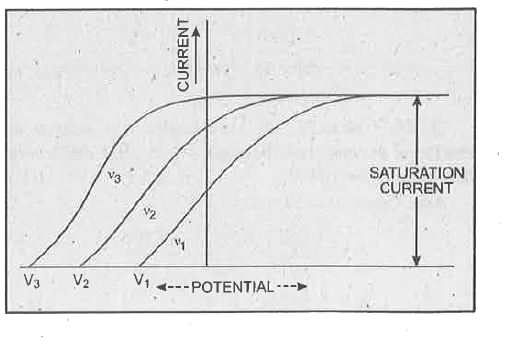 VARIATION of Stopping POTENTIAL with the frequency of the incident radiation. Take radiations of different frequencies, say of `v_(1), v_(2),v_(3)` ... but of the same intensity. Study variation of photoelectric current and potential of plate Q for each frequency and plot. A graph as shown in the figure will be observed. If `v_(3) gt v_(2) gt v_(1)`the stopping potential `V_(3)` will-be observed to be most negative and `V_(1)` the least negative. This means higher the frequency higher the energy of photoelectrons and more the negative have potential to be applied to stop it. |
|
| 8. |
State the principle of potentiometer. |
| Answer» Solution :The basic principal of a potentionmeter IA that when a constant CURRENT flows through a WIRE of uniform cross-sectional area and COMPOSITION,the potential drop across any length of the wire is directly proportional to that lengths. | |
| 9. |
(a) State Bohr's postulate to define stable orbits in hydrogen atom. How does de-Broglie's hypothesis explain the stability of these orbits ? (b) A hydrogen atom initially in the ground state absorbs a photon which excites it to the p=4 level. Estimale the frequency of the pholon. |
|
Answer» Solution :(a) See Short Answer Question Number 29. (b) We know that ENERGY of an electron in a hydrogen atom is, `E = (13.6)/(n^(2)) eV` For ground state n =1 , hence `E_(1) = - (13.6)/((1)^(2)) = - 13.6 eV` and for excited state `n = 4` , hence`E_(2) = - (13.6)/((4)^(2)) = - 0.85 eV` `THEREFORE ` Energygainedby absorbinga PHOTON of frequencyy is given by `E_(2) - E_(1) = (hv)/(e)` `rArr "" v=(e)/(h) [E_(2) - E_(1)] = (1.6 xx 10^(-19))/(6.63 xx 10^(-34)) [(-0.85)] = (1.6 xx 10^(9) xx 12.75)/(6.63xx 10^(-34)) = 3.08 xx 10^(15) Hz` |
|
| 10. |
When capacitors are fully charged, an external agent removes the dielectric slab from the capacitor C_2Find the change in potential energy of capacitor C_1 ( E =10 V, C_(1) = 2muF,C_(2)=4muFand k =2 ) |
|
Answer» 0J |
|
| 11. |
The sharpness of an L-C-R series resonance curve …... |
|
Answer» is more if Q - factor is small |
|
| 12. |
A current of 2.34 A flows in resistance of 11. 111111OmegaThe potential difference across the given resistance with due regard for the significant figure is |
|
Answer» 26.000 A |
|
| 13. |
Figure 8.01 shows a capacitor made of two circular plates each of radius 12 cm, and separated by 5.0 cm. The capacitor is being charged by an external source (not shown in the figure). The charging current is constant and equal to 0.15 A. (a) Calculate the capacitance and the rate of charge of potential difference between the plates. (b) Obtain the displacement current across the plates. (c) Is Kirchhoff.s first rule (junction rule) valid at each plate of the capacitor? Explain. |
|
Answer» Solution :(a) It is given that radius of each circular plate R = 12CM = 0.12 m, separation between the plates d = 5.0 mm `=5.0xx10^(-3)m` and charging current `I=0.15A` `therefore"Capacitance of the capacitor C"=(epsilon_(0).A)/(d)=(epsilon_(0)piR^(2))/(d)=(8.85xx10^(-12)xx3.14xx(0.12)^(2))/(5.0xx10^(-3))` `=80.1xx10^(-12)F=80.1pF` and rate of change of POTENTIAL difference between the plates of capacitor `(dV)/(dt)=(d)/(dt)((d)/(C ))=(1)/(C ).(dq)/(dt)=(I)/(C )["As "(dq)/(dt)=I]` `therefore""(dV)/(dt)=(0.15)/(80.1xx10^(-12))=1.87xx10^(9)VS^(-1)`. (B) Displacement current `I_(d)=epsilon_(0).(dphi_(E))/(dt)=epsilon_(0).(d)/(dt)(EA)=epsilon_(0).A(dE)/(dt)` But we known that `E=(sigma)/(epsilon_(0))=(q)/(epsilon_(0)A),"hence,"(dE)/(dt)=(1)/(epsilon_(0)A).(dq)/(dt)=(1)/(epsilon_(0)A).I` `therefore"Displacement current "I_(d)=epsilon_(0)A.(1)/(epsilon_(0)A)I=I` (c) Yes, Kirchhoff.s first rule is valid at each plate of the capacitor provided that we take current as the sum of conduction current and displacement current. With this understanding at fist plate of capacitor the incoming current `I_(d)=` outgoing current I. |
|
| 14. |
Assertion : Torque on the coil is the maximum, when coil is suspended in a radial magnetic field. Reason : The torque tends to rotate the coil on its own axis. |
|
Answer» If both ASSERTION and REASON are TRUE and the reason is the CORRECTEXPLANATION of the assertion. |
|
| 15. |
The basic components of robot are………... |
|
Answer» MECHANICAL linkage |
|
| 16. |
Answer the following questions: (e) When viewing through a compound microscope, our eyes should be positioned not on the eyepiece but a short distance away from it for best viewing. Why? How much should be that short distance between the eye and eyepiece? |
| Answer» Solution :(e) The image of the objective in the EYE-piece is known as ‘eye-ring’. All the rays from the object refracted by objective go through the eye-ring. Therefore, it is an ideal position for our eyes for viewing. If we place our eyes too close to the eye-piece, we shall not collect much of the LIGHT and also reduce our FIELD of view. If we position our eyes on the eye-ring and the area of the pupil of our eye is greater or equal to the area of the eye-ring, our eyes will collect all the light refracted by the objective. The precise location of the eye-ring naturally depends on the SEPARATION between the objective and the eye-piece. When you view through a microscope by placing your eyes on one end,the ideal distance between the eyes and eye-piece is usually built-in the design of the INSTRUMENT. | |
| 17. |
Two waves, each having a frequency of 100 Hz and a wavelength of 2.0 cm, are travelling in the same direction on a string. What is the phase difference between the wavesIf each of the waves has an amplitude of 2.0 mm, what would be the amplitudes of the reasultant waves in part (a) and (b)? |
| Answer» SOLUTION :ZERO, 4.0 MM | |
| 18. |
A car of mass 1000 kg is moving at 25m/s is brought to rest over a distance of 50 m. Find the breaking force and time required to stop. |
|
Answer» 8 sec |
|
| 19. |
Assertion : Macro properties of gas are affected with increase in height. Reason : These properties of gases depend on thermodynamic parameters. |
|
Answer» If both ASSERTION and REASON are true and reason is the correct EXPLANATION of assertion. |
|
| 20. |
Calculate (a) the refracting angle of a flint glass prism which should be combined with a crown glass prism of refracting angle 6° so that the combination may have no deviation for D line and (b) the angular separation between the C and F lines, given that the refractive indices of the materials are as follows: |
|
Answer» Solution : LET `A_1` and `A_2` be the refracting angles of the FLINT and crown GLASS prisms respectively. `mu_1 ` and `mu_2` be the refractive indices for the D line of flint and crown glasses respectively. (a) If `delta_1 , anddelta_2`, be the angles of deviations due to the flint and crown glass prisms respectively, then for no deviation of D line `DELTA _1+delta _2 =0 , A_1( mu_1-1)+ A_2(mu_2 -1) =0` ` (A_1)/(A_2)=- ((mu_1-1)/(mu_1))` The negative sign indicates that `A_1` and `A_2` are oppositely directed. ` (A_1 )/(6^0 ) = ((1.530 -1)/(1.795-1)) , A_1= 6^0 xx (0.530)/( 0.795)=-4^@ ` (b)Angular dispersion due to the flint glass prism `=A_1(mu_F - mu_C)_2= 6^@( 1.535- 1.527) = 0.048 ` Net angular dispersion = 0.048 -0.060 = -0.012 The negative sign indicates that the resultant dispersion is in the direction of the deviation produced by the flint prism. |
|
| 21. |
A body moves along a straight line with acceleration 3m/s^2 for 2 seconds and then with acceleration 4 m/s^2 for 3 seconds . What is the average acceleration |
|
Answer» `3.4m/s^2` |
|
| 22. |
An oil drop of 12 excess electrons is held stationary under a constant electric field of 2.55xx10^(4)NC^(-1) in Millikan's oil drop experiment. The density of the oil is 1.26xx10^(3)kgm^(-3). Estimate the radius of the drop (g=9.81ms^(-2),e=1.60xx10^(-19)C). |
| Answer» SOLUTION :(a) ZERO ,(B) zero(C ) 1.9 N/C | |
| 23. |
Two batteries having same emf E but having different internal resistances r_(1) and r_(2)(lt r_(1)) are connected in series to an externalresistance R as shown in figure. For this situation mark outthe correct statement(s). |
|
Answer» Only one value of R EXIST for which potential DIFFERENCE across BATTERY having internal resistance `r_(1)` is zero |
|
| 24. |
Calculate the dipole moment of a dipole with equal charges 2C and -2C separated by a distance of 2cm. |
|
Answer» 0.02 |
|
| 25. |
A sonometer wire resonates with a given tuning fork formin standing waves with five antinodcs between the two bridges when a mass of 9kg is suspended from the wire. When this mass is replaced by mass M. The wire resonates with the same tuning fork forming three antinodes for the same positions of the bridges. The value of M is |
| Answer» ANSWER :A | |
| 26. |
If the de-Brolie wavelength for a proton and for a alpha-particle are equal, then the ratio of their velocities will be |
|
Answer» `4 : 1` `v prop 1/m` `v_(p)/v_(prop)=m_(prop)/m_(p)=(4m_(p))/m_(p)=4/1` |
|
| 27. |
किसी क्रिस्टल के इकाई सेल में परमाणुओं की संख्या 4 है, तो क्रिस्टल की संरचना होगी |
|
Answer» scc |
|
| 28. |
In the circuit shown , find the current through resistors. |
|
Answer» SOLUTION :Here `epsi_1 = 4V, epsi_2 = 8V, r_1 = 0.5 OMEGA ` and `r_2 = 1.0 Omega` Since TWO batteries are connected in opposite order, hence net EMF `epsi_(eq) = epsi_2 - epsi_1 = (8- 4) V= 4V` Now resistances `R_2=3.0Omega` and `R_3= 6.0 Omega` are joined in parallel, hence their effective resistance `R_23= (R_2 R_3)/(R_2 + R_3) = (3.0 xx 6.0)/(3.0 + 6.0) = 2.0 Omega` ` therefore ` Total resistance of entire circuit `R_(eq) =r_1 + r_2 +R_1 + R_23 = 0.5 + 1.0+ 4.5 + 2.0 = 8.0 Omega` ` therefore`Main circuit current `I= (epsi_(eq))/(R_(eq)) = (4V)/(8.0 Omega) = 0.5 A` ` therefore `Potential difference between points B and A, `V = IR_23 = 0.5 xx 0.2=1.0 V` ` therefore `Current flowing through `R_2 = 3.0 Omega , I_2= (V)/(R_2) = (1.0)/(3.0) = 0.33 A` and current flowing through `R_3 = 6.0 Omega , I_3 = (V)/(R_3) = (1.0)/(6.0) = 0.17 A ` |
|
| 29. |
(A) : The energy of charged particle moving in a uniform magnetic field does not change. (R) : Work done by magnetic field on the charge is zero. |
|
Answer» Both 'A' and 'R' are true and 'R' is the CORRECT EXPLANATION of 'A'. |
|
| 30. |
What is self-inductance of a coil ? Write its SI U Unit. Obtain the expression for energy stored in an inductor. |
|
Answer» Solution :Self INDUCTANCE is the property by which an OPPOSING induced emf is produced in a coil due to a change in current, or magnetic flux, linked with the coil. Its S.I. unt is Henry. Self inductance of a coil is numerically equal to the flux linked with the coil when the current through the coil is 1 A. Self inductance of a coil is equal to the induced emf developed in the coil when the rate of change of current in the coil is one ampere per second. Energy stored in an inductor : Consider a source of emf connected to an inductor L. As the current starts growing, the opposing induced emf is given by\ `epsilon = - L (d i )/(dt)` If the source of emf sends a current i through the inductor for a small time dt, then the amount of work, done by the source, is given by `dW = |epsilon| idt` ` = L i (di)/(dt) dt` ` = Lidi` Hence the total amount of work done(by the source of emf) when the current increases from its initial VALUE `(i=0)` toits final value (I) is given by `W= int_(0)^(1) Lidi = L int_(0)^(1) Lidi = L [ (i^(2))/(2)]_(0)^(I) = 1/2 LI^(2)` This work done gets stored in the inductor in the formof energy. `:. U=1/2 LI^(2)` This work done gets stored in the inductor in the FORM of energy. `:. U= 1/2 LI^(2)` |
|
| 31. |
(A): Wheatstone Bridge provides practical method for determination of an unknown resistance. (R): The error in measuring the unknown resistance is minimum in meter bridge experiment, if the balance point is close to 50 cm.s |
|
Answer» Both 'A' and 'R' are true and 'R' is the CORRECT EXPLANATION of 'A' |
|
| 32. |
The intensity of each coherent source is I_(0). Which of the following gives the intensity at a point where the phase difference between the superposing waves isphi |
|
Answer» `I_(0) (1 cos phi)` |
|
| 33. |
A: If a bar magnet is cut into two equal halves then magnetic dipole moment of each part is half that of the original magnet. R: magnetic dipole moment is the product of pole strength and magnetic length. |
|
Answer» If both Assertion & Reason are the true and the reason is the CORRECT explanation of the assertion, then mark (1) |
|
| 34. |
State de Broglie hypothesis. |
| Answer» Solution :DE Broglie hypothesis, all matter particles LIKE electrons, protons, neutrons in motion are ASSOCIATED with WAVES. | |
| 35. |
Fading is the decrease in the strength of signal at the receiving end due to: |
|
Answer» REFRACTION of waves |
|
| 36. |
The peak voltage in the output of a half wave diode rectifier fed with a sinusoidal signal without filter is 10 V. The d.c component of the output voltage is |
| Answer» Solution :`V_(de)=V_(m)=(V_0)/(pi)=(10)/(pi)V` | |
| 37. |
In the circuit , if the forward voltage drop for the diode is 0.5 V , the current will be |
|
Answer» 3.4 mA = 8-0.5 = 7.5 V `:.` Current `i=(7.5)/(2.2xx10^3)=3.4` mA. |
|
| 38. |
In YDS interference pattern produced by two indentical slits , the intensityat the side of the central maximum is I . The intensity at the same spot when either of two slits is closed is |
|
Answer» I/2 |
|
| 39. |
A body under the action of five forces (in x-y plane) can be in equilibrium only if |
|
Answer» all the FORCES are equal. |
|
| 40. |
(a) There is a long uniformly charged cylinder having a volume charge density of rho C//m^3. Radius of the cylinder is R. Find the electric field at a point at a distance x from the axis of the cylinder for following cases(i) x lt R (ii) x gt RWhat is the maximum field produced by the charge distribution at any point? (b) The cylinder described in (a) has a long cylindrical cavity. The axis of cylindrical cavity is at a distance a from the axis of the charged cylinder (see figure). Find electric field inside the cavity. |
|
Answer» (ii) `(RHOR^(2))/(2epsilon_(0)x)` FIELD at the surface is maximum `E_(max)=(rhoR)/(2epsilon_(0))` (b). `VECE=(rhoveca)/(2epsilon_(0))` |
|
| 41. |
Where did the word ‘sloth’ come from? |
|
Answer» From books |
|
| 42. |
What basis could explain the phenomena such as photoelectric effect, Compton effect. |
| Answer» SOLUTION :QUANTUM NATURE. | |
| 43. |
(i) Describe briefly, with the help of suitable diagram, how the transverse nature of light can be demonstrated by the phenomenon of polarization. (ii) When unpolarized light passes from air to a transparent medium, under what condition does the reflected light get polarized ? |
Answer» Solution :(i)  When a polaroid `P_(1)` is rotated in the path of an unpolarised light there is no change in TRANSMITTED INTENSITY. The light transmitted through polaroid `P_(1)` is made to pass through polaroid `P_(2)`. On rotating polaroid `P_(2)` in path of light transmitted from `P_(1)` we notice change in intensity of transmitted light. This shows that light transmitted from `P_(1)` is polarized. Since light can be polarized, it has transverse nature. (ii) Whenever the reflected and REFRACTED rays are perpendicular to each other. |
|
| 44. |
The radius of innermost electron orbit of a hydrogen atom is 5.3 xx 10^(-11) m. What is the radius of orbit in the second excited state ? |
|
Answer» SOLUTION :RADIUS of innermost (n = 1) electron orbit of a hydrogen atom `r_(1)=5.3 XX 10^(-11 m` `therefore ` Radius of orbit in the second excited STATE (n = 3) will be `r= r_(1)(n)^(2)1 = 5.3 xx 10^(-11) xx (3)^(2) = 4.77 xx 10^(-10) m = 4.8 xx 10^(-10)` m |
|
| 45. |
What is the meaning of frantic? |
|
Answer» EXTREMELY WORRIED or frightened |
|
| 46. |
A mass of 1 kg is suspended by a thread. It is : (i) lifted up with an acceleration 4.9 m//s^(2), (ii) lowered with an acceleration 4.9 m//s^(2). The ratio of the tensions is : |
|
Answer» `3:1` |
|
| 47. |
A motor pump lifts 6 tonnes of water from a well of depth 25 m to the first floor of height 35 m from the ground floor in 20 minutes. The power of the pump (in kW) is [g = 10 m s^(-2)] |
|
Answer» 3 HEIGHT of first floor (h) = 35 m TIME (t) = 20 m We know that, POWER, `P=("work")/("time")` `P=(mgh)/(t)` `=(600xx10xx(35-25))/(20)` `= (600xx10xx10)/(20)` `= (6000)/(2)=3000 W = 3k W` |
|
| 48. |
Which of the following is a mismatched pair of protozoan group and its example? |
|
Answer» AMOEBOID PROTOZOANS - ENTAMOEBA histolytica |
|
| 49. |
The spin orbit interaction has no effect in the level of the hydrogen atom: |
|
Answer» s level |
|
| 50. |
Lift is going up with acceleration g. A mass M placed on the floor of the lift is dragged parallel to the surface. If coefficient of friction is mu, frictional force due to the body is |
| Answer» ANSWER :D | |


