

Saved Bookmarks
This section includes 7 InterviewSolutions, each offering curated multiple-choice questions to sharpen your Current Affairs knowledge and support exam preparation. Choose a topic below to get started.
| 1. |
In a series L-C-R circuit connected to an AC source operating at angular frequency omega=(1)/(sqrt(LC))and voltage of amplitude V_(0) the algebraic sum of the potential difference across the capacitor and inductor is : |
|
Answer» zero |
|
| 2. |
An astronomical telescope has an angular magnification of magnitude 5 for distant objects. The seperation between the objective and the eye piece is 36 cm and the final image is formed at infinity The focal length f_(0) of the objective and the focal length f_(e) of the eye piece are |
|
Answer» `f_(0) = 45 cm, f_(E) = - 9 cm ` |
|
| 3. |
Find the dissociation coefficient of an aqueous potassium chloride solution with a concentration of 0.1g//cm^(3) if the resistivity of this solution at 18^(@)C is 7.36xx10^(-2) ohm.m. The mobility of the potassium ions is 6.7xx10^(-8)m^(2)//(V.s) that of the chlorine ions 6.8xx10^(-8)m^(2)//(V.s) |
|
Answer» `alpha=(gammaM)/(eCN_(A)(b_(+)+b_(-)))` |
|
| 4. |
Derive the expression for force per unit length between two long straight parallel current carrying conductors. Hence define one ampere. |
|
Answer» Solution :Force between two parallel CURRENT carrying wires: AB and CD are two infinitely long CONDUCTORS, placed parallel to each other and separated by distance r. They carry current `I_(1) and I_(2)` in the same direction. Magnetc field produced by current `I_(1)` at any point on CD is `B_(1) = (mu_(0)I_(1))/(2pir)` This field acts perpendicular to CD and into the plane of paper. It exerts a force on wire CD carrying current `I_(2)` is `F = B_(1) I_(2) l` `F = (mu_(0))/(2pir) xx I_(2). I_(2) l rArr F = (mu_(0))/(2pi).(I_(1)I_(2))/(r).l` `:.` Force PER unit length is `F = (mu_(0))/(2pi).(I_(1)I_(2))/(r) " " :. F = (mu_(0))/(4pi).(I_(1)I_(2))/(r)` 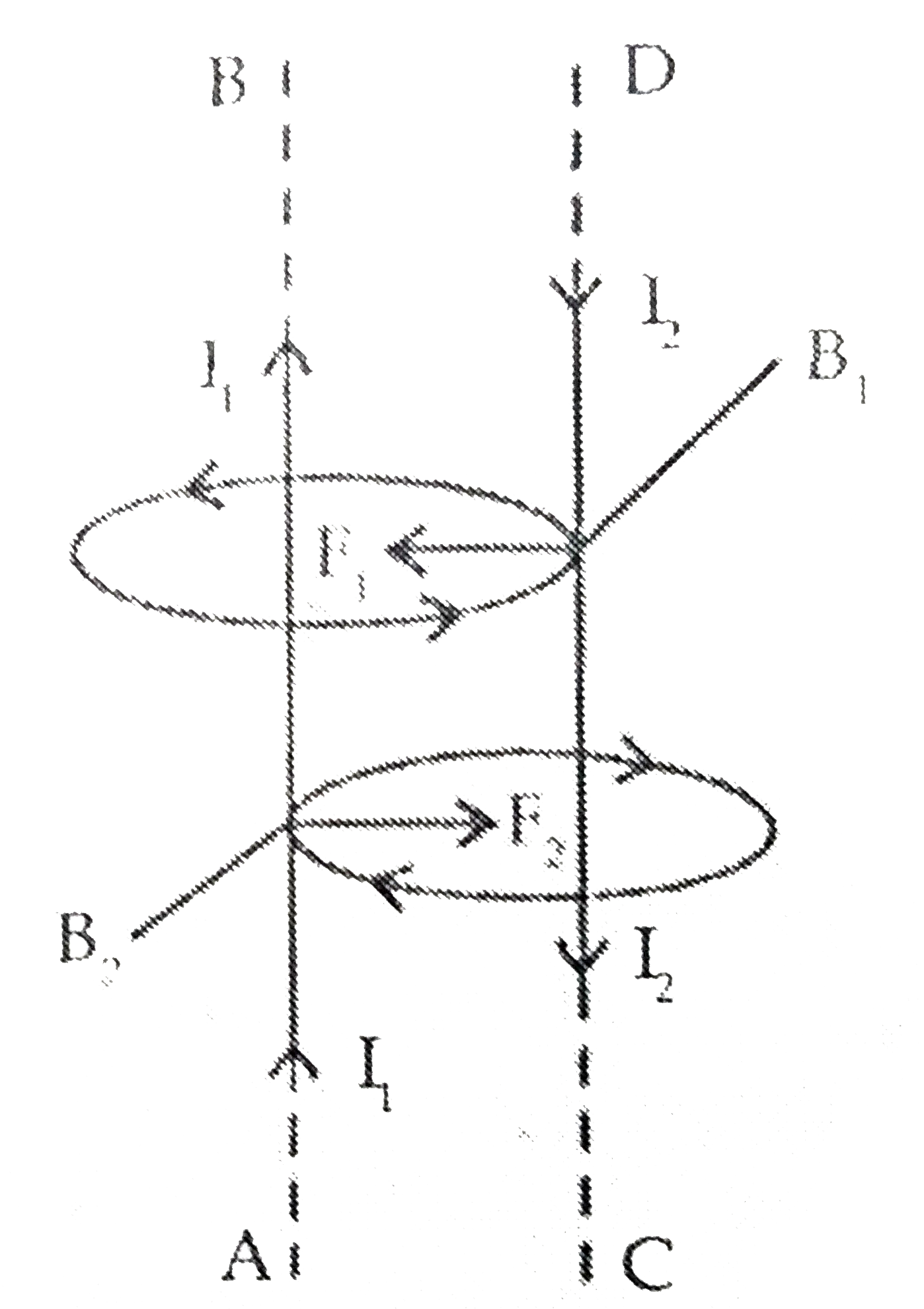 By Fleming's left hand rule, this force will be attractive Definition of ampere: Let `I_(1) = I_(2) = I A, r = 1m` then `F = (4pi xx 10^(-7) xx 2 xx 1 xx 1)/(4pi xx 1) " " [ :' mu_(0) = 4pi xx 10^(-7)]` `F = 2 xx 10^(-7) N` Thus, one amplere is that much current which when flowing through each of the two parallel uniform long linear conductors placed in free space at a distance of one metre from each other will attract or repel each other with a force of `2 xx 10^(-7)N` per metre of their length. Pattern of magnetic field : The pattern of the magnetic field indicates the force of attraction between two parallel conductors carrying current in the same direction (FIG .a) and force of repulsion between two parallel conductors carrying current in opposite direction (Fig.b) 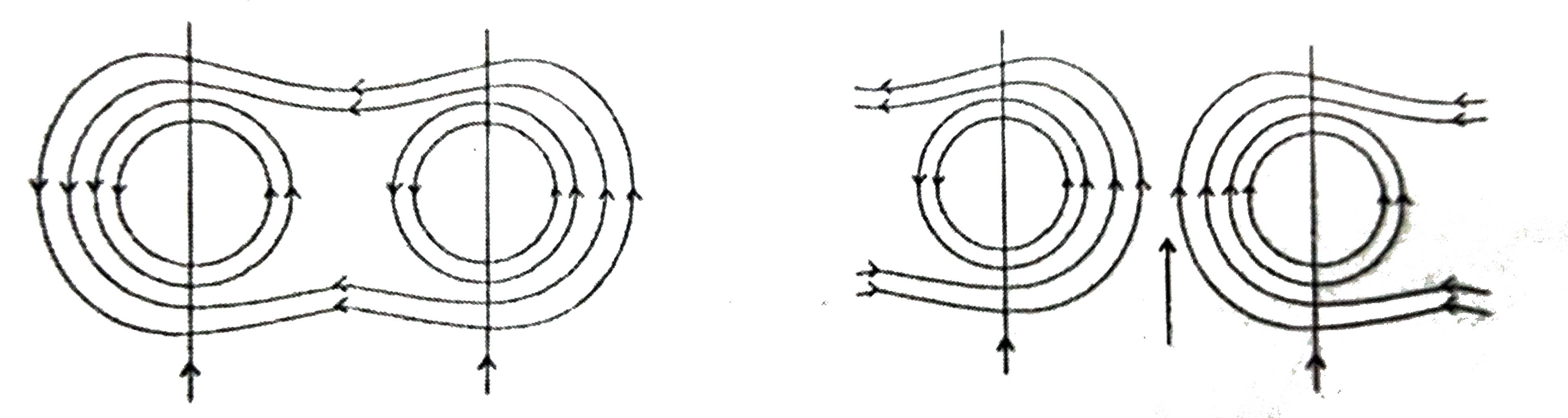
|
|
| 5. |
Statement -A: The acceleration vector of a particle in uniform circular motion averaged over one cycle is a null vector Statement-B : The average speed of a particle is either greater or equal to the magnitude of average velocity of the particle over the same interval of the time. |
|
Answer» A only TRUE |
|
| 6. |
Organelle other than nucleus, containing DNA is |
|
Answer» chloroplasts |
|
| 7. |
At a picnic, there is a contest in which hoses are used to shoot water at a beach ball from three directions. As a result, three forces act on the ball, vecF_(1), vecF_(2) and vecF_(3) (see the drawing). The magnitudes of vecF_(1) and vecF_(2)= 50. 0N and F_(2) = 90. 0N. Using the graphical technique, determine the angle such that the resultant force acting on the ball is zero. |
|
Answer» `21^(@)` |
|
| 8. |
The Bohr model for the spectra of a H-atom |
|
Answer» will not be applicable to hydrogen in the molecular form |
|
| 9. |
The current in the adjoining circuit will be: |
|
Answer» 1/45 Ampere |
|
| 10. |
According to Bohr principle, the relation between principal quantum number (n) and radius of the orbit ( r ) is |
|
Answer» r `ALPHA (1)/(N)` |
|
| 11. |
How we should deal with any sickness or injury 7 |
|
Answer» in a REALISTIC way |
|
| 12. |
Answer the following questions: (a) Quarks inside protons and neutrons are thought to carry fractional charges [(+2//3)e , (-1//3)e]. Why do they not show up in Millikan’s oil-drop experiment? |
| Answer» Solution :Quarks are thought to be CONFINED within a proton or neutron by FORCES which grow stronger if one tries to pull them apart. It, therefore, seems that though fractional charges may exist in NATURE, OBSERVABLE charges are STILL integral multiples of e. | |
| 13. |
Electric quantity …………is equivalent to mechanical quantity, force constant (k) |
|
Answer» charge (Q) |
|
| 14. |
How many deputy presidents were elected? |
|
Answer» two |
|
| 16. |
फलन f:NrarrN मे f(n)=2n+3है - |
|
Answer» एकैकी परंतु आच्छादक नहीं |
|
| 17. |
Current flowing through a pure inductance and a pure capacitance is called wattless current because average power consumed in the circuit is zero. |
|
Answer» |
|
| 18. |
A bodyof mass M is kepton a roughhorizontal surface (friction coefficient = mu) A person is tryingto pull the body by applying a horizontalforce butthebodyis not moving . The forceby the surface on A is F where |
|
Answer» F = Mg |
|
| 19. |
The characteristic impedance of a coaxial cable is of the order of |
|
Answer» `50OMEGA` |
|
| 20. |
A convex mirror having focal length 20 cm is used as side glass in car. Driver will find image of car coming behind 6 m away at ..... |
|
Answer» 15.4 cm `THEREFORE 1/v=1/f-1/u` `=(1)/(20)-(1)/(-600)=(30+1)/(600)=(31)/(600)` `therefore v=(600)/(31) ~~ `19.4 cm (approx) |
|
| 21. |
MI of a solid cylinder about a diameter of one of its faces is given by I = _____ |
| Answer» SOLUTION :[`m((R^2)/4 + (l^2)/3)`] | |
| 22. |
The galvanometer has been named so , because it is based on |
|
Answer» magnetic EFFECT of electric current |
|
| 23. |
When electron jumps from n = 4 level to n = 1 level , the angular momentum of electron changes |
|
Answer» `(h)/(2pi)` `L_(2)=4xx(h)/(2pi)"when n=4"` `L_(2)-L_(1)=(3h)/(2pi)` |
|
| 24. |
Which of these particles (having the same kinetic energy) has the shortest de-Broglie wavelength ? |
|
Answer» Electron |
|
| 25. |
Arrange the following in ascending order of their resistances a) Ammeter of range 10A b) Ideal voltmeter c) Voltmeter of range 100V d) Ammeter of range 1mA |
| Answer» Answer :C | |
| 26. |
The maximum intensity in the case of mu identical incoherent waves each of intensity 2(W)/(m^2)" is "32(W)/(m^2) the value of n is. |
| Answer» SOLUTION :`I= N I_(@), 32= N2, n= 16`. | |
| 27. |
k के किस मान के लिए समीकरण युग्म x+2y−3=0 5x+ky+7=0 का कोई हल नहीं है |
|
Answer» 10 |
|
| 28. |
Calculate the energy released in the following nuclear reaction and hence calculate the energy released when 235 gram of uranium-235 undergoes fission. U_(92)^(235) + n_(0)^(1) to Kr_(36)^(92) + Ba_(56)^(141) + 3n_(0)^(1) Rest masses of U^(235), Ba^(141) ,Kr^(92) and neutron are 235.04390 amu, 140.91390 amu, 91.89730 amu and 1.00867 amu respectively. Avogadro number = 6.023 xx 10^(23). |
|
Answer» SOLUTION :Sum of the masses of the reactants `=236.05257` AMU Sum of the masses of the products `=235.83721` amu Mass converted to energy per fission `=0.215236` amu Energy RELEASED per fission `=0.21536 xx 931` `=200.50016` MeV `200.5 xx 1.6 xx 10^(-13) = 3.208 xx 10^(-11)` J Energy released when 235 gram of `U^(235)` undergoes fission `=200.5 xx 6.023 xx 10^(23)` `=1.2076 xx 10^(26)` MeV or `1.932 xx 10^(13)` J |
|
| 29. |
A smooth sphere ofmass m is moving on a horizontal plane with a velocity (3hati +hat j). It collides with smooth a vertical wall which is parallel to the vector hatj . If coefficient of restitution e = 1/2then impulse that acts on the sphere is |
|
Answer» `-9/2mhati` |
|
| 30. |
Consider a system of three charges q/3,q/3 and –(2q)/3 placed at points A, B and C, respectively, asshown in the figure. Take O to be the centre of the circle of radius R and angle CAB = 60^@ :- |
|
Answer» The electric FIELD at point O is`q/(8piepsilon_0R^2)` directed along the neagtive x-axis 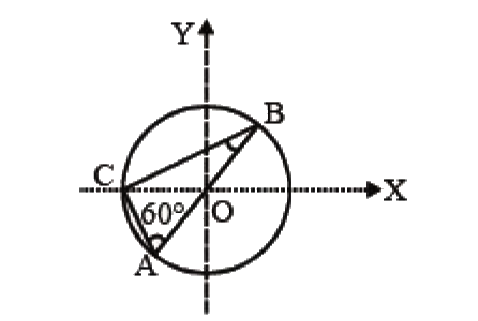 `vecE.=vecE_A+vecE_B+vecE_C` and `vecE_A=-vecE_B` So `vecE.=vecE_C` `=(2q//3)/(4piepsilon_0R^2)` along `vecOC` `=q/(6piepsilon_0^2 R^2)` along `vecOC` `=-q/(6piepsilon_0R^2) HATI` From geometry , we can find that `angleABC=30^@` and `angleACB=90^@` So, AB=2R , AC=R , BC=`sqrt3R` Total potential energy of the system is, `U=1/(4piepsilon_0)[(q//3xxq//3)/(2R) -(q//3xx2q//3)/R-(q//3xx2q//3)/(sqrt3R)]ne0` `F=(q//3xx2q//3)/(4piepsilon_0xx(sqrt3R)^2)` `=q^2/(54piepsilon_0R^2)` Potential at point O is , `V=(q//3+q//3-2q//3)/(4piepsilon_0R)=0` |
|
| 31. |
State the underlying principle of a transformer. How is the large-scale transmission of electric energy over long distances done with the use of transformers ? |
|
Answer» Solution :Principle : When an alternating voltage is applied to the primary, the resulting current produces an alternating magnetic flux which links the secondary and induces an emf in it. (mutual induction) Derivation : The induced emf or voltages `epsilon_(s)`, in the secondary, with `N_(s)` turns is `epsilon_(0) = (-N_(s)d phi)/(dt)` The alternating flux `varphi`also induces and emf called BACK emf, in the primary .This is `epsilon_(p) = (-N_(p) d phi)/(dt)` But `epsilon_(s) = V_(s) gt epsilon_(p) = V_(p)` Therefore, `V_(s) = (-N_(s)d phi)/(dt)` and `V_(p) = (-N_(p) d phi)/(dt)` Hence `(V_(s))/(V_(p)) = (N_(s))/(N_(p))` If the transformer is assumed to be 100% efficient (no energy losses),the power input is equal to the power output and scenes `P = VI rArr V_(p)I_(p) = V_(s)I_(s)`, then `(V_(s))/(V_(p)) = (N_(s))/(N_(p)) = (I_(p))/(I_(s))` THELARGE scale transmission and distribution of electrical energy over long distances is done with the use of transformers the voltage output of the generator is STEPPED-up (so that the current is reduced and consequently, the `I^(2)R` loss is cut down). It is then TRANSMITTED over long distances to an area sub-station near the CONSUMERS there the voltage is stepped down. It is for the stepped down at distributing substations and utility poles before a power supply of 230 V reaches our homes. |
|
| 32. |
How does the internal resistance of a battery changes with temperature ? |
| Answer» Solution :Electric CURRENT inside the battery is through ions in an ELECTROLYTE. When we INCREASE the TEMPERATURE of the electrolyte the its viscosity decreases, and ions GET more freedom to move. Hence internal resistance of the battery decreases with an increases with an increase in the temperature. | |
| 33. |
Photon is quantum of radiation with energy E = hv where v is frequency and h is Planck's constant . The dimensions of h are the sameas that of (A) Linear impulseB) Angular impulse C) Linear momentum D) Angular momentum |
|
Answer» Only A |
|
| 34. |
A constant voltage V_(0) is applied to a potentiometer of resistance R connected to an ammeter. A constant resistor r is connected to an ammeter. A constant resistor r is connected to the sliding contact of the potentiometer and the fixed end of the potentiometer. If the reading of ammeter vary as the sliding contact is moved from one end of the potentiometer to the other. The resistance of ammeter is assumed to be negligible. Find the minimum reading of the Ammeter. |
|
Answer» `(V_(0))/(R+r)` |
|
| 35. |
Suppose the earth was covered by an ocean of uniform depth h,(hltltR) Let sigma be density of ocean and p be mean density of earth. Let Deltag be the approximate difference of value of net acceleration duet to gravity between the bottom of the ocean and top (Deltag=g+("top")-g_("bottom")). Choose the correct option. |
|
Answer» `DELTAG=(4)/(3)piGh[2rho-3sigma]` |
|
| 36. |
The radius of the 5^(th) orbit of hydrogen atom is 13.25 Å. Calculate the wavelength of the electron in the 5 ^(th) orbit. |
|
Answer» SOLUTION :`2pir = nlambda` `2 xx3.14 XX 13.25 019Å = 5 xx LAMBDA` `thereforelambda = 16.64 Å` |
|
| 37. |
If the aperture of the objective of a telescope is decreased then its resolving power |
|
Answer» increases |
|
| 38. |
Consider the following statement A and B and identify the correct answer A) Polarised light can be used to study the helical structure of nucleic acids B) Optic axis is a direction and not any particular line in the crystal. |
|
Answer» A is false but B is true |
|
| 39. |
Arrange the following in asending order of magnetic induction at a point on axis of circular loop of radius (r) at a distance (x) from its centre (for the same currents in the loops) a) r=R,x=sqrt3R b) r=2R,x=sqrt5R c) r=R/2,x=2sqrt2R |
| Answer» Answer :D | |
| 40. |
What is the working principle of a moving coil galvanometer? |
| Answer» Solution :A current carrying loop when PLACED in a MAG netic FIELD EXPERIENCE a torque. | |
| 41. |
Fig. 6.05 shows a metal rod PQ resting on the smooth rails AB and positioned between the poles of a permanent magnet. The rails, the rod, and the magnetic field are in three mutual perpendicular directions. A galvanometer G connects the rails through a switch K. Length of the rod = 15 cm, B = 0.50 T, resistance of the closed loop containing the rod = 9.0 mOmega. Assume the field to be uniform. (a) Suppose K is open and the rod is moved with a speed of 12 cm s^(-1) in the direction shown. Give the polarity and magnitude of the induced emf. (b) Is there an excess charge built up at the ends of the rods when K is open ? What if K is closed ? (c) With K open and the rod moving uniformly, there is no net force on the electrons in the rod PQ even though they do experience magnetic force due to the motion of the rod. Explain. (d) What is the retarding force on the rod when'K is closed ? (e) How much power is required (by an external agent) to keep the rod moving at the same speed (= 12 cm s^(-1)) when Kis closed ? How much power is required when K is open ? (f) How much power is dissipated as heat in the closed circuit? What is the source of this power? (g) What is the induced emf in the moving rod if the magnetic field is parallel to the rails instead of being perpendicular? |
|
Answer» Solution :(a) `|varepsilon| = Blv sintheta.` Here `theta = 90^(@), l = 15 cm = 0.15 m, B = 0.50 T and V = 12 cm s^(-1)` Therefore, `lvarepsilol = Blv = 0.50 xx 0.15 xx 0.12 = 9.0 xx 10^(-3) V = 9.0 mV` Using left hand rule, the Lorentz.s force on electron is from P to RENDERING end P positive and end Q at negative potential. (b) Yes, an excess charge is build up at the ends of the rod when K is open, because of the induced emf set up between the ends. When K is closed, the excess charge is maintained by the CONTINUOUS flow of current due to induced emf. (c) The magnetic force `-e(vecvxxvecB)` is balanced by the electric force `-e vecE`. The electric force is set up due to the excess charges of opposite signs between the ends of the rod. (d) When K is closed the retarding force on the rod is `F = BIl = Bxxvarepsilon/Rxxl, and R = 9.0 MOMEGA = 9.0 xx 10^(-3)Omega` `therefore` The power required =`F v =7.5 xx 10^(-2) xx 10^(-3)W` The power dissipated `=varepsilo^(2)/R=((9.0xx10^(-3))^(2))/(9.0xx10^(-3))9.0 xx 10^(-3)W` The power is provided by the external agent SUPPLYING power. Since, `|varepsilon| = Blv sin theta and theta` in this case `0^(@)`, therefore the induced emf is zero. |
|
| 42. |
Two coherent point sources S_1 and S_2 vibrating in phase emit light of wavelength lamda. The separation between the sources is 2lamda . Consider a line passing through S_2 and perpendicular to the line S_1 S_2. What is the smallest distance from S_2where a minimum of intensity occurs? |
| Answer» SOLUTION :`7/12lamda` | |
| 43. |
The 6563Å Halpha line emitted by hydrogen in a star is found to be redshifted by 15Å. Estimate the speed with which the star is receding from the Earth. |
|
Answer» `686xx10^(5)ms^(-1)` |
|
| 44. |
In a Rutherford's scattering experiment when a projectile of chargez Z_(1)and mass M_(1)approaches a target nucleus of Z_(2)and mass M_(2) the distance of closest approach is r_(0). The energy of the projectile is........ |
|
Answer» directly PROPORTIONAL to `Z_(1), Z_(2)` `(1)/(2)mv^(2)=((Z_(1)E)(Z_(2)e))/(4pi epsi_(0)r_(0))=(Z_(1)Z_(2)e^(2))/(4pi epsi_(0)r_(0))` So the energy of projectile is proportional to `Z_(1),Z_(2)` |
|
| 46. |
What is the conventional direction of electric current |
| Answer» SOLUTION :DIRECTION of MOTION of POSITIVE CHARGES | |
| 47. |
Two organ pipes os same length open at both ends produce sound of different frequencies if their radii are different. Why? |
| Answer» Solution :The fundamental frequency in case of open organ PIPE is given by`n=V/(2(l+2e)) = v/(2(1+1.2r))` where E= 0.6 r Due to different raddi, FREQUENCIES will be different. | |
| 48. |
(a) Distinguish between nuclear fission and fusion. Show how in both these processes energy is released. (b) Calculate the energy release in MeV in the deuterium-tritium fusion reaction : " "_(1)^(2)H+" "_(1)^(3)H to " "_(2)^(4)He +n Using the data: m(" "_(1)^(2)H) = 2.014102 u, m(" "_(1)^(3)H) = 3.016049 u, m(" "_(2)^(4)He) = 4.002603 u, m_(n) = 1.008665 u and 1 u= 931.5 MeV/c^(2). |
| Answer» Solution :In both these PROCESSES total BINDING ENERGY of PRODUCTS is more than the total binding energy of reactants. As a result energy is released which is equal to the difference between binding energy of products and binding energy of reactants. | |
| 49. |
If two coil are wound on a soft iron core the mutual induction is |
|
Answer» small |
|
| 50. |
The point of suspension lambda of a simple pendulum with normal time perid T_(1) is moving upward according to equation y = kt^(2) where k =1 m//s^(2). If new time period is T^(2) the ratio T_(1)^(2)/T_(2)^(2) will be |
|
Answer» `2//3` `(dy)/(DT) = k.2t RARR (d^(2)y)/(dt^(2)) = 2k` GIVEN, `k = 1 m//s^(2)` The point of suspension of the pendulum is moving upwards with an ACCELERATION of `2 m//s^(2)`. This is the case where the pseudo acceleration is acting downwards. g. (effective acceleration due to gravity) `=g +2 = 12 m//s^(2)` `T_(1) = 2pi sqrt(l/g), T_(2) =2pi sqrt(l/g.), THEREFORE T_(1)^(2)/T_(2)^(2) =g^(.)/g = 12/10 = 6/5` |
|