

Saved Bookmarks
This section includes 7 InterviewSolutions, each offering curated multiple-choice questions to sharpen your Current Affairs knowledge and support exam preparation. Choose a topic below to get started.
| 1. |
In double slit experiment, the point on the screen where 3^(rd) order dark fringe from central position is obtained, phase difference between two waves will be ..... |
| Answer» Solution :Phase DIFFERENCE in dark fringe `=(2n-1)pi=5pi` | |
| 2. |
Two particles A and B move with constant velocities v_(1) and v_(2) along two mutually perpendicular straight lines towards the intersection point O.At moment t=0,the particle were located at distancce l_(1) and l_(2) from O. respectively .Find the time,when they are nearest and also the shortest distance between them. |
|
Answer» Solution :After time .t. ,the position of the POINT A and B are `(l_(1)-v_(1)t)` and `(l_(2)-v_(2)t)`. Repectively. The distance L.between the points A. and B. are `L_(2)=(l_(1)-v_(1)t)^(2)+(l_(2)-v_(2)t)^(2)` From minimum value of `L(dL)/(dt)=0` `(v_(1)^(2)+v_(2)^(2))t=l_(1)v_(1)+l_(2)v_(2)` or `t=(l_(1)v_(1)+l_(2)v_(2))/(v_(1)^(2)+v_(2)^(2))` PUTTING the value of t in equation (1) `L_(min)=(|1_(1)v_(2)+l_(2)v_(1)|)/(sqrt(v_(1)^(2)+v_(2)^(2)))` 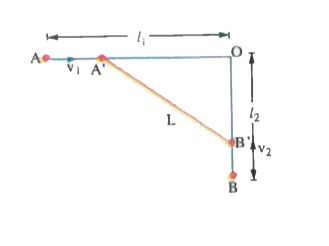
|
|
| 3. |
Two capacitors C_(1) = 2 mF and C_(2) = 8 mF are seperately charged from the same battery. These two capacitors are then allowed to discharge separately through resistors of same resistance with a switch in series which are kept open initially. Both switches are closed at t = 0. |
|
Answer» Current at t = 0 will be zero in both the capacitors. |
|
| 4. |
At t = 0 a travelling wave pulse on a string is described by the function y=10/(x^(2) +2) , here x and y are in meter and t in second, What will be the wave function representing the pulse at time t. if the pulse is propagating along ihe positive x-axis with .speed 2m/s .? |
|
Answer» `y=10/((x^(2)+ 2Y)^(2) +2)` |
|
| 5. |
The two coherent sources of equal intensity produce maximum intensity of 100 units at a point. If the intensity of one of the sources is reduced by 50% by reducing its width then the intensity of light at the same point will be |
|
Answer» 90 |
|
| 6. |
A double convex lens has radii 20 cm. The index of refraction of glass is 1.5. Compute the focal length of this lens in air and when immersed in carbon disulphide of refractive index 1.63. |
|
Answer» |
|
| 7. |
In order to double the frequency of the fundamental note emitted by a streched string, the length is reduced to 3/4th of the original length and the tension is chaged. The factor by which the tension is to be changed is |
|
Answer» `3/8` |
|
| 8. |
Two concentric spherical shells of conducting material and of radii a and b (bgta) are given charges q_(1) " and " q_(2), respectively. Find the potential at a point at a distance r form the centre, (i) outside the two shells, (ii) between the two shells. What is the potential difference between the two shells and what will happen if they are joined by a wire? |
|
Answer» |
|
| 9. |
A coil has an inductance 0.05H and 100 turns. Calculate the flux linked with it when 0.02A current is passed through it. |
|
Answer» 10 WB |
|
| 10. |
A magnet of magnetic moment M is cut into two equal partsthe resultant magnetic moment is |
|
Answer» `SQRT(2)`m `=(M)/sqrt(2)` |
|
| 11. |
A wave propagates on a string in positive x-direction with speed of 40 cm/s. The shape of string at t = 2s is y = 10 cos "" (x)/5 where x and y are in centimeter. Find the wave equation and draw the graph of y vs x. |
Answer» SOLUTION :`10 COS (x/5 - 8T + 16^@)`, 
|
|
| 12. |
A circuit connected with a source of 230 V, draws a current of 2A and power consumed from it is 100 W, then power factor of the circuit is ……. |
|
Answer» 0.02 `therefore 100=2xx230xxcos delta` `therefore cos delta=100/460 APPROX` 0.21739 `therefore cos delta approx` 0.22 |
|
| 13. |
For a LR circuit X_(L) = 40 Omega and R = 40sqrt(3) Omega. The power factor of the circuit is…………. |
| Answer» SOLUTION :`SQRT(3)/2` | |
| 14. |
Suppose the loop is stationary but the current feeding the electromagnet that produces the magnetic field is gradually reduced so that the field decreases from its initial value of 0.3 T at the rate of 0.02 T s^(-1). If the cut is joined and the loop has a resistance of 1.6 Omega, how much power is dissipated by the loop as heat ? What is the source of this power ? |
|
Answer» Solution :Induced emf, `epsilon=-(dphi)/(dt)` `THEREFORE epsilon=-d/(dt)(AB cos 0^@)(because vecA||vecB)` `=-A(dB)/(dt)` `=-(8xx10^(-2)xx2xx10^(-2))(-0.02)` `therefore epsilon=3.2xx10^(-5)` V Power dissipated in the form of HEAT, `P=epsilon^2/R` `=(3.2xx10^(-5))^2/1.6` `therefore P=6.4xx10^(-10)W` (watt) Magnetic field changing with time is an external source to produce this power. |
|
| 15. |
What did Mandela learn about courage? |
|
Answer» it is ABSENCE of fear |
|
| 16. |
In the above problem, the maximum value of magnetic field will be – |
|
Answer» SOLUTION :The MAXIMUM value of the magnetic field is given by `B_(m)=E_(m)/C=(62.6)/(3xx10^(8))=2.09xx10^(7)` |
|
| 17. |
Relative permeability of a material, mu, = 0.5. Identify the nature of the magnetic material and write its relation to magnetic susceptibility. |
|
Answer» SOLUTION :DIAMAGNETIC material `mu_(r) = 1 + x_(NI)` |
|
| 18. |
A uniformly charged thin spherical shell of radius R carries uniform surface charge density of sigma. It is made of two hemispherical shells, held together by pressing them with force F then F is proportional to |
|
Answer» `1/(in_0) sigma^2 R^2` |
|
| 19. |
A parallel-plate air capacitor has a capacitance of 4 muF. What will be its new capacitance if (i) the distance between the plates is redced to half the initial distance (ii) a slab of dielectric constant 5 is introduced filling the entire space between the two plates? |
|
Answer» SOLUTION :Data: `C_(1)=4 muF, d_(2) = d_(1)/2, k_(1)=1` (air), `k_(2)=5` `C=(Akepsilon_(0))/d` (i) With air as the dielectric, `C_(1) =(Ak_(1)epsilon_(0))/(d_(1))` and `C_(2) = (Ak_(1)epsilon_(0))/(d_(2))therefore C_(2)/C_(1) = d_(1)/d_(2)` `therefore` The new capacitance when the plate separation is reduced. `C_(2)= C_(1).d_(1)/d_(2) = 4 xx 2 =8 muF` (ii) With the plates separation `d=d_(1)`, `C_(1) = (Ak_(1)epsilon_(0))/(d_(1))` and `C_(2) = (Ak_(2)epsilon_(0))/d_(1)therefore C_(2)^(')/C_(1)therefore (C_(2)^('))/(C_(1)) = k_(2)/k_(1)` `therefore` the new capacitance when a dielectric slab is introduced between the plates, `C_(2)^(') =C_(1).k_(2)/k_(1) = 4 xx 5= 20 muF` |
|
| 20. |
A wave y = a sin (wt-kx) on a string meets with another wave producing a node at x = 0. The equation of the unknown wave is |
|
Answer» y = a SIN (wt+kx) |
|
| 21. |
A telescope using light having wavelength 5000 Å and using lenses of focal 2.5 and 30 cm . If the diameter of the aperture of the objective is 10 cm , then the resolving limit and magnifying power of the telescope is respectively |
|
Answer» `6.1xx10^(-6)` RAD and `12` |
|
| 22. |
What is modulation? Explain the types of modulation |
Answer» Solution :For long distance transmission, the LOW frequency baseband SIGNAL (input signal) is superimposed onto a high frequency radio signal by a process called modulation. There are 3 types of modulation based on which parameter is modified. They are (a) amplitude modulation, (b) frequency modulation, and (c) phase modulation.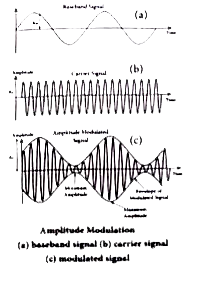 (a) Amplitude Modulation If the amplitude of the carrier signal is modified ACCORDING to the instantaneous amplitude of the baseband signal, then it is called amplitude modulation. Here the frequency and the phase of the carrier signal remain constant. Amplitude modulation is used in radio and TV broadcasting (b) Frequency modulation (i) The frequency of the carrier signal is modified according to the instantaneous amplitude of the baseband signal in frequency modulation. (ii) Here the amplitude and the phase of the carrier signal remain constant. Increase in the amplitude of the baseband signal increases the frequency of the carrier signal and vice versa. (iii) This leads to compressions and rarefactions in the frequency spectrum of the modulated wave. Louder signal leads to compressions and relatively weaker signals to rarefactions. (iv) When the amplitude of the baseband signal is zero in Figure (a), the frequency of the modulated signal is the same as the carrier signal. (V) The frequency of the modulated wave increases when the amplitude of the baseband signal increases in the positive direction (A,C). (vi) The increase in amplitude in the negative half cycle (B, D) reduces the frequency of the modulated wave (Figure (c)). 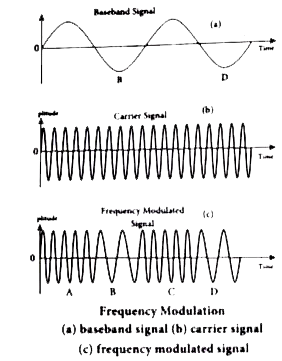 (c) Phase Modulation (PM) (i) The instantaneous amplitude of the baseband signal modifies the phase of the carrier signal keeping the amplitude and frequency constant is called phase modulation. Thismodulation is used to generate frequency modulated signals. (ii) The carrier phase changes according to increase or decrease in the amplitude of the baseband signals. 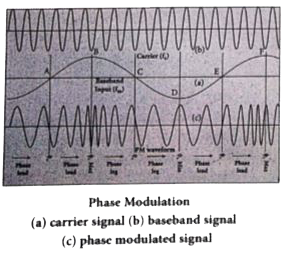 (iii) When the modulating signal goes positive, the AMOUNT of phase lead increases with the amplitude of the modulating signal. (iv) Due to this, the carrier signal is compressed or its frequency is increased. (v) The negative half cycle of the baseband signal produces a phase lag in the carrier signal. (vi) When the signal voltage is zero (A, C and E) the carrier frequency is unchanged. (vii) The frequency shift depends on (i) amplitude of the modulating signal and (ii) the frequency of the signal. |
|
| 23. |
Which of the following obeys Ohm.s law? |
|
Answer» Transistor |
|
| 24. |
Each of two large conducting parallel plates has one sided surface area A. If one of the plates is given a charge Q whereas the other is neutral, then the electric field at a point in between the plates is given by |
|
Answer» `(Q)/(A epsilon_(0))` |
|
| 25. |
Describe Geiger-Marsden scattering experiment. |
Answer» Solution :As SHOWN in above figure, they directed a BEAM of 5.5 MeV a-particle emitted from a `""_(83)^(214)Bi` Bi radioactive source at a thin metal foil made of gold. c-particles emitted by a `""_(83)^(214)Bi` radioactive source were collimated into a narrow beam by their passage through lead bricks. As shown in the figure below, the beam was allowed to FALL on a thin foil of gold of thickness `2.1xx10^(-7)m`.  The scattered C.-particles on striking the screen PRODUCED brief light flashes (scintillations). These flashes may be viewed through a microscope and the DISTRIBUTION of the number of scattered particles may be studied as a function of angle of scattering. The apparatus is placed in chamber having vacuum inside. |
|
| 26. |
A 2 cm high object is placed on the principal axis of a concave mirror at a distance of 12 cm from the pole. If the image is inverted, real and 5 cm high. The location of the image and the focal length of the mirror is |
|
Answer» 30CM, 8.6cm |
|
| 27. |
Which of the following is most suitable for the core of an electromagnet ? |
| Answer» | |
| 28. |
Traffic shock wave. An abrupt shlowdown in concentrated traffic can travel as a pulse, termed a shock wave, along the line of cars, either downstream ( in the traffic direction) or upstream, or it can be stationary. Figure 2-17 shows a uniformlyspaced line of cars moving at speed v=25.0 m/s toward a uniformly spaced line of slow cars moving at speed v_(s)=5.00 m/s. Assume that each faster car adds length L=12.0 m (car length plus buffer zone ) to the line of slow cars when it joins the line, and assume it slows abruptly at the last instant. (a) For what separation distance d between the faster cars does the shock wave remain stationary ? It the separation is twice that amount, what are the (b) speed and (c) direction ( upstream or downstream ) of the shock wave ? |
|
Answer» |
|
| 29. |
One copper wire having resistivity 1.7 xx 10^(-8) Omega, density 8.9 xx 10^(3) kgm^(-3), atomic weight 63.5g mol^(-1) , length 0.1 m and cross-sectional area10^(-6) m^(2)carries 1 A electric current. Find (i) potential difference across the wire (ii) drift velocity of free electron. (Avogadro number = 6.02 xx 10^(23) " mol"^(-1)and valency of copper - 1 |
|
Answer» SOLUTION :(i) `V = 1.7 xx 10^(-3) `V (II) `V_(d) = 7.4 xx 10^(-5) ` m/s |
|
| 30. |
One copper wire having resistivity 1.7 xx 10^(-8) Omega, density 8.9 xx 10^(3) kgm^(-3), atomic weight 63.5g mol^(-1) , length 0.2 m and cross-sectional area10^(-6) m^(2)carries 2 A electric current. Find (i) potential difference across the wire. (ii) drift velocity of free electron . (Avogadro number =6.02 xx 10^(23) " mol"^(-1) and valency of copper = 1 ) |
|
Answer» Solution :(i) V = 3.4 ` XX 10^(-3)` V , (II) `v_(d) = 7.4 xx 10^(-5)` m/s |
|
| 31. |
A prism of refractive index sqrt(2) has a refracting angle 60^(@). At what angle a ray must be incident on it so that it suffers minimum deviation ? |
|
Answer» `30^(@)` |
|
| 32. |
(A) : Sky wave signal are used for long distance radio communication. These signals are in general, less stable than ground wave signals. (R) :The state of ionosphere varies from hour to hour, day to day and season to season. |
|
Answer» Both 'A' and 'R' are TRUE and 'R' is the correct EXPLANATION of 'A'. |
|
| 33. |
A child stands at the centre of a turn table with his two arms out stretched. The turntable is set rotating with an angular speed of 40 rev/min. Now, the child folds his hands back and thereby reduces his moment of inertia to (2)/(5) times the initial value. The new kinetic energy of rotation is x times the initial kinetic energy of rotation. The value of x is : |
|
Answer» 2.5 `therefore I_(1)omega_(1)=I_(2)omega_(2)` Now it is given that `I_(2)=(2)/(5)I_(1)` `therefore omega_(1)=5//2omega_(1)` Also `K.E.=(1)/(2)((2)/(5)I_(1))(5//2omega_(1))^(2)` `E_(k)=(1)/(2)xx5//2xxI_(1)omega_(1)^(2)` `=2.5xx(1)/(2)I_(1)omega_(1)^(2)` `therefore` value of `x=2.5` |
|
| 34. |
Light ray falls at normal incidence on the firstface of an equilateral prism and emergres gracing the second face. What is the angle of deviation? What is the refractive indec of the material of the prism? |
|
Answer» Solution :The given situaton is shown in the FIGURE. Here, `A - 60^(@) : l_(1) = 0^(@), l_(2) = 90^(@)` Equation for angle of deviation. `d = i_(1) + l_(2) - A` Substituting the values, `d = 0^(@) + 90^(@)- 60^(@) = 30^(@)` `n=(1)/(sini_(c )):n=(1)/(SIN30)=(1)/(1//2)=2`  |
|
| 35. |
Suppose that the electric field amplitude of an electromagnetic wave is E_(0)=120N//C and that its frequency is v=50.0MHz. (a) Determine B_(0),omega,k and lambda (b) Find expressions for vecE and vecB. |
|
Answer» Solution :Here `E_(0)=120NC^(-1) and v=50.0MHz=50xx10^(6)HZ` (a) `B_(0)=(E_(0))/(c )=(120)/(3xx10^(8))=4xx10^(-7)T or 400nT` Angular FREQUENCY `omega=2piv=2xx3.14xx50xx10^(6)=3.14xx10^(8)"rad s"^(-1)` Wavelength `lambda=(c )/(v)=(3xx10^(8))/(50xx10^(6))=6m` Propagation constant `k=(2pi)/(lambda)=(2xx3.14)/(6)="1.05 rad m"^(-1)` (b) If electromagnetic wave is being PROPAGATED along x - axis, then `vecE=E_(0)sin(kx-omegat)hatj=120sin(1.05x-3.14xx10^(8)t)hatj` `and""vecB=B_(0)sin(kx-omegat)hatk=4xx10^(-7)sin(1.05x-3.14xx10^(8)t)hatj` and`""vecB=B_(0)sin(kx-omegat)hatk=4xx10^(-7)sin(1.05x3.14xx10^(8)t)hatk` |
|
| 36. |
There is a circular loop of current of radius , as shown in figure: If current enters at point A and leaves at point B where angle AOB " is " 90^(@)and the wire of the loop is of uniform cross section area, then calculate the magnetic field intensity at the centre of the loop. |
|
Answer» 0 `i_(1) = (3R)/(R + 3R) i = (3i)/4` ` i_(2) = R/(R+3R) i = i/4` Magnetic field intensity at the centre due to part AB can be written as follows: `B_(1) = 1/4 [(mu_(0)i_(1))/(2r)] = 1/4 [(mu_(0)(3i)/4)/(2r)] = (3 mu_(0)i)/(32r)` Magnetic field intensity due to the part BCDA can be written as follows: `B_(2) = 3/4 [(mu_(0)i_(1))/(2r)] = 3/4 [(mu_(0) i/4)/(2r)] = (3 mu_(0)i)/(32 r) ` Both the fields are having the same magnitude but the two are opposite in direction and hence the net magnetic field at the centre of the loop becomes zero. Note that we can predict the answer with just a bit of mental calculations. One portion is a quarter of the circle but current is three times than the other part which is three QUARTERS of the circle. Hence, OPTION (a) is correct. |
|
| 37. |
Two circular coils can be arranged in any of the three situations shown in the figure. Their mutual inductance will be |
|
Answer» MAXIMUM in SITUATION (a) |
|
| 38. |
The potential difference applied to an X-ray tube is 5KV and the current through it is 3.2 mA. The number of electrons striking the target per second is: |
|
Answer» `2XX10^(16)` |
|
| 39. |
Gauss's law is true only if force due to a charge varies as : |
|
Answer» `R^(-1)` |
|
| 40. |
When a cell is charged by sending current into the cell, what will be the terminal potential difference of the cell. |
| Answer» Solution :Electric cell CONVERTS electrical energy into chemical energy, when current passes through it. While charging the cell, e.m.f. is less than the terminal VOLTAGE `(in LTV)` and the direction of current INSIDE the cell is form +ve terminal to negative terminal.`v= epsi + IR` | |
| 41. |
Ability of the eye to see objects at all distances is called |
|
Answer» BINOCULAR VISION |
|
| 42. |
In an a.c. circuit instantaneous current is given as I = 10.0 sin 100pitThe time required for the current to achieve its peak value will be……………. |
| Answer» Solution :`1/200 s` [Hint: FREQUENCY of V = 50 Hz, HENCE, `t=T/4 =1/(4v) = 1/200 s`] | |
| 43. |
Sketch the wavefronts corresponding to converging rays |
Answer» SOLUTION :
|
|
| 44. |
To increase the range of a voltmeter we need to connect a suitable: |
|
Answer» HIGH RESISTANCE in series |
|
| 46. |
Current is flowing with a current density J=480Acm^(-2) in a copper wire. Assuming that each copper atom contributes one free electron and given that Avogadro number = 6.0xx10^(23) atoms/mole Density of copper = 9.0g//cm^(3) Atomic weight of copper = 64 g/mole Electronic charge =1.6xx10^(-19) coulomb The drift velocity of electrons is |
|
Answer» 1 mm/s n = number of electrons per unit VOLUME or `n=(("AVOGADRO number")xx"Density")/("Atomic weight of COPPER")` or `n=(6xx10^(23)xx9)/(64)` `v_(d)=480xx(64)/(6xx10^(23)xx9xx1.6xx10^(-19))=(480xx64)/(6xx9xx1.6xx10000)cm//s` `or v_(d)=(32)/(900)cm//s=(32xx10)/(900)mm//s=0.36 mm//s` |
|
| 47. |
At what speed is a particle moving if the mass is equal to three times its rest mass. Data m=3m_(0), v = ? |
|
Answer» Solution :`m=(m_(0))/(sqrt(1-(v^(2))/(c^(2))))` `3m_(0)=(m_(0))/(sqrt(1-(v^(2))/(c^(2))))` v=0.943C `=0.943xx3xx10^(8)` `v=2.829xx10^(8)MS^(-1)` |
|
| 48. |
How the purpose was met in alpha-particles experiment on what basis ? |
| Answer» SOLUTION :SCATTERING, DEFLECTION | |
| 49. |
Find the emf induced in a coil of 200 turns and cross-sectional area 0.2 m^(2), when a magnetic field perpendicular to the plane of the coil changes from 0.1 Wb m^(-2) to 0.5 Wb m^(-2) at a uniform rate over a period of 0.05 s. |
|
Answer» |
|
| 50. |
A circular coil of radius 8.0 cm and 20 turns is rotated about its vertical diameter with an angular speed of 50 rad s^(-1) in a uniform horizontal magnetic field of magnitude 3.0xx10^(-2)T. Obtain the maximum and average emf induced in the coil. If the coil forms a closed loop of resistance 10Omega, calculate teh maximum value of current in the coil Calculated the average power loss due to Joule heating. Where does this power come from? |
|
Answer» Solution :For a coil ROTATING in a magnetic field, `varepsilon=-BANomegasinomegat` `varepsilon_(max)=-BANomega` (NUMERICALLY) Here `B=3xx10^(-2)T,A=pir^(2)=pixx(8XX10^(-2))^(2)` `N=20,omega=50" rad "s^(-1)` `varepsilon_(max)=20xx50xxpixx64xx10^(-4)xx3xx10^(-2)=0.603V` `varepsilon_("average")` over a cycle is zero `I_(max)=(varepsilon_(max))/(R)=(0.603)/(10)=0.0603A` `P_("average")=(1)/(2)varepsilon_(max)I_(max)=(1)/(2)xx0.603xx0.0603=0.018W` Source of power LOSS is the external rotor which provides the necessary torque. |
|