

Saved Bookmarks
This section includes 7 InterviewSolutions, each offering curated multiple-choice questions to sharpen your Current Affairs knowledge and support exam preparation. Choose a topic below to get started.
| 1. |
(A):A body thrown up from the top of a tower and another body thrown down from the same point strike the ground witht the same velocity. (R ):Initial speed and acceleration are common for both. |
|
Answer» |
|
| 3. |
Range of an electronics communication system is the |
|
Answer» distance to the nearest TV STATION |
|
| 4. |
What is the force on a current carrying conductor placed in uniform magnetic force ? |
| Answer» SOLUTION :`[oversettoI(oversettolxxoversettoB)]` | |
| 5. |
The maximum kinetic energy of a photoelectron liberated from the surface of lithium with work function 2.35 eV by electromagnetic radiation whose electric component varies with time as: E = a [ 1 + cos (2pi f_(1)t) ] cos 2pi f_(2) t( where a is a constant ) is (f_(1) = 3.6 xx 10^(15) Hz, and f_(2) = 1.2 xx10^(15)Hz and planck's constant h= 6.6 xx 10 ^(-34) Js) |
|
Answer» `2.64` eV `E = a Pi + cos (2pif_(1)t)cos (2pif_(2)t)` `rArr E = [a cos ( 2pif_(2)t) + a cos (2pif_(1) t) cos (2pif_(2)t)]` `(cos A cos B = 1/2 cos (A+B)- cos (A-B))` `rArr E = a cos (2pif_(2) t) + a/2 cos 2pi ( f_(1) + f_(2))t-a/2 cos 2 pi ( f_(1) - f_(2))t` So, the electric component has 2 sub- components with frequencies are, `f_(2) (f_(1) + f_(2)) and (f_(1) - f_(2))` So, for maximum kinetic ENERGY of PHOTOELECTRON,whe take photon of maximum frequency. HENCE, `E_(max)=(hc_(max))/e = (6.6xx10^(-34)xx(3.6xx10xx1.2xx10^(15)))/(1.6xx10^(-19))` `=19.8 eV` Hence, the maximum kinetic energy, `KE_(max) =E_(max) - W_(0) = 19.8 - 2.35 = 17.45 eV` Hence, the correct option is (d). |
|
| 6. |
A wire of resistance R is streched to twice its original length without any change in its density.It's new resistance will be |
|
Answer» 2R |
|
| 7. |
The output of OR gate is 1 …….. |
|
Answer» if EITHER INPUT are 0. The OUTPUT of A or B or both will be identical `Y=A+B` |
|
| 8. |
When a polariser and analyser have theiraxes inclined to one another at 30^(@) , the amount of light transmitted is 5 SI units. What is the maximum intensityof light transmitted and at what angle between the two? |
|
Answer» |
|
| 9. |
Which type of isomerism is possible in the following two molecules ? (a) |
|
Answer» CHAIN ISOMERS 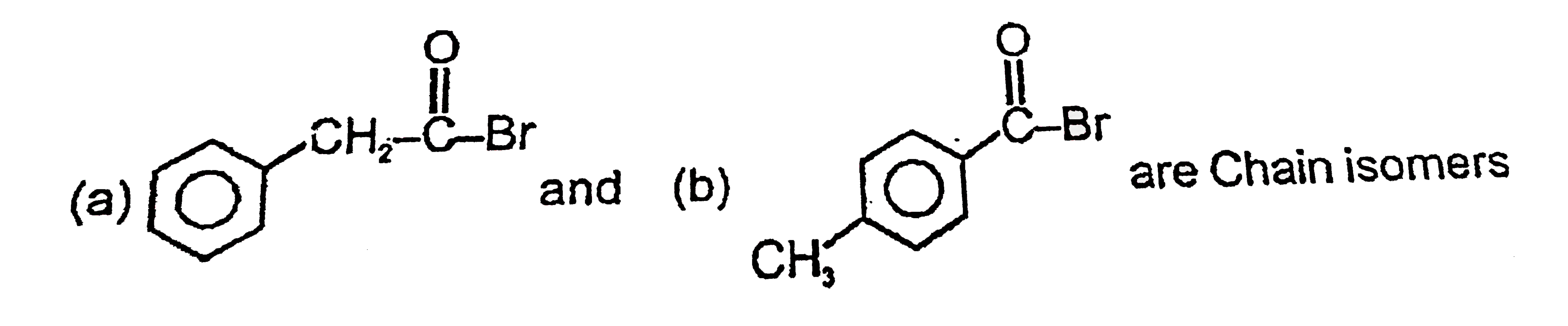 are Chain isomers. are Chain isomers.
|
|
| 10. |
In a silicon diode, the reverse current increases from 10 mu A to 200mu A, when the reverse voltage changes from 2 to 4V.The reverse ac resistance of the diode is |
|
Answer» `1 xx 10^5 OMEGA ` |
|
| 11. |
Which one of the following is not electromagnetic in nature? |
|
Answer» Cathode-rays |
|
| 12. |
Relativistic corrections become necessary when the expression for the kinetic energy (1)/(2)mv^(2), becomes comparable with mc^(2),where m is the mass of the particle.At what de-Broglie wavelength will realtivistic corrections become important for an electron? |
|
Answer» `lambda`=10 nm `lambda_(min)=(h)/(mv_(max))=(h)/(mc)` ………(1) `therefore lambda_(min)=(6.625xx10^(-34))/(9.1xx10^(-31)xx3xx10^(8))` `therefore lambda_(min)=0.002427`nm ........(2) `implies` From equations (1) and (2) , we can that if `VGTC` then `lambda ltlambda_(min)` Here in options (C )and (D) ,we are given `lambdaltlambda_(min)`.Hence in these two CASES we get `vgtC`. Hence in these two cases,we would require to make correction based upon theory of relativity. |
|
| 13. |
A body is subjected to a constant force vecF in newton given by : vecF=2hati+9hatj+12hatk, where hati,hatjand hatk are unit vectors along x,y and z-axis respectively. What is the work done by this force in moving the body through a distance of 2 m along 2-axis ? |
|
Answer» 24 J |
|
| 14. |
Draw a schematic diagramof a cyclotron.Explain its underlyingprinciple and working,statingclearly thefunction of the electric and magneticfields appliedon a charged particle. Deduce an expressionfor the period of revolutionand show that it does not depend on the speed of the charged particle. |
|
Answer» Solution :Cyclotron : It is a device by which positively charged particles like protons, deutrons, etc. can be accelerated. Principle : A positively charged particle can be accelerated by making it to cross the same electric field repeatedly withthe help of a MAGNETIC field. Construction : It consists of two semi-cylindrical BOXES `D_(1) and D_(2)`, called dees enclosed in an evacuated chamber. The chamber is kept between the poles of a powerful magnet so that uniform magnetic field ACTS perpendicular to the plane of the dees. An alternating voltage is applied in the gap between the two dees by using a high frequencyoscillator. The electric field is zero inside the dees. Working and theory : At a certain instant, let `D_(1)` be positive and `D_(2)` be negative. The radius of the circular path is GIVEN by `qv B=mv^()//ror r=mv//QB` Period of revolution, `T=(2pir)/(v)-(2pi)/(v). (mv)/(qB)=(2pi m)/(qB)` Frequency of revolution `f=(1)/(T)=(qB)/(2pi m)` Clearly, frequency f isindependent of both v and r and is called cyclotron frequency. If the frequency of applied a.c. is equal to f, then every time the proton reaches the gap between the dees, the direction of electric field is reversed and proton receives apush and finally it gains very high kinetic energy. The proton follows a spiral path. The accelerated protons are deflected protons are deflected towards the target. 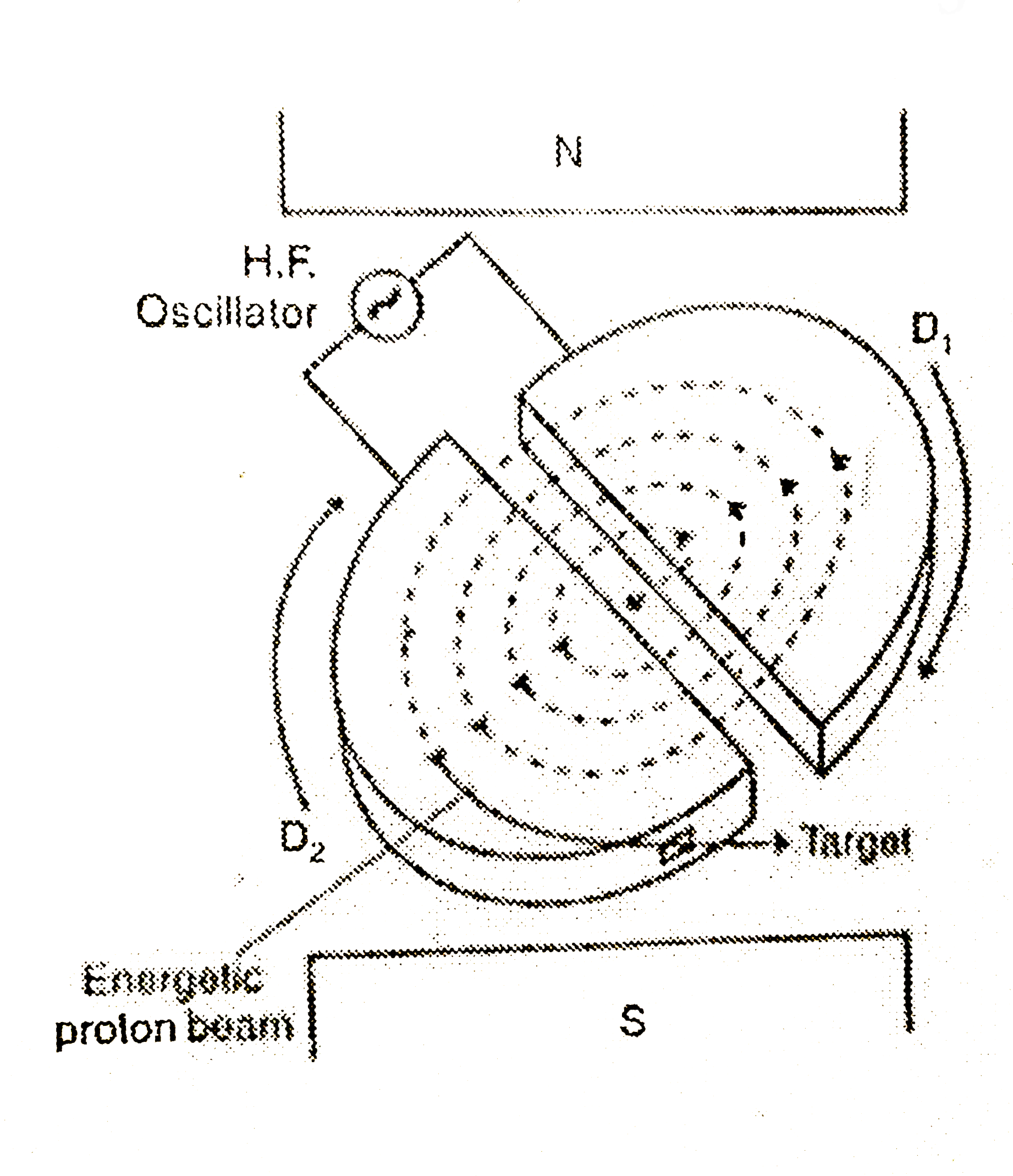
|
|
| 15. |
For the circuit shown in the figure, determine the charge of capacitor in steady state. |
| Answer» Answer :B | |
| 16. |
In a harbour, wind is blowing at the speed of 72 km/h and the flag on the mast of a boat anchored in the harbour flutters along the N-E direction. If the boat starts moving at a speed of 51 km/h to the north, what is the direction of the flag on the the mast of the boat? |
|
Answer» EAST (APPROXIMATELY) |
|
| 17. |
In Rutherford's experiment, the number of alpha- particles scattered through an angle of 60^@ by a silverfoil is 200 per minute. When the silver foil is replaced by a copper foil of the same thickness, the number of a particles scattered through an angle of 60^@ per minute is: |
|
Answer» `(200 XX Z_(Cu))/(Z_(AG))` |
|
| 18. |
Three charge each of magnitude q are placed at the corners of an equilateral triangle , the electrostatic force on the charge placed at the centre is ( each side of triangle L).Their equilibrium is : |
|
Answer» ZERO |
|
| 19. |
A magnetic field directed into the page changes with time according to the expression B = (0.03t^(2) +1.4)T, where t is in seconds. The field has a circular cross-section of radius R = 2.5cm. What is the magnitude and direction of electric field at P, when t=3.0s and r=0.02 m. |
|
Answer» Solution :`e= oint E.dl=(+d phi)/(dt)` `E(2PI R)=A.(dB)/(dt)=PI r^(2) xx (d)/(dt)(0.03t^(2)+1.4)` `E=(pi r^(2))/(2pi r) xx (0.06)=(r)/(2)(0.06t)` `|E|=(0.02)/(2) xx 0.06 xx 3=18 xx 10^(-4) N//C` |
|
| 20. |
What does the rattrap seller have to do to make his both ends meet? |
|
Answer» Peddling |
|
| 21. |
The given figure shows the P-V diagram for a Camot cycle. In this diagram, |
|
Answer» curve AB represents isothermal PROCESS and BC adiabatic process Differentiating w.r.t. V , we GET `(dP)/(dV) V^(gamma) + PgammaV^(gamma-1) = 0" or " (dP)/(dV) = - (gammaP)/V` For isothermal process, PV = constant Hence, `(dP)/(dV) = - P/V` Now dP/dV is the slope of the(P - V) GRAPH. Thus, the slope of the (P-V ) graph for an adiabatic process is `gamma`times that for an isothermal process. Hence, curves BC and DA both represent adiabatic process and curves AB and CD both represent isothermal process. |
|
| 22. |
A diode as a rectifier converts |
|
Answer» A.C. into D.C. |
|
| 23. |
What charge would be required to electrify a sphere of radius 25 cm, so as to get a surface charge density of 3/pi C/m^2? |
|
Answer» 0.25 `therefore Q=4pi R^2sigma=4 times PI times (25 times 10^-2)^2 times 3/pi` `=4 times 625 times 10^-4 times 3` `=7500 times 10^-4=0.75C` |
|
| 24. |
Define the electric resistivity of conductor. Plota graphshowing the variation of resistivity with temperature in the case of a (a) conductor (b) semiconductor .Briefly explain, how the difference in the behaviour of the two can be explained in terms of number density of charge carriers and relaxation time. |
Answer» Solution :2nd PART:  3rd part: We know , `rho=m/( N e ^2 R)` In conductors, the average relaxation time decreases with INCREASE In temperature,resulting in an increase in resistivity. In semiconductors , the increase in number density (with increase in temperature) is more than the decrease in relaxation time .The ultimate RESULT in therefore a decrease in resistivity. |
|
| 25. |
A ball of mass m moving with velocity v_0 experiences a head-on elastic collision with one of the spheres of a stationary rigid dumbbell as whown in figure. The mass of each sphere equals m//2, and the distance between them is l. Disregarding the size of the spheres, find the proper angular momentum overset~M of the dumbbell after the collision, i.e. the angular momentum in the reference frame moving translationally and fixed to the dumbbell's centre of inertia. |
|
Answer» Solution :From conservation of linear momentum along the DIRECTION of incident ball for the system consists with colliding ball and phhere `mv_0=mv^'+m/2v_1` (1) where `v^'` and `v_1` are the velocities of ball and SPHERE 1 respectively after collision. (Remember that the collision is head on). As the collision is perfectly elastic, from the definition of co-efficient of restitution, `1=(v^'-v_1)/(0-v_0)` or, `v^'-v_1=-v_0` (2) Solving (1) and (2), we get, `v_1=(4v_0)/(3)`, DIRECTED towards right. In the C.M. frame of spheres 1 and 2 (FIGURE) `overset~vecp_1=-overset~vecp_2` and `|overset~vecp_1|=|overset~vecp_2|=mu|vecv_1-vecv_2|` Also, `vecr_(1C)=-vecr_(2C)`, thus `overset~vecM=2[l/2(m//2)/(2)(4v_0)/(3)hatn]` (where `hatn` is the unit vector in the sense of `vecr_(1C)xxoverset~vecp_1`) Hence `overset~M=(mv_0l)/(3)` 
|
|
| 26. |
Explain comparison of emf of two cell by using potentiometer with necessary diagiam. |
Answer» Solution : As shown in figure a battery having emf E and internal resistance r variable resistance R and switch `K_(1)` is connected between TWO end A and B of POTENTIOMETER. `rArr` To compare emf of two cell `epsilon_(1) and epsilon_(2) `, positive terminal of both cell is connected with A and negative terminal of cell is connected with point 1 and 2 of three way switch with terminal 3 of three way switch galvanometer and jockey key is connected in series. Jockey key can be moved on wire. `rArr` First point 1 and 3 of three way switch are connected hence `epsilon_(1) `cellis in the cell By sliding jockey key on wire obtained point `N_(1)` such that galvanometer shows zero deflection. Let `AN_(1) = l_(1)` By using Krichhoff.s second law for loop, `AN_(1) G31A` `phi l_(1) + 0 - epsilon_(1) = 0` `therefore phi l_(1) = epsilon_(1)"" ` .... (1) `rArr` Now connect point 2 and 3 and obtain point `N_(1)` such that galvanometer show zero deflection, `AN_(2) = l_(2)` For `AN_(2) G 32 A `loop, `phi l_(1) + 0 - epsilon_(2) = 0` `therefore phi l_(2)= epsilon "" `..... (2) By taking RATIO of (1) and (2), ` (epsilon_(1))/(epsilon_(2)) = (l_(1))/(l_(2)) `....(2) when emf of one of the cell is given then from value of`l_(1) and l_(2)` by using EQUATION (3)value of unknown emf can be obtained. `rArr` By using potentiometer potential difference of very small value can be MEASURED. |
|
| 27. |
Audio signal cannot be transmitted because |
|
Answer» the SIGNAL has more noise |
|
| 28. |
A wire is stretched to double it's length. Will it's resistivity change ? |
| Answer» Solution :No, the RESISTIVITY `RHO(=m/(n e^2`TAU))` is the characteristic of the MATERIAL of the conductor which REMAINS the same. | |
| 29. |
For what distance is ray optics a good approximation the aperture is 4 mm wide and the wavelength is 100 mm ? |
| Answer» ANSWER :A | |
| 30. |
If the satellite is stopped suddenly in its orbit and is allowed to fall freely into the earth's surface with what speed it hits the surface of earth? |
|
Answer» `7.92 km//s` `0-(GMM)/(R+h)=(1)/(2)mv^(2)-(GMm)/(R )` `(1)/(2)mv^(2)=(GMm)/(R )-(GMm)/(R+R)=(GMm)/(2R)` `v=sqrt((GM)/(R ))=sqrt(gR)=sqrt(9.8xx6400xx10^(3))` `x=7.92 KMS^(-1)`. CORRECT choice is (a). |
|
| 31. |
The uterus open into vagina through a narrow |
|
Answer» hymen |
|
| 32. |
The dimension of 1//CR is, where C is capacitance and R is electrical resistance : |
|
Answer» `M^(0)L^(0)T^(2)` |
|
| 33. |
What should be the relative speed of approach of a source and an absorber consisting of free iron atoms for the resonance absorption of gamma-rays to take place? The energy of the photon is specified in the previous problem. |
|
Answer» `epsi_(gamma)^(ab)=epsi_(gamma)+2epsi_(R)=epsi_(gamma)(1+epsi_(gamma)/(Mc^(2)))` This distorts the resonance absorption. If we start bringing the source and the absorbing substance closer together, the gamma-photon.s energy increases because of the Doppler effect: `epsi_(gamma).=epsi_(gamma)sqrt((1+beta)/(1-beta))~~epsi_(gamma)(1+beta)`. At a certain speed we obtain `epsi_(gamma).=epsi_(gamma)^(ab)`, and resonance absorption sets in. We have `epsi_(gamma)(1+epsi_(gamma)/(Mc^(2)))=epsi_(gamma)(1+beta),"giving "beta=(epsi_(gamma))/(Mc^(2)),andv=betac=epsi_(gamma)/(Mc)` |
|
| 34. |
The image of a white object in with light formed by a lens is usually colored and blurred. This defect of image is called chromatic aberration and arises due to the fact that focal length of a lens is different for different colours. As R .I. mu of lens is maximum for violet while minimum for red, violet is focused nearest to the lenswhile red farthest from it as shown in figure. As a result of this, in case of convergent lens if a screen is placed at F_(v) center of the image will be violet and focused while sides are red and blurred. While at F_(R) , reverse is the case, i.e ., center will be red and focused while sides violet and blurred. The differece between f_(v) and f_(R) is a measure of the longitudinal chromatic aberration (L.C.A),i.e., L.C.A.=f_(R)-f_(v)=-df with df=f_(v)-f_(R)...........(1) However, as for a single lens, (1)/(f)=(mu-1)[(1)/(R_(1))-(1)/(R_(2))].............(2) rArr -(df)/(f^(2))=dmu[(1)/(R_(1))-(1)/(R_(2))]...............(3) Dividing E1n. (3) by (2) : -(df)/(f)=(dmu)/((mu-1))=omega,[omega=(dmu)/((mu-1))] "dispersive power",.........(4) And hence, from Eqns. (1) and (4) , L.C.A.=-df=omegaf Now, as for a single lens neither f nor omega zero, we cannot have a single lens free from chromatic aberration. Condition of Achromatism : In case of two thin lenses in contact (1)/(F)=(1)/(F_(1))+(1)/(F_(2))i.c,. -(dF)/(F^(2))=(df_(1))/(f_(1)^(2))-(df_(2))/(f_(2)^(2)) The combination will be free from chromatic aberration if dF=0 i.e., (df_(1))/(f_(1)^(2))+(df_(2))/(f_(2)^(2))=0 which with the help of Eqn. (4) reduces to (omega_(1)f_(1))/(f_(1)^(2))+(omega_(2)f_(2))/(f_(2)^(2))=0 ,i.e., (omega_(1))/(f_(1))+(omega_(2))/(f_(2))=0........(5) This condition is called condition of achromatism (for two thin lenses in contact ) and the lens combination which satisfies this condition is called achromatic lems, from this condition, i.e., form Eqn. (5) it is clear the in case of achromatic doublet : Since, if omega_(1)=omega_(2), (1)/(f_(1))+(1)/(f_(2))=0i.e., (1)/(F)=0 or F=infty i.e., combination will not behave as a lens, but as a plane glass plate. (2) As omega_(1) and omega_(2) are positive quantities, for equation (5) to hold, f_(1) and f_(2) must be of opposite nature, i.e., if one of the lenses is converging the other must be diverging. (3) If the achromatic combination is convergent, f_(C)ltf_(D) and as (f_(C))/(f_(d))=(omega_(C))/(omega_(D)), omega_(C)ltomega_(d) i.e., in a convergent achromatic doublet, convex lens has lesses focal legth and dispersive power than the divergent one. Chromatic aberration in a spherical concave mirror is proportional to : |
| Answer» Solution :N//a | |
| 35. |
(A) Always |(dvecv)/(dt)|=(d)/(dt)|vecV|,where vecv has its usual meaning (R ):Acceleration is rate of change of speed. |
|
Answer» |
|
| 36. |
A massless spring hangs from the ceiling with a small object attached to its lower end. The object is initially held at rest in a position y such that the spring is at its rest length. The object is then released from y and oscillates up and down, with its lowest position being 10cm below y, (a) What is the frequency of the oscillation? (b) What is the speed of the object when it is 8.0 cm below the initial position? (c ) An object of mass 600g is attached to the first object, after which the system oscillates with half the original frequency. What is the mass of the first object? (d) How far below y, is the new equilibrium (rest) position with both objects attached to the spring? |
| Answer» SOLUTION :(a) 2.2Hz, (B) 0.56m/s © 0.200kg, (d) 0.200m | |
| 37. |
Does normal shift produced by a medium depend on the positionof an object below the surface? |
| Answer» SOLUTION :NORMAL SHIFT does not DEPEND on the position of the object below the glass slab. | |
| 38. |
Four charges of +q, +q +q and +q are placed at the corners A, B, C and D of a square. The resultant force on the charge at D |
|
Answer» `(q^2)/(8 pi in_0 a^2) (1 + 2sqrt(2))` |
|
| 39. |
A ray of light is incident normally on one face of a right angled isosceles prism. It then grazes the hypotenuse. The refractive index of the material of the prism is |
|
Answer» 1.33 |
|
| 40. |
The ratio of effective capacitance of two equal capacitors connected in series to connected in parellel is |
|
Answer» `1:4` |
|
| 41. |
Name two series of hydrogen spectrum lying in the infra red region. |
|
Answer» <P> SOLUTION :Paschan & P FUND SERIES |
|
| 42. |
Half of the space between the plates of a parallel plate capacitor is filled with a dielectric material of dielectric constant K . The ramaining half contains airas shown in the figure . The capacitor is now given a charge Q . Then |
|
Answer» electric field in the dielectric filled region is higher than that in the air - filled region. The given capacitor is equivalent to twocapacitors in parallel with CAPACITANCES `C_(1)=(Kepsilon_(0)(A//2))/(d)=(Kepsilon_(0)A)/(2d)`… (i) `C_(2)=(epsilon_(0)(A//2))/(d)=(epsilon_(0)A)/(2d)`...(ii) 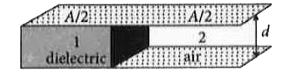 `thereforeC_(eq)=C_(1)+C_(2)=(Kepsilon_(0)A)/(2d)+(epsilon_(0)A)/(2d)` `=(epsilon_(0)A)/(2d)(K+1)=(C_(0))/(2)=(K+1)`,Where `C_(0)=(epsilon_(0)A)/(d)` `(Q_(1))/(Q_(2))=(C_(1))/(C_(2))=(K)/(1)` ...(iii) (Using (i)and (ii)) As surface charge density , `sigma=("Charge")/("Area")` `therefore(sigma_(1))/(sigma_(2))=(Q_(1))/(Q_(2))=(K)/(1)`...(iv)(Using (iii)) Total charge , `Q=Q_(1)+Q_(2)` ...(v) From (iii)and (v) , we get `Q_(1)=(KQ)/(K+1)andQ_(2)=(Q)/(K+1)` Electric field in dielectric filled region, `E_(1)=(sigma_(1))/(epsilon_(0)K)` Electric field in air - filled region , `E_(2)=(sigma_(2))/(epsilon_(0))` `therefore(E_(1))/(E_(2))=(sigma_(1))/(sigma_(2))xx(1)/(K)=Kxx(1)/(K)=1`(Using (iv)) |
|
| 43. |
A man is running on the ground .It is known that the coefficient of friction between the man and the ground is mu . Then which of the following statements is correct |
|
Answer» Normal reaction between man and ground is EQUAL to weight of man |
|
| 44. |
Which one of the following will penetrate in glass slab? |
|
Answer» `ALPHA` - RAYS |
|
| 45. |
The image of a white object in with light formed by a lens is usually colored and blurred. This defect of image is called chromatic aberration and arises due to the fact that focal length of a lens is different for different colours. As R .I. mu of lens is maximum for violet while minimum for red, violet is focused nearest to the lenswhile red farthest from it as shown in figure. As a result of this, in case of convergent lens if a screen is placed at F_(v) center of the image will be violet and focused while sides are red and blurred. While at F_(R) , reverse is the case, i.e ., center will be red and focused while sides violet and blurred. The differece between f_(v) and f_(R) is a measure of the longitudinal chromatic aberration (L.C.A),i.e., L.C.A.=f_(R)-f_(v)=-df with df=f_(v)-f_(R)...........(1) However, as for a single lens, (1)/(f)=(mu-1)[(1)/(R_(1))-(1)/(R_(2))].............(2) rArr -(df)/(f^(2))=dmu[(1)/(R_(1))-(1)/(R_(2))]...............(3) Dividing E1n. (3) by (2) : -(df)/(f)=(dmu)/((mu-1))=omega,[omega=(dmu)/((mu-1))] "dispersive power",.........(4) And hence, from Eqns. (1) and (4) , L.C.A.=-df=omegaf Now, as for a single lens neither f nor omega zero, we cannot have a single lens free from chromatic aberration. Condition of Achromatism : In case of two thin lenses in contact (1)/(F)=(1)/(F_(1))+(1)/(F_(2))i.c,. -(dF)/(F^(2))=(df_(1))/(f_(1)^(2))-(df_(2))/(f_(2)^(2)) The combination will be free from chromatic aberration if dF=0 i.e., (df_(1))/(f_(1)^(2))+(df_(2))/(f_(2)^(2))=0 which with the help of Eqn. (4) reduces to (omega_(1)f_(1))/(f_(1)^(2))+(omega_(2)f_(2))/(f_(2)^(2))=0 ,i.e., (omega_(1))/(f_(1))+(omega_(2))/(f_(2))=0........(5) This condition is called condition of achromatism (for two thin lenses in contact ) and the lens combination which satisfies this condition is called achromatic lems, from this condition, i.e., form Eqn. (5) it is clear the in case of achromatic doublet : Since, if omega_(1)=omega_(2), (1)/(f_(1))+(1)/(f_(2))=0i.e., (1)/(F)=0 or F=infty i.e., combination will not behave as a lens, but as a plane glass plate. (2) As omega_(1) and omega_(2) are positive quantities, for equation (5) to hold, f_(1) and f_(2) must be of opposite nature, i.e., if one of the lenses is converging the other must be diverging. (3) If the achromatic combination is convergent, f_(C)ltf_(D) and as (f_(C))/(f_(d))=(omega_(C))/(omega_(D)), omega_(C)ltomega_(d) i.e., in a convergent achromatic doublet, convex lens has lesses focal legth and dispersive power than the divergent one.The dispersive power of crown and fint glasses are 0.02 and 0.04 respectively. An achromtic converging lens of focal length 40 cm is made by keeping two lenses, one of crown glass and the other of flint glass, in contact with each other. The focal lengths of the two lenses are : |
|
Answer» `20cm and 40 CM` `RARR (omega_(1))/(omega_(2))=(f_(1))/(f_(2))=(1)/(2)……….(1)` `rArr (1)/(F)=(1)/(f_(1))+(1)/(f_(2))=(1)/(4)………..(2)` After SOLVING `(1)` &`(2)` `f_(1)=20 cm` `f_(2)=-40 cm` . |
|
| 46. |
The diagram of a logic circuit is given below . The output F of the circuit is represented by : |
|
Answer» `W.(X+Y)` |
|
| 47. |
The image of a white object in with light formed by a lens is usually colored and blurred. This defect of image is called chromatic aberration and arises due to the fact that focal length of a lens is different for different colours. As R .I. mu of lens is maximum for violet while minimum for red, violet is focused nearest to the lenswhile red farthest from it as shown in figure. As a result of this, in case of convergent lens if a screen is placed at F_(v) center of the image will be violet and focused while sides are red and blurred. While at F_(R) , reverse is the case, i.e ., center will be red and focused while sides violet and blurred. The differece between f_(v) and f_(R) is a measure of the longitudinal chromatic aberration (L.C.A),i.e., L.C.A.=f_(R)-f_(v)=-df with df=f_(v)-f_(R)...........(1) However, as for a single lens, (1)/(f)=(mu-1)[(1)/(R_(1))-(1)/(R_(2))].............(2) rArr -(df)/(f^(2))=dmu[(1)/(R_(1))-(1)/(R_(2))]...............(3) Dividing E1n. (3) by (2) : -(df)/(f)=(dmu)/((mu-1))=omega,[omega=(dmu)/((mu-1))] "dispersive power",.........(4) And hence, from Eqns. (1) and (4) , L.C.A.=-df=omegaf Now, as for a single lens neither f nor omega zero, we cannot have a single lens free from chromatic aberration. Condition of Achromatism : In case of two thin lenses in contact (1)/(F)=(1)/(F_(1))+(1)/(F_(2))i.c,. -(dF)/(F^(2))=(df_(1))/(f_(1)^(2))-(df_(2))/(f_(2)^(2)) The combination will be free from chromatic aberration if dF=0 i.e., (df_(1))/(f_(1)^(2))+(df_(2))/(f_(2)^(2))=0 which with the help of Eqn. (4) reduces to (omega_(1)f_(1))/(f_(1)^(2))+(omega_(2)f_(2))/(f_(2)^(2))=0 ,i.e., (omega_(1))/(f_(1))+(omega_(2))/(f_(2))=0........(5) This condition is called condition of achromatism (for two thin lenses in contact ) and the lens combination which satisfies this condition is called achromatic lems, from this condition, i.e., form Eqn. (5) it is clear the in case of achromatic doublet : Since, if omega_(1)=omega_(2), (1)/(f_(1))+(1)/(f_(2))=0i.e., (1)/(F)=0 or F=infty i.e., combination will not behave as a lens, but as a plane glass plate. (2) As omega_(1) and omega_(2) are positive quantities, for equation (5) to hold, f_(1) and f_(2) must be of opposite nature, i.e., if one of the lenses is converging the other must be diverging. (3) If the achromatic combination is convergent, f_(C)ltf_(D) and as (f_(C))/(f_(d))=(omega_(C))/(omega_(D)), omega_(C)ltomega_(d) i.e., in a convergent achromatic doublet, convex lens has lesses focal legth and dispersive power than the divergent one. Chromatic aberration in the formation of image by a lens arises because : |
|
Answer» of non-paraxial rays. |
|
| 48. |
The image of a white object in with light formed by a lens is usually colored and blurred. This defect of image is called chromatic aberration and arises due to the fact that focal length of a lens is different for different colours. As R .I. mu of lens is maximum for violet while minimum for red, violet is focused nearest to the lenswhile red farthest from it as shown in figure. As a result of this, in case of convergent lens if a screen is placed at F_(v) center of the image will be violet and focused while sides are red and blurred. While at F_(R) , reverse is the case, i.e ., center will be red and focused while sides violet and blurred. The differece between f_(v) and f_(R) is a measure of the longitudinal chromatic aberration (L.C.A),i.e., L.C.A.=f_(R)-f_(v)=-df with df=f_(v)-f_(R)...........(1) However, as for a single lens, (1)/(f)=(mu-1)[(1)/(R_(1))-(1)/(R_(2))].............(2) rArr -(df)/(f^(2))=dmu[(1)/(R_(1))-(1)/(R_(2))]...............(3) Dividing E1n. (3) by (2) : -(df)/(f)=(dmu)/((mu-1))=omega,[omega=(dmu)/((mu-1))] "dispersive power",.........(4) And hence, from Eqns. (1) and (4) , L.C.A.=-df=omegaf Now, as for a single lens neither f nor omega zero, we cannot have a single lens free from chromatic aberration. Condition of Achromatism : In case of two thin lenses in contact (1)/(F)=(1)/(F_(1))+(1)/(F_(2))i.c,. -(dF)/(F^(2))=(df_(1))/(f_(1)^(2))-(df_(2))/(f_(2)^(2)) The combination will be free from chromatic aberration if dF=0 i.e., (df_(1))/(f_(1)^(2))+(df_(2))/(f_(2)^(2))=0 which with the help of Eqn. (4) reduces to (omega_(1)f_(1))/(f_(1)^(2))+(omega_(2)f_(2))/(f_(2)^(2))=0 ,i.e., (omega_(1))/(f_(1))+(omega_(2))/(f_(2))=0........(5) This condition is called condition of achromatism (for two thin lenses in contact ) and the lens combination which satisfies this condition is called achromatic lems, from this condition, i.e., form Eqn. (5) it is clear the in case of achromatic doublet : Since, if omega_(1)=omega_(2), (1)/(f_(1))+(1)/(f_(2))=0i.e., (1)/(F)=0 or F=infty i.e., combination will not behave as a lens, but as a plane glass plate. (2) As omega_(1) and omega_(2) are positive quantities, for equation (5) to hold, f_(1) and f_(2) must be of opposite nature, i.e., if one of the lenses is converging the other must be diverging. (3) If the achromatic combination is convergent, f_(C)ltf_(D) and as (f_(C))/(f_(d))=(omega_(C))/(omega_(D)), omega_(C)ltomega_(d) i.e., in a convergent achromatic doublet, convex lens has lesses focal legth and dispersive power than the divergent one. A combination is made of two lenses of focal lengths f and f' in contact , the dispersive powers of the materials of the lenses are omega and omega' . The combination is achromatic when : |
|
Answer» `OMEGA=omega_(0), omega' =2omega_(0), f'=2f` `f` and `f'` must be of opposite SING. ALSO `omega_(C)ltomega_(D)` and `f_(C)ltf_(D)`. |
|
| 49. |
The image of a white object in with light formed by a lens is usually colored and blurred. This defect of image is called chromatic aberration and arises due to the fact that focal length of a lens is different for different colours. As R .I. mu of lens is maximum for violet while minimum for red, violet is focused nearest to the lenswhile red farthest from it as shown in figure. As a result of this, in case of convergent lens if a screen is placed at F_(v) center of the image will be violet and focused while sides are red and blurred. While at F_(R) , reverse is the case, i.e ., center will be red and focused while sides violet and blurred. The differece between f_(v) and f_(R) is a measure of the longitudinal chromatic aberration (L.C.A),i.e., L.C.A.=f_(R)-f_(v)=-df with df=f_(v)-f_(R)...........(1) However, as for a single lens, (1)/(f)=(mu-1)[(1)/(R_(1))-(1)/(R_(2))].............(2) rArr -(df)/(f^(2))=dmu[(1)/(R_(1))-(1)/(R_(2))]...............(3) Dividing E1n. (3) by (2) : -(df)/(f)=(dmu)/((mu-1))=omega,[omega=(dmu)/((mu-1))] "dispersive power",.........(4) And hence, from Eqns. (1) and (4) , L.C.A.=-df=omegaf Now, as for a single lens neither f nor omega zero, we cannot have a single lens free from chromatic aberration. Condition of Achromatism : In case of two thin lenses in contact (1)/(F)=(1)/(F_(1))+(1)/(F_(2))i.c,. -(dF)/(F^(2))=(df_(1))/(f_(1)^(2))-(df_(2))/(f_(2)^(2)) The combination will be free from chromatic aberration if dF=0 i.e., (df_(1))/(f_(1)^(2))+(df_(2))/(f_(2)^(2))=0 which with the help of Eqn. (4) reduces to (omega_(1)f_(1))/(f_(1)^(2))+(omega_(2)f_(2))/(f_(2)^(2))=0 ,i.e., (omega_(1))/(f_(1))+(omega_(2))/(f_(2))=0........(5) This condition is called condition of achromatism (for two thin lenses in contact ) and the lens combination which satisfies this condition is called achromatic lems, from this condition, i.e., form Eqn. (5) it is clear the in case of achromatic doublet : Since, if omega_(1)=omega_(2), (1)/(f_(1))+(1)/(f_(2))=0i.e., (1)/(F)=0 or F=infty i.e., combination will not behave as a lens, but as a plane glass plate. (2) As omega_(1) and omega_(2) are positive quantities, for equation (5) to hold, f_(1) and f_(2) must be of opposite nature, i.e., if one of the lenses is converging the other must be diverging. (3) If the achromatic combination is convergent, f_(C)ltf_(D) and as (f_(C))/(f_(d))=(omega_(C))/(omega_(D)), omega_(C)ltomega_(d) i.e., in a convergent achromatic doublet, convex lens has lesses focal legth and dispersive power than the divergent one. Chromatic aberration of a lens can be corrected by : |
|
Answer» PROVIDING DIFFERENT suitable curvatures of its two surfaces. |
|
| 50. |
Spectrum of sunlight is an example of: |
|
Answer» CONTINUOUS ABSORPTION SPECTRUM |
|