Saved Bookmarks
This section includes 7 InterviewSolutions, each offering curated multiple-choice questions to sharpen your Current Affairs knowledge and support exam preparation. Choose a topic below to get started.
| 1. |
Seminal plasma in humans is rich in |
|
Answer» FRUCTOSE and CALCIUM but has no ENZYMES |
|
| 2. |
The figure shows a snap photogaraph of a vibrating siring ai l = 0. The particle P is observed moving up with velocity 20sqrt(3) cm/s. The tangent at P makes an aggie 60IJ with x-axis. The mass per unit length of string is 50 g/m: |
|
Answer» wave is moving along positive x-direction |
|
| 3. |
A cell of emf 4.5V is connected to a junction diode whose barrier potential is 0.7V. If the external resistance in the circuit is 190 Omega , then the current in the circuit is |
|
Answer» 20mA |
|
| 4. |
What is the acceleration of pulse when it is at x distance from bottom end? |
| Answer» SOLUTION :`(G)/(2)` | |
| 5. |
A helicopter of mass 1000 kg rises with vertical acceleration of 15 ms^(-2). The crewand the passengers weight 300 kg. Given the magnitude and direction of the(a) force on the floor by the crew and passengers(b) action of the rotor of the helicopter on the surrounding air(c ) force on the helicopter due to the surrounding air. |
|
Answer» Solution :Here, MASS of the helicopter, `m_(1)=1000 kg` Mass of the crew and passengers `m_(2)=300 kg` Upward acceleration `a = 15 ms^(-2)` and `g=10 ms^(-2)` (a) FORCE on the floor of helicopter by the crew and passenger = appeared weight of crew and passengers `= m_(2)(g+a)` `=(1000+300)(10+15)` `=1300xx25=32500 N` (c ) Force on the helicopter due to SURROUNDING air is the reaction. As action and reaction are equal and opposite, THEREFORE, force of reaction `F^(1)=32500 N`, vertically upwards. |
|
| 6. |
A rough inclined plane is inclined at 30^(@) to the horizontal as shown in the figure. A uniform chain of length L is partly on the inclined plane and partly hanging from the top of the incline. If the coefficient of friction between chain and inclined plane is mu, the maximum length of the hanging part to prevent the chain from falling vertically is |
Answer» Solution : `sigma xg = sigma (L-x)g SIN 30+mu sigma(L-x)g cos 30` `x=(L-x)(1)/(2)+mu(L-x)(sqrt(3))/(2)` `therefore x=((1+sqrt(3)mu)L)/(sqrt(3)(mu+sqrt(3)))` |
|
| 7. |
In a series LCR circuit R = 200 Omegaand the voltage and the frequency of the main supply is 220 V and 50 Hz respectively. On taking out the capacitance from the circuit the current lags behind the voltage by 30°. On taking out the inductor from the circuit the current leads the voltage by 30°. The power dissipated in the LCR circuit is |
|
Answer» 305 W As on taking capacitor out of CIRCUIT CURRENT LAGS behind VOLTAGE by 30° and on taking inductor out current leads by 30°, so we conclude that `X_(C) = X_(L)` and it is a resonance situation. `THEREFORE I_(rms) = (220V)/(200 Omega) = 1.1A` and power dissipated,`=V_(rms).I_(rms) = 220V xx 1.1 A = 242 W` |
|
| 8. |
An ammeter has a resistance of 50ohm, can read upto 10m. In order to increase its range to 1 A, what should be theshunt resistance ? |
|
Answer» 500.5 ohm |
|
| 9. |
A body of mass m is thrown at an angle to the horizontal with the initial velocity v_0. Assuming the air drag to be negligible, find: (a) the momentum increment Deltap that the body acquires over the first t seconds of motion, (b) the modulus of the momentum increment Deltap during the total time of motion. |
|
Answer» SOLUTION :We have `Deltavecp=int vecFdt` `=underset(0)overset(t)intmvecgdt=mvecg t` (1) (B) Using the solution of problem 28(b), the total time of MOTION, `pi=-(2(vecv_0*vecg))/(g^2)` HENCE using `t=tau` in (1) `|Deltavecp|=mg tau` `=-2m(vecv_0*vecg)//g`(`vecv_0*vecg` is `-ve`) |
|
| 10. |
The focal length of a small concave mirror is 2.5 cm. In order to use this concave mirror as a dentist's mirror, the distance of tooth from the mirror should be : |
|
Answer» 2.5 cm |
|
| 11. |
Explain the terms 'depletion layer' and 'potential barrier' in a p-n junction diode. How are the (a) width of depletion layer, and (b) value of potential barrier affected when the p-n junction is forward biased ? |
|
Answer» Solution :Whenever a p-n junction is formed, holes diffuse from p-side to -side and electrons diffuse from n-side to p-side. Diffusion of an electron from a top-side leaves behind an immobile ionised donor (positive charge). Similarly, diffusion of a HOLE from p-ton-side leaves behind an immobile acceptor (negative charge). Thus, positive space charge region is developed on n-side of junction and a negative space charge region is developed on p-side of junction. Therefore, a .depletion layer. is formed on either side of junction consisting of immobile ion cores devoid of their electrons or holes. Consequently a junction potential is developed with p-side at lower potential and in-side at higher potential. This potential is called .potential barrier. because it BARS further diffusion of electrons and holes across the junction. In forward BIAS ARRANGEMENT (a) the WIDTH of depletion layer is reduced, and (5) height of barrier potential is lowered. |
|
| 12. |
State any two of Bohr's postulates. |
| Answer» Solution :(i) The ELECTRONS in an atom REVOLVE round the nucleus in certain stable CIRCULAR ORBITS and the centripetal force needed by the electron is provided by the electrostatic force of attraction exerted by the nucleus. (ii) The electrons can revolve around the nucleus in only same definite quantised orbits for which the angular momentum of electron is an integral MULTIPLE is `(h/2pi)`. | |
| 13. |
How biasing in diode, used in rectification ? |
| Answer» Solution :From the V-I characteristics of a JUNCTION diode it is clear that it ALLOWS the CURRENT to pass only when it is forward biased. So when an alternative voltage is applied across the diode, current flows only during that PART of the cycle when it is forward biased. | |
| 14. |
When the temperature of 4 moles of a gas was increased from80^@C to 100@0Cconstant volume, the change in internal energy was 60 J. What-is the total heat capacity of the gas at constant volume ? |
|
Answer» `2J//K` |
|
| 15. |
In the circuit shown the transformer is ideal with turnration(N_(1))/N_(2)=(5)/(1).The voltage of the source is V_(s) = 300 Volt. The voltage measured across the load resistance R_(L) = 100 Omega is 50 Volt. Find the value of resistance R in the primary circuit. |
|
Answer» |
|
| 16. |
A,B and C are the three identical conductors but made from different materials. They are kept in contact as shown. Their thermal conductivities are K, 2K and (K)/(2). The free and of A is at 100^(@)C and the free end of C is at 0^(@)C. During steady state, the temperature of the junction of A and B is nearly |
|
Answer» `37^(@)C`  `:.` HEAT current, `H=(100^(@)-0^(@))/(R+(R)/(2)+2R)=(200)/(7R)` If T. be the temperature of the junction of A and B, then `H=(100-T.)/(R)` or `(200)/(7R)=(100-T.)/(R)` or `T.=(500)/(7)=71^(@)C`. So, CORRECT choice is (b). |
|
| 17. |
A series R-C circuit is connected to an alternating voltage source. Consider two situations :- (a) When capacitor is air filled. (b) When capacitor is mica filled. Current through resistor is i and voltage across capacitor is V then :- |
|
Answer» `V_a=V_b` |
|
| 18. |
What is the use of moving coil galvanometer? |
| Answer» SOLUTION :MOVING coil GALVANOMETER is used to detect the | |
| 19. |
A rectangular glass slab is placed at the bottom of vessel filled with water. A ray is incident at an angle of incidence 50^(@) on the surface of water and on being refracted through water becomes incident on the glass slab. What is the angle of refraction in the glass slab? Refractive indices of water and glass are (4)/(3) and (3)/(2) respectively. [sin 50^(@)= 0.766, sin 30^(@)43' = 0.5108] |
|
Answer» |
|
| 20. |
In the previous problem, calculate the change in power taken by electric heater if the voltage supply connected to heater drops from 220 V to 190 V. |
|
Answer» |
|
| 21. |
Formation of image by a combination of converging and a diverging lens Find the location of the final image after all the refrections in Fig. 34-41. The radius of both the plano-convex lens and plano-concave lens is 10cm and refrective index is 1.5. |
|
Answer» Solution :Here again we are seeing an example of MULTIPLE events. The image of plano-convex lens will act as an object for the plano-concave lens. But to get there, we need to find the focal length of the lens first. CALCULATION : Focal length of the plano-convex lens is `(1)/(f)=(1.5-1)((1)/(+10)-(1)/(oo))=(1)/(20)` Focal length of plano-concave lens is `(1)/(f)=(1.5-1)((1)/(oo)-(1)/(+10))=-(1)/(20)` Since parallel beam is incident on the lens, its image from plano-convex lens will be formed at `+20cm` from it (at the focus) and will act as an object for the plano-concaveSince the two lenses are at a distance of 10cm from each other therefore for the NEXT lens `u=+10cm`. Hence `V=(uf)/(u+f)=(10xx-20)/(10-20)=20cm` Learn : We can see that a diverging lens is forming a REAL image. This is because the object for it is virtual and is between pole and object focus. 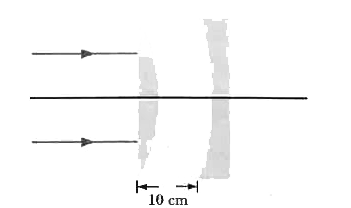
|
|
| 22. |
Consider the circuit given below Chose the sketch depicting the output Y of this circuit having inputs A and B as given below |
|
Answer»
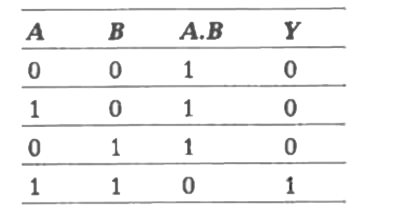 From 0 to `t _(1),` `A =1 , B =I, so Y =1` From `t_(1)` to `t _(2)` `A = 0,B =0, so Y=0` From `t _(2) ` to `t _(3),` `A = 1,B=0, so Y=0` From `t_(3)` to `t_(4),` `A = 0, B=1, so Y=0` From `t _(4) ` to `t _(5),` `A =1, B=1, so Y=1` From`t _(5)` to `t _(6)` `A = 0,B =0 so Y=0` |
|
| 23. |
A galvanometer can withstand safely a maximum current of 5 mA. If is converted into voltmeter readding upto 20 V by connecting in series an external resistance of 3960 Omega. The resistance of galvanometer is |
|
Answer» `48Omega` |
|
| 24. |
In Young's double slit experimental set up, it the wavelength alone is doubled the band width beta becomes, |
|
Answer» `(BETA)/2` |
|
| 25. |
In p-n junction the width of space charge region is approximately ….. mum. |
|
Answer» 0.5 |
|
| 26. |
Two equal and opposite charges are placed at a certain distance apart and force of attraction between them is F. If 75% charge of one is transferred to another, then the force between the charges becomes |
|
Answer» `(7F)/(16)` (attraction) |
|
| 27. |
A rocket is fired vertically up from the ground and it ascends with a resultant acceleration of 10 m//s^(2). The fuel of the rocket is finished 1 minute after firing. The velocity (v) versus height (h) graph for entire journey is: (g = 10 m//s^(2)) |
|
Answer»
`bar(BC) = ((600) (600))/(20) = 18km, bar(AC) = 36km`  `v^(2) = {{:(+0.02h, 0 le H le 18km),(-0.02(h-36), 18km le h le 36km),(+0.02 (36-h), 36km ge h ge 0km):}` |
|
| 28. |
Find the position of 1cm tall object which is plced 8cm infront of a concave mirror of radius is curvature 24cm. |
|
Answer» SOLUTION :(a) `1/v+1/u=1/f` `1/v-1/8=-1/12impliesv=24cm` |
|
| 29. |
The distance of 10th dark band from the centre of interference pattern is 28.5 mm. The band width is : |
|
Answer» 3.5 mm |
|
| 30. |
{:(MnO_(2)+KOH+O_(2)rarrunderset(("green"))(A)+H_(2)O),(A+Cl_(2)rarrunderset(("purple"))(B)+KCl):} Select correct statement:- |
|
Answer» compound B is cloured due to change transfer and it is paramagnetic in nature. |
|
| 31. |
A circular region in an xy plane is penetrated by a uniform magnetic field in the positive direction of the z axis. The field's magnitude B (in teslas) increases with time t (in seconds) according to B = at, where a is a constant. The magnitude E of the electric field set up by that increase in the magnetic field is given by Fig. 30-52 versus radial distance r, the vertical axis scale is set by E_(s) = 310 μN//C, and the horizontal axis scale is set by r_(s) = 4.00 cm. Find a. |
| Answer» SOLUTION :0.031 T is | |
| 32. |
In the legume seed, food is stored in |
|
Answer» Cotyledons |
|
| 33. |
How does the power of a convex lens vary, if the incident red light is replaced by violet light ? |
| Answer» Solution :The power of GIVEN CONVEX lens increases on account of the fact that `f_(V) lt f_(R)` | |
| 34. |
Which of the following cannot be obtained from an IC? |
|
Answer» Resistor |
|
| 35. |
How will the radioactivity of a cobalt specimen change in two years? The half-life is 5.2 years. |
|
Answer» `Q=-(dN)/(dt)lamdaN`. The ratio of the activities is `x=Q_(2)/Q_(1)=N_(2)/N_(1)=E^(-lamda(t_(2)-t_(1)))=2^(-(t_(2)-t_(1))/T)` Knowing the half-life, we can easily compute the DECREASE in the activity. |
|
| 36. |
When forces F_(1),F_(2),F_(3) are acting on a particle of mass m such that F_(1) and F_(2) are mutually perpendicular, then the particle remains stationary, If the force F, is now removed then acceleration of the particle is |
| Answer» Answer :A | |
| 37. |
Four wires made of same material have different lengths and radii, the wire having more resistance in the following case is |
|
Answer» `L = 100 CM, r = 1 MM ` |
|
| 38. |
A glass rod of length l moves with velocity v in a uniform magnetic field B. What is the e.m.f induced in the rod? |
| Answer» SOLUTION :GLASS is an INSULATOR So, no INDUCED e.m.f will be SET up | |
| 39. |
A Diwali rocket is ejecting 0.05 kg of gases per second at a velocity of 200 m/s. The accelerating force on the rocket is : |
| Answer» Answer :A | |
| 40. |
A monoatomic gas is heated at constant pressure: What is the percentage of total heat used for doing external work? |
| Answer» ANSWER :B | |
| 41. |
Which of the following is solid ? |
|
Answer» Sugar |
|
| 42. |
Two nearby points are at the same potential. What is the intensity of electric field in this region? |
| Answer» SOLUTION :E = -d/dr where dV is CHANGE in potential for DISPLACEMENT dr. SINCE there is no change in potential, dV/dr = 0. Hence, electric intensity in the region is zero. | |
| 43. |
A capacitor and a resistor are connected in series with an a.c. source. If the potential difference across C, R are 120 V, 90 V, respectively and if the rms current of the circuit is 3 A, calculate the (i) impedance, (ii) power factor of the circuit. |
|
Answer» Solution :Here, `V_(C) = 120 V` and `V_(R) = 90 V` and `I_(rms) = 3A` (i) VOLTAGE across R-C circuit `V_(rms) = SQRT(V_(C)^(2)+V_(R)^(2)) = sqrt((120)^(2) + (90)^(2)) = 150 V` `therefore` IMPEDANCE `Z = V_(rms)/I_(rms) = (150 V)/(3 A) = 50 Omega` (ii) Resistance of the circuit `R = V_(R)/I_(rms) = (90V)/(3 A) = 30 Omega` `therefore` Power factor `cos phi = R/Z = 30/50 = 0.60` |
|
| 44. |
If C is the speed of electromagnetic waves in vacuum, it's speed v in a medium of dielectric constant K and relative permeability mu is: |
|
Answer» `V=(1)/SQRT(MU,k)` |
|
| 45. |
In an a.c. circuit, instantaneous voltage and current are V = 200 sin 300 t "volt" and i = 8 cos 300t ampere respectively. What is the average power dissipated in the circuit? |
|
Answer» Solution :As the PHASE DIFFERENCE between current and voltage is `pi/2`. `THEREFORE P_("av") = I_("VEV") COS. (pi)/(2) =0` |
|
| 46. |
If 8 identical charges of -g each are placed at the eight corners of a cube of side b, then electrostatic potential energy of a charge +q_0 placed at the centre of the cube will be |
|
Answer» `(8 sqrt 2 Q q_0)/(4pi epsi_0b)` ` :.` Potential energy `u = 8[((-q)(q_0))/(4piepsi_0 r)] = -(4qq_0)/(sqrt3pi epsi_0b)` |
|
| 47. |
(a) Distinguish between sinusoidal and pulse shaped signals. (b) Explain, showing graphically, how a sinusoidal carrier wave is superimposed on a modulating signal to obtain the resultant amplitude modulated (AM) wave. |
|
Answer» Solution :(a) In the process of modulation, some specific characteristics of the carrier wave is varied in accordance with the information or message signal. The carrier wave may be: (i) Continuous (sinusoidal) wave, or (ii) Pulse, which is discontinuous. A continuous sinusoidal carrier wave can be expressed as `E= E_0 sin ( omegat + phi)` . Three distinct characteristics of such a wave are amplitude `(E_0)`, angular frequency `(omega)` and phase angle `(phi)`. Any one of these three characteristics can be varied in accordance with the modulating baseband (AF) signal, giving RISE to the respective amplitude modulation, frequency modulation and phase modulation. Again, the significant characteristics of a pulse are pulse amplitude, pulse duration or pulse width and pulse position (representing the TIME of rise or fall of the pulse amplitude). Any one of these characteristics can be varied in accordance with the modulating baseband (AF) signal, giving rise to the respective, pulse amplitude modulation (PAM), pulse duration modulation (PDM) or pulse width modulation (PWM) and pulse position modulation (PPM). (b) Amplitude Modulation : When a modulating AF wave is superimposed on a high frequency carrier wave in a manner that the frequency of modulated wave is same as that of the carrier wave, but its amplitude is made proportional to the instantaneous amplitude of the audio frequency modulating voltage, the process is called amplitude modulation (AM). LET the instantaneous carrier voltage `(e_c)` and modulating voltage `(e_m)` be represented by on. `e_c =E_c sin omega_c t` ....... (i) `e_m=E_m sin omega_m t `........ (ii)` Thus , in amplitude modulation , amplitude A of modulated waveis made proportional to the instantaneous modulatingvoltage ` e_m` i.e., `A= E_C + ke_m` ......... (iii) where k is a constant of proportionality . In amplitude modulation , the proportionality constant k is made equal to unity . Therefore , maximum positive amplitude of AM wave is give by `A = E_c + e_m = E_c + E_m sin omega_m t ` ... (iv) Itr is called top envelope . The maximum negative amplitude of AM wave is given by `-A = -E_c -e_m` `=-(E_c + E_m sin omega_m t)`........... (v) This is called BOTTOM envelope. 
|
|
| 48. |
In figure when key is pressed the ammeter A reads i ampere . The charge passing in the galvanometer circuit of total resistance R is Q . The mutual inductance of the two coils is |
|
Answer» Q/R |
|
| 49. |
What are the Cartesian sign conventions for aspherical mirror? |
|
Answer» Solution :(i) The incident light is taken from left to RIGHT (i.e. objecton theleft to mirror). (ii) All the distances are measured from the pole of the mirror (pole is takenasorigin). (iii) The distances measured to the right of pole along the principal axis are taken as positive. (iv) The distances measured to left of pole along the principal asix are taken as negative. (v) Heights measured in the UPWARD perpendicular direction to THEPRINCIPAL axis are takenas positive. (vi) Heights measured in the DOWNWARD perpendicular direction to the principal axis, are taken as negative. |
|
| 50. |
A series LCR circuit is connected to an AC source of voltage v and angular frequency Omega.When only the capacitor is removed the current lags behind the voltage by a phase angle'phi' and when only the inductor is removed the current leads the voltage by the same phase angle. Find the current flowing and the average power dissipated in the LCR circuit. |
|
Answer» <P> Solution :`tan phi = (X_(L) - X_(C)) = (omegaL - 91)/((omega C)/(R ))`when CAPACITOR is removed `tan phi = (omega L)/(R )` when inductor is removed `tan phi = ((-1)/(omega C))/(R )` -ve SIGN indicates that current leads the voltage `:. omega L = (1)/(omega C)` `omega = (1)/(sqrt(LC))` `rArr LCR` circuit is in resonance, `i_(rms) = (V_(rms))/(R )` `P_(AV) = V_(rms)i_(rms)` `= V_(rms)^(2)//R` |
|