

Saved Bookmarks
This section includes 7 InterviewSolutions, each offering curated multiple-choice questions to sharpen your Current Affairs knowledge and support exam preparation. Choose a topic below to get started.
| 1. |
A sphere S_1of radius r enclose a total chargeQ. If there is another concentric sphereS_2 of radius r_2 (gtr_1)and there be no additioanl charges between S_1 and S_2 find the ratio of electric flux through S_1 and S_2 |
| Answer» SOLUTION :`(phi_2)/(phi_1) =(q_1//in_0)/(q_2//in_0)=(q_1)/(q_2) =(Q)/(Q)= 1.`[since charge WITHIN both SPHERES is same =Q ] | |
| 2. |
Why do the electrostatic field lines not form closed loops? |
| Answer» SOLUTION :ELECTROSTATIC FIELD LINES cannot form closed LOOPS because electrostatic field is a conservative field. | |
| 3. |
In a Zener regulated power supply a Zener diode with V_(Z)=6.0V is used for regulation. The load current is to be 4.0 mA and the unregulated input is 10.0V. What should be the value of series resistor R_(S)? |
|
Answer» Solution :For a good load regulation, the current FLOW through the zener diodemust be larger than the current flow `I_(L)` through the load resistance `R_(S)`. Suppose `I_(Z)=5I_(L) and I_(L)=4mA`, so `I_(Z)=5xx4=20mA` hence TOTAL current through `R_(S)` is,  `I_(S)=I_(Z)+I_(L)` `=20+4` `therefore I_(S)=24mA` `rArr `Voltage drop across `R_(S)`. `DeltaV_(S)=V_(L)-V_(Z)` `=10-6` `=4V` `rArr ` Resistance `R_(S)=(DeltaV_(S))/(I_(S))=(4)/(24xx10^(-3))` `therefore R_(S)=166.66Omega` `therefore R_(S) ~~167Omega` `rArr` The value of the carbon resistance `150Omega` is closest to 167`Omega`. So, series resistance of 150`Omega` is appropriate. `rArr` Note that slight variation of the value of the resistor does not MATTER, but the current `I_(Z)` should be sufficiently larger than `I_(L)`. |
|
| 4. |
In the figure shown, mass of the plank is m and that of the solid cylinder is 8m. Springs are light. The plank is slightly displaced from equilibrium and then released. Find the period of small oscillations (in seconds) of the plank. There is no slipping at any contact point. The ratio of the mass of the plank adn stiffness of the spring i.e., (m)/(K) = (2)/(pi^(2)) |
Answer» Solution :If the plank is displaced SLIGHTLY by x towards left, then  `2Kx - f_(1) = m a_(2)` …(i) `f_(1) + f_(2) = 8 m a_(1)` …(II) `tau_(CM) = l_(cm) ALPHA` 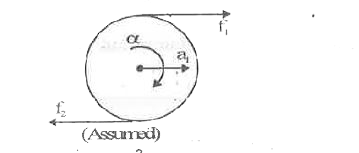 or `(f_(1) + f_(2))R = ((8m) R^(2))/(2) alpha` `(f_(1) + f_(2)) = ((8m) a_(1))/(2)` ...(iii) From (ii) and (iii), `2f_(1) = (8m) xx (3a_(1))/(2)` or `f_(1) = (8m) xx (3a_(1))/(4)` and `f_(2) = - 2 ma_(1)` Hence `f_(2)` will be in forward direction. Also, for no slipping, at the point of contant between plank and cylinder `2a_(1) = a_(2)` ...(iv) `f_(1) = (8m) xx ((3a_(2))/(8)) = (3m) a_(2)` ...(v) from (i) and (v) `2Kx - (3m) a_(2) = m a_(2)` `a_(2) = (2K)/(4m)x` or `((-d^(2)x)/(dt^(2))) = ((2K)/(4m))x` or `(d^(2)x)/(dt^(2)) = - ((2)/(4) xx (pi^(2))/(2)) x` `or omega^(2) =(pi^(2))/(4)` or `omega =(pi)/(2)` or `(2pi)/(T) = (pi)/(2)` or T = 4 seconds. |
|
| 5. |
Even though electric flux is a scalar quantity, we consider the flux flowering out of a surface as positive and flux entering into the surface as negative. Keeping this fact in min answer the following question. The total electric flux through a Gaussian surface is zero when there is a charge outside the surface. Why is it so when the charge produces electric field? |
| Answer» SOLUTION :The electric field will always be along the direction AWAY from the CHARGE (assumed POSITIVE). But the flux will have both positive and NEGATIVE values with equal magnitudes. Hence total flux will be zero for charge outside the closed surface. | |
| 6. |
An FMtransmission has a frequencydeviationof 18.75 KHz. Calcualte presentpresent modulation ifit is broadcast in 88- 108 MHz band. |
|
Answer» `37.5%` Perecnt modulation`m=Deltaf xx 100` `= (18.75)/(75)xx100` `=25%` As maximum devation of 75 KHz is allowed forFM b |
|
| 7. |
The transmission of heat by conduction is |
|
Answer» a reversible process |
|
| 8. |
(A): X-rays can penetrate through the flesh but not through the bones. (R): The penetrating power of X-rays depends on voltage. |
|
Answer» Both .A. and .R. are TRUE and .R. is the correct EXPLANATION of .A. |
|
| 9. |
An elastic ball is dropped from a height of 100 m. Due to the earth,20% of the energy is lost. To what height the ball will rise ? |
|
Answer» Solution :After REBOUND the energy possessed by the ball =(80/100)xxmgh=80/100xxmgxx100 (because the ball LOSES`20%` of its energy after collision with each)If the ball after collision RISES to height h then mgh=`80//100xxmgxx100 `therefore h=80m |
|
| 10. |
Which is bigger unit J or eV? Justify for your answer. |
| Answer» SOLUTION :Joule is BIGGER UNIT, `[1J = 6.25 X 10^15]` eV | |
| 11. |
In the circuit of figure, the battery emf is g the resitance is R and the capacitance is C. The switch S is closed for a long time interval, and zero potential difference is measured across the capacitor After the switch is opened. the potential difference across the capacitor reaches a maximum value of DeltaV. What is the value of the inductance? |
|
Answer» `(C(DeltaV)^(2))/(2epsi^(2))` |
|
| 12. |
The waves associated with matter is called matter waves Let lambda_e and lambda_p be the de Broglie wavelength associated with electron and proton respectively. If they are accerated by same potential then, lambda_e>lambda_p |
|
Answer» `lambda_egtlambda_p` |
|
| 13. |
Find the density of nuclear mass in ""_(92)^(238)U. Given R_0 = 1.5 fermi and mass of each nucleon is 1.67 xx 10^(-27) kg. |
|
Answer» |
|
| 14. |
Mention two observations of Geiger- Marsden's experiment on scattering of alpha particles . |
|
Answer» Solution :1.Most of the alpha - PARTICLES pass straight through the GOLD FOIL. 2.Only 0.14% of incident `alpha`-particles scatter by more than `1^@` 3.About ONE in 8000 of the `alpha`-particles is DEFLECTED by more than `90^@`. |
|
| 15. |
(A) : Silicon is preferred to germanium while constructing zener diodes (R): Thermal stability and current compatibility of silicon is high when compared to those of germanium. |
|
Answer» Both 'A' and 'R' are TRUE and 'R' is the correct explanation of 'A' |
|
| 16. |
A wire of uniform cross-section is stretched berween two points I w apart. The wire is fixed at one end und u weight of 9 kg is hung over a pulley at the other end produces fundamental frequency of 750 Hz. (a) What is the velocity of transverse waves propagating in the wire ? (b) If now the suspended weight is submerged in a liquid of density (5/9) that of the weight, what will be the velocity and frequency of the waves propagating along the wire ? |
|
Answer» Solution :In case of FUNDAMENTAL vibration of string `(lambda//2)=L.i.e, lambda=2xx1=2m` Now as `v=F lambda and f=750 HZ`, `V_(T)=2xx750=1500 m//s` (b) Now as in case of a wire under tension `v= sqrt((T)/(mu))` `V_(B)=1500 sqrt((T_(B))/(T_(A))) (or) 1500 sqrt((g[1-sigma//rho])/(g)=1000 m//s` so from `v=f lambda, f_(B)=(V_(B))/(lambda_(B))=(1000)/(2)=500 Hz i.e`, In this situation `lambda=2m, f=500 Hz and v=1000 m//s` 
|
|
| 17. |
A particle has an initial velocity 3hati+3hatj and cceleration of 0.41hati+0.3hatj. Its speed after 10s is |
|
Answer» 10 UNITS |
|
| 18. |
If units of length, mass and force are chosen as fundamental units, the dimensions of time would be : |
|
Answer» `M^(1//2)L^(-1//2)F^(1//2)` |
|
| 19. |
What are electromagnetic waves? |
| Answer» SOLUTION :Electromagnetic waves are non-mechanical waves which move with SPEED equals to the speed of light (in VACUUM). | |
| 20. |
Magnetic susceptibility of vacuum is … |
|
Answer» `0` |
|
| 21. |
Figure shows a potentiometer circuit for comparison of tworesistances. The balance point with a standard resistor R = 10.0 Ωis found to be 58.3 cm, while that with the unknown resistance X is68.5 cm. Determine the value of X. What might you do if you failedto find a balance point with the given cell of emf ε ? |
|
Answer» SOLUTION :Resistance of the standard resistor, `R = 10.0 Omega` Balance point for this resistance, `l_(1)=58.3` cm Current in the potentiometer wire `= l` Hence, potential drio across `R, E_(1)=iR` Resistance of the unknown resistor = X Balance point for this resistor, `I_(2)= 68.5` cm Hence, potential drop across `X, E_(2)= iX` The relation connecting emf and balance point is, `(E_(1))/(E_(2))=(l_(1))/(l_(2))` `(iR)/(iX) = (l_(1))/(l_(2))` `(iR)/(iX)=(l_(1))/(l_(2))` `X = (l_(1))/(l_(2))xxR` `= (68.5)/(58.3) XX 10 = 11.789 Omega` THEREFORE, the VALUE of the unknown resistance, X, is `11.75 Omega` If we fall to find a balance point with the given cell emf `epsilon`, then the potential drop across R and X MUST be reduced by putting a resistance in series with it. Only if the potential drop across R or X is smaller than the potential drop across the potentiometer wire AB, a balance point is obtained. |
|
| 22. |
In Davisson-Germer experiment ,deflection of galvanometer is……proportional to intensity of electron beam entering to collector. |
|
Answer» directly |
|
| 23. |
Welders wear special goggles or face masks with glass windows to protect their eyes from electromagnetic radiations. Name the radiations and write the range of their frequency. |
|
Answer» Solution :Welders wear special GLASS goggles or face masks with glass windows to protect their eyes from large amount of ULTRAVIOLET rays PRODUCED by welding arcs. Frequency RANGE of ultraviolet radiation is from`7XX10^(14)Hz" to "5xx10^(17)Hz`. |
|
| 24. |
In the Bohr's model of hydrogen-like atom the force between the nucleus and the electron is modified as F=(e^(2))/(4piepsi_(0))((1)/(r^(2))+(beta)/(r^(3))), where beta is a constant. For this atom, the radius of the nth orbit in terms of the bohr radius (a_(0)=(epsi_(0)h^(2))/(mpie^(2))) is |
|
Answer» `r_(n)=a_(0)n-beta` From question, `F_(e)=(e^(2))/(4piepsi_(0))((1)/(r^(2))+(beta)/(r^(3)))`, where `beta`=constant 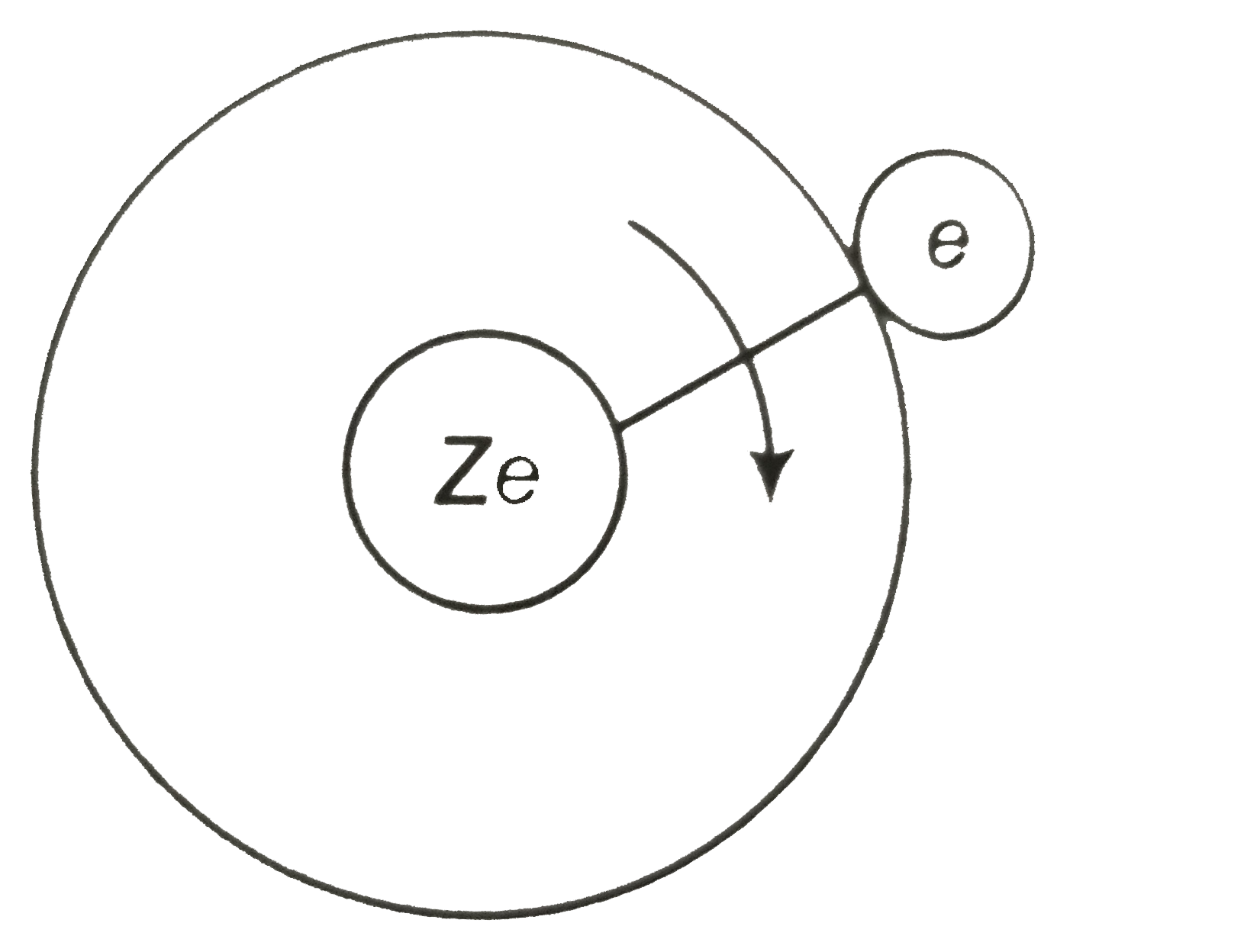 `F=(1)/(4piepsi_(0))(ZE^(2))/(r^(2))` We know that, `a_(n)=r_(n)=(epsi_(0)h^(2)n^(2))/(Zmpie^(2))` `a_(0)=r_(0)=(epsi_(0)h^(2))/(Zmpie^(2))` `therefore r_(n)=a_(n)n^(2)` As, we consider the nth electron which is attracted by nucleus while itself is repelled by the electron of inner shell to the consider shell. |
|
| 25. |
The intensity of central fringe in the interference pattern produced by two identical slits is I. When one of the slits is closed then the intensity at the same points is I_(0). The relation between I and I_(0) is |
|
Answer» `I= 4I_(0)` |
|
| 26. |
Calculate binding energy per nucleon of deuteron whosemass is 2.013554 a.m.u. Take mass of proton and neutron as 1.007825 a.m.u. and 1.008665 a.m.u. respectively and 1 a.m.u. =931 M eV. |
|
Answer» `=[1.007825+1.008665-2.013554]` a.m.u. `=[2.01649-2.013554]` a.m.u. `=0.002936 XX 931=2.733` M eV `:.` Binding ENERGY of DEUTERON `=0.002936xx931=2.733` M eV `:.` Binding energy PER nucleon of deuteron `=(2.733)/(2)=1.36` M eV |
|
| 27. |
A man standing symertrically between parallel cliffs,claps his hands and hearing a series of echoes at intervals of s if speed of sound in air is 340 m/s then the distance between two parallel cliffs is : |
|
Answer» 340 m x= `(v)/(2) = (340)/(2) = 170 `m. `THEREFORE` distance between two CLIFFS = `2XX 170 = 340 `m. Hence the correct CHOICE is (a). 
|
|
| 28. |
Quark composition of neutron is …………….. |
|
Answer» uuu |
|
| 29. |
Consider a strong connected At both ends with rigid wall (Fig. 16-36). Find the second longest resonance wave length for which 3/8 is an antinode. |
|
Answer» Solution :If we use normal frequencies for string with both rigid ends we can solve this problem simply by trial and error. We can consider rope of length 31/8 with one end rigid and one end free. Also, we can consider a rope of length I with both ends rigid. The frequencies which SATISFY both equations SIMULTANEOUSLY are the required frequencies. Calculations. All possible frequencies which will satisfy condition of both ends rigid: `f_(1)=m/(2F) sqrt(T/mu)` All possible frequencies which will satisfy condition of rope of length 3/8 with one end rigid and one end free : `f_(2)=(2n+1)/(4(3!//8)) sqrt(T/mu)` Only those vibrations will have resonance which satisfy `f_(1)=f_(2)`, so `(2n+1)/(4(3//8)) sqrt(T/mu) =f= (m)/(2f) sqrt((T)/(mu))` Therefore `8n+4=3m` 3m-8n=4 `m""n` `4"1"` `"124"` `"207"` The second row has the second lowest frequency, hence second largest WAVELENGTH. Therefore, on substituting value, `lambda=6t`. We can verify the answer by checking for the above value that results, in satisfying both the conditions. |
|
| 30. |
Which of the following figure represents an ideal diode characteristics? |
|
Answer»
|
|
| 31. |
A monkey weighing 10 kg climbing up a light rope and frictionless pulley attached to 15 kg mass at other end as in figure. In order to raise the 15 kg mass off the ground the monkey must climb-up |
|
Answer» with constant ACCELERATION g/3. |
|
| 32. |
A uniform rod of mass m and length L is at rest on a smooth horizontal surface. A ball of mass m, moving with velocity v_0, hits the rod perpendicularly at its one end and sticks to it. The angular velocity of rod after collision is |
|
Answer» `(6 v_0)/(5 L)` |
|
| 33. |
Two long parallel wires are separated by a distance of 8 cm carry electric currents of 3A and 5A. The distance of null point from the conductor carrying larger current when currents are flowing in the same direction is |
|
Answer» 3cm |
|
| 34. |
Two polarizing sheets are placed together with their transmission axes crossed so that no light is transmitted. A third sheet is inserted between them with its transmission axis at an angle of 45^@with respect to each of the other axes. Find the fraction of incident unpolarized light intensity transmitted by the three sheet combination. |
| Answer» SOLUTION :`(1/8)` | |
| 35. |
Two particles are projected from the same point with the same speed at differen angles theta_(1) and theta_(2) to the horizontal. If their respective times of flights are T_(1) and T_(2) and horizontal ranges are same then. (a) theta_(1)+theta_(2)=90^(@) "" (b) T_(1)=T_(2) tan theta_(1) (c) T_(1)=T_(2) tan theta_(2) "" (d) T_(1) sin theta_(2)= T_(2) sin theta_(1) |
|
Answer» a, B, d are correc |
|
| 36. |
A parallel plate capacitor has a capacitance of 50 muF in air and 100 muF when immersed in an oil. The dielectric constant k of the oil is: |
|
Answer» 0.45 |
|
| 37. |
The ratio of contributions made by the electric field and magnetic field components to the intensity of an e.m. wave is |
|
Answer» `c:1` |
|
| 38. |
What is the technique of coating mirrors ? |
|
Answer» Solution :The technique of coating mirrors was developed by Justus Von Liebig in 1835. A compound of silver and ammonia is poured on the glass SURFACE. A reducing agent like formaldehyde is added to reduce the compound to metallic silver. To avoid using a chemical reaction, mirror is often placed in a sealed chamber which is evacuated. A silver rod is heated in the sealed chamber till it evaporates.The silver vapours cover the mirror slowly. In the same way, mirrors can also be covered with aluminium. Telescope mirrors are COATED only on the front. House hold mirrors are coated on the back. Furhter, aluminium coating reflectsabout `92%` of blue light and `90%` of green and red light striking it. Silver coating reflects `97%` of blue light and `99%` of green and red light striking it. THEREFORE, reflections from aluminium coating are tinted slightly bluish, and reflections from silver coating are tinted slightly REDDISH. |
|
| 39. |
(a) State the principle on which the working of an optical fibre is based. (b) What are the necessary conditions for this phenomenon to occur ? |
|
Answer» SOLUTION :(a) WORKING of an optical fibre is based on the principle of total internal REFLECTION of light. When a signal in the form of light is DIRECTED at one end of the fibre at a SUITABLE angle, it undergoes repeated total internal reflections along the length of the fibre and finally comes out at the other end. (b) N/A |
|
| 40. |
The height of the Antenna a) limits the population covered by the transmission b) limits the ground wave propagation c) effectively used in line communication of sight communication |
| Answer» Answer :D | |
| 41. |
In the cyclotron, as radius of the circular path of the charged particle increase (omega = angular velocity, v = linear velocity) |
|
Answer» Both `OMEGA and upsilon` INCREASE |
|
| 42. |
The force between two charges 0.06m apart is 5N. If each charge is moved towards the other by 0.01m, then the force between them will become |
|
Answer» 170N |
|
| 43. |
A body of 5 kg hangs from a spring and oscillates with a time period of 2pi s. If the body is removed, the length of thespring will decrease by : |
|
Answer» `(k)/(g)` meter `:.""2pi=2pi sqrt((5)/(k))` `implies""k=5" NM"^(-1)`. Now F = KL. `implies""L=(F)/(k)=(5xx8)/(5)` l = g metre. Hence CORRECT choice is (b). |
|
| 44. |
State the conditions of maximum and minimum sum of two vectors. |
| Answer» SOLUTION :The SUM of two vectors is maximum when they are parallel and minimum when they are ANTIPARALLEL. | |
| 45. |
If the focal length of the lens is 20 cm, find the distance of the image from the lens in the following figure? |
|
Answer» Solution :According to figure, the point on the right side on the lens of which rays CONVERGE will behave as VIRTUAL object at the lens. `THEREFORE u=+12 cm,f=20 cm` By lens FORMULA,`1/f=1/v-1/u` `therefore 1/20=1/v-1/12` or `1/v=1/20+1/12=(3+5)/60=8/60` or `v=60/8`=7.5 cm so, image will be FORMED on same side of the virtual object at a distance of 7.5 cm from the lens. |
|
| 46. |
Unit of wave number is |
|
Answer» Hz |
|
| 47. |
A copper rod of mass m rests on two horizontal rails distance L apart and carries a current of I from one rail to the other. The coefficient of static friction between rod and rails is mu_(s) What are the (a) magnitude and (b) angle (relative to the vertical) of the smallest magnetic field that puts the rod on the verge of sliding? |
|
Answer» |
|
| 48. |
A dip circle is placed in magnetic meridian then the magnetic needle will align |
|
Answer» Horizontally |
|
| 49. |
A compound microscope has objective of focal length 3.2 mm and eyepiece of 12 mm focal length. If the objective forms image of the object 16 cm beyond its pole, then total magnification achieved is |
|
Answer» `1040x` |
|
| 50. |
A welder wears a mask. Give reason. |
| Answer» Solution :The FILTER in the mask absorbs ULTRAVIOLET radiations produced by the WELDING are. This radiation is DANGEROUS for the eyes. | |


