

Saved Bookmarks
This section includes 7 InterviewSolutions, each offering curated multiple-choice questions to sharpen your Current Affairs knowledge and support exam preparation. Choose a topic below to get started.
| 1. |
A particle falls from a height 'h' upon a fixed horizontal plane and rebounds. If 'e' is the coefficient of restitution the total distance travelled before rebounding has stopped is : |
|
Answer» `h((1+e^2)/(1-e^2))` `S=h+2e^2h+2e^4h+2e^6h+` or`S=h+2e^2h[1+e^2+e^4+e^6+…]` This GIVES infinite G.P. with common ratio `e^2`. `S=h+2e^h[(1)/(1-e^2)]=h[1+(2e^2)/(1-e^2)]` =`h[(1+e^2)/(1-e^2)]`. |
|
| 2. |
The distance between a slit and a biprism of acute angle 2^(@) is 10cm. Find the fringe width and the width of the entire band when observation is made on a screen at a distance of 90 cm from the biprism. The refractive index of the material of the biprism is 1.5 and lambda = 5890Å. |
|
Answer» |
|
| 3. |
What will be the top priority in the developmental goal of a landless labourer? |
|
Answer» Expansion of RURAL banking |
|
| 4. |
What is the relation between length and power of a lens ? |
| Answer» SOLUTION :power of LENS P=1/F(METER) (Diopter) or,p=100/f D when f is in CM. | |
| 5. |
Two consecutives harmonics of air colomn in a pipe closed at one end are of frequencies 150Hz. And 250Hz. Calculate the fundamental frequency- |
|
Answer» 50Hz |
|
| 6. |
As you have learnt in the text, the principle of linear superposition of wave displacement is basic to understanding intensity distributions in diffraction and interference patterns. What is the justification of this principle ? |
| Answer» Solution :The principle of LINEAR superposition of wave displacement is basic to understand intensity distributions in interference as well as diffraction patterns. The superposition principle follows from the linear CHARACTER of the differential equation of wave motion. if `y_(1) and y_(2)` are two possible solutions of a wave equation, then any linear combination of `y_(1) and y_(2)` is also a solution of that very wave equation. THEREFORE, we are fully JUSTIFIED in APPLYING the superposition principle to find intensity distributions in diffraction as well as interference patterns obtained due to superposition of waves. | |
| 7. |
A 100 Omega resistor is connected to a 200V, 50 Hz ac supply. (a) What is the rms value of current in the circuit ? (b) What is the net power consumedover a fully cycle ? |
|
Answer» SOLUTION :(a) `I_(rms) = ( V_(rms)) /( |Z|)` `= ( V_(rms))/( R ) ( :. ` Here `|Z |= R )` `= ( 220)/( 100)` `= 2.2 A` (b) `P = ( V_(rms)^(2))/ (R )` ( For purely RESISTIVE AC CIRCUIT ) `((220)^(2))/( 100)` `:. P = 484 W` |
|
| 8. |
TwocarsC_1and C_2movingin thesamedirectionon astraightroadwithvelocities12 m/sand 10 m/srespectively. Whenthe separation betweenthe two is200 m C_2startedacceleratingto avoidcollisionswhatis theminimumaccelerationof car C_2so thattheydon'tcollide . |
|
Answer» Solution :Byrelative ` veca _(C_1C_2)= veca_(C_1) - veca_(C_2) =0-a =(-a)` ` vecV_(C_1C_2)= vecV_(c_1) - vecV_(c_2) = 12- 10 =2 m//s ` so byrelativitywe want thecarto stop . ` thereforeV^2 - u^2= 2AS ` `implies0-2^2=- 2 xxa xx 200` `impliesa =1/100m//s^2= 0.1m//s^2= 1 CM //s^2` ` therefore ` Minimumacceelerationneededby CAR`C_2 =1 cm //s^2` |
|
| 9. |
Two short electric dipoles are placed as shown. The energy of electric interaction these dipoles will be |
|
Answer» <P>`(2kp_(1)p_(2)costheta)/(R^(3))` |
|
| 10. |
A thin converging lens has a focal length 'f' in air. If it is completely immersed in a liquid, briefly explain, how the focal length of the lens will vary ? |
|
Answer» Solution :The focal length of a CONVERGING lens is given by: `1/f = (n/n_(m)-1) (1/R_(1)+1/R_(2))` where n = refractive index of lens and `n_(m)` =refracting index of the surrounding medium. Hence in AIR `1/f = (n-1) (1/R_(1) + 1/R_(2))` and in a given liquid medium `=1/f. = (n/n_(m)-1) (1/R_(1)+1/R_(2))` `f. = ((n-1)n_(m)f)/(n-n_(m))` Following two cases are important here : (i) If `n_(m) lt n`, then `f.`is +ve and has a value greater than f i.e., focal length of the lens increases when immersed in given liquid medium but even now the lens behaves as a converging lens. (ii) If `n_m GT n`, then f. is -ve i.e., the lens will BEGIN to behave as a diverging lens. |
|
| 11. |
If the height of TV transmitting antenna is increased its coverage increases. Why ? |
| Answer» SOLUTION :`d=SQRT(2Rh)` or `d PROP sqrt(H)` | |
| 12. |
A consider the situation in figure. The bottom of the pot is a reflecting plane mirror. F is a fish and B is a bird. (a) At what distance(s) from itself will the fish see the image (b) At what distance(s) from itself will the bird see theimage(s) of the fish? Take m_(wa) = 4/3 |
Answer» Solution :(a) For the FISH, the distance of bird from FREE surface is`(4h)/(3)`or 1.33 h, Distance of fish from the free surface = 0.5 h. So, the required distance is 1.83 h.  Again, effective distance of bird from themirror is nh + h or 2.33 h. So, distance of bird's image from mirror is 2.33 h. Distance from fish is 2.33 h +0.5 h i.e. 2.83 h. (b)For the bird, distance of fish from the freesurface is `(h)/(2n) " or " (h)/( 2 xx 4/3) " or "(3h)/(8) ` or 0.375 h Distance of fish from bird is 0.375 h + h i.e. 1.375 h. Again, distance of image of fish from mirror is ` h/2` Effective distance (for the bird) of the image of fish is the mirror is ` 1/n | (3h)/(2) | + h"i.e."3/4 xx (3h)/(2) + h " or " (9H)/(8) + h " or " (17h)/(8)` or 2.125 h . |
|
| 13. |
(a) State Biot - Savart law and ecpress it in the vector form.(b) Using Biot - Savart law, law obtain the expression for the magnetic field due to a circular coil of radius r, carrying a current I at point on its axis distant x from the centre of the coil. |
|
Answer» Solution :(a) According to Biot -Savart 's law , the magnetic field dB due to a current element `Ivec(dl)`such that , `dBpropI`. . . (i) `dBpropdl` . . . (ii) `dBpropsintheta` . . . (III) `dBprop(1)/(r^(2))`. . . (iv) 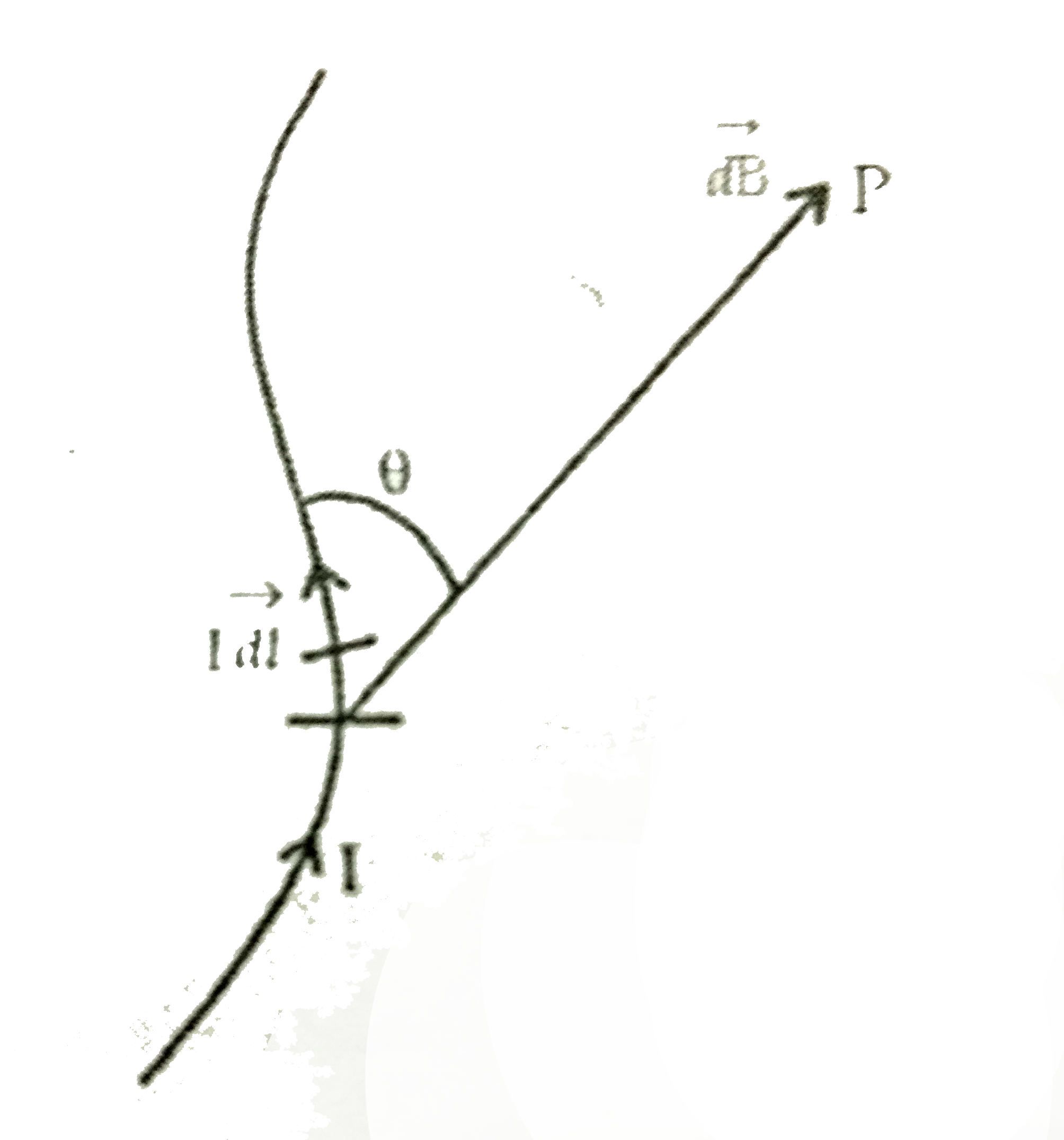 From equation (i) , (ii) , (iii) and (iv) ,`dBprop(Idlsintheta)/(r^(2))` `dBprop(KIdlsintheta)/(r^(2))` VALUEOF `K=(mu_(0))/(4pi)` `dB=(mu_(0))/(4pi)(Idlsintheta)/(r^(2))` Biot -Savart ' s law in vector FORM `vec(dB)=(mu_(0))/(4pi)(I(vecdlxxvecr))/(r^(3))` (b)Consider a circular coil ofradius r , CARRYING a current I . Plane of the coil is Y- Z Plane . Magnetic field due to a current carrying element is dB and due to M'N is dB'. According to Biot - Savart 's law , `|vecdB|=|vecdB'|=(mu_(0))/(4pi)(Idlsin90^(@))/(a^(2))=(mu_(0))/(4pi)(Idl)/(a^(2))` These fields MAY be resolved into components along X axis and Y axis .Component along X axis will be dB`sinphiand dB'sinphi`. Component along Y axis will be dB `cosphiand dB'cosphi`, they will be opposite in direction and cancelled out . I lence , net magnetic field at point P due to all the elements on the loop is given by 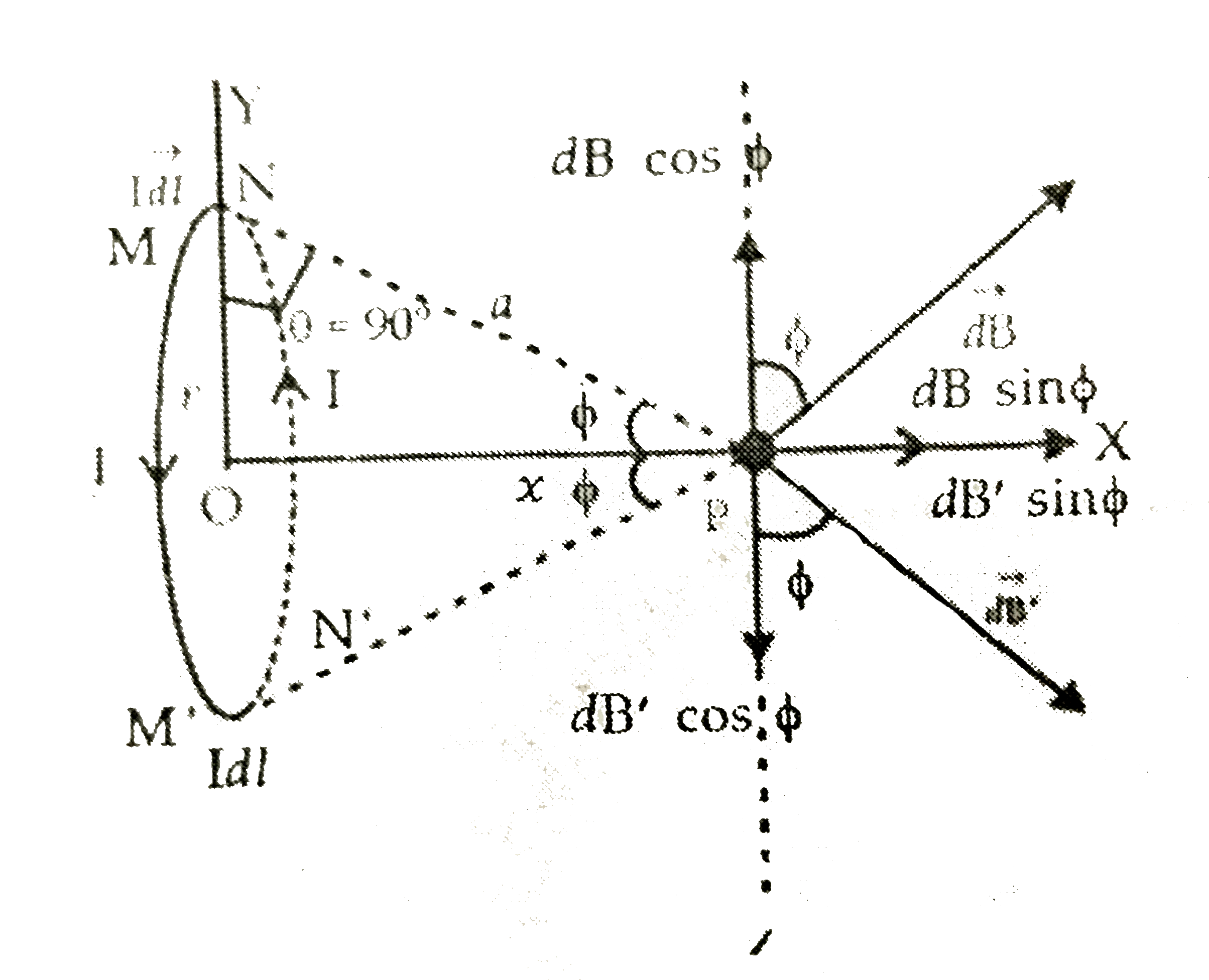 `B=intdBsinphi` Value of `dB=(mu_(0))/(4pi)(Idl)/(a^(2))andsinphi=(r)/(a)` `B=int_(0)^(2pir)(mu_(0))/(4pi)(Idl)/(a^(2))(r)/(a)` `B=(mu_(0))/(4pi)(I_(r))/(a^(3))int_(0)^(2pir)` `B=(mu_(0))/(4pi)(Ir)/(a^(3))(2pir)` `B=(mu_(0))/(4pi)(2pir^(2))/(a^(3))` `a=(r^(2)+x^(2))^(1//2)` `B=(mu_(0))/(4pi)(2pir^(2))/((r^(2)+x^(2))^(3//2))` |
|
| 14. |
An electric bulb is rated to give correct brightness at 24 V DC. It is connected to an AC source and its brightness is found to be one fourth of rated brightness. What is peak voltage across AC source ? |
|
Answer» `12 sqrt(2)` `(V^(2))/(R ) = (1)/(4) ((24^(2))/( R))` `implies V = 12 ` volts Peak voltage is `sqrt(2)` times the rms voltage . HENCE peak voltage across AC SUPPLY is `12SQRT(2)` volts. |
|
| 15. |
Let E_(n)=(-1-me^(4))/(8epsi_(0)^(2)n^(2)h^(2)) be the enrgy of the n^(th) level of H-atom if all the H-atoms are in the ground state and radiation of frequency (E_(2)-E_(1))//h falls. On it |
|
Answer» it will not be absorbed at all `E_(2).=E_(1)+hv :.E_(2).=E_(1)+h((E_(2)-E_(1))/(h))=E_(2)` Hence all such electrons go into n = 2 state i.e. first excited state. `rArr` Thus, OPTION (B) is correct. Here energy obtained from incident radiation `=E_(2)-E_(1)=-3.4-(-12.6)=10.2eV`which is not sufficient to take the electron into n = 3 state. Thus, none of given hydrogen atoms would go into n = 3 state. `rArr` Thus, option (D) is correct. |
|
| 16. |
If twomirrors are kept at 60^(@) to each other and a body is placed at the middle, then total number of images formed is |
|
Answer» SIX |
|
| 17. |
If particle mentioned below moves with same velocity which will have highest de-Broglie wavelength ? |
|
Answer» Neutron `lambda PROP (1)/(m)` Particle with LEAST mass will have maximum de-Broglie wavelength.Here ,`beta`-particle (ELECTRON) has least mass hence its de-Broglie wavelength will be maximum |
|
| 18. |
Coulomb's law for electrostatic force between two point charges and Newton's law for gravitational force between two stationary point masses, both have inverse-square dependence on the distance between the charges/masses. Compare the strength of these forces by determining the ratio of their magnitudes (i) for an electron and a proton and (ii) for two protons |
|
Answer» <P> Solution :(a) (i) The electricforce betweenan electron and a protonat a distancer APART iswhere the negativesign indicates that the force isattarctive the correspondinggravitationforce `F_(G)=-G(m_(p)m_(e))/(r_(3))` however it may be mentionedhere that the sign of the two forcesare differentof these forces between two protonsinside a nucleus are `f_(e )-230 N`the ratio of the two forces showsthat electricalforces are enormously stonger than thethe gravitationalforces using newton secondlaw of motionf=ma the acceleration that an electron will undergo is comparing this with the value of acceleration due to gravitywecan conclude that the effect of gravitationall field is negligible on the MOTION of electronunder the actionof coulomb force due ot a proton the valuefroacceleartionof the proton is `2.3xx10^(8)N//1.67 xx10^(27) kg =1.4 xx10^(19) m//s^(2)` |
|
| 19. |
For real numbers x and y, define xRy if and only if x-y+sqrt 2 is an irratinalnumber. Then the relation R is |
|
Answer» Reflexive |
|
| 20. |
A vessel has a small hole at the bottom. Its radius is 0.4 mm. The height to which water can be put inside the vessel without any leakage (Surface tension = 72 dyne/cm, g = 9.8 m//s^(2)) will be : |
|
Answer» 3·67 cm `h=(2T)/(RPG)=(2xx72)/(0.4xx10^(-1)xx1xx980)` h=3·67 cm HENCE the correct CHOICE is (a). |
|
| 21. |
A body starts sliding down from the top of an inclined plane at an angle theta with the horizontal direction. The first one third of the incline is smooth, the next one third has coefficient of friction mu/2 and the last one third has coefficient of friction mu. If the body comes to rest at the bottom of the plane then the value of mu is |
|
Answer» `(tantheta)/2` 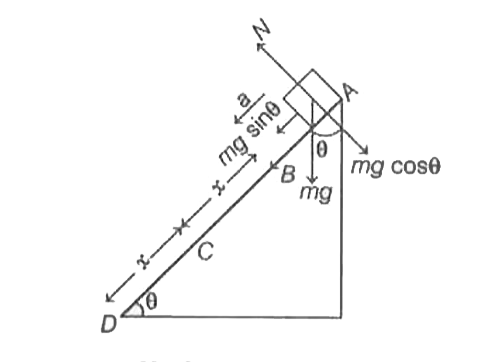 Let mass of body = m and AB= BC = CD = x [Given in AB, BC and CD plane coefficient of friction respectively 0, `mu/2 " and "mu`] For inclined plane AB, friction force, F = 0 So, the net force equation, `mgsintheta-0=ma` or `a=gsintheta` Here, from THIRD equation of the motion, `""v^(2)=u^(2)+2ax` or `""v^(2)=2 times gsintheta times x=2gxsintheta[because u=0]` For inclined plane BC, friction force, `F=(mu//2)mgcostheta` So, net force equation, `rArr mgsintheta-(mu//2)mgcostheta=ma^(.)` `rArr a^(.)=gsintheta-mu/2gcostheta` From third equation of the motion, `v^(2)=u^(2)+2a^(.)x` `rArr v^(2)=u^(2)+2a^(.)x ""[because " inthis case " u^(.)=v]` `rArr v^(2)=2gxsintheta+2(gsintheta-mu/2gcostheta)x` `""v^(2)=4gxsintheta-mugxcostheta` For inclined plane CD, friction force, `F=mumgcostheta` So, net force equation, `rArr mgsintheta-mumgcostheta=ma^(.)` `rArr a^(.)=gsintheta-mugcostheta` From third equation of the motion, `rArr v..=mu^(.)+2a^(.)x=mu^(.)+2a^(.)x ""(because mu^(.)=v^(.))` `rArr 0=4gxsintheta-mugxcostheta+2(gsintheta-mugcostheta)x` `rArr 0=6 gxsintheta=3mugx costheta rArr` 6gxsintheta=3ugxcostheta` `rArr mu=(6gxsintheta)/(3gxcostheta) rArr mu=2tantheta` |
|
| 22. |
In the following circuit, what are Pand Q? |
|
Answer» <P>P= 0, Q = 1 |
|
| 23. |
At any instant, the ratio of the amount of radioactive substance is 2: 1. If their half-lives be respectively 12 and 16 hours then after two days, what will be the ratio of the substances ? |
|
Answer» `1:1` |
|
| 24. |
Antenna is : |
|
Answer» INDUCTIVE |
|
| 25. |
A hydrogen atom initially in the ground level absorbs a photon, which excites it to the n = 4 level. Determine the wavelength andfrequency of photon. |
|
Answer» Solution :Energy of ELECTRON in `n^(th)` orbit of atom `E_(n) = - (13.6)/(n^(2))eV` `rArr`The energy of electron in ground state `E_(1)=-(13.6)/((1)^(2))eV [ :.` For ground state n=1] `:.E_(1)=-13.6eV` `rArr` Energy of electron in n=4 orbit, `E_(4)=-(13.6)/((4)^(2))eV` `=-(13.6)/(16)eV` `:.E_(4)=-0.85ev` `rArr` DIFFERENT in enegy of electron, `DeltaE=E_(4)-E_(1)` `=-0.85eV-(13.eV)` `=12.75 eV` br> `=12.75xx1.6xx10^(-19)J` `=20.4xx10^(-19)J` `rArr` Now, `DeltaE=hv` `:.v=(DeltaE)/(h)=(20.4xx10^(-19))/(6.625xx10^(-34))` `:.v=3.073xx10^(15)Hz` `rArr` , now `C= lambda v` `:. lambda (c)/(v)=(3xx10^(8))/(30.79xx10^(15))` `:. lambda=97.43xx10^(-9)=97.43 nm` |
|
| 26. |
The ground state of energy of hydrogen atom is -13.6 eV.What is the potential energy of the electron in this state? |
| Answer» Solution :`PE = 2 XX` Total ENERGY =`2 xx (-13.6) = - 27.2` eV | |
| 27. |
(a) Derive a relation between electric current and drift velocity of charge carriers. 9b) Deduce the expression for resistivty. (c) What is the effect of temperature on resistivity? |
Answer» Solution :Ohm.s law. It states that current flowing through a conductor is proportional to the potential difference across its two ends, PROVIDED to physical conditions (temperature, mechanical strain etc.) of the conductor remain unchanged. 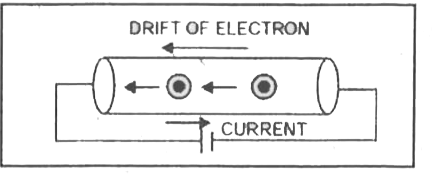 Drift velocity `(v_(d))` is the velocity of the free electrons with which they are drifted towards the positive terminal under the INFLUENCE of the external field. (a) Relation between electron current and drift velocity. CONSIDER that a wire of length l and area of cross-section A be subjected to an electric field of strength E. If V=Potential difference applied across the end of the wire, `therefore E=(V)/(l) or V=El` Let n=number of free electrons per unit volume of the conductor, `v_(d)=` Drift velocity of electrons `therefore` Charge flowing through the conductor wire=nA le Time taken by the electrons, `t=("Distance")/("Velocity")=(l)/(v_(d))` `therefore`Current, `I=("Charge")/("Time")=(nAl e)/((l)/(v_(d)))` `I=nv_(d)Ae`. . . (i) Since current density `J=(I)/(A)` So `J=nv_(d)e` this is the required relation between current and drift velocity. (b) Expression for Resistivity. According to Ohm.s law, `V=IR` or `V=(v_(d)nAe)R` `E=(V)/(l)=(v_(d)n eA)/(l)R` Force acting on each electron `eE=n e^(2)(AR)/(l)v_(d)` Acceleration under electric field`=(a=(eE)/(m))` `e(E)/(m)=((n e^(2))/(m))(AR)/(l)v_(d)`. .(ii) `therefore` Velocity acquired by the electron under the action of applied electric field is `therefore `Velocity acquired by the electron under the action of applied electric field is `v_(d)=(eE)/(m)tau` Where `tau`=relaxation time in which the electron is accelerated substituting `v_(d)` from above in equation (2), we have `(eE)/(m)=((n e^(2))/(m))(AR)/(l)xx(eE)/(m)tau` `therefore (AR)/(l)=(m)/(n e^(2))(1)/(tau)""[becauserho=(AR)/(l)]` `rho=(m)/(n e^(2))(1)/(tau)` This is the required expression for resistivity. (c) Variation of Resistivity with temperature Resistivity `rho=(m)/(n e^(2))(1)/(tau)` `thereforerhoprop(1)/(tau)` The resistivity varies with relaxation time. the relaxation time changes with collision. it will DECREASE with increase amplitude of vibration. since with the increase in temperature, the amplitude of vibration increases, relaxation time decreases and hence resistivity increases. In many metals, at room temperature resistivity increases with increase in temperature. at low temperature, resistivity increases at a higher power of T. this is shown in the figure. |
|
| 28. |
An amusement park ride called "The spinning Terror" is a large vertical drum which spins so fast that everyone stays pinned against the wall when the floor drops away the minimum |
|
Answer» angular velocity is `omega_("min")= sqrt((g)/(muR))` for everyone to stay INSIDE.  `mg=muN` `N=m omega_("min")^(2) r` ` rArr mg = mu MR omega_("min")^(2)` `rArr omega_("min")= sqrt((g)/(muR)) and v_("min")=omega_("min")xxR=sqrt((gR)/(mu))` |
|
| 29. |
Ifa circular piece of tin has a mea- Sured radius of 2.6 cm, tihen what is its circumference ? |
|
Answer» Solution :r=26 CM Circumferece of circular disc = 2pir `=2xx3.1428xx2.6` Here 2.6 has only 2 SIGNIFICANT digits. Hence in the above multiplication `pi` value should be written with 2+1 =3 significant figures. `pi = 3.1428 =3.14 ` Circumference =`2xx3.14xx2.6` =16.328 This is to be ROUNDED off to 2 significant digits. Circumference is 16cm. |
|
| 30. |
(a) State the postulates of Bohr's model of hydrogen atom and derive the expression for Bohr radius. (b) Find the ratio of the longest and the shortest wavelengths amongst the spectral lines of Balmer series in the spectrum of hydrogen atom. |
|
Answer» Solution :Bohr gave following three postulates for hydrogen atom: 1. An electron revolves round the nucleus in certain specifie circular motion in such a stationary ORBIT is provided by electrostatic force of attraction . Thus, `(mv_n^2)/(r_n)=1/(4piepsilon_0).e^(2)/r_(n)^2""...(i)` 2. For an orbit to be stationary (or non - radiating, the angular momentum of the electron must be an integer multiple of `h/(2pi)` , where h is the Planck.s constant. Thus, `L_(m)=mv_(n)r_(n)=(nh)/(2pi)""...(ii)` 3. Whenever an electron shifs from one of its specified non - radiating orbit to another such orbit, it emits/absorbs a PHOTON whose energy is equal to the initial and final states. Thus, `E_(i)-E_f=hv=(hc)/LAMDA""...(iii)` Form (i), we get `v_(n)^(2)=e^2/(4piepsilon_0mr_n)"".....(iv)` and from (ii) , we have `v_(n)=(nh)/(2pimr_n)""...(v)` Squaring (v) and then equating it with (iv) , we get `(n^2h^2)/(4pi^(2)m^(2)r_n^2)=e^2/(4piepsilon_(0)m.r_n)` `impliesr_n=(n^2h^2)/(4pi^(2)m^(2))xx(4piin_(0)m)/e^2=(in_0h^2)/(pime^2).n^2` In stable orbit of hydrogen atom n= 1 and then radius of 1st orbit is called Bohr.s radius `.a_0.` . Obviously `a_(0)=(in_(0)h^2)/(pime^2)`. Substituting values of various constants we find that `a_(0)= 5.29 xx10^(-11)m` (b) We know wavelength of various SPECTRAL lines of Balmer series is given by the relation `1/lamda=R[1/(2)^(2)-1/((n)^(2))]` where n = 3,4,5,6..... We obtain the longest wavelength when n = 3 and shortest wavelength when `n = oo` `implies1/(lamda_("longest"))=R[1/(2)^(2)-1/(oo)^2]=R/4` `implies(lamda_("longest"))/(lamda_("shortest"))=(R/4)/((5R)/36)=9/5` |
|
| 31. |
The armature coil of a generator has 20 turns and its area is 0.127 m^(2). How fast should it be rotated in a magnetic field of 0.2 Wbm^(-2) so that eh peak value of induced emf is 160 V? |
|
Answer» |
|
| 32. |
The equivalent capacity between A and B in the given circuit is (C_(1) =4muF,C_(2)=12 muF,C_(3)=8muF , C_(4)=4muF,C_(5)=8muF) |
|
Answer» `24 MUF` |
|
| 33. |
A charge Q is divided into two charge q and Q-4 The value of q such that the force between them is maximum is |
|
Answer» Solution :LET q and `(Q-q)` be the charges on those bodies FORCE between the charges `F= (1)/(4pi in_(0)) ((Q-q)q)/(r^(2))` For F to be MAXIMUM `(dF)/(dq)=0` `(d)/(dq) (Q-q) q= 0 rArr (Q-q) + (-q) = 0` `rArr Q -2q= 0, q= Q//2`. Thus the charge should be divided equally on TEH objects. |
|
| 34. |
According to Huygen, wavefronts will always move: |
|
Answer» PERPENDICULAR to WAVE moves |
|
| 35. |
Two bodies arethrown withthe sameinitial velocityatangle alphaand (90- alpha) to the horizon. Whatis the ratio of the maximum heights reached by the bodies . |
| Answer» SOLUTION :`H//H= TAN^(2) ALPHA` | |
| 36. |
What are the sign conventions followed for lenses? |
|
Answer» Solution :(i). The sign of focal length is not decided on the direction of measurement of the focal length from the pole of the lens as they have two focal LENGTHS, ONE to the left and another to the right (PRIMARY and secondary focal lengths on either SIDE ofthe lens). (ii) The focal length of the thin lens is taken as positive for a converging lens and negative for a diverging lens. (iii) The Incident light is taken from left to right (i.e. object on the left of mirror). (iv) All the distances are measured from the pole of the mirror (pole is taken as origin). (v) The distances measured to the right of pole along the principal AXIS are taken as positive. (vi)The distances measured to the left of pole along the principal axis are taken as negative (vii) Heights measured in the upward perpendicular direction to the principal axis are taken as positive. (viii) Heights measured in the downward perpendicular direction to the principal axis, are taken as negative. |
|
| 37. |
A narrow beam of light after reflection by a plane mirror falls on a scale at a distance 100 cm from the mirror. When the mirror is rotated a little, the light spot moves through 2 cm. The angle through which the mirror is rotated is |
|
Answer» 0.02 rad |
|
| 38. |
A circular coil of 500 turns of wire has an enclosed area of 0.1m^2per turn. It is kept perpendicular to a magnetic field of induction 0.27 and rotated by 180^@about a diameter perpendicular to the field in 0.1 s. How much charge will pass when the coil is connected to a galvanometer with a combined resistance of 50Omega |
|
Answer» SOLUTION :`q = (phi_i - phi_f)/( R) = (NBA - (-NBA) )/( R) = (2NBA)/( R)` ` q = (2 XX 500 xx 0.2 xx 0.1)/(50) = 0.4 C` |
|
| 39. |
The potential difference across the terminals of a cell of emf 1.1 Volt becomes 1 volt when an external resistance of 1 Omega is connected to its terminals. Its internal resistance is |
|
Answer» `1 OMEGA` |
|
| 40. |
In double refraction we get two refracted rays called O-ray and E - ray, then |
|
Answer» only the O-RAY is polarised |
|
| 41. |
A coil of inductance L has an inductive reactance of X_L in an A.C. circuit in which the effective current is I. The coil is made from a super - conducting material then, what power is dissipated in the coil ? |
|
Answer» 0 |
|
| 42. |
A block of weight W rests on horizontal floor with coefficient of static friction mu . It is desired to make the block move by applying minimum amount of force. The angle theta from the horizontal at which the force should be applied and the magnitude F of the force is |
|
Answer» `THETA = 0, F= mu W` |
|
| 43. |
A taut string from which mu= 5.0 xx 10^(-2) kg/m is under tension of 80 N. How much power in watt upto one decimal point must be supplied to the string to generated sinusoidal waves at a frequency of 6.0 Hz and amplitude of 6.00 cm . |
|
Answer» 5.2 watt |
|
| 44. |
Two soap bubbles with radii of curvature R_(1) and R_(2) where R_(2)lt R_(1) are brought into contact as shown in Fig. 21.10. What is the radius of curvature of the film between them? What is the contact angle of the films? |
|
Answer» Solution :The pressures from the left and from the RIGHT are equal, i.e. `Delta p_(1)+Deltap=Deltap_(2)= or (4 sigma)/(R_(1))+(4 sigma)/(R)=(4 sigma)/(R_(2))` Here `Delta=4sigma//R`, for the film has two surfaces--the EXTERNAL and the INTERNAL. Hence `(1)/(R)=(1)/(R_(1))-(1)/(R_(2))` Since at the point of contact of the three films we have a system of three forces of equal magnitude in equilibrium in a plane, the angle  between the forces is found from the condition that they form a closed triangle. |
|
| 45. |
In a decay process A decays to B. AtoB. Two graphs of number of nuclei of A and B versus time is given then |
|
Answer» `t_(2)-t_(1)=4sec` |
|
| 46. |
The diameter of the plate of a parallel plate condenser is 6 cm. If capacity is equal to a sphere of diameter 200 cm, the separation between the plates of the condenser is |
|
Answer» `4.5xx10^-4m` |
|
| 47. |
Find the mutual inductance between the straight wire and the square loop of figure. |
|
Answer» Solution :We know `(d PHI)/(dt)=E=Lxx(di)/(dt)` From the QUESTION (di)/(dt)=(d)/(dt) (i_(0) sin(OMEGA) t=i_(0) (omega)cos (omega)t)` (d phi)/(dt)=E=(mu_(0)ai_(0)(omega)cos(omega)t)/(2 pi)+In (1+(a)/(b))` `Now, E =M.(d phi)/(dt)` `Now, E=M.(dphi)/(dt)` `or (mu_(0)ai_(0)(omega)cos(omega)t)/(2 pi) In (1+(a)/(b))` `Mxxi_(0) (omega)cos (omega)t` `impliesM=(mu_(0)a)/(2 pi) In (1+(a)/(b))`. |
|
| 48. |
A conducting rod of length l is falling with a velocity v perpendicular to a uniform horizontal magnetic field B. The potential difference between the two ends will be |
|
Answer» 2 BLV |
|
| 49. |
A straight conductor of length r_(o) carrying a current l is placed perpendicular to a long straight conductor which carries a current i_(o) as shown in the figure. Find the force of interaction between them. |
|
Answer» |
|
| 50. |
An electron beam produces i) Electrical field around the beam ii) Magnetic field around the beam iii) Electrical field is more stronger than the magnetic field iv) Electrical and magnetic fields are not produced |
|
Answer» Only i & II are true |
|