

Saved Bookmarks
This section includes 7 InterviewSolutions, each offering curated multiple-choice questions to sharpen your Current Affairs knowledge and support exam preparation. Choose a topic below to get started.
| 1. |
The resistance each of 16 Omega and capacitance of each 100 mu F are arranged as shown in the figure. A battery of emf 12 V is joined across A and B. Find the (i) reading of the ammeter just after key is ciosed and after long time. (ii) charges in each capacitors when steady state is achieved. |
|
Answer» Solution :(`i`) Just after the key is closed The circuit will be as shown in figure `1` Then circuit can be simplify as figure `2` 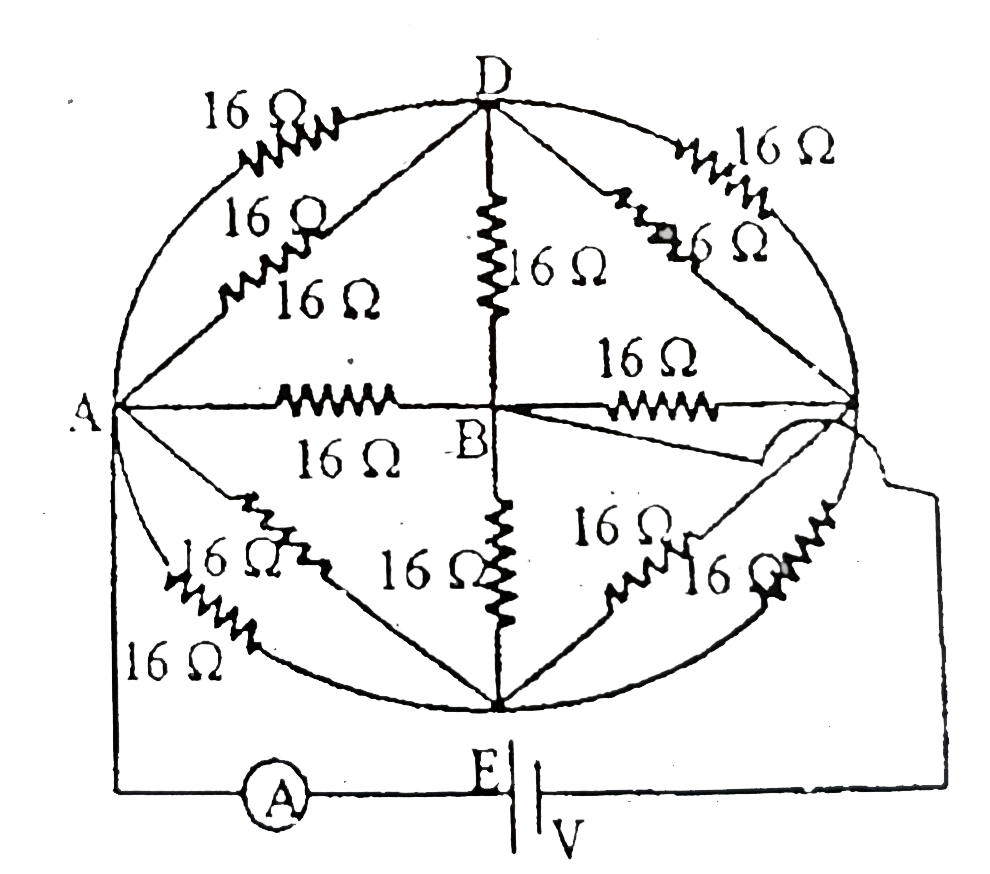 The points `D` and `E` will be at same potential hence the circuit can be further simplified as shown in figure `3` & `4` 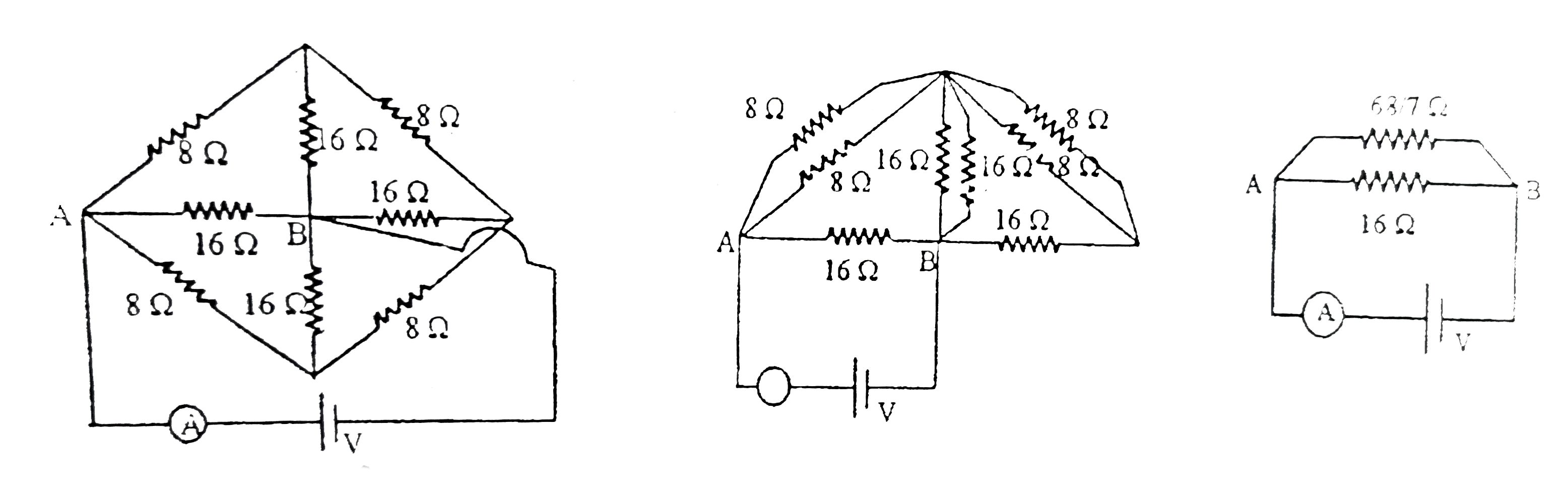 Hence equivalent RESISTANCE across `A` and `B`, `R_(eq)=((68)/(7)xx16)/((68)/(7)+16)=6.04 Omega` Hence reading of ammeter `I=(12)/(6.4)~~2A`. After long time the circuit can be redrawn as 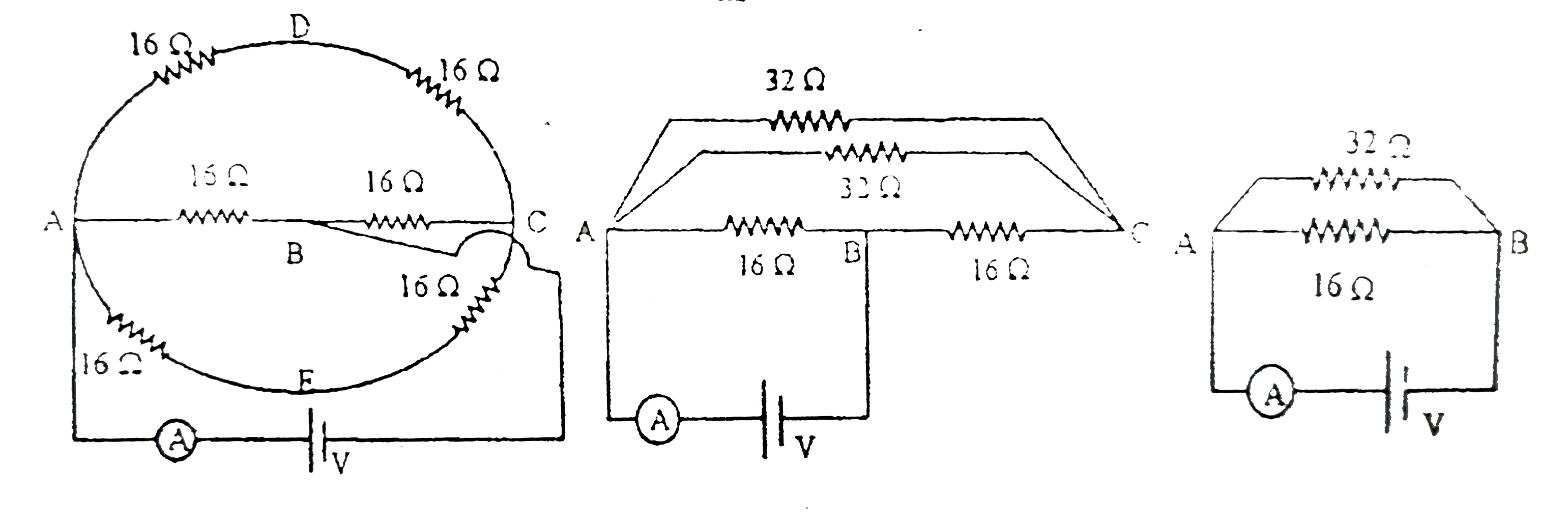 `R_(AB)=(16xx32)/(16+32)=(32)/(3)Omega` Hence the reading of the ammeter `I=(9)/(8)A` (`ii`) The current through paths `ADC` and `AEC` will be same and will be equal to `I_(2)=(1)/(2)xX(9)/(8)xx(16)/(48)=(3)/(16)A` Hence potential difference across `AD`, `AE`, `DC` and `CE`, `V'=16xx(3)/(16)=3V` Hence the charge in the `C_(1)`, `C_(2)`, `C_(5)` and `C_(6)q=100xx3=300muC` ALSO `V_(DB)=V_(EB)=12-3=9V` Hence the charge in the capacitor `C_(3)` and `C_(4)=100xx9=900muC` |
|
| 2. |
If two identical thin bar magnets having length l and pole strength m are placs at right ngle to each other in such a manner that south pole of one touches north pole of other. Then their resultant magnetic moment is : |
|
Answer» `SQRT2 `ml |
|
| 3. |
State clearly how an unpolarised light gets linearly polarised when passed through a polaroid. (i) Unpolarised light of intensity I_(0) is incident on a polaroid P_(1) which is kept near another polaroid P_(2) whose pass axis is parallel to that of P_(1). how will the intensities of light, I_(1) and I_(2), transmitted by the polaroids P_(1) and P_(2) respectively, change on rotating P_(1) without disturbing P_(2) ? (ii) Write the relation between the intensities I_(1) and I_(2). |
|
Answer» <P> Solution :For obtaining linearly polarised light on passing unpolarised light through a polaroid.(i) Let unpolarised light of intensity `I_(0)` is incident on a polaroid `P_(1)` then intensity of plane polarised light TRANSMITTED by polaroid `P_(1)` is `I_(1)=(I_(0))/(2)` As pass axis of polaroid `P_(2)` is parallel to that of `P_(1)`, hence intensity of light transmitted by polaroid `P_(2)` is `I_(2)=I_(1)=(I_(0))/(2)`. However, if the polaroid `P_(1)` is rotated about its axis and the pass axis of `P_(1)` SUBTENDS an angle `theta` with pass axis of `P_(2)`, then `I_(1)=(I_(0))/(2)` but `I_(2)=I_(1)cos^(2)theta=(I_(0))/(2)cos^(2)theta.` If `theta=90^(@)`, then `I_(2)=(I_(0))/(2)cos^(2)(90^(@))=0`. (ii) The relation between `I_(1) and I_(2)` is GIVEN as: `I_(2)=I_(1)cos^(2)theta`, where `theta` is the angle between the pass axes of two polaroids. |
|
| 4. |
An EM wave is travelling in a medium with a velocity vecv = v veci. Draw a sketch showing the propagation of the EM wave, indicating the direction of the oscillating electric and magnetic fields. |
Answer» SOLUTION :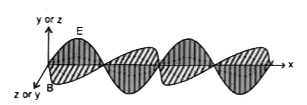
|
|
| 5. |
A source of sound of frequency 500Hz produces waves in a medium of wavelength 0.1m. The waves will travel distance of 300m in |
|
Answer» 0.6sec |
|
| 6. |
White light is used to illuminate the two slits in Young's double slit experiment. The distance between the slits is b and the screen is at a distance d (gt gt b) from the slits. At a point on the screen directly in front of one of the slits, certain wavelengths are missing. Some of the missing wavelengths are : |
|
Answer» `lambda=(B^(2))/(2d)` |
|
| 7. |
Long range radio transmission is possible when the radiowaves are reflected from the ionosphere. For this to happen the frequency of the radio waves must be in the range: |
|
Answer» 1 - 3 MHz |
|
| 8. |
An aluminium - alloy rod has a length of10.000 cm at 20.000^@Cand a length of at the oiling point of water . (a) what is the length of the rod at the freezing point of water ? What is the temperature if the length of the rod is 10.009 cm? |
|
Answer» |
|
| 9. |
In biprism experiment, biprism of refractive index mu has refracting angle alpha, the biprism is at a distance u from the slits. The distance between the two virtual images of the slits is |
|
Answer» `d= 2U (MU-1) ALPHA` |
|
| 10. |
To demonstrate the phenomenon of interference we require two sources which emit radiation |
|
Answer» of the same FREQUENCY and having a definite phase RELATIONSHIP |
|
| 11. |
Show variation of resistivity of copper as a function of temperature in a graph. |
Answer» SOLUTION :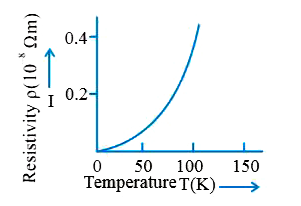
|
|
| 12. |
Name the parts of the electromagnetic spectrum which is used as a diagnostic tool in medicine. Write in brief, how these waves can be produced. |
| Answer» SOLUTION :X-RAYSX-rays are PRODUCED by the bombardment of high ENERGY ELECTRON | |
| 13. |
A straight copper wire of length 0.45 m is perpendicular to a uniform magnetic field of induction 0.7 T. It is moved at right angles to its length at a speed of 2m/s. (i) Find the induced emf between the ends of the wire. (ii) If the ends of are joined by completing a circuit through a 4-ohm resistor, at what rate must be work be done to keep the wire moving at the constant speed of 2m/s ? |
|
Answer» Solution :Data: `l=2m, B=0.7 T, v=2m//s, R=4 OMEGA` (i) The INDUCED emf, E=Blv `=(0.7)(2)(2) = 2.8 V` (ii) The induced current, `I=E/R = (2.8)/4 = 0.7A` The rate at which work must be done = electric power dissipated through the resistor `=EI= (2.8)(0.7) = 1.96` W |
|
| 15. |
A charge q is placed at the centre of the open end of cylindrical vessel. Find the flux of the electric field through the surface of the vessel. |
| Answer» Answer :A | |
| 16. |
The wavelength of wave of 5000 Å comir from a star at far distance is experience 5200 A, then what is the velocity ? |
|
Answer» `1.2xx10^(7)cm//s` `=5200-5000=200Å` Now `(DELTA lambda)/(lambda)=(v)/(c) RARR v=(c Delta lambda)/(v)=(3xx10^(8)xx200)/(5000)` `:.v=1.2xx10^(7)m//s` |
|
| 17. |
When light is incident on a soap film of thickness 5xx10^(-5) cm, the wavelength of light reflected maximum in the visible region is 5320 Å. Refractive index of the film will be, |
|
Answer» 1.22 `2murcosr=(2n+1)(LAMBDA)/(2) "" [thereforecosr=1]` `mu = ((2n + 1)lambda)/(4r)` For visible REGION, n = 2 `mu=((2(2)+1)xx5320xx10^(-10))/(4xx5000xx10^(-10))=0.5xx10^(-7)` `lambda = 500 Å` |
|
| 18. |
A point Q lies on the perpendicular bisector of an electric dipole of dipole moment p. If the distance of Q from the dipole is r (much larger than the size of the dipole) then electric field at Q is proportional to |
|
Answer» <P>`p^(-1) and R^(-2)` |
|
| 19. |
Assuming the ideal diode, draw the output waveform for the circuit given in figure. Explain the waveform. |
Answer» Solution :Here, `V=20sin(omegat)` and so maximum voltage is `V_(m)=20V`. It means that input voltage would change from +20V to -20V.  (i) For time intervals from 0 to `t_(1)` and from `t_(2)` to `(T)/(2)` when `v_(i) lt 5V`, potential at anode is less than potential at cathode `(V_(A) lt V_(K))` and so diode is reverse biased and so no current would pass through it. Hence input signal voltage would appear directly across load resistance `R_(L)` in the output. Hence WAVEFORM of output voltage `v_(0)` across `R_(L)` would be similar to input voltage `v_(i)`, which is shown in figure 3. (ii) At INSTANTS `t=t_(1) and t=t_(2)`, when `v_(i)=5V`, no current passes through resistance R and diode D and so `v_(0)=v_(i)=5V` which is shown in figure 3. (iii) Now, for time interval from `t_(1)` to `t_(2), v_(i) gt 5V` and so diode is forward biased where its resistance becomes zero and so potential DIFFERENCE across it will also be zero. Hence, in the time interval from `t_(1)` to `t_(2), v_(0)=5` V = constant (which is the battery voltage). (iv) Now, for negative half cycle from `(T)/(2)` to T, diode D is reverse biased and so no current passes through it DUE to infinite resistance and so input signal would pass directly through `R_(L)` and so waveform of `v_(0)` across `R_(L)` would be similar to waveform of `v_(i)` which is shown in figure 3. |
|
| 20. |
A car is moving towards a high cliff. The driver sounds a horn of frequency f. The reflected sound heard by the driver has frequency 2f. If v is the velocity of sound, then the velocity of the car, in the same velocity units, will be |
|
Answer» `v//sqrt(2)` `therefore f. =(v/(v-v_(s)))f`. Now, cliff is source, it EMITS frequency `f.` and the obserer is now the driver who observes `f^(..)`. `therefore f.. = [(v+v_(0))/v].` or `2F[(v+v_(0))/(v-v_(s))]f` `rArr 2v -2v_(0) =v+v_(0) rArr v=v_(0) + 2v_(0)` [as `v_(s) =v_(0)]` `rArr v_(0) =v/3` |
|
| 21. |
A radioactive isotope has a half-life of T years. The time required for its activity reduced to 6.25% of its original activity |
|
Answer» 4T years |
|
| 22. |
Determine the voltage drop across the resistance R_(1) in the circuit given in Fig. 4.55 with epsilon=90 V, R_(1)=5 k Omega, R_(2)=5k Omega, R_(3)=10 k Omega " and " R_(4)=10 k Omega. |
|
Answer» |
|
| 23. |
Dispersive power of prism material is |
| Answer» Solution :DISPERSIVE power of a medium for a PAIR of COLOURS is DEFINED as the RATIO of angular dispersion to the mean deviation. | |
| 24. |
The velocity of light in glass whose refractive index w.r.t. air is 1.5 is 2.5 xx 10^8 m//s. The refractive index of the liquid w.r.t. air is |
|
Answer» 0.8 |
|
| 25. |
A car stereo working at stabilized voltage supply of 9V DC and has a Zener diode of 9V , 0.25 W . But the voltage supply inside the car is 12 V DC . The boy approached you to get help . a. Which mode of bias will you suggest to connect Zener diode as voltage regulator ? b. Draw a circuit diagram of voltage regulation to help the boy . c . Which device is essential for circuit diagram ? Find the value of that device . [ Hint . Current throughthe load , I_(L) = 0] |
|
Answer» Solution :a . Reverse bias B. 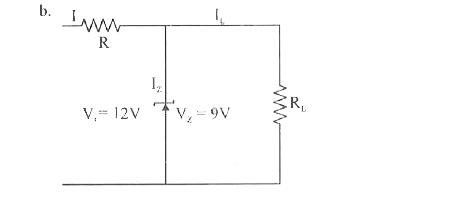 c. RESISTANCE : R can be CALCULATED using the equation `V_(i) = IR + V_(Z) ( R = 120 Omega)` |
|
| 26. |
Define cosmology? |
| Answer» Solution :Cosmology is the branch that INVOLVES the origin and evolution of the universe. It DEALS with formation of STARS, galaxy ETC. | |
| 27. |
A ball of radius R=50 cm is located in a non- magnetic medium with permittivityepsilon=4.0 . In that mediuma plane electromagnetic wave propagates, the strength amplitude of whose electri component is equal to E_(m) = 200 V //m. What amount of energy reaches the ball during a time interval t=1.0 min ? |
|
Answer» Solution :For the Poynting vector we can derive as `lt S gt = (1)/(2) sqrt((epsilon epsilon_(0))/(mu_(0))) E_(m)^(2)` along the DIRECTION of propagation. Hence in time `t`(which is much longer than the time period `I` of the wave, the enegry reaching the BALL is `piR^(2) XX (1)/(2) sqrt((epsilon epsilon_(0))/(mu_(0))) E_(m)^(2)XXT = 5 kJ`. |
|
| 28. |
A conducting ring of radius 1 m kept in a uniform magnetic field B of 0.01 T, rotates uniformly with an angular velocity 100 rad s^(-1) with its axis of rotation perpendicular to B. The maximum induced emf in it is |
|
Answer» a. `1.5piV` |
|
| 29. |
A particle is located in a two-dimensional square potential well with absolutely impenetrable walls (0 lt x lt a, 0 lt y lt b). Findthe probability of the particle with the lowesr energy to be located with in a region 0 lt x lt a//3 |
|
Answer» Solution :The wave function for the ground state is `Psi_(11)(x,y)=A "sin"(pix)/(a) "sin"(piy)/(b)` we find `A` normalization `1=A^(2)int_(0)^(a)dxint_(0)^(d)dy"sin"^(2)(pix)/(a)"sin"^(2)(piy)/(b)=A^(2)(ab)/(4)` THUS `A= (2)/(sqrt(ab))`. Then the requisite probability is `P=int_(0)^(a//3)dxint_(0)^(b)dy(4)/(ab)"sin"^(2)(pix)/(a)"sin"^(2)(piy)/(b)` `=(2)/(a)dx "sin"^(2)(pix)/(a)` on doing the `y` intergral `=(1)/(a)int_(0)^(a//3)d(1-"cos"(2PIX)/(a))=(1)/(a)((a)/(3)-("sin"(2pi)/(3))/(2pi//a))` `(1)/(3)-sqrt(3)/(4pi)=0.196= 19.6%` |
|
| 30. |
A charged rod having charge as shown is rotating with angular velocity omega about on hinge at its centre. At the instant shown rod is along x- axis Consider effect of field at the instant shown. |
|
Answer» A magnetic field `B_(0)hat(i)` will SLOW down rod. 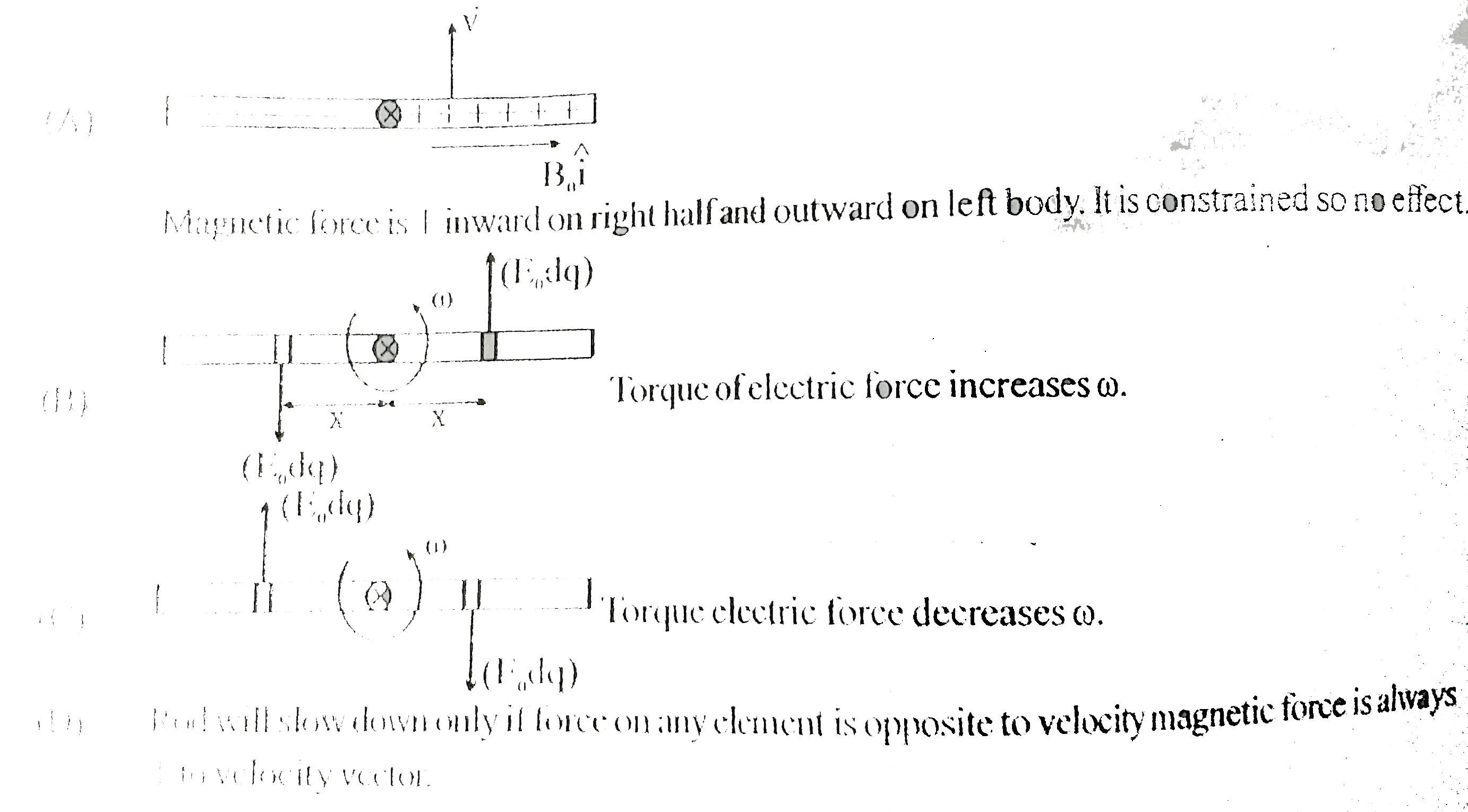 Magnetic FORCE is `bot` inward on right half and outward on LEFT body. It is constrained so no effect. Torque of electric force increases OMEGA Torque electric force DECREASES omega Rod will slow down only if force on any element is opposite to velocity magnetic force is always `bot` to velocity vector. |
|
| 31. |
There are three concentric metallic spherical shells of radius a, b and c respectively as shown in the figure. The innermost sphere is given a charge q and the outermost sphere is given a charge 4q while the middle sphere is earthed. Find the charges appearing on the inner and outer surfaces of middle sphere. |
Answer» Solution :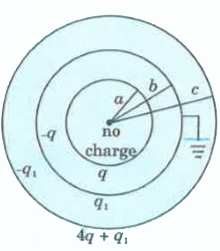 There is no electric field INSIDE the innermost sphere and hence its total charge q must be distributed uniformly on its outer surface. Metal SURFACES facing each other always carry EQUAL and opposite cahrges, hence charge on the inner surface of middle sphere must be -q, which becomes one of the answers to this QUESTION that is charge on inner surface of middle sphere. We need to find charge on its outer surface also. The middle sphere is an earthed object so its electric potential must be zero. Hence, it will acquire charge on its outer surface accordingly. Let us assume that charge on outer surface of the middle sphere be `q_(1)` then again due to electrical constraint of metals. charge on inner surface of the outermost, sphere must be `-q_(1)`. The outermost sphere is isolated and net charge given is 4q. Hence, charge on its outer surface must be `4q+q_(1)` so that net charge on its remains 4q. In order to calculate the magnitude of `q_(1)` we need to write electric potential of the middle sphere due to ENTIRE charge distributions and then equate it to zero, because an object connected to earth eventually acquires zero potential. `V=(q)/(4pi epsilon_(0)b)+(q_(1)-q)/(4pi epsilon_(0)b)+(4q)/(4pi epsilon_(0)c)=0` `rArr (q)/(4pi epsilon_(0)b)=(q_(1))/(4pi epsilon_(0)b)-(q)/(4pi epsilon_(0)b)+(4q)/(4pi epsilon_(0)c)=0 rArr q_(1)=-(4qb)/(c )` Finally we can say that charge on inner surface of middle sphere is -q and on outer surface it is -4qb/c. |
|
| 32. |
State the law of radioactive decay. Define the term 'decay constant' for a radioactive substance. How is it related to half life ? |
|
Answer» Decay constant i.e. `-(dN)/(dt) prop N_(0)` Decay constant is defined as the time after which the number of radioactive atoms reduce to 1/e times the ORIGINAL number ofatoms. Relation between half LIFE T and `lambda`. Half-life period The half-life of a radioactive substance is defined as the time during which half of the atoms of radioactive substancewill disintegrate. Let us denote the half-time of a substance by T. Then, by definition, after time T, number of atoms left behind will be `(N_(0))/(2)`. ...(1) Setting this condition i.e. when `t=T, N=(N_(0))/(2)` in the given equation (1), we get `(N_(0))/(2)=N_(0)e^(-lambda T)` or `e^(-lambdaT)=1/2 ` or `e^(lambdaT)=2` or `lambda T=log_(e)2=2.303 log_(10)2` `=2.303 xx 0.3010=0.693` Therefore, `T=(0.693)/(lambda)` ...(2) Thus, half life of radioactive substance is inversely proportional to its decay constant and is a characteristic property of its nucleus and cannot be ALTERED by any known method. |
|
| 33. |
There is a prism with refractive index equal to sqrt(2) and the refracting angle equal to 60^(@). One of the refracting surfaces of the prism is polished. A beam of monochromatic light will retrace its path if its angle of incidence over the refracting surface of the prism is |
|
Answer» `SIN^(-1)(SQRT2)` We know that `mu=(sini)/(SINR)` `therefore sin i=muxx sin r=sqrt2 xx sin 60^(@)` `=sqrt2xx(sqrt3)/(2) or i=sin^(-1)sqrt((3)/(2))` 
|
|
| 35. |
The- process of adding inpurities to pure semiconductor is called |
|
Answer» bonding |
|
| 36. |
Prove the theorem converse to the one of xi 28.8: if in the course of the heat exchange between two bodies contained in a closed and an adiabatically isolated system the entropy rises, then the heat transfer will be in the direction from the heated body to the cold one. |
| Answer» Solution :Let `DeltaS gt 0`, then (SEE `xi 28.8`) `-Q/(T_1) + Q/(T_2) > 0` , there leads to the Calusius principal (see `xi xi 28.9 and 29.5`). | |
| 37. |
What is nuclear density ? |
| Answer» Solution :The density of a nuclear matter is the ratio of the MASS of a nucleus to it.s VOLUME. As volume of a nucleus is directly proportional to it.s mass number A. So, the density of nuclear matter is independent of the size of nucleus. THUS, nuclear matter behave LIKE a liquid of constant density. | |
| 38. |
An astronomical telescope of ten-fold angular magnifiaction has a length of 44 cm. The focal length of the objective is : |
| Answer» Answer :C | |
| 39. |
6.A straight wire carrying a current of 12 A is bent into a semi-circular arc of radius 2.0 cm as shown in Fig. (a). Consider the magnetic field B at the centre of the arc. a . What is the magnetic field due to the straight segments? b. In what way the contribution to B from the semicircle differs from that of a circular loop and in what way does it resemble? c. Would your answer be different if the wire were bent into a semi-circular arc of the same radius but in the opposite way as shown in Fig. (b)? |
|
Answer» Solution :a. dl and r for each element of the straight segments are parallel. Therefore, d/ X = 0.Straight segments do not contribute to |B|. b. For all segments of the semicircular arc, drare all parallel to each other into the plan of the paper). All such CONTRIBUTIONS add up in magnitude. Hence direction of B for a semicircular are is given by the right-hand rule and magnitude is HALF that of a circular loop. Thus Bis `1.9 XX 10^(-4)`T normal to the PLANE of the paper going into it. c. Same magnitude of B but opposite in direction to that in (b). |
|
| 40. |
State further properties of em. Waves? |
| Answer» Solution :ELECTRIC and MAGNETIC fields VIBRATE in phase.They can be polarized. | |
| 41. |
Two identical parallel plate capacitors are joined in series to 100 V battery. Now a dielectric with K = 4 is introduced between the plates of secondcapacitor . The potential on capacitors are |
| Answer» Answer :D | |
| 42. |
Malaria does not occur in : |
|
Answer» Watermelons |
|
| 43. |
A progressive wave has a shape (or waveform) given by the equation, y = (2)/((x^2 - 6x + 14)^(3//2)), at the instant time t = 1. Express the wave equation in terms of time t, |
|
Answer» `y = (2)/([5 + (X - 3t)^2]^(3//2))` |
|
| 44. |
A certain region of space is to be shielded from magnetic fields. Suggest a method |
| Answer» Solution :(e) Consider soft iron substance (which has very high value of permeability) with some cavity (empty space). When this substance is subjected to external magnetic FIELD its majority field lines prefer to PASS through soft iron (due to its very high permeability) and so very few field lines pass through the REGION of cavity. Hence, if same substance is kept in this cavity then A/most no magnetic field lines pass through it. In other words, region of cavity is not affected by external magnetic field and so it is said to be magnetostatically shielded. This phenomenon is also CALLED "magnetic SCREENING". | |
| 45. |
A semiconductor with a band gap of 2.5 eV is used to fabricate a p-n photodiode . It can detect a signal of wavelength |
| Answer» Answer :D | |
| 46. |
A vessel contais helium, which expands at a constant pressure when 15 kJ of heat is supplied to it. What will be the variation of the internal energy of the gas? What is the work performed in the expansion? |
|
Answer» |
|
| 47. |
A whistle revolves in a circle with angular speed omega = 20 rad/sec using a string of length 50 cm . If the frequency of sound from the whistle is 385 Hz, what is the minimum frequency heardby an ovserver which is far away from the centre. Velocity of sound in air is 340 m/s |
|
Answer» 385 HZ `therefore U_(s) = r omega = 10 `m/s `V_(min) ((V)/(V + U_(s))). V = (340 XX 385)/(340 + 10) = 374 Hz.` Correct choice is (C). |
|
| 48. |
There is another useful system of units, besides the SI/mKs. A system, called the cgs (centimeter-gram-second) system. In this system Coloumb's law is given by vecF =(Qq)/(r^(2)).hatr where the distance is measured in cm (=10^(-2)m), F in dynes (=10^(-5) N) and the charges in electrostatic units (es units), where 1 es unit of charge 1/(3) xx 10^(-9) C. The number [3] actually arises from the speed of light in vacuum which is now taken to be exactly given by c = 2.99792458 xx 10^8 m/s. An approximate value of c then is c = [3] xx 10^8 m/s. (i) Show that the coloumb law in cgs units yields 1 esu of charge = 1 (dyne) 1/2 cm. Obtain the dimensions of units of charge in terms of mass M, length L and time T. Show that it is given in terms of fractional powers of M and L. (ii) Write 1 esu of charge = x C, where x is a dimensionless number. Show that this gives: 1/(4piepsilon_(0)) = 10^(-9)/x^(2) (Nm^(2))/C^(2) with x=1/[3] xx 10^(-9), we have 1/(4pi epsilon_(0)) = [3]^(2) xx 10^(9) (Nm^(2))/C^(2) or 1/(4pi epsilon_(0)) = (2.99792458)^(2) xx 10^(9) (Nm^(2))/C^(2) (exactly). |
|
Answer» Solution :(i) `F = (Qq)/r^(2)` `therefore` 1 dyne `=("1 esu charge")^(2)/(1 cm)^(2)` `therefore 1 esu = (1 "dyne")^(1//2) xx 1 cm` `=F^(1//2) L` `therefore` Dimensional formula of 1 esu, `=[M^(1//2)L^(3//2)T^(-1)]` Hence, in dimensional formula of esu charge, power of M is `1/2`and of L is `3/2`, which is non-integer. (II) Suppose 1 esu = xC, where X is a dimensionless number. The force between two CHARGES of 1 esu magnitude is `10^(-5)` N ( = 1 dyne) when they are at distance `10^(-2)` m (= 1 cm). `therefore F = 1/(4pi epsilon_(0)).x^(2)/(10^(-2))^(2)` `= 10^(-9)/x^(2).(Nm^(2))/C^(2)` but `x = 1/(|3| xx 10^(9))` `1/(4pi epsilon_(0)) = 10^(-9) xx |3|^(2) xx 10^(18) (Nm^(2))/C^(2)` `=9 xx 10^(9) (Nm^(2))/C^(2)` If `|3| = 2.99792458`, then `=1/(4pi epsilon_(0)) = 10^(-9) xx (2.99792548)^(2) xx 10^(18)` `=8.98755 xx 10^(9)` |
|
| 49. |
An aircraft with a wingspan of 40 m flies with a speed of 1080 km h^(-1) in the eastward direction at a constant altitude in the northen hemisphere, where the vertical component of earth's magnetic field is 1.75xx10^(-5)T. Then the e.m.f. that develops between the tips of the wings is |
|
Answer» 0.5 V |
|