

Saved Bookmarks
This section includes 7 InterviewSolutions, each offering curated multiple-choice questions to sharpen your Current Affairs knowledge and support exam preparation. Choose a topic below to get started.
| 1. |
Name the law which explains the relation between current and the magnetic field produced by the current. |
| Answer» SOLUTION :Biot-Savart.s LAW or Ampere.s CIRCUITAL law | |
| 2. |
A U-tube having uniform cross-section but unequal arm length I_(1)=100 cm and I_(2)=50 cm has same liquid of density rho_(1) filled in it upto a height h=30 cm as shown in figure. Another liquid of density rho_(2)=rho_(1)//2 is poured in arm. A Both liquids are immiscible What length of the second liquid (in cm) should be poured in A so that second overtone of A is in unison with fundamental tone of B. (Neglect end correction) |
|
Answer» Rightarrow`L=4x` FREQUENCY same Rightarrow`LAMBDA`=same `20-x=lambda/4` `70+3x=(5lambda)/4` `70-3x=100-5x` `2x=30,x=15` `L=4x=60` cm 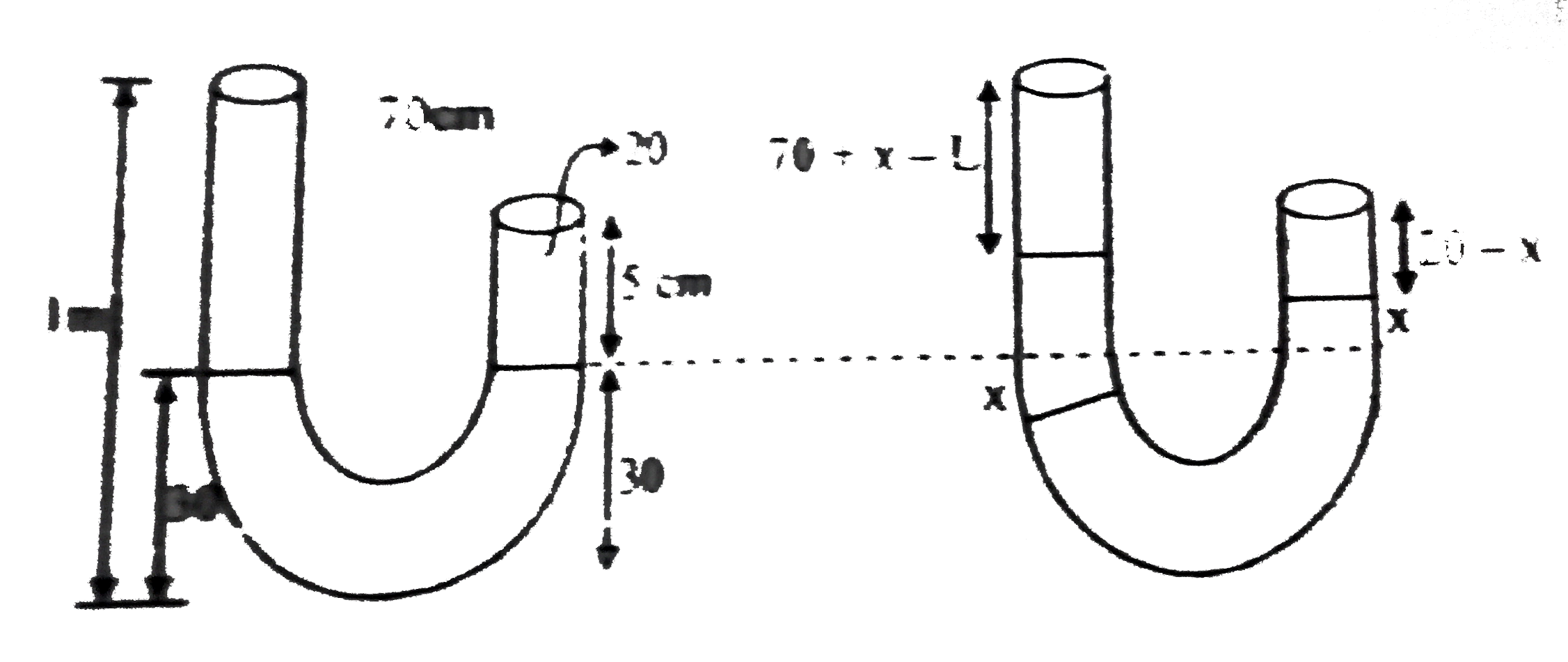
|
|
| 3. |
A rsisitance of R Omegadraws current from a potentiometer. Te potentiometer has a total resistance R _(0) Omega A voltage V is supplited to the potentiometer. Derive an expression for the voltage across R when the sliding contact is in the middle of the potenttometer. |
|
Answer» Solution :Resistance of WIRE AC of POTENTIOMETER= `R_(0)` Becaue point B is the midpoint of wire AC, resistance of wire AB = `(R_(0))/(2)` If equivalent resistance between points A and B is `R_(1)` then, `(1)/(R_(1)) = (1)/(R) + (1)/((R_(0))/(2))` `therefore (1)/(R_(1)) = (1)/(R) + (2)/(R_(0))` `therefore (1)/(R_(1)) = (R_(0) + 2R)/(R R_(0)) ` ` therefore R_(1) = (R R_(0))/(R_(0) + 2R) "" ` .... (1) Here resistance of wire AC = (resistance of wire AB ) + (resistance of wire BC ) `therefore R. = R_(1) + (R_(0))/(2) = (2R_(1) + R_(0))/(2) "" ` .... (2) Current PASSING through potentiometer wire, I`= (V)/(R.) = (2V)/(2 R_(1) + R_(0)) "" ` [From equation (2) ] Potential difference between points A and B, `V_(1) = I xx R_(1) ` `= ((2V)/(2R_(1) + R_(0))) xx R_(1)` = `(2v)/(2 ((R R_(0))/(R_(0) + 2R) ) + R_(0) ) xx (R R_(0))/(R_(0) + 2R) ` `therefore V_(1) = (2V)/(((2R R_(0) + R_(0)^(2) + 2 R R_(0))/(R_(0) + 2R))) xx (R R_(0))/(R_(0) + 2R)` `= (2V)/(R_(0) (R_(0) + 4R) ) xx R R_(0)` `therefore V_(1) = (2VR)/(R_(0) + 4R)` 
|
|
| 4. |
The largest wavelength in the ultraviolet region of the hydrogen spectrum is 122 nm. The smallest wavelength in the infrared region of the hydrogen spectrum (to the nearest integer) is |
|
Answer» 802nm |
|
| 5. |
A small square loop of wire of side l is placed inside a large square loop of side L. (L gt gt l). The loops are coplanar and their centres coincide. The mutual induction of the system is : |
|
Answer» `(L)/(L)` |
|
| 6. |
A beaker is filled with two immiscible transparent liquids of refractive indices mu_1 and mu_2 having thickness of layers d_1 and d_2 respectively. The apparent depth of the bottom of the beaker is |
|
Answer» `((d_1 × d_2)/(d_1 + d_2))((1/mu_1)+(1/mu_2))` |
|
| 7. |
The transverse nature of light is shown in, |
|
Answer» interference |
|
| 8. |
Three concentric, thin, spherical, metallic shells have radii 1, 2, and 4 cm and they are held at potentials 10, 0 and 40 V respectively. Taking the origin at the common centre, calculate the following: (a) Potential at r = 1.25 cm (b) Potential at r = 2.5 cm (c) Electric field at r =1.25 cm |
Answer» 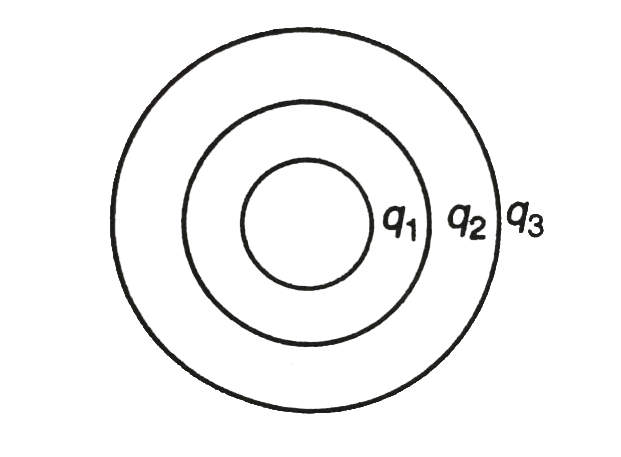 `=10=(9xx10^9)/10^-2[q_1/1+q_2/2+q_3/4]` =0(9xx10^9)/10^-2[q_1/2+q_2/2+q_3/4]` and `40=(9xx10^9)/10^-2[q_1/4+q_2/4+q_3/4]` SOLVING these equations we get `q_1=+200/9x10^-12C,q_2=-200xx10^-12` and `q_3=3200/9xx10^-2C` a. At `r=1.25cm` `V=(9xx10^9)/10^-2[((200/9)x10^-12)/1.25(200xx10^-12)/2+((3200/9)x10^-12)4]` `=6V` b. Potential at `r=2.5 cm` `V=(9xx10^9)/10^-2[((200/9)xx10^I-12)/2.5-(200xx10^-12)/2.5+((3200/9)xx10^-12)/4]` `=16V` c. Electric field at r=1.25` cm will be due to charge `q_1` only `:. E=1/(4piepsilon_0.q_1/r^2` ltbr. `=((9xx10^9xx(200/9)xx10^-12)/((1.25xx10^-2)^2)` `=1.28xx10^3V/m` |
|
| 9. |
If the spinning speed of the earth is increased, then the weight of the body at equator: |
|
Answer» does not change `g. = g -R omega^(2)cos^(2)lambda` which is less than g. As `omega ` INCREASE, g. decreases and hence weightof bodyalso decreases. Thus CORRECT choice is (B). |
|
| 10. |
Describe an experimental arrangement to study photoelectric effect. |
|
Answer» SOLUTION :Experimental setup : The apparatus is employed to stud the phenomenon of photoelectric EFFECT in detail. S is a source of electromagnetic waves of known and variable frequency v and intensity I.C is the cathode (negative electrode) made up of photosensitive material and is used to emit electrons.  The anode (positive electrode) A collects the electrons emitted from C. These electrodes are taken in an evacuated glass envelope with a quartz window that permits the passage of ultraviolet and visble light. The necessary potential difference between C and A is provided by HIGH tension battery B which is connected across a potential divider arrangement PQ through a key K.C is connected to the centre terminal while A to the sliding contact J of the potential divider. The plate A can be maintained at a desired positive or negative potential with respect to C. To MEASURE both positive and negative potential of A with respect to C, the voltmeter is designed to have its zero marking at the centre and is connected between A and C. the current is measured by a micro ammeter `mu A` in series. If there is no light FALLING on the cathode C, no photoelectrons are emitted and the microammeter reads zero. When ultraviolet or visible light is allowed to fall on C, the photoelectrons are liberated and are attracted towards anode. As a result, the photoelectric current is setup in the circuit whichf is measured using micro ammeter. The variation of photocurrent with respect to (i) intensity of incident light (ii) the potential difference between the electrodes (iii) the nature of the materaial and (iv) frequency of incident light can be studied with the help of this apparatus. |
|
| 11. |
Two identical long conducting wires AOB and COD are placed at right angle to each other, with one above other such that O is their common point for the two. The wires carry l_(1) and l_(2) currents, respectively. Point P is lying at distance d from 0 along a direction perpendicular to the plane containing the wire. The magnetic field at the point P will be |
|
Answer» `(mu_(0))/(2pid)((I_(1))/(I_(2)))` |
|
| 12. |
What is the role of nanostructure in the morpho butterfly wings ? |
| Answer» Solution :The scales on the wings of a MORPHO butterfly contain NANOSTRUCTURES that change the way light WAVES interact with each other, GIVING the wings brilliant METALLIC blue and green hues. | |
| 13. |
An inductor |
|
Answer» allows ac to pass ,blocks DC |
|
| 14. |
In a quark model of elementary particles, a neutron is made of one up quark (charge =2/3e) and two down quarks (charges =1/3e).Assume that they have a triangle configuration with side length of the order of 10^(-15)m. Calculate electrostatic potential energy of neutron. |
|
Answer» SOLUTION :The electrostatic POTENTIAL energy of neutron `u= 1/(4piepsi_0)[((2/3e)(-1/3e))/r + ((2/3e)(-1/3e))/r + ((-1/3e)(-1/3e))/r]` 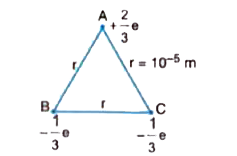 `1/(4pi epsi_0) (-1/3 e^2/r) = (-9 xx 10^9 xx (1.6 xx 10^(-19))^2)/(3XX (10^(-15)))` `=-7.68 xx 10^(-14) J = -(7.68 xx 10^(-14))/(1.6 xx 10^(-19)) eV =- 4.8 xx 10^5 eV= - 0.48 MEV` |
|
| 15. |
A body of volume 100 c.c. is immersed just completely in water contained in a jar. The weight of water and the jar before immersion of the body wass 600 g. After immersion, then weight of the water and jar will be |
|
Answer» 700 gwt. |
|
| 16. |
The approximate ratio of resistance in the forward and reverse bias of the p-n junction diode is: |
|
Answer» `10^2:1` |
|
| 17. |
Yellow light is used in a single slit of diffraction experiment with slit width 0.6mm.If yellow light is replaced by X-rays then the observed pattern will reveal |
|
Answer» the the CENTRAL MAXIMUM is narrower |
|
| 18. |
A solar cell is based on the _______ effect. |
| Answer» SOLUTION :PHOTOVOLTAIC EFFECT | |
| 19. |
Two junction diodes one of germanium (Ge) and other of silicon (Si) are connected as shown in fig to a battery of e.m.f. 12 V and a load resistance 10kOmega The germanium diode conducts at 0.3V and silicon diode at 0.7 V When a current flows in the circuit , the potential of terminal Y will be : |
|
Answer» 12 V Both Ge and Si DIDOES are in parallel When current FLOWS, P.D. REMAINS at 0.3 V, so no current flows through Si - DIODE. P.D. across `R_L=12-0.7 =11.3V` `:.` Potential at `Y = 11.3V` |
|
| 20. |
Electrostatic experiments cannot be conducted successfully on humid days. Explain. |
| Answer» SOLUTION :The humid air BECOMES CONDUCTING. Therefore, the static charge on the apparatus leaks off to the air. For this reason, electrostatic EXPERIMENTS do not work well on humid days. | |
| 21. |
Which one of the following ions exhibit highest magnetic moment ? |
|
Answer» `Cu^(+2)` `Ti^(+3) = [Ar]4s^(0) 3d^(1) ( 1 "unpaired" e^(-))` `Ni^(+2) = [Ar] 4s^(0) 3d^(8) (2 " unpaired " e^(-))` `Mn^(+2) = [Ar]4s^(0) 3d^(5) ( 5 " unpaired " e^(-))` |
|
| 22. |
sion giving 0.1 % of its original mass released as energy. (a) How much energy is released by an atomic bomb that contains 10 kg of .^(235)U. (b) If 1 ton TNT releases 4 xx 10^(9) joule. What is the TNT equivalent of the bomb ? |
|
Answer» |
|
| 23. |
The half life of a substance is 20 minutes. E The time interval between 33% decay and 67% decay. |
|
Answer» SOLUTION :For 33% DECAY, `N/N_0=1/2^(n_1) RARR 67/100=1/2^(n_1)`….(1) For 67% decay, `N/N_0=1/2^(n_2) rArr 33/100 = 1/2^(n_2)` ….(2) `n_2=t_2/T` `(2)/(1)=33/67 =1/(2^(n_2-n_1))` `rArr 1/(2)^1 =1/(2(t_2-t_1)/T) rArr (t_2-t_1)/T=1` `t_2-t_1`= T=20 minutes. |
|
| 24. |
The length of a metallic sheet is measured as 10.0 cm using a meter scale of L.C. 0.1 cm and its breadth is measured as 1.00 cm using a vernier callipers of L.C. 0.01 cm, the error in area is |
|
Answer» `PM 0.01 CM^(2)` |
|
| 25. |
What are characteristics of matter waves ? |
| Answer» Solution :MATTER WAVES has dual characteristics (wave LIKE and particle like ). | |
| 26. |
During negative B decay, an anti- neutrino is also emmited along with the ejected electron. Then |
|
Answer» only LINEAR MOMENTUM will be CONSERVED |
|
| 27. |
A particle of mass 'm' and charge 'q' moves with a constant velocity 'v' along the positive x-diiection. It enters a region containing a uniform magnetic field vecB directed along the negative Z-direction, extending from x = a to x = b. The minimum value of 'v' required, so that the particle can just enter the region x > b is |
|
Answer» `(qbB)/m` |
|
| 28. |
For the circuit shown in Fig. find1) the output voltage2) the voltage drop across series resistance, 3) the current through Zener diode. |
| Answer» SOLUTION :1) 50V,2)70V ,3) 9MA | |
| 29. |
A magnet with its north pole pointing down wards along the axis of an open ring as illustrated. As the magnet reaches close to the centre of the ring |
|
Answer» its acceleration BECOMES greater than G |
|
| 30. |
A double-slit apparatus is used to observe an interference patten projected on a screen from a stationary light source. If the light source is instead moved toward the double slits at constant speed along the axis of symmetry. What will be observed on the screen ? |
|
Answer» The INTERFERENCE patten will remain UNCHANGED |
|
| 31. |
A boat is moving with a velocity v_(bw)= 5 km/hr relative to water. At time t = 0, the boat passes through a piece of cork floating in water while moving downstream. If it turns back at time t_(I) =30 min, a) when the boat meet the cork again ? b) The distance travelled by the boat during this time. |
Answer» Solution :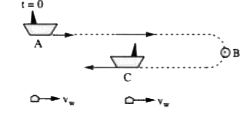 Consider an observer attached with CORK. The boat has same speed UPSTREAM and downstream relative to cork. Hence., if the boat travels for 30min. while moving AWAY from cork, it travel the same TIME while approching the cork. Therefore the boat meet thecork at T=2t = 60 min = 1h The distance travelled by boat in this time, `S=V_(BW) xx T = 5 xx 1= 5`km |
|
| 32. |
A body is projected with velocity u such that its horizontal range and maximum vertical heights are same. The maximum heights is ? |
|
Answer» `(U^(2))/(2g)` |
|
| 33. |
Finger prints on a piece of paper may be detected by sprinkling fluorescent powder on the paper and then looking it into |
| Answer» Answer :D | |
| 34. |
A sample contains a large number of nuclei. The probability that a nucleus in the sample will decay after four half - lives is (a)/(b) where a and b are least positive integers. Value of a+b will be |
|
Answer» |
|
| 35. |
A source of light is located at double focal length from a convergent lens. The focal length of the lens is f = 30 cm. At what distance from the lens should a flat mirror be placed, so that the rays reflected from the mirror are parallel after passing through the lens for the second time? |
Answer» SOLUTION : Object is at DISTANCE of 2f = 60 cm from the LENS. Image formed by lens `I_1` should be at a distance 60 cm from the lens. Now `I_2` the image formed by plane mirror should lie at focus or a distance of 30 cm from the lens. Hence, the mirror should be placed at distance 45 cm from the lens as shown in figure. |
|
| 36. |
The dimensions of four wires of the same material are given below. In which wire the increase in length will be maximum when the same tension is applied ? |
|
Answer» Length 100 cm, DIAMETER 1 mm `DeltalpropL/ArArrDeltalpropL/(d^(2))` Now `L/(d^(2))` is maximum when L = 50 cm and d = 0·5 mm in the given question. So CORRECT choice is (d). |
|
| 37. |
Kelvin's method of determination of resistance ofgalvanometer by metre bridge is |
|
Answer» EQUAL DEFLECTION method |
|
| 38. |
How does the refractive index of a transparent medium decreases with increase in wavelength of incident light used ? |
| Answer» SOLUTION :The refractive INDEX of a TRANSPARENT medium decreases with increase in wavelength of the INCIDENT light. | |
| 39. |
Potassium Permangante is of |
|
Answer» Purple |
|
| 40. |
Regarding the nature of the charge, we can conclude that : |
|
Answer» The charge is negative |
|
| 41. |
The radiation emitted by a perfectly black body is proportional to : |
|
Answer» temperature on ideal gas SCALE Thus CORRECT CHOICE is (c ). |
|
| 42. |
What is the name of the device in which DC is converted into AC ? |
| Answer» SOLUTION :OSCILLATOR | |
| 43. |
the length of the wire is doubled keeping V and d constant |
| Answer» SOLUTION :`v_d`=(Ee)/(m)TAU`=`(V)/(ml)etau` when l is doubled,drift velocity becomes HALF of the initial VALUE. | |
| 44. |
For one series LCR ac circuit, 200 V, 50 Hz source is connected . Here R= 6Omega , L=50.96 mH , C=398 muF, then find Resonant angular frequency |
| Answer» SOLUTION :`omega_0`=222.2 rad/s | |
| 45. |
A person of mass 72 kg sitting on ice pushes a block of mass of 30kg on ice horizontally with a speed of 12 ms^(-1). The coefficient of friction between the man and ice and between block and ice in 0.02. If g = 10 ms^(-2), the distances between man and the block, when they come to rest is |
|
Answer» 360 m |
|
| 46. |
Suppose India had a target of producing by 2020 AD, 200,200 MW of electric power, ten percent of which was to be obtained from nuclear power plants. Suppose we are given that, on an average, the efficiency of utillization (i.e, conversion to electric energy) of thermal energy produced in a reactor was 25%. How much amount of fissionable uranium would our country need per year by 2020? Take the heat energy per fission of ""^(235)U to be about 200 MeV. |
|
Answer» SOLUTION :Power requied from REACTOR = `2 xx 10^(10) W` For 1 year it is `2 xx 10^(10) xx 365.25 xx 86400` Let n kg of uranium is required. From 1 kg the energy released is `= (6.023 xx 10^23 xx 200 xx 10^6 xx 1.6 xx 10^(-19))/(0.235) J` `:.` Required energy = `25/100 xx m xx (6.023 xx 10^(23) xx 200 xx 10^6 xx 1.6 xx 10^(-19))/(0.235) J` `:. m = (2 xx 10^(10) xx 365.25 xx 86400 xx 100 xx 0.235)/(25 xx 6.023 xx 10^(23) xx 200 xx 10^(6) xx 1.6 xx 10^(-19)) = 3.08 xx 10^4 kg`. |
|
| 47. |
For one series LCR ac circuit, 200 V, 50 Hz source is connected . Here R= 6Omega , L=50.96 mH , C=398 muF, then find Impedance at resonance , current and resonance and power dissipated at resonance . |
| Answer» SOLUTION :Z=6 `OMEGA` , `I_(RMS)` = 66.7 A , `P=26.693xx10^3` W | |
| 48. |
Find the total negative or positive charge on a 2 g silver coin. The atomic number and atomic mass of silver is 47 and 107.9 u respectively, Given: Avogadro's number is 6.023 xx 10^23 g^(-1) "mol"^(-1) . |
| Answer» SOLUTION :`PM 84.2xx10^3` C | |
| 49. |
Which logic function has the output "low" only when both inputs are "high"? |
| Answer» SOLUTION :NAND, XOR | |
| 50. |
STATEMENT-1: Out of galvanometer, ammeter an voltmeter, resistance of ammeter is lower and resistance of voltmeter is highest because STATEMENT-2: An ammeter is connected in series and a voltmeter is connected in parallel, in a circuit. |
|
Answer» Statement-1 is TRUE , Statement-2 is True , Statement-2 is a CORRECT EXPLANATION for Statement-1. |
|