Saved Bookmarks
This section includes 7 InterviewSolutions, each offering curated multiple-choice questions to sharpen your Current Affairs knowledge and support exam preparation. Choose a topic below to get started.
| 1. |
The dimensional formula ML^(2)T^(-2) stands for |
|
Answer» ANGULAR velocity |
|
| 2. |
If 1.5 A constant current is passing through a resistance, then the value of rms of current over half period will be...…. |
|
Answer» 1.5A |
|
| 3. |
A capacitor is filled with two dielectrics of the same dimensions but of dielectric constants 2 and 3 as shown in figure (a) and in figure (b), the ratio of the capacitances in the two arrangements is |
|
Answer» `25 :24` |
|
| 4. |
Magentron is a device consisting of a filamentof radiusa and coaxialcylindricalanodeof radiusbwhich are locatedinaunifrom magneticfield parallel to the filament. An acceleratingpotentialdiffernece V is appliedbetweenthe filamentand theanode. Find thevalue of magneticinduction at whichthe electrons leaving the filamnentwith zero velocity reach the anode. |
|
Answer» Solution :This differs from theprevious problemin `(a harr b)` and the MAGNETIC FIELD is along the z-direction. Thus `B_(x) = B_(y) = 0, B_(x) = B` Assuming as usual the chargeof the electronto be `-|E|`, we writethe equaction of motion `(d)/(dt) mv_(x) = (|e| V_(x))/(rho^(2) In (b)/(a)) = -|e| B doty, (d)/(dt) mv_(y) = (|e| V_(y))/(rho^(2) In (b)/(a)) + |e| B dotx` and `(d)/(dt) mv_(x) = 0 implies z = 0` The motion is confined to the plane `z = 0`. Eliminating`B` fromthe first two equactions, `(d)/(dt) ((1)/(2) mv^(2)) = (|e| V)/(In b//a) (x dotx + y doty)/(rho^(2))` or, `(1)/(2) mv^(2) = |e| V (In rho//a)/(In b//a)` so, as expected since magnetic forces do not work, `v = sqrt((2|e|V)/(m))`, at `rho = b`. On the other hand, elaminating `V`, we also get, `(d)/(dt)m (xy_(y) - yv_(x)) = |e| B (x dotx + y doty)` `i.e.(xy_(y) - yv_(x)) = (|e| B)/(2m) rho^(2) +` constatn The CONSTANT is easily evaluated, since `v` is zero at `rho = a`. Thus, `(xy_(y) - yv_(x)) = (|e| B)/(2m)(rho^(2) - a^(2)) gt 0` At `rho = b, (xv_(y) - yv_(x)) le vb` Thus, `vb GE(|e|B)/(2m) (b^(2) - a^(2))` or, `B le (2 mb)/(b^(2) - a^(2))sqrt((2 |e|V)/(m)) xx (1)/(|e|)` or, `B le (2b)/(b^(2) - a^(2)) sqrt((2mB)/(|e|))` |
|
| 5. |
(a) In Young's double-slit experiment, derive the condition for (i) constructive interference and (ii) destructive interference atapoint on the screen. (b) A beam of light consisting of two wavelenths, 800 nm and 600 nm is used to obtain the interference fringes in a Young's double-slit experiment on a screen placed 1.4m away. if the two slits are separated by 0.28 mm, calculate the least distance from the central bright maximum where the bright fringes of the two wavelengths coincide. |
|
Answer» SOLUTION :(b) Here `lamda_(1)=800nm,lamda_(2)=600nm,D=1.4m and d=0.28mm=2.8xx10^(-4)m`. LET at a distance .x. from central maxima the bright fringes due to `lamda_(1) and lamda_(2)` coincide first time. For this to happen `nlamda_(1)=(n+1)lamda_2`, where n is an integer `implies (n+1)/(n)=(lamda_(1))/(lamda_(2))=(800nm)/(600nm)=4/3 implies n=3`. It means that at distance x, nth i.e., 3rd maxima for wavelength `lamda_(1)` is just coinciding with (n+1)th i.e., 4th maxima for wavelength `lamda_(2)` `therefore x=(nDlamda_(1))/(d)=(3xx1.4xx800xx10^(-9))/(2.8xx10^(-4))=1.2xx10^(-2)m or 1.2cm`. |
|
| 6. |
(A ): Mass of a body decreases slightly when it negatively charged. (R ): Charging is due to transfer of electrons. |
|
Answer» Both .A. and .R. are true and .R. is the CORRECT EXPLANATION of .A. |
|
| 7. |
While a person lifts a book of mass 2 kg from the floor to a tabletop, 1.5 m above the floor, how much work does the gravitational force do on the booK? |
|
Answer» `-30J` |
|
| 8. |
A rod of leng th 'l' rests at a point A against a smooth vertial wall while end B is on the floor as shown in the fig. If the end Amoves uniformly downwards, what will be the velocity of the end B if x is the distance of point B from wall. |
|
Answer» `v_(B)=sqrt(l^(2)/x^(2) -1.v_(a))` `x^(2)+y^(2)=l^(2)` or `2xdx/dt+2y(dy)/(dt)=0` or `(dx)/(dt)=v=-y//x((dy)/(dt))=y//x.v_(a)` As `v_(a)` is constant magnitude of the given DOWNWARD velocity as .y. decreases with time. Then `v_(b)=y//x.v_(a)` But `y=sqrt(l^(2)-x^(2))` `:.v_(b)=sqrt((l^(2)-x^(2))/x).v_(a)` 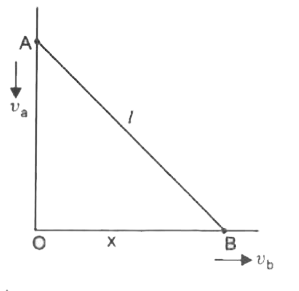
|
|
| 9. |
A spring obeying Hook's law has a force constant K Now the spring is cut in two equal parts, the force constant of each part will be: |
|
Answer» K :.`k’=2k` Hence correct choice is (c) |
|
| 10. |
A current changing at 2A/sec in one coil produced a.m.. of 40 milivolt in the other. The mutual inductance will be: |
|
Answer» 0.2 |
|
| 11. |
Consider the circullar loop having current I and with central point O. The magnatic field at the central point O is |
|
Answer» `(2 mu_(0)i)/(3 pi R)` ACTING downward |
|
| 12. |
Using the Rydberg formula, calculate the wavelength of the delta-line in the Lyman series of the hydrogen spectrum. |
|
Answer» `1218Å` For answer SEE PHYSICS Darpan, Part-2, Section-B, Illustration of Textbook EXAMPLE no. 12.6 |
|
| 13. |
Define the rms value of an AC. |
| Answer» Solution :The RMS value of an AC is the SQUARE root of the mean of the squares of the INSTANTANEOUS values taken over a complete CYCLE. | |
| 14. |
How does the sign of the phase angle phi, by which the supply voltage leads the current in an LCR series circuit, change as the supply frequency is gradually increased from very low to very high values. |
|
Answer» Solution :The phase angle `phi` by which VOLTAGE leads the current in L-C-R series circuit is given by, `tan phi=(X_L-X_C)/R=(2pivL-1/(2pivC))/R` `therefore` for `V lt v_r "tan" phi lt 0` and where v=frequency for `v GT v_r tan phi gt 0 v_r`= resonant frequency for `v=v_r tan phi=0` |
|
| 15. |
Duringmotionof a manfrom a equatorto poleofearth , its weightwill ( neglect the effectof changein the radiusof earth ) |
|
Answer» INCREASE by `0.34 %` |
|
| 16. |
Show that electric field intensityon the surface of a charged conductor is vecE=(sigma)/(epsi_(0))n, where sigma is the surface density of charge and vecn is the outward pointing unit normal vector. |
| Answer» SOLUTION :In equation (5) `EPSI= epsi_(0)` for vacuum or AIR. | |
| 17. |
Paragraph : A scientist was asked to find the height of the roof of a dome shaped hall. He took a spherical ball of radius 20 cm which he suspend with the string from the roof of dome. The height of the ball above the ground was 5 cm when suspended. He noted the time of 20 oscillations to be 100 s. The height of the roof of the dome from the ground is : |
|
Answer» 6.19 m `=6.34+.2+0.5=6.59`m. So correct CHOICE is ( c ). |
|
| 18. |
A uniform string is clamped at x=0 and x = L and is vibrating in its fundamental mode. Mass per unit length of the string is mu, tension in it is T and the maximum displacement of its midpoint is A. Find the total energy stored in the string. Assume to be small so that changes in tension and length of the string can be ignored |
|
Answer» |
|
| 19. |
Paragraph : A scientist was asked to find the height of the roof of a dome shaped hall. He took a spherical ball of radius 20 cm which he suspend with the string from the roof of dome. The height of the ball above the ground was 5 cm when suspended. He noted the time of 20 oscillations to be 100 s. The length of the string used to suspend the bob of pendulum is : |
|
Answer» 6.39 m length of STRING used `=l-` radius of bob `=6.34-.20` `=6.14` m. So CORRECT choiceis(B). |
|
| 20. |
The correct between intensity of magnestisation (I) and magnetic field (H) for a ferromagnetic substance is given by |
|
Answer»
|
|
| 21. |
Paragraph : A scientist was asked to find the height of the roof of a dome shaped hall. He took a spherical ball of radius 20 cm which he suspend with the string from the roof of dome. The height of the ball above the ground was 5 cm when suspended. He noted the time of 20 oscillations to be 100 s. The time period of the pendulum when suspended from roof is : |
|
Answer» Solution :`T=(100)/(20)=5" s"` So CORRECT choice is (a). |
|
| 22. |
Distinguish between AC and DC. |
Answer» SOLUTION :
|
|
| 23. |
A bomb of 12 kg explodes into two parts 4 kg and 8 kg. The velocity of 8 kg mass is 6 ms^(-1).The the other is : |
|
Answer» Solution :Initial momentum= FINAL momentum. `12xx0=8xx6+4v` `IMPLIES v=-12 ms^(-1)` `:. K.E=(1)/(2)4(-12)^(2)=288 J` |
|
| 24. |
The distance between an object and its real image, formed by a converging lens, is held fixed. This distance is greater than four times the focal length of the lens. Show that there are two possible positions for the lens, and that the size of the object is given by sqrt(I_1 I_2) Where I_1 and I_2are the sizes of the two images. |
|
Answer» O=I1/I2  Diminished image of size `I_2` for the POSITION `L_2` of the lens 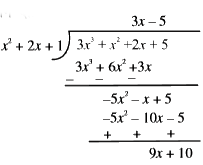 ` m_2 = (I_2)/(O) = v/u`....(2) From (1) and (2) , ` (I_1 I_2)/(O^2) = v/u XX u/v = 1` ` O = sqrt(I_1 I_2)` |
|
| 25. |
Two converging lenses have focal length f_1 and f_2 (f_1gtgtf_2). The optical axis of the two lenses coincide. This lenssystem is used to from an image of real object. It is observed that final magnification of the image does notdepend on the distance x. Whole arrangement is shown in figure. Final magnification is : |
|
Answer» `(f_1f_2)/(f_1+f_2)` |
|
| 27. |
You are give many resistance, capacitors and inductors. These are connected to a variable DG voltage source (the first two circuits) or an AC voltage source of 50Hz frequency (the next three circuits) in different ways as shown in Column II. When a current I (steady state for DC or rms for AC) flows through the circuit, the corresponding voltage V_(1) and V_(2) (indicated in circuits) are related as shown in Column I. Match the column |
|
Answer» |
|
| 28. |
A monochromatic beam of light of wave length 4500 AU in water is refracted from water (R.I. = 1.33) to glass (R.I. = 1.5). The wavelength of refracted beam is : |
|
Answer» 5042 AU |
|
| 29. |
The magnitude of the average electric field normally present in the atmosphere just above the surface of the Earth is about 150 N/C, directed inward towards the centre of the Earth. This gives the total net surface charge carried by the Earth to be: [Given to epsilon_0 = 8.85 xx 10^(-2) C^2//N -m^(2),R_(E) = 6.37 xx 10^6 m] |
|
Answer» `+670 KC` |
|
| 30. |
The resistance of galvanomet is 999 Omega. A shunt of 1 Omega is connected to it. If the main current is 10^(-2) A, what is the current flowing through the galvanometer. |
|
Answer» SOLUTION :`G = 999 OMEGA, S = 1 Omega = i 10^(-2) A , i_g = ?` `i_g = i ((S)/(G+S)) = 10^(-2) xx ((1)/(999+1)) = 10^(-5) A.` |
|
| 31. |
A lamp connected in parallel with a large inductor glows brightly when the switch is turned off.why? |
| Answer» Solution :Large induced EMF is produced DUE to the break in current in the inductor. This back emf causes the bulb to glow BRIGHTLY. | |
| 32. |
(i) Calculate the equivalent resistance of the given electrical network between points A and B. (ii) Also calculate the current through CD and ACB, if a 10 V d.c. source is connected between A and B and the value of R is assumed as 2Omega. |
|
Answer» Solution :(i) The circuit network can be REDRAWN as shown in Fig. The network is a balanced Wheatstone.sbridge and hence resistance of branch CD does not allow flow of CURRENT and is useless. ` therefore ` Resistance of branch FCE = R+R=2R and resistance of branch FDE = R + R=2R ` therefore` Equivalent resistance between A and B `R_(eq)= (2R xx 2R)/(2R + 2R)` = R (ii)If `R = 2OMEGA` then `R_(eq) = 2Omega` No current FLOWS through CD in balanced CONDITION of bridge. Current in arm AFCEB=`(V)/(2R) = (10V)/((2 xx 2) Omega) = 2.5A` |
|
| 33. |
Which charge configuration produces a uniform electric field ? |
|
Answer» point CHARGE |
|
| 34. |
Two electrically charged particles , having charges of different magnitudes , when placed at a distance 'd' from each other , experience a force of attraction 'F' . Thesetwo particles are put in contact and again placed at the same distance from each other. What is the nature of new force between them ? |
| Answer» SOLUTION :REPULSIVE . | |
| 35. |
The amplitude of an alternating voltage is 240 V. What is its rms value? |
| Answer» | |
| 36. |
Which of the phenomenon is not common to sound and light waves? |
|
Answer» interference |
|
| 37. |
What is TIR ? |
| Answer» Solution :When light is INCIDENT at an angle more than critical angle for the TWO media,the ray is TOTALLY REFLECTED is called TIR. | |
| 38. |
A metal sphere by radius 1 cm is charged with 3.14muC. Find the electric intensity at a distance 1 m from centre of metal sphere. |
| Answer» SOLUTION :`R=1cm,q=3.14xx10^-6C,r=1mepsilon_0=8.825xx10^-12F//m.` Electric FIELD intensity `E=q/(4piepsilon_0r^2)(RGTR)=(3.14xx10^6)/(4xx3.14xx8.85xx10^-12(1)^2)=10^6/(4xx8.85=2.825xx10^4N//C.` | |
| 39. |
For a cell, the graph between the p.d.(V) across the terminals of the cell and the current I drawn from the cell is shown in the fig. the emf and the internal resistance of the cell is E and r respectively. |
|
Answer» `E=2V, r=0.5Omega` |
|
| 40. |
The currents l, l_Z and l_L are respectively :- |
|
Answer» 15 mA, 5 mA, 10 mA l=12.5 mA Current in `2kOmega` resistance is `l_L=10/2000`=5 mA and `l_Z=l-l_L` =(12.5-5)mA =7.5 mA |
|
| 41. |
In what way capillarity helps? |
| Answer» SOLUTION :If there is no capillary action, kerosene lamps and cigarette lighters cannot work since the liquid will not climb up along the wick. There WOULD be no plants on the earth . Since capillarity is to a large extent responsible for raising water from soil upto green leaves, capillary action takes PLACE in the absorption of liquids by blotting paper and in the use of TOWEL in drying our hands, in both the cases liquid rises through narrow CHANNEL between fibers. | |
| 42. |
If a straight conductor of length 40cm bent in the form of a square and the current 2A is allowed to pass through square, then find the magnetic induction at the centre of the square loop |
|
Answer» Solution :`B_("net")=4B_("side")` `B_("net")=4(mu_(0))/(4pi)XXI/(L//2)(sin45^(@)+sin45^(@))` `=4XX(mu_(0))/(4pi)xxI/(L//2)(sqrt2)=(mu_(0))/(4pi)(8sqrt(21))/L` `=10^(-7)xx8sqrt2xx2xx10=16sqrt2muT` 
|
|
| 43. |
In the adjacent figure 'OX' is the principal axis of a stationary spherical mirror (either concave mirror or convex mirror). NM is an incident ray, after reflection it passes through the origin O, such that ZOMN=106^(@) LM is another incident ray, which after reflection, passes through the point K having coordinates^,, 0), such.that ZOML=76^(@). The point P (x_(2) , 0) is the pole of the spherical mirror and point C(x_(3) , 0) is the centre of the curvature of spherical mirror. In the figure side of each square is equal to 1cm. Q A point object is moving with velocity i + 4 j cm / sec with respect to ground. Find the speed of image with respect to ground, when it reaches [7/3cm,0cm] |
|
Answer» 10 cm/s |
|
| 44. |
What is star gazing ? How is it accomplished ? |
|
Answer» Solution :Star gazing is the process of observing very far off stars. For this, we need radicallydifferenttelescopes. To see farther, more LIGHT must be COLLECTED, which would require larger MIRRORS. Themassive mirror bend under their oun weigt distorting the images. To overcome these limitations, two approaches are being TRIED : Active optics and SpaceTelescope. In the first category, flexible mirrors are used whose shape is changed under computercontrol to secure a sharp focus INSPITE of the effects of gravity and temperature changes. In the second category, Hubble Space Telescope was launched into earth's orbit by USA in 1990. |
|
| 45. |
In the adjacent figure 'OX' is the principal axis of a stationary spherical mirror (either concave mirror or convex mirror). NM is an incident ray, after reflection it passes through the origin O, such that ZOMN=106^(@) LM is another incident ray, which after reflection, passes through the point K having coordinates^,, 0), such.that ZOML=76^(@). The point P (x_(2) , 0) is the pole of the spherical mirror and point C(x_(3) , 0) is the centre of the curvature of spherical mirror. In the figure side of each square is equal to 1cm. QFind the value of Xi (in cm) |
|
Answer» 72 |
|
| 47. |
Define 'binding energy'. Sketch the graph between binding energy per nucleon and mass number. |
|
Answer» Conclusion. (i) There exists peaks in the curve corresponding to mass number `A=4, 12, 16, 20`. The nuclei corresponding to those mass number `""_(2)He^(4), ""_(6)C^(12), ""_(8)O^(16), ""_(10)Ne^(20)`, the peaks indicate that these nuclei have more binding energy per nucleon than their immediate NEIGHBOURS. So they are more STABLE nuclei. (II) Binding energy per nucleon is smaller for light and heavier nuclei i.e. light and heavier nuclei are less stable than middle one. In order to attain higher value of binding energy per nucleon, the heavier nuclei may split into lighter nuclei (process of fission) and lighter nuclei may unite to form heavier nuclei (process offusion). In both of these nuclear PROCESSES, a large amount of energy is released. 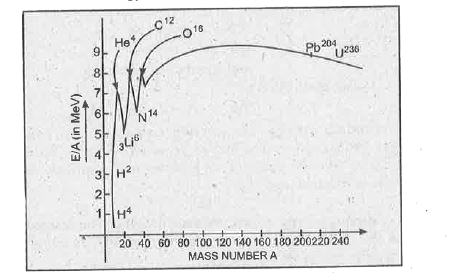
|
|
| 48. |
When a p-n junction diode is reverse baised, then: |
|
Answer» no current flows 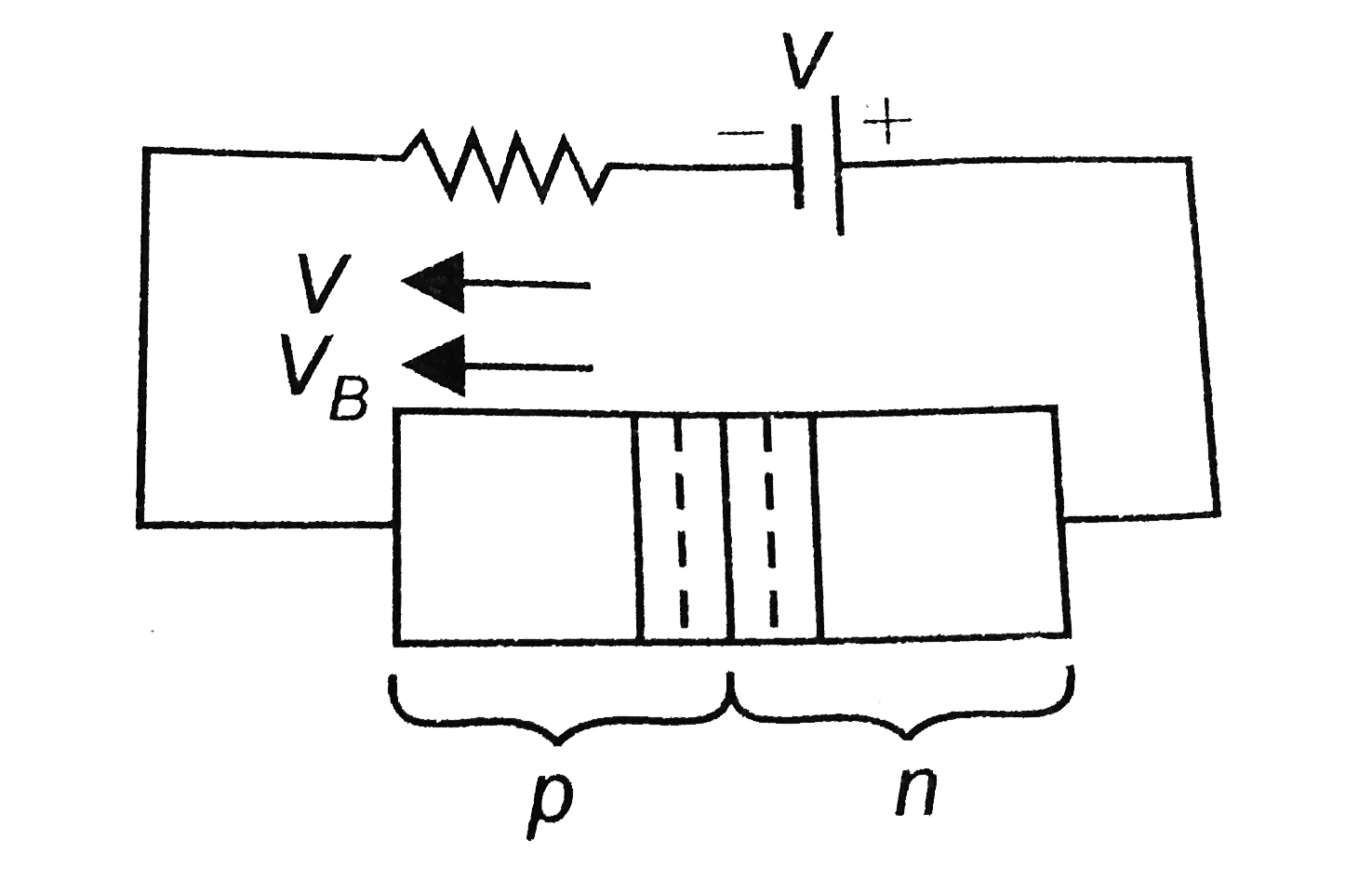
|
|
| 49. |
In a step up transformer the ratio of number of turns in primary and secondary coils is 1 : 10. If the transformer is an ideal one and its primary is connected to 220 V mains, the voltage developed across secondary coil is ………….. |
|
Answer» <P> SOLUTION :`V_(s) =V_(p) N_(s)/N_(p) = 220 XX (10) = 2200 V` |
|
| 50. |
Two coils of wires A and B are mutually at right angles to each other as shown in the figure. If the current in one coil is changed, then in the other coil |
|
Answer» No CURRENT will be induced |
|