

Saved Bookmarks
This section includes 7 InterviewSolutions, each offering curated multiple-choice questions to sharpen your Current Affairs knowledge and support exam preparation. Choose a topic below to get started.
| 1. |
If dielectric constant and dielectric strength be denoted by K and X respectively, then a material suitable for the use as a dielectric in a capacitor must have |
|
Answer» HIGH K and high X |
|
| 2. |
Which of the following statements is not correct for the given compounds P & Q ? |
|
Answer» P `&` Q are tautomers 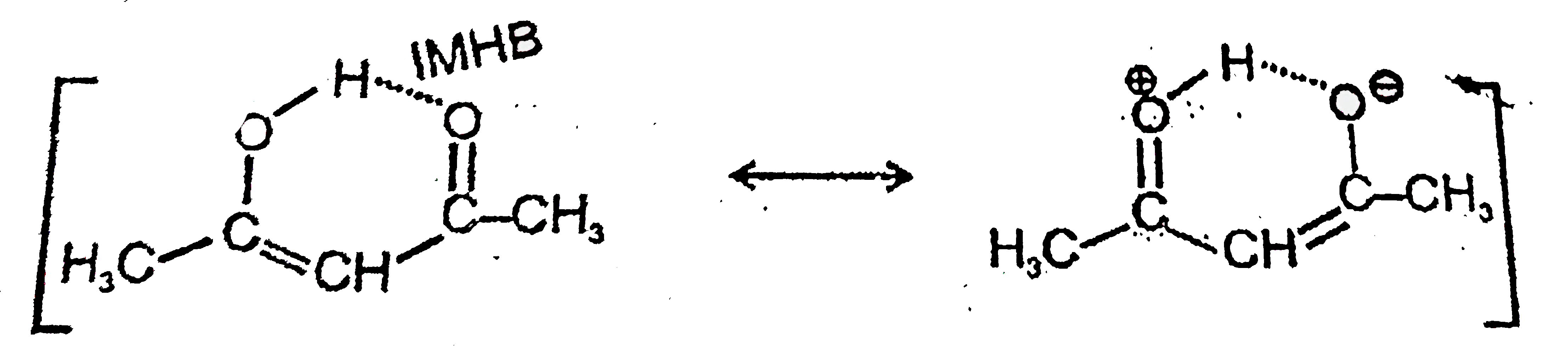
|
|
| 3. |
._(2)He^(3) and He_(1)^(3) nuclei have the same mass number. Do they have the same binding energy? |
| Answer» Solution :No. `._(2)He^(3)` and `._(1)He^(3)` nuclei have the same MASS number, but the BINDING energy of `._(1)He^(3)` has 1 proton and 2n. The REPULSIVE force between protons is missing in `._(1)He^(3)` . | |
| 4. |
The minimum force required to move a body up an inclined plane is three times the minimum force required to prevent it from sliding down the plane. if co- efficinet of firction between the body and inclined plane is (1)/(2sqrt3) the angle of inclined plane is |
|
Answer» `60^(@)` |
|
| 5. |
When ""_(3)^(7)Li is bombarded by protons, the resultant nuclie is ""_(4)^(8)Be, then emitted particle is : |
| Answer» Answer :D | |
| 6. |
If the rms current in a 50 Hz ac circuit is 5 A,the value of the current 1/300s after its value becomes zero is _____ |
|
Answer» `5sqrt2A` `therefore I_m = sqrt2xxI_(rms)=sqrt2xx5A` Now `t=1/300`s `I=I_m sin omegat` `=5sqrt2sin 2pivt` `=5sqrt2sin 2pixx50xx1/300` `=5sqrt2"sin"pi/3` `=5sqrt2 XX sqrt3/2` `=5sqrt(3/2)`A |
|
| 7. |
A box of mass 25 kg starts from rest and slides down an inclined plane 8 meter long and 5 meter high. It is found to move at the bottom at 7 m/s. What is the force of friction |
|
Answer» 79.6 N |
|
| 8. |
A proton and an alpha particle, both initially at rest, are accelerated so as to have the same kinetic energy. What is the ratio of their de-Broglie wavelength ? |
|
Answer» <P> SOLUTION :de-Broglie wavelength,`lambda = (h)/(p) = (h)/(sqrt(2 mK))` i.e. `lambda prop (1)/(sqrt(m)) ""[m_(ALPHA) = 4 m_(p)]` `(lambda_(p))/(lambda_(alpha)) = sqrt((m_(alpha))/(m_(p))) = sqrt((4 m_(p))/(m_(p))) = sqrt((4)/(1)) = (2)/(1)` `lambda_(p) : lambda_(alpha) = 2 : 1` |
|
| 9. |
Can you suggest any similarity between the magnetic field produced by electric current and electric field produced by charges? |
| Answer» SOLUTION :Both OBEY INVERSE SQUARE LAW. | |
| 10. |
An electric field E is produced between two parallel plates having a separation d as shown. (a) With what minimum speed should an electron be projected from the lower plate in the direction of field so that it may reach the upper plate ? (b) Suppose the electron is projected from the lower plate with the speed calculated in part (a). The direction of projection makes an angle of 60^(@)with the field. Find the maximum height reached by the electron. (c ) After how much time , the electron again strikes the lower plate ? (d) Horizontal distance travelled by the electron in time calculated in part (c ). Charge on electron : e ,mass of electron : m, consider only electric force. |
|
Answer» Solution :(a) Force on electron `F = eE`, in downward direction. Let the electron be thrown with speed `u`. Retardation of electron `a = (e E)/(m)` The electron just reaches the upper plate i.e. its velocity at upper plate is zero. `v^(2) = u^(2) - 2 as` `0 = u^(2) - (2e Ed)/(m) rArr u = sqrt((2e Ed)/(m))` Note : This problem is SIMILAR to motion under gravity ,here `g = eE//m`. (B) This is the case of motion in a plane and similar to PROJECTILE motion , here `g = eE//m`. `y`-direction : Velocity of electron at highest point `= 0`. `v_(y)^(2) = u_(y)^(2)- 2 a_(y) s` when `s = H_(max) ,v_(y) = 0`. `0 = (u sin 30^(@))^(2) - 2 (e E)/(m) H_(max)` `H_(max) = (u^(2) sin^(2) 30^(@))/(2 eE//m) = (2eEd)/(m) .(1)/(4) .(1)/(2e E//m)` `= (d)/(4)` (c) `O` to `A` : Displacement in y-direction is zero. `y = u_(y)t - (1)/(2) a_(y) t^(2)` `0 = u sin 30^(@) t - (1)/(2) a_(y) t^(2)` `t = (2 u sin 30^(@))/(a_(y)) = 2 sqrt((2 eEd)/(m)) .(1)/(2) .(1)/(eE//m)` `= sqrt((2 MD)/(eE))` (d) Distance `OA : x` -direction `x = u_(x)t = u cos 60^(@) t` `= sqrt((2 eEd)/(m)) .(1)/(2) sqrt((2md)/(eE)) = d` Note : This case is similar to projectile motion , MAXIMUM height , time of flight and range are being asked. 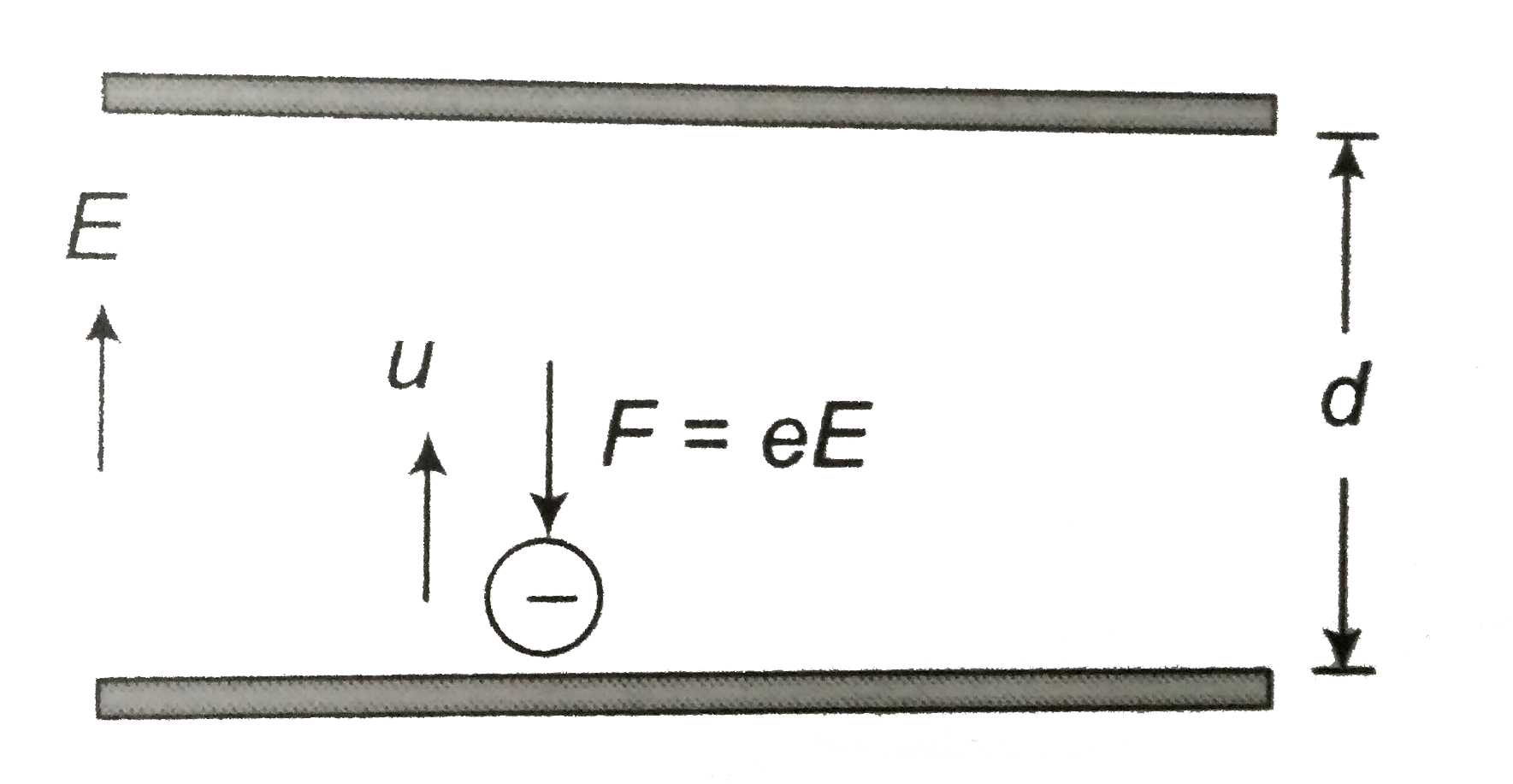 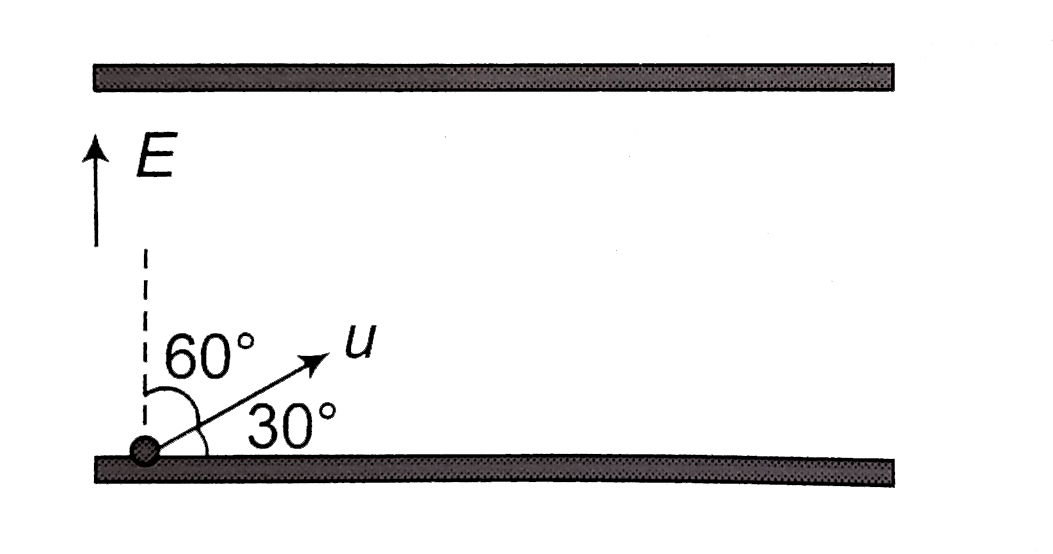 
|
|
| 11. |
The intensity of gamma- rays falls to 1/8th of its value after passing through 27 mm of lead toil. What should be thickness of the foil to reduce intensity of gamma- rays of its original value? |
|
Answer» 24 mm Here, `mu="absorption coefficient of FOIL"` x=thickness of the foil First case : `I_(0)/8=I_(0) e^(-27mu)` `1/8=e^(-27mu)` or `(1/2)^(3)=(e^(-9mu)^(3)` `therefore 1/2 =e^(-9mu)` `or 1/2 I_(0)=I_(0) e^(-9mu) ............(2)` Comparing with equation (1) intensity is reduced to `1/2 I_(0)` when x=9mm |
|
| 12. |
What does M. Hamel's motionless posture reflect? |
|
Answer» the SCHOOL is dismissed |
|
| 13. |
{(a,1),(b,1),(c,1),(d,1)} प्रतिचित्रण होगा |
|
Answer» अचर प्रतिचित्रण |
|
| 14. |
The SI unit of displacement current is |
|
Answer» Henry |
|
| 15. |
Agonic lines are |
|
Answer» ZERO DECLINATION |
|
| 16. |
For unit magnification, the distance of an object from a concave mirror of focal length 20 cm will be : |
|
Answer» 20 cm |
|
| 17. |
The quark content of proton and neutron are respectively |
|
Answer» UDD,udd |
|
| 18. |
The correct relation between magnitude of f_(1) and f_(2) in above problem is : (A) f_(1) gt f_(2)(B) f_(2) gt f_(1)(C ) f_(1) = f_(2)( D) not possible to decide due to insufficient data. |
|
Answer» Solution :By Newtons' third law the above FRICTION forces are action-reaction pair and equal but OPPOSITE to each other in direction. HENCE ( C ) . Also NOTE that the direction of kinetic friction has nothing to do with APPLIED force F. |
|
| 19. |
A charge of 8mC is located at the origin. Calculate the work done in taking a small charge of -2 xx 10^(-9)C from a point P (0,0,3 cm) to a point Q(0,4cm,0), via a point F (0.6 cm, 9cm). |
|
Answer» SOLUTION :q=8mC `=8 xx 10^(-3)C q_(0)=-2 xx 10^(-9)C` Work DONE =change in PE `U_(1)=(1)/(4pi epsi_(0)) (q_(1)q_(2))/(r_(1)r_(2))=(9 xx 10^(9) xx 8 xx 10^(-3) xx (-2) xx 10^(-9))/(3 xx 10^(-2))` `U_(2)=(9 xx 10^(9) xx 8 xx 10^(-3) xx -2 xx 10^(-9))/(4 xx 10^(-2))` `U_(2)-U_(1)=(9 xx 10^(9) xx 8 xx 10^(-3) xx 2 xx 10^(-9))/(10^(-2)) {1/3-1/4}=9 xx 8 xx 2XX 10^(-1) xx 1/(12)=1.2J` |
|
| 20. |
The near and far points of a person are at 40 cm and 250 cm respectively. Find the power of the lens he/she should use while reading at 25cm. With this lens on the eye, what maximum distance is clearly visible? |
|
Answer» Solution :If an object is placed at 25 cm from the correcting lens, it should produce the virtual image at 40 cm. Thus, `u=-25CM,v=-40,1/f=1/v-1/u=-1/(40cm)+1/(25cm)` or, `f=200/3cm=+2/3morP=1/f=+1.5D` The UNAIDED eye can see a maximum DISTANCE of 250 cm. Suppose the maximum distance for clear vision is d when the lens is used. Then the object at a distance d is imaged by the lens at 250 cm. We have, `1/v-1/u=1/for-1/(250CM)-1/d=3/(200cm)ord=-53cm` Thus, the person will be ABLE to see upto a maximum distance of 53 cm. |
|
| 21. |
According to Bohr's theory, hydrogen atom for an electron in the nth permissible orbit |
|
Answer» |
|
| 22. |
Explain about satellite communication in detail. |
|
Answer» Solution :(i) The satellite communication is a made of communication of signal between transmitter and receiver via satellite. The message signal from the Earth station is transmitted to the satellite on BOARD via an uplink (frequency band 6 GHz), amplified by a transponder and then retransmitted to another earth station via a downlink (frequency band 4 GHz) (III) The high-frequency radio wave signals TRAVEL in a straight line (line of sight) may come across tall buildings or MOUNTAINS or even encounter the curvature of the earth. (iv) A communication satellite relays and amplifies such radio signals via transponder to reach distant and far off place using uplinks and downlinks. It is also called as a radio repeater in sky. Application : (i) Weather Satellites : They are used to monitor the weather and CLIMATE of Earth. By measuring cloud mass, these satellites enable us to predict rain and dangerous storms like hurricanes, cyclones etc. (ii) Communication satellites : They are used to transmit television, radio, internet signal etc. Multiple satellite are used for lon distance. (iii) Navigation satellites : These are employed to determine the geographic location of ships, aircrafts or any other object. |
|
| 23. |
Two plano concave lenses of glass of refractive index 1.5 have radii of curvature of 20 and 30 cm. They are placed in contact with curved surfaces towards each other and the space between them is filled with a liquid of refractive index (4/3). Find the focal length of the system. |
| Answer» SOLUTION :`-72 CM` | |
| 24. |
Dr. Zakir Hussain was born in |
|
Answer» HYDERABAD |
|
| 25. |
A rectangular loop of sides 10 cm and 5 cm with a cut is stationary between the pole pieces of an electromagnet. The magnetic field of the magnet is normal to the loop. The current feeding the electromagnet is reduced, so that the field decreased from its initial value of 0.2 T at the rate of 0.02Omega. If the cut is joined and the loop has a resistance of 2.0Omega, then the power dissipated by the loop as heat is |
|
Answer» 5 nW `(dB)/(dt)=0.2Ts^(-1)rArrR=2Omega` `therefore"emf, e"=(dphi)/(dt)=A.(dB)/(dt)=50xx10^(-4)xx0.02=10^(-4)V` POWER dissipated in the form of heat `=(e^(2))/(R)=(10^(-4)xx10^(-4))/(2)=0.5xx10^(-8)W=5xx10^(-9)W=5nW` |
|
| 26. |
Use mirror equation to deduce that an object placed between the pole and focus of a concave mirror produces a virtual and enlarged image. |
|
Answer» Solution :For concave MIRROR `f lt 0 and u lt 0` `f lt u lt 0` `/f GT 1/u or 1/f-1/u gt 0` `1/v gt 0` Virtual image is formed ALSO `1/v lt 1/|u| or v gt |u|` `m=v/|u| gt 1` magnified image |
|
| 27. |
When a black coloured mineral is treated with KOH in presence of air a green coloured compund A is formed, find total electron(s) in e-orbitals of central metal of A by considering CFT. |
|
Answer» ----`t_2` ---E one ELECTRON in `e_g`. |
|
| 28. |
Two bodies A and B having same surface areas have emmissivities of 0.01 and 0.49 respectively. The two bodies emit total radiant power at the same rate. The wavelength A8 corresponding to maximum spectral radiancy 111 the radiation from B shifted from the wavelength corresponding to maximum spectral radiancy in the radiation from A by 1 µm. Jf temperature of A is 5200 K then, |
|
Answer» the TEMPERATURE of B is 26006K |
|
| 29. |
निम्न में से कौन-सी भौतिक राशि सरंक्षित नहीं की गई है? |
|
Answer» ऊर्जा |
|
| 30. |
In the following circuit C_1 = 900 mu F which is charged to a p.d of 100V and C_2= 100 mu F is an unchanged capacitorL = 10 henry . Explain how will you change C_2 to a.p.d of 300V by adjusting the switched S_1 and S_2 |
|
Answer» Solution :Energy of `C_1 = 1/2 C_1V^2 = 1/2 XX 900 xx 10^(-6) xx 100 xx 100` ` = 4.5 J` To charge `C_2` to a p.d. of 300 V, the energy needed ` = 1//2 C_2V^2` ` = 1//2 xx 100 xx 10^(-6) xx 300 xx 300 = 4.5 J` Now FIRST close `S_1` and open `S_2` . allow the charge on `C_1` to discharge completely and the energy is stored in the inductor . this happens during the first `1/4` th of the period of oscillation i.e.,`t_1 = T/4 = (2pi sqrt(LC_1) )/(4) = 0.15 sec ` upto 0.15 sec , ` S_1` should be closed and `S_2` should be OPENED . Now close `S_2` and open `S_1` so that the inductor begins to discharge and `C_2` gets completely charged during the next ` 1/4 th ` of period of oscillation . i.e.,`t_2 = T/4 = (2pi sqrt(LC_2) )/(4) = 0.05 sec ` Upto 0.05 sec , `S_2` is to closed and `S_1`is to be opened |
|
| 31. |
A point charge q_1 is placed inside cavity 1 and another point charge q_2 is inside cavity 2. A point charge q is placed outside the conductor. For the situation described above, answer the following questions. If the potential of the conductor is V_0 and charge q_2 is placed at the center of cavity 2, then potential at point Q is |
|
Answer» `q_2/(4piepsilon_0r'^2) + V_0` `=V_(0)+(q_(2))/(4piepsilon_(0)r_(2))=(q_(2))/(4piepsilon_(0))((1)/(r'_(2))-(1)/(r_(2)))+V_(0)` 
|
|
| 32. |
A copper wire has a resistance of 10Omega and an area of cross-section 1 m m^(2). A potential difference of 10 V exists across the wire. Calculate the drift speed of electrons if the number of electrons per cubic metre in copper is 8xx10^(28) electrons. |
|
Answer» Solution :Here, `R=10Omega, A=1 mm^(2)=10^(-6)m^(2), V=10V, n=8xx10^(28)"electrons/m"^(3)` Now, `I=enAv_(d)` `therefore (V)/(R )=enAv_(d)"" (or) v_(d)=(V)/(enAR)` `=(10)/(1.6xx10^(-19)xx8xx10^(28)xx10^(-6)xx10)=0.078xx10^(-3)ms^(-1)` `=0.078xx m ms^(-1)` |
|
| 33. |
A point charge q_1 is placed inside cavity 1 and another point charge q_2 is inside cavity 2. A point charge q is placed outside the conductor. For the situation described above, answer the following questions. If charge q_2 is at point Q (inside cavity 2), then vecE at the center of cavity 2 due to induced charge on the surface of cavity 2 would be |
|
Answer» `q_2//(4piepsilon_0r'_(2)^(2))` toward `q_2` 
|
|
| 34. |
A pipe.s lower end is immersed in water such that the length of air column from the top open end has a certain length 25 cm. The speed of sound in air is 350 m/s. The air column is found to resonate with a tuning fork of frequency 1750 Hz. By what minimum distance should the pipe be raised in order to make the air column resonate again with the same tuning fork? |
| Answer» ANSWER :D | |
| 35. |
A point charge q_1 is placed inside cavity 1 and another point charge q_2 is inside cavity 2. A point charge q is placed outside the conductor. For the situation described above, answer the following questions. vecE inside the conductor at point S distant r from point charge q, due to charge on outer surface of the conductor, would be |
|
Answer» `(Q+q_1+q_2)//4piepsilon_0r^2` away from charge q `vec(E)_(q)+vec(E)_(q_(1)+q_(2)+Q)=0` ltbr. Or `vec(E)_(q_(1)+q_(2)+Q)=-VER(E)_(q)=(q)/(4piepsilon_(0)r^(2))` TOWARD q 
|
|
| 36. |
When the magnitude of the current in a pure LC circuit is maximum, the energy is stored in |
|
Answer» the ELECTRIC FIELD of the CAPACITOR |
|
| 37. |
What is the angle between the plane of polarisation and the direction of propagation of beam of plane polarised light ? |
|
Answer» `0^(@)` |
|
| 38. |
A point charge q_1 is placed inside cavity 1 and another point charge q_2 is inside cavity 2. A point charge q is placed outside the conductor. For the situation described above, answer the following questions. If q_1 is at the center of cavity 1, then vecE at point S, at a distant r from the center of cavity 1(rgtr_1), due to the induced charge on outer surface of the conductor , would be |
|
Answer» `q_1//4piepsilon_0r^(2)` AWAY from the CENTER of cavity 1 `vec(E)_(q1)+vec(E)_(-q1)=0` `vecE_(-q1)=-vec(E)_(q1)=(q_(1))/(4piepsilon_(0)r^(2))` toward centre of cavity 1 
|
|
| 39. |
A source of sound of frequency 1000 Hz moves to the right with a speed of 32 m/s relative to the ground. To its right is a reflecting surface moving to the left with a speed of 64 m/s relative to the ground. Take speed of sound in air to be 332 m/s. |
| Answer» Solution :`(a) to (Q) , (B) to (p) , (c ) to (r ) , (d) to (s)` | |
| 40. |
The name magnet was derived from (Fe_2O_3) found near a city called ? |
| Answer» SOLUTION :MAGNESIA | |
| 41. |
A point charge q_1 is placed inside cavity 1 and another point charge q_2 is inside cavity 2. A point charge q is placed outside the conductor. For the situation described above, answer the following questions. The charge on outer surface of the conductor would be |
|
Answer» `Q+q_1+q_2` and nonuniformly distributed 
|
|
| 42. |
Photo electric effect can be explained only by assuming that light |
|
Answer» is a FORM of TRANSVERSE waves |
|
| 43. |
Identify the correct orderin which the value of normalreaction increases ( object is palcedon rough horizontal surface ) (i) The object is pushed with theforce F at an angle'q' with horizontal (ii) The object is pulled with the force F at an angle 'q'with horizontal (iii)The objectis pushed downwith the orce F normally (iv) The object pulledup with the force F normally |
|
Answer» I,ii,iii,iv |
|
| 44. |
Arrange the given electromagnetic radiations in the descending order of wavelengths : X-rays, radio waves, blue light, infrared light. |
| Answer» Solution :Radio WAVES, infrared LIGHT, BLUE light and X-rays. | |
| 45. |
A conducting spherical bubble of radius r and thick-ness t(t lt lt r) is charged to a potential V. Now it collapses to form a spherical droplet. Find the potential of the droplet. |
|
Answer» SOLUTION :Here charge and MASS are conserved. If R is the RADIUS of the resulting drop formed and `rho` is density of soap solution, `(4)/(3) piR^(3)rho=4pir^(2)t rho rArrR=(3r^(2)t)^(1//3)` Now potential of the bubble is `V=(1)/(4PI in_(0))(q)/(r )` or `q=4pi in_(0)rV` Now potential of resulting drop is `V^(1)=(1)/(4pi in_(0)) (q)/(R ) =((r )/(3t))^(1//3)V`. |
|
| 46. |
At breakdown region of a Zener diode, which of the following does not change much |
|
Answer» Current |
|
| 47. |
(a) Draw a labelled diagram of a stepup transformer. Obtain the ratio of secondary to primary voltage in terms of number of turns and currents in the two coils. (b) A power transmission line feeds input power at 2200 V to a step-down transformer with its primary windings having 3000 turns. Find the number of turns in the secondary to get the power output at 220 V. |
|
Answer» <P> Solution :(a) N/A(b) Here, `V_(p) = 2200 V, N_(p) = 3000` and `V_(s) = 220 V` `THEREFORE V_(s)/V_(p) = N_(s)/N_(p)` `RARR` Number of turns in the secondary coil `N_(s) = V_(s)/V_(p).N_(p) = (220 xx 3000)/(2200) = 300` |
|
| 48. |
Write the equivalent capacitance of a number of identical capacitors connected in parallel. |
Answer» SOLUTION : `C_P = ` effective capacitance of the CENTRE CAPACITORS in PARALLEL. `C_PV = C_1 V+ C_2V + C_3 V` ` C_P= C_1 + C_2 + C_3` |
|
| 49. |
A simple pendulum is suspended from the ceiling of trolley which is sliding down on a inclined plane of inclination theta. Find the angle made by the string with normal to the trolley (a) when trolley slides down with uniform velocity (b) when the plane is smooth. |
Answer» Solution :(a) Let T be tension in the string and the string makes an angle `alpha` with the normal to the TROLLEY.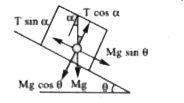 In EQUILIBRIUM, `T cos alpha = Mg cos THETA` `T sin alpha = Mg sin theta` `Tan alpha = Tan theta rArr alpha = theta` (b) When trolley is sliding on smooth inclined plane, the ACCELERATION trolley `a = g sin theta`. The bob of the pendulum EXPERIENCES a pseudo force .ma. opposite to the acceleration of the trolley. 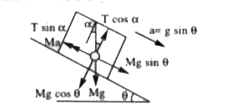 In equilibrium, `T sin alpha+Ma=Mg sin theta` `T sin alpha = Mg sin theta - Ma = Mg sin theta - Mg sin theta` `T sin alpha = 0 rArr sin alpha = 0 rArr alpha = 0` |
|
| 50. |
Derive the expression for the radius of nth Bohr's orbit in Hydrogen atom. |
|
Answer» Solution :We know that when an ELECTRON revolves in a stable orbit, the centripetal force is provided by electrostatic force of ATTRACTION acting on it due to a proton present in the nucleus. `therefore""(mv_(n)^(2))/(r_(n))=(1)/(4pi in_(0)).(e^(2))/(r_(n)^(2)) rArr v_(n)^(2)=(e^(2))/(4pi in_(0)mr_(n))"...(i)"` and from Bohr.s quantum condition, we have `mv_(n).r_(n)=(nh)/(2pi) or v_(n)=(nh)/(2pi mr_(n))"...(ii)"` Squaring (ii) and then EQUATING it with (i), we get `(n^(2)h^(2))/(4pi^(2)m^(2)r_(n)^(2))=(e^(2))/(4pi in_(0)m.r_(n))` `rArr""r_(n)=(n^(2)h^(2))/(4pi^(2)m^(2))xx(4piin_(0).m)/(e^(2))=(in_(0)h^(2))/(pime^(2)).n^(2)` |
|