

Saved Bookmarks
This section includes 7 InterviewSolutions, each offering curated multiple-choice questions to sharpen your Current Affairs knowledge and support exam preparation. Choose a topic below to get started.
| 1. |
What type of charge carriers are there ina p-type semiconductor ? |
| Answer» Solution :It contains both types of charge CARRIERS. Here HOLES are MAJORITY carriers and electrons are minority carriers. | |
| 2. |
Show that a bar magnet behaves as an equivalent current carrying solenoid. |
Answer» Solution : Let .a. be radius of solenoid of length 2l. To calculate magnetic field at a point on the a x is of a solenoid, consider a small element of thickness ‘dx. of solenoid at a distance .x. from .O.. Number of TURNS in this element =n.dx If current .l. flows through element n dx the magnitude of magnetic field at ‘P. due to this element is `dB = (mu_0)/(4pi) (2pi (ndx) Ia^2)/([(r -x)^2 + a^2]^(1//2) )` If point .P. is at large distance from .O. i.e., r >>x and r >> a then `[(r -x)^2 +a^2] = r^2` `dB = (mu_0)/(4pi) (2pi (ndx) Ia^2)/((r^2)^(3//2))` ` dB = (mu_0)/(4pi) (2pi (ndx) Ia^2)/(r^3)` The TOTAL magnetic field at .P. due to the current .I. in solenoid is `B = int_(-1)^1 dB = int_(-1)^(1) (mu_0)/(4pi) (2pi n I a^2 dx)/(r^3)` `B = (mu_0)/(4pi) (2pi nIa^2)/(r^3) int_(-1)^1 dx ` `B = (mu_0)/(4pi) (2pi nIa^2)/(r^3) [x]_(-1)^1` `B = (mu_0)/(4pi) (2pi nIa^2)/(r^3) [l+l]` `B = (mu_0)/(4pi) (2In pi a^2 2l)/((r )^3)` `B = (mu_0)/(4pi) (2In A.2l)/(r^3) "" ( because pia^2 = A)` `B = (mu_0)/(4pi) (2(n.2l)IA)/(r^3)` `B = (mu_0)/(4pi)( 2NIA)/(r^3)` `B = (mu_0)/(4pi) (2m)/(r^3)` This equation is similar to expression for magnetic field on the AXIS of a short BAR magnet. HENCE a solenoid carrying current behaves as a bar magnet. |
|
| 3. |
A non-relativistic enegry particle moves in a transverse uniform magnetic fiel with induction B. Find the time dependence of the particles's kinetic enegry diminshing due to radiation. How soon will its kinetic enegry decrease e-fold? Calculate this time interval for the case (a) of an electron, (b) of a proton. |
|
Answer» <P> Solution :`R = (mv)/(eB)`.Then `P = (1)/(4piepsilon_(0))(2)/(3c^(3)) ((eV^(2))/(R ))^(2) = (1)/(4pi epsilon_(0)) (2)/(3c^(3)) ((e^(2)BV)/(m))^(2)` `= (1)/(3piepsilon_(0)c^(3)) ((B^(2)e^(4))/(m^(3))) T` This is the radiated power so `(dT)/(dt)=- (B^(2)e^(4))/(3piepsilon_(0)m^(3)c^(3))T` Intergrating `T = T_(0)e^(-v//TAU)` `tau = (3piepsilon_(0)m^(3)c^(3))/(B^(2)e^(4))` `tau` is `(1836)^(3) ~~ 10^(10)` times less for an electorn than for a proton so electrons radiate away THERI enegry mush fatser in a MEGNETIC field. |
|
| 4. |
Pyrometeris deviceto measure |
|
Answer» Very LOW temperature |
|
| 5. |
Write the formula for Doppler shift for light." |
|
Answer» Solution :When the source of light and the observer are in relative motion then the frequency of light is different than the frequency EXPERIENCED by observer. This is known as the Doppler effect. For example : If there is no medium and the source moves away from the observer, then later wavefronts have to travel a greater distance to each the observer and hence take a longer time. The time taken between the arrival of two successive wavefronts is hence longer at the observer than it is at the source. Thus, when the source moves away from the observer the frequency as measured by the source will be smaller. This is known as the Doppler effect. The increase in WAVELENGTH due to Doppler effect as red SHIFT since a wavelength in middle of the visible region of the spectrum moves towards the red end of the spectrum. When waves are received from a source moving towards the observer there is an APPARENT decrease in wavelength this is referred to as blue shift. In the case of visual light, the frequency increases when the source is coming closer to the observer and the frequency DECREASES as it goes away. Second method : In the case of visual light, the frequency decreases, means the frequency of light comes closer to red light then this phenomenon is called red shift and if frequency increases means the frequency of light comes closer to blue light, then this phenomenon is called blue shift. General equation for Doppler effect for sound is `(v_(L))/(v+v_(L))=(v_(S))/(v+v_(S))` where `v_(L)` and `v_(S)` are the frequencies experience by observer and emitted by source respective v = velocity of sound `v_(L)=` velocity of observer `v_(S)=` velocity of source In case of light, velocity of light c instead velocity of sound v and frequency of source is and frequency experienced by observer is then, `(v_(L))/(c+v_(L))=(v_(S))/(c+v_(S))` `:.(v_(L))/(v_(S))=(c+v_(L))/(c+v_(S))` but if observer is stationary then `v_(L)=0` `:.(v_(L))/(v_(S))=(c)/(c+v_(S))` `:.` Fractional change in frequency, `=(v_(L)-v_(S))/(v_(S))=(c-c-v_(S))/(c+v_(S))` `:.(Deltav)/(v_(S))=-(v_(S))/(c+v_(S))""["":.v_(L)-v_(S)=Deltav]` `:.(Deltav)/(v_(S))=-(v_(S))/(c)""["":.v_(S)` is neglected compare to c in denominator] `:.Deltav=-(v_(S))/(c)xxv_(S)` which is the formula for Doppler shift. When source moves away from observer, `v_(S)` is considered as positive. This formula is true when the speed of source is lower than that of light. The direction of motion of celestial bodies can be determined using this. |
|
| 6. |
For photosensitive surface threshold wavelength is 5200Å .When monochromatic radiation of ……is incident on this surface,photoelectron will be emitted. |
|
Answer» Infraredbulb of power 1 W Which lies in uyltraviolet region .It will not DEPEND on power so for any power but wavelength `le` 5200 Å photo-electric emission will TAKE place. |
|
| 8. |
Considerthe following statements: Ultrasonic wavescan be used to (1) Transform two immiscible liquids like water andoil into a stable emulsion (2) Detect blowholes and cracksinside mould (3) Remove dirt , stain and dust particles in clothesof these statements . |
|
Answer» 1 and 2 are CORRECT . |
|
| 9. |
Can you give any situation where Gauss.s law cannot be helpful? |
| Answer» Solution :Consider an electric dipole. The field does have axial SYMMETRY about the dipole axis but there is no simple surface over which normal COMPONENT of `bar(E )` is constant. So, practically it is DIFFICULT to apply Gauss.s LAW to such a system even though the law is valid in this situation. | |
| 10. |
A glass slab of thickness 3 cm and refractive index 3/2 is placed on ink mark on a piece of paper. For a person looking at the mark at a distance 2 cm above it, the distance of the mark will appear to be in cm |
|
Answer» 4 cm |
|
| 11. |
The work done by the charge Q through displacement Delta vecr = a hati +b hatj in electric field vecE= E_(1)hati +E_(2) hatj is ............ |
|
Answer» `Q [E_(1)a +E_(2)B]` `=Q (E_(1) hat+E_(2)HATJ). (ahati+b hatj)` `:. W = Q ( E_(1) a +E_(2)b)` |
|
| 13. |
In previous question, the radiation froce on the roof will be: |
|
Answer» `8.53xx10^(-5) N` `=(1.6xx10^(5))/(3xx10^(8))=5.32xx10^(-4) N` |
|
| 14. |
A particle is dropped from a height H. The de Broglie wavelength of the particle as a function of height is proportional to : |
|
Answer» H |
|
| 15. |
A current carrying circular loop lies on a smooth horizontal plane. Can a uniform magnetic field be set up in such a manner that the loop turns around itself(i.e. turns about vertical axis) |
| Answer» Solution :(a) No, because that would require `tau`to be in the vertical direction. But `tau = IA xx B` ,and SINCE A of the horizontal loop is in the vertical direction, τ would be in the plane of the loop for any B. (b) Orientation of stable equilibrium is ONE where the area vector A of the loop is in the direction of external magnetic field. In this orientation, the magnetic field produced by the loop is in the same direction as external field, both normal to theplane of the loop, thus giving rise to maximum FLUX of the total field. (c) It assumes circular shape with its plane normal to the field to maximise flux, since for a GIVEN perimeter, a circle ENCLOSES greater area than any other shape. | |
| 16. |
Consider the condition shown in the figure. Pulley is massless and frictionless, springs are massless. Both the blocks are released with the springs in their natural lengths. Choose the correct options. |
|
Answer» MAXIMUM elongation in the spring `S_(1)` is `(4m_(1)m_(2)g)/(K_(1)(m_(1)+m_(2)))`  Now at maximum elongation of spring is x `a_(2//1)=2 g-k_(eq)xx(1/(m_(1))+1/(m_(2)))` `vdv=[2g-k_(eq)xx((m_(1)+m_(2))/(m_(1)m_(2)))]dx` `rArr x_(max)=(4m_(1)m_(2)g)/(K_(eq)(m_(1)+m_(2)))` `k_(1) x_(1)=k_(2)x_(2)=k_(eq)x` |
|
| 17. |
Partial observation of matter waves is possible only when de Broglie wavelength is of the order of the size of ___ in nature. |
| Answer» SOLUTION :PARTICLE | |
| 18. |
Find the refractive index of a medium through which light travels with a velocity of 2xx10^8ms^-1 ? |
| Answer» SOLUTION :`MU`=C/V, v=`2xx10^5ms^-1`,C=`3xx10^8ms^-1`.,`mu=3xx10^8/2xx10^8=3/2 or mu=15` | |
| 19. |
AB and CD are long straight conductor, distance d apart, carrying a current I. The magnetic field at the midpoint of BC is |
|
Answer» `(-mu_(0)I)/(2pid)HATK` |
|
| 20. |
Find the a. maximum frequency, and b. minimum wavelength of X-rays produced by 30 kV electrons. |
|
Answer» Solution :`V=30kV=30xx10^(3)V, K_("max")=eV=1.6xx10^(-10)xx30xx10^(3)` a. `h upsilon=eV` `upsilon=(E )/(h)V=(1.6xx10^(-19)xx30xx10^(3))/(6.62xx10^(-34))=7.25xx10^(18)Hz` b. `v=upsilon lambda` `lambda=(v)/(upsilon)=(3xx10^(8))/(7.25xx10^(18))=0.414xx10^(-10)m=0.0414xx10^(-9)m=0.0414 nm` |
|
| 21. |
The refracting angle of an equilateral prism is A. Derive an expression for the angle ofdeviation for a ray of light incident on the refracting surface of the prism. Draw a neat curve to show the variation of deviation with angle of incidence of the incident ray. |
| Answer» | |
| 22. |
One of the rectangular components of a velocity of 20ms^(-1) is 10 ms^(-1) Find the other component. |
|
Answer» `10 sqrt(3) MS^(-1)` |
|
| 23. |
An alpha nucleus of energy 1/2 m vartheta^(2) bombards a heavy nuclear target of charge Ze. Then the distance of closset approach for the alpha nucleus will the proportional to |
|
Answer» `(1)/(VARTHETA)` |
|
| 24. |
Meaning of the term 'creed': |
|
Answer» a set of FUNDAMENTAL beliefs |
|
| 25. |
Electrons with de-Broglie wavelength lamda fall on the target in an X-ray tube. The cut-off wavelength of the emitted X-rays is: |
|
Answer» `lamda_(0)=(2mclamda^(2))/(h)` `LAMBDA=(h)/(p)=(h)/(sqrt(2mK))` `or K=(h^(2))/(2mlambda^(2))` CUT of wavlength of X-ray is RELATED to K.E. as `(hc)/(lambda_(0))=K=(h^(2))/(2mlambda^(2))` `rArr lambda_(0)=(2mclambda^(2))/(h)` |
|
| 26. |
A movie projector forms an image 3.5 m long of an object 35 mm. Supposing there is negligible absorption of light by aperture then illuminance on slide and screen will be in the ratio of |
|
Answer» `100 :1` |
|
| 27. |
An organ pipe P_(1)closed at one end and vibrating in its first overtone, and another pipe P_2 open at both ends and vibrating in its third overtone, are in resonance with a given tuning fork. The ratio of the length of P_(1)to that of P_2 is: |
|
Answer» `8/3` |
|
| 28. |
How many electrons must be removed from a piece of metal to give it a positive charge of 1.0 xx 10^(-7)C |
|
Answer» `6.25 XX 10^(11)` |
|
| 29. |
What is meant by specific binding energy ? |
|
Answer» SOLUTION :It is the RATIO of total binding ENERGY of the nucleons to the NUMBER of nucleons present in a nucleons `["or" ("Total B.E.")/( "A") = "Specific BE"]` |
|
| 30. |
What is electromagnetic wave ? |
| Answer» SOLUTION :An electromgnetic WAVE is a wave radiated by an ACCELERATED charge and which PROPAGATES hrough space as coupled electric and magnetic fields | |
| 31. |
Crystalline substances have a sharp melting point . Why ? |
| Answer» Solution :This is DUE to the fact that all the BONDS in a crystal get ruptured at a UNIQUE fixed TEMPERATURE for that crystal and at the fixed temperature the crystal changes into liquid state . | |
| 32. |
Using logarithmic tables, evaluate: (0.02467)^(2/3) |
|
Answer» Solution :`x=(0.02467)^((2)/(3))` `IMPLIES LOGX=(2)/(3)log0.02467=2xxbar(2).3921=bar(2).9281` `impliesx="ANTI "logbar(2).9281=0.08474` |
|
| 33. |
An electric charge is placed at the centre of a cube of side a. The electric flux through one of its foces will be |
|
Answer» `(q)/(6 epsilon_(0))` |
|
| 34. |
Assertion (A) : Electron has higher mobility than hole in a semiconductor. Reason (R) : Mass of electron is less than that of hole. |
| Answer» SOLUTION :The REASON is FALSE. | |
| 35. |
Eddy currents in the core of transformer can't be developed by |
|
Answer» INCREASING the NUMBER of turns in SECONDARY coil |
|
| 36. |
A ray of light passes from glass (mu = 1.5) to water (mu = 1.33). The value of the critical angle of glass is .......... |
|
Answer» `SIN^(-1)(8/9)` `therefore C=sin^(-1)(1/n)` …...........(1) Here light RAY enter from to WATER, so relative refractive index will be taken.`therefore n=(n_g)/(n_w)=(1.5)/(1.33)` `therefore1/n=(1.33)/(1.5)=8/9` From equation (1), `C=sin^(-1)(8/9)` |
|
| 37. |
In the above question, the displacement of particle at t = 1 sec and x = 4 cm is: |
|
Answer» 4 cm `y = 2sin" (2pi)/(lambda) (24t - x)` t = 1, x = 4CM `y = 2sin ((2pi)/(16) xx20)` = `2sin(2pi + (pi)/(2)) = y = 2cm` |
|
| 38. |
In how many of following species positive charge is delocalized ? |
Answer» 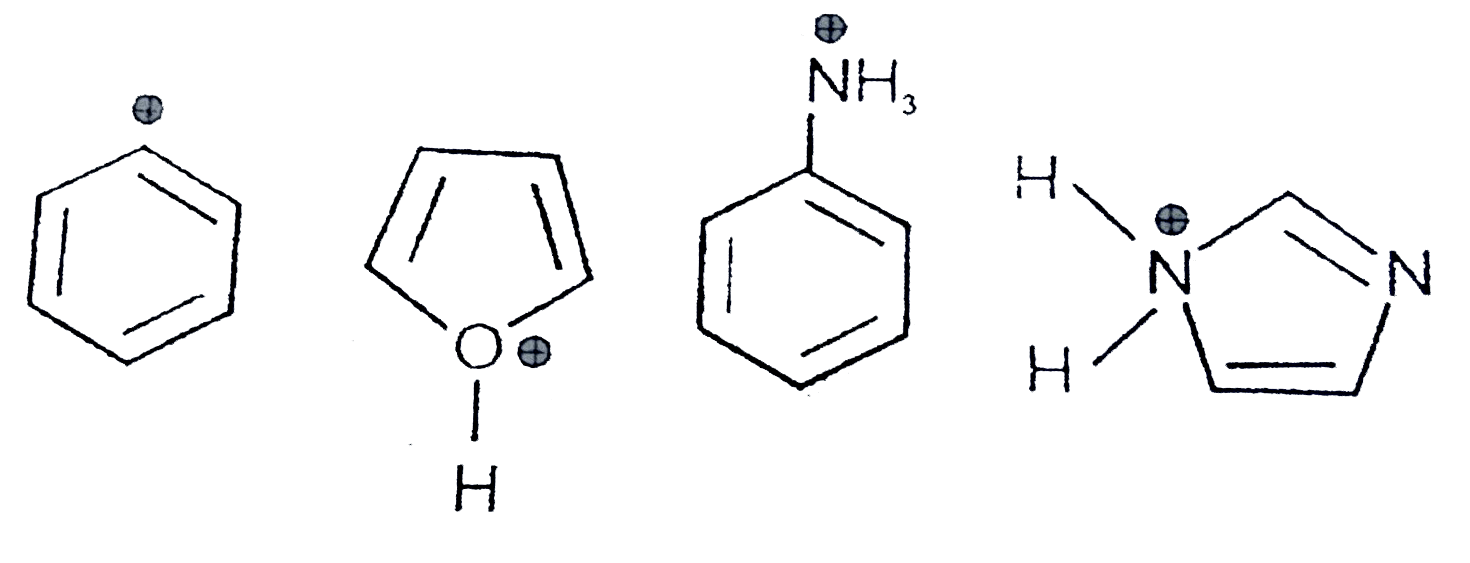
|
|
| 39. |
Which of the following is an application of eddy currents? |
|
Answer» LUX meter |
|
| 40. |
यदि p(x)=2x^2-7x+3 तो p(0) का मान है |
|
Answer» 3 |
|
| 41. |
Calculate the electrostatic force and gravitational force between the protos and the electron in a hydrogen atom. They are separated by a distance of 5.3xx10^(11) m. The magnitude of charges on the electron and proton are 1.6xx10^(-19) C.M Mass of the electrons is m_(e)=9.1xx10^(-31) kg and mass of proton is m_(p)=1.6xx10^(-27) kg . |
|
Answer» <P> Solution :The proton and the electron attract other . The magnitude of the electrostatic force between these two particles is given by`F_(e)=(ke^(2))/(r^(2))=(9xx10^(9)xx(1.6xx10-19)^(2))/((5.3xx10^(-11))^(2))=(9xx2.56)/(28.09)xx10^(-7)=8.2xx10^(-8)`N The gravitational force between the proton and the electron is ATTRACTIVE . The magnitude of the gravitational these particles is `F_(G)=(Gm_(e)m_(p))/(r^(2))=(6.67xx10^(-11)xx9.1xx10^(-31)xx1.6xx10^(-27))/((5.3xx10^(-11))^(2))=(97.11)/(28.09)xx10^(-47)=3.4xx10^(-47)N` The ratio of the two forces `(F_(e))/(F_(G)) =(8.2xx10^(-8))/(3.4xx10^(-47))=2.41xx10^(39)` Note that `F_(e)~~10^(39)F_(G)` The electrostatic force between a proton and an electron is enormously greater than the gravitational force between them. Thus the gravitational force is negligible when compared with the electrostatic force in many situations such as for small size objects and in the atomic domain . This is the reason why a charged comb attracts an uncharged piece of paper with greater force even though the piece of paper is attracted DOWNWARD by the Earth . 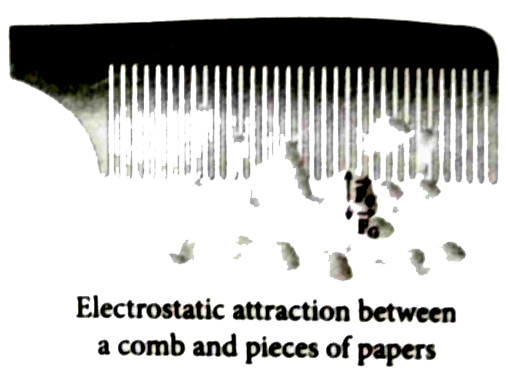
|
|
| 42. |
A ball is projected from the ground with speed u at an angle alpha with horizontal. It collides with a wall at some distance from the point of projection and returns on the same level. Coefficient of restitution between the ball and the wall is e, then time taken in path AB and maximum height attained by the ball is |
|
Answer» `( a )/(EU cos alpha) , ( U^(2) SIN^(2) alpha)/( 2G)` |
|
| 43. |
State Ampere's circuital law, expressing it in integral form. |
| Answer» Solution : The line integral of magnetic field (B) around any closed path in VACUUM is u 0 times the net CURRENT (I) THREADING the AREA ENCLOSED by the curve. | |
| 44. |
An electric bulb has a rating 500W, 100V. It is used in a circuit having a 200V supply. What resistance must be connected in series with the bulb so that it delivers 500 W ? |
|
Answer» `10OMEGA` |
|
| 45. |
The range of voltmeter can be increased by four times by joining a resistance of 2.4kOmega (2400Omega)in series with it .The resistance of voltmeter is : |
|
Answer» `7.2KOmega` |
|
| 46. |
In a certain region of space, electric field is along the z-direction throughout. The magnitude of electric field is, however, not constant but increases uniformly along the positive z-direction, at the rate of 10^5 NC^(-1)per meter. What are the force and torque experienced by a system having a total dipole moment equal to 10^(-7)cm in the negative z-direction ? |
Answer» Solution :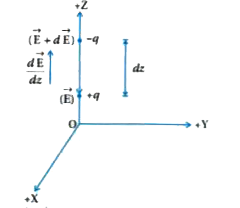 As shown in the figure, consider a point dipole (very tiny) with length dz, as shown in the figure. Its electric dipole MOMENT is, `vecp =(-vecdz)q` `therefore p = (dz)q`………..(1) Resultant electric FORCE EXERTED on above dipole by given electric field which is along + Z axis and increases with a rate `(dvecE)/(dz)`along + Z axis (as per the statement) is, `vecF = vecF_(+) + vecF_(-)` `=qvecE + (-q)(vecE + dvecE)` `=-qdvecE` `=-q (dvecE)/(dz) dz` `therefore vecF = -p (dvecE)/(dz)`............(2) (From equation (1)) Here, negative sign indicates that above force is along - Z axis. Taking magnitude, `F = p(dE)/(dz)` `=(10^(-7)) (10^(5))` `therefore F = 10^(-2) N` (Along -Z axis) Now, torque exerted on above dipole by the APPLIED electric field is, `tau = pEsin theta` `=pEsin 180^(@) (therefore vecp || -vecE)` `therefore tau =0` |
|
| 47. |
Two simple harmonic motions are represented by y_(1)=5[sin2pit+sqrt(3))cos2pi t] and y_(2)=5sin(2pit+(pi)/(4)). The ratio of their amplitude is : |
|
Answer» `1:3` `=10[(1)/(2)sin 2pi t+(sqrt(3))/(2)cos 2pi t]` `=10[cos""(pi)/(3)sin2pi t+sin""(pi)/(3)cos 2pi t]` `y_(1)=10 sin(2pi t+(pi)/(3))` `y_(2)=5sin(2pi t+(pi)/(4))` So ratio of amplitude of `y_(1)` and `y_(2)` is `(10)/(5)=(2)/(1)` So CORRECT choice is (d). |
|
| 48. |
A carrier wave of peak voltage 12 V is used to transmit a message signal. What should be the peak voltage of the modulating signal in order to have a modulation index of 75% ? |
|
Answer» Solution :Here , `E_C = 12 V ` , ` m_a = 75%= 0.75 , E_m = ?` We have , `E_("max")=E_m + E_c ` ` E_("min") = E_c -E_m` and `m_a = (E_("max") -E_("min"))/(E_("max") + E_("min"))` `=((E_m + 12) - (12-E_(m)))/((E_m + 12) + (12-E_m))` or ` 0.75 = (2E_m)/(24)` ` or E_m = 0.75 XX 12 = 9V` |
|
| 49. |
In an AC generator, the brushes in contact with the step rings alternatively become positive and negative in the time interval of 5 ms. What is the frequency of the voltage generated ? |
|
Answer» 200 Hz T=5 ms + 5 ms = 10 ms = 0.01 s `THEREFORE` Frequency `f=1/T=1/0.01`=100 Hz |
|
| 50. |
(A) : An electron and proton entres a magnetic field with equal velocities, then, the force experienced by proton will be more than electron. (R) : The charge of proton is 1837 times more than the charge of electron. |
|
Answer» Both 'A' and 'R' are TRUE and 'R' is the correct explanation of 'A'. |
|