

Saved Bookmarks
This section includes 7 InterviewSolutions, each offering curated multiple-choice questions to sharpen your Current Affairs knowledge and support exam preparation. Choose a topic below to get started.
| 1. |
The forbidden energy gap is maximum in |
|
Answer» metals |
|
| 2. |
A horizontal pipe line carries water in a streamline flow. At a point along the pipe where the cross-sectional area is 10cm^(2), the water velocity is 1 m/s and the pressure is 2000 Pa. What is the pressure of water at another point where the cross -sectional area is 5 cm^(2) ? |
| Answer» ANSWER :D | |
| 3. |
Boolean algerbra is essentially based on |
|
Answer» logic |
|
| 4. |
The dimensions of a wooden block are 1.1m xx 2.36 m x 3.1 m. The number of significant figures in its volume should be |
|
Answer» 1 |
|
| 5. |
What is electromagnetic spectrum ? |
| Answer» SOLUTION :An ordinary distribution of em. WAVES in accordance to their wave lengths or frequency into distinct groups having DIFFERING PROPRTIES is called electromagnetic spectrum. | |
| 6. |
Find the threshold wavelengths for photoelectric effect from a copper surface, a sodium surface and a cesium surface. The work functions of these metals are 4.5 e V, 2.3 eV and 1.9 eV respectively. |
|
Answer» Solution : If ` lambda_0` be the THRESHOLD wavelength and `varphi` be the work function, ` ( lambda_0)= hc/varphi` `= 1242 eV nm/varphi.` ` For COPPER, lambda_0=(1242 E V nm/ 4.5 e V) = 276 nm. ` ` For sodium, lambda_0= (1242e V nm/ 2.3 e V) = 540nm.` ` For cesium, lambda_0 = (1242 e V nm/ 1.9 e V) = 654 nm.` |
|
| 7. |
In a uniformly charged sphere of total charge Q and radius R the electric fieled E is plotted as a function of distance from the centre. The graph which would correspond to the above will be : |
|
Answer»
|
|
| 8. |
A neutron collides elastically with an initially stationary deuteron. Find the fraction of the kinetic energy lost by the neutron (a) in a head-on collision , (b) in scattering at right angles. |
|
Answer» `VEC(p)_(1)+vec(p)_(2)=vec(p)_(3)+vec(p)_(4)` or `p_(1)=p_(3)+p_(4)`.....(4) According conservation principle of kinetic energy `T_(1)+T_(2)=T_(3)+T_(4) or T_(1)=T_(3)+T_(4)` or `(p_(1)^(2))/(2m)=(p_(3)^(2))/(2m)+(p_(4)^(2))/(2m)` or `(p_(1)^(2))/(2m)=((p_(1)-p_(4))^(2))/(2m)+(p_(4)^(2))/(2m)` (from eqn.(i)) or `(p_(1)^(2))/(2m)=(p_(1)^(2)+p_(4)^(2)-2p_(1p_(4)))/(2m)+(p_(4)^(2))/(2m) or (p_(1)^(2))/(2m)=(p_(1)^(2))/(2m)+(p_(4)^(2))/(2m)+(p_(4)^(2))/(2m)` or `p_(4)((1)/(m)+(1)/(M))=(2p_(1p4))/(2m) or p_(4)((1)/(m)+(1)/(M))=(2p_(1))/(m)` or `p_(4)=((2M)/(m+M))p_(1)` `:. p_(4)^(2)=((2M)/(m+M))^(2)p_(1)^(2)`.....(II) `:.` Loss in kinetic energy of neuton `=Delta T_(1)=` gain in `K.E`. of deuteron `DeltaT_(1)=T_(4)=(p_(4)^(2))/(2M)` FRACTION =`(DeltaT_(1))/(T_(1))=(((2M)/(m+M))^(2)(p_(1)^(2))/(2M))/((p_(1)^(2))/(2m))` `eta=((2M)/(m+M))((m)/(M))=(4mM)/((m+M)^(2))` Here `M~~2m` `:.` Fraction in `eta=(8)/(9)=0.89` (b) According to conservation priciple of momentum, `vec(p)_(1)+vec(p)_(2)=vec(p)_(3)+vec(p)_(4)` or `vec(p_(1))+0=vec(p)_(3)+vec(p)_(4)` or `vec(p)_(1)-vec(p)_(3)^(2)-2p_(1)p_(3)+vec(p)_(4)` Applying parallelogram law of vectors `p_(1)^(2)+p_(3)^(2)-2p_(1)p_(3)cos 90^(@)=p_(4)^(2)` According to conservation principle of kinetic energy `T_(1)+T_(2)=T_(3)+T_(4)` or `T_(1)+0=T_(3)+T_(4)` or `(p_(1)^(2))/(2m)=(p_(3)^(2))/(2m)+(p_(4)^(2))/(2m)` or `(p_(1)^(2))/(2m)=(p_(3)^(2))/(2m)+(p_(1)^(2)+p_(3)^(2))/(2M)` or `(p_(1)^(2))/(2m)=(p_(3)^(2))/(2m)+(p_(1)^(2)+p_(3)^(2))/(2M)` or `(p_(1)^(2))/(2m)=(p_(3)^(2))/(2m)+(p_(1)^(2)+p_(3)^(2))/(2M)` or `(p_(1)^(2))/(2m)((1)/(m)-(1)/(M))=(p_(3)^(2))/(1)((1)/(m)-(1)/(M))` or `p_(1)^(2)(p_(1)^(2))/(2m)((M-m)/(mN))= +p_(3)^(2)((m+M)/(mM))` or `p_(3)^(2)=((m-M)/(m+M))p_(1)^(2)` `:.` Loss in kinetic energy of NEUTRON is `DeltaT=T_(1)-T_(3)` `=(p_(1)^(2))/(2m)-(p_(3)^(2))/(2m)=(p_(1)^(2)-p_(3)^(2))/(2m)` `eta=(DeltaT)/(T_(1))=((p_(1)^(2)-p_(3)^(2))/(2m))/((p_(1)^(2))/(2m))` `1-(p_(3)^(2))/(p_(1)^(2))=1-((M-m)/(M+m))(p_(1)^(2))/(p_(1)^(2))` `h=1-((M=m)/(M+m))=(2m)/(M+m)=(2)/(3)` 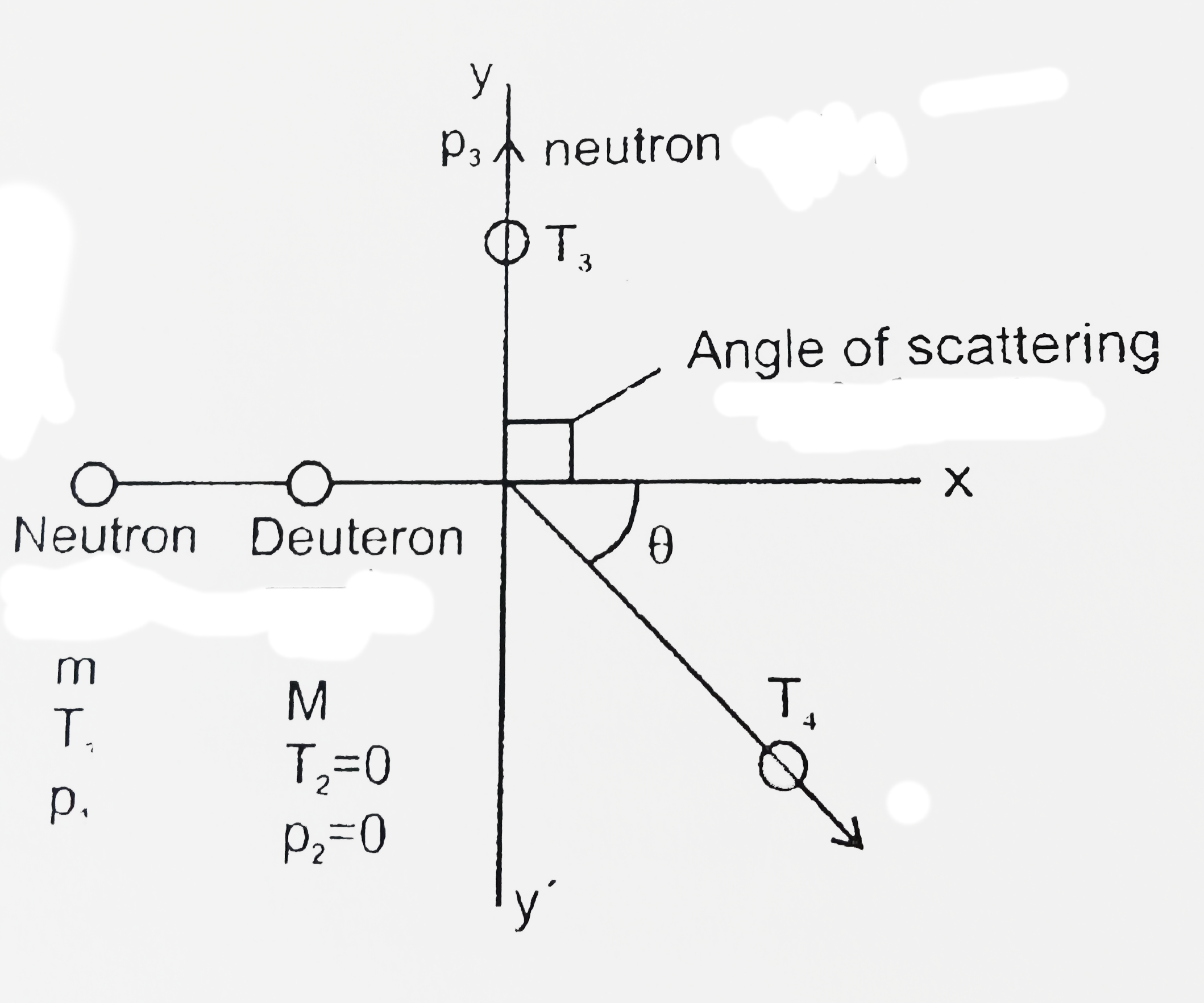
|
|
| 9. |
For an A.C. L-C-R series circuit at resonant frequency, which of the following is wrong ? |
|
Answer» Value of resistance is zero HENCE in L-C-R, A.C. circuit impedance `|z|=sqrt(R^2+(omegaL-1/(omegac))^2)` |z|=`sqrtR^2` `THEREFORE` |z|=R |
|
| 10. |
The workdone to bring a + IC charge from infinity to a point .P. is called |
|
Answer» capacitance |
|
| 11. |
The kinetic energy of an electron with de Broglie wavelenght of 0.3 nano metre is : |
|
Answer» `0.168 EV` |
|
| 12. |
What for ultraviolet rays are mostly used ? |
| Answer» SOLUTION :STERILIZING FOODS and UTENSILS. | |
| 13. |
The resolving power of a telescope can be increased by increasing |
|
Answer» wavelength of light |
|
| 14. |
A transistor is connected in CE configuration. The voltage drop across the load resistance (R_C) 3 ks is 6 V. Find the base current. The current gain alpha of the transistor is 0.97 Data : Voltage across the collector load resistance (R_C) = 6 V . alpha= 0.97 :R_C= 3 k Omega |
|
Answer» Solution :Thevoltageacross the collectorresistanceis`R_C= I_C R_C= 6V ` hence `I_C=(6 )/(RC )= ( 6 )/( 3 xx 10^3) =2mA` currentgai` beta= (a)/(1-a)= ( 0.97 )/( 1-0.97 ) = 32.33` ` thereforeI_B= (I_C )/(beta) = ( 2 xx 10^(-3))/( 32.33 )= 61.86mu A` |
|
| 15. |
Impact Parameter |
|
Answer» |
|
| 16. |
A potential of V = 3000 V is applied to a combination of four initially uncharged capacitors as shown in the figure. Capacitors A, B, C and D have capacitances C_(A)=6.0 muF,C_(B)=5.2 muF,C_(C)=1.5 muF and C_(D) = 3.8 muF, respectiely. If the battery is disconnected, then potential difference across capacitor B is (approximately) |
|
Answer» 3000 V |
|
| 17. |
प्रोकैरियोटिक कोशिका का केवल एक कोशिकांग है : |
|
Answer» माइटोकॉन्ड्रिया |
|
| 18. |
In a certain region, the electric potential is given by the formula V(x ,y, z) = 6xy - y + 2yz Find the components of electric field and the vector electric field at point (1, 1, 0) in this field. Find the vector of electric at (1, 1, 0). |
|
Answer» `-(6hati+9hatj+HATK)` `=-[(6y)hati+(6x-1+2z)HATJ+(2Y)hatk]` (1,1,0) ( NEAR point) `vecE= -[6hati +(6-1+0) hatj+2hatk]` `vecE = - [6 hati+5hatj+2hatk]` |
|
| 19. |
A capacitor block d.c. and allows a.c. to flow through it ? Explain. |
|
Answer» SOLUTION :The reactance of a capacitor is given by `X_c = 1/(2pifC)` i.e.,`X_c PROP 1/F` Frequency of d.c = f = 0, `X_c = INFTY` |
|
| 20. |
Sound waves do not exhibit |
|
Answer» interference |
|
| 21. |
The particles having position vectors vecr_1= (6hat i + 10hat j) meter and vecr_2=(-10hat i - 6hat j) meter are moving with velocities vecV_1 = (8hat i + 6hat j) m/s and vecV_2= (2alpha hat j + 14hat j) m/s. If they collide after 2 second, then value of alpha is |
|
Answer» 2 |
|
| 22. |
What is the angle of dip at a place, where the horizontal and vertical components of the earth's magnetic field are equal ? |
| Answer» Solution :`TAN DELTA =(B_V)/(B_H) = 1 ` , hence `delta =tan^(-1) (1) = 45^@ ` or `pi/4` | |
| 23. |
The base current in a transistor circuit changes from 45muA. Accordingly, the collector current changes from 0.2 mA to 0.400 mA. The gain in current is |
|
Answer» 9.5 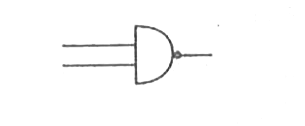
|
|
| 24. |
A simple pendulum with bob of mass m and conducting wire of length L swings under gravity through an angle 2 theta. The earth’s magnetic field component in the direction perpendicular to swing is B . Maximum potential difference induced across the pendulum is |
|
Answer» `2BL sin ((THETA)/(2)) (GL)^(1//2)` |
|
| 25. |
Which provides the basis for the observation that the universe is expanding? |
|
Answer» Newton's law of universal gravitation |
|
| 26. |
In the circuit shown, an ideal cell of emf E is connected in series to a non-ideal ammeter and voltmeter. Reading of the voltmeter is V_(0). When a resistance is added in parallel to the voltmeter its reading becomes (V_(0))/(10)and the reading of the ammeter becomes 10 times the earlier value. find V_(0) in terms of E. |
|
Answer» |
|
| 27. |
A pendulum is transported from sea-level, where the acceleration due to gravity g is 9.80m//s^(2), to the bottom of Death Valley. At this location, the period of the pendulum is decreased by 3.00%. What is the vaue of g in Death Valley? |
|
Answer» `9.22m//s^(2)` |
|
| 28. |
The primary winding of a transformer has 500 turns whereas its secondary has 5000 turns. The primary is connected to an A.C. supply 20 V, 50 Hz. The secondary will have an output of |
|
Answer» <P>2V, 50 Hz `(N_(s))/(N_(p))=(E_(s))/(E_(p))` or `(5000)/(500)=(E_(s))/(20)` or`E_(s)=(5000xx20)/(500)=200 V` and frequency remains the same. THEREFORE secondary winding will have an output of 200 V, 50 Hz. |
|
| 29. |
A circular loop of radius 0.1 m carriying a current of 20 A is held perpendicular th the unifrom magnetic induction of 0.02 telsa. The torque acting on this loop is : |
|
Answer» 0.5 `PI` Nm |
|
| 30. |
Explain the use of junction diode as a full wave rectifier by drawing circuit diagram and draw the form of input and output waves. |
Answer» Solution :The full wave rectifier is made of a transformer, two junction diode `D_(1) and D_(2)` and a load resistance `R_(L)`.  The primary coil of the transformer is connected to the a.c. supply. The p-side of the two DIODES are connected to the ends of the secondary of the transformerand both diodes are connected to the centre tap of the secondary by attaching the n-sides to the load resistance `R_(L)`. Each diode works only during half of the full cycle of a.c. simultaneously, and therefore during the full cycle of a.c. between the two ends of load resistance `R_(L)`, the current obtain in one direction which is called RECTIFIED (unidirectional) current. Full wave rectification can also be obtained using four junction diodes, which does not required a centre tap in the secondary. The voltage at B becomes positive during a.c. cycles when the voltage at A relative to the centre tap becomes negative so current does not flow from `D_(1)` (due to reverse bias) but current flow from `D_(2)` (due to forward bias) and current flow from load resistance `R_(L)` in X to Y direction. And when the diode A becomes forward bias and B becomes reverse bias during a.c. cycle, the current does not flow from diode B but current is flow in A so the current flows from load resistance `R_(L)` in the X to Y direction. HENCE, current flows from both diode simultaneously occur during the SUBSEQUENT a.c. cycle hence flows load resistance in one direction so D.C. voltage across the resistance is obtained. The input of both diode and the output waveform obtain from `R_(L)` in full wave rectifier is shown in below figure (c ).  The efficiency of a full wave rectifier is higher than the efficiency of a halfwave rectifier. |
|
| 31. |
Calculate the maximum kinetic energy of electrons emitted from a photosensitive surface of work function 3.2 eV, for the incident radiation of wavelength 300 nm. |
|
Answer» |
|
| 32. |
The maximum distance between the transmitting and receiving TV towers is D. If the heights of both transmitting and receiving tower are doubled then the maximum distance between them becomes. |
| Answer» ANSWER :A | |
| 33. |
According to Huygen's principal light is a front of |
|
Answer» particle |
|
| 34. |
Which has maximum b,p and m,p out of : |
|
Answer» I in both cases `M.pt. PROP MOL w.tprop"symmetry"` 
|
|
| 35. |
In the experiment of n assuring speed of sound by resonance tube, it is observed that for tunning fork of frequency v= 480 Hz, length of air column cm, I_(1) = 30 cm, I_(2) = 70 cm, then upsilon_(1) is equal to |
|
Answer» `338 MS^(-1)` |
|
| 36. |
What is an extrinsic semiconductor ? |
| Answer» SOLUTION :EXTRINSIC SEMICONDUCTOR is a pure semiconductor doped with controlled quantity of either a trivalent or a pentavalent IMPURITY. | |
| 37. |
A platform seating the source of sound emitting sound of frequency n and two detectors D_(1)and D_2 (S, D_(1) & D_2 are at rest with respect to.ihe platform) is moving with a constant velocity of 5ms^(-1) with respect to ground towards a vcrticarwall which in turn is moving away from the platform with a speed of 5 ms^(-1)with respect to ground. Stationary detectors D_3 and D_4 are positioned behind the platform and between the platform and the wall as shown in the figure. Speed of sound in still air is V= 340 ms^(-1) . Take lambda = V//n. In matching the two columns consider the sound received by the detectors directly from the source and also after reflection from the wall. Air is still with respect to ground. |
|
Answer» |
|
| 38. |
Frequency of cyclotron is independent of ……. |
|
Answer» radius of its TRAJECTORY |
|
| 39. |
Calculate the resolving power of a telescope whose objective has a diameter of 5.08 m and lambda = 6000 Å. |
|
Answer» |
|
| 40. |
A wire of Young's modulus 2 xx 10^11 N/m^2 is stretched by a force so as produce a stress of 4 xx 10^6 N/m^2 . The energy stored per unit volume of the wire is |
|
Answer» a)`2 xx 10^(-5) "joule"/m^3` |
|
| 41. |
Two coils each of self-inductance L are closely wound in series, if the sense of their winding arte opposite. The equivalent inductance is: |
|
Answer» 0 |
|
| 42. |
Explain the use of a metre bridge for finding unknown resistance. |
|
Answer» Solution :It works bridge is balanced, we get `(P)/(Q)=(R)/(S)`. it consists of uniform wire AC one metre long, soldered to the ends of two THICK RECTANGULAR strips of copper A and C on the wooden base. A metre scale is also fitted on the wooden board. Another copper strip D is also fixed on the wooden board as shown in the figure. R is a resistance BOX and S is unknown resistance. positive of battery is connected to point A and negative to point C. A SLIDING contact B called jockey can be moved along the graduated scale. G is a galvanometer connected between D and B. 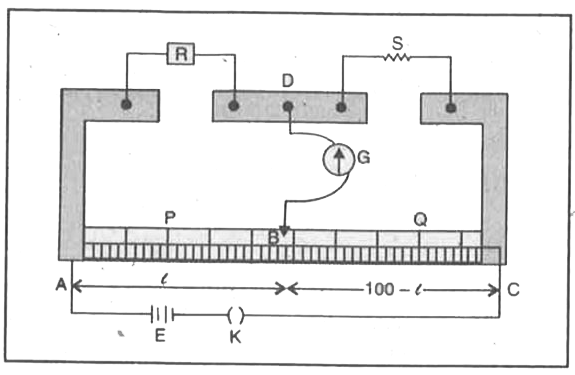 Key K is inserted and a known resistance R is taken out from the resistance box. move the jockey on the wire till for a certain position B, galvanometer shows no deflection. the bridge is then said to be balanced. if P(=lr) and Q[(=(100-l)r] are the resistance of part AB and BC, then we have `(P)/(Q)=(R)/(S)` or `(R)/(S)=(P)/(Q)=(lr)/((100-l)l)` or `(R)/(S)=(lr)/(100-l)` or `S=(100-l)/(l)R` Knowing l, and R, S can be calculated. |
|
| 43. |
निम्नलिखित संख्याओ को दशमलव रूप मे व्यक्त कीजिए :-1/15 |
|
Answer» `0.0bar6` |
|
| 44. |
A source of sound S is moving with a velocity 50 m/s towards a stationary observer. The observer measures the frequency of the source as 1000 Hz. What will be the apparent frequency of the source when it is moving away from the observer after crossing him : the velocity of soudn in the medium is 350 m/s . |
|
Answer» 1333 Hz |
|
| 45. |
What we have lost in terms of our health? |
|
Answer» ABILITY to smile |
|
| 46. |
A parallel plate capacitor of capacitance 0.1muF is shown in the figure. Its two plates are given charges 2muC and 1muC. Find the value of heat dissipated after switch is closed : |
|
Answer» |
|
| 47. |
A uranium nucleus ""_(92)U^(238) emits an alpha particle and a beta - particle in succession. The atomic number and mass number of the final nucleus will be |
| Answer» Answer :D | |
| 48. |
(a) Write the nature of path of free electrons in a conductor in the (i) presence of electric field (ii) absence of electric field. (b) Between two successive collisions each free electron acquires a velocity from 0 to v where v=(e E)/(m)tau. What is the avergae velocity of a free electron in the presence of an electric |
|
Answer» SOLUTION :(a) (i) In the presence of electric FIELD, the paths of free electrons in a metal conductor are curved. (ii) In the absecnce of electice field, the paths of free electrons in a metal conductor are straight lines between two successive collisions. (b) Average velocity of a free electron in the presence of electric field is `v= (eE)/(m) tau` Where the symbols have their usual meanings. The different free electrons in a metal conductor move with differennt velocity in the presence of electric field. (C) As the temperature of a conductor increases, the thermal speed of the electrons incereases and also the amplitude of vibration of the metal atoms/ions increases. Now thr free electrons colide more frequently with the atoms/ions of metal. As a result of it, the VALUE of relaxation time `tau` decreases. Since average velocity`v PROP tau`, so the average valocity of free electrons decreases. |
|
| 49. |
What is the main conclusion of a-particle scattering experiment? |
| Answer» Solution :From LARGE angle scattering of `ALPHA`-particles we conclude that almost whole mass and whole positive charge of the atom is CONCENTRATED in a tiny space, called nucleus, at the centre of atom. | |
| 50. |
Above Curie temperature |
|
Answer» A FERROMAGNETIC SUBSTANCE BECOMES PARAMAGNETIC |
|


