

Saved Bookmarks
This section includes 7 InterviewSolutions, each offering curated multiple-choice questions to sharpen your Current Affairs knowledge and support exam preparation. Choose a topic below to get started.
| 1. |
A circuit consists of a coil, a switch and a battery, all in series. The interval resistance of the battery is negligible compared with that of the coil. The switch is originally open. It is thrown closed, after a time interval Deltat. The current in the circuit reaches 80.0% of its final value. The switch then remainsclosed for a time interval much longer than Deltat. The wires connected to the terminals of the battery are then short circuited with another wire and removed from the battery, so that the current is uninterrupted. At the moment 2Deltat after the coil is short-circuited, the current in the coil is what percentage of its maximum value? |
|
Answer» `20.0%` |
|
| 2. |
The threshold wavelength for photoelectric emission from a material is 5200Å. Photoelectrons will be emitted when this material is illuminated with monochromatic radiation from a |
|
Answer» 50 watt infrared LAMP |
|
| 3. |
Four lenses A, B, C and D of power + 100 D , 50D " and " 5D. Which lerses will you use to design a compound microscope for best magnification ? |
|
Answer» A and C |
|
| 4. |
One cannot see through the fog, because …..... . |
|
Answer» fog absorbs light |
|
| 5. |
A circuit consists of a coil, a switch and a battery, all in series. The interval resistance of the battery is negligible compared with that of the coil. The switch is originally open. It is thrown closed, after a time interval Deltat. The current in the circuit reaches 80.0% of its final value. The switch then remainsclosed for a time interval much longer than Deltat. The wires connected to the terminals of the battery are then short circuited with another wire and removed from the battery, so that the current is uninterrupted. At an instant that is a time interval Deltat. After the short circuit, the current is what percentage of its maximum value? |
|
Answer» `20.0%` |
|
| 6. |
Which one of the following is the correct sequence of the wavelengths of radiations? |
|
Answer» UV GT GREEN gt IR gt HARD X-rays |
|
| 7. |
Electric field at a distance r from infinitely long conducting sheet is proportional to |
|
Answer» `R^(-1)` |
|
| 8. |
Light of which of the following energy is no possible? |
|
Answer» `6.625xx10^(-34)J` Energy should be in MULTIPLE of `6.625xx10^(-34)J` |
|
| 9. |
A proton and an electron have same de Broglie wavelength. Which of them moves faster and which possesses more kinetic energy ? Justify your answer. |
|
Answer» Solution :We KNOW that `lambda=(H)/sqrt(2mK)` Since proton and electron have same de Broglie wavelength, we get `(h)/sqrt(2m_(p) K_(p))=(h)/sqrt(2m_(e)K_(e))` Since `m_(e) lt m_(p). K_(p) lt K_(e)`, the electron has more kinetic ENERGY than the proton. `K_(p)/K_(e)=(1/2 m_(p) v_(p)^(2))/(1/2 m_(e)v_(e)^(2))` `v_(p)/v_(e)=sqrt((m_(e)^(2))/(m_(p)^(2)) =m_(e)/m_(p)" since "K_(p)/K_(e)=m_(e)/m_(p)`, Since `m_(e) lt m_(p), v_(p) lt v_(e)`, the electron moves FASTER than the proton. |
|
| 10. |
A closed organ pipe of radius r_1 and an open organ pipe of radius r_2 and having same length 'L' resonate when excited' with a given tuning fork. Closed organ pipe resonates in its fundamental mode where as open organ pipe resonates in its first overtone, then |
|
Answer» `r_2 - r_1 =L` |
|
| 11. |
What are Maxwell's equations ? |
|
Answer» SOLUTION :These are as FOLLOWS. (i) Gauss.s LAW in electrostatic `ointvecE.vecds = (q)/epsilon_0` (ii) Gauss.s law in MAGNETISM. `ointvecB.vecds=0` |
|
| 12. |
It is intended to measure a maximum current of 25 A with an ammeter of range 2.5 A and resistance 0.9Omega. How will you do it? What will be the combined resistance? |
|
Answer» |
|
| 13. |
If a light ray incidents normally on one of the faces of the prism of refractive index 2 and emergent ray just grazes the second face of the prism, then the angle of deviation is |
|
Answer» `0^(@)` |
|
| 14. |
The small currents in reverse biased condition of p-n diode are due to |
|
Answer» Electrons |
|
| 15. |
A ray of light incident on a 60^@ angled prism of refractive index sqrt2 suffers minimum deviation . The angle of incidence is: |
| Answer» ANSWER :C | |
| 16. |
The value of the spin only magnetic moment for one of the following configurations is 2.84 BM. The correct one is - |
|
Answer» `d^(5)`(in strong field Ligand) `=sqrt((n+2))n` `=2.84 B.M` Which corresponds to n=2. AMONG the given configurations, `d^(4)` SYSTEM in sstrong ligand filed will have 2-unpained `e^(-)` in `t_(2)g` SET of orbitals as SHOWN below. 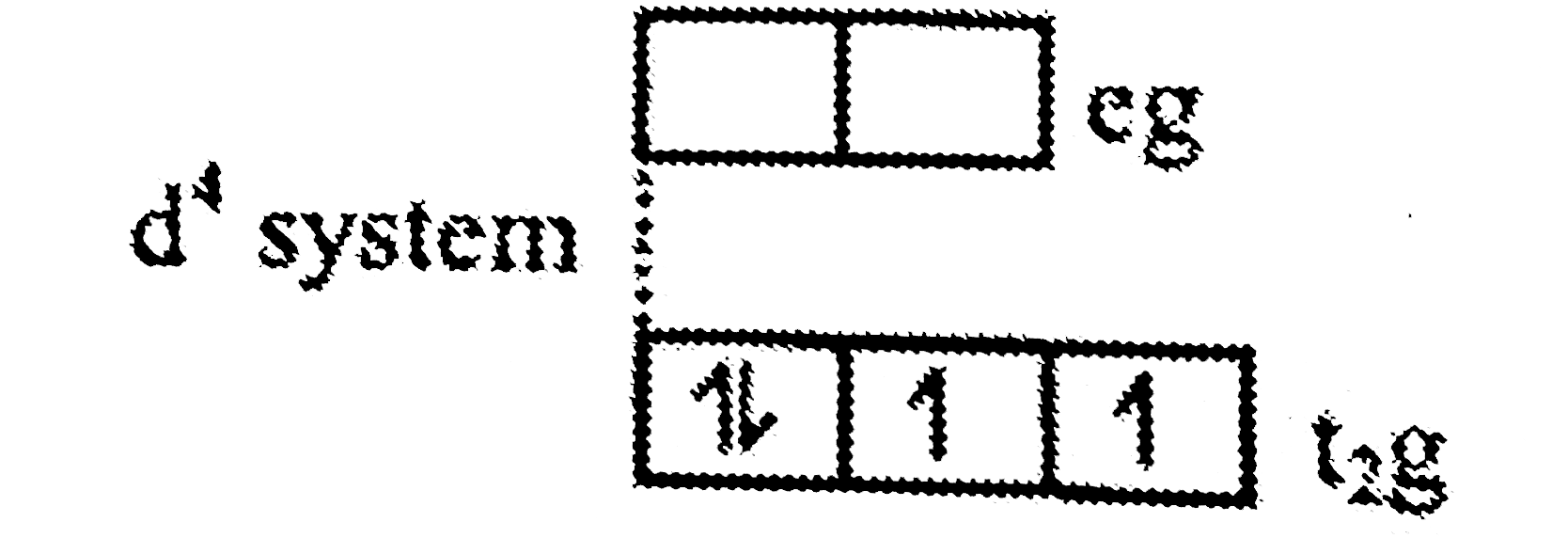
|
|
| 17. |
If vec E and vec B representelectric and magnetic field vectors of an electromagnetic wave, the direction of propagation of the wave is along |
|
Answer» Solution :`vecE` is PERPENDICULAR to `VECB` . `vecE and vecB`are both perpendicular to the direction of PROPAGATION of the EM WAVE. |
|
| 18. |
Which is better for high fidelity reception FM or AM? |
| Answer» SOLUTION :FM transmission gives HIGH FIDELITY due to the PRESENCE of large no of sidebands. | |
| 19. |
A charged 30 muF capacitor is connected to a 27 mH inductor. What is the angular frequency of free oscillations of the circuit? |
| Answer» SOLUTION :`1.1xx10^(3)s^(-1)` | |
| 20. |
What is meant by geographic meridian and magnetic meridian ? |
| Answer» Solution :A VERTICAL PLANE containing the longitude circle ( all the plane ) and the axis of rotation of the earth is CALLED the geographic meridian. SIMILARLY a vertical plane passing through a place and containing the axial line connecting the magnetic north-south poles of earth is called magnetic meridian. | |
| 21. |
The energy stored in an inductor is |
|
Answer» electrostatic |
|
| 22. |
The equation of a progressive wave is y=5xx10^-3sin962.8t+pix) metere. The direction of propagation and the wavelength of wave respectively are . |
|
Answer» Solution :The GIVEN EQUATION is `y = 5 xx 10^-3 sin(62.8t + PIX)m` `= 5 xx 10^-3 sin2pi(10T + x/2)m` The standard equation is `y = A sin2pi(nt + x/lamda)` |
|
| 23. |
Draw the resultant simplified logie cireuit. (i) A•barB+barA•B=Y (ii) (A+barb)•(barA+B)=Y |
Answer» Solution :(i) The required LOGIC diagram for the given Boolean expression is given in figure. Here the input B before applying to FIRST AND gate and input A before applying to second AND gate have been inverted. The output of these GATES are, therefore, `AbarB and barAB` RESPECTIVELY. These outputs are fed to OR gate which gives `T=AbarB+barAB` as shown in figure.  ii) The required logic diagram for the given Boolean expression is shown in figure. The input B to first OR gate and input A to second OR gate have been inverted. The output of these gates are, therefore, `A +barB and barA + B` as shown. These inputs when APPLIED to AND gate give the required output. `Y=(A+barb).(barA+B)` 
|
|
| 24. |
A potentiomete wire of 10m length and 20 Ohm resistance is connected in series with a resistance Rohms and a battery of emf 2V, negligible internal resistance. Potential gradient on the wire is 0.16 millivolt/centimetre then R is ---- ohms |
|
Answer» 50 |
|
| 25. |
A radiation of energy E falss normally on a perfectly reflecting surface. The momentum transferred to the surface is |
|
Answer» `(E)/(C)` |
|
| 26. |
A and B are two points in a closed circuit. The potential difference across the condenser of capacity 5 mu Fis |
| Answer» ANSWER :A | |
| 27. |
A point electric dipole with dipole moment .p. is placed in the external uniform electric field whose strenght is E_(0) with .p. parallel to E_(0). Then |
|
Answer» Net FORCE EXPERIENCED by the dipole is zero |
|
| 28. |
Remote sensing satellites move in an orbit that is at an average height of about 500 km from the surface of the earth. the camera onboard one such satellite has a screen of area A on which the images captured by it are formed. If the focal length of the camera lens is 50 cm, then the terrestrial area that can be observed from the satellite is close to |
|
Answer» `2XX10^(3)A` |
|
| 29. |
A thermo- couple is formed by Mn and Hg . The current flows _________ . |
|
Answer» from MN to Hg at COLD JUNCTION |
|
| 30. |
Use the mirror equation to deduce that : a) an object placed between f and 2f of a concave mirror produces a real image beyond 2f. [Note : The exercise helps you deduce algebraically properties of images that one obtains from explicit ray diagrams.] |
|
Answer» Solution :Apply mirror equation and the condition: (a) `flt0` (concave mirror), `u lt 0` (object on left) (B) `f gt 0, u lt 0` (c) `f gt 0 " (convex mirror) and "v LT0` (d) `f lt 0" (concave mirror), "f lt u lt 0` to DEDUCE the desuired result. |
|
| 31. |
Theratioof volumesofnuclei( assumedto bein sphericalshape) withrespectivemass numbers8and 64is |
|
Answer» a) `0.5` |
|
| 32. |
Angular resolution of telescope is of order of ...... for 10 cm objective diameter and 5000 Å wavelength of light. |
|
Answer» `10^6` RAD `=1.22(5000xx10^(-10))/(10xx10^(-2))` `=6.1xx10^(-6)` `deltan=10^(-6)` rad `lambda=5000` Å `=5000xx10^(-10)m` D=10 CM `=10xx10^(-2)m` |
|
| 33. |
A proton of mass 'm' moving with a speed v (lt lt c, velocity of light in vaccuum) completes a circular orbit in time 'T' in a uniform magnetic field. If the speed of the proton is increased to sqrt2v, what will be time needed to complete the circular orbit? |
|
Answer» `sqrt2T` Here T is independent of v. So there is no CHANGE in the time period of proton if speed is increased to `sqrt2v`. |
|
| 34. |
(A) : The coil is wound over the metallic frame in moving coil galvanometer. (R) : The metallic frame help in making steady deflection without any oscillation. |
|
Answer» Both 'A' and 'R' are true and 'R' is the CORRECT EXPLANATION of 'A'. |
|
| 35. |
Ifx = at + bt^(2), where x is the distance travelled by the body in kilometer while t is the time in second, then the unit of b is |
| Answer» ANSWER :C | |
| 36. |
The refractive index of a medium is sqrt3. What is the angle of refraction, if the unpolarised light is incident on it at the polarising angle of the medium ? |
|
Answer» SOLUTION :The angle of reflection=polarising angle `i_(p)=TAN^(-1)(SQRT3)=60^(@)` `THEREFORE` Angle of refraction `r=90^(@)-i_(p)=90^(@)-60^(@)=30^(@)`. |
|
| 37. |
Ampere's circuital law is the integral form of |
|
Answer» LENZ's law |
|
| 38. |
In an NPN transistor used as an amplifier is CE-mode. |
|
Answer» Both EMITTER-base and collector base junctions are forward BIASED |
|
| 39. |
Sometimes a radioactive nucleus decays into a nucleus which itself is radioactive. An exmple is: ""^(38)"S" overset ("half-life") underset(=2.48) to ""^(38)Cloverset ("half-life") underset(=0.62h) to ""^(38)Ar ("stable") Assume that we start with 1000 ""^(38)S nuclei at time t=0. The number of ""^(30)Cl is of count zero at t=0 and will again be zero at t=oo. At what value of t, would the number of counts be a maximum? |
|
Answer» Solution :The given decay sequence is `.^(38)("Sulper") overset ("half-life") underset(=2.48) to .^(38)Cloverset ("half-life") underset(=0.62h) to .(38)Ar ("stable")` At any time t, suppose `.^(38)S` has `N_(1) (t)` active nuclei and `.^(38)Cl` have `N_(2)(t)` active nuclei. `:. (dN_(1))/(dt)=-lambda_(1)N_(1)`=RATE of formation of `.^(38)Cl` and`(dN_(2))/(dt)=-lambda_(2)N_(2)+lambda_(1)N_(1)`= net rate of decay of `.^(38)Cl=-lambda_(2)N_(2)+lambda_(1)N_(0)e^(-lambda_(1)t)` Multiplying both sides by `e^(lambda_(2)t)dt` and rearranging, `e^(lambda_(2)t)dN_(2)+lambda_(2)N_(2)e^(lambda_(2)t)d t=lambda_(1)N_(0)e^((lambda_(2)-lambda_(1)t)dt` Integrating both sides, we GET `N_(2)e^(lambda_(2)t)=(N_(0)lambda_(1))/(lambda_(2)-lambda_(1)) e^((lambda_(2)-lambda_(1)t)+C.......(i)` Where C is constant of integration. At `t=0, N_(2)=0 :. C=-(N_(0)lambda_(1))/(lambda_(2)-lambda_(1))` Putting in (i), we get `N_(2)e^(lambda_(2)t)=(N_(0)lambda_(1))/(lambda_(2)-lambda_(1))[e^((lambda_(2)-lambda_(1)t))-1)]` `N_(2)=(N_(0)lambda_(1))/(lambda_(2)-lambda_(1))[e^(-lambda_(1))-e^(-lambda_(2)t)]` for maximum count ,`N_(2)=max, (dN_(2))/(dt)=0` `(N_(0)lambda_(1))/(lambda_(2)-lambda_(1)) e^(-lambda_(1)t) (-lambda_(1))=(N_(0)lambda_(1))/(lambda_(2)-lambda_(1)) e^(-lambda_(2)t) (-lambda_(2))` or `(lambda_(1))/(lambda_(2))=(e^(-lambda_(2)t))/(e^(-lambda_(2)t))=e^((lambda_(1)-lambda_(2))t)` or `log_(e) ((lambda_(1))/(lambda_(2)))=(lambda_(1)-lambda_(2))tlog_(e) e` or `t=(log_(e)(lambda_(1)//lambda_(2)))/((lambda_(1)-lambda_(2)))=(log_(e) T_(2)//T_(1))/(0.693(1/(T_(1))-1/(T_(2))))` `t=(2.303log_(10) (0.62//2.48)xxT_(1)T_(2))/(0.693 (T_(2)-T_(1)))=(2.303(0-0.602)xx2.48xx0.62)/(0.693(0.62-2.48))=(2.303xx0.602xx2.48xx0.62)/(0.693xx1.86)=1.65sec` |
|
| 40. |
Charge q_(2) is at the centre of a circular path with radius r. work done in carrying charge q_(1) once around this equipotential path , would be |
|
Answer» `(1)/(4 pi epsilon_(0)) xx (q_(1)q_(2))/(r^(2))` |
|
| 41. |
Three resistors of 3 Omega ,6 Omega and 9 Omegaare connected in parallel. A potential difference of 18 V is maintained across the combination. Find the current in each resistor. |
|
Answer» SOLUTION :`I = V/R` `I_(1) = (18)/(3) = 6 A` `I_(2) = (18)/(6) = 3A` `I_(1) = (18)/(9) = 2A` |
|
| 42. |
If a body is in equilibrium under a set of non-collinear forces, the minimum number of forces has to be |
|
Answer» Four |
|
| 43. |
State the relation between the frequency v of radiation emitted by a LED and the band gap energy E_(g)of the semiconductor used to fabricate it. |
| Answer» SOLUTION :`E_(G)` = hn, where h is the PLANCK's CONSTANT. | |
| 44. |
Which of the following is the evidence th show that there must be a force acting on earth and directed towards the sun ? |
|
Answer» Deviation of the FALLING bodies TOWARDS east |
|
| 45. |
Two charged conductors, each of which being effectively a capacitor, are connected by a conducting by a conducting wire. Which type of combination of capacitors is this series or parallel? |
| Answer» SOLUTION :PARALLEL | |
| 46. |
In the following graph, say whether T_(1) gt T_(2) or not. |
|
Answer» Solution :Since slope of (1) `GT` slope of (2), `K_(1) gt K_(2) , R_(1) lt R_(2)` ,since R `prop` temperature. `T_(1) lt T_(2)`. |
|
| 47. |
Among the following, the waves which can penetrate the ionosphere are |
|
Answer» 10GHz |
|
| 48. |
The half-life of a radioactive substance is 5000 years. In how many years, its activity will decay to 0.2 times of its initial value ? Given "log"_10 5 = 0.6990. |
|
Answer» `1.16xx10^5` YEARS |
|
| 49. |
Magnifying power of an astronomical telescope for normal visionwith usual notation is |
|
Answer» a) `-f_(0)//f_(E)` |
|
| 50. |
Two identical plano-convex lenses L_(1)(mu_(1)-1.4) and L_(2)(mu_(2)-1.5) of radii of curvature R=20cm are placed as shown in Figure. Q. Now, the secocnd lens is shifted vertically downward by a small distance 4.5mm and the extended parts of L_(1) and L_(2) are blackened as shown in figure. Find the new position of the image of the parallel beam. |
|
Answer» `200//9` cm behind the lens 2.5 mm below the principal axis of `L_(1)` `(1)/(f_(1))=(mu-1)((1)/(R)-(1)/(oo))rArrf_(1)=50cm` `(1)/(f_(2))=(mu-1)[(1)/(oo)-(-(1)/(R))]rArrf_(2)=40cm` The equivalent focal length f of the COMBINATION is given by `(1)/(f)=(1)/(f_(1))+(1)/(f_(2))rArrf=(200)/(9)cm` Hence, the image of the parallel beam is formed on the common principal axis at a distance of 22.22cm from the combination on the right side. b. Image formed by `L_(1)` is at a distance of 50cm behind the lens. This image lies on the principal axis of `L_(1)` and will act as an object for `L_(2)` For `L_(2)`, object distance, `u=+50cm` `f_(2)=+40cm` `(1)/(upsilon)-(1)/(u)=(1)/(f)rArrmu=(200)/(9) cm` Magnification CAUSED by `L_(2), m=(upsilon)/(u)=(4)/(9)` For `L_(2)` object `I_(1)` is at a distance of 4.5mm above its principal axis. Hence, distance of image `I_(2)` of the object (virtual) `I_(1)` is at a distance `(4//9)xx4.5=2mm` above the principal axis of `L_(2)` `[:. "height of image" =m xx "height of object" ]` Hence, FINAL image is at a distance of 22.22cm behind the combination at a distance of 2.5mm below the principal axis of `L_(1)`. 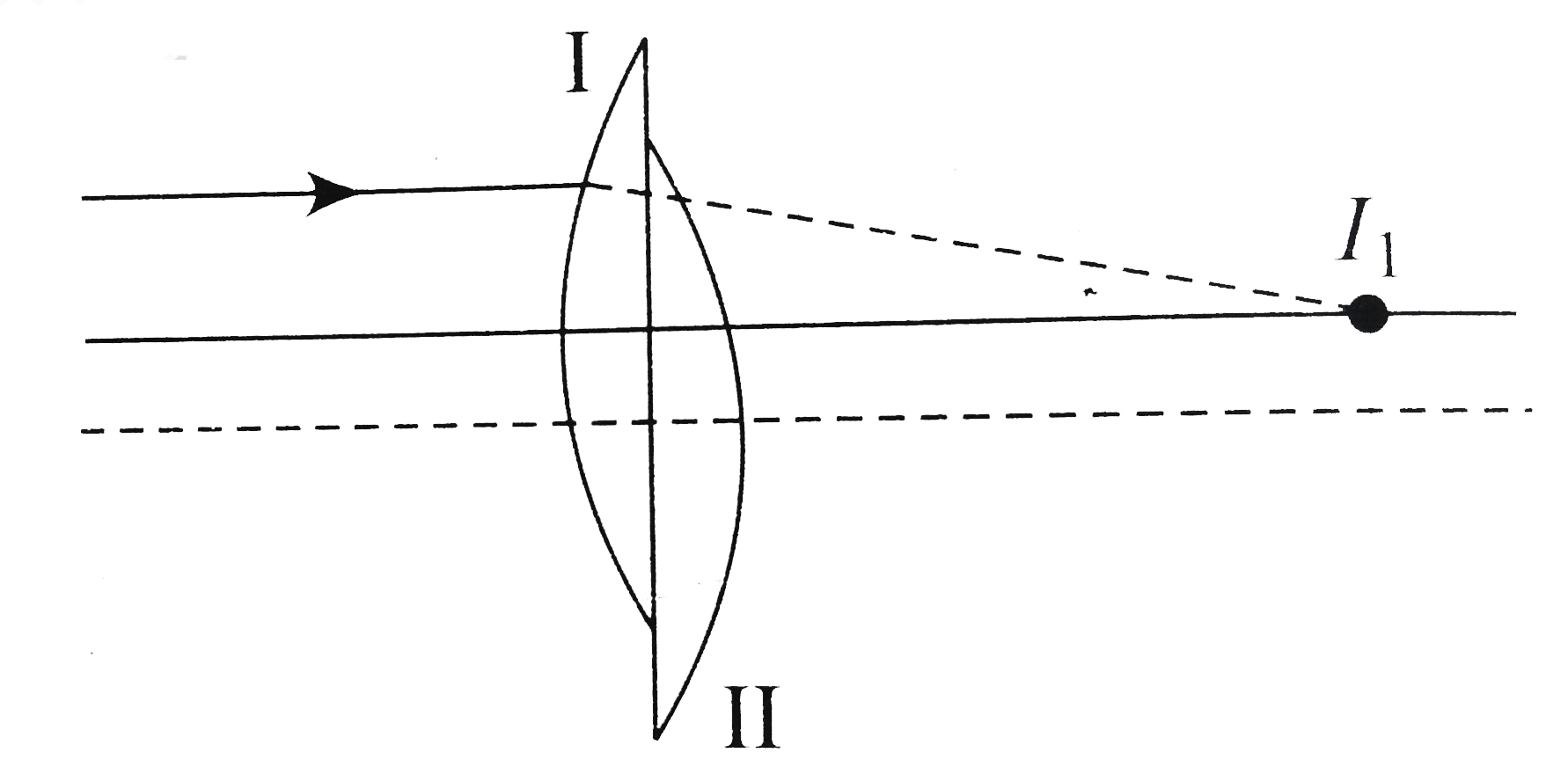
|
|