

Saved Bookmarks
This section includes 7 InterviewSolutions, each offering curated multiple-choice questions to sharpen your Current Affairs knowledge and support exam preparation. Choose a topic below to get started.
| 1. |
Explain the nature of the curves on the basis of Einstein's equation. |
|
Answer» SOLUTION :As per EINSTEIN's equation, (a) The STOPPING potential is same for `I_(1)` and `I_(2)` as they have the same frequency. (b) The saturationcurrents are as shown in figure because `I_(1) gt I_(2) gt I_(3)`. |
|
| 2. |
An emf 96.0mVis induced in the windings of a coil when the current in a nearby coil is increasing at the rate of 1.20A/s. The mutual inductance of the two coils is |
|
Answer» 40mH |
|
| 3. |
Water drops fall from the roof a building 20 m high at regular time intervals. If the first drop strikes the floor when the sixth drop begins to fall, the heights of the second and fourth drops from the ground at that instant are (g = 10 ms^(-2)) |
|
Answer» `12.8 m and 3.2 m` |
|
| 4. |
Explain what would happen if in the capacitor in Q.1, a 3mm thick mica sheet were inserted between the plates while the voltage supply remained connected. |
|
Answer» SOLUTION :While the voltage supply remained connected, voltage remains constant. Capacity INCREASES to `C' = kC_0 = 6xx1.77xx10^(-11)F = 1.062 xx10^(-10)F` Charge increases to, `q' = C'V = 1.062 xx10^(-10)xx10^(2)C = 1.062 xx10^(-8)C`. |
|
| 5. |
A 0.5kg mass is rotated in a horizontal circle of radius 20 cm. What is the centripetal force acting on it when its angular of rotation speed on 0.6 rad/s |
|
Answer» 0.36 N |
|
| 6. |
M_(x) and M_(y) denote the atomic masses of the parent and the daughter nuclei respectively in radioactive decay . The Q - value for a beta^(-) decay is Q_(1) and that for a beta^(+) decay is Q_(2). If m_(e) denotes the mass of an electron then which of the following statements is correct? |
|
Answer» `Q_1=(M_x-M_y)c^2` and `Q_2=(M_x-M_y-2m_e)c^2` `THEREFORE Q_1=[m_N(._ZX^A)-m_N(._(Z+1)Y^A)-m_e]c^2` `=[m_N(._ZX^A)+Zm_e-m_N(._(Z+1)Y^A) - (Z+1)m_e]c^2` `=[m(._ZX^A)-m(._(Z+1)Y^A)]c^2=(M_x- M_y)c^2` `beta^+` decay is represented as `._ZX^A=._(Z-1)Y^A + ._1e^0 + UPSILON + Q_2` `therefore Q_2=[m_N(._ZX^A)-m_N(._(Z-1)Y^A)-m_e]c^2` `=[m_N(._ZX^A)+Zm_e-m_N(._(Z-1)Y^A) - (Z-1)m_e-2m_e]c^2` `=[m(._ZX^A)-m(._(Z-1)Y^A)-2m_e] c^2=(M_x-M_y-2m_e) c^2` |
|
| 7. |
Hammer of mass M strikes a nail of mass’m’ with a velocity 20 m//s into a fixed wall. The nail penetrates into the wall to a depth of 1 cm. The average resistance of the wall to the penetration of the nail is |
|
Answer» `((M^(2))/(M+m))xx10^(3)` `MV+ m (0) = (M+ m) V^(1)` `V = 20 m//s` From WORK Energy theorem, `1/2 (M+ m) V^(2)= f xx 1cm` `f=1/2 (M+ m)((Mxx20)/(M+m))^(2)` `f=(2M^(2))/(M+m)xx!)^(4)N` |
|
| 8. |
A cell of 1.5V is connected across an inductor of 2mH in series with a 2 Omega resistor What is the rate of growth of current immediately after the cell is switched on. |
|
Answer» Solution :`E=L(dI)/(dt)+IR`, THEREFORE, `(dI)/(dt)=(E-IR)/(L)` E=1.5 Volt,R=2 `OMEGA`, L = 2mH = `2 xx 10^(-3)` H When the cell is SWITCHED on, I = 0 Hence `(dI)/(dt)=(E)/(L)=(1.5)/(2 xx 10^(-3)) As^(-1)= 750 As^(-1)` |
|
| 9. |
If the longest wavelength of the ultraviolet region of hydrogen spectrum is lambda_(0) then the shortest wavelength of its infrared region is ...... |
|
Answer» `(46)/(7)lambda_(0)` `:.(1)/(lambda_(0))=R[(1)/(l^(2))-(1)/(n^(2))]` `=R[1-(1)/(4)]` `(1)/(lambda_(0))=(3R)/(4) .....(1)` For minimum wavelength of infrared spectrum for Paschen series, n = 0 `(1)/(lambda)=R[(1)/(3^(2))-(1)/(n^(2))]` `=R[(1)/(9)-(1)/(OO^(2))]` `=(R)/(9)....(2)` By taking ratio of (1) and (2) `(lambda)/(lambda_(0))=(3R)/(4)xx(9)/(R)` `:. lambda=(27)/(4)lambda_(0)` |
|
| 10. |
Voltage senstivity of a moving coil galanometer is 4div/mV and resistance is 30Omega.The current sensitivity is : |
|
Answer» 15div//mA |
|
| 11. |
When 10 A current passes through 12Omega resistance, maximum voltage across it is …….. |
|
Answer» 20 V SIMILARLY in case of voltage `V_(dc)=V_(ac)=V_(rms)=V_m/sqrt2`(where `V_(rms)`= rms value of voltage and `V_m` = maximum voltage ) `I_m=sqrt2I_(rms)` =1.414 x 10 =14.14 A `therefore` MAX. voltage `V_m=I_m R` =14.14 x 12 = 169.68 V |
|
| 12. |
The telescope where the objective is convex lens large focal length and eye piece of short focal length is called what ? |
| Answer» SOLUTION :GALILEAN | |
| 13. |
I am very light and present in every matter. When I move along the equator from east to west, I am pushed up. When I am stationary, no force. : Who am I? |
| Answer» SOLUTION :LORENTZ force in earth.s magnetic FIELD F =qvB | |
| 14. |
Find the resultant of the vectors vec(OA), vec(OB), vec (OC) as shown in figure. The raidus of the circle is r. |
|
Answer» SOLUTION :`VECR=vec(OA)+vec(AB)+vec(OC)` `vecR= rhati+r COS 45 I +r sin45 hatj+r hatj` `vecR=(r+(r)/(sqrt(2)))hatj+(r+(r)/(sqrt(2)))hatj` `|vecR|= (sqrt(2r)+tau)` along `vec(OB)` 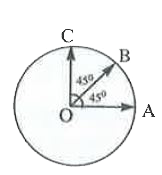
|
|
| 15. |
(i) A poor emitter has a large reflectivity . Explain why. (ii) A copper tumbler feels much colder than a wooden block on a cold day. Explain why. (iii) The earth would become so cold that life is not possible on it in the absence of the atmosphere. Explain why? (iv) Why clear nights are cooler than cloudy nights? Why does a piece of red glass when heated and taken out glow with green light? (vi) Why does the earth not become as hot as the sun although it has been receiving heat from the sun for ages? (vii) Animals curl into a ball when they are very cool. Why? (viii) Heat is generated continuously in an electric heater but its temperature becomes constant after some time. Explain why? (ix) A piece of paper wrapped tightly on a wooden rod is observed to get charred quickly when held over a flame as compared to a similar piece of paper when wrapped on a brass rod. Explain why? (x) Liquid in a metallic pot boils quickly whose base is made black and rough than in a pot whose base is highly polished . Why? |
|
Answer» (ii) Copper is a good conductor of heat, whereas a wood is a bad conductor of heat . When copper tumbler is touched, the heat will flow from our body which is at higher temperature than the copper tumbler and hence we feel cold. In case of wooden tray, no heat is transferred from our body to the tray and hence we do not feel cold. (iii) The atmosphere of earth behaves as an insulating envelop to infra red radiations, which do not allow the whole heat received by earth during day time to escape from it during night . But if there is no atmosphere ,then the whole heat radiated by earth will leave its surface and it becomes too cold. (iv) On a clear night , the earth radiates energy into SPACE at a rate proportional to the fourth power of its temperature (about `300K`). The incoming radiation from space is very small because its average temperature is near absolute zero. On the other hand with cloud over, the earth radiates at `300K` , but the radiation is absorbed in the clouds, which radiate energy back to earth again the radiation is trapped , like the green house effect. (v) A red glass absorbs green light STRONGLY at room temperature. when it is heated it emits green light, THUS satisfying Kirchoff's law. (vi) Because during day time it receives the heat but it radiates the heat during nights. (vii) The energy radiates per unit time is directly proportional to the surface area of the body. By curling into a ball, the surface area of the body of the body of the animals decreases and hence loss of heat is reduced. (viii) This is because the rate at which heat is generated becomes equal to the rate at which heat is lost by radiation (i.e., steady state) after some time when the heater is switched on. (ix) Wood is bad conductor of heat and is unable to conduct away the heat. So the paper quicklyreaches its ignition temp. and is charred .On the other hand, BRASS is good conductor of heat and away the heat quickly.So the paper does not reach its ignition point easily. (x) Black and rough surface is a good absorber of heat than the polished surface. That is why liquid in metallic pot BOILS quickly whose base is made balck and rough. |
|
| 16. |
Using Rutherford model of the atom, derive the expression for the total energy of the electron in hydrogen atom. What is the significance of total negative energy possessed by the electron? |
|
Answer» Solution :As per Rutherford model of the ATOM, an electron revolves around the nucleus of HYDROGEN atom such that the requisite centripetal force is provided by the coulombian attraction force acting on it due to nucleus. Thus `(mv^(2))/(r)= (1)/(4pi in_(0)).(e^(2))/(r^(2)) rArr mv^(2) =(1)/(4 pi in_(0)) .(e^(2))/(r)` `therefore ` Kinetic energy of orbiting electron `K = (1)/(2) mv^(2) = (1)/(2) xx(1)/(4 pi in_(0)) .(e^(2))/(r) = (e^(2))/(8 pi in_(0)r)` andpotential energy of orbitingelectron `U = (q_(1)q_(2))/(4 pi in_(0) r) = (e^(2))/(4pi in_(0) r)` `therefore ` Totalenergyof electron in hydrgoenatom ` E =K + U = (e^(2))/(8 pi in_(0) r)- (e^(2))/(4pi in_(0)r)=- (e^(2))/(8 pi in_(0)r)` The negative sign of energy signifies that the electron is bound to the nucleus and cannot escape from its orbit at its own. |
|
| 17. |
In Young’s double slit experiment, deduce the condition for (a) constructive, and (b) destructive interference at a point on the screen. Draw a graph showing variation of intensity in the interference pattern against position ‘x’ on the screen. |
|
Answer» Solution :Phase difference `(PHI)`in series LCR CIRCUIT is given by `TAN phi=(V_C-C_L)/V_R=(i_m(X_C-X_L))/(i_mR)` `=((X_C-X_L))/R` When current and voltage are in phase `phi=0impliesX_C-X_L=0impliesX_C=X_L` |
|
| 18. |
Which of the followingdoes not produce any gaseous product when reacts with water ? |
|
Answer» `Ca_(3)N_(2)` `CaC_(2)+2H_(2)OrarrCa(OH)_(2)+C_(2)H_(2)uarr` `Ca_(3)P_(2)+6H_(2)Orarr3Ca(OH)_(2)+2PH_(3)uarr` `CaO+H_(2)Orarrunderset(("liquid"))(CA(OH)_(2))` |
|
| 19. |
A biconvex lens made of material with refractive index n_(2). The radii of curvatures of its left surface and right surface are R_(1) and R_(2). The media on its left and right have refreactive indices n_(1) and n_(3) respectively. The first and second focal lengths of the lens are respectively f_(1) and f_(2). Assume that n_(1) = n_(3). Which of the following statements is not correct ? |
|
Answer» `f_(1) = f_(2)`. |
|
| 20. |
if the threshold wavelength for the given metal is 8 xx 10^(-6)m ,then What is the photoelectric work function for a metal ? |
| Answer» | |
| 21. |
A freshly prepared radioactive source of half-life 2 h emits radiation of intensity which is 64 times the permissible safe level. The minimum time after which it would be possible to work safely with this source is |
|
Answer» 128 h |
|
| 22. |
A biconvex lens made of material with refractive index n_(2). The radii of curvatures of its left surface and right surface are R_(1) and R_(2). The media on its left and right have refreactive indices n_(1) and n_(3) respectively. The first and second focal lengths of the lens are respectively f_(1) and f_(2). Assume that R_(1) = R_(2), n_(1) ne n_(3). The ratio, f_(1)//f_(2), of the two focal lengths is equal to |
|
Answer» `1` |
|
| 23. |
The energy of an x-ray photon is 4 kev. Its frequency is nearly |
| Answer» Answer :A | |
| 24. |
Two parallel wires PQ, RS of resistance 10Omega and 20Omega are seperated by a distance of 10 cm and connected in parallel across a cell of emf200V and negligible intemal resistance. A wire AB of mass I g and length J cm is balanced exactly, between them. What must be the current in it. |
Answer» Solution : AB experience a FORCE of attraction due to PQ and RS. ApplyV=iR `200=i_(1)xx10rArri_(1)=20A` `200=i_(2)xx20rArr=10A` AB will be in EQUILIBRIUM if `(mu_(0))/(2pia)i_(2)i_(3)I+mg=(mu_(0)i_(1)i_(3))/(2pia)` `(mu_(0))/(2pia)xx(i_(1)i_(3)-i_(2)i_(3))I=mg` `(4pixx10^(-7))/(2pixx5xx10^(-2))(20i_(3)-10i_(3))xx1/100=10^(-3)xx9.8` `(2xx10^(-5)xx10i_(3))/(5xx100)=9.8xx10^(-3)` `i_(3)=24500A`. |
|
| 25. |
What is a rectifier ? How a p-n junction diode can be used as a rectifier? |
|
Answer» Solution :p-n junction as half wave RECTIFIER The CIRCUIT for using junction DIODE as half wave rectifier is as shown below in figure (a) .  During first half of a.c.one of the ends of secondary SAY A ,becomes positive and diode operates under forward bias and the current flows through load R. During second half, A becomes negative and diode operates under negative bias. Practically no current flows through the load. Thus half of the cycle of a.c. is rectified and we GET unidirectional current as shown in fig. (b). |
|
| 26. |
A parallel beam of fast moving electrons is incident normally on a narrow slit. A flueroscent screen is placed at a large distance from the slit. If the speed of the electron is increased, which of the following statements is correct ? |
|
Answer» DIFFRACTION pattern is not observed on the screen in the CASE of electrons. |
|
| 27. |
Derive the equation for effective focal length for lenses in out of contact. |
|
Answer» Solution :When two thin lenses are separated by a distance d. (i) Let O be a point object on the principal axis of a lens. OA is the incident ray on the lens at a point A at a height h above the optical centre. (II) The ray is deviated through an angle `delta` and forms the image at I on the principal axis. (iii) The incident and refracted rays subtend the angles, `angleAOP = alpha` and `angleAIP = beta` with the principal axis respectively. In the TRIANGLE `triangleOAI` , the angle of deviation `delta` can be written as, ` delta = alpha + beta "" ....(1)` If the height h is small as compared to PO and Pl the angles `alpha , beta ` and `delta`are also small. Then, ` alpha ~~ tan alpha = (PA)/(PO) , " and " beta ~~ tan beta = (PA)/(PI) "" ....(2)` Then,` delta= (PA)/(PO) + (PA)/(PI) "" ....(3)` Here, `PA = h,PO = - u " and " PI = v` ` delta = (h)/( - u) + h/v = h ((1)/(-u) + (1)/(v)) "" ....(4)` After rearranging ` delta = h (1/v - 1/u) = h/f` ` delta = h/f "" ...(5)` (iv) The above equation tells that the angle of deviation is the ratio of height to the focal length. Now, the case of two lenses of focal length `f_1` and `f_2` arranged coaxially but separated by a distance d can be considered as shown in the below Figure.  (v)For a parallel ray that falls on the arrangement, the two lenses produce deviations `delta_1` and `delta_2` respectively and The net deviation `delta` is. ` delta= delta_1 + delta_2 "" ....(6)` From Equation (5), ` delta_1 = (h_1)/(f_1) , delta_2 = (h_2)/(f_2) " and " delta = (h_1)/(f) "" ....(7)` The equation (6) becomes, ` (h_1)/(f) + (h_1)/(f_1) + (h_2)/(f_2) "" ....(8)` From the geometry, ` h_2 - h_1 = P_2 G - P_2 C= CG` `h_2- h_1 = BG tan delta_1 ~~ BGdelta_1` ` h_2 - h_1 = d(h_1)/(f_1)` ` h_2 = h_1 d(h_1)/(f_1) "" ....(9)` Substituting the above equation in Equation (8). ` (h_1)/(f) = (h_1)/(f_1) + (h_1)/(f_2) + (h_1 d)/(f_1 f_2)` On further simplification, `1/f = (1)/(f_1) + (1)/(f_2) + (d)/(f_1f_2) "" ....(10)` (vi) The above equation could be used to FIND the equivalent focal length. To find the position of the equivalent lens, we can further write from the geometry, ` PP_2 = EG = (GC)/(tan delta)` `PP_2 = EG = (GC)/(tan delta) = (h_1 - h_2)/(tan delta) = (h_1 - h_2)/(delta)` From equations (7) and (9) ` h_2 - h_1 = d (h_1)/(f_1) " and " delta= (h_1)/(f)` `PP_2 = (d (h_1)/(f_1)) xx ((f)/(h_1))` ` PP_2 = (d (f)/(f_1))` |
|
| 28. |
A 10muF capacitor is connected to a 230 V, 50 Hz source. Find the capacitive reactance and the current (rms and peak ) in the circuit. If the frequeny is doubled , what happens to the capacitive reactance and the current ? |
|
Answer» SOLUTION :`X_C approx 318.5 Omega, I_(RMS)=0.72 A , I_(max)=1.02 A` If the frequency is DOUBLED , then the value of `X_C` will be halved and CURRENT will doubled . |
|
| 29. |
Due to economic reasons, only the upper side band of an AM wave is transmitted, but at the receiving station, there is a facility for generating the carrier. Show that if device is available which can multiply two signals, then it is possible to recover the modulating signal at the receiver station. |
|
Answer» Solution :Let `omega_c and omega_m` be the ANGULAR frequency of carrier WAVES and message SIGNAL wave respectively. For simplicity, let the signal received at the receiving station be `e = E_1 cos (omega_c + omega_m)t` Let the instantaneous voltage of carrier waves `(e_c)` given by `e_c = E_c cos omega_ct ` be avialable at the receiving station, Now, `e xx e_c = E_1E_c cos (omega_c + omega_m) t cos omega_ct` `(E_1E_c)/2 [ cos {(omega_c + omega_m) t + omega_ct} + cos { (omega_c + omega_m) t - omega_ct}]` `= (E_1E_c)/2[cos(2omega_c+omega_m) t + cos omega_mt]` At the receiving station, when the signal is passed through low-by pass FILTER, it will pass the high frequency signals `(2omega_c + omega_m)` but obstruct the low frequency signal `omega_m`. Therefore, we can record the modulating signal `= (E_1E_c)/2 cos omega_mt`, which is a signal of angular frequency `omega_m`. |
|
| 30. |
In the adjoining figure the potential difference between X and Y is 60 V . The potential difference between the points M and N - will be |
|
Answer» 10 V 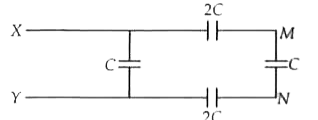 In the given FIGURE , capacitors 2C, C (between M and N) and 2C are in SERIES . If Q is the charge on each of these capacitors , then `60=(Q)/(2C)+(Q)/(C)+(Q)/(2C)=(2Q)/(C)rArrQ=30C` Potential differece between M and N is `(Q)/(C)=(30C)/(C)=30V` |
|
| 31. |
In a PN junction |
|
Answer» HIGH POTENTIAL at N side and low potential at P side |
|
| 32. |
Show that the current in a pure resistor is in phase with the ac voltage across it and hence S.T. average power dissipation in a resistor is i^(2)R where I is r.m.s value of ac. |
Answer» SOLUTION : Let I be the current in a RESISTOR voltage drop a cross the resistor will be iR, supplying KVL to the closed loop. We write `v_(m)sinomegat=iR`. i.e., `i=((v_(m))/(R))sinomegat` i.e., `i=i_(m)sinomegat` where `i_(m)=(v_(m))/(R)` HENCE current is in phase with the APPLIED voltage. By definition of power `p=i^(2)R` i.e., `p=i_(m)^(2)Rsinomegat` Average power, `barp=(:i^(2)R:)=(:i_(m)^(2)Rsin^(2)omegat:)` Since, `(:sin^(2)omegat:)=(1)/(2)` `barp=i_(m)^(2)R(:sin^(2)omegat:)` i.e. `barp=(1)/(2)i_(m)^(2)R` 
|
|
| 33. |
Assuming the gravity to be in negative z -direction, a forcevecF =vecV xx vecA is exerted on a particle in addition to the force of gravity where vecV is the velocity of the particle and vecA is a constant vector in positive x - direction. What minimum speed a particle of mass in be projected so that it continues to move undeflected with constant velocity? |
|
Answer» Solution :`|VECF| =vA sin THETA` Here, `theta`is angle between `vecv` and `vecA` The particle MOVES undeflected if `vecF` acts be in positive z-direction. Hence, veloicty should be in negative y-direction. or `vecV_("MIN") =-(mg)/A hatj` |
|
| 34. |
The steam temperature in a boiler is 600^@C, the pressure is 200 atm. The steam is ejected from a Laval nozzle. Find the velocity and the temperature of steam in the critical cross section. To avoid the condonsation of steam as it leaves the nozzle, its temperature should exceed 100^@C. What is the maximum speed at which the steam leaves the nozzle? |
|
Answer» `(a_0^2)/(gamma - 1) = (v_(cr)^2)/(2) + (v_(cr)^2)/(gamma - 1) `, where `v_(cr) = a_0 sqrt(2/(gamma + 1))` To find the velocity of steam LEAVING the nozzle, we make use of the Barnoulli EQUATION in the form of (30.8) and obtain `v = sqrt(2c_p (T_0 - T))`. |
|
| 35. |
A radioactive material consists nuclides of 3 isotope which decay by alpha- emission, beta- emission and deuteron emission respectively. Their half lives are T_(1)=400sec,T_(2)=800sec and T_(3)=1600 sec respectively. At t=0, probability of getting alpha.beta a and deuteron from radio nuclide are equal. If the probability of alpha emission at t = 1600 seconds is n/13, then find the value of .n. is _____ |
|
Answer» |
|
| 36. |
If C be the capacitance and V be the electric potential ,then the dimensional formula ofCV^(2) is |
|
Answer» `M^(1)L^(2)T^(-2)A^(0)` `:.` Dimensional formula of `CV^(2)=[ML^(2)T^(-2)]` So cannot choice is `(a)`. |
|
| 37. |
A uniform magnetic field gets modified as shown in Fig.when two specimens X and Y are placed in it. (i) Identify the two specimens X and Y. (ii) State the reason for the behaviour of the field lines in X and Y. |
|
Answer» Solution :(i) Specimen X is diamagnetic but specimen Y is paramagnetic. (ii) Individual atoms of a diamagnetic MATERIAL (say X) do not possess a permanent dipole moment of their own. The application of an external magnetic field induces in each atom a small dipole moment in the opposite direction. As a RESULT, magnetic field lines are repelled or expelled and the field INSIDE the material is reduced. Individual atoms of a paramagnetic material possess a permanent dipole moment of their own. On ACCOUNT of continuous random thermal motion of the atoms, the net MAGNETISATION of the material is zero. In the presence of an external magnetic field, the individual atomic dipole moments tend to align in the same direction. As a result, field lines get concentrated inside the material and the field inside is enhanced. |
|
| 38. |
STATEMENT -1 : Gravitational field inside a spherical mass shell is zero even if the mass distribution is uniform or non-uniform. and STATEMENT -2 : A mass object when placed inside a mass spherical shell, is protected from the gravitational field of another mass object placed outside the shell. |
|
Answer» STATEMENT 1- TRUE, Statement -2 is True, Statement -2 is a correct EXPLANATION for Statement -10 |
|
| 39. |
A prism having refractive index 1.414 and refracting angle 30^(@) has one of the refracting surfaces silvered. A beam of light incident on the other refracting surface will retrace its path, if the angle of incidence is : |
|
Answer» `0^(@)` r_(2) = 0` `THEREFORE "" r_(1) = A = 30^(@)` From Snell.s law `n = (sin i_(1))/(sinr_(1))` `n = (sin i_(1))/(sin 30)` `sin i_(1) = SQRT(2) XX (1)/(2) = (1)/(sqrt(2))` `sin i_(1) = (1)/(sqrt(2))` `i_(1) = 45^(@)` |
|
| 40. |
Is the frequency of oscillation of magnetic energy or magnetic energy or electrostatic energy is same as that of change in LC oscillator ? |
| Answer» Solution :No, The FREQUENCY of OSCILLATION of KINETIC energy or POTENTIAL energy is double the frequency of OSCILATION of charge. | |
| 41. |
Surface tension of a soap solution is T. There is a soap bubble of radius r. Calculate the amount of charge that must be spread uniformly on its surface so that its radius becomes 2r. Atmospheric pressure is P_0. Assume that air temperature inside the bubble remains constant. |
|
Answer» |
|
| 42. |
A sounding body of negligible dimension emitting a frequency of 150 Hz is dropped from a height. During its fall under gravity it passes near a balloon moving up with a constant velocity of 2m/s one second after it started to fall. The difference in the frequency observed by the man in balloon just before and just after crossing the body will be : (Given that -velocity of sound = 300m/s, g = 10m//s^2) |
|
Answer» 12 |
|
| 43. |
What is the magnitude of the equatorial and axial fields due to a bar magnet of length 5.0 cm at a distance of 50 cm from its mid pointthe magnetic moment of the bar magnet is 0.40 A m^(2) |
|
Answer» `b_(eq)=3.2xx10^(-7) T` `l=2.5 CM xx10^(-2) m` `d=50 cm =0.5 and M =0.40 A m^(2)` As `B_(equi)=(mu_(0)M)/(4pid^(3))` `=(4pixx10^(-7)T mA^(-1)Am^(2))/(4pi(0.5m)^(3)` `B_("equi")=3.2 xx10^(-7) T` `B_("axial")=(mu_(0)2M)/(4pid^(3))` `B_("net")=B_(M_(1))+B_(m_(2))+B_(H)` `=(mu_(0))/(4pix^(3))` =`(10)^(-7)/(10^(-3))xx2.2+3.6xx10^(-5)` `=2.56 xx10^(-4) wb//m^(2)` |
|
| 44. |
What is the phase relationship between the AC input and output voltages in a common emitter amplifier ? What is the reason for the phase reversal ? |
| Answer» Solution :In a common emitter amplifier, the input and OUTPUT voltages are `180^(@)` out of opposite phases. The reason for this can be seen from the fact that as the input out of phase or in that as the input VOLTAGE rises. so the CURRENT increases through the BASE CIRCUIT. | |
| 45. |
The momentum of photon whose frequency is f is |
|
Answer» `(HF)/(C)` |
|
| 46. |
Does the apparent depth of a tank of water change if viewed obliquely ? if so, does the apparent depth increase or decrease ? |
| Answer» SOLUTION :yes. Apparent depth of a tank of water decreases when VIEWED obliquely (DUE to REFRACTION of LIGHT) | |
| 47. |
Draw the shape of the wavefront coming out of a concave mirror when a plane wave is incident on it. |
Answer» SOLUTION :The REFLECTED WAVEFRONT is SHOWN in FIGURE. 
|
|
| 48. |
What is the ratio of sin i and sin r in terms of velocities in the given figure. |
| Answer» SOLUTION :`v_1//v_2` | |
| 49. |
A pole is held vertically with one end on the ground. The length of the pole is 30 m. The pole is allowed to fall. Assuming that the lower end of the pole does not slip with what velocity will the upper end strike the ground g = 10 m |
|
Answer» 5 m `s^(-1)` `(1)/(2) (ml^2)/(3)XX(v/I)^(2)=mgxx(l)/(2)` `:. V=sqrt(3gl)` `=sqrt(3xx10xx30)=30 ms^(-1)` |
|
| 50. |
First a set of n equal resistors of R each are connected in series to a battery of emf E and internal resistance R. A current I is observed to flow. Then the n resistors are connected in parallel to the same battery. It is observed that the current is increased 10 times. What is 'n'? |
|
Answer» SOLUTION :When n RESISTORS of value R are connected in SERIES with cell with emf `epsilon` and internal resistance R then current . `I = (E)/(R + nR) = (E)/(R (1 + n)) ""` .... (1) Instead n resistor of R value are connected in parallel then current, 10 I = `(E)/(R + (R)/(n))` `= (nE)/(R (n + 1)) "" ` ... (2) `therefore 10 I = n ((E)/(R (n + 1) )) ` `therefore 10 I = nI "" therefore n = 10 ` |
|