

Saved Bookmarks
This section includes 7 InterviewSolutions, each offering curated multiple-choice questions to sharpen your Current Affairs knowledge and support exam preparation. Choose a topic below to get started.
| 1. |
An object is placed at (0, 0) and a plane mirror is placed,inclined 30° with the x axis. (a) Find the position of image. (B) If the object starts moving with velocity 1 hat(i) m//s and the mirror is fixed find the velocity of image. |
|
Answer» |
|
| 2. |
Two coherent sources A and B of radio waves are 5.00 m apart. Each source emits waves with wavelength 6.00m. Consider points along the line between the two sources. Atwhat distances, if any, from A is the interference (a) constructive (b) destructive? |
|
Answer» SOLUTION :(a) Atcentre path difference is ZERO. Therefore, CONSTRUCTION interference will be obtained. (B) `lambda/2 = 3m.` At a distance, where path difference is `lambda/2 or 3m` destructive interference will be obtained.  At`P_1BP_1 -AP_1 = 3m = lambda/2` At `P_2 = AP_2 - BP_2 = 3m = lambda/2`. |
|
| 3. |
If number of turns in a coil is increased from 10 to 100, its inductance becomes .... times the original value. |
|
Answer» 10 `THEREFORE L_2/L_1=(N_2/N_1)^2` `=(100/10)^2` `therefore L_2/L_1=100 "" therefore L_2=100 L_1` |
|
| 4. |
Consider the following statement A and B and identify the correct answer A) Primary waves travels in a medium with speed of light in all directions. B) Secondary waves travels in backward direction only but not with speed of light |
|
Answer» A is FALSE but B is TRUE |
|
| 5. |
If vecA=vecB+vecC and magnitude ofvecA, vecB and vecC are 5, 4 and 3 kmt, the angle between vecA and vecC is |
|
Answer» `cos^-1(3/5)` |
|
| 6. |
Electrons in an x-ray tube are accelerated through a potential (Z=40) target. Determine the cutoff frequency for x-ray production. |
|
Answer» `4.7xx10^(19)HZ` |
|
| 7. |
Complete the path of light with correct value of angle of emergence. |
| Answer» SOLUTION :`sin^-1(3//4)` | |
| 8. |
In which form and where is the energy of the capacitor stored? |
| Answer» Solution :Electrical ENERGY and it is STORED between the PLATES in the FORM of electrie field. | |
| 9. |
A boy walks to his school at a distance of 6 km with constant speed of 2.5 km/h and walks back with a constant speed of 4 km/h. His average speed for the round trip is: |
|
Answer» `(24)/(13) kmh^(-1)` TOTAL TIME `(t_1+t_2)=(12)/(5)+(3)/(2)=(39)/(10)hr`. `v_a=(6+6)/((39)/(10))=(40)/(13) km//hr` |
|
| 10. |
A uniform conductor of resistance R is cut into 20 equal pieces. Half of them are joined in series and the remaining half of them are connected in parallel. If the two combinationi. are joined in series, the effective resistance of all the pieces is ........ |
|
Answer» R RESISTANCE of each part when wire is div.ided into 20 equal parts = `(R)/(20)` Equivalent resistance of 10 such parts joined in series is, `R_(1) = (10 R)/(20) = (R)/(2)` Equivalent resistance of 10 remaining parts when joined in PARALLEL, `R_(2) = (R)/(200)` Equivalent resistance of circuit, R = `R_(1) + R_(2)` `= (R)/(2) + (R)/(200) = (100 R + R)/(200) = (101)/(200) ` R |
|
| 11. |
What are polariser and analyser? |
|
Answer» SOLUTION :Polariser: The POLAROID which PLANE polarises the unpolarised light PASSING through it is called a polariser. Analyser: The polaroid which is used to examinewhertter a beam of light is POLARISED or not is called an analyser. |
|
| 12. |
An immersion heater with electrical resistance 7Omegais immersed in 0.1 kg of water at 20^@ Cfor 3 min. If the flow of current is 4 A , what is the final temperature of the water assuming whole of heat produced is consumed in water. (Specific heat capacity of water = 4.2 xx10^(3) J kg^(-1)K^(-1)) |
| Answer» Answer :D | |
| 13. |
How does the maximum kinetic energy of electrons emitted vary with the work function of the metal. |
|
Answer» Solution :The maximum KE of emitted electrons `k_(max) = 1/2 mv_max^2 = hv=W_0` CLEARLY, the larger the WORK function of the METAL, lesser is the maximum KE of the PHOTOELECTRONS. |
|
| 14. |
In refraction, light waves are bent on passing from one medium to the second medium, because in the second medium. |
|
Answer» the frequency is DIFFERENT |
|
| 15. |
Statement-1: Ampere's law cannot be used determine magnetic field due a current carrying wire of finite length Statement-2: Ampere's law is not valid for wires finite length |
|
Answer» Statement-1 is TURE, Statement-2 is Ture, Statement-2 is CORRECT explanation for Statement-1 |
|
| 16. |
When a photon of energy 7eV is made incident on a metal then the emitted electron is stopped by a stopping potential of -5.5 V. The work function of metal will be: |
|
Answer» `-1.5eV` |
|
| 17. |
Two identical rods of copper and iron are coated with wax uniformly. When water, the length upto which wax melts are 8.4 cm and 4.2 cm respectively. If thermal conductivity of copper is 0.92, then thermal conductivity of iron is : |
|
Answer» `0.23` |
|
| 18. |
Two sinusoidal waves with the same amplitude of 4.0mm and the same wavelength traveled together along a string that is stretched along an x axis, the resultant wave due to their interference was recorded on video tape. The curves in Fig. 16-20 represent the resultant wave in two freeze frames, first as the solid curve and then, 1.0 ms later, as the dotted curve. The grid lines along the x axis are 1.0 cm apart, and the string clements oscillated vertically (perpendicular to the x axis) by 6.0 mm as the resultant wave passed through them. That wave moved a distance d =4.20 cm to the right in the 1.0 ms time interval. Write equations for the two interfering waves and for their resultant wave. Figure 16-20 The resultant wave of two sinusoidal string wave traveling along an x axis is shown at two instants, between which the resultant wave travels distance d. |
|
Answer» Solution :From Fig. 16-20, we see that the resultant wave is a sinusoidal wave that moves in the positive direction of the x axis. The interfering waves must both move in that direction and we can write them as `y_(1) (x,t) =y_(m) sin (kx-omegat) ` and `y_(2) (x,t) =y_(m) sin (kx-omegat+phi)` where `y_(m)=4.0 mm.` We can now write the resultant wave as `y. (x,t) =[2y_(m)^(.) cos""1/2 phi] sin (kx-omegat+1/2 phi) ` The amplitude `2y_(m) cos 1//2 phi` of the resultant wave is half the total oscillation distance of 6.0 mm, so we have `2y_(m) cos ""1/2 phi=3.0mm` SUBSTITUTING. `y_(m)= 4.0 mm` and solving for a we get `phi=2cos^(-1) (3.0mm)/(2(4.0mm))=136^(@) approx 2.4 rad` Thus, the phase constant in Eq. 16-59 is = 2.4 rad and the phase constant in Eq. 16-60 is 1/2 `phi =1// (2.4+ rad) approx "1.2 rad,"`. To find the angular wave number we use two key ideas. First, the common value of k in Eqs. 16-58 16.59 and 16-60 is related to the common wavelength EQUATION `k= 2pi//lambda`. Second, the wavelength can measured in Fig. 16-20 as the distance (parallel to the axis) between REPETITIONS of the wave shape. Let.s use the solid curve and pick any point at which it crosses the x axis. That curve makes an identical crossing 3.0 cm to the right (or LEFT) from the first point. Thus, `lambda= 3.0 cm,` and `k=(2pi)/(lambda)=(2pi)/(0.030m)=209 m^(-1)` To find the common angular frequency `omega` we use two more key ideas: The common value of `omega` in Eqs. 16-58, 16-59, and 16-60 is related to k and the common wave speed y by equation `v=omega//k`. That wave speed v is the ratio of the distance d traveled by the resultant wave to The time interval At required for that travel. Thus, we have `omega=kv-k d/(triangle t)=(209 m^(-1)) (0.0420 m)/(0.0010 s)=8778 s^(-1) approx 8800 s^(-1)` We can now write Eqs. 16-58 and 16-59 for the interfering waves as `y_(1) (x,t) =(4.0mm) sin (209 x-8807)` and `y_(2) (x,t) =(4.0mm) sin (209x -8800t+2.4 rad)` with x in meters and t in SECONDS. We can also write Eq. 16-60 for the resultant waves as `y. (x,t)=(3.0 mm) sin (209 x-8800 t+1.2 rad)` again with x meters and t in seconds. The phase difference between two waves must be 24 rad although the two wave equations can have any value of initial phase. |
|
| 19. |
A transverse wave is travelling on a string. The equation of the wave |
|
Answer» is the general equation for displacementof a particle of the string at any INSTANT.t.. |
|
| 20. |
a jet of water at a speed of 18 m/s. Find the excess pressure in the fire-hose, the diameter of which is 6 cm. |
|
Answer» `Delta p = 1/2 rho v_2^2 - 1/2 rho v_1^2` The velocity of fluid in the fire-hose MAY be found from the CONTINUITY equation. |
|
| 21. |
What is meant by digital signal ? |
| Answer» SOLUTION :The VOLTAGE signal that does not VARY CONTINUOUSLY but has only two levels of voltage is called a digital signal. | |
| 22. |
The rod AB oriented parallel to the x^' axis of the reference frame K^' moves in this frame with a velocity v^' along its y^' axis. In its turn, the frame K^' moves with a velocity V relative to the frame K as shown in figure. Find the angle theta between the rod and the x axis in the frame K. |
|
Answer» Solution :In `K^'` the coordinates of A and B are `A:(t^', 0, -v^'t^', 0), B: (t^', L, -v^'t^', 0)` After performing Lorentz transformation to the frame K we get `A: tgammat^' B:t =gamma(t^'+(Vl)/(c^2))` `x=gammaVt^'` `x=gamma(l+Vt^')` `y=v^'t^'` `y=-v^'t^'` `z=0` `z=0` By TRANSLATING `t^'rarrt^'-(Vl)/(c^2)`, we can WRITE the coordinates of B as `B: t=gammat^'` `x=gammal(1-V^2/c^2)+Vt^'gamma=lsqrt(1-v^2/c^2)+Vt^'gamma` `y=-v^'(t^'-(Vl)/(c^2))`, `z=0` Thus `Deltax=lsqrt(1-(V^2/c^2))`, `Deltay=(v^'Vl)/(c^2)` HENCE `TANTHETA^'-(v^'V)/(c^2sqrt(1-(v^'V)/(c^2))` 
|
|
| 23. |
In a diffraction pattern due to a single slit of width .a.. The first minimum is observed at an angle 30^(@) when light of wavelength 5000 A^(@) is incident on the slit. The first secondary maximum is observed at an angle of |
|
Answer» `SIN^(-1)""(1/4)` |
|
| 24. |
A ray of light passes through an equilateral prism (mu=1.5) The angle of minimum deviation is (Given sin48^@36' =0.75. |
| Answer» ANSWER :B | |
| 25. |
Mention three application of total internal reflection of light. |
|
Answer» Solution :The PRINCIPLE of total internal reflection is USED in 1. Optical fibres. 2. Total reflection PRISMS. 3. BRILLIANCE of diamond. |
|
| 26. |
How does the random motion of free electrons in a conductor get affected when a potential difference is appplied across its ends ? |
| Answer» Solution :RANDOM motion of free electrons GETS DIRECTED TOWARDS the POINT at a higher potential. | |
| 27. |
Relative electric permittivity of a medium is 9 and relative permeability close to unity. What is the speed of em waves in the medium. |
|
Answer» SOLUTION :`V=1/SQRT(muin)=1/(sqrt(mu_0,mu_r)sqrt(e_0,e_r))=1/sqrt((mu_0E_r)(mu_rE_r))` `V=C/sqrt9=C/3` |
|
| 28. |
Howdoestherelaxation timeofelectroninthe conductorchangewhentemperatureofthe conductordecreases. |
| Answer» SOLUTION :Whentemperatureoftheconductordecreases,ionicvibrationintheconductordecreasessorelaxationtimeincreases. | |
| 29. |
When an object is placed between f and 2f of a concave mirror, would the image formed be (i) real or virtual, and (ii) diminished or magnified ? |
| Answer» Solution :When an object is placed between f and 2f of a CONCAVE mirror, the image formed is (i) REAL, and (II) magnified. | |
| 30. |
The coefficients of absorption and reflection of the surface of a body are 0.70 and 0.25 respectively. If 200 calories of radiant heat is incident on the surface of the body, the quantity of heat transmitted will be |
|
Answer» 140 cal `t=1-(a+r)=1-0.95=0.05` `Q_(t)=1t+Q=0.05xx200=10cal` |
|
| 31. |
Three small balls, each of mass 10 g , are suspended from a commonpointby 1-m silk threads . The balls are identically charged and hung at the corners of an equiliteral triangle of 0.1 m. What is the charge on each ball ? |
|
Answer» |
|
| 32. |
A two terminal when connected in series with a battery and a galvanometer in series with it through a two way key as shown in figure. The galvanometer shows maximum deflection which gradually decreases to zero, when key k_(1) is close and k_(2) open. Now key k_(1) is open and k_(2) is closed. Now battery is disconnected and galvanometer is directly connected to the same device the deflection in galvanometer is maximum and reversed and decreases to zero gradually. The device is- |
|
Answer» p-n junction |
|
| 33. |
Can you see how the two wires having different conductivities connected in a circuit will have different values of the electric field inside them? What will be the sign of excess charge built up on the interface between two cylindrical conductors as shown in the figure? |
|
Answer» |
|
| 34. |
An elevator is going up. The variation in the velocity of the elevator is as given in the graph. What is the height to which the elevator takes the passengers |
|
Answer» 3.6 m |
|
| 35. |
In compound microscope the convex lens facing the object is called _____. |
| Answer» SOLUTION :OBJECTIVE LENS,EYE lens | |
| 36. |
The plates of a parallel plate capacitor have surface area .A. and are initially separated by a distance .d.. They are connected to a battery of voltage v_0Now, the plates of the capacitor are pulled apart w a separation 2d. Then, increase in the energy of the battery is |
|
Answer» `(in_(0)AV_0^2)/(4D)` |
|
| 37. |
The work done is rotating a magnetic dipole moment in uniform magnetic field is ? |
| Answer» SOLUTION :MB `(1 - COS THETA)` | |
| 38. |
……..cannot be explained by wave theory of light. |
|
Answer» INTERFERENCE |
|
| 39. |
Two cells connected in series have electromotive force of 1.5 V each. Their internal resistances are 0.5 Omega and 0.25 Omega respectively. This combination is connected to a resistance of 2.25 Omega. Calculate the current flowing in the circuit and the potential differnce across the terminals of each cell. |
|
Answer» |
|
| 40. |
In the figure shown a conducting rod of length l, resistnace R and mass m is moved with a constant velocity v.The magnetic field B varies with time t as B=5 t, where t is time in second.At t=0 the area of the loop containing capacitor and the rod is zero and the capacitor is uncharged.The rod started moving at t=0 on the fixed smooth conducting rails which have negligible resistance.Find (i)The current in the circuit as a function of time t. (ii)If the above system is kept in vertical plane such that the rod can move vertically downward due of gravity and other parts are kept fixed and B=constant =B_(0).then find the maximum current in the circuit. |
|
Answer» =`BA=(5t)(lvt)=5lvt^(2)` `therefore epsilon =|(dphi)/(dt)|=10 l vt` `q/C=epsilon-IR rArr q/c=10l vt -iR` Differentiating both SIDES w.r.t `t` `10lv-(di)/(dt)R=i/c` `i=10 LVC(1-e^(-t//cR))` (ii)`q//c=epsilon-iR=BVl-IR`, for maximum value of `i,di//dt=0` `i//c=Bal-di//dtxxR` `l//c=B((mg-Bil)/m)l-0` `therefore i=i_(max)=(mg Bl c)/(m+B^(2)l^(2)c)` 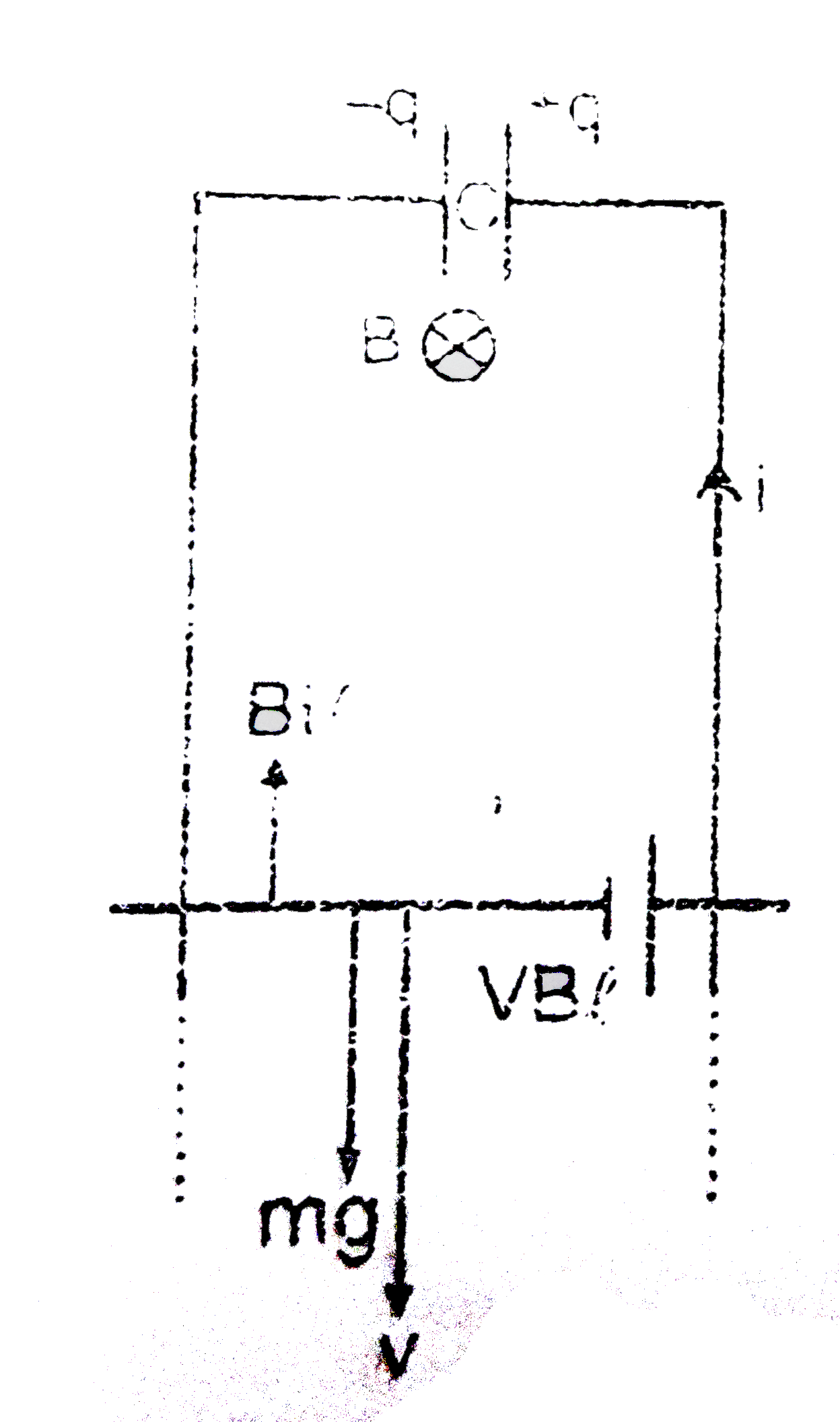
|
|
| 41. |
Given that int (dx)/(sqrt(2ax - x^2)) = a^n sin^(-1) [(x - a)/(a)]where a constant. Using dimenstional analysis , the value of n is |
| Answer» ANSWER :B | |
| 42. |
An electric current is flowing due south along a power line. What is the direction of magnetic field (i) above it and (ii) below it ? |
| Answer» SOLUTION :i)WEST , and II) EAST | |
| 43. |
Which of the following is true for an electron in a Bohr's orbit of hydrogen atom? |
|
Answer» T.E.=P.E. |
|
| 44. |
A square conducting loop is placed near an infinitely long current carrying wire with one edge parallel to the wire as shown in the figure. If the current in the straight wire is suddenly halved, which of the following statements will be true? ''The loop will..'' |
|
Answer» stay stationary 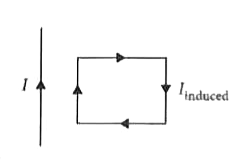
|
|
| 45. |
What is dual nature of radiation ? |
| Answer» SOLUTION :In various phenomena, RADIATION either possess wave nature or quantum (particle) nature, this is known as DUAL nature of radiation. | |
| 46. |
A point object moves on a circular path such that distance covered by it is given by function S=(t^(2)/(2)+2t) meter ( t in second). The ratio of the magnitude of acceleration at t = 2 s and t = 5 s. is 1: 2 then the radius of the circle is |
|
Answer» 1 m |
|
| 47. |
Should a quantity having magnitude and direction be necesserily a vector, give example |
| Answer» Solution :No, The NECESSARY condition is that the quantity must also OBEY the LOW of VECTOR addition. For example, electric current, time, large angles have magnitude and direction but even then they do not obey low of vector addition. | |
| 48. |
If L= 1.00 mH, C = 1.00nF, then find the resonant frequency. |
|
Answer» Solution :Resonant FREQUENCY, `omega_(0) = ( 1)/( SQRT( LC )) = ( 1)/( sqrt(( 1 xx 10^(-3) ) xx ( 1 xx 10^(-9)))) = ( 1)/( sqrt( 10^(-12)))` `:. OMEGA _(0) = 1.00 xx 10^(6)` rad `//` s |
|
| 49. |
Two charges 4muC and 1muC are seperated by 16m. Where do you place a third charge so that it doesn't experience any force. |
|
Answer» |
|
| 50. |
Given figures show the arrangements of two lenses. The radii of curvature of all the curved surfaces are same. The ratio of the equivalent focal length of combinations P, Q and R is ...... |
|
Answer» <P>`2:2:1`  In given diagram P, Q and R lenses are in CONTACT. `therefore` For P COMBINATION of lenses, `(1)/(F_P)=1/f+1/f=2/f` `[because 1/F=(1)/(f_1)+(1)/(f_2)` for combination of lenses] or `F_P=f/2` Similarly for Q and R combination. `F_Q=f/2" and "F_R=f/2` Therefore, `F_P`: `F_Q`: `F_R` is equal to 1:1:1 |
|