

Saved Bookmarks
This section includes 7 InterviewSolutions, each offering curated multiple-choice questions to sharpen your Current Affairs knowledge and support exam preparation. Choose a topic below to get started.
| 1. |
Young's double slit experiment is used to demonstrate interference of light. If one of te slits is closed still dark and bright bands are observed on the screen this is due to |
|
Answer» Inetrference |
|
| 2. |
A dip circle shows an apparent dip of 60^(@) at a place Where the true dip is 45^(@). If the dip eirele is rotated through 90^(@) , what apparent dip will it show? |
|
Answer» `40^(@)` For a DIP circle, `cot^(@)theta = cot^(@) theta_(1) + cot^(@)theta_(2)` where, `theta_(1) and theta_(2)` are the apparent dips in two perpendicular POSITIONS. `therefore cot^(2)45^(@)=cot^(@)60^(@) + cot^(2)theta_(2)` `implies (1)^(2) = (1/sqrt3)^(2)+cot^(2) theta_(2) [therefore TAN 60^(@) = sqrt3]` `implies cot^(2) theta_(2) =1-(1/sqrt2)^(2)=1-1/3=2/3` `implies cottheta_(2) = sqrt(2/3)=sqrt(0.67)=0.816` `theta_(2) ~~ 51^(@).` |
|
| 3. |
The strip zero in radiowave transmission is that range where |
|
Answer» there is no reception of either ground WAVE or SKY wave |
|
| 4. |
In 1896 in Waco, William Crush parked two locomotives at opposite ends of a 6.4-Km-longtrack, fired them up, tied throttles open, and theb allowed them to crash head-on at full speed (Fig. 8.1 )in front of 30,000 spectators. Hundreds of people were hurt by flying debris, several were killed. Assuming each locomotive weighed and its acceleration was a constant what was the total kinetic energy of the two locomotives just before the collision? |
|
Answer» SOLUTION :(1) We need to find the kinetic energy of each locomotivewith Eq. 8-1, but that means we need each locomotive .s speed just before the collision and its mass. (2) Bacause we can assume each locomotive had constant acceleration we can use the equations in Table 2-1 (Chapter2) to find its speed just before the collision. Calculations: We choose Eq. 2-1 (Chapter 2) because we KNOW values for all the variables except With and (half the initial separation ), this YIELDS We can find the mass of each locomotive by dividing its given weight by G: Now, using Eq. 8-1, we find the total kinetic energy of the two locomotives just before the collision as This collision was like an EXPLODING bomb. |
|
| 5. |
Find the magnitude of the centripetal acceleration of a car following a curve of radius 500 m at a speed of 25.0 m/s (about 90 km/h). Compare the acceleration with that due to gravity for this fairly gentle curve taken at high speed. |
|
Answer» Solution :As the values of v and R are given, the expression `a=v^(2)//R` is the most suitable to use. Calculation: Substituting the values of v and r into `a=v^(2)//R` gives `a=(v^(2))/R=((25.0m//s)^(2))/(500m)=1.25m//s^(2)` On comparing this with the acceleration DUE to gravity `(g=9.80m//^(2))`, we consider the ratio of a/g, `a/g=(1.25m//s^(2))/(9.80m//s^(2))=0.128` Thus a=0.128g, which is apparent, PARTICULARLY if you were not wearing a SEAT belt. |
|
| 6. |
An electron falls through distance of 1.5 cm in a uniforth electric field of magnitude 2.0xx 10 ^(4) NC^(-1)The direction of the field is reversed keeping its magnitude unchanged and a proton falls through the same distance compute the time of falls in each case . Contrast the situation with that of 'free fall under gravity' |
|
Answer» Solution :In the field is upwards , so the negativelycharged electron experiences a downward force of magnitude EE is the magnitude of the electric field. The acceleration of the electron is `a_e (aE)/( m_e) ` ,where `m_e` is the mass of the electron. Starting from rest , the time required by the electron to the fall through a distance h is given by `t_e =sqrt((2h)/( a_e) ) =sqrt((2hm_e)/(eE) ) ` For ` e=1.6 xx10^(-19) C,m_e =9.11 xx10 ^(-11) kg. ` `E=2.0xx10^(4)NC^(-1) ,h=1.5 x10^(-2) m,` `t_0 =2.9 xx10^(-9)s ` the field is downward and the positively CHARGED proton experiences a downwards force of magnitude eE. The acceleration of the proton is `a_p =(eE)/( m_p) , `where `m_p` is the mass of the proton `m_p =1.67 xx10 ^(37) `kg. The time of fall for the proton is `t_p =sqrt((2h)/(a_p)) =sqrt((2hm_p)/(eE) ` Thus ,the heavier particle (proton) takes a greater time to fall through the same distance . This is in basic contrast to the situation of free fall gravity where the time of fall is independant of the same mass of the body. Note that in this example we have ignored the acceleration due to gravity in a calculating time of fall . To see if this is justified let us calculate the acceleration of the proton in the given electric field. ` a_p =(eE)/( m_p) =(1.6xx10^(19))xx(2.0xx10^(4))/(1.67xx 10^(-37)) =1.9xx 10^(12) ms^(-2) ` Which is enormous compared to the value of `g(9.8 ms^(-2)) ` the acceleration due to gravity. the accelration of the electron is given greater. Thus the effect of acceleration due to gravity can be ignored in this example. |
|
| 7. |
How does the electric flux due to a point charge enclosed by a spherical Gaussian surface altered when its radius is increased? |
| Answer» SOLUTION :The electric FLUS does not ALTER at all and remains UNCHARGED. | |
| 8. |
Calculate the binding energy per nucleon of ""_3^7Li (7 u), Given mass of a proton = 1.007825 u and mass of neutron = 1.008665u. |
|
Answer» SOLUTION :Mass of 3 proton = `3 XX 1.007825 = 3.023475 U` Mass of 4 neutrons = `4 xx 1.008665 = 4.03466 u` Total mass = 7.058135 u Mass of `""_3^7Li = 7.0878 u` `:.` Mass defect = `0.029665 u` Binding ENERGY = `0.029665 xx 931 MEV = 27.618 MeV` `:.` Binding energy per nucleon = `3.945 MeV`. |
|
| 9. |
For two vectors A and |barA+barB|=|barA-barB| is always true when (i) |barA|=|barB|ne0 "" (ii) A bot B (iii) |barA|=|barB|ne0 and A and B are paralle or anti parallel (iv) When either A or B is zero. |
|
Answer» I and II are true |
|
| 10. |
A plano - convex lens of refractive index 1.5 and radius of curvature 30cm is silvered at the curved surface. Now this lens has been used to form the image of an object. At what distance from this lens and object be placed in order to have a real image of the size of the object |
|
Answer» 20cm |
|
| 11. |
Which is the primary constitutional unit for diode and transistor? |
|
Answer» Solution :The primary constitutional unit for DIODE, transistor is p-n JUNCTION. Understanding the function of p-n junction it is necessary to understand the function of many semiconductor compositions. SINCE the p-n junction has TWO electrodes, it is CALLED the p-n junction diode. |
|
| 12. |
Four coils resistances 3,6,9 and 30Omega respectively are arranged to form a wheatstone bridge. Determine the value of the resistance with which the coil of 30Omega should be shunted so as to balance the bridge. |
|
Answer» |
|
| 13. |
In the formation of a rainbow, the light from the sun on water droples undergoes |
|
Answer» dispersion only |
|
| 14. |
Which of the following is unit of electric field intensity ? |
|
Answer» (A) `N^(-1)C` |
|
| 15. |
Elinstein was awarded Nobel Prize in 1921 for his work on photoelecric effect. On photoelecric effect which characteristic of incident radiation is kept constant in this experiment? |
| Answer» SOLUTION :FREQUENCY | |
| 16. |
Temperature dependence of drift velocity depends on the following factors. |
|
Answer» Number of charge CARRIERS can change with temperature |
|
| 17. |
Assertion : The temparature coefficient of resistance is positive for metals and negative for semiconductors. Reason : On raising the temperature in metals drift velocity increases but in semiconductors more change carries are released. |
|
Answer» If both assertion and reason are true and the reason is the correct EXPLANATION of the assertion |
|
| 18. |
When parents put pressure on their children, what happens? |
|
Answer» They BECOME distressed |
|
| 19. |
A light ray travelling parallel to the principal axis of a convex lens of focal length 12 cm strikes the lens at a height of 5 mm from the principalaxis. What is the angle of deviation produced? |
| Answer» ANSWER :D | |
| 20. |
The maximum distance upto which TV transmission from a TV tower of height h can be received is proportional to |
| Answer» ANSWER :A | |
| 21. |
In a hydrogen atom, the transitiontakes place from n = 3to n = 2 . If Rydberg constant is 1.097 xx 10^(7) m^(-10. The wavelengthof the emiited radiation is |
|
Answer» `(36)/(5R_(H))` `1/lambda=R_(11)XX(1)^(2)[1/4-1/9]` `1/lambda=R_(11)[5/36]` `=lambda=(36)/(5R_(11))` |
|
| 22. |
In the figure, the blocks have unequal masses m_(1) " and " m_(2)(m_(1)gtm_(2)). m_(1) has a downward acceleration a . The pulley P has a radius r, and some mass. The string does not slip on the pulley. |
|
Answer» The TWO SECTIONS of the string have unequal tensions. |
|
| 23. |
A galvanometer has a resistance of 15.0Omega and the meter shows full scale deflection for a current of 2.0 mA. How will you convert this meter into (i) an ammeter of range 0-5.0A and (ii) a voltmeter of range 0 to 15.0V? Also determine the resistance of the meter in each case. |
|
Answer» (ii). `7485Omega` in SERIES, `R_(V)=7500Omega` |
|
| 24. |
The half-line period of a radioactive element A is same as the mean life time of another radioactive element B. Initially both have the same number of atoms. Then |
|
Answer» A and B havethe samedecayrateinitially `(t_(1//2))_(A) = (t_("MEAN"))_(B)` `(0.6931)/(lambda_(A)) = (1)/(lambda_(B))` `lambda_(A) = 0.6931lambda_(B)` `lambda_(A)LT lambda_(B)` |
|
| 25. |
A charged particle moves with a speed u in a circular path of radius raround a long uniformly charged conductor |
|
Answer» `V prop r` |
|
| 26. |
A square of side L meters lies in the xy-plane in a region, where the magnetic field is given by vecB=B_0 (2hati+3hatj+4hatk)Twhere B_0is constant. The magnitude of flux passing through the square is |
|
Answer» `2B_0L^2Wb` `vecB=B_0 (2hati+3hatj+4hatk)` `phi=vecB.vecA=B_0(2hati+3hatj+4hatk).L^2hatk` `phi=4B_0L^2`Wb |
|
| 27. |
A loop made of straight edegs has six corners at A(0,0,0), B(L, O,0) C(L,L,0), D(0,L,0) E(0,L,L) and F(0,0,L). Where L is in meter. A magnetic field B = B_(0)(hat(i) + hat(k))T is present in the region. The flux passing through the loop ABCDEFA (in that order) is |
|
Answer»
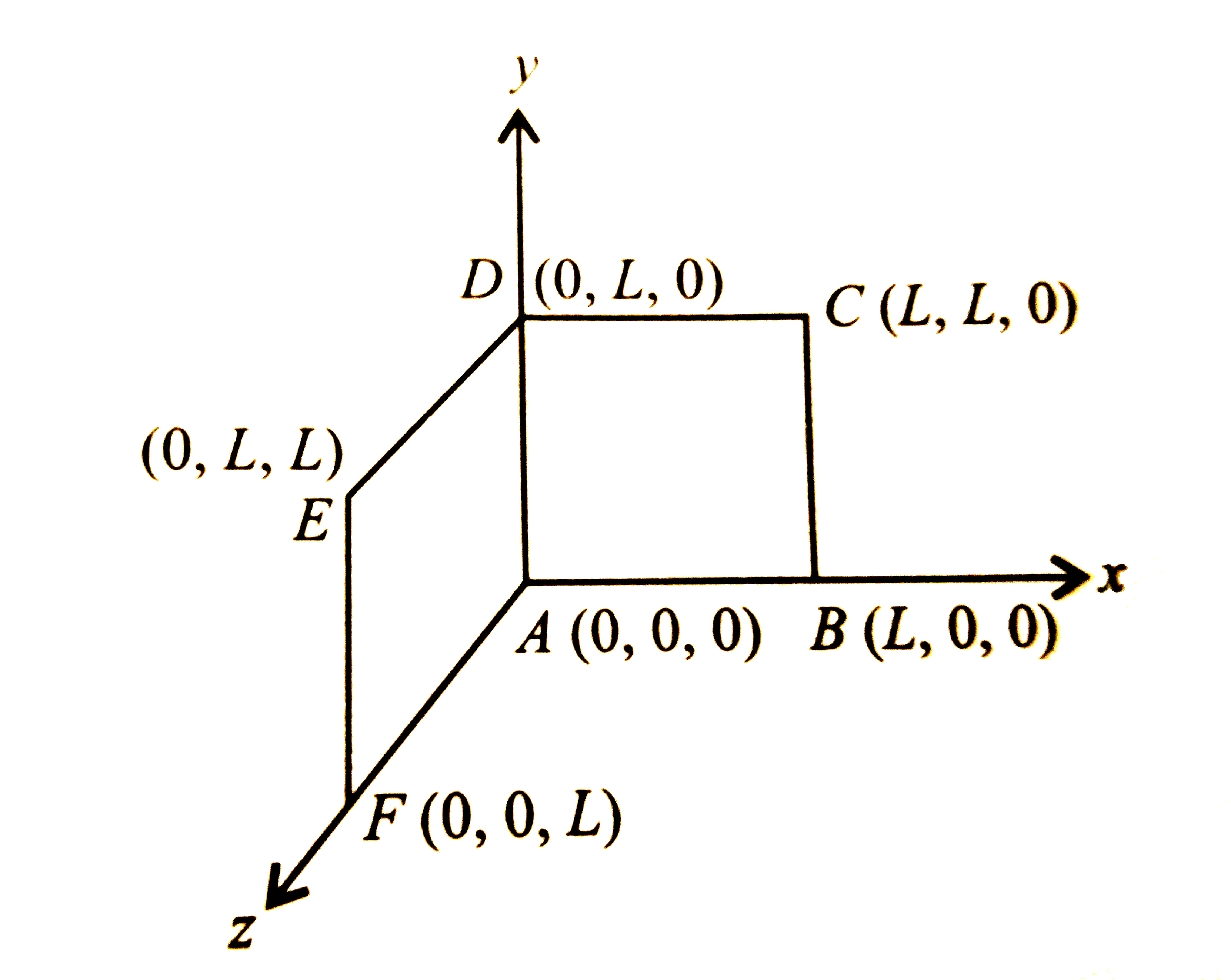 AREA vector of ABCD`=L^(2)hat(j)` Area vector of DEFA= `L^(2)hat(i)` TOTAL magnetic flux, `phi=vec(B)*vec(A)` `=B_(0)(hati+hatk)* L^(2)( hati+hatk)=B_(0)L^(2)(1+1)=2B_(0)L^(2)Wb` |
|
| 28. |
Explain the magnetic susceptibility (chi) of material. From it explain relative magnetic permeability of material and magnetic permeability of material. Obtain the relation between them. |
|
Answer» Solution :The MAGNETISATION of material M proportional to the magnetic intensity (H). `overset(to) (M) prop overset(to) (H)` `therefore overset(to) (M) = chi overset(to) (H) ""…(1)` Here `chi` is dimensionless QUANTITY called it as the magnetic susceptibility. It is a measure of how a magnetic material responds to an external field. For paramagnetic material it is small and positive. For DIAMAGNETIC material it is small and negative because this material `overset(to) (M) and overset(to)(H)` are opposite in direction. Think the material which can be magnetize are filled in interior of solenoid. Total magnetic field obtain when current I in solenoid pass through is, `overset(to) (B) = mu_(0) (overset(to) (H) + overset(to) (M) )""...(2)` From equation (1) and (2), `overset(to) (B) = mu_(0) (overset(to) (H) + chi overset(to) (H) )` `therefore overset(to) (B) = mu_(0) (1+ chi) overset(to) (H)""...(3)` Here `mu_(0) (1 + chi) ` is the permeability `mu` of the material. Hence, `mu= mu_(0) (1 + chi) ""...(4)` `(mu) /( mu_0) = (1 + chi ) = mu_r""...(5)` `therefore mu= mu_(0) (1 + chi) = mu_(0) mu_r ""...(6)` Here, (1) `mu_r` is called the relative magnetic permeability of the substance. It is a dimensionless quantity. It is the analog of the dielectric constant in electrostatics. (2) Equation (6) indicates the interrelation between `mu, mu_r and H` and only ONE of them is independent. Given one the other two MAY be easily determined. Putting equation (6) in equation (3), `overset(to) (B) = mu_(0) mu_r overset(to) (H)""...(7)` `overset(to) (B) = muoverset(to) (H) ( because mu_(0) mu_(r) = H) ""...(8)` |
|
| 29. |
Statement I : In a young's double slit experiment two slits are at distance d part.Interference pattern is observed on a screen at distance D from the slits. At a point on screen directly opposite to one of the slits, a dark fringe is observed.The wave length of wave is (d^(2))/(D). Statement II : If the entire double slit experiment is dipped in water, the fringe size gets reduced. |
|
Answer» Statement I is true, statement II is FALSE. `therefore (lambda)/(2) = D(1 + (d^(2))/(D^(2)))^(1/2) - D` `(d^(2))/(2D) = (lambda)/(2)` `therefore lambda = (d^(2))/(D)` 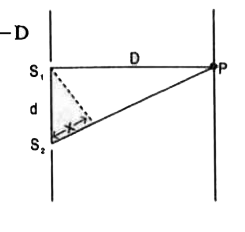
|
|
| 30. |
A plane mirror is fixed at the bottom of a tank containing water. A small object is kept at a height of 24 cm from the bottom and is viewed from a point vertically above it. The distance between the object and the image in the mirror as appears to the person is |
|
Answer» 48 cm |
|
| 31. |
Conisder the dipole vec(p) kept in a space of electric field a shown. The dipole will move |
|
Answer» upwards |
|
| 32. |
A solid cylinder is kept on one edge of a plank of same mass and length 25 m placed on a smooth surface as shown in the figure. The coefficient of friction between the cylinder and the plank is 0.5. The plank is given a velocity of 20ms^(-1) towards right. Find the time (in S) after which plank any cylinder will separate. [g=10ms^(-2)] |
|
Answer» |
|
| 33. |
(a) Using Bohr's postulates, derive the expression for the total energy of the electron in the stationary states of the hydrogen atom. (b) Using Rydberg formula, calculate the wavelengths of the spectral lines of the first member of the Lyman series and of the Balmer series. |
|
Answer» Solution :`mvr=(nh)/(2pi)` `(mv^(2))/( r )=(1)/(4PI epsi_(0)).(e)/( r^(2) )` `r=(e^(2))/(4pi epsi_(0) mv^(2))` `r=(Ze^(2))/(4pi epsi_(0)m((nh)/(2pi mr))^(2))` `rArr r=(epsi_(0) n^(2)h^(2))/(pi me^(2))` Potential ENERGY `U=-(1)/(4pi epsi_(0)).(e^(2))/( r )` `(me^(4))/(4 epsi_(0)n^(2)h^(2))` `KE=(1)/(2)mv^(2)` `=(1)/(2)m((nh)/(2pi mr))^(2)` `=(n^(2)h^(2)pi^(2)m^(2)e^(4))/(8pi^(2)me_(0)^(2)n^(4)h^(4))` `KE=(me^(4))/(8epsi_(0)^(2)h^(4))` `KE=(me^(4))/(8epsi_(0)^(2)n^(4)h^(2))` `TE=KE+PE` `=(me^(4))/(8 epsi^(2)n^(2)h^(2))-(me^(4))/(4 sum^(2)jn^(2)h^(2))` `=-(me^(4))/(8 epsi_(0)^(2)n^(2)h^(2))` Rydberg formula : For first MEMBER of Lyman series For first member of Balmer Series `(1)/(lambda)=R((1)/(1^(2))-(1)/(2^(2)))` `=(4)/(3R)` For first member of Balmer Series `(1)/(lambda)=R((1)/(2^(2))-(1)/(3^(2)))` `lambda=(36)/(5R)` |
|
| 34. |
The magnetic field of earth is due to |
|
Answer» Motion and distribution of some material in and outside the earth |
|
| 35. |
Find the wavelength of X-ray radiation if the maximum kinetic energy of compton electrons is T_(max) = 0.19 MeV. |
|
Answer» Solution :We see form the previous PROBLEM that the electron GAINS the maximum `K.E.` when the photon is SCATTERED backwards `theta = 180^(@)`. Then `omega_(0) = omega_(0) = (mc^(2)//cancel h)/(sqrt(1+(2mc^(2))/(T_(max)) )-1)` Hence `lambda_(0) = (2pic)/(omega_(0)) = (2picancel h)/(mc) [sqrt(1+(2mc^(2))/(T_(max)))-1]` Substituting the values we get `= lambda_(0) = 3.695 pm`. |
|
| 36. |
Barrier potential of a p-n junction diode does note depend on ……. |
|
Answer» DOPING density Potential barrier does not DEPEND on design but depend on temperature, doping density and forward bias. |
|
| 37. |
A galvanometer of 10 ohm resistance gives full scale deflection with 0.01 ampere of current .It is to be convertes into an ammeter for measuring 10 ampere current. The value of shunt resistance required will be : |
|
Answer» 0.01 ohm |
|
| 38. |
There is a current of 40 ampere in a wire of 10^(-6) square metre area of cross-section. If the number of electrons per cubic metre is 10^(-29), then the drift velocity is: |
|
Answer» `250xx10^(-3)` m/s |
|
| 39. |
What is the current out of the battery? |
|
Answer» 1A |
|
| 40. |
The ground state energy of hydrogen atom is - 13.6 eV. When electron is in excited state its excitation energy is ...... |
|
Answer» `3.4eV`  `DeltaE=E_(2)-E_(1) "also" E_(n)=-(13.6)/(n^(2))EV` `:.DELTA=-(13.6)/(2^(2))-((13.6)/(1^(2)))` `=-3.4+13.6` `:.DeltaE=(-3.4)-(-13.6)=10.2eV` |
|
| 41. |
If , lambda_(1) and lambda_(2)are the wavelength of thenumbers of the Lyman and Paschen seri respectively. Then lambda_(1):lambda_(2)=..... |
|
Answer» `1:3` `:.lambda_(1)=(4)/(3R)....(1)` `(1)/(lambda_(2))=R[(1)/(3^(2))-(1)/(4^(2))]` `=R[(1)/(9)-(1)/(16)]=R[(7)/(144)]` `:.lambda_(2)=(144)/(7R)...(2)` `:.(lambda_(1))/(lambda_(2))=((4)/(3R))/((144)/(7R))` `:.lambda_(1):lambda_(2)=(7)/(108)` |
|
| 42. |
In a high altitude cosmic station on a mountain at an altitude of 3250 mabovesealevel,calculatethepressureofair at this station. Take the temperature of the air constant and equalto 5^(@)C . Themass of one kilomoleof airis 29 kg /kmoleand the pressureat sealevelis 760of mercury . |
| Answer» SOLUTION :`~~ 506 .3` mmof HG | |
| 43. |
Gauss’s theorem in electrostatics can be expressed mathematically as: |
|
Answer» `PHI=(pivarepsilon_0)/2` |
|
| 44. |
The kinetic energy of a beam of electrons, accelerated through a potential V, equals the energy of a photon of wavelength 5460 nm. Find the de-Broglie wavelength associated with this beam of electrons. |
|
Answer» Solution :As per question, kinetic enegy of electron K=energy of a photon of wavelength `lamda=5460nm=5460xx10^(-9)m ` THUS, `K=(HC)/(lamda)=(6.63xx10^(-34)xx3xx10^(8))/(5460xx10^(-9))=3.64xx10^(-20)J` `therefore`de-Broglie wavelength `lamda_(de)=(H)/(sqrt(2mK))=(6.63xx10^(-34))/(sqrt(2xx9.1xx10^(-31)xx3.64xx10^(-20)))=2.62xx10^(-9)m=2.62m`. |
|
| 45. |
Condition for autocollimation Find the distance between the convex lens and convex mirror, both of focal length 20cm (Figs. 34-42a and b ), so that for an object kept at 30cm from the lens, the final image is at the object itself. (This is commonly known as condition for autocollimation that we discussed in Section 33.5) |
|
Answer» Solution :(1) This condition occurs when the object and image coincide. In the case of mirror, this happens when the object for the mirror is at its pole or at the center of curvature (Figs. 34-42a and B). In the second case, the angle of incidence is `0^(@)` and hence the angle of reflection will also be `0^(@)`. (2) In the case of single lens, image can never coincide with the object because the rays are refractedinto the next medium. But if the lens is kept before the mirror, after refraction from the lens, rays will fall on the mirror. If the image of the lens is at th pole or at the center 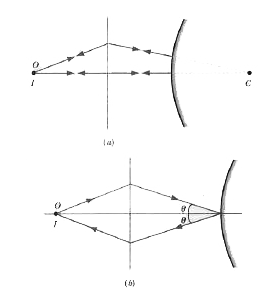 of the curvature of the mirror, the rays will retrace their path and hence by the principle of optical reversibility, we can say that image will again form on the object. Calculation : For the lens , `v=(UF)/(u+f)=(20xx-30)/(-30+20)=60cm` For the mirror, this image should act as an object. The autocollimation will occur if this image is formed at pole. In this situation, the distance between the lens and the pole will be 60cm Autocollimation will also occur if this image is formed at the center of curvature of the mirror. But the center of curvature is 40cm away from the pole as can be seen in the figure. So, the lens can also be at 60-40=20cm from the mirror. Learn : In fact, a beam of LIGHT can be made to retrace its path by using a transparent sphere silvered at its back. For this the condition of autocollimation requires that the intermediate image which acts as an object for the mirror at the back is at the center of the sphere (Fig. 34-43b) or at its pole (Fig. 34-43a). It is obvious that due to refraction from a sphere, image cannot be formed at its center (angle of refraction will become zero for a finite angle of incidence as can be 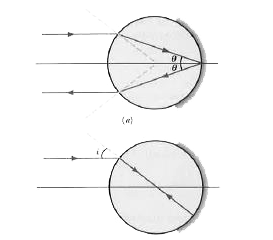 seen in Fig. 35-43b). But the image due to refraction at the curved surface can be definitely formed at the pole of the mirror. This would happen if the refrective index of the sphere is exactly two times the refractive index of the medium from which the radiation is incident. Note : This is conventionally known as a cat.s eye retroreflector. The term cat.s eye derives from the resembalance of the cat.s eye retroreflector to the optical system that produces the well-known phenomenon of"glowing EYES " or eye SHINE in cats and other vertebrates (which are only reflecting light, rather than actually glowing). |
|
| 46. |
A 8muFcapacitor is charged by a 400V supply through 0.1 MOmegaresistance. The time taken by the capacitor to develop a potential difference of 300V is : |
|
Answer» 2.2 sec |
|
| 47. |
A thin uniform disc of mass m and radius R suspended by an elastic thread in the horizontal plane performs torsional oscillations in a liquid. The moment of leastic forces emerging in the thread is equal to N=alpha varphi, where alpha isa constant and varphi is the angle of rotation from the equilibrium position. The resistance force acting on a unit area of the disc is equal to F_(1)eta v, where eta is a constant and v is the velocity of the given element of the disc relative to the liquid. Find the frequency of small oscillation. |
|
Answer» Solution :LET us calculate the moment `G_(1)` of all the resistive forces on the disc. When the disc rotates an element `(r d r d theta ) ` with coordinates `( r, theta)` has a velocity `r dot ( varphi)` where `varphi` is the intantaneious angle of ROTATION from the equilibrium position and `r` is measured from the centre. Then `G_(1)=int_(0)^(2pi)d theta int _(0)^(R) dr. r. (F_(1)xxr)` `=int _(0)^(R) eta r dot(varphi) r^(2) d gammaxx2pi =( eta pi R^(4))/( 2) dot ( varphi)` Also moment of inertia `=( MR^(2))/( 2)` THUS `( mR^(2))/( 2) ddot( varphi)+ ( pi etaR^(4))/( 2) dot (varphi) + alpha varphi=0` or` ddot(varphi) +2(pi eta R^(2))/(2m) dot( varphi)+(2 alpha)/(m R^(2))varphi=0` Hence `omega_(0)^(2)=(2alpha)/( mR^(2))` and ` beta =( pi eta R^(2))/( 2m )` and angular frequency`omega=sqrt(((2 alpha)/( mR^(2)))-((pi etaR^(2))/(2m))^(2))` Note `:-` normally by frequency we mean `( omega)/( 2pi)`. |
|
| 48. |
What's the mass of neutron and proton and what's proton's charge ? |
|
Answer» SOLUTION :`1.673xx10^(-27)KG, 1.672xx10^(-27) kg,` `1.6xx10^(19) C` |
|
| 49. |
The linear momentum of the electron in the ground state of H-atom is 2 xx 10^(-24) kg m//s, its linear momentum in the 8^(th) orbit is |
|
Answer» `2.5 xx 10^(-25) kg m//s` `:. P_(8)=P_(1)/8=(2xx10^(-24))/8=2.5xx10^(-25)` kg m/s |
|