

Saved Bookmarks
This section includes InterviewSolutions, each offering curated multiple-choice questions to sharpen your knowledge and support exam preparation. Choose a topic below to get started.
| 44401. |
A parallel plate capacitor consists of two plates of area 10^-2m^2 placed at a distance of 3.0 cm apart in air. The capacitor is charged to a potential of 900 V Then, ‘ capacity of capacitor is :(Given varepsilon=9xx10^-2N//C) |
|
Answer» `6xx10^-12F` |
|
| 44402. |
A composition string is made up by joining two strings of different masses per unit length 1 g/m and 4 g/m. The composite string is under the same tension. A transverse wave pulse : y = (6 mm) sin(5t + 40x), where .tf is in seconds and .x. in meters, is sent along the lighter string towards tile joint The joint is at x = 0, The equation of the wave pulse refler.-i from the joint is |
|
Answer» (2 mm) sin(5t - 40x) |
|
| 44403. |
The aperture of objective lens of a telescope is made large so as to |
|
Answer» increase its MAGNIFYING power |
|
| 44404. |
{:("(i) H.C Oersted","(a) Cyclotron"),("(ii) William Gilbert","(b) Magnetic lorentz force "),("(iii) Lawrence","(c) Electromagnetis"),("(iv)Lorentz","(d)Earth powerful magnet"):} |
|
Answer» |
|
| 44405. |
Path length . |
| Answer» Solution :The length of the path over which a particle PEFORMS SHM is twice the amlplitude of the motion and is called the path length or RANGE of the SHM. | |
| 44406. |
Goldstein used a perforated cathode and discovered a new kind of rays called_____. |
| Answer» SOLUTION :cathetrons | |
| 44407. |
If the vetical component of earth's magnetic field be 4.0xx10^(-5) Wbm^(-2), then what will be the potential difference induced between the rails of a metre- gange running north-south when a train is running on them with a speed of 36 kmh^(-1) |
|
Answer» |
|
| 44408. |
The charge flowing in a conductor varies with time as Q= at -(1)/(2)bt^(2)+(1)/(6)ct^(3) where a, b and c are positive constants. If at time t, the current in the conductor is i, which of the following graphs is correct ? |
|
Answer»
|
|
| 44409. |
A carnot engine has the same efficiency between 800 K and 500 K and x K to 400 K. What is the value of x? |
|
Answer» 900 K |
|
| 44410. |
Consider an extended object immersed in water contained in a plane trough. When seen from close to the edge of the trough the object looks distorted because |
|
Answer» the apparent depth of the points CLOSE to the edge are nearer the surface of the water compared to the points away from the edge.  Consider a plane trough (a long and shallow water reservoir with plane bottom) with AD a water surface. Now, observe point like objects `P_1` and `P_2`, at equal depth AB = CD = h obliquely a point Q, nearer to edge CD. Here, for incidence ray `P_1Q`, angle of incidence is `theta_1`. and angle o refraction is `theta._1`. Similarly, for incident ray `vac(P_2Q)` angle of incidence is `theta_2`, and angle of refraction is `theta._2` . Here because of refraction at surface AD of water, we get `theta._1 gt theta_1` and `theta._2 gt theta_2`. Here `theat_2 gt theta_1` and so we get `theta._2 gt theat._1` . Because of this virtual depths of virtual positions `P._1` and `P._2` (of real objects, respectively `P_1` and `P_2`.) are obtained as `d_1` and `d_2` where `d_1 lt d_2` as seen from the figure) Thus virtual depth is found to be less nearer the edge of trough and farther the edge of trough, it is found to be more. Now, here if object is an extended object, extended from `P_1` to `P_2` then due to same depth, object is actually planar but when it is observed from near the edge of water surface in a trough image of planar object appears to be distorted. Thus, option (A) is correct. Now, as per the statement if we consider object in air at `R_1`, near the water surface then its real image is formed at point `P_1`. Here `angleR_1QM = theta._1` and `angleP_1QN = theta_1` where `theta_1 lt theta._1` `implies` Option (B) is also correct. Now, in above figure if we SHIFT point-like object towards end B then angle of incidence `theta` goes on increasing. At one stage when `theta ge C` (where C = CRITICAL angle), object is not seen from air due to total internal reflection. Thus, option (C) is also correct. |
|
| 44411. |
Am electric dipole is placed in a uniform electric field . (i)Show that no traslatory force acts on it .(ii)Derive an expression for the torque acting on it.(iii)Find work done in rotating the dipole through 180^(@). |
Answer» Solution :Electric dipole of charges + q and - q separated by distance 2a is shown in figure. It is PLACED in a uniform electric FIELD at an angle `theta` with it. (i)Force on charge `+q,F_(1)=qvecE` , in the DIRECTION of `vecE`. Force on charge `-q,F_(2)=-qvecE`,in the opposite direction of E. `therefore` Net translatory force on dipole `=F_(1)+F_(2)` `=+qvecE-qvecE=0` HENCE , no translatory force acts on it. (ii)But the two equal parallel and unlike forces form a couple in which a torque is given by `TAU="Force"xx`perpendicular distance between the two forces `=qExx2asintheta` `tau=pEsintheta` where , `p=qxx2a=`dipole moment (iii)Work done in rotating the dipole through `180^(@)` is `W=intdW` `=int_(0^(@))^(180^(@))tau d theta=pEint_(0^(@))^(180^(@))sin theta d theta` `=pE[-costheta]_(0^(@))^(180^(@))` `=pE[cos180^(@)-cos0^(@)]` `=pE[1+1]=2pE` |
|
| 44412. |
An infinite number of charges each q are placed in the x-axis distances of 1, 2,4,8...... meter from the origin. If the changes are allately positive and negative find the intensity of electric field at origin |
Answer» SOLUTION :The ELECTRIC field intensities due to POSITIVE charges at origin is away from the charges and due to -ve charges the field intensity is towards the charges  The resultant intensity at the origin `E = E_1 - E_2 + E_3 - E_4 `--------- `E = Q/(4 pi epsilon_0)(1 - 1/(2^2) + 1/(4^2) - 1/(8^2) + …...)` Since the expression in the bracket is in GP with a common ratio = `(-1)/(2^2) = (-1)/(4)` `E = Q/(4 pi epsilon_0) (1)/([1 - ((-1)/(4))]) = Q/(4 pi epsilon_0) cdot 4/5` `E = 4/5cdot Q/(4 pi epsilon_0) "" E = Q/(5PI epsilon_0)`. |
|
| 44413. |
How do you convert a moving coil galvanometer into a voltmeter? |
| Answer» SOLUTION :A moving coil galvanometer can be converted into a voltmeter by connecting a RESISTANCE in SERIES with the galvanometer. | |
| 44414. |
A horizontal metallic rod of mass 'm' and length 'l' is supported by two vertical identical springs of spring constant 'K' each and natural length l_(0). A current 'i is flowing the the rod in the direction shown. If the rod is in equilibrium, then the lengthof each spring in this state is: |
|
Answer» `l_(o)+(ilB-mg)/(K)` |
|
| 44415. |
Calculate the equivalent resistance between points A and B in each of the following networks of resistors : |
|
Answer» |
|
| 44416. |
A long sighted person has a least - distance of distinct vision of 50 cm. He wants to reduce it to 25 cm. He should use a : |
|
Answer» CONCAVE lens of FOCAL length 50 cm `(1)/(F) = (1)/(oo) - (1)/(100) rArr f = - 100 cm` |
|
| 44417. |
Three identical ideal springs, each of spring constant K = 2000 N/m are connected in three different arrangements as shown in the figure-I, figure-II and figure-III respectively. A massless hook A is connected to the lower and of each configuration. If a mass of 10kg is connected to hook A, the magnitude of displacement of point P are x_(1), x_(2) and x_(3) in figure-I, figure-II and figure-III respectively. Choose the correct option. |
|
Answer» `x_(1)=0.150m, x_(2)=0.075 m, x_(3)=0.075m` 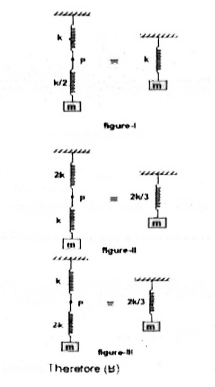 `x_(10)=(3mg)/(k)` `kx_(1)=(k)/(2)(x_(10)-x_(1))` `RARR (3kx_(1))/(2)=(k)/(2)x_(10)` `rArr 3x_(1)=x_(10)` `rArr x_(10)=(mg)/(k)=0.05m` `x_(20)=(3mg)/(2k)` `2kx_(2)=k(x_(20)-x)` `rArr x_(2)=(x_(20))/(3)=(mg)/(2k)=0.025m` `x_(30)=(3mg)/(2k)` `kx_(3)=2k(x_(20)-x_(3))` `rArr x_(3)=(2x_(20))/(3k)=(mg)/(k)=0.05m` |
|
| 44418. |
An ideal gas has temperature T_(1) at the initial state i shown in the P- V [ diagram. The gas has a higher temperature T_(2)at the final states a and b, which it can reach the paths shown. The change in entropy is: |
|
Answer» greatest in a As `Q_(b) gt Q_(a), therefore` Change in entropy is greater in case (b). |
|
| 44419. |
Soft iron is used to manufacture electromagnets because their |
|
Answer» magnetic saturation mit is HIGH while RETENTIVITY and coercive force are small |
|
| 44420. |
The electric field in a large region of earth's atmosphere is directed vertically down. At an altitude of 300m, the electric field is 60 V/m. At an altitude of 200m, the electric field is 100 V/m. The net amount of charge contained in the cube of 100m edge, located between 200m and 300m altitude is |
|
Answer» `3.54 MU C ` |
|
| 44421. |
Draw the graphical representation of variation of current amplitude I_0 with frequency omega for a series LCR circuit. |
| Answer» SOLUTION :REFER QUESTION 16 coceptual quastions | |
| 44422. |
Using the formula for the radius of nth orbit r_(n)=(n^(2)h^(2)epsi_(0))/(pi mZe^(2)) derive an expression for the total energy of electron in n^(th) Bohr's orbit. |
Answer» Solution :The atomic model of Bohr is shown in the figure.  Let mass of electron m, charge e, linear speed in `n^(th)` orbit `v_(n)` and orbital radius `r_(n)`. POSITIVE charge on nucleus Ze, where Z = atomic number of element. The necessary centripetal force is provided by Colombian attractive force between an electron and the positive charge of the nucleus. `:.(mv_(n)^(2))/(r_(n))=((Ze)(e))/(4pi epsi_(0)r_(n)^(2))` `:.(1)/(2)mv_(n)^(2)=(Ze^(2))/(8 pi epsi_(0)r_(n))` `:.` Kinetic energy `K=(Ze^(2))/(8pi epsi_(0)r_(n)) ""....(1)` And potential energy. `U=(kq_(1)q_(2))/(r_(n))` `:.U=-((Ze)(e))/(4pi epsi_(0) r_(n))=-(Ze^(2))/(4pi epsi_(0)r_(n))....(2)` `rArr` Total energy of electron, `E_(n)` = kinetic energy K + potential energy `=(Ze^(2))/(8 pi epsi_(0)r_(n))-(Ze^(2))/(4pi epsi_(0)r_(n))`[ `:.` from equation (1) and (2)] `=-(Ze^(2))/(8pi epsi_(0)r_(n))` Now putting `r_(n)=(n^(2)h^(2)epsi_(0))/(pi m Ze^(2))` `E_(n)=-(Ze^(2))/(8pi epsi_(0))XX(pi m Ze^(3))/(n^(2)h^(2)epsi_(0))` `:. E_(n)=(mZ^(2)e^(4))/(8n^(2)h^(2)epsi_(0)^(2)) ""...(3)` `:. E_(n) prop -(Z^(2))/(n^(2))`[ `:.` All other terms are contant] For hydrogen atom Z=1. `E_(n)=(me^(4))/(8 n^(2)h^(2) epsi_(0)^(2)) ""...(4)` which is the total energy of electron in the `n^(th)` orbit of atom. It is assumed that deriving this formula the electronic orbits are circular. Putting the accepted value of m, e, h and €, in equation (4), `E_(n)=(2.18xx10^(-18))/(n^(2))J` but `1.6xx10^(-19)KJ=1eV` `:.E_(n)=-(2.18xx10^(-18))/(n^(2)xx1.6xx10^(-19))eV` `=-(13.6)/(n^(2))eV [ "where" (me^(4))/(8h^(2) epsi_(0)^(2))=3.6eV]` The negative sign of the total energy INDICATES that electron is bound with nucleus. |
|
| 44423. |
Asses the radii of the deuterium and the polonium nuclei and the height of the Coulomb potential barrier of these nuclei. |
|
Answer» |
|
| 44424. |
The wavelengths of a photon, an electron and a uranium nucleus are same. Maximum energy will be of |
|
Answer» photon |
|
| 44425. |
A particle of charge 1 muC is moving from point A that is at potential 100 V to point B that is at potential 500 V. Calculate the change in kinetic energy of the charged particle. |
| Answer» SOLUTION :`4XX10^(-4)J` | |
| 44426. |
Arrives at lens equation from lens maker's formula . |
|
Answer» SOLUTION :Fromrefraction through a double convex lens the RELATION between the object DISTANCE u, image distance `v_(1)` and radius of curvature `R_(1)` as `(mu_(2))/(v_(1))-(mu_(1))/(u)=(mu_(2)-mu_(1))/(R_(2))` The relationbetween the object distance `v_(1)` image distance v and radius of curvature `R_(2)`canbe `(mu_(1))/(v)-(mu_(2))/(v_(1))=(mu_(1)-mu_(2))/(R_(2))` Adding EQUATION (1) and (2) `(mu_(1))/(v)-(1)/(u)=(mu_(2)-mu_(1))[(1)/(R_(1))-(1)/(R_(2))]` If the object is placed at infinty `(u = oo)`, the image will be FORMED at the focus,i.e. v = f `(1)/(f)=((mu_(2)-mu_(1))/(mu_(1)))[(1)/(R_(1))-(1)/(R_(2))]` This is len.s maker.s formula. When the lens is placed in air `mu_(1) = 1 and mu_(2) = mu` Equation (4) becomes, `(1)/(f)=(mu_(2)-mu_(1))[(1)/(R_(1))-(1)/(R_(2))]` Fromequation (3) and (4), we have `(1)/(v)-(1)/(u)=(1)/(f)` This is the len.s equation |
|
| 44427. |
An electron falls through a distance 1.5 cm in a uniformelectric field of magnitude 2.0xx 10^(4)NC^(-1) .Calculate the time it takes to fall through this distance starting from rest. If the direction of the field is reversed keeping its magnitude uncharged , calculate the time taken by a proton to fall through this distance starting from rest. |
|
Answer» Solution :Here distance to be covered s `= 1.5 CM = 1.5 xx 10^(-2)m, ` ELECTRON field ` E= 2.0 xx 10 ^(4)N C^(-1)` , charge on an electron /proton `=+- e= 1.6 xx 10 ^(-19)C ,` initial velocityu=0 , mass of electron m`= 9.1 xx 10 ^(-31) ` kg and mass of proton `m. =1.67 xx 10 ^(27) kg.` Acceleration of electron in ELECTRIC field a= `(F)/( m) = ( eE)/( m) ` So as per relation s=ut `+(1)/(2)at ^(2) ` , the time taken by electron to cover the distance ` "" t= sqrt(( 2s)/( a)) = sqrt(( 2sm)/( eE)) =sqrt(( 2xx( 1.5xx10^(-2))xx (9.1xx10^(-31)))/( (1.6xx 10^(-19) ) xx ( 2.0 xx10 ^(4)) ) ` `"" = 2.9xx 10 ^(-9) s ` Similarly time taken by proton t. =`sqrt(( 2sm.)/( eE) ) = sqrt(( 2xx( 1.5xx10^(-2)) xx (1.67xx10 ^(-27)))/( (1.6xx 10^(-19) ) xx ( 2.0 xx10 ^(4))) ` ` ""= 1.3 xx10 ^(-7) s`  `)
|
|
| 44428. |
Dose the change in magnetic flux induce e.m.f. or current? |
| Answer» SOLUTION :The change in magnetic flux ALWAYS induces e.m.f. However, the current is INDUCED only the circuit is closed. | |
| 44429. |
What is sky wave ? |
| Answer» Solution :Sky waves. The radiowaves SENT by a TRANSMITTING ANTENNA and REACH the RECEIVING antenna after reflection in the ionosphere are called sky waves. | |
| 44430. |
Assuming that two diodes D_(1) and D_(2) used in the electric circuit shown are ideal, find out the value the current flowing through 2 Omega resistor . |
|
Answer» Solution :An ideal diode offers no resistance in FORWARD bias but an INFINITE resistance in reverse bias. Hence, no current will flow through diode `D_(2)` and main circuit current FLOWING through 2`Omega` resistor will be ` L = (2 V)/((3 + 2)Q) = 0.4 A ` 
|
|
| 44431. |
Two prisms of identical geometrical shape are combined with their refracting angles oppositely directed. The materials of the prisms have refractive indices 1.52 and 1.62 for violet light. A violet ray is deviated by 1.0^@ when passes symmetrically through this combination. What is the angle of the prisms ? |
|
Answer» `Ler A=angle of the prisms `mu_y=1.52 and mu_y=1.62` `mu_y=1.0^@` `delta_y=(mu_y-1)A-(mu_y-1)A` [since A=a] `delta_y=(mu_y-mu_y)A` `A=delta_y/(mu_y=mu_y)=1/((1.62)-(1.52))` `=1/0.1=10^@` |
|
| 44432. |
Energy of electron in first excited state in Hydrogen atom is -3.4eV. Find K.E. and P.E. of electron in the ground state. |
|
Answer» SOLUTION :`because` Energy of electron in frist EXCITED state in HYDROGEN atom, `E=-3.4eV` `therefore"K.E. of electron K"=-E=+3.4eV` `"and P.E. of electron U"=2E=2xx(-3.4)=-6.8eV` |
|
| 44433. |
A 60 pF capacitor is fully charged by a 20 V supply. It is then disconnected from the supply and is connected to another uncharged 60 pF capacitor in parallel. The electrostatic energy that is lost in this process by the time the charge is redistributed between them is ( in nJ) |
|
Answer» 30  Energy LOSS `= U_(i) - U_(f)` `= (1)/(2) CV^(2) =-2 [ (1)/(2) C ((V)/(2))^(2)]` =`(1)/(2) CV^(2)-(1)/(4) CV^(2)` `= (CV^(2))/(4)` `= (60xx10^(-12)xx(20)^(2))/(4)` `= (60xx400)/(4) xx10^(-12)` `= 6xx10^(-9) J 6 ` n j |
|
| 44434. |
A microscope has an object and eyepiece of focal lenghts 5 cm and 50 cm respectively with tube length 30 cm. Find the magnificationof the microscope in the (i) near point and (ii) normal focusing. |
|
Answer» Solution :`f_(0)=5cm=5XX10^(-2)m,f_(E)=50cm=50xx10^(-2)m,` `L=30cm=30xx10^(-2)m,D=25cm=25xx10^(-2)m` (i) The total magnification m in the near point focusing is, `m=m_(0)m_(e)=((1)/(f_(o)))(1+(D)/(f_(e)))` Substituting `m=m_(o)m_(e)=((30xx10^(-2))/(5xx10^(-2)))(1+(25xx10^(-2))/(50xx10^(-2)))=(6)(1.5)=9` (ii) The total magnification m innormal focusingis `m = m_(o)m_(e) = ((L)/(f_(o)))((D)/(f_(e)))` Substituting, `m=m_(o)m_(e)=((30xx10^(-2))/(5xx10^(-2)))((25xx10^(-2))/(50xx10^(-2)))=(6)(0.5)=3` |
|
| 44435. |
Derive an expression for the capacitance of a parallel plate capacitor. Explain the effect of dielectrics on capacitance of this capacitor. Or. Derive expression for capacitance of a parallel plate capacitor. Explain the effect of dielectrics on its capacitance. |
|
Answer» Solution :Capacitor is an arrangement for storing a large amount of electric charge hence electric ENERGY in a very small space. Principle. It is based on the principle that when an earthed conductor is placed in the neighbourhood of a charged conductor, the capacitance of the system increases considerably. Let positive charge be given to a plate A till it is maximum positive [Fig (a)]. Now consider another insulated plate B held near A. By induction, nearer side of B acquired NEGATIVE and farther side positive potential. whereas the induced negative charge tries to decrease the potential of A, induced positive charge tries to increase the potential of A. since induced negative charge in nearer, its effect is larger than induced positive charge. hence the potential of A gets reduced and capacity is increased. 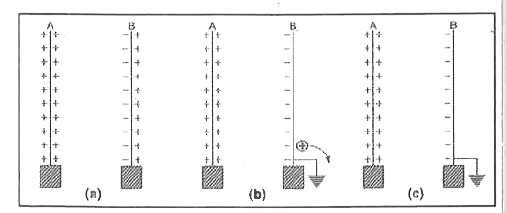 Connect B to the earth [Fig. (b)]. induced free positive charge goes to the earth wheares induced negative charge remains bound. due to this, potential of A is greatly reduced and its capacity increased enormously. Thus, capacitance of an insulated conductor is increased considerably by bringing near it an uncharged earthed conductor. this is the principle of capacitor. Expression for capacitance of PARALLEL plate capacitor parallel plate capacitor consists of two thin conducting plates A and B held parallel to each other at a certain distance d apart. medium between plates is given to the vacuum. plate A is insulated and B is earthed. When charge +q is given to A, it induced -q on the nearer face of B and +q on the farther face of the plate B. free ve charge on B flows to the earth. Electric field intensity between the plates is `E=(SIGMA)/(epsi_(0))` Where `sigma` is the charge density and equal to `q//A`. 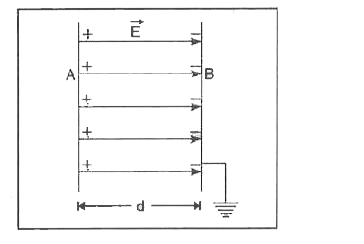 now, `E=(V)/(d)`, where V is the P.D. between plates. `therefore V=Ed=(sigma)/(epsi_(0))d=(qd)/(Aepsi_(0))` `C=(q)/(V)=(q)/((qd)/(Aepsi_(0)))=(Aepsi_(0))/(d)` If the medium between the plates has dielectric constant K, then the capacitance of the capacitor become `C_(m)=(KAepsi_(0))/(d)`. |
|
| 44436. |
A resistance of 2Omega is connected across one gap of a metre-bridge (the length of the wire is 100 cm) and an unknown resistance, greater than 2Omega, is connected across the other gap. When these resistances are interchanged, the balance point shifts by 20 cm. Neglecting any corrections, the unknown resistance is : |
|
Answer» `3OMEGA` |
|
| 44437. |
Given the expression for electric field intensity at a point due to a thin infinitely long straight wire. Give the meaning the of symbols used. |
Answer» Solution :ELECTRIC field intensity due to a thin long wire : A line charge is in the form of a thin charged rod with unform linear charge density `lambda` (charge PER unit length), To determine the electric field intensity `vecE` at any point P at a perpendicular distance r from the rod let a right CIRCULAR closed cylinder of radius r and lenghtl with the infinitely long line of charge as its axis (as SHOWN in figure). The magnitudeof `vecE` at every point on the curved surface of the cylinser is the same as all such points are at the same distance from the line charge . Also `vecE` and unit vector `hatn` normal to curved surface arein the same direction so `theta=0^(@)`. To determine the electric field intensity `vecE` at any point P at a perpendicular distance r from the rod let a right CIRCULAR closed cylinder of radius r and lenghtl with the infinitely long line of charge as its axis (as SHOWN in figure). The magnitudeof `vecE` at every point on the curved surface of the cylinser is the same as all such points are at the same distance from the line charge . Also `vecE` and unit vector `hatn` normal to curved surface arein the same direction so `theta=0^(@)`.`THEREFORE`Contribution of curved surface of cylinder towards electric flux , `oint_(s)vecE*vecds=ointvecE*hatnds` `=Eoint_(s)ds=E(2pirl)`where`(2ppiel)` is area of the curved surface of the cylinder. On the ends of cylinder , the angle between electric field `veceandhatn` is `90^(@)` . So it will not contribute to electric flux on cylinder. `rArrointvecE*vecds=Exx2pirl` Charge enclosed in the cylinder i.e= linear charge density `xx` lenght `q=lambdal` According to Gauss.s theorem `ointvecE*vecds=(q)/(epsilon_(0))` `rArr(2pirl)xxE=(lambdal)/(epsilon_(0))` `E=(lambdal)/(2piepsilon_(0)rl)` `thereforeEprop(l)/(r)` (As `(lambda)/(2piepsilon_(0)r)=`constant) |
|
| 44438. |
A liquid wets a solid if the angle of contact theta is |
|
Answer» `theta = 90^@` |
|
| 44439. |
Two charges of10 mu Cand 20 muCrespectively are placed at points A and Brespectively separated by a distance of 60 cm . The distance of the point P fromA, where the net electric field is zero, is(##U_LIK_SP_PHY_XII_C01_E04_021_Q01.png" width="80%"> |
|
Answer» 20cm |
|
| 44440. |
A voltmeter is an ……as it measure the emf of a cell ……. |
|
Answer» |
|
| 44441. |
Two projectiles are thrown with same velocity but at an angle theta and (90^(@) - theta) with horizontal, the ratio of their maximum heights will be : |
|
Answer» (1:1) |
|
| 44442. |
(A): It is more difficult to push a magnet into a coil with more loops.(R): The emf induced in each loop resists the motion of the magnet when it is moved towards the coil. |
|
Answer» Both .A. and .R. are TRUE and .R. is the CORRECT EXPLANATION of .A. |
|
| 44443. |
A positive charge and a negative charge are initially at rest. If same electric field is applied on them. |
|
Answer» both have accelerated MOTIONS in the direction of the field |
|
| 44444. |
What is the effect on the interference fringes in a Young's double-slit experiment due to each of the following operations: (a) the screen is moved away from the plane of the slits, (b) the (monochromatic) source is replaced by another (monochromatic) source of shorter wavelength, (c) the separation between the two slits is increased, (d) the source slit is moved closer to the double-slit plane, (e) the width of the source slit is increased, (f) the monochromatic source is replaced by a source of white light? (In each operation, take all parameters, other than the one specified toremain unchanged.) |
|
Answer» Solution :(a) Angular separation of the fringes remains constant `(= lambda//d)`. The actual separation of the fringes increases in proportion to the distance of the screen from the plane of the two slits. (b) The separation of the fringes (and also angular separation) decreases. See, however, the condition MENTIONED in (d) below. (C) The separation of the fringes (and also angular separation) decreases. See, however, the condition mentioned in (d) below. (d) Let s be the size of the source and S its distance from the plane of the two slits. For interference fringes to be seen, the condition `s//S lt lambda//d` should be satisfied, otherwise, interference patterns produced by different parts of the source overlap and no fringes are seen. Thus, as S decreases (i.e., the source slit is brought closer), the interference pattern gets less and less sharp, and when the source is brought too close for this condition to be valid, the fringes disappear. Till this happens, the fringe separation remains fixed. (e) Same as in (d). As the source slit WIDTH increases, fringe pattern gets less and less sharp. When the source slit is so wide that the condition`s//S lt lambda//d` is not satisfied, the interference pattern disappears. (f ) The interference patterns due to different component colours of white light overlap (INCOHERENTLY). The central bright fringes for different colours are at the same position. Therefore, the central fringe is white. For a point P for which `S_(2)P-S_(1)P=lambda_(b)//2`,where `lambda_(b)(~~4000Å)` represents the wavelength for the BLUE colour, the blue component will be absent and the fringe will appear red in colour. Slightly farther away where `S_(2)Q-S_(1)Q=lambda_(b)=lambda_(r)//2" where "lambda_(r)(~~8000Å)` is the wavelength for the red colour, the fringe will be predominantly blue. Thus, the fringe closest on either side of the central white fringe is red and the farthest will appear blue. After a few fringes, no clear fringe pattern is seen. |
|
| 44445. |
A rader and a power of 1kW and is operating at a frequency of 10 G Hz. It is located on a steep hill top of height 500 m. What is the maximum distance upto which it can detect an object located on the surrounding earth's space ? Given that radius of earth=6400km. |
|
Answer» Solution :HENCE `h=500m` `R=6400km=6.4xx10^(6)m` `:.` Coverage range, `d=SQRT(2HR)` `=sqrt(2xx500xx6.4xx10^(6))` `80xx10^(3)m=80km.` |
|
| 44446. |
Draw a schematic diagram of a reflecting telescope (Construction). Write its two advantage over a refracting telescope. |
Answer» Solution :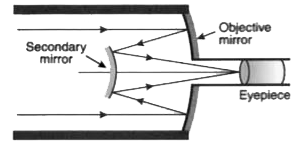 TWO ADVANTAGES `:` (i) No chromatic aberration. (ii) LESS spherical aberration. (iii)LARGE magnifying power. (IV) Large resolving power. |
|
| 44447. |
As shown in the following figure take A and B inputwaveforms. Sketch the output waveform obtained from NAND gate. |
Answer» SOLUTION :
|
|
| 44448. |
STATEMENT - 1 : Mutual induction depends on geometry and orientation of loops w.r.t. each other STATEMENT - 2 : A capacitor acts as an infinite resistance for AC. STATEMENT - 3 : The A. C. voltage across a resistance can be measured using a hot-wire volt meter. |
|
Answer» TFT |
|
| 44449. |
A magnet of length 14 cm and magnetic moment p is broken into two parts of length 6 cm and 8 cm . They are put at right angle to each other with the opposite poles together. The magnetic moment of the combination is : |
|
Answer» `p/10` |
|
| 44450. |
In the above, suppose that the smaller ball does not stop after collision, but continues to move downwards with a speed = v_(0)/2, after the collision. Then, the speed of each bigger ball after collision is |
|
Answer» `4v_(0)//sqrt5` |
|


