

Saved Bookmarks
This section includes 7 InterviewSolutions, each offering curated multiple-choice questions to sharpen your Current Affairs knowledge and support exam preparation. Choose a topic below to get started.
| 1. |
How many of the followign are correct orders for Basic Strength : |
|
Answer» |
|
| 2. |
How many of the carboxylic acid reduce tollen's reagent ? CH_(3)COOH, HCOOH, C_(6)H_(5)COOH, CH_(3)CH_(2)CH_(2)COOH, (CH_(3))_(2) CHCOOH phthalic acid, isophthalic acid, m- toluic acid, salicylic acid |
|
Answer» |
|
| 3. |
How many of given statements are true for lanthanums? 1. The common oxidation state of all lanthanides is +3. 2. All lantanides belongs to group III of modern periodic table. 3. All lanthanides belongs to seventh period of periodic table 4. The radius for all lanthanides cations (M^(+3)) decrease from Ce^(+3) to Lu^(+3). 5. The basic character of hydroxide increases on moving from Ce(OH)_(3) to Lu(OH)_(3) 6. All lanthanides are metals. 7. The reducing power of lanthanides decreases from Ce to Lu. 8. Lanthanides reacts with cold water to liberate H_(2). |
|
Answer» (3). Incorrect as all belongs to `6^(th)` period. (4) True due to lanthanide contraction. (5). Incorrect as basicing decreases from `Ce(OH)_(3)` to `Lu(OH)_(3)` BECOMES of fazans rule. 6. Correct 7. Correct 8. All lanthanides have -ve S.R.P. hence all releases hydrogen. |
|
| 4. |
How many % of H_2O_2 present in commercially marketed H_2O_2 at STP ? |
| Answer» ANSWER :C | |
| 5. |
How many of following elements get disproportionated in strongly alkaline medium solution? S,Ne,P,H,CI,F,O,N |
|
Answer» <P> |
|
| 6. |
How many octahedral voids are there in 1 mole of a compound having cubic close packed structure ? |
| Answer» SOLUTION :No. of OCTAHEDRAL voids = No. of atoms in the PACKING = 1 MOLE =`6.02xx10^23` | |
| 7. |
How many O-atoms are shared per SiO_(4) tetrahedra in silicate anion of beryl mineral ? |
|
Answer»
|
|
| 8. |
How many nutrons are there in hydrogen ? |
|
Answer» 0 |
|
| 10. |
How many number of P, O and H respectively on L.H.S. and R.H.S in following redox reaction after balanced ? P_(4)+OH^(-)toPH_(3)+H_(2)PO_(2)^(-) |
|
Answer» P = 16, O = 12, H = 34 (ii) `underset("Increase of "(4)xx1)(underset((0))(P_(4))+underset((0))(P_(4))+OH^(-)tounderset((-12))(4PH_(3))+underset((+4))(4H_(2)PO_(2)^(-)))` (iii) `underset("DECREASE of "(12)xx1)(underset((0))(P_(4))+underset((0))(P_(4))+OH^(-)tounderset((-12))(4PH_(3))+underset((+4))(4H_(2)PO_(2)^(-)))` (iv) `P_(4)+3P_(4)+OH^(-)to4PH_(3)+12H_(2)PO_(2)^(-)` (v) `4P_(4)+12OH^(-)+12H_(2)Oto4PH_(3)+12H_(2)PO_(2)^(-)` `P_(4)+3OH^(-)+3H_(2)OtoPH_(3)+3H_(2)PO_(2)^(-)` |
|
| 11. |
How many number of molecule are there in 4.4 g of CO_(2)gas ? (C = 12, O = 16g/mole) |
|
Answer» `6.022xx10^(21)` |
|
| 12. |
How many number of atoms present in half of HCP unit cell |
|
Answer» |
|
| 13. |
How many number of carbon atoms present in 250 gm CaCO_(3) ? |
|
Answer» |
|
| 14. |
How many number of atoms are present in fcc unit cell ? |
|
Answer» 4 `= 8xx(1)/(8)+6xx(1)/(2)=1+3=4` atoms per unit cell. |
|
| 15. |
How many number of atom effectively present in a cubic unit formed by arrangement of eight B.C.C unit cell |
|
Answer» |
|
| 17. |
How many nucleous are present in an atom of Nobelium, ._(102)^(254)No ? How many electrons are present n the atom ? How many nucleons may be considered as neutrons? |
| Answer» Solution :Nucleous = 254, ELECTRONS = 102 and neutrons `= 254 - 102 = 152` | |
| 18. |
How many ‘nodes’ are there in 3s orbital ? |
|
Answer» 3 |
|
| 19. |
How many nodes are present in 3p-orbital, Represent diagrammatically |
|
Answer» SOLUTION :Number of PLANAR NODES = 1 (because for p-orbital, `l = 1` and number of planar nodes = value of l for that orbital) Number of radial/spherical nodes `= N - l - 1 = 3 - 1 - 1 =1` `:.` Total number of nodes in 3p -orbital `= n -1 = 3 - 1 = 2` 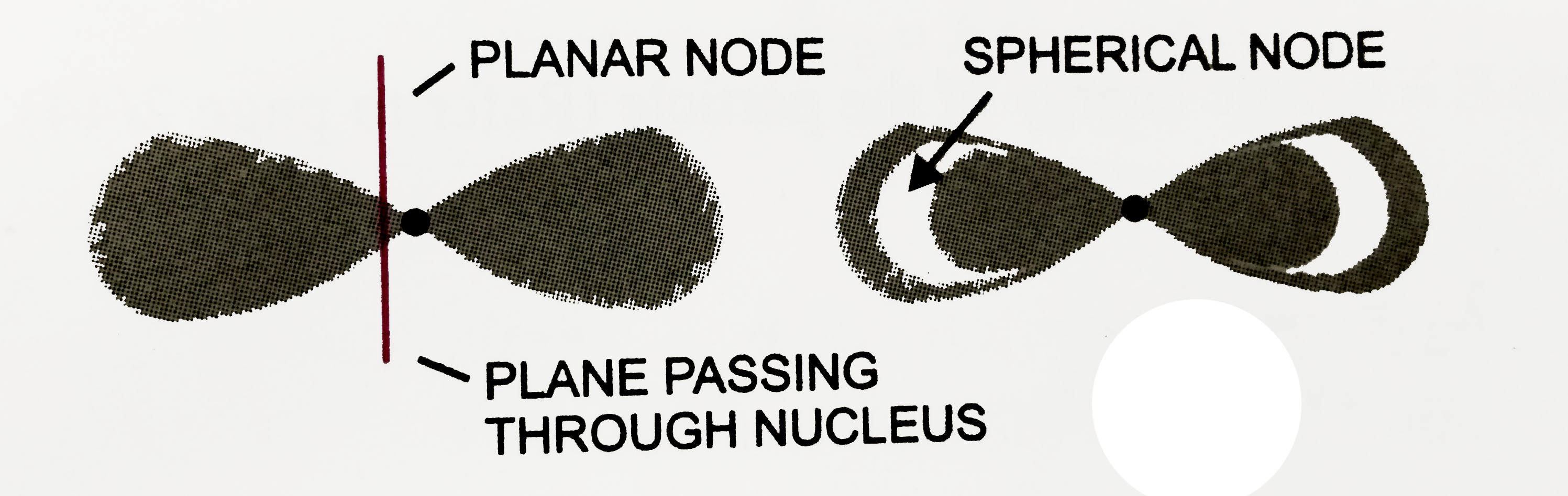
|
|
| 21. |
How many nodes are possible for 2z orbtial? |
|
Answer» 1 |
|
| 22. |
How many no. of sigma and pi bond are in the following ? (CN)_(2)- C= C - (CN)_(2) |
|
Answer» `7 SIGMA, 2PI` |
|
| 23. |
How many nodal planes are present in pi (2p_(x)) and pi^(**) (2p_(x)) molecular orbitals ? |
| Answer» SOLUTION :ONE and TWO RESPECTIVELY . | |
| 24. |
How many nodal planes and nodal regions are present for 3p orbital? |
|
Answer» SOLUTION :NUMBER of nodal planes for any p-orbial is 1 Number of nodal regions `=n-2=3-2=1`. |
|
| 25. |
How many no. of sigma and pi bond are in ethene respectively? |
|
Answer» 5 and 1 |
|
| 26. |
How many no. of active hydrogen atoms are present in a compound (mol. Mass 90) 0.45 g of which when treated with Na metal liberates 112 ml of the H_(2) gas at STP |
|
Answer» |
|
| 27. |
How many neutrons are there in nucleus of tritium ? |
|
Answer» 0 |
|
| 28. |
How many neutrons are there in ""_(38)^(88)Sr ? |
|
Answer» 38 ATOMIC NUMBER = No. of protons = No. of electrons = 38 Atomic mass = 88 Number of neutrons = 88 - 38 = 50 |
|
| 30. |
How many neutrons and protons respectively are present in the ._(6)C^(13) nuclei ? |
|
Answer» `6,13` |
|
| 31. |
How many neutrons and protons are there in the following nuclei ? ._(6)^(13)C, ._(8)^(16)O, ._(12)^(24)Mg, ._(26)^(56)Fe, ._(38)^(88)Sr |
Answer» SOLUTION :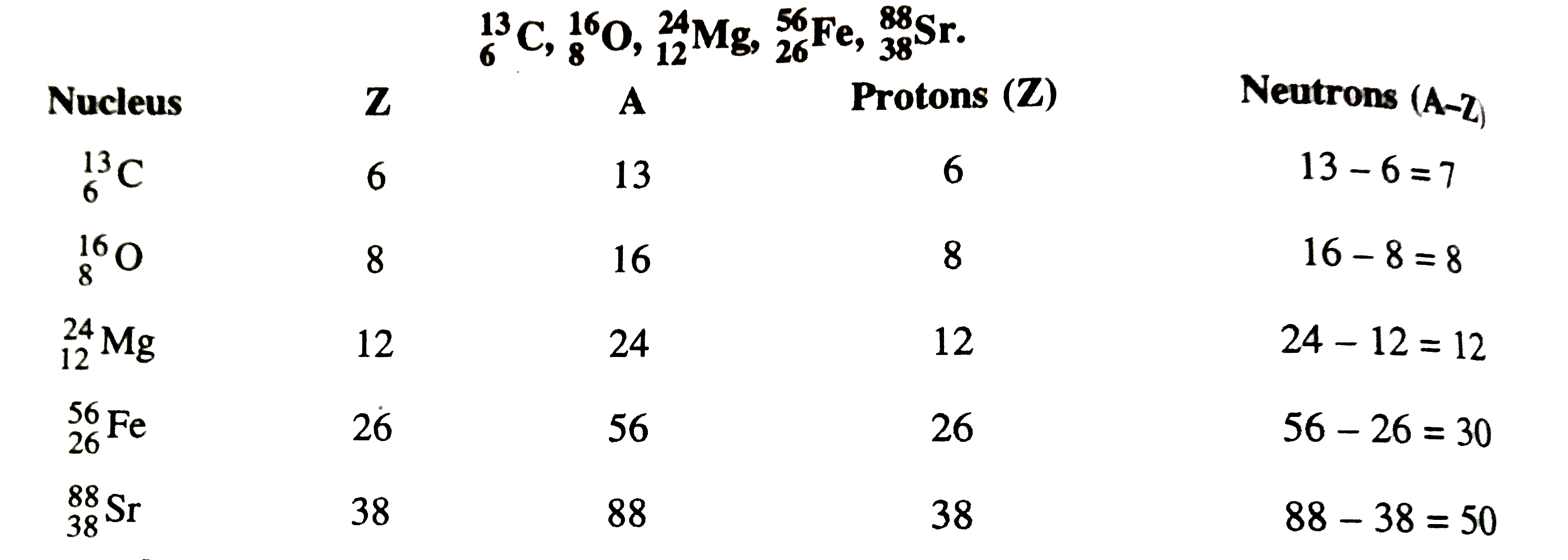
|
|
| 32. |
How many neutorns and protons are there in the following nuclei? ._(6)^(13)C, ._(8)^(16)C, ._(12)^(24)Mg, ._(26)^(56)Fe, ._(38)^(88)Sr |
Answer» SOLUTION :
|
|
| 33. |
How manyneutrons andprotonsare therein the followingnuclei. ._(6)^(13) C, ._(8)^(16) O , ._(12)^(24) Mg, ._(38)^(88) Sr |
Answer» SOLUTION :PROTONS andneutronsare innucleiare asunderin table 
|
|
| 34. |
How many monobromo derivatives are obtained when 2-methylbutane is subjected to photobromination ? |
Answer» Solution :The NUMBER of different monohalogen derivatives OBTAINED from any alkane depends upon the number of different types of HYDROGENS it contains. Now 2-methylbutane contains four different SETS of equivalent hydrogens (as shown by encircled integers ) and hencegives four monobromo derivatives on photobromination. 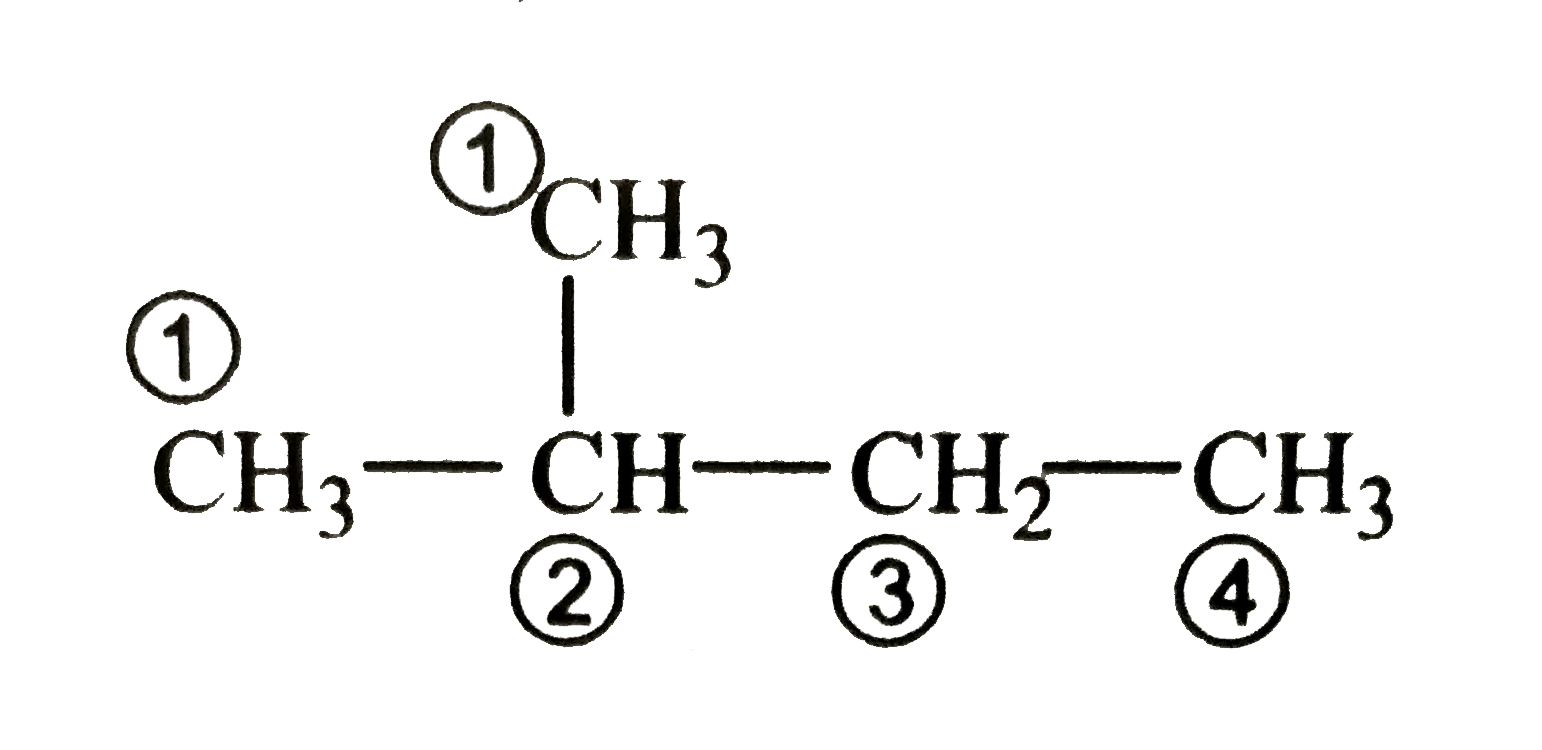
|
|
| 35. |
How many monochlorinated product of methyl cyclohexane are optically active. |
Answer» 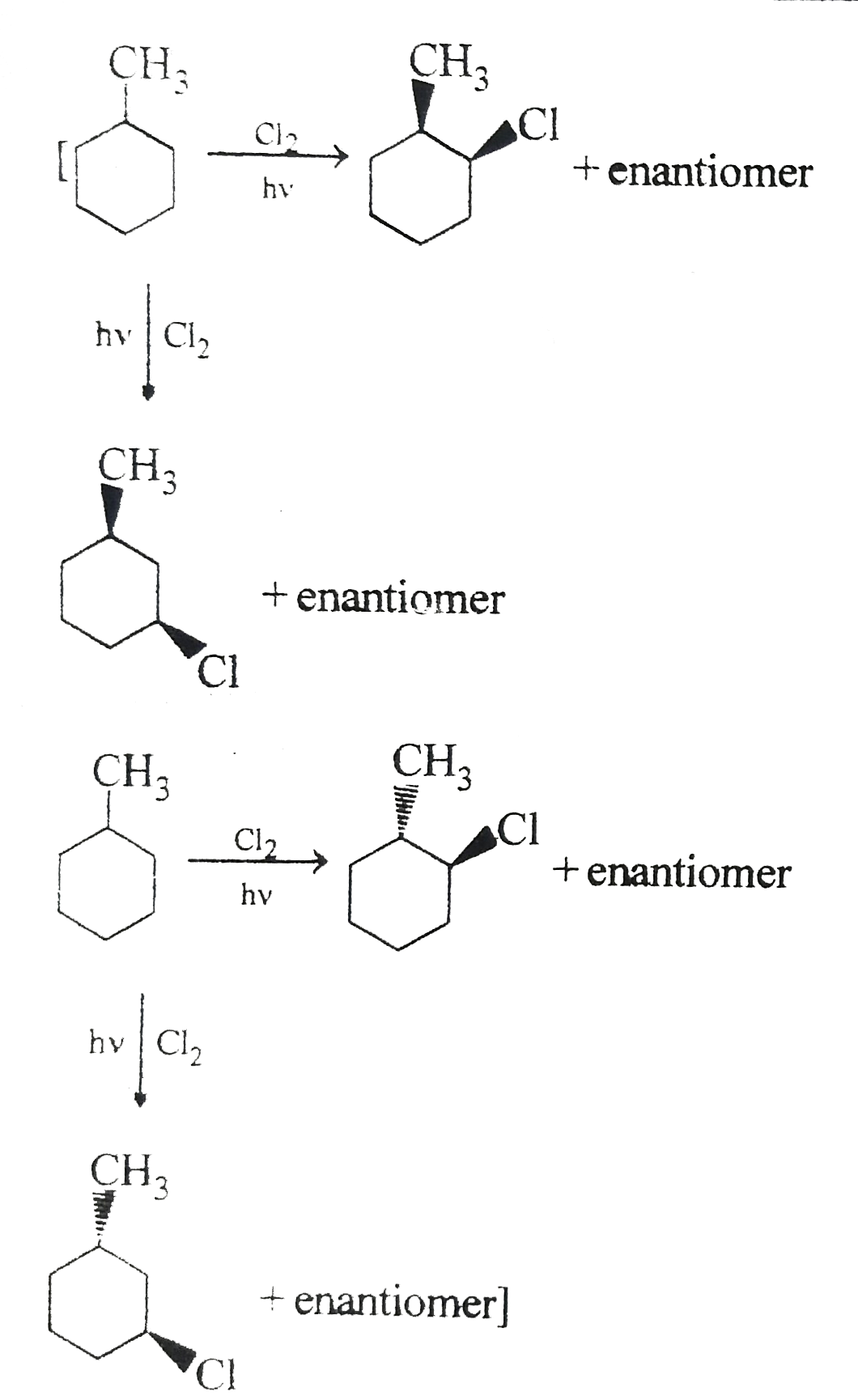
|
|
| 37. |
How many moles of water is present in IL of water? |
|
Answer» 1 Molar mass of water = 18G NUMBER of moles=`("Mass")/("Molar Mass")=1000/18=55.55` moles |
|
| 38. |
How many moles of solute particles are present in one litre of 10^(-4)MK_(2)SO_(4)? |
|
Answer» Solution : In`10^(-4)MK_(2)SO_(4)` solution, there are `10^(-4)` moles of potassium SULPHATE. `K_(2)SO_(4)` MOLECULE contains 3 IONS `(2K^(+) and 1 SO_(4)^(2-))` 1 mole of `K_(2)SO_(4)` contains `3 xx 6.023xx 10^(23)`ions `10^(-4)` mole of`K_(2)SO_(4)`contains `3xx6.023xx10xx10^(-4)+ ions= 18.069xx10^(19)` |
|
| 39. |
How many moles of solute particles are present in one litre of10^(-4 )M potassium sulphate ? |
|
Answer» Solution :In `10 ^(-4)M K _(2) SO _(4)` solution, there are `10 ^(-4)` moles of potassium sulphate. `K _(2)SO _(4)` molecule contains 3 ions `(2 K ^(+) and 1 SO _(4) ^(2-))` 1 MOLE of `K _(2) SO _(4)` contains `3 XX 6. 023 xx 10 ^(23)` ions `10 ^(4) ` mole of `K _(2) SO _(4)` contaisn `3 xx 6.023 xx 10 ^(23) xx 10 ^(-4) ` ions `= 18.069 xx 10 ^(19)` |
|
| 40. |
How many moles of P_(4)O_(6) and P_(4)O_(10) will be produced by the combustion of 12.4gm of phosphorus in 12.8gm of O_(2), leaving no P_(4) or O_(2)? [Atomic wt. P=31] |
|
Answer» 0.11 MOL and 0.3 mol |
|
| 41. |
How many moles of solute are required in 300 g solvent to prepare 3 molal solution ? |
|
Answer» 0.01 ` 3 = ("MOLE")/("weight of solvent")` `= ("MALE")/(0.300)` Mole `= 3 xx 0.3 = 0.9` |
|
| 42. |
How many moles of PbCO_(3) are present in 1 mole of white lead |
|
Answer» |
|
| 43. |
How many moles of P_(4) can be produced by reaction of 0.1 mole Ca_(5)(PO_(4))_(3)F,0.36 mole SiO_(2) and 0.90 mole C according to the following reaction? 4Ca_(5)(PO_(4))_(3)F+18SiO_(2)+30Crarr3P_(4)+2CaF_(2)+18CaSiO_(3)+30CO |
|
Answer» `0.060` `{:((0.1)/(4),(0.36)/(18),(0.9)/(30)),(=0.025,0.02,0.03):}` `THEREFORE SiO_(2)` is the LR `18SiO_(2)rarr3P_(4)implies0.36rarr0.06P_(4)` |
|
| 44. |
How many moles of oxygen are present in a 550 cm^3 sample of a gas at a pressure of 1.5 atm and at a temperature of 27^@C? (Given, R = 8.31 kPa dm^3 K^(-1) mol^(-1)). |
|
Answer» Solution :Since the value of R is given in k Pa `dm^3 K^(-1) mol^(-1)` (SI unit), the units of pressure and volume must correspond to it i.e., pressure should be EXPRESSED in k Pa and volume in `dm^3`. Therefore, `P= 1.5 atm = 1.5 xx 101.325 = 152 k Pa "" ( :. 1 atm = 101.325 k Pa)` `V = 550 cm^3 = 550 xx 10^(-3) dm^3 = 0.550 dm^3 ( :. 1 cm^3 = 10^(-3) dm^3)` `T = 27^@C = 273 + 27 = 300 K " and " N` = ? ACCORDING to the ideal gas equation, PV = nRT or `n= (PV)/(RT)=( 152 xx 0.550)/( 8.31 xx 300) =3.35xx10^(-2)` moles. |
|
| 45. |
How many moles of oxygen gas can be produced during electricity decomposition of 180 g of water ? |
|
Answer» 2.5 moles 36 g of water produces 1 MOLE of `O_2` GAS 180 g of water will produce 180/36 = 5 moles of `O_2` gas. |
|
| 46. |
How many moles of oxygen atoms are present in 75 grams of pure calcium carbonate? |
|
Answer» Solution :100G of `CaCO_(3)` moles of .O. ATOMS 75 G of `CaCO_(3) =?` Number of moles of .O. atoms `=(75)/(100)xx3=2.25` |
|
| 47. |
How many moles of oxygen are given by the complete decomposition of1.225 g KClO_3? |
| Answer» Solution :`2KClO_3to2KCl+3O_2`2 moles` to` 2 moles+3moles 2MOLES `KClO_3`given 3 moles of `O_(2) 2xx122.5gKClO_3`given 3 moles of `O_2` NUMBER of moles of OXYGEN FORMED from `1.225gKClO_3=(3xx1.225)/(2xx122.5)=0.015 mol` | |
| 48. |
How many moles of oxygen are contained in one litre at S.T.P. of air if its volume content is 21% in air |
|
Answer» `=(1 xx 21)/100 = 0.21 L` `therefore` 22.4 L of oxygen at S.T.P. contain moles =1 `therefore 0.2 L` of oxygen at S.T.P. will contain moles `=1/(22.4) xx 0.21 = 9.4 xx 10^(-3)` Hence, ONE litre of air at S.T.R contains `9.4 xx 10^(-3)`moles of oxygen. |
|
| 49. |
How many moles of OH^(-) are present in the balanced equation? Cr(OH)_(3)+H_(2)O_(2)overset(OH^(-))rarr H_(2)O+CrO_(4)^(-2) |
|
Answer» Solution :The BALANCED equation is `2Cr(OH_(3)) +3H_(2)O_(2)+4OH^(-) to 2CrO_(4)^(-2)+8H_(2)O` NUMBER of MOLES of hydroxyl `(OH^(-))` required in the balanced equation =4 |
|