

Saved Bookmarks
This section includes 7 InterviewSolutions, each offering curated multiple-choice questions to sharpen your Current Affairs knowledge and support exam preparation. Choose a topic below to get started.
| 1. |
Hydrogen by donating one electron forms H^(+). In this property, it resembles with …...... |
|
Answer» TRANSITION metals |
|
| 2. |
Hydrogen bonds are formed in many compounds e.g., H_(2)O, HF, NH_(3). The boiling on the such compounds depends to a extent on the strength of hydrogen bond and the number of hydrogen bonds. The correct decreasing order of the boiling points of above compounds is : |
|
Answer» `HF GT H_(2)O gt NH_(3)` STRENGTH of H-bond is in the ORDER : H.....F `gt ` H ..... O `gt` H...... N `H_(2)O` molecule is joined to FOUR other `H_(2)`O molecules through H-bonds and each HF molecules is joined only to two other HF molecules. So, b.p. of`H_(2) O gt `b.p. of HF `gt` b.p. of `NH_(3)` |
|
| 3. |
Hydrogen bonds are present even in vapour state of |
|
Answer» `H_2 O` |
|
| 4. |
Hydrogen bonds are formed in many compounds, e.g.,H_(2) O, HF, NH_(3). The boiling point of such compounds depends to a large extent on the strength of hydrogen bond and the number of hydrogen bonds. The correct decreasing order of the boiling points of above compounds is : |
|
Answer» `HF GT H_(2)O gt NH_(3)` But each `H_(2)O ` molecule is linked to4 other `H_(2)O ` moleculesthrough H-bonds WHEREAS each HF molecule is linked only to two HF molecular . HENCE .b.pt .of `H_(2)Ogtb.pt of HF` |
|
| 5. |
Hydrogen bonding plays an important role in determining the physical properties of substances.Illustrate hydrogen bonding using an example. |
| Answer» SOLUTION :REFER to the THEORY | |
| 6. |
Hydrogen bonding plays an important role in determining the physical properties of substances.Compare the boiling points of o-nitrophenol and p-nitrophenol based on hydrogen bonding. |
| Answer» SOLUTION :p-nitrophenol has higher boiling POINT than orthonitrophenol.This is DUE to intermolecular hydrogen bonding in it. | |
| 7. |
Hydrogen bonding plays a central role in the following phenomena : |
|
Answer» Ice floats in water cage-like structure on ACCOUNT of hydrogen bonding with other `H_(2)O` molecular . Hence ,ice floats on water (b) `R-NH_(2) +H-OHharr R-overset(+)underset((I))(NH_(3))+OH^(-)` `R_(3)N +H-OHharr R_(3)-overset(+)underset((II))(NH)+OH^(-)` Cation (I) is more stabilised through hydrogen bonding than cation (II). Hence ,`R-NH_(2)` is stronger base than `R_(3) N` in aqueous solution . (c) HCOOH is stronger acid than `CH_(3)COOH`due to inductive effect and not due to hydrogen bonding . (d) Acetic acid dimerises in benzene through intermolecular hydrogen bonding 
|
|
| 8. |
Hydrogen bonding is said to be formed, -when sightly acidic hydrogen-atom attached to a strongly, electronegative fluorine, oxygen or nitrogen atom. is held with weak. electrostatic forces by the non-bonded pair of electrons of another atom. The co-ordination number of hydrogen in such cases is two. It acts as a bridge between two atoms, to one of which it is covalently bonded and to other attached through electrostatic forces, also called hydrogen bond. Though the hydrogen atoms in a methyl group are not polarised, if an electronegative group like chloro, carbonyl, nitro or cyano (in order to increase electronegativity) is attached to it, the C-H bond gets polarised due to the inductive effect and the hydrogen atom becomes slightly acidic resulting in the formation of weak hydrogen bonds. Though a weak bond the H-bond effects is large number of the physical properties of compounds some of which are - Boiling points of liquids - Solubility of polar compounds in polar solvents (containig H attached with strong electronegative atom) - Viscosity of liquids . Acidity Which of the following combinations can involve hydrogen bonding I) Mixture of KF and HF "" II) Mixture of CH_(3)COCH_(3) and CHCI_(3) III) Mixture of NH_(4) CIand H_(2)O"" IV) Mixture of CH_(3) and H_(2)O |
|
Answer» (I), (II) and (IV) |
|
| 9. |
Hydrogen bonding between Ha nd F atom is stronger than that between H and O atoms. However, H_(2)O is more viscus and its bp is greater than that of HF. Explain. |
|
Answer» Solution :Hydrogen bonding between H----F is much stronger than that between H----O because F is more ELECTRONEGATIVE than O. however boiling point of `H_(2)O` is much higher than that of HF because a single molecule of water can form four H-bonds with four other `H_(2)O` molecules, while one `H-F` molecule can form only two H-bonds with four other `H_(2)O` molecules, while one H-F molecule CANN form only two H-bonds with HF molecules. Because of this, `H_(2)O` is more VISCUS thann HF and its boiling point is higher. 
|
|
| 10. |
Hydrogen bonding is exhibited by |
|
Answer» All the molecules containing H-atomsd |
|
| 11. |
Hydrogen bond is the strongest in- |
|
Answer» O-H----S |
|
| 12. |
Hydrogen bond may be formed between |
|
Answer» Two hydrogen atoms |
|
| 13. |
Hydrogen bond is formed between hydrogen atoms and highly electronegative elements It is of two types -intermolecular and intramolecualar It is a weaker bond than ionic, covalent and metallic bonds Which is a correct statement ? . |
|
Answer» Paranitophenol is steam volatile but not orthonitrophenol |
|
| 14. |
Hydrogen bond is form in which molecules of the following ? Why ? CH_(3) OH, CH_(3) "COOH", CH_(3) Cl, HF , C_(6) H_(6), NH_(3) , NF_(3) |
| Answer» Solution :In `CH_(3) OH, CH_(3) "COOH", HF and NH_(3)` HYDROGEN BOND form because they all have partially positive changed hydrogen and negative atom can reach near to it. | |
| 15. |
Hydrogen bond is a weak electrostatic force of attraction between covalently bonded hydrogen and more electronegative species like F,O and N. It play an important role in influencing many physical constants. It is a weaker bond than covalent bond but stronger than vanderWaal forces of attraction. Which of the following can exsist as a hexamer in vapour state ? |
|
Answer» `H_2 O` |
|
| 16. |
Hydrogen bond is a weak electrostatic force of attraction between covalently bonded hydrogen and more electronegative species like F,O and N. It play an important role in influencing many physical constants. It is a weaker bond than covalent bond but stronger than vanderWaal forces of attraction. Hydrogen bonding is absent in |
|
Answer» `CH_3 OH ` |
|
| 17. |
Hydrogen bond is a weak electrostatic force of attraction between covalently bonded hydrogen and more electronegative species like F,O and N. It play an important role in influencing many physical constants. It is a weaker bond than covalent bond but stronger than vanderWaal forces of attraction. Chelation is observed in |
|
Answer» <P>P - NITROPHENOL. |
|
| 18. |
Hydrogen bond is a weak electrostatic force of attraction between covalently bonded hydrogen and more electronegative species like F,O and N. It play an important role in influencing many physical constants. It is a weaker bond than covalent bond but stronger than vanderWaal forces of attraction. During the boiling of a liquid, the bonds broken are |
|
Answer» INTRAMOLECULAR HYDROGEN bonding |
|
| 19. |
Hydrogen bond is |
|
Answer» A weak COVALENT bond |
|
| 20. |
What mass of HNO_3 is required to make llitre of 2N solution to be used as an oxidizing agent in the reaction ? 3Cu + 8HNO_3 rarr 3Cu(NO_3)_(2)+2NO+4H_2O |
|
Answer» chlorine `H_2 + 2K to 2KH (K^(+) H^(-))` |
|
| 21. |
Hydrogen atoms are de-excited from N shell. Illustrate the spectral lines obtained in the emission. |
|
Answer» Solution :Number of spectral lines = `SIGMA(n_(2)-n_(1))=Sigma(4-1)=Sigma3=3+2+1=6`. Six spectral lines are OBTAINED : 3 Lyman lines in UV, 2 BALMER lines in visible and 1 Paschen line in IR region. |
|
| 22. |
Hydrogen atom has only one electron, so mutual repulsion between electrons is absent. However, in multielectron atoms mutual repulsion between the electron is absent. However, in multielectron atoms mutual repulsion between the electrons is significant. How does this affect the energy of an electron in the orbitals of the same principal quantum number in multielectron atoms ? |
| Answer» Solution :In case of HYDROGEN atom, the energies of the electron in different orbitals depends only on the value of N. Hence, different orbitals of the same shell have same energy. However, in case of multielectron atoms, the energies of the orbitals depend upon `n + L` values. Hence, for the same value of n but different value of l, i.e., different subshells belonging to the same main shell have different energies. | |
| 23. |
Hydrogen atom has only one electron, so mutual repulsion between electrons is absent. However, in multielectron atoms mutual repulsion between the electrons is significant. How does this affect the energy of an electron in the orbitals of the same principal quantum number in multielectron atoms ? |
| Answer» SOLUTION :The energy of electron is determined by the value of n in hydrogen ATOM and by n + I in multielectron atom. So for a given principal QUANTUM number electrons of s, p, d and f orbitals have DIFFERENT energy. | |
| 24. |
Hydrogen atom has |
|
Answer» half FILLED subshel |
|
| 25. |
Hydrogen and oxygen combine to form two compounds, water and hydrogen peroxide. If the percentage of oxygen is 88.89 in water and 94.12 in hydrogen peroxide, show that the data support law of multiple proportions. |
|
Answer» Solution :In water, Oxygen = 88.89% `therefore` Hydrogen = 100 - 88.89 = 11.11 % `therefore` 11.11 G of hydrogen combine with oxygen = 88.89 `therefore` 100 g of hydrogen will combine with oxygen `=(88.89)/11.11 xx 100 = 800.1 g` In hydrogen peroxide, Oxygen = 94.12% `therefore` Hydrogen =`100-94.12 = 5.88%` `therefore` 5.88 g of hydrogen combine with oxygen = 94.12 g 100 g of hydrogen will combine with oxygen `=(94.12)/5.88 xx 100 = 1.60 xx 10^(3) g` The ratio in the amounts of oxygen combining with 100 g of hydrogen in the two compounds is therefore, `800.1 : 1.60 xx 10^3` or 1 : 2. Thus, the amounts of oxygen that combine with a fixed amount of hydrogen in `H_2O` and `H_2O_2` are in the SIMPLE whole NUMBER ratio. Hence, the given data SUPPORT law of multiple proportions. |
|
| 26. |
Hydrogen and Oxygen both are gas. Which compound is formed by combination of these two ? |
|
Answer» |
|
| 27. |
Hydrogen and oxygen are combined in the ratio of 1 : 16 by mass in hydrogen peroxide. What is the percentage compostion of hydrogen peroxide ? |
|
Answer» Percentage of HYDROGEN in `H_(2)O_(2)=((2U))/((34u))xx100=5.88%`. |
|
| 28. |
Hydrogen always shows positive deviation in the compressibility factor vs pressure curves . Why ? |
|
Answer» Solution :Hydrgen molecules have small size . Intermolecular repulsions operate between MOLECULE of hydrogen. The real volume of hydrogen GAS is more than the idea volume. HENCE , `z > 1` for hydrogen at any PRESSURE. |
|
| 29. |
Hydrogen acts as an oxidizing agent when it is reacted with "_________________". |
|
Answer» IODINE to GIVE HYDROGEN iodide |
|
| 30. |
Hydrogen (a moles) and iodine (b moles) react to give 2x moles of the HI at equilibrium. The total number of moles at equilibrium is |
|
Answer» `a+b+2x` |
|
| 31. |
Hydrogen acts as a reducing agent and thus resembles |
|
Answer» halogens |
|
| 32. |
Hydroformylation of olefins yields aldehydes which futher undergoes reduction to give alcohols. |
|
Answer» |
|
| 33. |
Hydrochloric acid present in the gastric juice is secreted by the lining of our stomach in a significant amount of __________ L day^(-1) . |
|
Answer» `1.2-1.5` |
|
| 34. |
Hydrochloric acid is sold commercially as 12M solution. How many moles and how many grams of HCl are present in 300 mL of 12.0 M solution ? |
|
Answer» `("12 MOL L"^(-1))=("Moles of HCl")/("0.3 L")` Moles of HCl `= ("12 mol L"^(-1))xx("0.3 L")=3.6` mol Mass of HCl `=("3.6 mol")xx("36 G mol"^(-1))=131.4 "g HCl"`. |
|
| 35. |
Comment over the following statement. Hydrocarbons may be both acyclic as well as cyclic |
|
Answer» |
|
| 36. |
Hydrocarbons are the parent compounds of all other organic compounds. |
|
Answer» |
|
| 37. |
Hydrocarbons (a) C_(3)H_(6) (b) C_(4)H_(8) (c) C_(5)H_(10) (d) C_(6)H_(12) formula write the unsaturated hydrocarbons formula and structures and forms ? |
Answer» SOLUTION :General formula for all of these is `C_(n)H_(2N)`. All of them ae saturated and cyclic HYDROCARBON. Whose structures and names are as FOLLOWS : 
|
|
| 38. |
Hydrocarbon which is liquid at room temperature is |
|
Answer» pentane |
|
| 39. |
Hydrocarbon perioxide is a thich syrup liquid with abetter taste. It can be prepared by a number of methods both in the laboratory as well as commercially. However, the concentrations of hydrogen peroxide is a big problem since it readily decomposes when heated under normal conditions of temperature and pressure. (i) How is the strength of H_(2)O_(2) generally expressed? (II) What is the meaning of 20 volume H_(2)O_(2) solution? (iii) What are the values associated with the use of hydrogen perioxde? |
|
Answer» SOLUTION :(i) Strength of `H_(2)O_(2)` is generally expressed in terms of volume i.e. as 10 volume, 15 volume, 20 volumes etc. (ii) A 20 volume of `H_(2)O_(2)` solution means that 1 mL of `H_(2)O_(2)` evolves 20mL of `O_(2)` under N.T.P. conditions (III) HYDROGEN proxide is useful in a number of ways. It acts as a bleachin agent for delicate materials like, silk, wool nad a constitutent of hair dyes. It is also reagarded as a better bleaching agent in the laundary than CHLORINE since it does not release any poisnous vapoours unlike chlorine and thus, promotes Green Chemistry. It is used as an antiseptic fore washing fresh WOUNDS. It is also as an oxidant in rocket fuels. |
|
| 40. |
Hydrocarbon that may show geometrical isomerism |
|
Answer» alkane |
|
| 42. |
Hydrocarbon containing following bond is most reactive |
|
Answer» `C-=C` |
|
| 43. |
Hydrocarbon (A) reacts with bromine by substitution to form an alkyl bromide which by Wurtz reaction is converted to gaseous hydrocarbon containing less than four carbon atoms. (A) is |
|
Answer» `CH-=CH` `CH_4+Br_2 overset"hv"to CH_3Br+HBr` `CH_3-CH_3+Br_2 overset"hv"to CH_3CH_2Br + HBr` (II) Since `CH_2=CH_2` and `CH-=CH` GIVE addition REACTIONS on treatment with `Br_2` , therefore , hydrocarbon (A) cannot be `CH_2=CH_2` or `CH-=CH`. (iii)Since alkyl bromide on Wurtz reaction gives a hydrocarbon containing less than four carbon atoms, therefore, alkyl halide must be `CH_3Br` and the hydrocarbon formed must be ETHANE. `2CH_3Br + 2Na underset"(Wurtz reaction)"oversetDeltato underset"Ethane"(CH_3-CH_3)+ 2NaBr` |
|
| 44. |
Hydrocarbon (A) reacts with bromine by substitution to form an alkyl bromide which by Wurtz reaction is converted to gaseous hydrocarbon containing less than four carbon atoms. (A) is:1.CH -= CH2.CH_2 = CH_23.CH_3 - CH_34.CH_4 |
|
Answer» `CH -= CH` |
|
| 45. |
Hydrocarbon (A) reacts with bromine be substitution to form an alkyl bromide which by Wurtz reaction is converted gaseous hydrocarbon containing less than four carbon atoms. (A) is |
|
Answer» `CH_(4)` |
|
| 46. |
Hydrocarbon (A), C_6H_10 on treatment with H_2//Ni,H_2/Lindler catalyst and Na /Liquid ammonia forms three different reduction products (B), (C) and (C) respectively. (A) does not form any salt with ammoniacal AgNO_3 solution, but forms a salt(E) on heating with NaNH_2 in an intert solvent. Compound (E) reacts with CH_3I to give (F). Compound (D) on oxidative ozonolysis gives n-butanoic acid along with other product. Give structurs of (A) to (F) with proper reasoning . |
Answer» Solution :(i) The given compound (A) is confirmed by the following reactions. 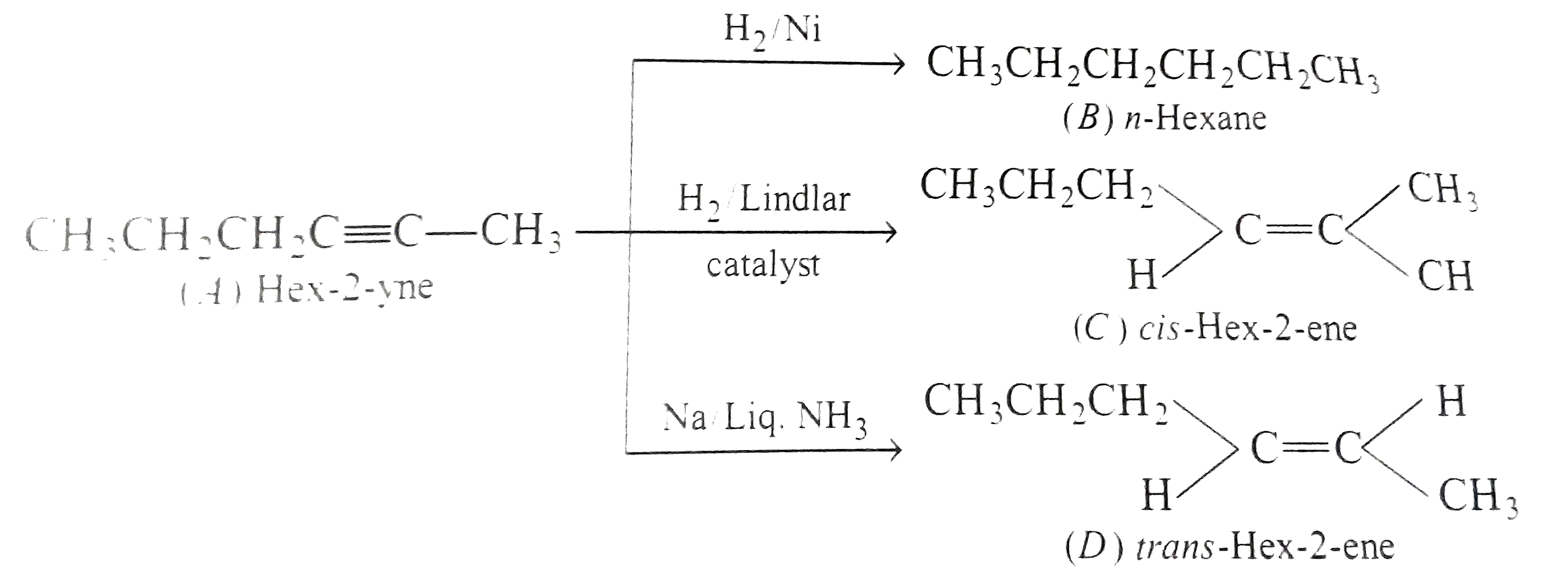 (ii) A does not FORM any SALT with ammonical `AgNO_3` solution , but forms a salt (E) on heating with `NaNH_2`in an inert SOLVENT. `underset((A)"Hex-2-yne")(CH_3CH_2 CH_2-C-=C-CH_3)overset(NaNH_2)tounderset((E))(CH_3CH_2CH_2CH_2)-C-=CNa overset(CH_3I)tounderset((F))(CH_3CH_2CH_2CH_2-C-=C-CH_3` (iii) Oxidative oxonolysis of (D) gives `CH_3CH_2CH_2CH_2COOH` ALONG with `CH_3COOH`. 
|
|
| 47. |
Hydrides of which of the following Lattices are different from those of parent metals |
|
Answer» Ni |
|
| 48. |
Hydride ion is a strong |
|
Answer» conjugate acid of `H_(2)` |
|
| 49. |
Hydrides of alkaline earth metals do not posses same nature. Comment |
|
Answer» Solution :BeH_(2)` is covalent and POLYMERIC`MgH_(2)`is aprtlyionicand polumeric . Hydrides of CA, Sr and Ba are IONIC. They are called salinehydrides and arethermally very stable . |
|
| 50. |
Hydrazine (N_2H_4) is weak base and its dissociation constant is 1.8xx10^(-6) . So, calculate pH of 0.25 M solution. |
|
Answer» Solution :Suppose dissociation of hydrazine is `alpha` . `therefore 0.25 alpha` M Hydrazine dissociated So, [OH] and `[NH_2NH_3^+] = 0.25 alpha` `{:("EQUILIBRIUM" , NH_2NH_(2(aq)) + ,H_2O_((L)) hArr , NH_2NH_(3(aq))^(+) + , OH_((aq))^(-)),("Initial" , 0.25 M, -, 0.0,0.0),("Equilibrium change M" , -0.25 alpha, ,0.25 alpha, 0.25 alpha),("Equili. M" , 0.25-0.25 alpha, ,0.25 alpha, 0.25alpha):}` `=0.25(1-alpha)approx 0.25` `K_b=([NH_2NH_3^+ ][OH^-])/([NH_2NH_2])` `therefore 1.8xx10^(-6) = ((0.25alpha)(0.25alpha))/(0.25(1-alpha))` `=((alpha^2)0.25)/(1-alpha)` `therefore 1.8xx10^(-6) = 0.25 alpha^2` `prop= sqrt((1.8xx10^(-6))/0.25)=2.6833xx10^(-3)` `[OH^-]= C prop = 0.25 alpha= 0.25 (2.6833xx10^(-3))` `=6.708xx10^(-4)` pOH=-log `(6.708xx10^(-4))`= 3.1734 pH=14.0-pH =14.0 - 3.1734 = 10.827 |
|