

Saved Bookmarks
This section includes 7 InterviewSolutions, each offering curated multiple-choice questions to sharpen your Current Affairs knowledge and support exam preparation. Choose a topic below to get started.
| 1. |
Hydrazine does not give Lassaigne's test for nitrogen. Why ? |
| Answer» Solution :Hydrazine `(NH_(2)-NH_(2))` does not contain any CARBON. THEREFORE, UPON fusing with sodium metal, it does not form any sodium cyanide `(NaCN)` which is the primary requirement for the Lassaigne's test. | |
| 2. |
Hydrazine as a drug is used in the treatment of : |
|
Answer» MALARIA |
|
| 3. |
Hydraulic mortar is used as |
|
Answer» BLEACHING AGENT |
|
| 4. |
Hydration of different ions is an example of |
|
Answer» ION - DIPOLE interaction |
|
| 5. |
Hydration enthalpy of alkali metals ...... with increase in ionic size. |
| Answer» Answer :C | |
| 6. |
Hydrated sodium aluminium silicate is ___________. |
|
Answer» |
|
| 7. |
Hydrated magnesium chloride cannot be dehydrated by heating. |
|
Answer» SOLUTION :The formula of the HYDRATED salt is `MgCl_(2).6H_(2)O`. When heated, it gets hydrolysed to form MgO. `MgCl_(2).6H_(2)O overset("Heat")(to) MgO + 2HCl + 5H_(2)O` Therefore, the salt cannot be DEHYDRATED by HEATING as such. The dehydration is done by passing HCl gas through the hydrated salt at about 650 K. `MgCl_(2).6H_(2)O underset(650K)overset(HCl(g))(to) underset("Anhydrous")(MgCl_(2)) + 6H_(2)O` |
|
| 8. |
Hydrated calcium chloride when fused loses water of crystallization to form anhydrous calcium chloride but anhydrous magnesium chloride cannot be prepared by heating magnesium chloride hexahydrate . Why so ? |
|
Answer» Solution :ANHYDROUS `MgCl_(2)` cannot be prepared by simply heating `MgCl_(2) . 6 H_(2)O` because it gets hydrolysed by its own water of crystallization . `MgCl_(2) + 6H_(2)O to Mg O + 2 HCL + 5 H_(2)O` However , if hydrated magnesium chloride is heated in an atmosphere of HCl GAS at 650 K, it checks the above hydrolysis reaction and the hydrated magnesium chloride now loses water of crystallization to form anhydrous magnesium chloride now loses water of crystallization to form anhydrous magnesium chloride `MgCl_(2) . 6 H_(2)O overset(HCl "gas")underset(650K)(to) MgCl_(2) + 6 H_(2)O`. |
|
| 9. |
Hydrated AlCl_(3) is used as : |
|
Answer» CATALYST in CRACKING of petroleum |
|
| 10. |
Hydrated AlCl_(3) is used as |
|
Answer» CATALYST in cracking of petroleum |
|
| 11. |
Hydogen accepts an electron to attain the inert gas configuration. In this way it resembles __________ |
|
Answer» chalcogens |
|
| 12. |
Hydrolith is_____ . |
|
Answer» `BeH_(2)` |
|
| 13. |
Hybridization produces a set of orbitals which are |
|
Answer» Parallel |
|
| 14. |
Hybridization of central atom in SiF_6^(-2), [Sn(OH)_6]^(-2) |
| Answer» SOLUTION :`sp^3d^2` | |
| 15. |
Hybridisation overset(+)CH_3 " and "overset(-)CH_3 are |
|
Answer» sp and `sp^2` respectively |
|
| 16. |
Hybridisation of triply bonded carbons, carbon-carbon triple bond length and bond strength of carbon-carbon triple bond are |
|
Answer» `SP, 1.20A^(@) and 600 KJ Mol^(-1)` |
|
| 17. |
Hybridisation of one s and one p orbitals form |
|
Answer» Two mutually PERPENDICULAR orbitals |
|
| 18. |
Hybridisation of central atom in PCl_(5) involves the mixing of orbitals. |
|
Answer» `s, p_(x),p_(y),d_(x)2, d_(x)2 - y^(2)` |
|
| 19. |
Hybridisation of carbon atom in carbon dioxide is |
| Answer» ANSWER :C | |
| 20. |
Hybridisation of Al in AlCl_(3) (monomeric fromltbgt above 800^(@) C) and Al_(2) Cl_(6) (dimeric form below400^(@)C) respectively are |
|
Answer» `SP^(2) , sp^(3)` hybridisation of Al Dimeric form is 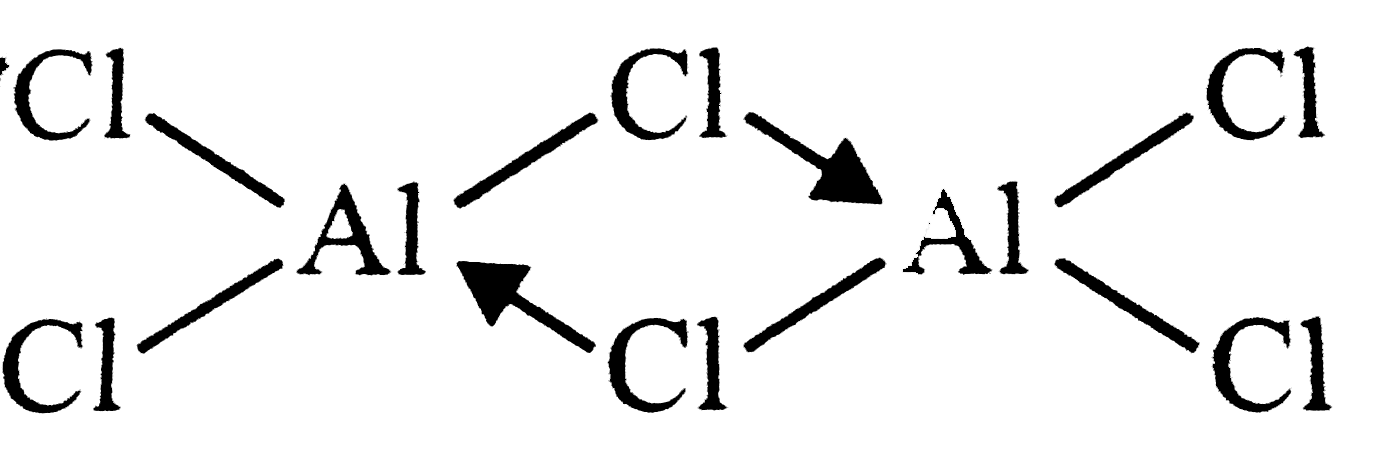 It has `sp^(3)` hybridisation of Al to accommodate 8 ELECTRONS from CL ATOMS . |
|
| 22. |
HVZ reaction can be empolyed to convent propionic acid to |
|
Answer» Malonic acid 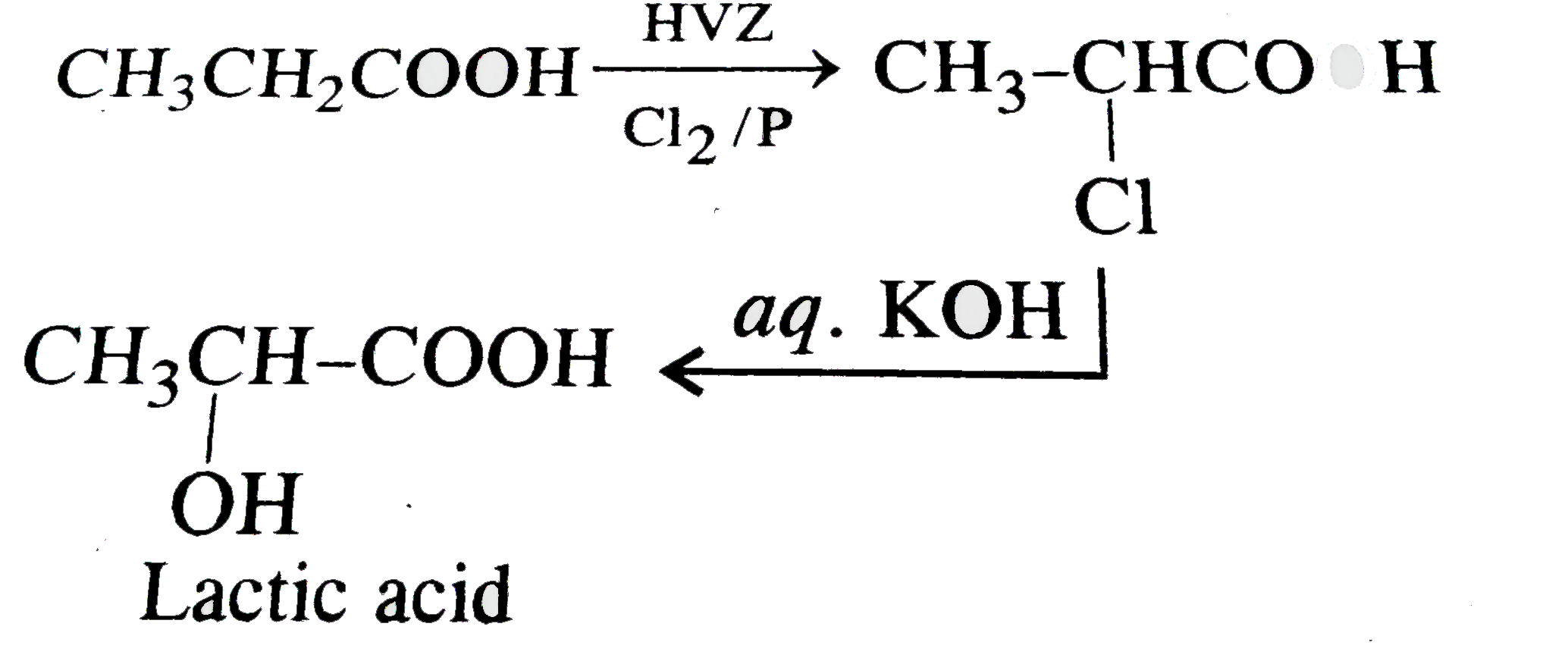
|
|
| 23. |
Humphrey series in the hydrogen spectrum is obtainned as a result of the jump of electrons from n_(2) ge ....." to " n_(1) =...... |
|
Answer» |
|
| 24. |
Hunsdiecker reaction is used to prepare alkyl chloride and alkyl bromide starting from |
|
Answer» diazonium SALT |
|
| 25. |
Human body requires 2370 K. Cal of energy daily. The heat of combustion of glucose is -790 K.cal/mole. The amount of glucose required for daily consumption is |
| Answer» ANSWER :B | |
| 26. |
Huckel's rule of aromaticity is |
|
Answer» Having 6 pi electrons |
|
| 27. |
Howwould you react to thestatementthat theelectronegativity of N onPaullingscaleis 3.0in allthenitrogen compound ? |
| Answer» Solution :The electronegativityof any GIVEN atom is notconstant . Thereforethe STATEMENT that theelectronegativityof N onPaulingscale is3.0in allnitrogencompounds is worng. Actually electronegativityvarieswiththe stateof hybridizationand theoxidation stateof the ELEMENT. Theelectronegativityincreases as thepercentage of s- character of a hybridorbitalincreasesor theoxidation stateof theelementincreases. Forexamplethe electronegativeof Nincreasesas we movefrom `sp^(3) -sp^(2)-sp-` hybridorbital. SIMILARLY, the electronegativityof N in `NO_(2)` whereoxidationstateof N is+ 4is higherthan that in NOwherethe oxidationstateof N is + 2 | |
| 28. |
How would you react to the statement that the electronegativity of N on Pauling scale is 3.0 in all the nitrogen compounds? |
|
Answer» Solution :The electronegativity of nitrogen will not be `3.0` in all its COMPOUNDS. It depends UPON the other atoms attached to it. It ALSO depends on the state of HYBRIDIZATION and the oxidation state of the ELEMENT. |
|
| 29. |
How would you prepxare acetic acid from methyl magnesium iodide? |
Answer» Solution :Solid carbon dioxide reacts with GRIGNARD REAGENT to form addition PRODUCT which on hydrolysis YIELDS acetic ACID. 
|
|
| 30. |
How would you prepare quick lime ? |
|
Answer» SOLUTION :Quick LIME is produced on commercial scale hy heating limestone in a lime kiln at 1173K `CaCO_(3) OVERSET(/_\)toCaO+CO_(2)uarr` This reaction being reversible, `CO_(2)` is removed as soon as it is produced to enable the reaction to PROCEED to completion |
|
| 31. |
How would you prepare pure sodium chloride from crude salt? |
|
Answer» SOLUTION :CRUDE salt CONTAINS sodium sulphate, calcium sulphate, calcium chloride and magnesium chloride as impurities along with sodium chloride. (b) Pure NaCl is OBTAINED from crude salt by removal of insoluble impuriti from the crude salt solution with minimum amount of water. (c) Sodium chloride can be crystallized by passing HCL gas into this solution. (d) Calcium and magnesium chloride being more soluble than NaCl,remain in solution |
|
| 32. |
How would you prepare propyne from acetylene ? |
Answer» SOLUTION :
|
|
| 33. |
How would you prepare hydrogen in the laboratory? |
|
Answer» Solution :• Small amounts of HYDROGEN are CONVENIENTLY prepared in laboratory by the reaction of metals, such as zinc, iron and TIN, with dilute ACID. `Zn_((s))+2HCl_((aq))toZnCl_(2(s))+H_(2(g))`• In principle, any metal with a negative standard reduction potential will react with an acid to generate hydrogen. 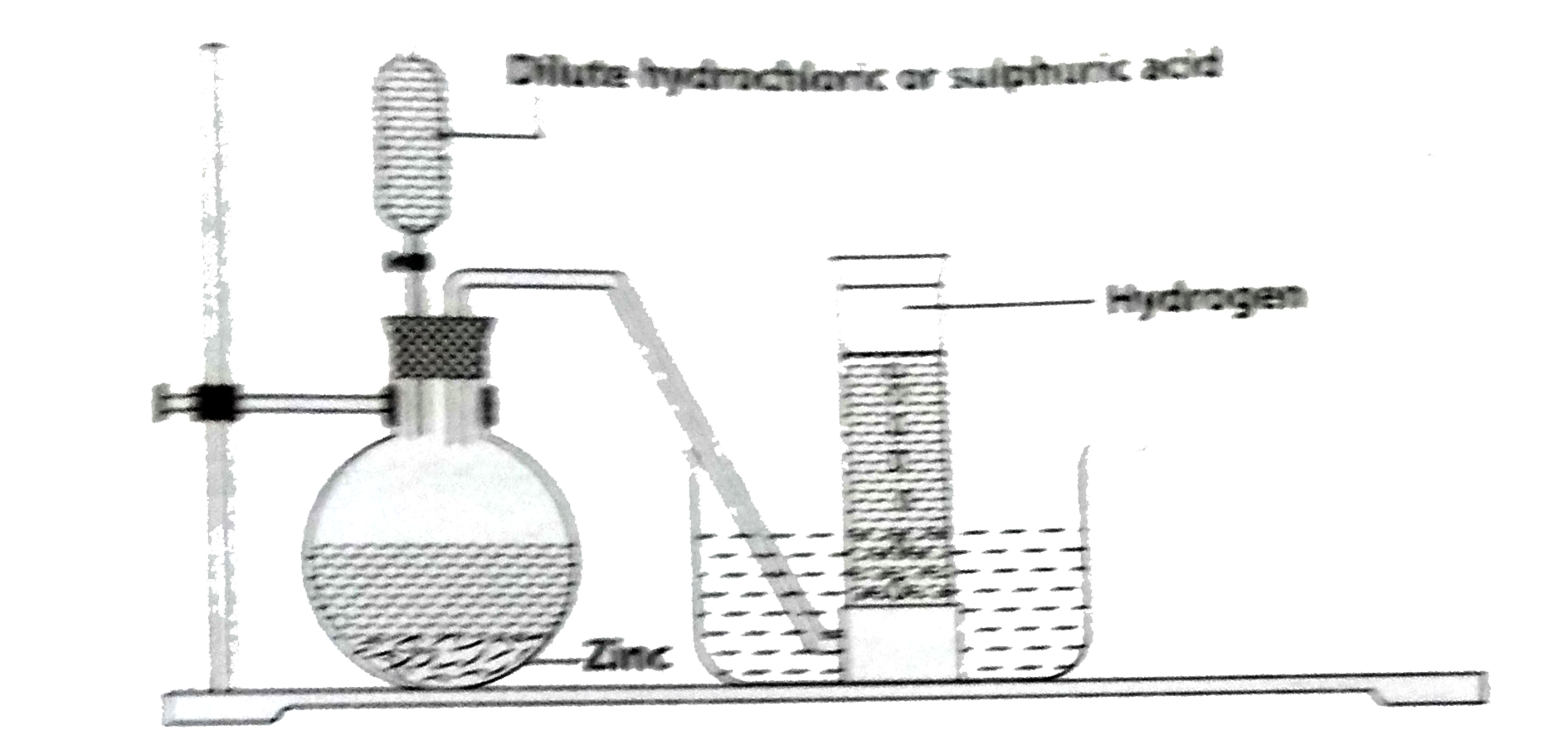
|
|
| 34. |
How would you prepare Hydrogen peroxide? |
|
Answer» Solution :HYDROGEN PEROXIDE can be prepared by adding a METAL peroxide to dilute ACID. `BaO_(2(s))+H_(2)SO_(4(aq))toBaSO_(4(s))+H_(2)O_(2(aq))` |
|
| 35. |
How would you prepare haloalkane through halogen exchange reactions? |
|
Answer» Solution :HALOGEN exchange reactions: (a) Finkelsteing reaction: Chloro or BROMOALKANE on heating with a CONCENTRATED solution of sodium iodide in dry acetone gives iodo alkanes. This reaction is called Finkelstein reaction, (`S_(N)2` reaction).  (b) Chloro or BROMO alkanes on heating with metallic FLUORIDES like AgF, `SbF_(3)` or `Hg_(2)F_(2)` gives fluoro alkanes. this reactions is called swarts reaction. 
|
|
| 36. |
How would you prepare beryllium hydride from beryllium chloride? |
|
Answer» SOLUTION :BERYLLIUM chloride is treated with LiAlH, to get beryllium hydride `2BeCl_(2) + LiAlH_(4)to2BeH_(2) + LiCl + AICI_(3)` |
|
| 37. |
How would you make up 425 mL of 0.150M HNO_3 from 68.0% HNO_3? The density of 68.0% HNO_3 is1.41g/mL. |
|
Answer» |
|
| 38. |
How would you justify the presence of 18 elements in the 5th period of the Preodic Table ? |
| Answer» SOLUTION :The `5^th` period of the periodic table bagins with the element in which 5s ORBITAL STARTS filling. It must endwith the compietion of 5p orbitals. The order in which the energy of the available orbitals increasses is `5s < 4D < 5p`. | |
| 39. |
How would you justify the presence of 18 elements in the 5^(th) period of the periodic table? |
|
Answer» Solution :When n = 5, 1 = 0, 1, 2 , 2, 3. The order in which the energy of the available orbitals 4d, 5s and 5p increases in `5s lt 4d lt 5p`. The total number of orbitals available are 9. The maximum number of ELECTRONS that can be accommodated is 18 and THEREFORE 18 ELEMENTS are there in the `5^(th)` PERIOD. |
|
| 40. |
How would you justify the presence of 18 elements in the 5th period of the periodic table. |
| Answer» Solution :When n = 5, l = 0, 1, 2, 3. The order in which the energy of the available orbitals 4d, 5s and 5P increases is 5s `gt` 4d `gt` 5p. The total number of orbitals available are 9. The MAXIMUM number of electrons that can be accommodated is 18 and therefore 18 elements are there in 5th PERIOD. | |
| 41. |
How wouldyou justifythe presence of 18elements in the5thperiodof the periodic Table. |
| Answer» SOLUTION :In themodern periodictableeach periodstartswith thefillings of a principal energylevel. Thusthe 5thperiodbeginswith thefillingof principal quantumnumbern=5. Whenn= 5, l = 0, 1,2,3 .Butaccordingto aufbauprincipal , the electronsare addedtodifferentorbitalsin orderof theirincreasingenergies. Nowthe energies of 5d - and5f- subshell. are higher than thatof 6S- subshellbut thefilledonly in5s, 4d- and 5p- subshellswhoseenergies increase intheorder`: 5 s LT 4 d lt 3 t p.` NOWS- subshellhas two , p- subshellhas threeand d-subshellhas five -orbitals. Hencein allthereare 9 (1+3+5)orbitalsthat can have 2 electrons therefore9 orbitals at themaximumcan have18 electrons andhence5thperiodhas18 elements | |
| 42. |
How wouldyou explainthe lower atomicradius of Ga as compared to Al ? |
| Answer» Solution :DUE to poor shielding of the valence electrons of GA by the inner 3d-electrons, the effectivenuclear charge of Ga is greter in magnitudethan that of Al. As a result, the electrons in gallium experiencegreater force of attractionby then nucleusthan in Al and henceatomic size of Ga (135 pm) is slightly LESS than of Al (143 pm). | |
| 43. |
How would you explain the lower atomic radius of Ga as compared to Al ? |
| Answer» Solution :Although Ga has one shell more than Al, its size is LESSER than Al. This is because of the poorshielding EFFECT of the 3d-electrons. The SHIELDING effect of d-electrons is very POOR and the effective NUCLEAR charge experienced by the valence electrons in gallium is much more than it is in the case of Al. | |
| 44. |
How would you explain the given observations? BeO is almost insoluble but BeSO_4, is soluble in water. |
| Answer» Solution :`O^(2-)` is smaller in size than `SO_4^(2-)`. Consequently, SMALL `Be^(2+)` ion is TIGHTLY packed with small `O^(-)` ion and thus, lattice enthalpy of BeO is GREATER than its hydration enthalpy. So BeO is insoluble in water. On the other HAND, small `Be^(2+)` ion is loosely packed with large `SO_4^(2-)` ion and thus, lattice enthalpy of `BeSO_4` is LESS than its hydration enthalpy. So, `BeSO_4`is soluble in water. | |
| 45. |
How would you explain the given observations? Lil is more soluble than KI in ethanol. |
| Answer» Solution :KI is predominantly ionic. On the other hand, due to HIGH POLARISING power of very small `LI^(+)`ion, LIL is predominantly covalent. For this reason, Lil is more soluble than KI in the organic SOLVENT ethanol. | |
| 46. |
How would you explain the following observations ? Lil is more soluble than Ki in ethanol. |
| Answer» Solution : Lil is more soluble than KI in ethanol. As a result of its small size, the lithium ion has a higher polarising power than the potassium ion. It POLARISES the electron cloud of the iodide ion to a MUCH GREATER EXTENT than the potassium ion. This causes a greater covalent character in LiI than in KI. Hence, Lil is more soluble in ethanol. | |
| 47. |
How would you explain the given observations? Ba0 is soluble but BaSO_4, is insoluble in water. |
| Answer» SOLUTION :Large `Be^(2+)`ion is TIGHTLY packed with large `SO_4^(2-)` ion and thus, lattice enthaipy of `BaSO_4` is greater than its hydration enthalpy. So, `BaSO_4` is insoluble in water On the CONTRARY, large `BA^(2+)` ion is loosely packed with SMALL `O^(2-)` ion and thus lattice enthalpy of BaO is less than its hydration enthalpy. So, BaO is water soluble. | |
| 48. |
How would you explain the following observations? (i) BeO is almost insoluble but BeSo_(4) is soluble in water (ii) BaO is soluble but BaSo, is insoluble in water (iii) Lil is more soluble than KI in ethanol. |
|
Answer» Solution :Lattice energy of BeO is COMPARATIVELY higher than the hydration energy is almost insoluble in water. Whereas `BeSO_(4)` is ionic in NATURE and its hydran dominates the lattice energythe hydration energy Both BaO and `BaSO_(4)` are ionic compounds but the hydration energy of BaO is higher than utice energy, therefore it is SOLUBLE in water Since the size of `Li^(+)` ion is very small in comparison to `K^(+)` ion, it polarises the electron ud of ion to a great extent. THUS Lil dissolves in ethanol more easily than the kI |
|
| 49. |
How would you explain the following observations ? Beo is almost insoluble but BeSO_(4) in soluble in water. |
| Answer» Solution : BeO is almost insoluble in water and`BeSO_(4)` is soluble in water. `Be^(2+)`is a small cation with a high polarising POWER and `O^(2-)`is a small anion. The SIZE compatibility of `Be^(2+)` and `O^(2-)`is high. Therefore, the lattice energy released during their formation is alsovery high. When BeO is dissolved in water, the hydration energy of its ions is not sufficient to overcome the high lattice energy. Therefore, BeO is insoluble in water. On the other hand, `SO_(4)^(2-)`ion is a LARGE anion. Hence, `Be^(2)+`can easily polarize `SO_(4)^(2-)` ions, making `BeSO_(4)` unstable. Thus, the lattice energy of `BeSO_(4)` is not very high and so it is soluble in water. | |
| 50. |
How would you explain the following observations ? BaO is soluble but BaSO_(4) is insoluble in water. |
| Answer» SOLUTION :BaO is SOLUBLE in water, but `BaSO_(4)` is not. `Ba^(2+)`is a LARGE cation and `O^(2-)`is a small anion. The size compatibility of `Ba^(2+)` and `O^(2-)`is not HIGH. As a result, BaO is unstable. The lattice energy released during its formation is also not very large. It can easily be overcome by the hydration energy of the ions. Therefore, BaO is soluble in water. In `BaSO_(4), Ba^(2+) and SO_(4)^(2-)`are both largesized. The lattice energy released is high. Hence, it is not soluble in water. | |