Saved Bookmarks
This section includes 7 InterviewSolutions, each offering curated multiple-choice questions to sharpen your Current Affairs knowledge and support exam preparation. Choose a topic below to get started.
| 1. |
In the coinage metals (IB) group, the I.E decreases from Cu to Ag and the increases from Ag to Au this is attributed to |
|
Answer» INCREASED atomic size |
|
| 2. |
Find the oxidation number of Ni in K_4 [Ni(CN)_4] |
|
Answer» `-1` |
|
| 4. |
In the chlorination of Methane which of the following reaction involve in the chain termination step . |
|
Answer» `Cl-Cl to 2dotCl` |
|
| 5. |
In the chlorination of methane, a by-product may formed is |
|
Answer» `CI_2` |
|
| 6. |
In the chlorination of ethane in the presence of sunlight which one of the following is also formed in minute quantity? |
|
Answer» `CH_(4)` |
|
| 7. |
In the chemical reaction K_(2)Cr_(2)O_(7)+xH_(2)SO_(4)+ySO_(2) to K_(2)SO_(4)+Cr_(2) (SO_(4))_(3)+zH_(2)O Here x,y and z are |
|
Answer» 1,3,1 |
|
| 8. |
In the chemical change aN_(2)H_(4)+bBrO_(3)^(-)toaN_(2)+bBr^(-)+6H_(2)O, answer the following questions: Thenumber of electrons lost or gained during the redox change are: |
|
Answer» 8<BR>10 `[Br^(5+)+6erarrBr^(-)]xx2` |
|
| 9. |
In the chemical change : aN_(2)H_(4)+bBrO_(3)^(-) rarr aN_(2)+bBr^(-) +6H_(2)O , answer the following questions:The equivalent weight of N,H, in the above reaction is: |
|
Answer» 8 |
|
| 10. |
In the chemical change aN_(2)H_(4)+bBrO_(3)^(-)toaN_(2)+bBr^(-)+6H_(2)O, answer the following questions: The element oxidised and reduced in the reaction are respectively: |
|
Answer» `N_(2)H_(4),BrO_(3)^(-)` <BR>N,Br `Br^(5+)+6erarrBr` |
|
| 11. |
In the change of NO^(+) to NO, the electron is added to the |
|
Answer» `sigma` orbital `[pi (2p_(y))]^(2) ` `NO = KK[sigma (2s)]^(2)[sigma^(**) (2s)]^(2) [sigma(2p_(z))]^(2) [pi(2p_(x))]^(2) ` ` [pi(2p_(y))]^(2) [pi^(**) (2p_(x))]^(1)` |
|
| 12. |
In the Celcius scale, melting point of ice is 0^@C. Another scale of temperature is based on absolute zero. Draw a graph showing the relationship between volume and temperature of an ideal gas at a constant pressure. |
Answer» SOLUTION :
|
|
| 13. |
In the Celcius scale, melting point of ice is 0^@C. Another scale of temperature is based on absolute zero. Consider a gas at 0^@C. At what temperature will the volume be doubled if the pressure is kept constant? |
|
Answer» Solution :`T_1 = 0^@C` = 273K `V_1 = 1, V_2 = 2` At CONSTANT pressure according to Charles law `V_1/T_1 = V_2/T_2` 1/273 = `2/T_2` `therefore T_2 = 273xx2` = 546K |
|
| 14. |
In the Celcius scale, melting point of ice is 0^@C. Another scale of temperature is based on absolute zero. Identify the scale. |
| Answer» SOLUTION :KELVIN SCALE | |
| 15. |
In the Castner -Kellner process, the gases that are liberated at outer and middle compartment are respectively |
|
Answer» `H_(2) and Cl_(2)` |
|
| 16. |
In the case of osmoles solvent molecules move from solution having? |
|
Answer» HIGHER VAPOUR pressure to LOWER vapour pressure |
|
| 17. |
In the case of dibromo derivatives of the following compound, the derivative having highest energy has the bromo subsituents in positions |
|
Answer» 1,2 |
|
| 18. |
In the case of autocatalysis |
|
Answer» REACTANT catalyses |
|
| 19. |
In the case of CaCO_3 harr CaO+CO_2, attainment of equilibrium state is noticed with the help of constancy in |
|
Answer» `[CaCO_3]` |
|
| 20. |
In the case of auto catalysis |
|
Answer» REACTANT CATALYSES |
|
| 21. |
In the case of alkali metals, the covalent character decreases in the order |
|
Answer» `MFgtMCIgtMBrgtMI` |
|
| 22. |
In the carbon cycle form whichhot starts obain their energy, the ._(6)^(12)C nuclecus: |
|
Answer» is COMPLETELY CONVERTED into energy |
|
| 23. |
In the calgon process of softening of water, which of the following is used ? |
|
Answer» SODIUM polymetaphosphate |
|
| 24. |
IN the borax bead test which compound is formed ? |
|
Answer» Orthoborate |
|
| 25. |
In the Born- Haber calculation of the lattice enthalpy of LiF from its elements , which process is exothermic? |
|
Answer» Dissociation energy of `F_(2)(g)` |
|
| 26. |
In the Bohr's orbit, what is the ratio of total kinetic energy and the total energy of the electron ? |
|
Answer» `-1` But electrostatic force = centrifugal force i.e., `(Ze^(2))/(r^(2)) = (mv^(2))/(r) :. P.E. = - mv^(2)` Total energy `= (1)/(2) mv^(2) - mv^(2) = - (1)/(2) mv^(2)` `:.` K.E./Total energy `= -1` Note. Similarly, `E_("total")//P.E. = 1//2` and K.E./P.E. `= - 1//2` |
|
| 27. |
In the Bhor's models for the unielectronic species followingf symbols are used. r_(n,z) rarr Radius of n^(th) orbit with atomic number "Z"U_(n,z)rarrPotential energyof electron in n^(th) orbit with atomic number "Z"K_(n,z)rarrKinetic energyof electron in n^(th) orbit with atomic number "Z" v_(n,z)rarrVelocity ofelectron in n^(th) orbit with atomic number "Z" T_(n,z)rarrTime period of revlution of electron energyof electron in n^(th) orbit with atomic number "Z"Calulate z in all in cases.Represent your answer as abcd, wherea,b,c andd repersent number from 0 to 9. a,b,c and drepresents the value of "z" in parts (i),(ii),(iii) & (iv) . Suppose your answer is 1,2,3&4 thenthe same must be filled in OMR sheet as 12314.00. |
|
Answer» value COMES out to be 1,2,3,3 RESPECTIVELY . |
|
| 28. |
In the balanced equation for the reaction As_(2)S_(2)+aCIO_(3)^(-)+bOH^(-)toxAsO_(4)^(3-) +yCIO^(-)+zSO_(4)^(2-)+6H_(2)O |
|
Answer» x+y+z=a |
|
| 29. |
In the balanced equation - 5H_(2)O_(2) + xClO_(2)+ 2OH^(-) rarr xCl^(-) + y O_(2)+6H_(2)O Find x and y . |
|
Answer» `x = 5, y = 2 ` |
|
| 30. |
In the balanced chemical reaction, IO_(3)^(-) +aI^(-) + bH^(+) rarr cI_(2)+ dH_(2)O a,b,d and d respectively correspond to "_____________________" |
|
Answer» 5,6,3,3 |
|
| 31. |
In the balanced chemical reaction IO_(3)^(-)+AI^(-)rarrCH_(2)O+dI_(2) a,b,c and d respectively correspond to |
|
Answer» 5,6,3,3 |
|
| 32. |
In the balanced chemical reaction, IO_(3)^(-)+a I^(-)+ b H^(+) to c H_(2)O+d I_(2): The coefficients a, b, c and d respectively correspond to |
|
Answer» 5,6,3 and 3 |
|
| 33. |
In the anion HCOO^(-) the two carbon-oxygen bonds are founds to be of equal length. What is the reason for it? |
|
Answer» The ANION `HCOO^(-)` has TWO equivalent RESONATING structures |
|
| 34. |
In the aluminothermic process, Al acts as a/an |
|
Answer» Flux `Al+Fe_(2)O_(3) RARR Al_(2)O_(3)+Fe` |
|
| 35. |
In the alkane H_(3)C-CH_(2)-C(CH_(3))_(2)-CH_(2)-CH(CH_(3))_(2), identify 1^(@), 2^(@), 3^(@) carbon atoms and give the number of H atoms bonded to each one of these. |
Answer» Solution :In given alkane, its straight chain structure and the type of CARBON is shown as follows :  (i) NO. of `1^(@)` carbon and HYDROGEN : In these structure there are 5 `-CH_(3)` group. They are on the terminal carbons. All `-CH_(3)` has 3 hydrogens are `1^(@)` in state. Therefore, 15 hydrogens are in `1^(@)` state. (ii) No. of `2^(@)` carbon and hydrogen : In structure carbon in `-CH_(2)` is `2^(@)`. There are 2, `-CH_(2)` group therefore 2, `-CH_(2)` has 4 hydrogen in `2^(@)` state. (III) No. of `3^(@)` carbon and hydrogen : In structure there is 1, -CH group in which there is only 1 hydrogen. Hydrogen of -CH is in `3^(@)` state. (iv) 1 carbon is being attached to 4 other carbon atoms, which is tertiary carbon. SINCE H isn.t possible with it. |
|
| 36. |
In the alkane H_3C-CH_(2)-C(CH_(3))_2-CH_(2)-CH(CH_(3))_2, identify 1^(@),2^(@),3^(@), carbon atoms and give the number of H atoms bonded to each one of these. |
Answer» Solution : The graphic formula of the compound is as follows: Total NUMBER of H atoms ATTACHED to `1^@` CARBONS = 15 Total number of H atoms attached to `2^@`carbons = 4 Total number of H atoms attached to `3^@`carbon =1. |
|
| 37. |
In the alkane, CH_3CH_2-C(CH_3)_2 -CH_2-CH(CH_3)_2, identify the 1^@,2^@,3^@ carbon atoms and give the number of H-atoms bonded to each one of these. |
|
Answer» Solution :The expanded FORMULA of the given COMPOUND is `Hoverset(1^@)-undersetundersetH|oversetoversetH|Coverset(2^@)-undersetundersetH|oversetoversetH|Coverset(4^@)-undersetundersetunderset(1^@)(CH_3)|oversetoversetoverset(1^@)(CH_3)|Coverset(2^@)-undersetundersetH|oversetoversetH|Coverset(3^@)-undersetundersetunderset(1^@)(CH_3)|oversetoversetoverset(1^@)(CH_3)|C-H` 15 H attached to FIVE `1^@` carbon 4 H attached to two `2^@` carbons 1 H attached to one `3^@` carbon |
|
| 38. |
In the adsorption of a gas on solid, Freundlich isotherm is obeyed. The slope of the plot is zero. Then the extent of adsorption is |
|
Answer» Directly proportional to the PRESSURE of the gas ln`(x)/(m)=ln" "k+(1)/(n)ln" "p,"slope"=(1)/(n)=0` THUS, `(x)/(m)=kp^(0)` |
|
| 39. |
In the adduct formation of trimethyl and amine with boron halide BX_(3) + N(CH_(3))_(3) + [X_(3)B rarr N(CH_(3))_(3)], the enthalpy change is more negative in the case of |
|
Answer» `BF_(3)` |
|
| 40. |
In the adsorption of a gas on a solid, Freundlich isotherm is obeyed. Then the extent of adsorption is |
|
Answer» directly proportional to the PRESSURE of the gas Slope` =(1)/(n)=0.` Then `(x)/(m)=kp^(@)` i.e., extent of adsorption is independent of pressure. |
|
| 41. |
In the addition of HBr to 1, 3-buta diene, one product is called the kinetic product and the other is called the thermodynamic product. Which of the following description applies to kinetic product? a) 1, 2 product b) 1, 4 product c) most stable d) least stable e) formed slowest f) formed fastestg) formed at low pressure h) formed at high temperature i) most substituted alkene j) least substituted alkenek) bromide attack at most substituted sitel) bromide attack at least substituted site |
|
Answer» 1. a, c, F, g, J, l least substituted alkene, bromide attack at most substituted site |
|
| 42. |
In the above reaction the using reagents X and Y are : |
|
Answer» Na/liq. `NH_(3)` for X |
|
| 43. |
In the above reaction sequence, X is |
|
Answer» `ClCH_(2)CH_(2)Cl` 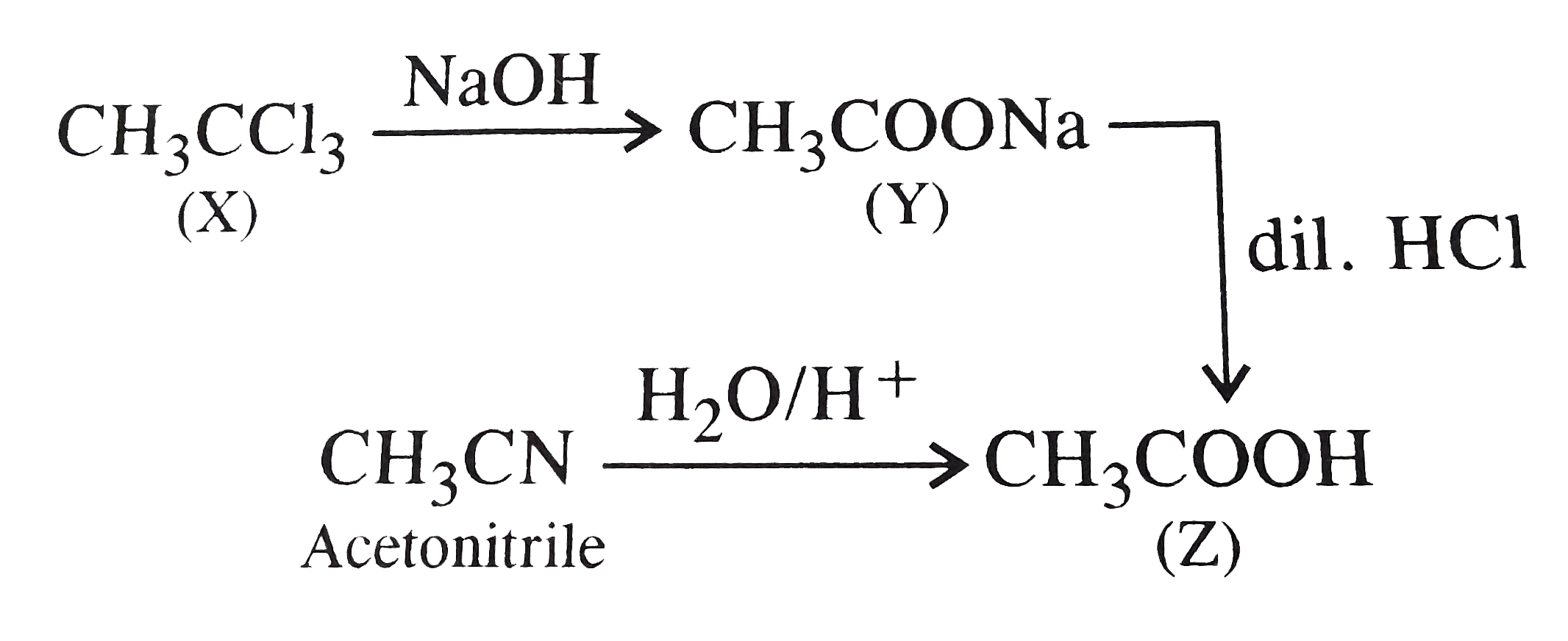
|
|
| 44. |
In the above reaction scheme, MnO_(2) appears more than once. From (A)-(F), how many of them contain MnO_(2)? |
Answer» 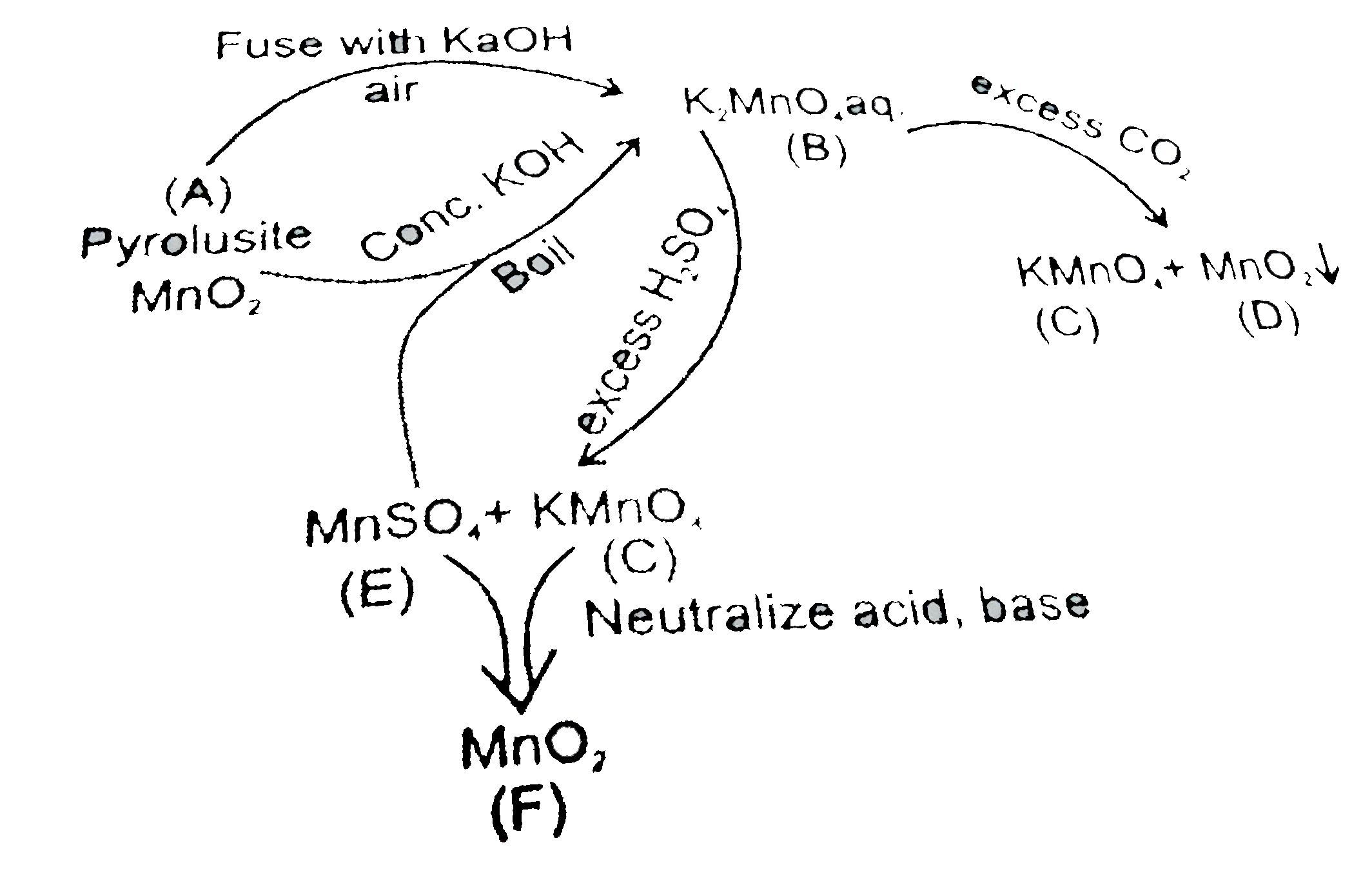
|
|
| 45. |
In the above reaction, product P is |
|
Answer»
|
|
| 46. |
Inthe above reaction how many grams of KClO_(3) is formed by 100L of Cl_(2), whose pressure of 950 mm Hg at 25^(@)C. |
|
Answer» `200 g` `=(950xx100)/(760xx0.0821xx298)=8.10g` MOLES |
|
| 47. |
In the above reaction 'A' is arbide of 3^(rd) period element which forms amphoteric oxide. Q. IUPAC name of 'E' is |
|
Answer» 2-methyl propane |
|
| 48. |
In the above reaction 'A' is arbide of 3^(rd) period element which forms amphoteric oxide. Q. 'D' can be converted into 'B' by using |
|
Answer» Ni |
|
| 49. |
In the above reaction 'A' is arbide of 3^(rd) period element which forms amphoteric oxide. Q. Homologue of 'D' is |
|
Answer» `CH_(2)O` |
|
| 50. |
In the above reaction |
|
Answer» `HNO_(3)` functions as a base |
|