

Saved Bookmarks
This section includes 7 InterviewSolutions, each offering curated multiple-choice questions to sharpen your Current Affairs knowledge and support exam preparation. Choose a topic below to get started.
| 1. |
In th eLassaigne's test for nitrogen in an organic compound, the Prussian blue colour is obtained due to the formation of: |
|
Answer» `Na_(4)[Fe(CN)_(6)]` |
|
| 2. |
In terms of work, the decrease in free energy during aprocess is equal to "…................" |
| Answer» SOLUTION :useful ( or MAXIMUM ) WORK DONE by the system | |
| 3. |
In terms of rate constants for forward and backward reactions (k_(f) and k_(b)) , equilibrium constant of a reaction is equal to …………. . |
|
Answer» |
|
| 4. |
In terms of period and groups where would you locate the element with Z = 114 ? |
| Answer» Solution :The element has the configuration [Rn] `5f^46d^107s^27p^2`. The OUTERMOST SHELL is 7 and hence the element belongs to seventh period. Group = 10 + VALENCE electrons. So it belongs to group 14 (p block). | |
| 5. |
In terms of ionization enthalpy and electron gain enthaply , what type of atoms combine to form an ionic compound ? |
| Answer» SOLUTION :METAL atom with low IONIZATION enthalpy and a non-metal atom with HIGH electrongain enthalpy | |
| 6. |
In terms of period & group where would you locate the element with Z = 114. |
|
Answer» Solution :Z = 114 which is situated between 86 nad 118. ` :. ` Its PERIOD = 7 .  If `Z = 114 `, its Group is 14. ELECTRONIC Configuration : `[RN]^(86)5f^(14)6d^(10)7s^(2)7p^(2)` Last`e^(-) ` is in 7p `:. ` It is P-Block element. `{:(-,6d" contain ",10),(-,7s" contain ",2),(-,7p" contain ",2),(,,bar(14)):}` `:. ` It is PRESENT in `14^(TH)` Group. |
|
| 7. |
In termsof periodand groupwherewouldyou locatethe elementwith Z = 114 ? |
|
Answer» <P> Solution :The filling of the6th periodends at `._(86)Rn.` Thereafterthe fillingof 7thperiod.Likein 6thperiod in 7thperiodalso, the fillingof foursubshellsi.e.,`7s , 7p , 6d` and5foccurs . Butaccordingto aufbau principletheirenergiesincreasein the order: `7 s lt 5 f lt 6 d lt 7 p`. thereforeafter`._(86) Rn` the nexttwoELEMENTSWITH Z=87 andZ = 88are s- blockelementsthe nextfourteen, i.e.,Z =90- 103aref- blockelementstne nextteni.e, z= 89and z= 104- 112are d- blockelements and thelastsixi.e.,Z= 113-118are p- blockelements. Therforethe elementsz= 114is thesecondp- blockelement (i.e.,group14)of the 7TH period. Thusthe location of theelementwith Z=114in theperiodtable is Period=7 thBlock: p- BlockGroup: 14 Ifofficialname isFlerovium ANDIT symbol isFl . |
|
| 8. |
In terms of period and group, where would you locate the element with Z = 114. |
|
Answer» |
|
| 9. |
In terms of intermolecular forces, explain why do some substances exist as solids? |
| Answer» Solution :When the constituent PARTICLES of a substance are so closely PACKED that the INTERMOLECULAR forces of ATTRACTION are much stronger than the thermal ENERGY, the substance exists as a solid. | |
| 10. |
In terms of dielectric properties, barium titanate is _____ |
|
Answer» |
|
| 11. |
In terms of ionisation enthalpy and electron gain enthalpy. |
| Answer» SOLUTION :Metal ATOM with LOW ionisation ENTHALPY and a non-metal atom with HIGH electron-gain enthalpy: | |
| 12. |
Interms ofelectronic configurationwhat theelementof a givenperiodand agrouphave incommon ? |
| Answer» Solution :For elementin a period the numberof shellsis EQUAL and forelementswithina GROUP thenumber ofelectronsin the outermost shell( valenceshell ) is THESAME. | |
| 13. |
In terms ofelectronic configuration what does elements of given period and a group have in common? |
|
Answer» SOLUTION :In a PERIOD , all elements have equal number of shells. In a GROUP , all elements have equal number of electrons in the OUTERMOST shell. |
|
| 14. |
In terms of critical constants, the compressibility factor is |
| Answer» Solution :`P_(c )V_(c )=(3)/(8)RT_(c ) :. z=(P_(c )V_(c ))/(RT_(c ))=(3)/(8)` | |
| 15. |
In terms of Charle's law explain why b-273^(@)C is the lowest possible. Temperature. |
| Answer» Solution :CHARLES Lawplottedgraphically with volume against TEMPERATURE in `-273^(@)C`. Charles concluded that all GASES at this temperature could have zero and below this temperature volume would be negatie. It SHOW `-273^(@)C` is lowest temperature attainable. | |
| 16. |
In terms of Charles' law explain why -273^(@)C is the lowest temperature. |
| Answer» SOLUTION :At `-273^(@)C`, VOLUME of the gas BECOMES EQUAL to zero, i.e., the gas CEASES to exist. | |
| 17. |
In terms of Charles. law explain why -273^(@)C is the lowest possible temperature. |
|
Answer» Solution :Eq. of Charle.s : `V_(t)=V_(0)((273.15+t)/(273.15))`….(Eq.-i) Put `t=-273/15^(@)C` in above equation. `THEREFORE V_(t)=V_(0)((273.15-273.5)/(273.15))` `therefore V_(t)=V_(0)((0)/(273.15))` `therefore V_(t)=0=V_(-273.15)` Therefore the VOLUME BECOME zero at the temperature `- 273.15^(@)C`. Actually all the GASES liquifies before reaching such low absolute `(-273.15^(@)C)` temperature and this is the least probable temperature. At this `- 273.15^(@)C` temperature the volume of the gases is zero and it is called absolute zero. |
|
| 18. |
In terms of Charles' law explain why -273^@C is the lowest possible temperature? |
| Answer» Solution :At `-273^@C`, VOLUME of a gas reduces to ZERO. If the temperature is lowered further, a NEGATIVE VALUE of volume is obtained which MAKES no sense. For details, see the text. | |
| 19. |
In terms of band theory, what is the difference (i) between a conductor and an insulator ?(ii ) between a conductor and a semiconductor ? |
|
Answer» Solution :(i)The ENERGY gap between the VALENCE band and conduction band in an insulator is very large whereas in a conductor, the energy gap is very small or there is OVERLAPPING between Valence band and conduction band. (II) In conductor, there is very small energy gap or there is overlapping between valence band and conduction band but in a semiconductor, there is always a small energy gap between them |
|
| 20. |
In terms of band theory , what is the differnec (i)Between a conductor and an insulator. (ii)betweena conductor and a semicondutor? |
| Answer» Solution : (i) The energy GAP betweeen the valence BAND and conduction band in an INSULATION is very large wheras in a conductor , the energy gap is very small or there is overlapping between valance band and conduction band. (II)In aconductor, there is very small, energy gap or there is overlappingbetween valance band and conduction band but in a SEMICONDUCTOR, there is always a small energy between them. | |
| 21. |
In synthesis of which compound, the water gas is used ? |
| Answer» Solution :WATER GAS is USED in SYNTHESIS of `CH_3OH` (methanol). | |
| 22. |
In Swarts reaction, chloroalkane is converted to ………………… . |
| Answer» SOLUTION :Fluoroalkane | |
| 23. |
In sulphur estimation, 3.2 grams of an organic compound give 2.33 grams of BaSO_4 . Then the percentage of sulphur in the organic compound is |
|
Answer» 0.15 |
|
| 24. |
In sulphur estimation, 0.157 g of an organic compound gives 0.4813 g of barium sulphate. The percentage of sulphur in the compound, is |
|
Answer» `42.10` 23 g of `BaSO_(4)` CONTAINS 32 g of sulphur `:. 0.4813 g` of `BaSO_(4)` will contain `=(32 xx 0.4813)/(233)` g of sulphur `%` of `S=(32 xx 0.4813xx100)/(233xx0.157)=42.10`. |
|
| 25. |
In sulphur estimation, 0.157 g of an organic compound gave 0.4813g of barium sulphate. What is the percentage of sulphur in the compound ? |
|
Answer» Solution :233g `BaSO_(4)` contain 32G sulphur `0.4813g BaSO_(4)` contain `(32 xx 0.4813)/(233)G` sulphur `:.` % of sulphur `= (32 xx 0.4813 xx 100)/(233 xx 0.157) = 42.10` |
|
| 26. |
In Sulphur estimation, 0.157 g of an organic compound gave 0.4813 g of barium sulphate. What is the percentage of sulphur in the compound ? |
|
Answer» SOLUTION :Here, mass of the SUBSTANCE taken = 0.157 g MAS of `BaSO_(4)` ppt. formed = 0.4813 g Now,1 mole of `BaSO_(4) -= 1 g` atom of S or (137 + 32 + 64) = 233 g of `BaSO_(4) -= 32 g` of S i.e., 233 g of `BaSO_(4)` contain sulphur = 32 g `:.` 0.4813 g of `BaSO_(4)` will contain sulphur `= (32)/(233) xx 0.4813 g` `:.` % age of sulphur in the compound `= (32)/(233) xx (0.4813)/(0.157) xx 100 = 42.10` |
|
| 27. |
In sulphur estimation, 0.157 g of an organic compound gave 0.4813 g of barium sulphate. What is the percentage of sulphur in the compound ? (Ba = 136, S= 32, O= 16) |
|
Answer» SOLUTION :molar mass of `BaSO_(4) = Ba + S + 4(O)` `= 137 + 32 + 64` = 233g `underset(32g)(S ) overset(NHO_(3))RARR H_(2)SO_(4) overset(BaCl_(2))rarr underset(233g)(BaSO_(4))` `:. 233g BaSO_(4)` contain 32g sulphur 0.4813g `BaSO_(4)` contain mass of sulphur `= (32 xx 0.4813)/(233)gm` %S `= (32)/(233) xx (0.4813)/(0.157) xx 100` = 42.10% |
|
| 28. |
In sucrose, the glycosidic linkage is |
|
Answer» `ALPHA` 1:4 LINKAGE |
|
| 29. |
In steam distillation the equation of total vapour pressure is P= p_(1) + p_(2) where p_(1) is more than…… |
|
Answer» <P> SOLUTION :VAPOUR PRESSURE of water `p_(2)` |
|
| 30. |
In steam distillation, the vapour pressure of the volatile organic compound is |
|
Answer» EQUAL to ATMOSPHERIC pressure |
|
| 31. |
In steam distillation of toluene, the pressure of toluene in vapour is |
|
Answer» EQUAL to pressure of barometer |
|
| 32. |
In steam distillation: (i) The liquid is boiled at low temperature. (ii) Vapour pressure of liquid lt Atmospheric pressure (iii) (liquid + pressure of water vapour)=1 atmosphere. (iv) The mixture of organic liquid are obtained. (v) The condensation of mixture of (vapour of water + vapour of lliquid) |
| Answer» SOLUTION :(i-T), (ii-T), (iii-F), (iv-F), (v-T) | |
| 33. |
In standard state the non spontaneous reaction among the following is |
|
Answer» Melting of ice |
|
| 34. |
In sphalerite structure C.N. of cation and anion are respectively |
|
Answer» 6, 6 |
|
| 35. |
In sommerfeld's modification of Bohr's theory , the trajectory of an electron in a hydrogen atom is |
|
Answer» A PERFECT ELLIPSE |
|
| 36. |
In spectral series of hydrogen , the series which does not come in infrared region is |
|
Answer» Pfund |
|
| 37. |
In Sommerfeld's modification of Bohr's theory, the trajectory of an electron in a hydrogen atom is: |
|
Answer» PERFECT ellipse |
|
| 38. |
In some ofthe reactions,thallium resembles aluminum, whereasin other it resembleswith group I mentals. Supportthis statement by givingsome evidences. |
|
Answer» Solution :Aluminium shows a uniformoxidation`+3`.Like aluminium, Tl ALSO shows +3 oxidationstate is some of its compoundslike `TiCl_(3), Tl_(2)O_(3)` ETC. Like `Al, Tl` alsoforms octahedral complexes : `[AlFe_(6)]^(3-)`and `[TlF_(6)]^(3-)` Group 1 metalsshows an oxidationstate of +1. Like group 1 METALS. Tl due to inert pair effect also shows +1 oxidationstate insome of its compounds such as `Tl_(2)O, TlCl, TlClO_(4)`, etc. Like group 1 oxides, `Tl_(2)O` is strongly BASIC. |
|
| 39. |
In some of the reactions thallium resembles aluminium, whereas in others it resembles with group-I metals. Support this statement by giving some evidences. |
|
Answer» Solution :Thallium belongs to GROUP 13 of the periodic table. The most COMMON oxidation state for this group is +3. HOWEVER, heavier members of this group also display the +1 oxidation state. This happens because of the inert pair effect. Aluminium displays the +3 oxidation state and ALKALI metals display the +1 oxidation state. Thallium displays both the oxidation states. THEREFORE, it resembles both aluminium and alkali metals. Thallium, like aluminium, forms compounds such as `TlCl_3` and `Tl_2O_3`. It resembles alkali metals in compounds `Tl_2O` and TlCl. |
|
| 40. |
In some of the reactions thallium resembles aluminium, whereas in others it resembles with group I metals. Support this statement by giving some evidences. |
|
Answer» Solution :Similar to aluminium, thallium shows +3 oxidation STATE in compounds like `Tl_2 O_3, TlCl_3, Tl_2 (SO_4)_3`, ETC. It FORMS complex `[TIF_6]^(3-)` similar to that formed by aluminium,`[AlF_6]^(2-)` Due to inert-pair effect, it also exhibits oxidation state of +1 as exhibited by ALKALI metals of group 1. Some of its compounds formed in this state are `Tl_2 O , TlCl` etc., which are similar to the compounds like `Na_2 O, NACL` etc. Like `Na_2 O, Tl_2 O` is strongly basic. Thus, it resembles group 1 metals also. |
|
| 41. |
in solvolysis of 1,2-dimrhtyl propyl-p-toluene sulfonate in acidic acid at 75^(@)C, How many (alkene +Substition ) products will be formed ? |
|
Answer» 2 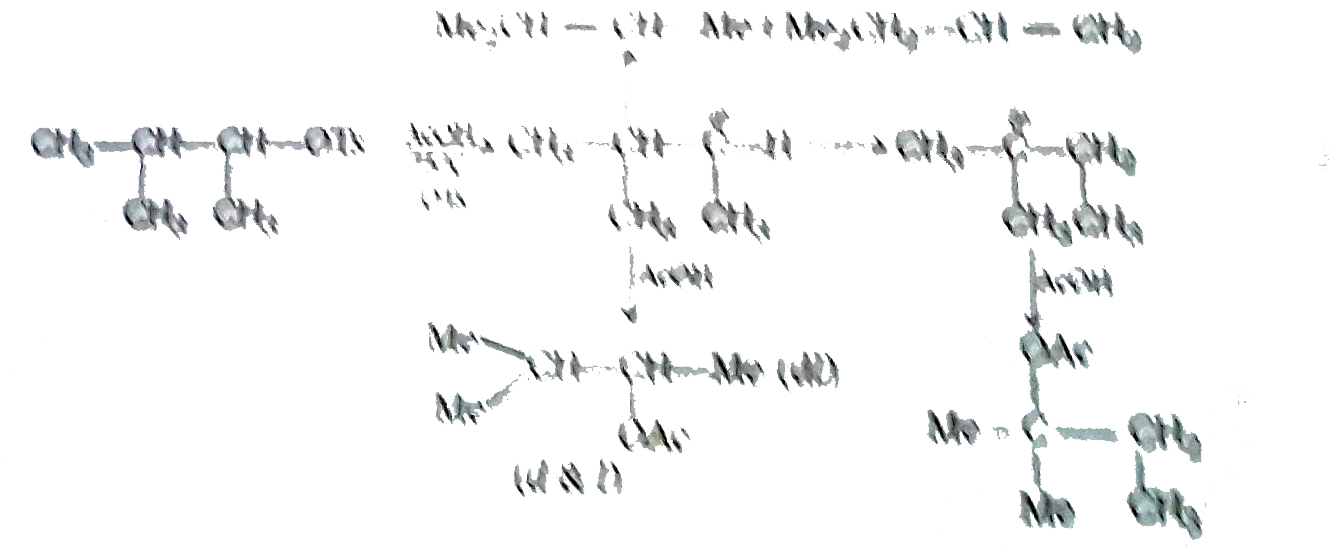
|
|
| 42. |
In Solvay's ammonia soda process for the manufacture of washing soda which of the following does not happen |
|
Answer» The raw material recyled is ammonia |
|
| 43. |
In Solvay's process NaHCO_(3) separates out due to |
|
Answer» high lattice energy |
|
| 44. |
In solvay process when ammonical brine is saturated with CO_(2) gas the product formed is |
|
Answer» `NH_(4)HCO_(3)` |
|
| 45. |
In solid ice, oxygen atom is surrounded |
|
Answer» tetrahedrally by 4 hydrogen ATOMS |
|
| 46. |
In solid hydrogen, the intermolecular bonding is |
|
Answer» Ionic `H_(2)O_(2) gt D_(2) gt H_(2)` |
|
| 47. |
In solid conundrum the number of oxygen atoms coordinate to aluminium ion is |
|
Answer» |
|
| 48. |
In solid argon, the atoms are held together by |
|
Answer» Ionic bonds |
|
| 49. |
In solid state Ar atoms are held together by |
|
Answer» IONIC bonds |
|