

Saved Bookmarks
This section includes 7 InterviewSolutions, each offering curated multiple-choice questions to sharpen your Current Affairs knowledge and support exam preparation. Choose a topic below to get started.
| 1. |
In the oxidation of nitrition to nitrate by H_(2)O_(2) the change in oxidation state of nitrogen chnges |
| Answer» Solution :`NO_2^(-) to NO_3^(-)` | |
| 2. |
In the Ostwald's process for the manufacture of HNO_(3), the catalyst used is |
|
Answer» Mo |
|
| 3. |
In the organic reaction by fission of bond, which intermediate species from? Write species and explain their stability |
|
Answer» Solution :In organic compound the covalent bond PRESENT between atoms. During organic reaction the fission of covalent bond is take place. In the fission of bond the displacement of electron is according to central atom and in these three type of intermediate from (a) heterolytic fission one carbocation or carbanion FORM (b) In homolytic fission, a free radical form (a) (i) Carbocation: In it the (+1) positive charge present on carbon. e.g `{:(overset(+)(CH_(3)),lt,CH_(3)overset(+)(CH_(2)),lt,(CH_(3))_(2) overset(+)(CH) ,lt(CH_(3))_(3)overset(+)(C )),(1^(@),,1^(@),lt,2^(@),lt 3^(@)):}` (ii) Carbanions: Chemical species bearing a negative charge on carbon. Like carbon of carbocation in carbocation three covalent bond but carbanion carbon posses eight electron `H_(3)baroverset(..)(C), H_(3)C baroverset(..)(C) H_(2), (H_(3)C)_(2) baroverset(..)(C)H, (CH_(3))_(3) bar(C )`: ETC. are carbanions. Its stability order METHYL `GT 1^(@) gt 2^(@) gt 3^(@)`. (b) Free radical: The free radicals produced by homolytic cleavage of a covalent bonds. In free radical the one electron present on atom. `overset(.)(C )H_(3), CH_(3) overset(.)(C )H_(2), (CH_(3))_(2) overset(.)( C)H, (CH_(3))_(3) overset(.)(C )` etc. are free radicals the stability order of free radicals is `1^(@) lt 2^(@) lt 3^(@)`. means- `overset(.)(CH_(3)) lt CH_(3) overset(.)(CH_(2)) lt (CH_(3))_(2) overset(.)(CH) lt (CH_(3))_(3) overset(.)(C )` |
|
| 4. |
In the organic compound CH_(2)= CH-CH_(2)-CH_(2)- -=CH, the pair of hydridised orbitals involved in the formation of C_(2)-C_(3) bond is |
|
Answer» `SP- sp^(2)` |
|
| 5. |
In the organic compound CH_(2)= CH - CH_(2) - CH_(2) - C -= CH,the pair of hybridised orbitals involved in the formation of C_(2)-C_(3) bond is (a) sp - sp^(2) (b) sp - sp^(3) (c) sp^(2) - sp^(3) (d) sp^(3) - sp^(3) |
|
Answer» Solution :When both DOUBLE BONDS are PRESENT at equivalent positions, double bond is given preference while numbering the carbon chain. Thus, `underset(sp^(2))OVERSET(1)(C)H_(2) =underset(sp^(2))overset(2)(C)H - underset(sp^(3))overset(3)(C)H_(2)-underset(sp^(3))overset(4)(C)H_(2) - underset(sp)overset(5)(C) -= underset(sp)overset(6)(C)H` `:. C_(2) - C_(3)` bond is formed by overlap of `sp^(2) - sp^(3)` orbitals. Thus, option (c) is correct. |
|
| 6. |
In the nitration of an aromatic compound using a mixture of concentrated nitric acid and sulphuric acid, the acids respectively function as |
|
Answer» an OXIDISING AGENT and an acid |
|
| 7. |
In the Nalgonda method, chemicals used for defluoridation of water in correct order are |
|
Answer» `CAO + CaOCl_(2)` |
|
| 8. |
In the molecule of XeF_(4), hybridisation of Xe atoms is |
|
Answer» `SP^(3)` |
|
| 9. |
In the molecule O_(A) = C = O_(B), theformal charge on O_(A)C " and " O_(B) are respectively. |
|
Answer» `- 1, 0, + 1` 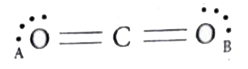 FORMAL charge of `O_(A)//O_(B) = N_(V) - (N_(E) +(N_(b))/(2))= 6 - (4+(4)/(2))= 6 - 6 = 0` Formal charge of `C = 4 - (0 + (8)/(2))= 4 - 4 = 0` |
|
| 10. |
In the molecule O_(A) = C = O_(B), the formal charge on O_(A), C and O_(B) are respectively. |
|
Answer» `-1, 0, +1`  Formal charge of `O_(A)//O_(B) = N_(V) - (N_(e ) + (N_(b))/(2)) =6-(4 + (4)/(2)) =6-6=0` Formal charge of `C=4 -(0 +(8)/(2)) =4-4=0` |
|
| 11. |
in the modern periodic table, the period indicates the value of : |
|
Answer» ATOMIC NUMBER |
|
| 12. |
In the modern periodic table, the period indicates the value of |
|
Answer» f ATOMIC number |
|
| 13. |
In themodern periodictablethe periodindicatedthe value of ( a)atomicnumber ( b)mas number( c) principalquantumnumber (d) azimuthalquantum number |
| Answer» Solution :In themodernperiodictableeachperiodbeginswith thefillingof a newshell.Therefore TRHE periodindicates THEVALUE ofprincipal QUANTUM number. Thusoption ( C) is CORRECT . | |
| 14. |
In the modern periodic table, the period indicates the value of ..... |
|
Answer» ATOMIC mass |
|
| 15. |
In the modern periodic table, the elements are placed in order to increasing atomic number. These have been numerous designs of the table over the years but the most common is the long form of periodic table. The long form of periodic table shows all the elements in numerical order. What is the atomic number of the (as yet undiscovered) alkali earth metal after radium? |
|
Answer» 120 |
|
| 16. |
In the modern periodic table, the elements are placed in order to increasing atomic number. These have been numerous designs of the table over the years but the most common is the long form of periodic table. The long form of periodic table shows all the elements in numerical order. Write the expected ground state electronic configuration of the element with one unpaired 5p electron that forms a covalent compound with fluorine. |
|
Answer» `[KR]5s^2 , 5p^5` |
|
| 17. |
In theModernPeriodicTableCalciumelement( atomic numbernumber20 ) issurrounded byelementwithatomicnumber12, 19 , 21 and38 . Whichof thesehas physicaland chemicalpropertiesresembling calcium? |
|
Answer» Solution :An elementin the periodictable WHICHIS surrounded byfourotherelementscan beregarded as thecentralelementof one horizontalrow( period )and onevarticalcolumngroup ) . The threeelementof the horizontal row haveconsecutive atomicnumbersand hencelie in thesameperiod. On THEOTHER handthe threeelements ofthe VERTICAL columndo nothave consecutive atomicnumbersadn hencelie in thesame group. For examplethe elementcalciumwith atomicnumber20 issurroundedby fourelementwith atomicnumber 12, 19 , 21and 38.Thus theatomicnumber20 issurroundedwhichlie in thesame groupare 12, 20 and38. Thereforethe physicaland chemicalproperties ofcalcium resemble withthoseof theelements havingatomicnumbers12 and 38. |
|
| 18. |
In the mixture of (NaHCO_(3) + Na_(2)CO_(3)), volume of HCl required is x mL with phenolphthalein indicator and y mL with mthyl orange inidicator in same titration. Hence, volume of HCl for complete reaction of Na_(2)CO_(3) is : |
|
Answer» 2 x Let volume of HCL for COMPLETE reaction of `Na_(2)CO_(3)=V_(1)` mL and volume of HCl for complete reaction of `NaHCO_(3)=V_(2)` mL . With phenolphthalein, `50% Na_(2)CO_(3)` will be neutralized. `therefore "" (V_(1))/(2)=x, V_(1)=2x` |
|
| 19. |
In the mineral , spinel, having the formula MgAl_2O_4, oxide ions are arranged in the cubic close packing , Mg^(2+) ions occupy the tetrahedral voids while Al^(3+)ions occupy the octahedral voids. (i)What percentage of tetrahedral voids is occupied by Mg^(2+) ions ? (ii)What percentage of octahedral voids is occupied by Al^(3+) ions ? |
|
Answer» Solution :According to the formula `MgAl_2O_4`, if there are 4 oxide ions, there will be `1 Mg^(2+)` ion and `2 Al^(3+)` ions. But if the `4 O^(2-)` ions are in ccp arrangement, there will be 4 octahedral VOIDS and 8 tetrahedral voids. Thus, `1 Mg^(2+)` ions is present in ONE of 8 tetrahedral voids `therefore` % of tetrahedral voids OCCUPIED by `Mg^(2+)=1/8xx100=12.5%` Similarly, `2 Al^(3+)` ions are present in two octahedral voids out of 4 AVAILABLE `therefore` % of octahedral voids occupied by `Al^(3+) =2/4xx100=50%` |
|
| 20. |
In the mixture of NaHCO_(3) and NaCO_(3), volume of a given HCl required is x ml with phenolphathalein indicator and further y mL is required with methyl orange indicator. Hence volume of HCl for complete reaction of NaHCO_(3) present in the original mixture is |
|
Answer» 2x EQ. o HCL = `(1)/(2)` Eq `NC_(2)CO_(3)` `XxxN=(1)/(2)` eq `NO_(2)CO_(3)` In presence of methyl orange Eq. of `HCl=(1)/(2)` Eq `NO_(2)CO_(3)+` Eq `NaHCO_(3)` `yxxN=xN+` Eq `NaHCO_(3)` `THEREFORE` Eq `NaHCO_(3)` = `(y-x)xxN` Here `(y-x)` is the volume of HCl |
|
| 21. |
In the metallurgical processes the flux used for removing acidic impurities is |
|
Answer» SILICA |
|
| 22. |
In the metallurgical processes, aluminium acts as |
|
Answer» an oxidising agent |
|
| 23. |
In the mechanism of Hoffmann reaction, which intermediate rearranges to alkyl isocyanate ? |
|
Answer» Bromamide |
|
| 24. |
In the manufacture of NH_(3) by Haber's process involving the reaction. N_(2(g))+3H_(2(g))overset([Fe_(2)O_(2)])(hArr)2NH_(3(g)),DeltaH=-22.08" kcal". The favourable conditions are |
|
Answer» HIGH PRESSURE and LOW TEMPERATURE. |
|
| 25. |
In the macromolecular type of colloids, the dispersed particles are themselves large molecules (usually polymer). Since these molecules have dimesions comparable to those of colloidal particles, their dispersions are called macromolecular colloids. Most lyophilic sols belong to this category. There are certain colloids which behave as normal strong electrolytes at low concentrations, but exhibit colloidal properties at higher concentrations due to the formation of aggergated particles. These are known as micelles associated colloids. Surface active agents like soaps and synthetic detergents belong to this class. Critical micelle concentration ( C.M.C) is the lowest concentration at which micelle formation appears. C.M.C.increase with the total surfactant concentration. At the concentration higher than C.M.C. they form extended parallel sheets known as lamellar micelles which resemble biological membranes which are two molecules thick. The individual molecule is perpendicular to the sheets such that hydrophilic groups are on the outside in aqueous solution and hydrophobic on the inside in a nonpolar medium. In concentrated solution, micelles take the form of long cylinders packed in hexagonal arrays and are called hytotropic mesomorphs . in an aqueous solution (polar medium), the polar groups point toward the periphery and the hydrophobic hydrocarbon chains point toward the canter forming the core of the micelle. Micelles from the ionic surfactants can be formed only above a certain temperature called the kraft temperature they are capable of forming ions molecules of soaps and detergents consist of lyophilic as well as lyophobic parts which associate together to form micelles. Micelles may contain as many as 100 molecules or more. 2.56 g of sulphur (colloidalsulphur) in 100mL solution shows osmotic pressure of 2.463 atm at 27^(@)C. How many sulphur atoms are associated in a colloidal sol ? (Solution constant =0.0821 L atm mol^(-1) K^(-1)) |
| Answer» ANSWER :D | |
| 26. |
In the macromolecular type of colloids, the dispersed particles are themselves large molecules (usually polymer). Since these molecules have dimesions comparable to those of colloidal particles, their dispersions are called macromolecular colloids. Most lyophilic sols belong to this category. There are certain colloids which behave as normal strong electrolytes at low concentrations, but exhibit colloidal properties at higher concentrations due to the formation of aggergated particles. These are known as micelles associated colloids. Surface active agents like soaps and synthetic detergents belong to this class. Critical micelle concentration ( C.M.C) is the lowest concentration at which micelle formation appears. C.M.C.increase with the total surfactant concentration. At the concentration higher than C.M.C. they form extended parallel sheets known as lamellar micelles which resemble biological membranes which are two molecules thick. The individual molecule is perpendicular to the sheets such that hydrophilic groups are on the outside in aqueous solution and hydrophobic on the inside in a nonpolar medium. In concentrated solution, micelles take the form of long cylinders packed in hexagonal arrays and are called hytotropic mesomorphs . in an aqueous solution (polar medium), the polar groups point toward the periphery and the hydrophobic hydrocarbon chains point toward the canter forming the core of the micelle. Micelles from the ionic surfactants can be formed only above a certain temperature called the kraft temperature they are capable of forming ions molecules of soaps and detergents consist of lyophilic as well as lyophobic parts which associate together to form micelles. Micelles may contain as many as 100 molecules or more. Cleansing action of soap occurs because |
|
Answer» Oil and GREASE can be absorbed into the hydrophobic CENTRES of soap micelles and washed away |
|
| 27. |
In the macromolecular type of colloids, the dispersed particles are themselves large molecules (usually polymer). Since these molecules have dimesions comparable to those of colloidal particles, their dispersions are called macromolecular colloids. Most lyophilic sols belong to this category. There are certain colloids which behave as normal strong electrolytes at low concentrations, but exhibit colloidal properties at higher concentrations due to the formation of aggergated particles. These are known as micelles associated colloids. Surface active agents like soaps and synthetic detergents belong to this class. Critical micelle concentration ( C.M.C) is the lowest concentration at which micelle formation appears. C.M.C.increase with the total surfactant concentration. At the concentration higher than C.M.C. they form extended parallel sheets known as lamellar micelles which resemble biological membranes which are two molecules thick. The individual molecule is perpendicular to the sheets such that hydrophilic groups are on the outside in aqueous solution and hydrophobic on the inside in a nonpolar medium. In concentrated solution, micelles take the form of long cylinders packed in hexagonal arrays and are called hytotropic mesomorphs . in an aqueous solution (polar medium), the polar groups point toward the periphery and the hydrophobic hydrocarbon chains point toward the canter forming the core of the micelle. Micelles from the ionic surfactants can be formed only above a certain temperature called the kraft temperature they are capable of forming ions molecules of soaps and detergents consist of lyophilic as well as lyophobic parts which associate together to form micelles. Micelles may contain as many as 100 molecules or more. Select the correct statement about phopholipids |
|
Answer» In aqueous solution, they form micelles |
|
| 28. |
In the macromolecular type of colloids, the dispersed particles are themselves large molecules (usually polymer). Since these molecules have dimesions comparable to those of colloidal particles, their dispersions are called macromolecular colloids. Most lyophilic sols belong to this category. There are certain colloids which behave as normal strong electrolytes at low concentrations, but exhibit colloidal properties at higher concentrations due to the formation of aggergated particles. These are known as micelles associated colloids. Surface active agents like soaps and synthetic detergents belong to this class. Critical micelle concentration ( C.M.C) is the lowest concentration at which micelle formation appears. C.M.C.increase with the total surfactant concentration. At the concentration higher than C.M.C. they form extended parallel sheets known as lamellar micelles which resemble biological membranes which are two molecules thick. The individual molecule is perpendicular to the sheets such that hydrophilic groups are on the outside in aqueous solution and hydrophobic on the inside in a nonpolar medium. In concentrated solution, micelles take the form of long cylinders packed in hexagonal arrays and are called hytotropic mesomorphs . in an aqueous solution (polar medium), the polar groups point toward the periphery and the hydrophobic hydrocarbon chains point toward the canter forming the core of the micelle. Micelles from the ionic surfactants can be formed only above a certain temperature called the kraft temperature they are capable of forming ions molecules of soaps and detergents consist of lyophilic as well as lyophobic parts which associate together to form micelles. Micelles may contain as many as 100 molecules or more. Which part of soap (RCOO^(-)) dissolves grease and forms micelle ? |
|
Answer» R PART (called tail of the anion ) |
|
| 29. |
In the macromolecular type of colloids, the dispersed particles are themselves large molecules (usually polymer). Since these molecules have dimesions comparable to those of colloidal particles, their dispersions are called macromolecular colloids. Most lyophilic sols belong to this category. There are certain colloids which behave as normal strong electrolytes at low concentrations, but exhibit colloidal properties at higher concentrations due to the formation of aggergated particles. These are known as micelles associated colloids. Surface active agents like soaps and synthetic detergents belong to this class. Critical micelle concentration ( C.M.C) is the lowest concentration at which micelle formation appears. C.M.C.increase with the total surfactant concentration. At the concentration higher than C.M.C. they form extended parallel sheets known as lamellar micelles which resemble biological membranes which are two molecules thick. The individual molecule is perpendicular to the sheets such that hydrophilic groups are on the outside in aqueous solution and hydrophobic on the inside in a nonpolar medium. In concentrated solution, micelles take the form of long cylinders packed in hexagonal arrays and are called hytotropic mesomorphs . in an aqueous solution (polar medium), the polar groups point toward the periphery and the hydrophobic hydrocarbon chains point toward the canter forming the core of the micelle. Micelles from the ionic surfactants can be formed only above a certain temperature called the kraft temperature they are capable of forming ions molecules of soaps and detergents consist of lyophilic as well as lyophobic parts which associate together to form micelles. Micelles may contain as many as 100 molecules or more. Select the incorrect statement (s) |
|
Answer» Surface active agents LIKE soaps and SYNTHETIC detergent are micelles. |
|
| 30. |
In the macromolecular type of colloids, the dispersed particles are themselves large molecules (usually polymer). Since these molecules have dimesions comparable to those of colloidal particles, their dispersions are called macromolecular colloids. Most lyophilic sols belong to this category. There are certain colloids which behave as normal strong electrolytes at low concentrations, but exhibit colloidal properties at higher concentrations due to the formation of aggergated particles. These are known as micelles associated colloids. Surface active agents like soaps and synthetic detergents belong to this class. Critical micelle concentration ( C.M.C) is the lowest concentration at which micelle formation appears. C.M.C.increase with the total surfactant concentration. At the concentration higher than C.M.C. they form extended parallel sheets known as lamellar micelles which resemble biological membranes which are two molecules thick. The individual molecule is perpendicular to the sheets such that hydrophilic groups are on the outside in aqueous solution and hydrophobic on the inside in a nonpolar medium. In concentrated solution, micelles take the form of long cylinders packed in hexagonal arrays and are called hytotropic mesomorphs . in an aqueous solution (polar medium), the polar groups point toward the periphery and the hydrophobic hydrocarbon chains point toward the canter forming the core of the micelle. Micelles from the ionic surfactants can be formed only above a certain temperature called the kraft temperature they are capable of forming ions molecules of soaps and detergents consist of lyophilic as well as lyophobic parts which associate together to form micelles. Micelles may contain as many as 100 molecules or more. In multimolecular colloidal sols, atoms or molecules are held together by |
|
Answer» H- bonding |
|
| 31. |
In the light of Heisenburg uncertainty principle, which radiation photon can locate the position of electron in an atom most precisely? |
| Answer» Solution :`gamma`-ray | |
| 32. |
In the Libermann's nitroso reaction, sequential changes in the colour of phenol occurs as |
|
Answer» Brown or red `rarr` green `rarr` deep BLUE |
|
| 33. |
In the Leclanche dry cell, anode is |
| Answer» Solution :Zinc container | |
| 34. |
In the lassaigne's test , one of the organic compounds gave red colour with FeCl_(3). Compound can be : |
|
Answer» `Na_(2)S` |
|
| 35. |
In the Lassaigne's test , one of the organic compound X gives blood red colour with FeCl_(3) . Compound X, when fused with sodium metal forms compound Y. molecular mass of compound Y is |
|
Answer» |
|
| 36. |
In the Lassaigne's test for the detection of sulphur, the purple colour is due to the formation of |
|
Answer» `Na_(4) [Fe(CN)_(5) NOD]` |
|
| 37. |
In the Lassaigne's test for the detection of nitrogen in the organic compound, the appearance of blue coloured compound is |
|
Answer» ferric ferricyanide |
|
| 38. |
In the Lassaigne's test for nitrogen in an organic compound, the Pressian blue colour is obtained due to the formation of : |
|
Answer» `Na_(4)[FE(CN)_(6)]` |
|
| 39. |
Lassigne's solution on treating with sodium nitro prusside solution gives a violet colour indication the presence of ______in the organic compound. |
|
Answer» |
|
| 40. |
In the Lassaigne's test for nitrogen in an organic compound, the Prussian blue colour is obtained due to the formation of : (a) Na_(4)[Fe(CN)_(6)] (b) Fe_(4)[Fe(CN)_(6)]_(3)(c) Fe_(2)[Fe(CN)_(6)] (d) Fe_(3)[Fe(CN)_(6)]_(4) |
| Answer» SOLUTION :The prussian blue colour is due to the formation `Fe_(4)[FE(CN)_(6)]_(3)`. Thus, OPTION (b) is correct. | |
| 41. |
In the laboratory H_(2)O_(2) is prepared by the action of: |
|
Answer» cold DILUTE `H_(2)SO_(4)` on HYDRATED `BaO_(2)` |
|
| 42. |
In the labelled N-atoms which is correct basic strength order: |
|
Answer» `2 GT 1 gt 3` |
|
| 43. |
In the IUPAC system, PhCH_(2)CH_(2)CO_(2)H is named |
|
Answer» 3-phenylpropanoic ACID |
|
| 44. |
In the isothermal expansion of an ideal gas |
|
Answer» `DELTA U = 0` |
|
| 45. |
In the isoelectronic species the ionic radii (A^@) of N^(3-) , O^(2-) and F^- are respectively given by |
|
Answer» ` 1.36, 1.71, 1.40 ` |
|
| 46. |
In the infrared region of the atomic spectrum of hydrogen, a line is obtained at 3802 cm^(-1). Calculate the energy of this photon (h = 6.626 xx 10^(-34) J sec) |
|
Answer» |
|
| 47. |
In ...... the intramolecular H-bond is present. |
|
Answer» <P>p- CHLOROPHENOL Ethan - 1, 2 - diol . It is `CH_(2) OH - CH_(2)OH`.  According to above figure, in one MOLECULE the intrarnolecular H-bond present between one oxygen and its nearer hydrogen. 
|
|
| 48. |
In the icosahedron of B_(12) unit each boron atom is bonded to how many boron atoms. |
|
Answer» |
|
| 49. |
In the influence of electric field the splitting of spectral lines is called |
|
Answer» ZEEMAN effect |
|
| 50. |
In the hydrogenation of phenyl ethylene C_(6)H_(5)CH=CH_(2) using a platinum catalyst the volume of hydrogen (measured at STP) that reacts with one mole of phenyl ethylene could be |
|
Answer» 11.2L |
|