

Saved Bookmarks
This section includes 7 InterviewSolutions, each offering curated multiple-choice questions to sharpen your Current Affairs knowledge and support exam preparation. Choose a topic below to get started.
| 1. |
In the reaction, 2FeCl_(3)+H_(2)Sto2FeCl_(2)+2HCl+S |
|
Answer» `FeCl_(3)` acts as an oxidizing AGENT |
|
| 2. |
In the reaction: 2Al(s)+6HCl(aq) to 2Al^(3+)(aq) +6Cl^(-)(aq)+3H_(2)(g) |
|
Answer» 6L HCI (aq) is consumed for every 3L `H_2` (g) produced `THEREFORE` 1 mole of HCl PRODUCES `=(3 xx 22.4)/6 = 11.2 L` of `H_(2)` at S.T.P. |
|
| 3. |
In the reaction : 2Al_((s)) + 6 HCl_((aq)) rarr 2Al_((aq))^(3+) + 6 C bar(l)_((aq)) + 3H_(2(g)) |
|
Answer» `6L HCL_((aq))`is consumed for every 3L `H_(2)`produced. 6 mole HCL reacts to produce3 mole `H_(2)` 6 mole HCl reacts to produce `3 xx22.4 L H_(2)` at STP `:.` 1 mole HCl reacts to produce `11.2L xx L H_(2)` at STP |
|
| 4. |
The reaction between aluminium and ferric oxide can generate temperatures up to 3273 K and is used in welding metals. (Atomic mass of Al = 27 u Atomic mass of 0 = 16 u) 2Al + Fe_(2)O_(3) to Al_(2)O_(3)+ 2Fe, If, in this process, 324 g of aluminium is allowed to react with 1.12 kg of ferric oxide. (i) Calculate the mass of Al_(2)O_(3) formed. (ii) How much of the excess reagent is left at the end of the reaction? |
Answer» SOLUTION :Given : `2Al+Fe_(2)O_(3)rarrAl_(2)O_(3)+2F_(e)` Molar mass of `Al_(2)O_(3)` formed `=6molxx102gmol^(-1)` `{:[(Al_(2)O_(3)),((2xx27)+(3xx16)),(54+48=102):}]=612g` Excess reagent `=Fe_(2)O_(3)` Amount of excess reagent LEFT at the end of the reaction `=1molxx160mol^(-1)` `=160g{:[(Fe_(2)O_(3)),((2xx56)+(3xx16)),(112+48=160):}]=160g` |
|
| 5. |
In the reaction 2Al+N_(2)rarr2AlN, Al is |
|
Answer» Reduced |
|
| 6. |
In the reaction, 2Ag + 2H_(2)SO_(4) rarrAg_(2)SO_(4) + 2H_(2)O + SO_(2) ,H_(2)SO_4acts as : |
|
Answer» oxidising AGENT |
|
| 7. |
In the reaction2 SO_(3 (g)) , hArr 2 SO_(2 (g)) + O_(2 (g)) , SO_(3 (g)) is 50 % dissociated at 27^(@)C when the equilibrium pressure is 0.5 atm . Partial pressure of SO_(3 (g)) at Equilibrium is |
|
Answer» 0.5 ATM |
|
| 8. |
In the reaction 2 KCIO_(3) rarr 2KCI+3 O_(2) the element which has been oxidised is …………….and the element which has been reduced is …………… |
|
Answer» |
|
| 9. |
In the reactio, Fe(OH)_3(s) hArr Fe^(3+) (aq)+ 3OH^(-)(aq), if the concentration of OH^(-) ions is decreased by 1/4 times , then the equilibrium concentrationof Fe^(3+) will …………………………. . |
|
Answer» not CHANGED When concentration of `OH^(-)` IONS decreased by `1/4` times,then `K_C = [Fe^(3+)]xx(([OH^(-)])/4)^3 = 1/64 [Fe^(3+)][OH^(-)]^3` To maintain `K_C` as constant, concentration of `Fe^(3+)` will increase by 64 times. |
|
| 10. |
In the reactant of KMnO_(4) with an oxalate in acidic medium. MnO_(4)^(-) is reduced to Mn^(2+) and C_(2)O_(4)^(2-) is oxidised to CO_(2). Hence, 50 ml of 0.02 M KMnO_(4) is equivalent to |
|
Answer» 100 ML of 0.05 M `H_(2)C_(2)O_(4)` `50xx0.02xx5=MxxVxx2` `implies MxxV=2.5=50.0.05` |
|
| 11. |
In the radial probability distribution curve for the 2s orbital of the hydrogen atom, the minor maximum, the node and the major maximum occur at the following distances from the nucleus respectively |
|
Answer» 1.1Å, 0.53 Å, 2.6Å |
|
| 12. |
In the quantitative estimation of phosphorous by using magnesia misture, the formula used is : |
|
Answer» percentage of `P=(62)/(222)xx(W xx100)/(w)` |
|
| 13. |
In the quantitative estimation of phosphorous by using ammonium molybdate, the formula used is : where W is the mass of ammonium phospho molydbate and w is the mass of the compound. |
|
Answer» <P>percentage of `P=(31)/(1877)XX (W xx100)/(w)` |
|
| 14. |
In the quantitative estimation of oxygen by using I_(2)O_(5), the formula used is : |
|
Answer» percentage of `O=(44)/(32)xx(W xx100)/(w)` |
|
| 15. |
In the production of dihydrogen gas via water gas shift reaction CO(g)+H_(2)(g) underset("Catalyst")overset("heat")to CO_(2)(g)+H_(2)(g) CO_(2) gas is removed by scrubbing with solution of |
|
Answer» SODIUM arsenite |
|
| 16. |
In the production of ammonia to complete the reaction (increase production) what should be done ? |
|
Answer» Solution :`N_(2(g)) + 3H_(2(g)) hArr 2NH_(3(g))` this is the reaction for production of AMMONIA. If the `NH_3` is continuously removed from reaction than reaction more in forward direction and more PRODUCT form. So in industry (product) `NH_3` is liquified and removed from equilibrium so more production is OBTAINED. |
|
| 17. |
In the problem number 21, the number of mole of N_(2)O_(4) in 100 g of the mixture is: |
|
Answer» `0.43` Number of MOLES of `N_(2)O_(4)=1-alpha=1-0.2=0.8` Weight of `N_(2)O_(4)` in MIXTURE =moles of `N_(2)O_(4)xx Mw` of `N_(2)O_(4)=0.8xx92=73.6 g` Weight of `NO_(2)` in mixture = moles of `NO_(2) xx Mw` of `NO_(2)` `=0.4xx46=18.4 g` Total weight `=73.6+18.4=92.0 g` In `92 g` of mixture, number of moles of `N_(2)O_(4)=0.8` In `100 g` of mixture, number of moles of `N_(2)O_(4)` `=(0.8xx100)/92=0.86` |
|
| 18. |
In the present graph, the area of circle A and B are 25 unit and 20 unit respectively work done will be 5x, units, x= _____ |
|
Answer» B: clockwise `= +20` `W_("on") = -5 rArr W_("by) = 5` |
|
| 19. |
In the presence of six ligand units the degeneracy of d-orbitals is lost and split into two sets. The pair of orbitals present in a single set are |
|
Answer» `d_(XY) and d_(x^2-y^2)` |
|
| 20. |
In the presence of peroxide, hydrogen chloride and hydrogen iodide do not give anti-Markovnikov addition to alkenes because : |
|
Answer» both are HIGHLY ionic |
|
| 21. |
In the presence of peroxide, addition of HBr to propene takes place according to anti-Markovnikov's rule but peroxide effect is not seen in the case of HCl and HI. Explain. |
Answer» SOLUTION :In presence of peroxides, addition of HBr to propene takes place according to anti-markovnikov's rule. The reaction occurs by a FREE radical MECHANISM as shown below : 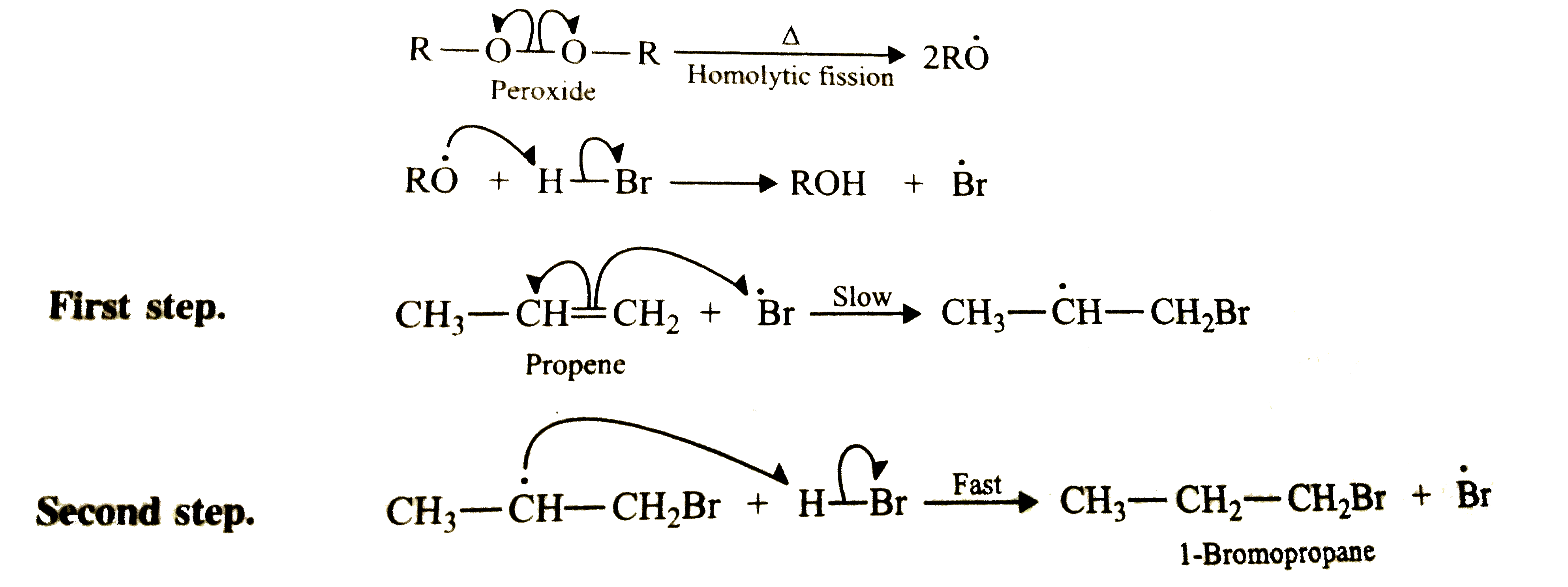 In CASE of HBr both these steps are exothermic and hence peroxide effect is observed. However, in case of HCl or HI, EITHER first on the second step is endothermic and hence peroxide effect is not observed. |
|
| 22. |
In the presence of peroxide , HCl and HI do not give anti-Markownikoff's addition to alkenes because : |
|
Answer» ONE of the steps is endothermic in HCl and HI |
|
| 23. |
In the presence of peroxide addition of HBr to propene takes place according to Anti-Markovnikov's rule but peroxide effect is not seen in the case of HCl and HI. Explain. |
|
Answer» Solution :Peroxide effect proceeds via free radical chain me chains mass given below : (i) `C_(6)H_(5)-overset(O)overset(||)(C)-O-O-overset(O)overset(||)(C)-C_(6)H_(5) overset("Homolysis")RARR 2C_(6)H_(5)-overset(O)overset(||)(C)-Orarr 2C_(6)H_(15)+2CO_(2)` (ii) `overset(.)(C_(6))H_(5)+H-Br overset("Homolysis")rarr C_(6)H_(5)+Br` (iii)  (iv)  Peroxide effect is observed only in the case of HBr and not seen incase of HI and HCl. This is due to the fact that the H-Cl bond is stronger than B-Br bond. ALSO, bond energy of H-Cl bond is higher than H-Br. H-Cl bond is not CLEAVED by the free radical where as the H-I bond is weaker and iodine free RADICALS combine to form iodine molecules. |
|
| 24. |
In the presence of iron catalyst, benzene reacts with chlorine to form |
|
Answer» CHLOROBENZENE |
|
| 25. |
In the presence of dry HCl, ethylene glycol reacts with acetaldehyde to yield |
|
Answer» An ester 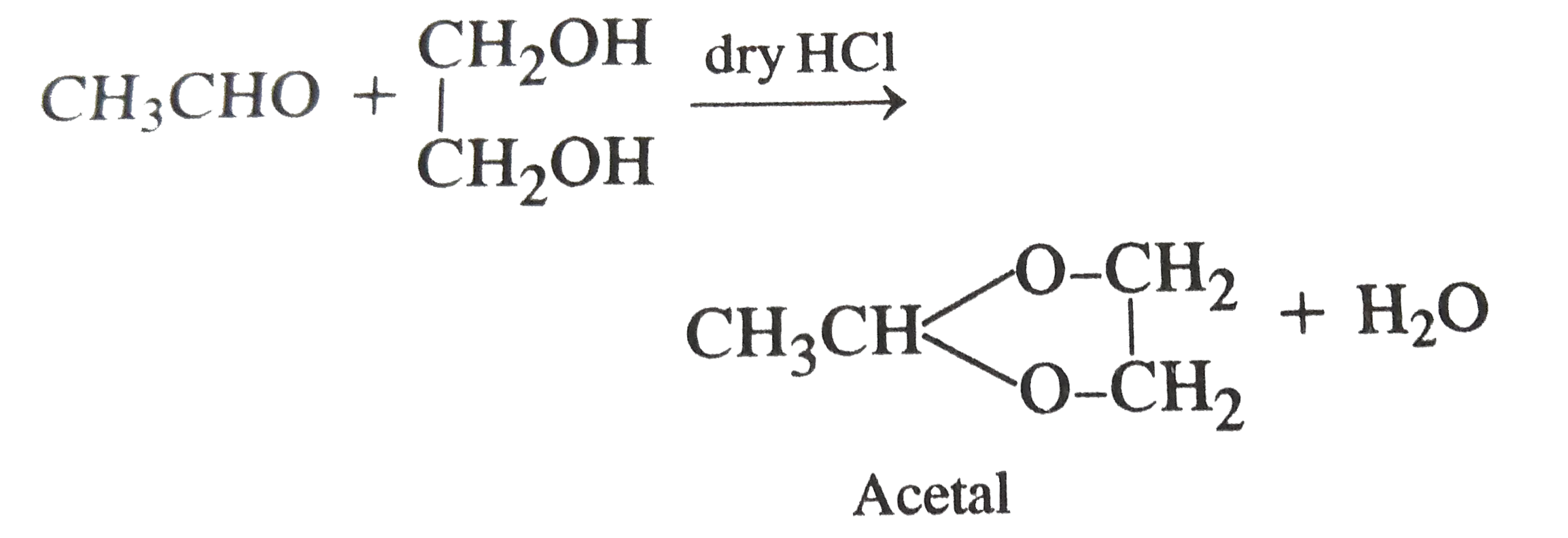
|
|
| 26. |
In the presence of dilute HCl, H_(2)S results in the precipitation of group II cations but not group IV cations during qualitative analysis. It is due to : |
|
Answer» HIGHER concentration of `H^(+)` ions |
|
| 27. |
In the presence of aluminium ethoxide, aldehydes get converted into esters. The reaction is known as |
|
Answer» SCHMIDT reaction |
|
| 28. |
In the presence of a peroxide, hydrogen chloride and hydrogen iodode do not undergo anti-Markovnikov's addition to alkenes because |
|
Answer» both are highly ionic `(i) X^(.)+CH_(2)=CH-RrarrXCH_(2)overset(.)(C )HR` `(ii) XCH_(2)CHR+H-Xrarr XCH_(2)CH_(2)R+X^(.)` For `HCl`, STEP `(i)` is exothermic while step `(ii)` is endothermic. For `HI`, step `(i)` is endothermic while step `(ii)` is exothermic. |
|
| 29. |
In the preparation of sodium carbonate (Na_(2)CO_(3)) which of the following is used ? |
|
Answer» Slaked lime |
|
| 30. |
In thepreparationof sodium carbonate, whichof thefollowingis used? |
|
Answer» SLAKEDLIME |
|
| 31. |
In the preparation of Iron from haematite (Fe_(2)O_(3)) by the reaction with carbon Fe_(2)O_(3)+CrarrFe+CO_(2) 94.5 kg of 10x% pure Iron could be produced from 120 kg of 90%pure Fe_(2)O_(3)? Find the value of x. |
|
Answer» `2xx160g rarr4xx56gm` `(90)/(100)xx120 RARR(10x)/(100)xx94.5implies x=8` |
|
| 32. |
In the preparation of HNO_(3), we get NO gas by catalytic oxidation of ammonia. The moles of NO produced by the oxidation of two moles of NH_(3) will be |
| Answer» Solution :`4NH_(3)+5O_(2)OVERSET(DELTA)to4NO+6H_(2)Oor2NH_(3)+5//2O_(2)to2NO+3H_(2)O` | |
| 33. |
In the preparation of HNO_3we get NO gas by catalytic oxidation of ammonia. The moles of NO produced by the oxidation of two moles of NH_3will be |
| Answer» Solution :`{:(UNDERSET(=)4NH_3+5O_2,RARR,underset(=)4NO+6H_2O),(4 " MOLES",,"4 moles"),(2 " moles",,"2 moles"):}` | |
| 34. |
In the preparation of H_(2)O_(2) from Na_(2)O_(2) with ice cold sulphuric acid, Sodium sulphate is cystallised in the form of |
|
Answer» `Na_2SO_4.H_2O` |
|
| 35. |
In the preparation of H_2O_2 from BaO_2 ,phosphoric acid is preferred to sulphuric acid because |
|
Answer» The soluble IMPURITIES like barium persulphate CATALYSE the decomposition of `H_2O_2` |
|
| 36. |
In the preparation of Grignard reagent from haloalkane, the metal used is |
|
Answer» Mg |
|
| 37. |
In the preparation of H_(2)O_(2) by auto oxidation method the starting substance is |
|
Answer» 2-ethyl anthra quinone |
|
| 38. |
In the preparation of CaO from CaCO_(3) using the equilibrium CaCO_(3) (s) hArr CaO (s) + CO_(2) (g) , K_(p)is expressed as : log K_(p) = 7. 282 - 8500/TFor the complete decomposition of CaCO_(3), the temperature in Celsius to be used is |
|
Answer» Solution :For decomposition , `K_(p) = 1.` ` :. Log 1 = 7.282 - 8500/ T` i.e., `7.282 = 8500/T (log 1 = 0 ) ` or `T = (8500)/(7.282) = 1167 K` `= 1167 - 273 ^(@) C = 894 ^(@)C.` |
|
| 39. |
In the preparation of alkene from alcohol using Al_2 O_3 which is effective factor? |
|
Answer» Porosity of `Al_2O_3` |
|
| 40. |
In the preceeding problem, if[A^(+)]"and"[AB_(2)^(-)] "are" y "and" x respectively, under equilibrium produced by adding the substance AB to the solvents, then K_(1)//(K_(2) "is equal to" |
|
Answer» `(y)/(X)(y-x)^(2)` |
|
| 41. |
In the preceding problem, if [A^+] and [AB_(2)^(-)] are y and x respectively under equilibrium produced by addings the substance AB to the solvents than K_(1)//K_(2) is equal to : |
|
Answer» `(y)/(X)(y-x)^(2)` |
|
| 42. |
In the plot of Z (compressibility factor) vs P,Z attains a value of unity at a particular pressure. What does it signify? |
| Answer» SOLUTION :`mu_("MOLES probabic"):mu_(AV):mu_(RMS)=1:1.128:1.224` | |
| 43. |
In the periodic table, with the increase in atomic number, the metallic character of an element..... |
|
Answer» Decreases in a PERIOD and increases in a GROUP.  In a group, ATOMIC no. increases, metallic nature decreases, as electrons are more ATTRACTED by their NUCLEI. |
|
| 44. |
In the phenomenon of osmosis through the semipermeable membrane |
|
Answer» solvent molecules PASS from SOLUTION to solvent |
|
| 45. |
In the periodic table, the maximum chemical reactivity is at the extreme left (alkali metals) and extreams right (halongens). Which properties of these two groups are responsible for this ? |
|
Answer» Least ionisaiton enthalpy on the LEFT and HIGHEST NEGATIVE electron gain enthalpy on the right |
|
| 46. |
In the periodic table transition elements begin with |
|
Answer» Scandium |
|
| 47. |
In the periodic table the element with Z = 24 is placed in the period. |
|
Answer» 1 |
|
| 48. |
In the periodic table, the elements are arranged in the periods following the |
|
Answer» HUND's rule of MAXIMUM MULTIPLICITY |
|
| 49. |
In the periodic table, inversion of atomic weights took place in this pair |
|
Answer» ARGON - Potassium |
|