

Saved Bookmarks
This section includes 7 InterviewSolutions, each offering curated multiple-choice questions to sharpen your Current Affairs knowledge and support exam preparation. Choose a topic below to get started.
| 1. |
In the reaction, Fe(OH)_(3)(s)hArrFe^(3+)(aq)+3OH^(-)(aq) if the concentration of OH^(-) ions is decreased by 1//4 times , then the equilibrium concentration of Fe^(3+) will |
|
Answer» not changed |
|
| 2. |
In the reaction C(s) + CO_(2)(g)hArr2CO(g) the following amounts of sbstance were formed in 0.2 litre flask CO_(2) = 0.06 mole. The equilibrium constant is |
|
Answer» `0.208` `K = 0.208` |
|
| 3. |
In the reaction, C_((s)) + CO_(2(g)) harr 2CO_((g)) the equilibrium pressure is 12 atm. If 50% of CO_(2) reacts, calculate K_(P). If K_(P)= y^(2) then what is 'y" ? |
|
Answer» <P>  total PRESSURE = `(3P)/(2)=12 IMPLIES P=8` atm `:. K_(P)=((8)^(2))/((4))=4` |
|
| 4. |
In the reaction Cr_(2) O_(7)^(2-) + 14 H^(+) + 6I^(-) to 2 Cr^(3+) + 3H_(2)O + I_(2)Wchich element is reduced? |
|
Answer» H |
|
| 5. |
In the reaction : Cl_2 + OH^(-) rarr Cl^(-) +ClO_(4)^(-) +H_(2)O chlorine is : |
|
Answer» OXIDIZED 
|
|
| 6. |
In the reaction, Cl_(2)+CH_(4)overset(hv)toCH_(3)Cl+HCl presence of a small amount of oxygen |
|
Answer» increases the rate of reaction for a brief period of time |
|
| 7. |
In the reaction : Cl_(2)+H_(2)S to 2HCl+S, the oxidation number of S changes from |
| Answer» Answer :C | |
| 8. |
In the reaction, CH_(3)OH rarr HCOOH, the number of electrons that must be added to the right is : |
|
Answer» 4 |
|
| 9. |
In the reaction- CH_(3)CN rarr CH_(3)COOH + NH_(3) The hybridisation of carbon in carbonyl group changes from- |
|
Answer» sp to `sp^(3)` |
|
| 10. |
In the reaction CH_(3)CN+2H underset("ether")overset(HCl)rarr X underset(Delta)overset(H_(2)O)rarr Y, Y is |
|
Answer» acetaldehyde |
|
| 11. |
In the reaction CH_(3)-Br+2Na+Br-CH_(3) rarr, the reaction is called |
|
Answer» WURTZ reaction |
|
| 12. |
In the reaction, C_(6)H_(6)+ RCOCl overset(AlCl_(3))to C_(6)H_(5)COR+ HCl the attacking electrophile is: |
|
Answer» `AICI_(2)^(+)` |
|
| 13. |
In the reaction C_6H_5CH_3 overset"Oxidation"to A overset"NaOH"to B overset"Soda-lime"to C the product C is |
|
Answer» `C_6H_5OH` |
|
| 14. |
In the reaction C_(3)H_(6)(g)+nO_(2)(g)toCO_(2)(g)+H_(2)O(l). The ratio of the coefficients of CO_(2) and H_(2)O is |
|
Answer» `1:1` |
|
| 15. |
In the reaction, C_(2)O_(4)^(2-)+MnO_(4)^(-)+H^(+)toMn^(2+)+CO_(2), the reducing agent is .......... |
| Answer» SOLUTION :`C_(2)O_(4)^(2-)` | |
| 16. |
In the reaction : C_(2)O_(4)^(2-)+MnO_(4)^(-)+H^(+) to Mn^(2+)+CO_(2)+H_(2)O, the oxidising agent is |
|
Answer» `MnO_(4)^(-)` |
|
| 17. |
In the reaction , C_2H_5Br underset((ii)CuI)overset((i)Li)to"(X)" overset(CH_3Br)to (Y) , the products X and Y are ________ and ____________ respectively. |
|
Answer» |
|
| 18. |
In the reaction C_(2)H_(4)overset(x)rarr Product, if the hybridization of carbon atom (s) in the product is sp^(3), X is not |
|
Answer» `H_(2)//NI` |
|
| 19. |
In the reaction, C + 4HNO_(3) rarrCO_(2) + 2H_(2)O + 4NO_(2), HNO_3acts as |
|
Answer» An oxidising AGENT |
|
| 20. |
In the reaction BF_3 + NH_3 to BF_3 larr NH_3 BF_3 and NH_3are ….. |
|
Answer» CONJUGATE ACID, BASE. |
|
| 21. |
In the reaction between strong acid and strong base, 1.8 g of water is formed. The heat evolved is used to raise the temperature of one kg of water at 25^@C. What is the final temperature of water? |
|
Answer» Solution :Number of moles of water formed `= ("WEIGHT of water")/("gram molecular weight") = (1.8)/18 = 0.1` Heat liberated `= 13.7 xx 0.1 = 1.37 K`. Cal. Heat (q) is given as, `q = ms q 1.37 xx 1000 = 1000 xx 1 xx q`. The RISE in temperature of water `q = 1.37^@`. Final temperature of water = `25 + 1.37^@ = 26.37^@C` |
|
| 22. |
In the reaction between I_2 and H_2O_2 in alkaline medium, what is the oxidant and reductant? |
|
Answer» Solution :`I_2 + H_2O_2 + 2OH^(-) to 2I^(-) + 2H_2O + O_2` HYDROGEN peroxide is oxidised to oxygen and IODINE is reduced to iodide ion. THUS `H_2O_2`is reductant and `l_2` is OXIDANT |
|
| 23. |
In the reaction between hydrogen and oxygen gives water vapour, the ratio of volumes is 2:1:2. This illustrates the law of |
|
Answer» conservation of MASS |
|
| 24. |
In the reaction between dilute nitric acid and magnesium metal, (a) how many moles of HNO_(3) reacts with a gram atom of metal? and (b) how many moles of HNO_(3) is oxidised by a gram atom of metal? |
|
Answer» Solution :The skeleton equation is `MG+HNO_(3) to Mg(NO_(3))_(2)+NH_(4)NO_(3)+H_(2)O` The BALANCED equation is `4Mg +10HNO_(3) to 4Mg(NO_(3))_(2)+NH_(4)NO_(3)+3H_(2)O` (a) NUMBER of MOLES of `HNO_(3)` that reacts with a gram atom of Mg=10/4=2.5 (b) `NO_(3)^(-)` is a spectator ion. It is NEGLECTED in the equation. `4Mg+NO_(3)^(-)+10H^(+) to 4Mg^(2+)+NH_(4)^(+)+3H_(O)` Number of moles of `HNO_(3)` that is reduced by a gram atom of Mg=0.25. |
|
| 25. |
In the reaction between BF_(3) and NH_(3), BF_(3) acts as ...........whereas NH_(3) acts as ........... |
|
Answer» |
|
| 26. |
In the reaction between BF_(3) and C_(2)H_(5)OC_(2)H_(5) which one of them will act as an acid ?Justify your answer. |
Answer» SOLUTION :The reaction between `BF_(3) and C_(2)H_(5)OC_(2)H_(5)` is As `BF_(3) ` accepts a pair of electrons, hence `BF_(3)` is the LEWIS acid. |
|
| 27. |
In the reaction between acidified KMnO_(4) and FeSO_(4) solution, the number of electrons involved in the process is |
|
Answer» 2 |
|
| 28. |
In the reaction below, X is Neopentyl alcohol overset(H_2SO_4)to X |
|
Answer» 2-methylpentane 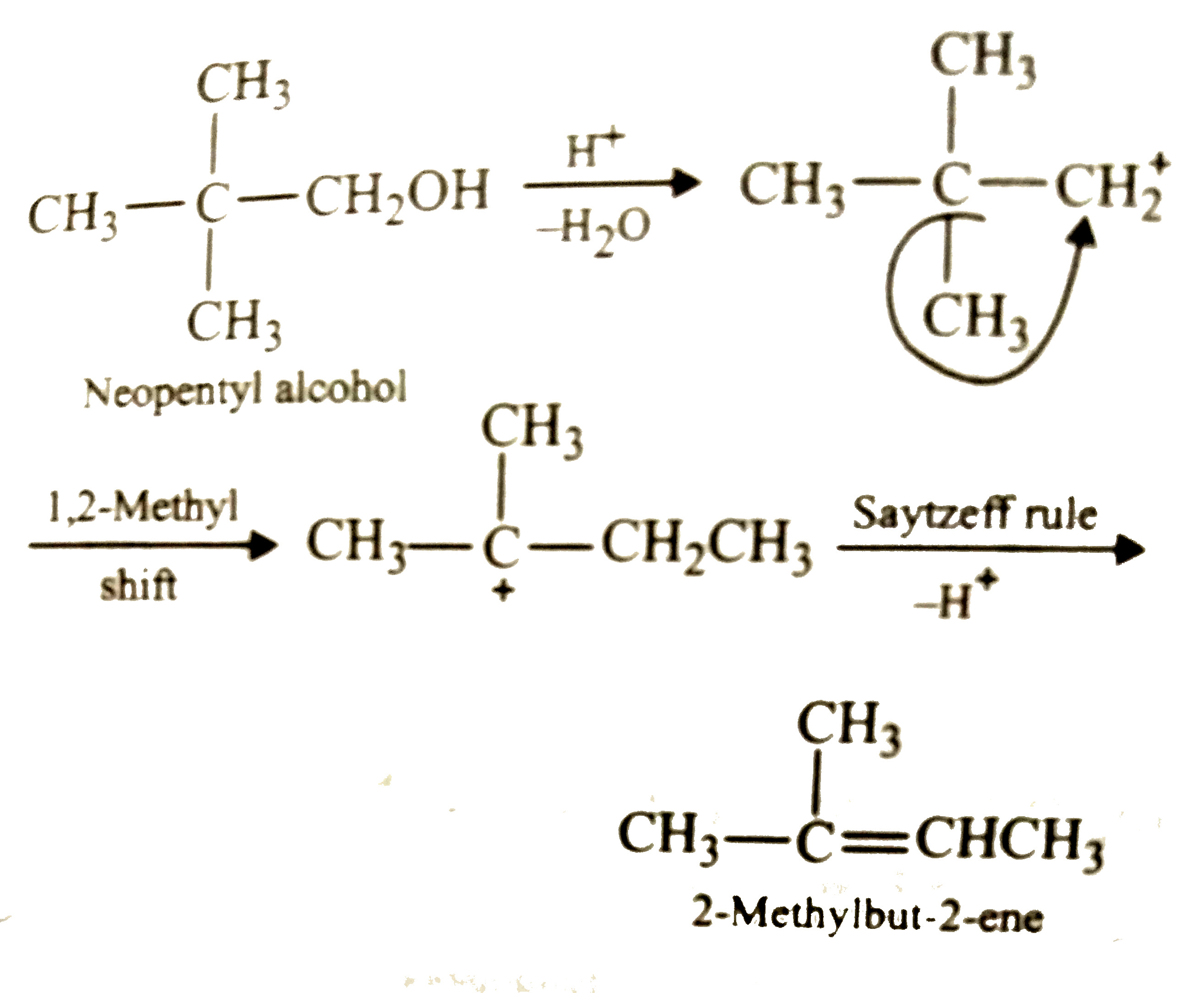
|
|
| 29. |
In the reaction , As_(2)S_(3) + HNO_3 rarr H_3AsO_(4) +H_(2)SO_(4) +NO , the element oxidised is/are : |
|
Answer» As only Both As & S |
|
| 30. |
In the reactionAl + Fe_(3)O_(4) rarr Al_(2) O_(3) + Fe (a) Which element is oxidized and which is reduced? (b) Total no. of elecetros transferred during the change. |
|
Answer» |
|
| 31. |
In the reaction AB_(2)(l)+3X_(2)(g)hArrAX_(2)(g)+2BX_(2)(g) DeltaH=-2700 kcal per mole. Of AB_(2)(l). The entalpies of formation of AX_(2)(g) and BX_(2)(g) are in the ratio of 4 : 3 and have opposite sign. The value of DeltaH_(f)^(@)(AB_(2)(l))=30 kcal//mol. Then : |
|
Answer» `DeltaH_(f)^(@)(AX_(2))=-96kcal//mol` |
|
| 32. |
In the reaction , Ag_(2)O+ H_(2)O_(2) to 2Ag + H_(2)O+ O_(2)H_(2)O_(2) acts as |
|
Answer» REDUCING AGENT |
|
| 33. |
In the reactionAB (g) hArr A(g) + B (g)"at " 30^(@) C,K_(p)for the dissociation equilibrium is2*56 xx 10^(-2) atm. If the dissociation of AB is |
|
Answer» 0.87 `p_(AB)=(1-alpha)/(1+alpha) P,p_(A)= alpha/(1+alpha)P,p_(B)=alpha/(1+alpha)P` `K_(p)=(alpha^(2)P)/(1-alpha^(2))=alpha^(2)/(1-alpha)" " ( :'P=1 "atm")cong alpha^(2)` `alpha = sqrt(K_(p)) = sqrt (2*56 xx 10^(-2))=0.16, i.e., 16 % ` |
|
| 34. |
In the reaction : A overset("HBr") to B overset( "alc. KOH") to C underset(Zn, H_(2)O)overset(O_(3))to CH_(3)CHO+ CO_(2)the compound A is |
|
Answer» Ethylene |
|
| 35. |
In the reaction A + B rArr C + D, what will happen to the equilibrium is concentration of A is increased ? The equilibrium constant for a reaction is 2 xx 10^(-23) at 25^@C and 2 xx 10^(-2) at 50^(@). Is the reaction endothermic or exothermic ? (c) Mention at least three ways by which the concetration of SO_(3) can be increased in the following reaction in a state of equilibrium. 2SO_(2)(g) + O_(2)(g) hArr (g) |
|
Answer» Solution :The reaction will shift in the forward direction. (b) ENDOTHERMIC (c) (i) INCREASING concentration of `SO_2` (ii) incrasing PRESSURE. (iii) increasing concentration of oxygen. |
|
| 36. |
In the reaction A^(+) + B rarr A+ B^(+) , there is no entropy change. Enthalpy change, Delta Hequals 22 kJ mol^(-1) of A^(+) . Calculate the DeltaG for the reaction . Under what condition free energy change will have negative value ? |
|
Answer» |
|
| 37. |
In the reaction A + 2B hArr2C, if 2 moles of A, 3.0 moles of B and2.0 moles of C are placed in a 2.0 L flask and equilibrium constant (K_(c)) for the reaction is |
|
Answer» `0.073` `K = ([0.5]^(2))/([1.25]XX[2]^(2)) = 0.05` |
|
| 38. |
In the reaction 8Al+3Fe_(3)O_(4)rarr 4Al_(2)O_(3)+9Fe the number of electrons transferred from the reductant to the oxidant is |
|
Answer» 8 |
|
| 39. |
In the reaction, 4Zn + NO_(3)^(-) + 7H_(2)O rarr 4Zn^(2+) + NH_(4)^(+) + 10OH^(-), the substance which gets reduced is "______________". |
|
Answer» `Zn` is REDUCED to `Zn^(2+)` |
|
| 40. |
In the reaction 4A+2B+3CrarrA_(4)B_(2)C_(3), what will be the number of moles of product formed, starting from one mole of A, 0.6 moles of B and 0.72 moles of C |
|
Answer» `0.25` `(1)/(4),(0.6)/(2)(0.72)/(3)` `(0.72)/(3)lt(1)/(4)lt(0.6)/(2)` implies C is LIMITING reagent implies AMOUNTOF product = `(0.72)/(3)=0.24` |
|
| 41. |
In the reaction 3Mg+N_(2)rarrMg_(3)N_(2) |
|
Answer» Magnesium is REDUCED `3Mg rarr3Mg^(+2)+2e^(-), Mg`is oxidised. |
|
| 42. |
In the reaction 3Br_(2)+6CO_(3)^(2-)+3H_(2)Oto5Br^(-)+BrO_(3)^(-)+6HCO_(3)^(-) |
|
Answer» BROMINE is oxidized and carbonate is reduce |
|
| 43. |
In the reaction 3Br_(2) + 6CO_(3)^(2-) + 3H_(2)OrarrBr^(-) + BrO_3+ 6HCO_(3)^(+) |
|
Answer» BROMINE is oxidised and CARBONATE is REDUCED |
|
| 44. |
In the reaction : 3Br_2+6CO_3^(2-)+3H_2O rarr 5Br^(-) +BrO_3^(-) +6HCO_3^(-) |
|
Answer» `Br_2` is oxidised and CARBONATE is REDUCED . |
|
| 45. |
In the reaction2X+B_(2)H_(6)rarr [BH_(2)X_(2)]^(+)[BH_(4)]^(-) the amines (s) X is/are |
|
Answer» `NH_3` `2NH_(3)+B_(2)H_(6)rarr[BH_(2)(NH_3)_2]^(+)[BH_(4)]^(-)` `CH_(3)NH_3:2CH_(3)NH_(2)+B_(2)H_(6)rarr [BH_(2)(CH_3NH_2)_(2)]^(+)[BH_4]^(-)` `(CH_3)_2NH:2(CH_3)_(2)NH+B_(2)H_(6)rarr[BH_(2)(CH_3NH_2)_(2)]^(+)[BH_4]^(-)` with `(CH_3)_3N,B_(2)H_6` forms an adduct `(CH_3)_3N+B_(2)H_(6)rarr2[(CH_3)_3N rarrBH_(3)]` |
|
| 46. |
In the redox reaction2S_(2)O_(3)^(2-)+I_(2) rarrS_(4)O_(6)^(2-)+2I^(-) |
|
Answer» M |
|
| 47. |
In the reaction , 2NH_(3) (g) hArr N_(2) (g) + 3H_(2) (g) |
|
Answer» `K_(P) = K_(C)` `THEREFORE K_(P) = K_(C) (RT)^(2) = K_(P) gt K_(C)` |
|
| 48. |
In the reaction , 2Na+ Cl_(2) rarr 2NaCl, "_______________". |
|
Answer» Na GETS OXIDIZED while `Cl_(2)` gets REDUCED |
|
| 49. |
In the reaction : 2H_2O_2 to 2H_2O + O_2 |
|
Answer» `H_2O_2` UNDERGOES only OXIDATION. 
|
|