

Saved Bookmarks
This section includes 7 InterviewSolutions, each offering curated multiple-choice questions to sharpen your Current Affairs knowledge and support exam preparation. Choose a topic below to get started.
| 1. |
Lithium on direct reaction with nitrogen formed.... |
| Answer» Answer :A | |
| 3. |
Lithium metal crystallizes in the bcc lattice . If the experimental density = 4.5 xx 10^(2) kg m^(-3) and the vacany i.e., unocupied volume (due to defect structure) is 10% calculate the edge length (cm) given at mass of lithium = 6.99 g cm^(-3). |
|
Answer» `3.59 XX 10^(-8)` |
|
| 4. |
Lithium is the lighest alkali metal but in aqueous solution , Li^(+) has the lowest mobility among alkali metals . Why so ? |
| Answer» Solution :Because of SMALLEST size AMONG alkali metals , `LI^(+)` ions are most highly hydrated in aqueous solution . As a result , among alkali metals , mass of hydrated LITHIUM ion is the highest and thus has lowest IONIC mobility . | |
| 5. |
Lithium is strongest reducing agent due to |
|
Answer» its HIGH ionisation enthalpy |
|
| 6. |
Lithium is monovalent . Magnesium is divalent. But Li and Mg are diagonally related pair of elements. Why ? |
|
Answer» Solution :LITHIUM and Magnesium have certain similarities in their properties. Hence, they are CALLED diagonally related pair of elements (a) Li and Mg have simillar ELECTRONEGATIVITY . (b)`Li^(+)` and `Mg^(2+)` have similar POLARISING POWER. |
|
| 7. |
Lithium is kept wraped in parafin wax not stored in kerosene oil. Why? |
| Answer» Solution :It is because lithium, is a light metal and therefore it FLOATS at the SURFACE of kerosene oil. In order to prevent its exposure to air it is KEPT WRAPPED in paraffin wax. | |
| 8. |
Oxygen is divalent in its compounds, but sulphur is even hexavalent. Why? |
|
Answer» SOLUTION :LITHIUM and Magnesium have certain SIMILARITIES in their properties. Hence, they are called diagonally RELATED PAIR of elements. The reasons are (a) Li and Mg have similar electronegativity. (b) `Li^(+)` and `Mg^(2+)` have similar polarising power. |
|
| 9. |
Lithium is generally used as an electrode in high energy density batteries . This is because |
|
Answer» LITHIUM is the hightest element |
|
| 10. |
Lithium iodide crystal has a face-centred cubic unit cell. If the edge length of the unit cell is 620 pm, determine the ionic radius of I^- ion. |
|
Answer» Solution :As LiI has FCC arrangement, `I^-` ions will OCCUPY the CORNERS and face-centres. These ions will touch each other ALONG the face diagonal `therefore` Face diagonal AB=`4r_(1^-)=sqrt(a^2+a^2)=sqrt2a therefore r_(1^-)=(sqrt2a)/4=(1.414xx620"pm")/4` =219.17 pm 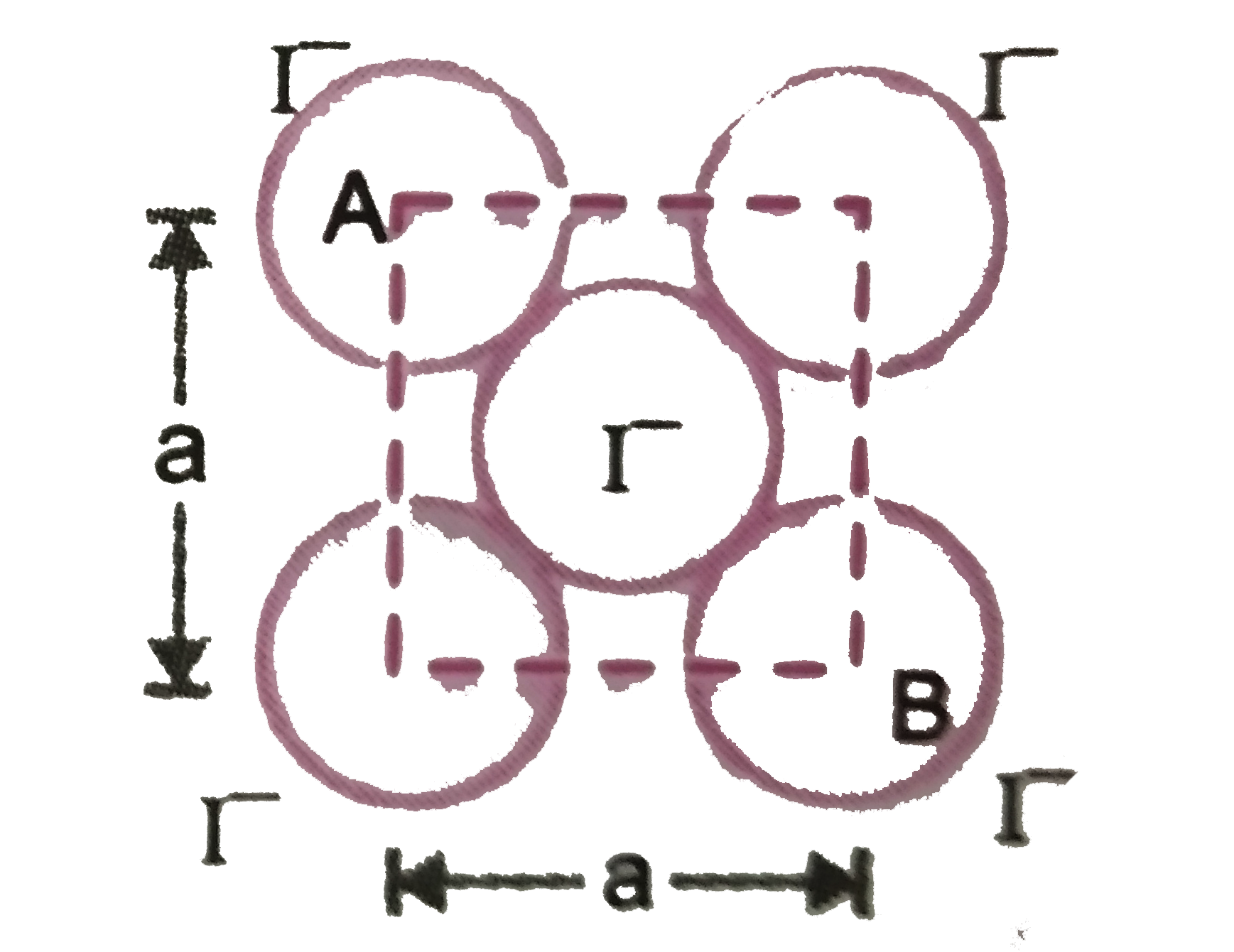
|
|
| 11. |
Lithium hydride can be used to prepare other useful hydrides. Beryllium hydride is one of them. Suggest a route for the preparation of beryllium hydride starting from lithium hydride. Write chemical equations involved in the process. |
|
Answer» Solution :Beryllium hydride cannot be prepared directly by REACTION with `H_(2)`. It is prepared by REACTING with `LiAlH_(4)`. Following REACTIONS take PLACE : `8LiH+Al_(2)Cl_(6) to 2LiAlH_(4) +6LiCl` `2BeCl_(2) +LiAlH_(4) to 2BeH_(2)+LiCl +AlCl_(3)` |
|
| 12. |
Lithium hydride can be used to prepare other useful hydrides . Beryllium hydride is one of them . Suggest a route for the preparation of beryllium hydride starting from lithium hydride . Write chemical equations involved in the process . |
|
Answer» Solution :`BeH_(2)` cannot be PREPARED directly by heating POWDERED beryllium with dihydrogen . It can , however , be prepared from the corresponding halides by reduction with complex alkali metal hydrides such as lithium aluminium hydride as follows . `8 LiH + Al_(2) Cl_(6) to 2 LiAlH_(4) + 6 LiCl` `2 BeCl_(2) + LiAlH_(4) to 2 BeH_(2) + LiCl + AlCl_(3)`. |
|
| 13. |
Lithium has the highest ionization enthalpy amoung alkali metals , yet is the strongest reducing agent . Why so ? |
| Answer» Solution :In aqueous solutions , the tendency of an element to lose electrons does not entirely depend upon its ionization enthalpy . It ALSO depends upon its enthalpy of sublimation and the enthalpy of hydration of the ion LEFT after the loss of an electron . The combined effect of these factors is measured in terms of electrode potential . Since lithium has the most negative `(-3*04 V)` electrode potential of group 1 elements, therefore , lithium is the STRONGEST reducing agent . | |
| 14. |
Lithium has a bcc structure . Its density is 530 kg m^(-3) and the its atomic mass is 6.94 g mol^(-1) . Calculate the edge length of the unit cell of lithium metal (N_A=6.02xx10^23 mol^(-1)) |
|
Answer» 527 pm For bcc, Z=2 , M=`6.94 "g mol"^(-1)` , `rho=530 KG m^(-3)=(530xx1000)/(1xx(100)^3cm^3)=0.53 g cm^(-3)` `therefore a^3=(2xx6.94)/(0.53xx6.02xx10^23xx10^(-30))` `=4.35xx10^7=43.5xx10^6` `therefore a=(43.5)^(1//3)xx10^2 =3.52xx10^2` pm =352 pm |
|
| 15. |
Lithium has a bcc structure. Its density is 530 kgm^(-3)and its atomic mass is6. 94 g mol^(-1) . Calculate the edge length of the unit cell of calculate the edge length of the unit cell of lithium metal(N_(A) = 6.02 xx 10^(23) mol^(-1)) |
|
Answer» 527 pm ` p = ( Z XX M)/( a^(3) xx N_(0)xx 10^(-30))g//cm^(3)` for bcc,Z =2 ,M = 6.94 ` g " mol"^(-1)` ` p = 530 kg m^(-3) = ( 530 xx 1000)/( 1xx (100)^(3) cm^(3)) = 0.53 " gcm"^(-3)` `a^(3) = ( 2 xx 6.94)/( 0.53 xx6.02 xx 10^(23) xx 10^(-30))` ` = 4.35xx 10^(7) =43.5 xx 10^(6)` `a= ( 43.5)^(1//3) xx 10^(2)= 3.52 xx 10^(2) "pm" = 352 "pm" ` |
|
| 16. |
Lithium forms monoxide only when heated in oxygen. Sodium forms monoxide and peroxide in excess of oxygen. Other alkali metals form superoxide with oxygen i.e MO_(2). The abnormal behaviour of lithium is due to small size. The larger size of nearer alkali metals also decides the role in formation of superoxides. The three ions are related to each other as follows O^(2-) overset(1/2O_(2))rarrunderset(O_(2^(2-)))overset(O_(2))rarrunderset("superoxide ion")2O_(2) Lithium does not form stable peroxide because |
|
Answer» of its SMALL size |
|
| 17. |
Lithium forms monoxide with oxygen whereas sodium forms peroxide with oxygen. Why? |
|
Answer» Solution :The fact that a small cation can stabilize a small anion and a large cation can stabilize a large anion EXPLAINS the formation and stability of the OXIDES (ii) The size of Lition is very small and it has a strong positive field AROUND it. It can COMBINE with only small anion, 02-ion, resulting in the formation of monoxide Li,O. (iii) The Nation is a larger cation and has a weak positive field around it and can stabilize a BIGGER peroxide ion, `O_(2)^(2)`or `[-O-O-]^(2-)` resulting in the formation of peroxide `Na_(2)O_(2)` |
|
| 18. |
Lithium forms body centred cubic structure. The length of the side of its unit cell is 351 pm. Atomic radius of the lithium will be. |
|
Answer» 300 pm For BCC unit cell, `a SQRT(3)=4r` `r=(a sqrt(3))/(4)=(351xxsqrt(3))/(4)=152` pm Thus neglecting `a//v^(2)` GIVES `P(V-b)=RT` or `PV=RT+Pb` or `(PV)/(RT)=Z=(RT+Pb)/(RT)rArr Z=1+Pb//RT` |
|
| 19. |
Lithium exhibits many physical and chemical similarites with magnesium because |
|
Answer» Both have the same size |
|
| 20. |
Lithium directly reacts with carbon to form _______ the ionic compound |
|
Answer» LITHIUM CARBIDE |
|
| 21. |
Lithium iodide is more covalent than Lithium chloride. Give reason. |
|
Answer» Solution :(i) The smaller CATION and larger anion shows greater covalent CHARACTER DUE to greater extent of polarisation. (ii) The sizè of `Li^(+)` ion issmaller than `Na^(+)` ion and hence the POLARISING power or `Li^(+)` ion is more. So lithium chloride is more covalent than sodium chloride. |
|
| 22. |
Lithium borohydride, LiBH_(4) , crystallizes in an orthorhombic system with 4 molecules per unit cell. The unit cell dimensions are : a= 6.81 Å, b = 4.43 Åand c= 7.17 Å . Calculate the density of the crystal. Take atomic mass of Li= 7, B =11 and H =1 a.m.u |
|
Answer» Solution :Molar mass of `LiBH_(4) = 7 + 11 + 4= 22 G mol^(-1) ` Mass of the unit cell = `(4 xx 22 " g mol"^(-1))/(6.022 xx 10^(23)"mol"^(-1)) = 14.62 xx 10^(-23) g` Volume FO the unit cell = ` a xx b xx c ` ` ( 6.81 xx 10^(-8) cm) ( 4.43 xx 10^(-8) cm) ( 7.17 xx 10^(-8) cm) = 21. 63 xx 10^(-23) "cm"^(3)` Density of the unit cell = `("Mass")/("Volume") = ( 14.62 xx 10^(-23)g)/(21.63 xx 10^(-23) cm^(2)) = 0.676 g cm^(-3)` |
|
| 23. |
Lithium cannot form because of its |
|
Answer» SMALL size |
|
| 24. |
Lithium borohydribe, LiBH_4, crystallizes in an orthorhombic system with 4 molecules per unit cell. The unit cell dimensions are : a=6.81 Å, b=4.43 Å and c=7.17 Å.Calculate the density of the crystal. Take atomic mass of Li=7, B=11 and H=1 a.m.u. |
|
Answer» Solution :Molar MASS of `LiBH_4`=7+11+4=22 g `mol^(-1)` Mass of the UNIT cell =`(4xx22 "g mol"^(-1))/(6.02xx10^23 "mol"^(-1))=14.62xx10^(-23)g` Volume of the unit cell = a X b x c =`(6.81xx10^(-8) cm)(4.43xx10^(-8)cm) (7.17xx10^(-8)cm) =21.63xx10^(-23) cm^3` `THEREFORE` Density of the unit cell =`"Mass"/"Volume"=(14.62xx10^(-23)g)/(21.63xx10^(-23) cm^2)=0.676 g cm^(-3)` |
|
| 25. |
Lithium and beryllium, the first members of alkali metals group and alkaline earth metals group, show anomalous behaviour due to the small sizes of their atoms and ions, high ionisation enthalpies, high polarizing power and absence of vacant d-orbitals in their valence shell. Lithium resembles magnesium while beryllium resembles aluminium due to diagonal relationships. How will you distinguish between BaSO_4 and BeSO_4 ? |
| Answer» SOLUTION :`BaSO_4` is insolublein WATER but `BeSO_4` is SOLUBLEIN water | |
| 26. |
Lithium and Mg show …… . |
| Answer» SOLUTION :DIAGONAL RELATIONSHIP | |
| 27. |
Litharge is chemically |
|
Answer» `PBO` |
|
| 29. |
Exaplin the uses of plaster of paris. |
|
Answer» SOLUTION :(i) In the building industry as well as plasters. (ii) It is used for immobilising the affected part of organ where there is a BONE fracture. (iii) In dentistry, in ornamental WORK and (iv) For MAKING CASTS of statues and busts. |
|
| 30. |
List the raw materials required in the manufacture of portland cement. What is the role of gypsum in it? |
|
Answer» Solution :The purpose of ADDING gypsum to cement is to slow down the PROCESS of setting of the cement so that it GETS sufficiently hardened. Raw MATERIALS used for the manufacture of portand cement. |
|
| 31. |
list thequantumnumber(m_(l)" and "l)ofelectrons for3dorbital |
|
Answer» SOLUTION :l of3d orbital=2 qand `m_(i)= l….. 0 …… + 1` -2 -1 , 0,+ 1,+2 |
|
| 32. |
List the metals which are lighter than water. Write the increasing order of their density. |
| Answer» SOLUTION :Lithium is the lightest metal. Li, NA and Kare LIGHTER than water. Their densities are less than ONE gram per CC. | |
| 33. |
List the characteristics of internal energy. |
|
Answer» The internal energy of a SYSTEM is an extensive property. The internal energy of a system is a state function. The change in internal energy of a system is expressed as `DeltaU-U_(f)-U_(i)` in a cyclic process, there is no internal energy change. ` DeltaU_("cyclic") = 0 ` If the internal energy of the system in the final state `(U_(f))` is less than the internal energy of the system in its initial state `(U_(i)) , "then" Delta U`would be NEGATIVE. `Delta U = U_(f) - U_(i) = - ve(U_(f)LT U_(i))` If the internal energy of the system in hte final state `(U_(f))` is greater than the internal energy ofthe system in its initial state `(U_(i)) "then" DeltaU`would be positive. `Delta U = U_(f) - U_(i) = + ve (U_(f)gt U_(i))` |
|
| 34. |
List the characteristics of Gibbs free energy. |
|
Answer» Solution :(i) Free energy is defined as G = H - TS 'G' Is a state function. (ii) G - Extensive property ,`DeltaG` intensive property. When mass REMAINS CONSTANT between initial and final state of system. (iii) 'G' has a single value for the THERMODYNAMIC state of the system. (iv) `G and DeltaG` value correspond to the system only. `{:("Process","Spontaneous","Equilibrium","Non-spontaneous"),(DeltaG,-Ve,"zero",+Ve):}` Gibbs free energy and the net work DONE by the system: For any system at constant pressure and temperature `DeltaG=DeltaH-TDeltaS""...(1)` We known that, `DeltaH=DeltaU+PDELTAV` `:.DeltaG = DeltaU+PDeltaV-TDeltaS` from first law of thermodynamics `DeltaU=q+w` form second law of thermodynamics `DeltaS=(q)/(T)DeltaG=q+w+PDeltaV-T((q)/(T))` `DeltaG=w+PDeltaV` `-DeltaG=-w-PDeltaV""...(2)` But `-PDeltaV` represent the work done due to expansion against a constant external pressure. |
|
| 35. |
List the characteristics of entropy. |
|
Answer» Solution :Characteristics of entropy: (i)Entropy is a thermodynamic state function that is a measure of the randomness or disorderliness of the system . (II)In general, the entropy of gaseous system is greater than liquids and greater The symbol of entropy is S. (iii)Entropy is defined as "for a reversible CHANGE TAKING place at a constant temperature (T), the change in entropy `(DeltaS)` of the system is equal to heat energy ABSORBED or evolved (q) by the system divided by the constant temperature (T). `DeltaS_"sys" =q_"rev"/T` (iv)If heat is absorbed , then `DeltaS` is positive and there will be increase in entropy . If heat is evolved , `DeltaS` is negative and there is a decrease in entropy . (v)The change in entropy of a process represented by `DeltaS` and is given by the equation, `DeltaS_"sys" =S_f-S_i` (vi)If `S_f > S_i , DeltaS` is positive , the reaction is spontaneous and reversible . If `S_f lt S_i , DeltaS` is negative , the reaction is non-spontaneous and irreversible . (vii) Unit of entropy :SI unit of entropy is `J K^(-1)` |
|
| 36. |
List out the various types of hydrides formed, when dihydrogen reacts with s-block, p-block, d-block and f-block elements. |
|
Answer» SOLUTION :(i) DIHYDROGEN with s-block elements form Ionic hydrides. (ii) Dihydrogen with p-block elements form Covalent hydrides (III) Dihydrogen with d & f-block elements form METALLIC hydrides. |
|
| 37. |
List out the uses of magnesium |
|
Answer» Solution :Magnesium is used 1. in the removal of sulphur from iron and steel.ltbbrgt 2. in the REFINING of TITANIUM in the "Kroll" process. 3. as photoengrave plates in printing industry. 4. Magnesium ALLOYS are used in AIRPLANE and missile construction. 5. Mg ribbon is used in synthesis of Grignard reagent in organic synthesis. 6. It alloys with aluminium to improve its mechanical, fabrication and welding property. 7. as a desiccant. 8. as sacrificial anode in controlling galvanic corrosion. 9. Magnesium is the co-factor of all enzymes that utilize ATP in phosphate transfer and energy release. |
|
| 38. |
List out the techniques used to reduce particulate pollutants for air. |
| Answer» Solution :The particulates from AIR can be removed by using electrostatic precipitators , gravity settling chambers, wet scrubbers or by CYCLONE COLLECTORS. These techniques are base on washing away or settling of the PARTICULATE matter. | |
| 39. |
List out the source of human body that produces free radicals. |
|
Answer» SOLUTION :Sources for human body produces free RADICALS. i. Human body is exposed to X-rays. ii. Cigarette smoke. III. INDUSTRIAL chemicals. IV. Air pollutants. |
|
| 40. |
List out the properties th at allow water to play a key role in the biosphere |
| Answer» Solution :Water has higher specific HEAT, thermal CONDUCTIVITY, surface TENSION, dipole moment and DIELECTRIC constant. These properties allow water to play a key ROLE in t he biosphere. | |
| 41. |
List out the properties of elements which increase in a group from top to bottom as well as in a period from left to right. |
|
Answer» Solution :Properties those increase both in a GROUP as well as in a period are : 1) Atomic number 2) Mass number 3) SHIELDING effect and 4) EFFECTIVE nuclear charge |
|
| 42. |
List out the factors that influence the solubility |
| Answer» Solution :The SOLUBILITY of a solute genrally DEPENDS on the NATURE of the solute and the solvent in which it is dissolved. It OLSO depends on the TEMPERATURE and pressure of the solution. | |
| 43. |
List out the exception to the octet rule. |
|
Answer» Solution :1. Molecules with electron deficient CENTRAL atoms. 2. Molecules containing odd electrons. 3. Molecules with expanded VALENCE shells. |
|
| 44. |
What are the applications of Bomb Calorimeter? |
|
Answer» Solution :Applications of bomb CALORIMETER : (i) Bomb calorimeter is used to determine the AMOUNT of heat release in COMBUSTION REACTION. (II) It is used to determine the calorific value of food. (iii) bomb calorimeter is used in many industries such as metabolic study , food processing , explosive testing and etc. |
|
| 45. |
List out few examples in irreversible reactions (changes) taking place in our daily life activity. |
|
Answer» SOLUTION :(i) Ripening of fruits and vegetables in few days. (II) Tarnishing of SILVER in few months. (III) Rusting of IRON slowly. |
|
| 46. |
List out and compare the chemical properties of metals and non - metals. |
Answer» SOLUTION :
|
|
| 47. |
{:("List-I","List-II"),("(Deuterolysis of)","(Compound formed)"),("(A) metal nitride",(1)"CD"_(4)),("(B) "CaC_(2),(2)"PD"_(3)),("(C) "Al_(4)C_(3),(3)C_(2)D_(2)),("(D) "Ca_(3)P_(2),(4)"ND"_(3)),(,(5)D_(2)SO_(4)):} The correct match is |
|
Answer» `{:(A,B,C,D),(4,3,5,2):}` |
|
| 48. |
{:("","List- I","","List -II"),("(A)", "Green house gases","(1)", CO),("(B)","Silent killer gas","(2)",CO_(2)),("(C)","Photo chemical smog ","(3)",CFCs),("(D)","Acid rains ","(4)",O_(3)NO_(2)),("","",(5),N_(2)O_(3)SO_(3)):} The correct match is |
|
Answer» `{:(A,B,C,D),(2,1,4,5):}` |
|
| 49. |
{:("List-I","List-2"),("Pollutant","Effect"),((A)SO_(4)^(-2) gt 550 "ppm baby syndrome",(1)"Causes disease blue"),((B)(NO_(3))^(-1) gt 50 "ppm",(2)"Damage to kideny, liver,reproduction system."),((C)"lead and Hg",(3)"Eutrophication of the pond"),((D)CO_(2)","H_(2)","O_(2)","N_(2) NO_(3)^(-1)", " (PO_(4))^(-3)", " B" " Cl Cu , (4) " Causes laxative effect"):} The correct match is |
|
Answer» `{:(A,B,C,D),(4,1,2,3):}` |
|
| 50. |
{:("List-I","List-2"),("(A) Major constituent",(I)O_(2)" and water vapour"),("(B) Minor constituent",(II)"Ar and "CO_(2)),((B)"Minor constituent",(III) N_(2)),((C)"Trace constituent",(IV)"He, "N_(2)O "and"O_(3)):} The correct match reagarding air |
|
Answer» `{:(A,B,C),(III,II,IV):}` |
|