

Saved Bookmarks
This section includes 7 InterviewSolutions, each offering curated multiple-choice questions to sharpen your Current Affairs knowledge and support exam preparation. Choose a topic below to get started.
| 1. |
MnO_(4)^(-) is a good oxidising agent in different mediums changing to MnO_(4)^(-)toMn^(2+) toMnO_(4)^(2-) toMnO_(2) toMn_(2)O_(3) Changes in oxidation number respectively are |
|
Answer» 1,3,4,5 |
|
| 2. |
MnO_(4)^(-) ions are reduced in acidic condition to Mn^(2+) ions whereas they are reduced in neutral condition to MnO_(2). The oxidation of 25 mL of a solution X containing Fe^(2+) ions required in acidic condition, 20 mL of a solution Y containing MnO_(4)^(-) ions. What volume of solution Y would be required to oxidise 25 mL of solution X containing Fe^(2+) ions in neutral condition ? |
|
Answer» 11.4 mL `(M_(1)V_(1))/(1)=(M_(2)V_(2))/(5)` `(M_(1)xx20)/(1)=(M_(2)xx25)/(5)` `M_(1)=(M_(2))/(4)` Neutral MEDIUM `MnO_(4)^(-)+3Fe^(2+) +4H^(+) to MnO_(2)+3Fe^(3+)+2H_(2)O` `(M_(1)V_(1))/(1)=(M_(2)V_(2))/(3)` `((M_(2))/(4))xxV_(1)=(M_(2)xx25)/(3)` `V_(1)=33.3 mL` |
|
| 3. |
MnO_(4)^(-) ions are areduced in acidic condition to Mn^(2+) ions where they are reduced in neutral conditointo MnO_(2) the oxidation of 25 ml of a solutoin x containing Fe^(2) ions requred in acidic condition 20 ml ofa soluton y containg MnO_(4)^(-) ions what volume of solution Y would be required to oxidise 25 ml of solution x containing Fe^(2+) ions in neutral condition ? |
|
Answer» 11.4 ml `MnO_(4)^(-)+8H^(+)+5Fe^(2+)rarrMn^(2+)+5Fe^(3+)+4H_(2)O` `MnO_(4)^(-)+2H_(2)O+3Fe^(2)rarrMnbO_(2)+3Fe^(3+)+4OH` since under acidic condition 1 mole of `MnO_(4)^(-)` OXIDISES 5 moles of `Fe^(2+)` ions but only 3 moles under neutral CONDITIONS therefore volume of `MnO_(4)^(-)` used oxidation of 25 ml of same `Fe^(2+)` solution under neutral condition `(20xx5)/(3)=33.3mL` |
|
| 4. |
MnO_(4)^(-2) undergoes disproportionation reaction in acidic medium but MnO_(4)^(-) does not. Give reason. |
Answer» Solution :In `MnO_(4)^(-2)` oxidation number MN is +6 but its increases +7 or DECREASES +4, +3, +2, 0. So this type of reaction is known as disproportionation reaction.  In `MnO_(4)^(-)` oxidation number of Mn is +7 which CONTAINS less oxidation number than +7. So `MnO_(4)^(-)` not acts as disproportionation reaction. |
|
| 5. |
MnO_(2) on reaction with conc. HCl liberates chlorine, the liberated chlorine ontreatment with aqueous KI gives iodine. The iodine is neutralized by 40 of 0.1 N hypo solution. The reaction is : 2Na_(2)S_(2)O_(3)+I_(2) to 2NaI+Na_(2)S_(4)O_(6) The amount of MnO_(2) used in the reaction is : |
| Answer» Answer :B | |
| 6. |
MnO_(2) + KOH + O_(2) rarr K_(2)MnO_(4) + H_(2)O. Give the stoichiometric coefficient of reactants and products respectively. |
|
Answer» 2, 4, 1, 2, 1 |
|
| 7. |
…….ml (volume ) is required of or 10 volume H_2O_2 of 2N KMnO_4 in acidic medium ? |
|
Answer» Solution :`N=V/5.6=10/5.6`= 1.7857 N `H_2O_2` `N_1V_1(H_2O_2) = N_2V_2(KMnO_4)` `V_1=(2xx200)/1.7857`=224 ml of `H_2O_2` |
|
| 8. |
Mixture x= 0.02 mol of [Co(NH_(3))_(5)SO_(4)]Br and0.02 mole of [Co(NH_(3))_(5)Br]SO_(4) was prepared in 2 L of solution. 1 litre of mixture x+ excess of AgNO_(3) rarr y 1 litre of mixture x +excess of BaCl_(2) rarr z Number of moles of yand z are ... |
|
Answer» 0.01, 0.01 |
|
| 9. |
Mixture of nitrobenzene and aniline can be separated by |
|
Answer» Distillation |
|
| 10. |
Mixture of MgCl_2 and Mgo is called |
| Answer» Solution :Sorel.s cement | |
| 11. |
Mixture of lime stone end clay when heated forms |
|
Answer» Hydraclic MORAL |
|
| 12. |
Mixture of Con. HCl and anhydrous ZnCl_(2) is called____ |
|
Answer» BAYER's REAGENT |
|
| 13. |
Mixture of calcium carbonate and magnesium carbonate are used as flux in isolation of ....... metals. |
|
Answer» Steel |
|
| 14. |
Mixture of ....... and plaster of paris, which on setting become hard and known as kiln cement. |
|
Answer» Borex |
|
| 15. |
Mixture of 1 mole BaF_(2) and 2 mole H_(2)SO_(4) can not be neutralised by : |
| Answer» Solution :N//A | |
| 16. |
Mixture 'a' may contain: (P) PbCI_(2) (Q) AgCI (R) Hg_(2)CI_(2) |
|
Answer» Only P |
|
| 17. |
Mixing of solutions of BaCl_(2) and Na_(2)SO_(4) results in the formation of a precipitate of BaSO_(4) only if.......greater than.......... |
|
Answer» |
|
| 18. |
Mixing of two gases by diffusion is |
|
Answer» REVERSIBLE |
|
| 19. |
Mixing of N_(2) and H_(2) form an ideal gas mixture at roo, temperature in a container.For this process, which of the following statements is true? |
|
Answer» `DELTAH = 0, DeltaS_("SURROUNDING") =0 , DeltaS_("system") = 0 and DeltaG = -ve` |
|
| 20. |
Minimum percentage of ethyl alcohol by weight in its aqueous solution, so that gun powder soaked in the aqueous solution catches fire is |
|
Answer» `95.5%` |
|
| 21. |
Minimum number of physical forms that an element should exist to show allotropy. |
|
Answer» 0 |
|
| 23. |
Minimum number of carbon required to exhibit chain isomerism |
|
Answer» 3 |
|
| 24. |
The minimum number of carbon atoms to be present in an alkyne to exhibit chain isomerism is |
|
Answer» 3 |
|
| 25. |
Minimum de-Broglie wavelength is associated with |
|
Answer» Electron `SO_2` molecule has least WAVELENGTH because their MOLECULAR mass is high. |
|
| 26. |
Minimum amount of Ag_(2)CO_(3)(s) required to produce sufficient oxygen for the complete combusion of C_(2)H_(2) which produces 11.35 litre of CO_(2) at STP after combusion is: Ag_(2)CO_(3) (s) rightarrow 2Ag(s) + CO_(2)(g) + (1/2)O_(2)(g), C_(2)H_(2) +(5/2)(O_(2)) rightarrow 2CO_(2) + H_(2)O |
|
Answer» 276g |
|
| 27. |
Minimum carbon atoms required for an alkane to show opticalisomerism. |
Answer» 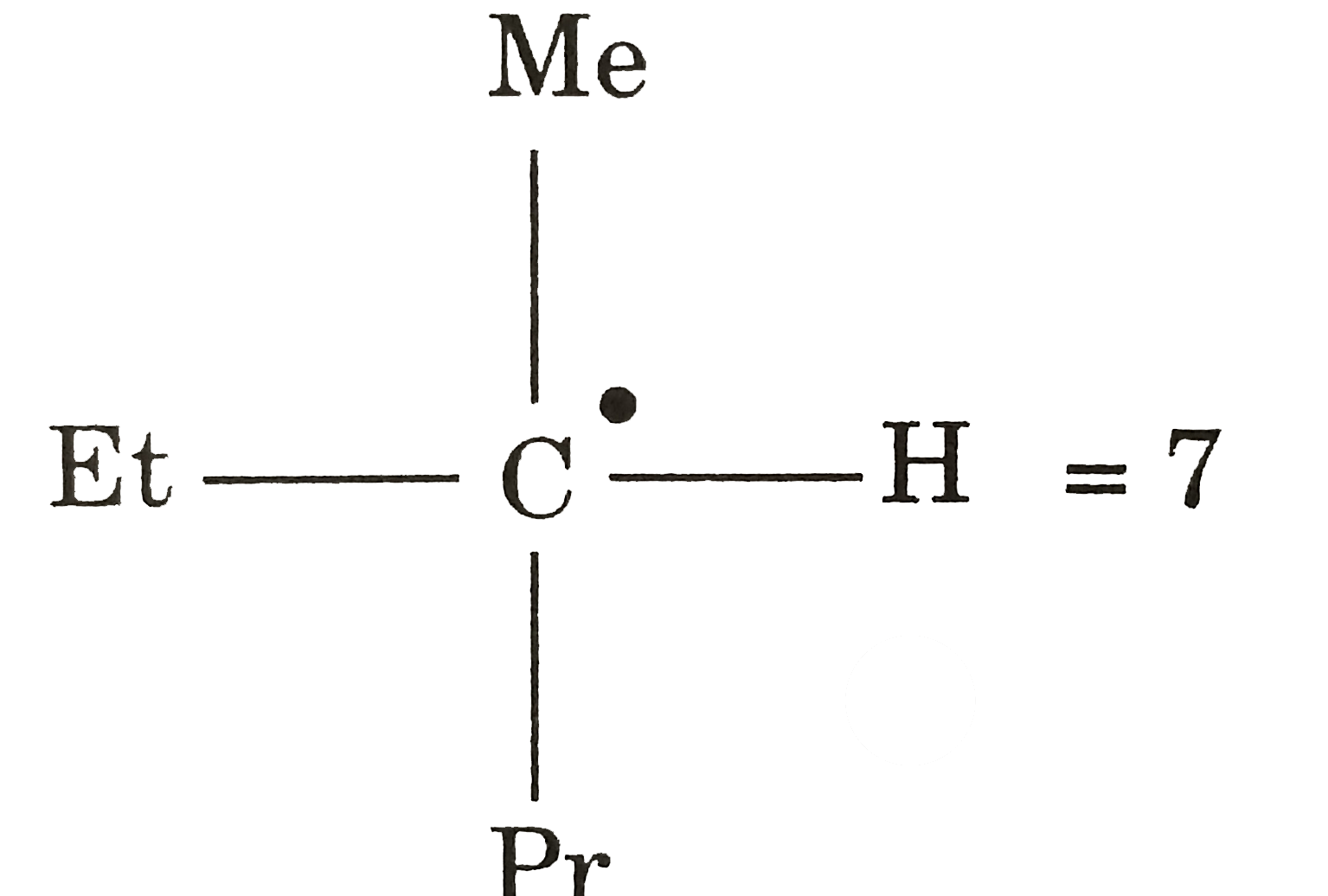
|
|
| 28. |
Minimum amount of energy required to remove a proton is approximately: |
|
Answer» 2MeV |
|
| 29. |
Minimum accelerating potential (volts) needed to accelerate an electron to produce a yellow line (lambda= 310 nm) in the spectrum , in an electron tube containing some vapours is : |
|
Answer» 1.2 |
|
| 30. |
Mineral of aluminium that does not contasin oxygen is |
|
Answer» corundum |
|
| 31. |
Milk is an example of |
|
Answer» GEL |
|
| 32. |
Milk is a colloid in which a |
|
Answer» Liquid is dispersed in a liquid |
|
| 33. |
Milk is |
|
Answer» FAT DISPERSED in WATER |
|
| 34. |
Milk can be preserved by adding a few drops of |
|
Answer» Formic ACID solution |
|
| 35. |
Milk can be preserved by adding a few drops of:- |
|
Answer» FORMIC ACID solution |
|
| 36. |
Mild oxidation of glycerol with H_(2)O //FeSO_(4) gives |
|
Answer» GLYCERALDEHYDE The mixture of dehydroxy acetone and glyceraldehyde is known as glycerose. |
|
| 37. |
Mild oxidation of bynzyl chloride with Cu(NO_(3))_(2) gives_____ |
|
Answer» BENZOIC acid |
|
| 38. |
{:("Microcosmic salt"overset(Delta)rarr.,underset(("Transparent"))('M')+H_(2)O+NH_(3)(uarr)),(,""darrCoO),(,'N'("Blue bead")):} Molecular formula of microcosmic salt is: |
|
Answer» `Na_(2)B_(4)O_(7).10H_(2)O` |
|
| 39. |
{:("Microcosmic salt"overset(Delta)rarr.,underset(("Transparent"))('M')+H_(2)O+NH_(3)(uarr)),(,""darrCoO),(,'N'("Blue bead")):} Compound M and N are: |
|
Answer» `Na_(3)PO_(4)` and `NaCoPO_(4)` |
|
| 40. |
Microcosmic salt reacts with coloured ions to form characteristic bead which is due to formation |
|
Answer» Borates `NaPO_(3)+CuOrarrNaCuPO_(4)`(Blue mass) |
|
| 41. |
Microcosmic salt is |
|
Answer» `Na(NH_(4)HPO_(4).4H_(2)O` |
|
| 42. |
Mica is chemically |
|
Answer» Sheet SILICATE |
|
| 43. |
MgSO_(4).7H_(2)Ooverset(150^(@))(to)MgSO_(4).xH_(2)Ooverset(200^(@))(to)MgSO_(4).yH_(2)O |
|
Answer» `:.(x+y=1+0=1)` |
|
| 44. |
MgSO_(4).7H_(2)Ooverset(423k)(to)Aoverset(473k)(to)B Boverset(Delta)(to)C+2SO_(2)+O_(2) Which of the following options are incorrect. |
|
Answer» `{:(A,B,C),(MgSO_(4)*H_(2)O,MgSO_(4),MgO):}` 
|
|
| 45. |
MgSO_(4) on reaction with NH_(4)OH and Na_(2)HPO_(4) forms a white crystalline. What is its formulla? |
|
Answer» `Mg(NH_(4))PO_(4)` `MgSO_(4)+Na_(2)HPO_(4)+NH_(4)OH RARR underset("White ppt.")(Mg(NH_(4))PO_(4)darr +Na_(2)SO_(3)+H_(2)O` |
|
| 46. |
MgSO_(4(s)) + H_(2)O rarr MgSO_(4(aq)), Delta H = - 84K. Cals, Delta H of the reaction is known as |
|
Answer» HEAT of DILUTION |
|
| 47. |
Mg(OH)_2 is soluble in NH_4CI, but not in NaCl. Why? |
|
Answer» Solution :Adding `NH_4 CI` to `Mg(OH)_2`, the interaction takes place to give magnesium chloride and ammonium hydroxide. `Mg(OH)_2 + 2NH_4 CI toMgCl_2 + 2NH_4 OH ` `NH_4 OH ` being a weak base, reduces the `[OH^(-)]` in solution. Product of `[Mg^(2+)]` and `[OH^(-)]` REMAINS lower than `K_(sp)`of `Mg(OH)_2` to give no precipitation of `Mg(OH)_2` . Adding NACL to `Mg(OH)_2`, the interaction LEADS to give magnesium chloride and sodium hydroxide. `Mg(OH)_2 +2NaCl toMgCl_2 + 2NaOH` NaOH being a strong base produces free `OH^(-)` ions in solution. Ionic product of `[Mg^(2+)] and [OH^(-) ]` EXCEEDS the solubility product, showing precipitation of magnesium hydroxide |
|
| 48. |
MgO has the structureof NaCl and TICl has the structure of CsCl. What are the coordination numbers of the ions in MgO and TiCl ? |
| Answer» SOLUTION :6 and 8 RESPECTIVELY. | |
| 49. |
MgO has the structure of NaCl and TICI has the structure of CsCl. What are the coordination mumber of the ions in MgO and TICI ? |
| Answer» SOLUTION :6 and 8 respecitvely | |
| 50. |
MgCl_(2).6H_(2)Ocannot be dehydrated on strong heating .Why? |
|
Answer» Solution :`MgCl_(2).6H_(2)O` has SIX WATER molecules andthe wateris called water of crystallisation .On HEATING it loses found fourwater molecules . `MgCl_(2).6H_(2)O overset ("heat") toMgCl_(2).2H_(2)O+4H_(2)O` water in `MgCl_(2).2H_(2)O` is called lattice water . On heating , lattice water reacts with mahnesium chloride/It UNDERGOES HYDROLYSIS and forms refractory magnesia . Therefore `MgCl_(2).2H_(2)O` is heated in the presence of dry HCl, to prevent possible hydrolysis. |
|