Saved Bookmarks
This section includes 7 InterviewSolutions, each offering curated multiple-choice questions to sharpen your Current Affairs knowledge and support exam preparation. Choose a topic below to get started.
| 1. |
MgCl_(2) is linear but SnCl_(2) is angular-explain. |
| Answer» Solution :For `MgCl_(2),H=(1)/(2)[2+2-0+0]=(4)/(2)=2`, i.e., the central Mg-atom is sp-hybridised. Therefore, the molecule is linear. On the other hand, for `SnCl_(2),H=(1)/(2)[4+2-0+0]=(6)/(2)=3`, i.e., the cental Sn-atom is `sp^(2)`-hybridised. Therefore, the two bond pairs and one lone PAIR present in the molecule are directed TOWARDS the corners of an equilateral triangle. HENCE, `SnCl_(2)` molecule is angular. | |
| 2. |
MgAl_(2)O_(4), is found in the Spinal structure in which O^(2-) ions consititute CCP lattice, Mg^(2+) ions occupy 1/8th of the Tetrahedral voids and Al^(3+) ions occupy 1.2 of the Octahedral voids. Find the total +ve charge contained in one unit cell |
|
Answer» `+7//4` electronic CHARGE |
|
| 3. |
MgCl_(2) and CaCl_(2) are easily hydrated, while NaCl and KCl are not hydrated. Why? |
|
Answer» SOLUTION :Compounds of alkaline earth metals are more extensively hydrated than those of alkali metals because the hydration enthalpies of alkaline earth metal ions are larger than those of alkali metal ions. e.g., `MgCl_(2)` and `CaCl_(2)` exist as `MgCl_(2).6H_(2)O` and `CaCl_(2).6H_(2)O` while NACL and KCI do not form such hydrates. |
|
| 4. |
Mg_(3) N_(2) when reacted with water gives off ammonia but HCl is not obtained when MgCl_(2) reacts with water at room temperature . Explain . |
|
Answer» Solution :`Mg_(3)N_(2)` is a SALT of a strong BASE `Mg(OH)_(2)` and a weak acid `NH_(3)` . Therefore , it undergoes hydrolysis to give `NH_(3)` . `Mg_(3) N_(2) + 6H_(2) O to 3 Mg(OH)_(2) + 2NH_(3)` In contrast , `MgCl_(2)` is a salt of a strong base `Mg(OH)_(2)` and a strong acid HCl . Therefore , it does not undergo hydrolysis to give HCl . `MgCl_(2) + 2 H_(2)O cancelto Mg (OH)_(2) + 2 HCl` |
|
| 5. |
Mg_(2)C_(3) + H_(2) O to |
| Answer» SOLUTION :`Mg_(2)C_(3) + 4H_(2)O to 2Mg(OH)_(2) + CH_(3)C -= CH` | |
| 6. |
Mg^(2+) ions is essential for selective precipitation of Fe(OH)_(3) be aqueous NH_(3). |
|
Answer» `Fe^(3+) + 3OH^(THETA)` (from `NH_(4)OH) rarr Fe(OH)_(3)` `NH_(4)OH rarr NH_(4)^(o+) + overset(Theta)OH` Due to common ion `(NH_(4))`, the supression of ionisation of `NH_(4)OH` TAKES PLACE, so the concentartion, of `overset(Theta)OH` is less. So only the `Fe(OH)_(3)` ppt. not `Mg(OH)_(2)` since `K_(sp)` of `Fe(OH)_(3) lt K_(sp) "of" Mg(OH)_(2)` |
|
| 7. |
Mg^(2+) can be detected and esitimated in hard water by titrating with EDTA at pH=10 using NH_(4)OH+NH_(4)Cl buffer. The end point is given by the apearance of blue colour. The indicator used is |
|
Answer» Solochromeblack 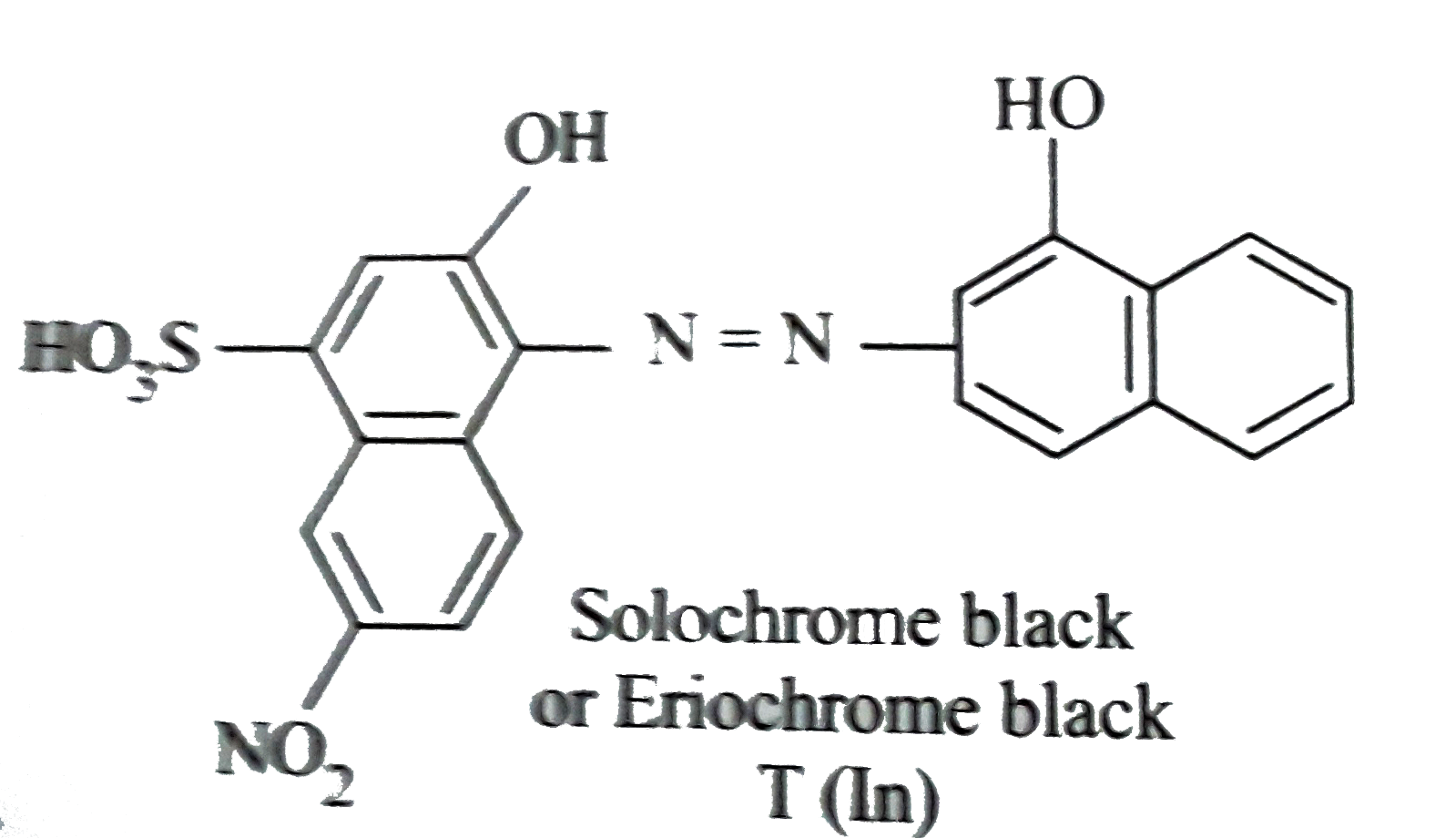 `underset("Wine red")(Mg-In)+ EDTA OVERSET(NH_(4)OH+NH_(4)CI)underset((pH=10))rarrMg-EDTA+underset("BLUE")(In)` |
|
| 8. |
Mg^(2+) is .......... Than Al^(3+) |
|
Answer» stronger Lewis acid |
|
| 9. |
M_((g)) to M_((g))^(+) + e^(-) , DeltaH=100 eV , M_((g)) to M_((g))^(2+) + 2e^(-) , DeltaH=250 eV Which is incorrect statement ? |
|
Answer» `I_1 of M_((G)) is 100 eV` |
|
| 10. |
Mg of a substance when vaporized occupy a volume of 5.6 litre at NTP. The molecular mass of the substance will be: |
|
Answer» M |
|
| 11. |
Mg is an important component of which bio molecule occuring extensively in living world? |
|
Answer» HAEMOGLOBIN |
|
| 12. |
Mg can reduce NO_(3)^(-) to NH_(3) in basic solution: NO_(3)^(-) + Mg_((s)) + H_(2)O rarr Mg (OH)_(2(s)) + OH_((aq.))^(-) + NH_(3(g)) A 25.0 mL sample of NO_(3)^(-) solution was treated with Mg. The NH_(3(g))was passed into 50mL to 0.15N HCl. The excessHCl required 32.10 mL of 0.10M NaOH for its neutralisation. What was the molarity of NO_(3)^(-) ions in the originalsample? |
|
Answer» |
|
| 13. |
Mg and Li are similar in their properties due to |
|
Answer» same e/m ratio |
|
| 14. |
Mg and Zn have following resemblance : |
|
Answer» MGO and ZnO are amphoteric C) Mg andZn are used as electrodes D) Both Mg and Zn used to prevend corrosion as they FORM oxide layer |
|
| 15. |
Mg and Li are similar in their properties due to..... |
|
Answer» same e/m and ratio. |
|
| 16. |
Methylene blue is an indicator widely used in acid-base titration, it is formed on mixing: |
|
Answer» `Na_(2)SO_(3)` |
|
| 17. |
Methylation of diborane gives [Me = methyl group] |
|
Answer» `B_2 (Me)_6` |
|
| 18. |
Methylation of diborane gives [Me = methyl group] |
|
Answer» `B_(2) (Me)_6` |
|
| 19. |
Methyl orange, an acid base indicator, is the sodium salt of an acid that contains C,H,N,S and oxygen. Quantitative analysis gave C = 51.4%, H = 4.3%, N = 12.8%, S = 9.8% and Na = 7.0%. What is the empirical formula of methyl orange? |
|
Answer» |
|
| 20. |
Methyl magnesium iodide reacts with ethyl alcohol to produce |
| Answer» Answer :B | |
| 21. |
Methyl group (CH_3 ) shows the following effect: |
|
Answer» Electromeric EFFECT |
|
| 22. |
Methyl chloride prepared by chlorination of methane is always contaminated with some ethane What is the source of ethane ? Explain. |
Answer» Solution :Chlorination of METHANE is a free radical reaction which occurs by the following MECHANISM :  From the above mechanism, it is EVIDENT that during PROPAGATION step, `oversetdot(CH_3)` free radicals are produced which may undergo three reactions , i.e. (i)-(iii). In the chain termination step , the two `oversetdot(CH_3)` free radicals combine together to FORM ethane `(CH_3-CH_3)` molecules . |
|
| 23. |
Methyl carbanion is................and...............with ammonia. |
|
Answer» |
|
| 24. |
Methyl benzoate is prepared by the reaction between benzoic acid and methanol, according to the equation C_(6)H_(5)COOH + CH_(3)OH rightarrow C_(6)H_(5)COOCH_(3) + H_(2)O In an experiment 24.4gm of benzoic acid were reacted with 70.0mL of CH_(3)OH. The density of CH_(3)OH is 0.79 g mL^(-1). The methyl benzoate produced had a mass of 21.6g. What is the percentage yeild of product? |
|
Answer» 0.917 |
|
| 25. |
Methyl benzoate can be prepared by |
|
Answer» `C_(6)H_(5)COOH + CH_(3)OH OVERSET(H^(+))RARR` |
|
| 26. |
Methyl alcohol is treated with conc.HI and red P. The main product obtained is |
|
Answer» <P>`CH_3OH` |
|
| 27. |
Methyl alcohol and acetone can be separated by : |
|
Answer» FRACTIONAL distillation |
|
| 28. |
Methyl acetate and propionic acid are |
|
Answer» FUNCTIONAL isomer |
|
| 29. |
Methoxy methane and ethanol are |
|
Answer» position ISOMERS |
|
| 30. |
Method of incineration is mostly applicable to |
| Answer» Solution :Dried leaves & bodies | |
| 31. |
Methlamine on treatment with nitrous acid gives |
|
Answer» Methyl alcohol |
|
| 32. |
Mething points are normally the highest for |
|
Answer» TERTIARY AMIDES |
|
| 33. |
Methanol is soluble in water due to |
|
Answer» COVALENT BOND nature |
|
| 34. |
Methanol + CO underset("Catalyst")overset(Rh)rarr X X in the above sequence is |
|
Answer» Ethanol |
|
| 35. |
Methanol cannot be dried with anhydrous CaCl_(2) because |
|
Answer» `CaCl_(2)` dissolves in it |
|
| 36. |
Factor hypothesis was proposed by ............. |
| Answer» SOLUTION :Berthlot | |
| 37. |
Methane undergoes slow atmospheric oxidation and produces carbonmonoxide. If 2xx10^(22) oxygen molecules are used in such oxidation, what weight of methane is consumed? |
|
Answer» Solution :Slow atmospheric oxidation of methane is given by the equation `2CH_(4)+3O_(2) to 2CO+4H_(2)O` 3 moles of `O_(2)="2 moles of "CH_(4)` `3 xx 6.022 xx 10^(23) O_(2)` molecules = The weight of `CH_(4)` consumed `(2 xx 16)"GRAMS of "CH_(4)` `2 xx 10^(22) O_(2)` molecules=? The weight of `CH_(4)` consumed `=(2 xx 10^(22) xx 32)/(3 xx 6.022 xx 10^(23))=0.354 G` |
|
| 38. |
Methane reacts with excess of chlorine is diffused sunlight to give the final product as |
|
Answer» Chloroform |
|
| 39. |
Methane molecule is .............. in shape with all bond angles equal to ............. |
| Answer» SOLUTION :TETRAHEDRAL `109^@ 28.` | |
| 40. |
Methane may be obtained from monochloromethane by |
|
Answer» REDUCTION with nascent hydrogen (Zn + HCl) |
|
| 41. |
Methane is tetrahedral but not square planner in nature, prove it. |
| Answer» Solution :On X-ray STUDY of methane the ANGLE among H-C-H is of `109.5^(@)` which PROVES that methane has tetrahedral SHAPE. | |
| 42. |
Methane is converted into faormaldehyde. What is the ratio of molecular weight to equivalent weight of Methane? |
|
Answer» EQ wt of `CH_(4)=("Mole wt of "CH_(4))/(4)` |
|
| 43. |
Methane gas producing field is |
|
Answer» Wheat field |
|
| 45. |
Methane can be converted into ethane by the reactions |
|
Answer» chlorination FOLLOWED by the reaction with ALCOHOLIC KOH |
|
| 46. |
Both methane and ethane can be prepared in one step from _________. |
| Answer» Answer :A | |
| 47. |
Metamers of this compounds is/are : |
|
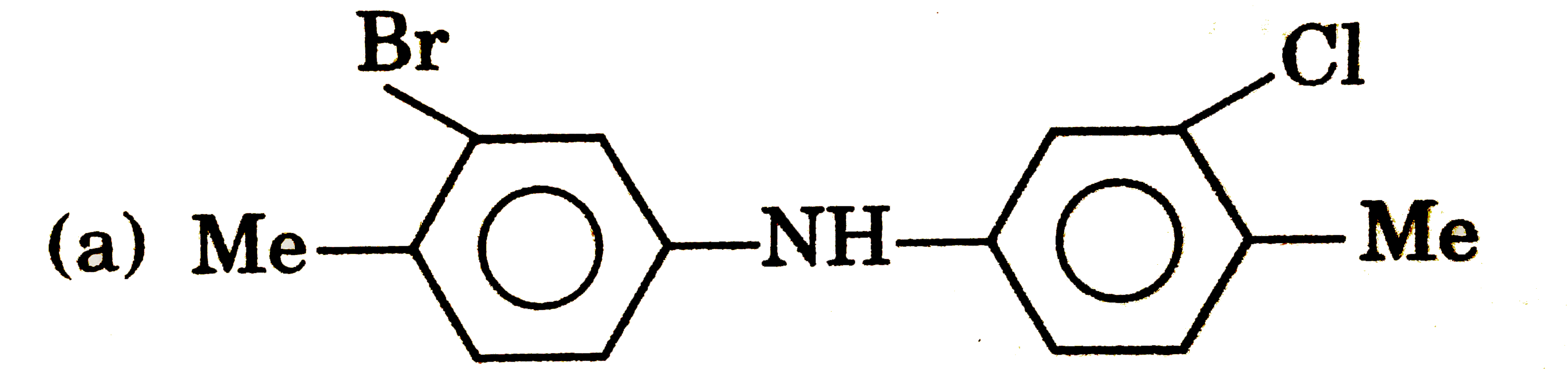
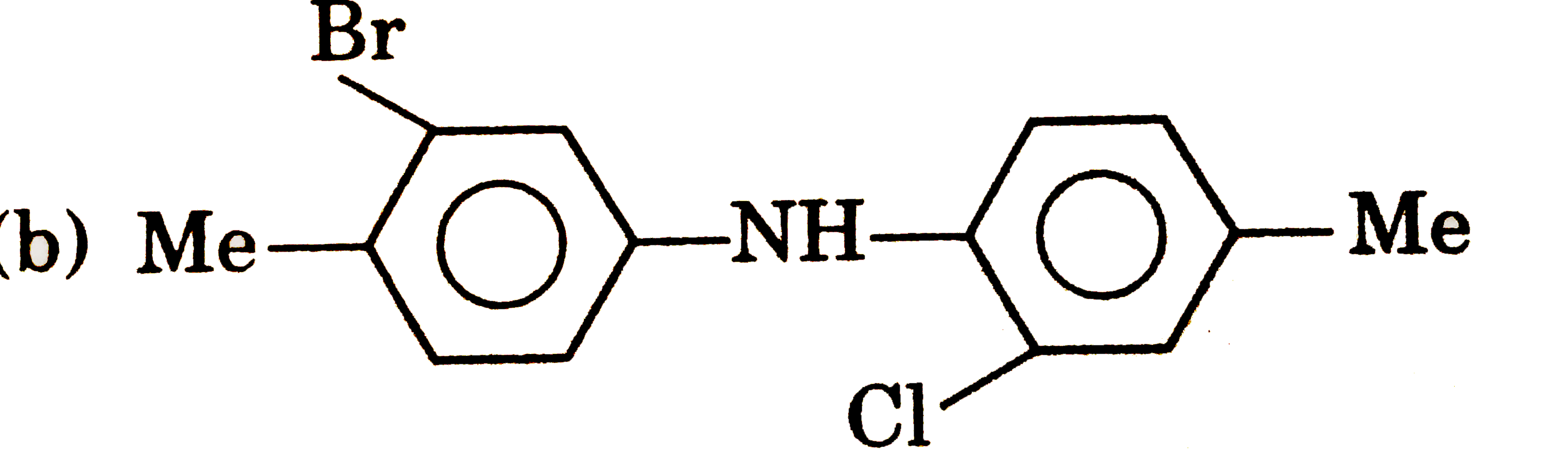
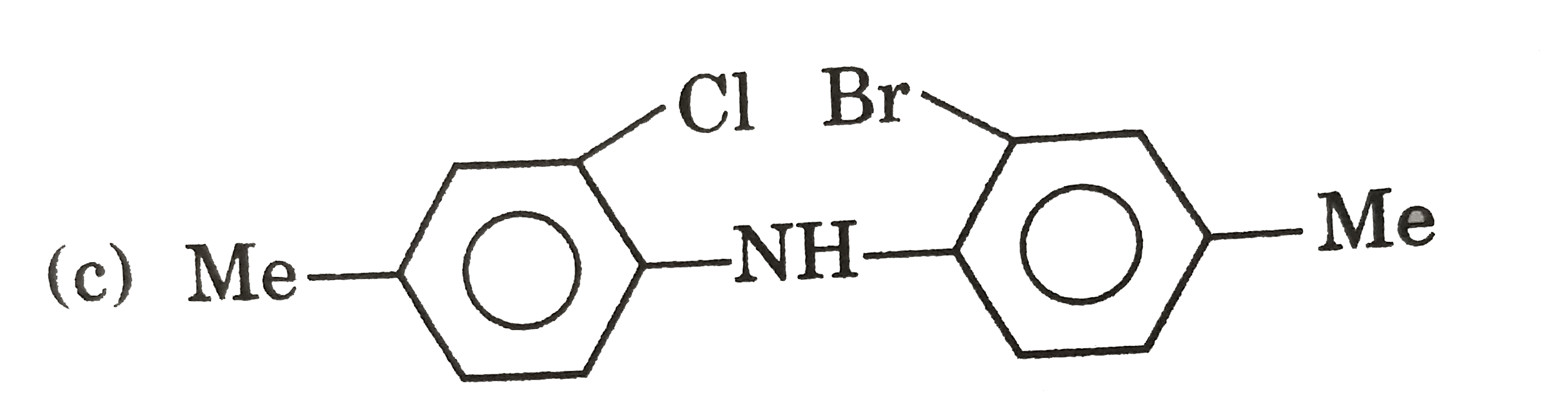
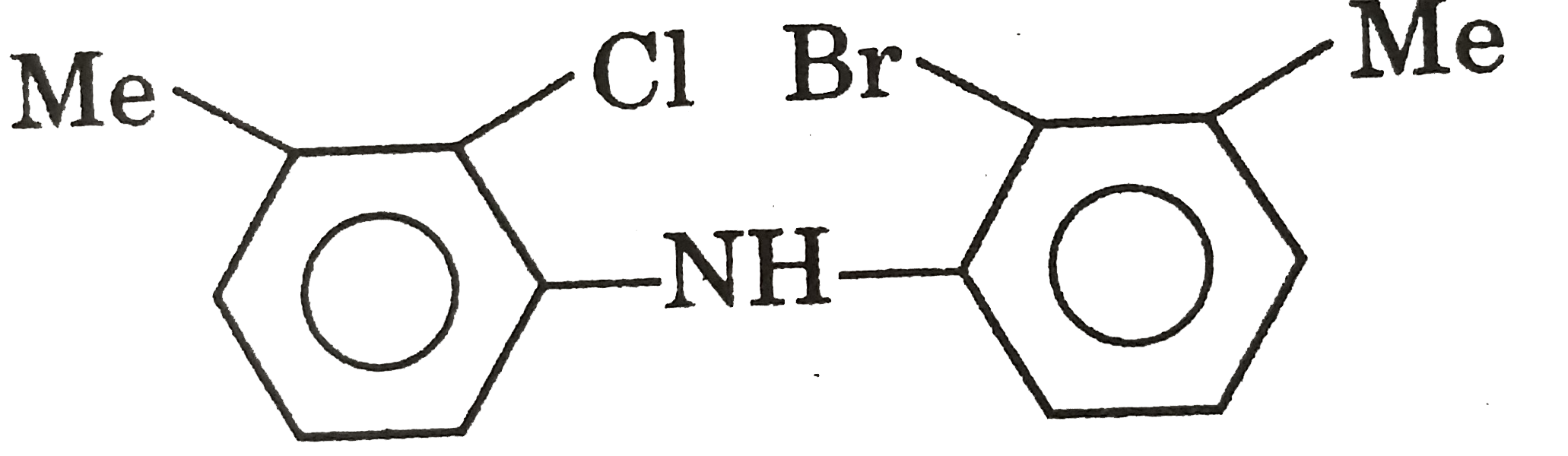
Answer»
|
|
| 48. |
Metamerism is exhibited by |
|
Answer» `C_2H_5COOC_2H_5` 
|
|
| 49. |
Metals that are passive by conc HNO_(3) are cr,zn,Al |
|
Answer» only 1 |
|