Saved Bookmarks
This section includes 7 InterviewSolutions, each offering curated multiple-choice questions to sharpen your Current Affairs knowledge and support exam preparation. Choose a topic below to get started.
| 1. |
Probability of finding an electron at the nodal surface is |
|
Answer» Unity |
|
| 2. |
Principle of crystallization method depends on |
|
Answer» Solubility difference |
|
| 3. |
Principal quantum number of the shell to which the g-subshell first arise is ______. |
|
Answer» |
|
| 4. |
Principal quantum number is related to |
|
Answer» Size of the ORBIT |
|
| 5. |
Principal, azimuthal and magnetic quantum numbers are respectively related to |
|
Answer» SIZE, ORIENTATION and SHAPE |
|
| 6. |
Primary, secondary and tertiary amines are |
|
Answer» Chain ISOMERS |
|
| 7. |
Primary and secondary alcohols on action of red hot copper give |
|
Answer» ALDEHYDES and ketones respectively `R_(2)CHOH underset(575K)overset(Cu)rarrR_(2)CO+H_(2)O` |
|
| 8. |
Primary alkyl halide react with aqueous NaOH follows ………………….. . |
| Answer» SOLUTION :`S_(N^2)` | |
| 9. |
Primary alcohols undergo which type of reaction to form alkenes? |
|
Answer» Elimination |
|
| 10. |
Primary alcohol can best changed to aldehyde by using the reagent |
|
Answer» pyridinium chlorochromate |
|
| 12. |
Pressure - Volume work involved in an isothermal compression is |
|
Answer» `-2.303nRTlog((V_(f))/(V_(i)))` |
|
| 13. |
Pressure remaining constant, at what temperature the volume of a gas will be double of its volume at 0^@C ? |
|
Answer» `100^@C` |
|
| 14. |
Pressure of Ig of an ideal gas A at 27^@C is found to be 2 bar. When 2g of another ideal gas B is introduced in the same flask at same temperature, the pressure becomes 3 bar, then M_B = ____ M_A |
|
Answer» <P> `P alpha N implies (n_A)/(n_B) = 2/1 , (1//M_A)/(2//M_B) implies (M_B)/(M_A) = 4`. |
|
| 15. |
Pressure of halogen in a compound is tested by: |
|
Answer» IODOFORM test |
|
| 16. |
Pressure of a mixture of 4 g of O_(2) and 2 g of H_(2) confined in a bulb of 1 litre at 0^(@)C is |
|
Answer» 25.15 atm Total N=`9//8" mol"` PV=nRT`"or"P=nRT//V` `=(9//8)xx(0.0821)(273)//1=25.215" atm"` |
|
| 17. |
Pressure of gas at 0^(@)C temperature is 2 atm and 10 L respectively then at which temperature pressure becomes 2.5 atm ? (Gay Lussac.s law) |
|
Answer» |
|
| 18. |
Pressure of Gas cylinder (LPG) is 14.9 bar that is safe but at 27^(@)C bar pressure apply then what temperature cylinder will blast ? |
|
Answer» |
|
| 19. |
Pressure of a gas increases when its temperature is increased at constant volume. This is because, with increase in temperature - |
|
Answer» collision FREQUENCY of the gas molecules increases. |
|
| 20. |
Pressure of 1 g of an ideal gas A at 27 ^(@)C is found to be 2 bar. When 2 g of another ideal gas B is introduced in the same flask at same temperature the pressure becomes 3 bar. Find a relationship between their molecular masses. |
|
Answer» SOLUTION :Suppose the molecular mass of the ideal gas A is MA and that of B is Me. When only the ideal gas A is PRESENT, `PV = nRT` `2xx V = 1/M_Axx RxxT (:. n = m/M =1/M) ...(i)` On mixing the TWO gases, total number of moles `=1/M_A+2/M_B` Hence, according to the gas EQUATION `PV = nRT` `3xxV=(1/M_A+2/M_B)xxRxxT... (ii)` Dividing eq. (ii) by eq. (i), we have `3/2 = ((M_B + 2M_A)/(M_A M_B))/(1/M_A)=(M_B+2M_A)/M_B =(1+2xxM_A)/M_B` or `2xxM_A/M_B = 3/2 - 1 = 1/2` or `M_A/M_B = 1/2 xx 1/2 = 1/4` or `M_B =4xxM_A` |
|
| 21. |
Pressure of 1 g of an ideal gas A at 27^(@)C is found to be 2 bar. When 2 g of another ideal gas B is introduced in the same flask at same temperature the pressure becomes 3 bar. Find a relationship between their molecular masses. |
|
Answer» Solution :Ideal gas A : Mass `(m_(1))=1 g` Pressure `p_(A)=2` bar Molecular mass `= M_(A)` Ideal gas B : Mass `(m_(2))=2g` Pressure `p_(B)=1` bar Molecular mass `= M_(B)` Temperature T and volume V of both gases are same Total pressure `p_(A)+p_(B)=3` bar `therefore p_(B)=3` bar `- p_(A)` = 3 bar - 2 bar = 1 bar Mole `(n_(A))=(1g)/(M_(A))` and Mole `(n_(B))=(2g)/(M_(B))` Total mole `= (n_(A)+n_(B))=(1)/(M_(A))+(2)/(M_(B))` `pV=nRT` `pV=(m)/(M)RT` `therefore p=(m)/(M)((RT)/(V))` `therefore p_(A)=(m_(A))/(M_(A))((RT)/(V))""`.....(i) `therefore p_(B)=(m_(B))/(M_(B))((RT)/(V)) ""`.....(II) where, `(RT)/(V)=` constasnt (`because` R constant and T, V are not changed) Now RATIO of (i) and (ii) as under so, `(p_(A))/(p_(B))=(m_(A))/(M_(A))xx(M_(B))/(m_(B))` `therefore ("2 bar")/("1 bar")=(1g xx M_(B))/(M_(A)xx 2g)` `therefore (M_(B))/(M_(A))=(2xx2)/(1xx1)=4 "so " M_(B)=4M_(A)` |
|
| 22. |
Pressure of 1 g of an ideal gas A 27^(@)C is found to be 2 bar. When 2 g of another ideal gas B is introduced in the same flask at same temperature, the pressure becomes 3 bar. Find the relationship between their molecular masses. |
|
Answer» Solution :Suppose molecular MASSES of A and B `M_(A)` and `M_(B)` respectively. Then their number of moles will be `m_(A)=(1)/(M_(A)),""n_(B)=(2)/(M_(B))` `P_(A)=2"BAR", P_(A)+P_(B)=3"bar",i.e.,P_(B)=1"bar"` Applying the relation, PV=nRT `P_(A)V=n_(A)RT,P_(B)V=n_(B)RT` `:."" (P_(A))/(P_(B))=(n_(A))/(n_(B))=(1//M_(A))/(2//M_(B))=(M_(B))/(2M_(A))` `"or" (M_(B))/(M_(A))=2XX(P_(A))/(P_(B))=2xx(2)/(1)=4"" or "" M_(B)=4M_(A)`. |
|
| 23. |
Pressure is determined as force per unit area of the surface. The SI unit of pressure, pascal is as shown below : 1 Pa = 1 Nm^(-2) . If mass of air at sea level is 1034 g cm^(-2), calculate the pressure in pascal. |
|
Answer» Solution :Pressure is the force (i.e., weight) PER unit area. Weight of air at SEA level = m.g = `1.034 xx 9.8 =10.1332 KG ms^(-2), (therefore m =1034 g = 1.034 kg, g = 9.8 ms^(-2)`) `therefore` Pressure `=("Weight")/("area") = (10.1332 kg ms^(-2))/(10^(-4) m^(2)) = 101332 kg m^(-1) s^(-2)` `therefore` 1 Pascal `=1 Nm^(-2) =(1N)/m^(2) = (1 kg ms^(-2))/m^(2) = 1 kg m^(-1) s^(-2)` `therefore` Pressure of air `=101332 kg m^(-1)s^(-2) = 101332 Pa = 1.01332 xx 10^(5)` Pa |
|
| 24. |
Pressure is determined as force per unit area of the surface. The SI unit of pressure, pascal is as shownbelow : 1Pa = 1N m^(-2) If mass of air at sea level is 1034 g cm^(-2), calculate the pressure in pascal. |
|
Answer» `P=("Force")/("Area")=(1034g XX 9.8ms^(-2))/(cm^(2))` `=(1034 kg xx 100 xx 100 xx9.8 ms^(-2))/(1000m^(2))` `= 101332.0Nm^(-2) = 1.01332 xx 10^(5)Pa` |
|
| 25. |
Pressure exerted by saturated water vapour is called aqueous tension. What correction tern will you apply to the total pressure to obtain pressure of dry gas ? |
|
Answer» Solution :WHENEVER a GAS is collected over water, it is saturated and moistured with water vapoures which possesses their own pressure. The pressure due to water vapours is known as aqueous tension thus, the TOTAL pressure of the gas (P moisdt gas) is `P_("MOIST gas")=P_("dry gas")+` aqueous tension Thus, `P_("dry gas")` is given as `P_("dry gas")=P_("moist gas")-` aqueous tension Hence, the correction term applied to the total pressure of the gas in order to OBTAIN pressure of dry gas is p moist gas - aqueous tension. |
|
| 26. |
Pressure exerted by saturated water vapour is called aqueous tension. What correction term will you apply to the total pressure to obtain pressure of dry gas ? |
|
Answer» <P> Solution :`P_("dry GAS")=P_("moist gas")` (i.e., total PRESSURE)-AQUEOUS tension. |
|
| 27. |
Pressure exerted by 2 grams of helium present in a vessel is 1.5 atm. If 4 grams of gas 'x' is introduced into the same vessel keeping the condition constant, the pressure is 2.25 atm Gas 'x' is |
|
Answer» hydrogen |
|
| 28. |
Presence of which of the following compounds make water hard. Na_(2)SO_(4),Ca(HCO_(3))_(2),MgCl_(2),Na_(2)CO_(3),CaSO_(4),KCl , NaHCO_(3),MgSO_(3),CaCl_(3) |
|
Answer» |
|
| 29. |
Present a comparative account of the alkali and alkaline earth metals with respect to the following characteristics : (i) Tendency to form ionic/covalent compounds (ii) Nature of oxides and their solubility in water (iii) Formation of oxosalts (iv) Solubility of oxosalts (v) Thermal stability ofoxosalts . |
Answer» SOLUTION :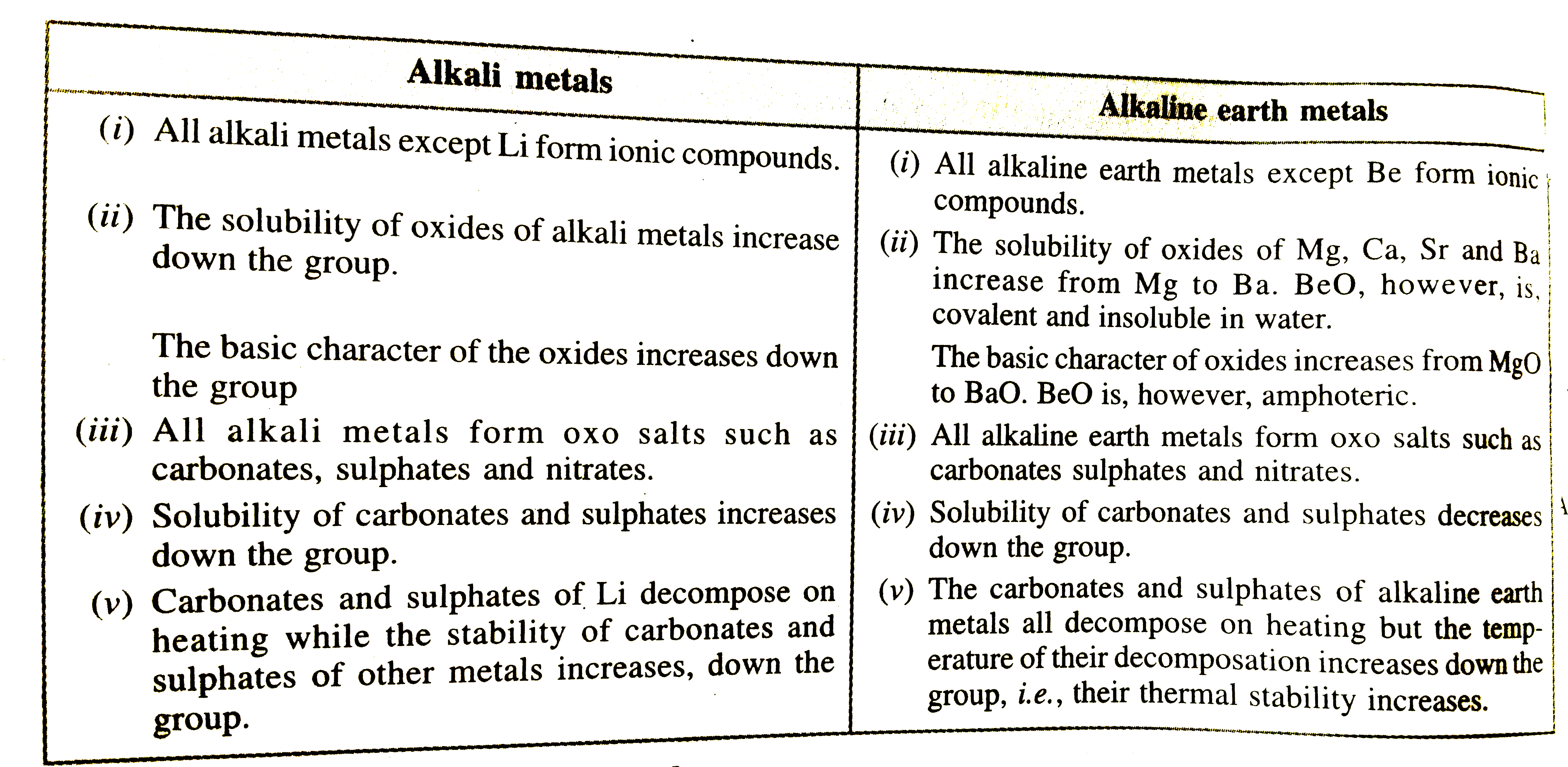
|
|
| 30. |
Present a comparative account of the alkali and alkaline earth metals with respect to the following characteristics : (a) Tendency to form ionic/covalent compounds.(b) Nature of oxides and their solubility in water. (C) Formation of oxosalts (d) Solubility of oxosalts (e) Thermal stability of oxosalts |
|
Answer» Solution : (a) ALKALINE EARTH metals give ionic compounds but these compounds are less ionic than alkali metals because of more effective nuclear CHARGE and small size. (b) Oxides of alkaline earth metals are less basic than the oxides of alkali metals. These oxides are WATER soluble and the reactions are highly exothermic. Hydroxides of alkaline earth metals are less basic than hydroxides of alkali metals. (c) Alkaline earth metals give oxo salts with oxoacids but reactivity of alkali metals is faster. The reactivity of alkaline earth metals is less due to small size and more nuclear charge. (d) Oxosalts of alkaline earth metals are more soluble than oxosalts of alkali metals because of small size of cation and high hydration enthalpy. (e) Thermal stability of oxosalts of alkali metals is more than oxosalts of alkaline earth metals. `Na_(2)CO_(3)`is stable towards heat but `MgCO_(3)` on heating is decomposed into MgO and `CO_(2)`. |
|
| 31. |
Presence of water is avoided in the preparation of H_(2)O_(2) from Na_(2)O_(2). Explain. |
| Answer» Solution :`Na_(2)O_(2)` reacts with WATER to formNaOH. The reaction is EXOTHERMIC and the heat evolved CAUSES the decomposition of `H_(2)O_(2)`. | |
| 32. |
Presence of which cation makes the water hard in nature? |
|
Answer» CA & Mg |
|
| 33. |
Presence of unsaturation in organic compounds can be tested with |
|
Answer» FEHLING's REAGENT |
|
| 34. |
Presence of water can be detected by |
|
Answer» ADDING a drop to anhydrous copper sulphate which changes its colour from white to blue `underset("(anhydrous, white)")(CuSO_(4))+5H_(2)O to underset("(hydrated, blue)")(CuSO_(4).5H_(2)O)` |
|
| 35. |
Presence of chiral carbon in organic compound is neither a necessary not a sufficient condition for showing optical activity. The chirality, i.e., dissmmetry of a molecule as a whole is the necessary condition foroptical activity.Which one of the following is achiral molecule? |
|
Answer»

|
|
| 36. |
Presence of chiral carbon in organic compound is neither a necessary not a sufficient condition for showing optical activity. The chirality, i.e., dissmmetry of a molecule as a whole is the necessary condition foroptical activity.Which of these compounds will NOT show optical activity? |
|
Answer» `CH_3 - CHCOH - CH_2 - CH_3` 
|
|
| 37. |
Presence of a nitro group in a benzene ring |
|
Answer» ACTIVATES the RING towards ELECTROPHILIC substitution |
|
| 38. |
Prepare the following product from methane (i) Methyl chloride (ii) Carbon black (iii) Carbon monoxide (iv) Methanol (v) Methanal (vi) carbonmonoxide (vii) dihydrogen (viii) Methyl iodide (ix) Methyl bromide |
Answer» SOLUTION :
|
|
| 39. |
Prepare propyne form its corresponding alkene |
|
Answer» Solution :PREPARATIONOF propynefrompropane : <BR> `CH_(3) - CH = CH_(2) + Br_(2) to CH_(3) - underset( Br) underset( |) (CH ) - underset( Br) underset(|) (CH_(3))` `CH_(3) -CH= CHunderset( Na Br) OVERSET(NaNH) (to)CH_(3)- underset(Br) underset(|) (C ) = CH_(2)` (2-Bromopropene ) |
|
| 40. |
Prepare alkene from alkylhalide (dehydrohalogenation). Explain its detail. |
|
Answer» Solution :Preparation : Alkyl halide (RX) heated with potassium hydroxide is dissolued in ethanol liquid) gives, `beta`-elimination REACTION. Form of Reaction : In these reaction, from alkyl halide, halide releases in the form of ACID and alkene is formed, these is known as elimination reaction. Halogen and hydrogen is removed form `beta`-carbon and HX is released. Therefore the reaction is CALLED `beta`-elimination of alky halide. general reaction :   Rate of reaction : (i) Rate of reaction depends on the NATURE of halogen `I gt Br gt Cl`. (ii) Rate of reaction also depends on alkyl groups. Series of alkyl rate of reaction. `3^(@) gt 2^(@)1^(@)`. |
|
| 41. |
Preparation of methyl chlooride is followed by ……………….mechanism |
| Answer» SOLUTION :Freeradical | |
| 42. |
Preparation of Cl_2from HCl and MnO_2involves the process of: |
|
Answer» OXIDATION of `MnO_2` |
|
| 43. |
Preparation of alkene by hydrogenation explain with example. |
Answer» Solution :(a) Hydrogenation of alkyne forming "Cis ALKENE". General reaction :  Process : (i) As per requirement of alkene, number of hydrogens are TAKEN accordingly. (ii) Lindlar.s catalyst is used as catalyst. (iii) palladised charcoal partially DEACTIVATED with poisons like sulphur compounds or quinoline. Partially deactivated palladised charcoal is known as lindlar.s catalyst. (b) Partial hydrogenation of alkyne forming trans alkene (Birch Reduction). `underset("Alkyne")(RC-=CR.+H_(2)) underset("Partial reduction")overset("Na/liquid "NH_(3))rarr`  Preparation : (i) For the preparation of alkene, counted number of dihydrogens are used. (ii) This reaction is done with liquid ammonia and sodium metal. (iii) Reaction between`(Na+NH_(3))` with `H_(2)`, there is PARTICLE reduction. "Trans - alkane" is formed as product. (c) Low carbon oxyne reduced to alkene by lindlar.s catalyst. EG.-(i) : `underset("Ethyne")(CH-=CH+H_(2))overset(Pd//C)rarr underset("Ethen")(CH_(2)=CH_(2))` Eg.-(ii) : `underset("Propyne")(CH_(3)C-=CH+H_(2))overset(Pd//C)rarr underset("Propene")(CH_(3)CH=CH_(2))` |
|
| 44. |
Prefix ‘alkali’ for alkali metals denotes |
|
Answer» Silvery lustre |
|
| 45. |
Preduct that anhyrous AICI_(3) is covalent form the data given below, ionisation enegry for AI = 51.37 kJ mol^(-1), Delta_(hyd) H for AI^(3+) =- 4665 kJ "mole"^(-1), Delta_(hyd)H for CI^(Theta) =- 381 kJ mol^(-1)) |
| Answer» SOLUTION :The total hydration enegry of `AI^(3+)` and `3CI^(Theta)` IONS is `DeltaH_(hyd) ={-4665 +3(-381)} kJ mol^(-1) = - 5808 kJ mol^(-1)` The enegry RELEASED is more than that required for the ionisation of `AI` to `AI^(3+)` (which is `-4665 kJ mol^(-1))` causing ionisation of `AICI_(3)` solution. Thus, the compound `AICI_(3)` BECOMES ionic in aqueous solution. | |
| 46. |
Prediction of amount of products and reactants on the base of vale of equilibrium constant of the following reactions at constant temperature.(a)H_(2(g)) hArr 2HI_((g)) , K_c=57.0 (b)N_2O_(4(g)) hArr 2NO_(2(g)), K_c=4.64xx10^(-3) (c)N_(2(g)) + O_(2(g)) hArr 2NO_((g)) , K_c=4.8xx10^(-31) (d) H_(2(g)) + Cl_(2(g)) hArr 2HCl_((g)) , K_c=4.0xx10^31 |
|
Answer» Solution :Reaction (a) : The value of `K_c` is between `10^(-3)` to `10^3` [Products] `GT` [Reactants] because `K_c gt1`. Reaction (b) : The value of `K_c` is between `10^(-3)` to `10^(+3)` So, [Products] `LT`[REACTANT] because `K_c lt 1`. Reaction (c): The value of `K_c` is very less. So, the amount of PRODUCT at equilibrium is nigligible. Reaction (d) : `K_c` is much HIGH, So, only mainly products present at equilibrium. |
|
| 47. |
Predict which of the following will have appreciable concentration of reactions and produst: (a) Cl_(2)(g) hArr 2Cl (g),K_(c)=5 xx 10^(-39) (b) Cl_(2)(g)+2NO(g) hArr 2NOCl(g) : K_(c) = 3.7 xx 108 (c) Cl_(2)(g)+2NO_(2)Cl(g),K_(c)=1.8 |
|
Answer» SOLUTION :Following CONCLUSION can be drawn from the values of `K_(c)` Since the value of `K_c` is very small, this means that the molar CONCENTRATION of the products is very small as compared to that of the reactants. (b) Since the value of `K_C` is quite large, this means that the molar concentration of the products is very large as compared to that of the reactants. (c) Since the value of `K_C` is 1.8, this means that both the products and reactants have APPRECIABLE concentrations. |
|
| 48. |
Predict X in above reaction |
|
Answer»
|
|
| 49. |
Predict which out of the following molecules will have higher diple moment and why ? CS_(2) and OCS |
|
Answer» Solution :`Soverset(larr)=Coverset(rarr)(=S)and Ooverset(larr)=Coverset(rarr)(=S)` , bond are linear MOLECULES but bond moments in `CS_(2)` cancel out so that NET dipole MOMENT = 0 . But in OCS, bond MOMENTOF C = O is not equal to that of C = S . Hence , it has a net dipole moment. THUS , dipole moment of OCS is higher. |
|
| 50. |
Predict which of the following reaction will have appreciable concentration of reactants and products ? (i) Cl_(2(g))hArr2Cl_((g)),K_(c)=5xx10^(-39) (ii) Cl_(2(g))+2NO_((g))hArr2NOCl_((g)),K_(c)=3.7xx10^(-8) (iii) Cl_(2(g))+2NO_(2(g))hArr2NO_(2)Cl_((g)),K_(c)=1.8 |
| Answer» Solution :The REACTION (iii) has an APPRECIABLE concentration of reactants and products because its `K_(c)` is NEITHER too low nor very high. | |