

Saved Bookmarks
This section includes 7 InterviewSolutions, each offering curated multiple-choice questions to sharpen your Current Affairs knowledge and support exam preparation. Choose a topic below to get started.
| 1. |
Write the IUPAC name for the following compoundH_(3)C-underset(CH_(3))overset(CH_(3))overset(|)underset(|)(C)-CH_(3) |
|
Answer» SOLUTION :IUPAC NAMES 2, 2 - dimethy lpropane |
|
| 2. |
What is entropy? |
| Answer» SOLUTION :ENTROPY is a MEASUREOF RANDOMNESS of a SYSTEM. | |
| 3. |
Which of the following substituents has +M (Mesomeric) effect ? |
| Answer» SOLUTION :`-NR_2 , - NH_2 , - NHR`groups are +M groups. | |
| 4. |
Calculate the bond orderof O_2 molecule. |
| Answer» SOLUTION :BOND ORDER = `(N_b-N_a)/2`=(10-6)/2=2 `O_2` is PARAMAGNETIC | |
| 5. |
What is the difference in the origin of cathode rays and anode rays ? |
| Answer» SOLUTION :Cathode rays ORIGINATE from the cathode whereas anode rays are not PRODUCED from the anode. They are produced from the gaseous ATOMS by knock out of the electrons by high speed cathode rays. | |
| 6. |
Which one of the following alkali metals is highly reactive with water? |
|
Answer» Li |
|
| 7. |
Write in brief about reaction steps of sulphonation reaction of benzene ORsulphonation mechanism. |
|
Answer» Solution :(a) Steps involved the formation of electrophilic `SO_(3)`. `2H_(2)SO_(4) hArr SO_(3) + 2HSO_(4)^(-) + 2H_(3)O^(+)` (B) Slow step which involved formation of UNSTABLE `sigma` complex (CARBOCATION) in which attachment of electrophilic group.  (c) INTERMEDIATE `sigma`-complex quickly donate proton `(H^(+))`, to the `HSO_(4)^(-)` and form benzene sulphonate ionsl which obtain proton from the `H_(3)O^(+)` and form benzene sulphonic ACID. |
|
| 8. |
The species present in solution when CO_(2), is dissolved in water are: |
|
Answer» `CO_(2),H_(2)CO_(3),HCIO_(3)^(-),CO_(3)^(2-)` |
|
| 9. |
Which of the following does not show geometrical isomerism? |
|
Answer» 1,2 - dichloro-1-penten |
|
| 11. |
Which of the following hydrides is electron-precise hydride ? |
|
Answer» `B_(2)H_(6)` |
|
| 12. |
Which ot the following is the most stable from of the compound formed id 'F" is replaced by 'I"? |
|
Answer» Eclipsed |
|
| 13. |
When an atom or an ion is missing from its normal lattice site, a lattice vacancy (Schottky defect) is created. In stoichimetric ionic crystals, a vacancy of one ion has to be accompanied by the vacancy of the oppositely charged ion in order to maintain electrical neutrality. In a Frenkel defect an ion leaves its position in the lattice and occupies an interstitial void. This is the Frenkel defect commonly found along with the Schottky defects and interstitials. In pure alkali halides, Frenkel defects are not found since the ions cannot get into the interstitial sites. Frenkel defects are found in silver halides because of the small size of the Ag^(+)ion. Unlike Schottky defects, Frenkel defects do not change the denstiy of the solids. In certain ionic solids (e.q. AgBr) both Schottky and Frenkel defects occur. The defects discussed above do not disturb the stoichiometry of the crystalline material. There is large variety of non-stoichiomertic inorganic solids which contain an excess or deficiency of one of the elements. Such solids showing deviations from the ideal stoichiometric composition from an inmportant group of solids. For example in the vanadium oxide, VO_(x), x can be anywhere between 0.6 and 1.3. There are solids which are difficult to prepare in the stoichiometric composition. Thus, the ideal composition in compounds such as FeO is difficult to obtain (normally we get a composition of Fe_(0.95)O but it may range from Fe_(0.93)O " to " Fe_(0.96)O). Non-stoichiometric behaviour is most commonly found for transition metal compounds though is also known for some lanthanoids and actinoids. Zinc oxide loses oxygen reversibly at high temperature and turns yellow in colour. The excess metal is accommodated interstitially, giving rise to electrons trapped in the neighbourhood. The enhanced electrical conductivity of the non-stoichiometric ZnO arises from these electrons.ltrbgt Anion vacancies in alkali halides are produced by heating the alkali halide crystals in an atmosphere of the alkali metal vapur. When the metal atoms deposit on the surface they diffuse into the crystal and after ionisation the alkali metal ion occupies cationic vacancy whereas electron occupies anionic vacancy. Electrons trapped in anion vacancies are referred to as F-centers (from Farbe the German word for colour) that given rise to interesting colour in alkali halides. Thus, the excess of potassium in KCl makes the crytal appear violet and the excess of lithium in LiCl makes it pink. AgCl is crystallized from molten AgCl containing a little CdCl_(2). The solid obtained will have |
|
Answer» CATIONIC vacancies EQUAL to number of `Cd^(2+)` IONS incorporated |
|
| 14. |
When an atom or an ion is missing from its normal lattice site, a lattice vacancy (Schottky defect) is created. In stoichimetric ionic crystals, a vacancy of one ion has to be accompanied by the vacancy of the oppositely charged ion in order to maintain electrical neutrality. In a Frenkel defect an ion leaves its position in the lattice and occupies an interstitial void. This is the Frenkel defect commonly found along with the Schottky defects and interstitials. In pure alkali halides, Frenkel defects are not found since the ions cannot get into the interstitial sites. Frenkel defects are found in silver halides because of the small size of the Ag^(+)ion. Unlike Schottky defects, Frenkel defects do not change the denstiy of the solids. In certain ionic solids (e.q. AgBr) both Schottky and Frenkel defects occur. The defects discussed above do not disturb the stoichiometry of the crystalline material. There is large variety of non-stoichiomertic inorganic solids which contain an excess or deficiency of one of the elements. Such solids showing deviations from the ideal stoichiometric composition from an inmportant group of solids. For example in the vanadium oxide, VO_(x), x can be anywhere between 0.6 and 1.3. There are solids which are difficult to prepare in the stoichiometric composition. Thus, the ideal composition in compounds such as FeO is difficult to obtain (normally we get a composition of Fe_(0.95)O but it may range from Fe_(0.93)O " to " Fe_(0.96)O). Non-stoichiometric behaviour is most commonly found for transition metal compounds though is also known for some lanthanoids and actinoids. Zinc oxide loses oxygen reversibly at high temperature and turns yellow in colour. The excess metal is accommodated interstitially, giving rise to electrons trapped in the neighbourhood. The enhanced electrical conductivity of the non-stoichiometric ZnO arises from these electrons.ltrbgt Anion vacancies in alkali halides are produced by heating the alkali halide crystals in an atmosphere of the alkali metal vapur. When the metal atoms deposit on the surface they diffuse into the crystal and after ionisation the alkali metal ion occupies cationic vacancy whereas electron occupies anionic vacancy. Electrons trapped in anion vacancies are referred to as F-centers (from Farbe the German word for colour) that given rise to interesting colour in alkali halides. Thus, the excess of potassium in KCl makes the crytal appear violet and the excess of lithium in LiCl makes it pink. Stongly heated ZnO crystal can conduct electricity. This is due to |
|
Answer» Movement of extra `ZN^(2+)` ions present in the interstitial sites |
|
| 15. |
When an atom or an ion is missing from its normal lattice site, a lattice vacancy (Schottky defect) is created. In stoichimetric ionic crystals, a vacancy of one ion has to be accompanied by the vacancy of the oppositely charged ion in order to maintain electrical neutrality. In a Frenkel defect an ion leaves its position in the lattice and occupies an interstitial void. This is the Frenkel defect commonly found along with the Schottky defects and interstitials. In pure alkali halides, Frenkel defects are not found since the ions cannot get into the interstitial sites. Frenkel defects are found in silver halides because of the small size of the Ag^(+)ion. Unlike Schottky defects, Frenkel defects do not change the denstiy of the solids. In certain ionic solids (e.q. AgBr) both Schottky and Frenkel defects occur. The defects discussed above do not disturb the stoichiometry of the crystalline material. There is large variety of non-stoichiomertic inorganic solids which contain an excess or deficiency of one of the elements. Such solids showing deviations from the ideal stoichiometric composition from an inmportant group of solids. For example in the vanadium oxide, VO_(x), x can be anywhere between 0.6 and 1.3. There are solids which are difficult to prepare in the stoichiometric composition. Thus, the ideal composition in compounds such as FeO is difficult to obtain (normally we get a composition of Fe_(0.95)O but it may range from Fe_(0.93)O " to " Fe_(0.96)O). Non-stoichiometric behaviour is most commonly found for transition metal compounds though is also known for some lanthanoids and actinoids. Zinc oxide loses oxygen reversibly at high temperature and turns yellow in colour. The excess metal is accommodated interstitially, giving rise to electrons trapped in the neighbourhood. The enhanced electrical conductivity of the non-stoichiometric ZnO arises from these electrons.ltrbgt Anion vacancies in alkali halides are produced by heating the alkali halide crystals in an atmosphere of the alkali metal vapur. When the metal atoms deposit on the surface they diffuse into the crystal and after ionisation the alkali metal ion occupies cationic vacancy whereas electron occupies anionic vacancy. Electrons trapped in anion vacancies are referred to as F-centers (from Farbe the German word for colour) that given rise to interesting colour in alkali halides. Thus, the excess of potassium in KCl makes the crytal appear violet and the excess of lithium in LiCl makes it pink. Which of the following is most appropriate crystal to show Frenkel defect |
|
Answer» CsCl |
|
| 16. |
When an atom or an ion is missing from its normal lattice site, a lattice vacancy (Schottky defect) is created. In stoichimetric ionic crystals, a vacancy of one ion has to be accompanied by the vacancy of the oppositely charged ion in order to maintain electrical neutrality. In a Frenkel defect an ion leaves its position in the lattice and occupies an interstitial void. This is the Frenkel defect commonly found along with the Schottky defects and interstitials. In pure alkali halides, Frenkel defects are not found since the ions cannot get into the interstitial sites. Frenkel defects are found in silver halides because of the small size of the Ag^(+)ion. Unlike Schottky defects, Frenkel defects do not change the denstiy of the solids. In certain ionic solids (e.q. AgBr) both Schottky and Frenkel defects occur. The defects discussed above do not disturb the stoichiometry of the crystalline material. There is large variety of non-stoichiomertic inorganic solids which contain an excess or deficiency of one of the elements. Such solids showing deviations from the ideal stoichiometric composition from an inmportant group of solids. For example in the vanadium oxide, VO_(x), x can be anywhere between 0.6 and 1.3. There are solids which are difficult to prepare in the stoichiometric composition. Thus, the ideal composition in compounds such as FeO is difficult to obtain (normally we get a composition of Fe_(0.95)O but it may range from Fe_(0.93)O " to " Fe_(0.96)O). Non-stoichiometric behaviour is most commonly found for transition metal compounds though is also known for some lanthanoids and actinoids. Zinc oxide loses oxygen reversibly at high temperature and turns yellow in colour. The excess metal is accommodated interstitially, giving rise to electrons trapped in the neighbourhood. The enhanced electrical conductivity of the non-stoichiometric ZnO arises from these electrons.ltrbgt Anion vacancies in alkali halides are produced by heating the alkali halide crystals in an atmosphere of the alkali metal vapur. When the metal atoms deposit on the surface they diffuse into the crystal and after ionisation the alkali metal ion occupies cationic vacancy whereas electron occupies anionic vacancy. Electrons trapped in anion vacancies are referred to as F-centers (from Farbe the German word for colour) that given rise to interesting colour in alkali halides. Thus, the excess of potassium in KCl makes the crytal appear violet and the excess of lithium in LiCl makes it pink. When LiCl is heated into the vapour of lithium, the crystal acquires pink colour. This is due to |
|
Answer» Schottkty defects |
|
| 17. |
Which of the following is responsible for asthmatic attacks ? |
|
Answer» INHALATION of pollen |
|
| 18. |
Write the general valence shell electronic configuration of group 14 elements. |
| Answer» SOLUTION :`ns^2 np^2` | |
| 19. |
Which of the following are functional isomers of methyl ethanoate ? |
|
Answer» `CH_(3)-CH_(2)-COOH` |
|
| 20. |
Three students, Manish Ramesh and Rajni were determining the extra elements present in an organic compound given by their teacher. They prepared the Lassaigne's extract (L.E.) independently by the fusion of the compound with sodium metal. Then they added solid FeSO_(4) and dilute sulphuric acid to a part of Lassaigne's extract. Manish and Rajni obtained prussian blue colour but Ramesh got red colour. Ramesh repeated the test with the same Lassaigne's extract, but again got red colour only. They were surprised and went to their teacher and told him about their observation. Teacherasked them to think over the reason for this. Can you help them by giving the reason for this. observation. Also, write the chemical equations to explain the formation of compounds of different colours. |
|
Answer» Solution :If the organic compound contains both N and S, then during fusion it may form either sodium thiocyanate (NaSCN) or a mixture of sodium cyanide (NaCN) and sodium SULPHIDE `(Na_(2)S)` depending upon the amount of sodium metal used. If the sodium metal used. If the sodium metal used is less, only NaSCN is produced. This then reacts with `Fe^(3+)` ions (produced by oxidation of `Fe^(2+)` ion during preparation of Lassaigne's extract) to give red colouration due to the FORMATION of ferric thiocyanate. `Fe^(2+) overset("AERIAL oxidation")RARR Fe^(3+), Fe^(3+) + 3NaSCN rarr underset("(Red colouration)")underset("Ferric thiocyanate")(Fe(SCN)_(3))+3Na^(+)` However, if excess of sodium metal is used, the initially formed sodium thiocyanate decomposes to form a mixture of sodium cyanide and sodium sulphide. `underset("Sod. thiocyanate")(NaSCN)+2Naoverset(Delta)rarr underset("Sod. cyanide")(NaCN)+underset("Sod. sulphide")(Na_(2)S)` NaCN thus formed then reacts with `FeSO_(4)`, more NaCN and `Fe^(3+)` ions to give ultimately prussian blue colour due to the formation of ferric ferocyanide or IRON (III) hexacyanoferrrate (II). `2NaCN + FeSO_(4) rarr Na_(2)SO_(4) + Fe(CN)_(2)` `Fe(CN)_(2) + 4NaCN rarr underset("Sod. hexacyanoferrate (II)")(Na_(4)[Fe(CN)_(6)])` `3Na_(4)[Fe(CN)_(6)]+4 Fe^(3+) rarrunderset("(Prussian blue)")underset("Iron (III) hexacyanoferrate (II)")(Fe_(4)[Fe(CN)_(6)]_(3)+12 Na^(+)` From the above discussion, it follows that Manish and Rajni used excess sodium and hence formed NaCN in the Lassaigne's extract which gave prussian blue colour due to the formation of iron (III) hexacyanoferrate (II) while Ramesh used less sodium and hence formed NaSCN in the Lassaigne's extract which gave red colouration due to the formation of ferric thiocyanate. |
|
| 21. |
The stability of +1 oxidation state among Al, Ga, In and Tl increases in the sequence |
|
Answer» `TI LT In lt GaltAI` |
|
| 22. |
What products are obtained when magnesite dissolved is desolved in hot dilute H_(2)SO_(4) |
|
Answer» `MgSO_(4),H_(2)O,CO_(2)` |
|
| 23. |
The structure of product( R ) is |
|
Answer»

|
|
| 24. |
Which of the following are correct regarding standerd molar entroyat 298K ? |
|
Answer» `S_(O3)^(@)gtS_(O2)^(@)` |
|
| 25. |
What are the main sources of thermal pollution ? |
| Answer» SOLUTION :THERMAL POWER PLANTS and NUCLEAR plants | |
| 26. |
Which is the symbol for equilibrium of speringly soluble salt ? |
|
Answer» `K_a` |
|
| 27. |
What is the type of hybridisation of carbon atom in the following ? (a) What is hybridisation of carbon N-= C - CH= CH_(2) (b) The carbon of single bond C-C in H- C -= C - CH= CH_(2) (c ) H-C -= C - C = CH (d) H_(2)C = C = C = CH_(2) |
| Answer» SOLUTION :`sp, sp^(2) and sp^(2)` (B) `sp, sp^(2)` (C ) All sp (d) `sp^(2), sp, sp, sp^(2)` (E ) all `sp^(2)` | |
| 28. |
Which one of the following reagents is used to identify acetic acid ? |
|
Answer» `NaOH " and " I_(2)` |
|
| 30. |
Write hydrocarbon radicalsthat can be formed as intermediates during monochlorination of 2-methylpropane ? Which of them is more stable ? Give reasons . |
|
Answer» Solution :2-methylpropane has two sets of equivalent hydrogens marked as 'a' and 'B' and hence GIVES two radicals, I and II. `undersetI(oversetalphaCH_3-underset*oversetoversetoversetalpha(CH_3)|C-oversetalphaCH_3) larr underset"2-Methylpropane"(oversetalphaCH_3-undersetboversetoversetoverseta(CH_3)|C-oversetaCH_3) to underset"II"(CH_3-oversetoverset(CH_3)|(.^alphaCH)-oversetdotCH_2)` Radical (I) is more STABLE than radical (II) because of the following two reasons : (i)Radicals (I) is `3^@` while radical (II) is `1^@` (ii)Radical (I) has nine `ALPHA`-hydrogen and hence is STABILIZED by nine hyperconjugation structues while radical (II) has only one `alpha`-hydrogens and is stabilized by one hyperconjugation structures as shown below : 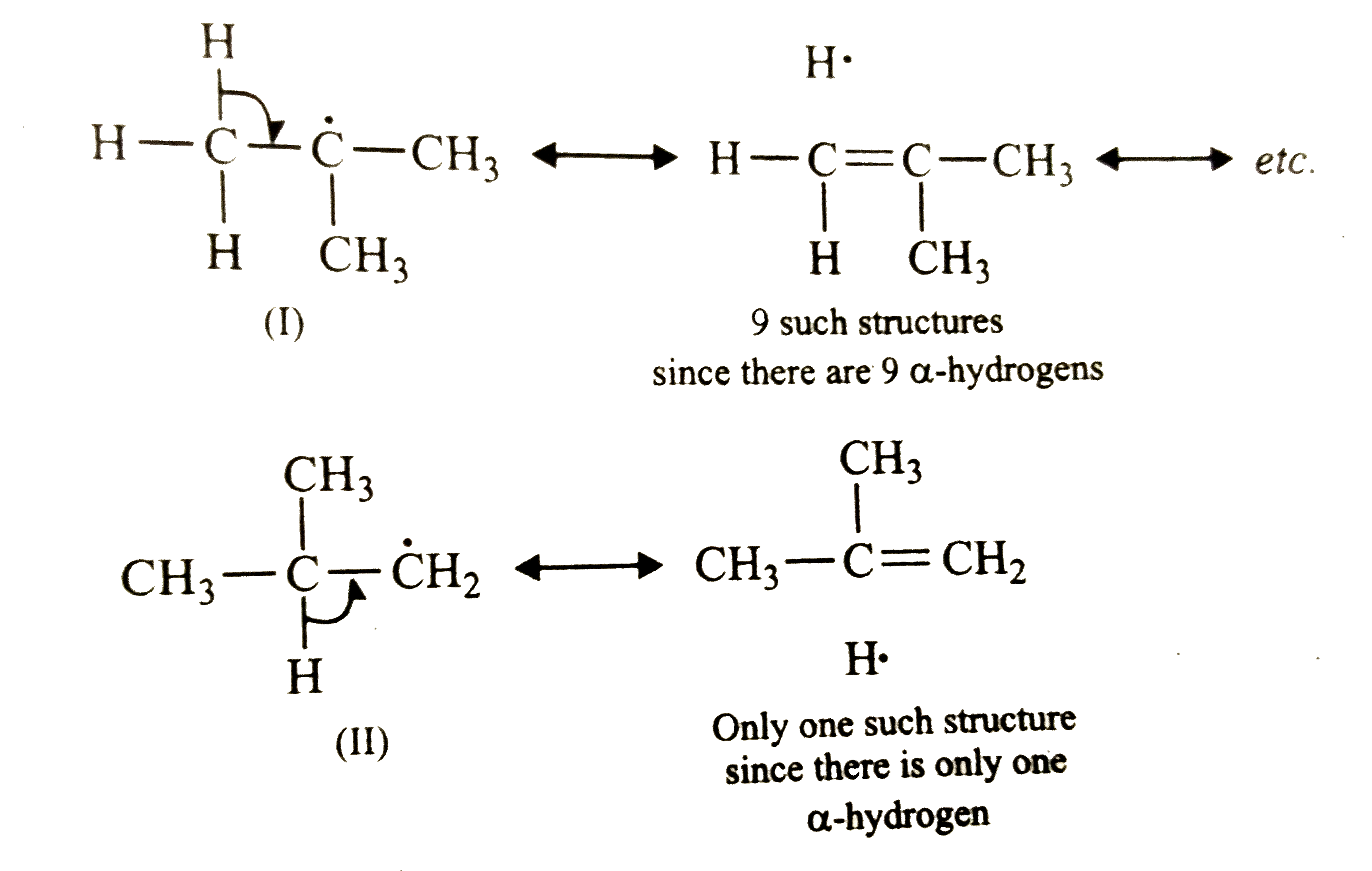
|
|
| 31. |
Which is the conjugate base of H_2PO_4^- ? |
|
Answer» `PO_4^(3-)` |
|
| 32. |
Write mathematical statement of first law of thermodynamics. |
| Answer» SOLUTION :`DeltaU = q+w` where`DeltaU =` INTERNAL ENERGY CHANGE,` q=` heat absorbed and `w=` WORK done. | |
| 33. |
Zr is in 4d-series, Hf is in 5d-series. But their atomic radii is same. Why? |
|
Answer» Solution :Same radii of Zr and HF is DUE to lanthanide contraction. Elements whose 4f is filled have abnormal small SIZES, because of the ineffective screening by inner f-orbitals. |
|
| 34. |
Which of the following feature of an atom is not a direct result of Rutherford's experiment |
|
Answer» EXTRAORDINARY hollow NATURE of atom |
|
| 35. |
Which hybird orbitals are used by carbon atoms in the following molecules?CH_3-CH_3 |
Answer» SOLUTION :
|
|
| 37. |
X(C_4H_(9)Br) overset(alc. KOH)to Y overset(Br_2)to Z ("Dibromide") overset(NaNH_2)to W + "Gas" underset("Soln.") overset(AgNO_3// NH_4OH)to "White ppt" Which of the following statement(s) is/are correct |
|
Answer» Y and W are chain isomers 
|
|
| 38. |
X(C_4H_(9)Br) overset(alc. KOH)to Y overset(Br_2)to Z ("Dibromide") overset(NaNH_2)to W + "Gas" underset("Soln.") overset(AgNO_3// NH_4OH)to "White ppt" Reductive ozonolysis of Y yields |
|
Answer» 2 MOLES of `CH_3CHO` 
|
|
| 39. |
Write the compressibility factor interms of molar volumes. What is its significance? |
|
Answer» Solution :COMPRESSIBILITY factor is the ratio of actual molar VOLUME of a gas to the molar volume of a gas. `z = ("REAL volume of gas")/("ideal volume of gas").` The VALUE of .z. denotes the extent of deviation of the gas from the BEHAVIOUR of ideal gas behaviour at the given pressure and temperature. |
|
| 40. |
Which of the following is not a basic physical quantity? |
|
Answer» Length |
|
| 41. |
When inert gas is added to the given reversible process at constant pressure , then the equilibrium will |
|
Answer» Be unaffected |
|
| 42. |
Write the possible isomers for the formula C_(5)H_(12) with their names and structures. |
|
Answer» Solution :(i) `underset("n-pentane")(CH_(3)-CH_(2)-CH_(2)-CH_(2)-CH_(3))` (ii) `underset("ISOPENTANE")(CH_(3)-underset(CH_(3))underset(|)(CH)-CH_(2)-CH_(3))` (iii) `underset("Neopentane")(CH_(3)-underset(CH_(3))underset(|)overset(CH_(3))overset(|)C-CH_(3))` (i), (ii) and (iii) are chain isomers |
|
| 43. |
Which of the following statements about alkaline earth metals are correct? 1. Hydration enthalpy of Sr^(2+) is greater than that of Be^(2+) 2. CaCO_(3) decomposes at a higher temperature than BeCO_(3) 3. Ba(OH)_2 is a stronger base thanMg(OH)_2 4. SrSO_(4) is less soluble in water than CaSO_4. . Select the correct answer using the codes given below: |
|
Answer» 4 only |
|
| 44. |
Which is incorrect match with respect to the reagent used for lab test ? |
|
Answer» carbohydrate ` to alpha`-Naphthol (molish reagent) |
|
| 45. |
The wavelength of the radiation emitted, when in hydrogen atom electron falls from infinity to stationary state 1, would be ("Rydberg constant "1.097 xx 10^(7) m^(-1)) |
| Answer» Answer :A | |
| 46. |
Write structural formulae of all isomers of C_(6)H_(14). Give their IUPAC names also. |
| Answer» SOLUTION : For ANSWER, CONSULT SECTION 12.20 | |
| 47. |
The three types of cubic unit cells are --------, ------------ and ------- |
| Answer» SOLUTION :SIMPLE CUBIC , BCC, FCC | |
| 48. |
Whatis the implicationuncertaintyprinciple ofexistence of definitepath of tradectories of electron? |
| Answer» Solution :ACCORDINGTO uncertaintyprinciple thetrasectory of anobjectisdeterminedby its locationand VELOCITYOF wrongmoments.Forelectronit isnot possiblesimultaneouslytodeterminethe positionand VELOCITYAT anygiveninstantto arbitraryofprecision. | |
| 49. |
Which of the following is not the point of difference between Be and other alkline earth metals? |
|
Answer» It has a tendency to form COVALENT bonds. `Be_(2)C+4H_(2)Oto2Be(OH)_(2)+CH_(4)` |
|
| 50. |
Which of the following represents the correct IUPAC name for the compounds concerned? 2,2-Dimethylpentane or 2-Dimethylpentane |
|
Answer» |
|


