Saved Bookmarks
This section includes 7 InterviewSolutions, each offering curated multiple-choice questions to sharpen your Current Affairs knowledge and support exam preparation. Choose a topic below to get started.
| 2. |
What iscathode ray ? |
| Answer» SOLUTION :THEYARE negativelychargedparticlewhichare ELECTRONAND ELECTRONIS thefundamentalparticleof allatoms . | |
| 3. |
(viii) CuO+NH_3 to Cu+N_2+H_2O |
|
Answer» Solution :`CuO+NH_3 to Cu+N_2+H_2O`. `Cu+2e^(-) to Cu` (Reduction) ……………(1) `N^(-3) to N_(2)^(0)+3e^(-)` (oxidation) ……………(2) MULTIPLY equation (2) by 2 to balance nitrogen atom `2N^(-3) to N_(2)^(0)+6e^(-)` ……………(3) Multiply Equation (1) by 3 to BALACNE the number of electrons. `3Cu^(2+) +6e^(-)to 3Cu` ……………(4) ADD equation (3) and (4) . `3Cu^(2+)+2N^(-3) to 3Cu+N_(2)` Over all balanced equation `3CuO +2NH_(3) to 3Cu+N_(2)+H_(2)O` Balance O atom by adding `H_2O` on the SIDE falling short of it. |
|
| 4. |
Xunderset((2)H_(2)O //H^(+))overset((1)O_(3))toCH_(3)-CH_(2)-COOH^(+) HOOC-CH_(2)-CH_(2)-COOH+HCOOH |
|
Answer» `CH_(3)-CH_(2)-C-=C-(CH_(2))_(2)-C-=CH` |
|
| 5. |
Which ions are responsible for the electrical potential across the cells membrane ? |
|
Answer» `Na^(+) & Zn^(2+)` |
|
| 7. |
Write Lewis structure of O_(2)^(-) ion and find out oxidation state of each oxygen atom? What is the average oxidation state of oxygen in this ion ? |
|
Answer» Solution :The Lewis STRUCTURE of `O_(2)^(-)` is `:overset(.)underset(..)(O)- underset(..)overset(..)(O):-. ` SINCE O atom CARRYING no charge has six electrons and hence its O.N. is zero but O atom carrying NEGATIVE charge has seven electrons and hence its O.N. is `-1` . THEREFORE , average O.N. of each O = 1/2 (0+1) = 1/2. |
|
| 8. |
What is the fission of covalent bonds? |
| Answer» SOLUTION :Fission of COVALENT bond MEANS the REACTION breaking the bond. | |
| 9. |
Which of the following groups of elements is assigned zero electronegativity ? |
| Answer» Answer :A | |
| 11. |
xg of H_(2)O_(2) requires 100ml M//5 KMnO_(4) in a titration in a solution having p^(OH)=1.0 Which of the following is/are currect |
|
Answer» the value of x is 1.7 g |
|
| 12. |
The reagent used in the conversion of ethylene dichloride is …………………… . |
| Answer» SOLUTION :`Zn+CH_3OH` | |
| 13. |
Which of the following is true about photochemical smog? |
|
Answer» It is REDUCING in nature |
|
| 14. |
Which of the following is not disproportionation reaction. |
|
Answer» `P_(4_((s))) +OH_((aq))^(-) RARR PH_(3(g)) +H_(2)PO_(2(aq))^(-)` |
|
| 15. |
Which of the following reaction is useful to convert benzene into toluene ? |
|
Answer» WURTZ REACTION |
|
| 16. |
What would be the SI unit for the quantity PV^(2)T^(2)//n? |
|
Answer» Solution :`(PV^2T^2)/N =((NM^(-2))(m^3)^2(K)^2)/(MOL)` `= Nm^4 K^2 mol^(-1)` |
|
| 17. |
What would happen if no salt bridge were used in the elctrochemical cell (e.g Zn - Cu cell )? |
| Answer» Solution :The positive ions i.e `(ZN^(2+))` formed by loss of electrons will accumulate AROUND zinc electrode and negative ions i.e `(SO_(4)^(2+))` left after reduction of `Cu^(2+)` ions will accumulatearound copper electrode thus the solution will DEVELOP charges and the current stops FLOWING further since inner circuit is not COMPLETE therefore the current stops flowing | |
| 18. |
What is meant by Conjugate acid -base pair? Write the conjugate acids for CN^(-) and H_(2)O |
|
Answer» Solution :Acid BASE PAIR which differ by ONE photon. Conjugate acid of `CN^(-)` is HCN, Conjugate acid of`H_(2)O` is `H_(3)O^(+)` |
|
| 19. |
What do you understand by the term 'non-stoichiometric hydrides'? Do you expect this type of the hydrides to be formed by alkali metals? Justify your answer. |
| Answer» Solution :Alkali metals do not form non-stoichiometric hydrides. Since alkali metals are highly reducing , they transfer their VALENCE shell electron to the hydrogen atom, thereby forming `H^(ө)` ion. Thus alkali metal hydrides are ionic, in which `H^(ө)` ions occupy holes in the metal LATTICE. Since there is COMPLETE transfer of an electron from alkali metal atom to hydrogen atom, the ratio of metal to hydrogen is INTEGRAL and hydride formed is stoichiometric hydrides. | |
| 20. |
Which position gives major product when E^(+) attack the following compound |
| Answer» SOLUTION :DUE to `+M` and steric reasons. | |
| 21. |
What will be the work done by the system when one mole of an ideal gas expands in vacuum ? |
|
Answer» Zero |
|
| 22. |
Which of the following compound(s) give precipitate of its basic salt with ammonia solution? |
|
Answer» `CuSO_(4)` |
|
| 23. |
There are isomers. Identify them and give the forms of isomerization. |
| Answer» Solution :(i),(ii) and (iii) are the ISOMERS of hexane `C_(6)H_(14)`. They are BRANCHED isomers. | |
| 24. |
Which of the following reagent will convert gt CO group into gt C(C_(6)H_(5))OH ? |
|
Answer» Phenol |
|
| 25. |
The relative lowering of vapour pressure of a sugar solution in water is3.5xx 10^(-3)The mole fraction of water in that solution is |
|
Answer» <P>`0.0035` `3.5 xx 10 ^(-3) =x _("sugar")` `x _("sugar") + x _(H _(2)O)=1` `x _(H_(2)O)=1 -0.0035 = 0.9965` |
|
| 26. |
Which of the following statements about the electron is incorrect ? |
|
Answer» It is a negatively charged particle. |
|
| 27. |
The tendency of an element to lose an electron is called |
|
Answer» Electronegativity |
|
| 28. |
Which one of the followingcauses cancer? |
|
Answer» 1,2-Benzpyrene |
|
| 29. |
Which oneof the following is incorrect statement ? |
|
Answer» for a system at EQUILIBRIUM, Q is always less than the equilibrium constant |
|
| 30. |
Which boron compound possess HBO_2 formula ? |
|
Answer» BORIC ACID |
|
| 32. |
Which of the following statements about hydrogen are incorrect? |
|
Answer» Hydronium ion, `H_(3)O^(+)` exists freely in solution. Dihydrogen `(H_(2))` can act asreducing agent. For EXAMPLE `CuO+H_(2) to Cu+H_(2)O` `ZnO+H_(2) to Zn+H_(2)O` Out of the three isotopes, PROTIUM `(._(1)^(1)H)` is the most common. |
|
| 34. |
Two identical vessels are filled with 44g of Hydrogen and 44g of carbon dioxide at the same temperature. If the pressure of CO_2 is 2 atm, the pressure of Hydrogen is |
| Answer» ANSWER :B | |
| 35. |
Which of the following will not produce dihydrogen gas? |
|
Answer» Cu + dil (HCI) |
|
| 37. |
Which of the following reactions of methane is incomplete combustion ? |
|
Answer» `2CH_(4)+O_(2)overset(Cu//523 K//100 "ATM")rarr 2CH_(3)OH` |
|
| 38. |
Which one of the following species does not acts as a nucleophile ? |
|
Answer» ROH |
|
| 39. |
Write the IUPAC names of the following compounds. (i) CH_(3)-underset(CH_(3))underset(|)(CH)-underset(CH_(2)-CH_(3))underset(|)(CH)-CH_(2)-CH_(3) (ii) CH_(3)-underset(CHO)underset(|)(CH)-CH_(2)-CH_(3) |
|
Answer» SOLUTION :(i) 3-ethyl-2-methyl PENTANE (II) 2-methylbutanal |
|
| 40. |
Which of the following orders regarding the bond length is correct? |
|
Answer» `O_(2)^(-) O_(2) GT O_(2)^(+)` |
|
| 41. |
You are provided with a mixture of three components in a very small amount. Suggest a method for their identification. |
| Answer» SOLUTION :By ADSORPTION CHROMATOGRAPHY. | |
| 42. |
Which is the actual configuration of Cr(Z=24).Why? |
|
Answer» Solution :`Cr(z=24)1S^(2)2S^(2)2P^(6)3S^(2)3P^(6)3D^(5)4S^(1)` the reason for this is ,Cr with `3d^(5)` configuration is half filled and it will be more stable. Chromium has [Ar]`3d^(5)` `4s^(1)` and not [Ar]`3d^(4)4s^(2)` due to the symmetrical distribution and exchange energies of d electrons. |
|
| 43. |
What is the correct increasing order of liquefiaility of the gas? |
|
Answer» `H_(2)ltCO_(2)ltCH_(4)ltN_(2)` |
|
| 44. |
What is the mass of hydrogen peroxide present in 1 litre of 2M solution ? Calculate the volume of oxygen at STP liberated upon complete decomposition of 100 cm^(3) of the above solution. |
|
Answer» Solution :Step 1. To calculate the mass of `H_(2)O_(2)` in 1 litre of 2M solution. Molecular mass of `H_(2)O_(2)=2xx1+2xx16=34` u. By definition, 1 litre of 1 M `H_(2)O_(2)` contains 34 g of `H_(2)O_(2)` `therefore` 1 litres of 2M `H_(2)O_(2)` will contain `H_(2)O_(2)=34xx2=68` Step 2. To calculatethe volume of `O_(2)` LIBERATED at STP from `100 cm^(3)` of 2M solution. 1 litre of 2M `H_(2)O_(2)` solution will contain `H_(2)O_(2)=(68)/(1000)xx100=6.8g` The equation representing the DECOMPOSITION of `H_(2)O_(2) ` is `underset(2xx34=68 g)(2H_(2)O_(2))to 2H_(2)O + underset(22400 cm^(3) at "STP")(O_(2))` Now 68 g of `H_(2)O_(2)` at STP give `O_(2)=22400 cm^(3)` `therefore 6.8 ` g of `H_(2)O_(2)` at STP will evolve `O_(2)=(22400)/(68)xx6.8=2240 cm^(3)=2.24 litres.` |
|
| 45. |
Write structures of various carbocations that can be obtained from 2-methylbutane . Arrange these carbocations in order of increasing stabililty. |
|
Answer» Solution :`square ` 2-methyl butane has four different sets of EQUIVALENT H-atoms . `CH_(3) - underset (CH_(3))underset (|)(C)H- CH_(2) - CH_(3)` ` square ` Removal of H-atom from any of C-atom GIVES four different carbocations . (i) ` CH_(3) - underset(CH_(3))underset(|) overset (BETA)(CH)-overset(oo)(CH_(2) )- overset(+)(CH_(2))` (ii) ` CH_(3) - underset(CH_(3))underset(|) (CH)-overset(+)(CH_(2) )- CH_(3)` (iii) ` CH_(3) - underset(CH_(3))underset(|) overset(+)(C)larrCH_(2) - CH_(3)` (iv)` overset(+)(CH_(2)) - underset(CH_(3))underset(|) (C)- CH_(2) - CH_(3)` ` square ` Stability order of carbocation is ` 3^(@) gt 2^(@) gt 1^(@)` ` square ` Though I & IV are primary carbocations , I has ` alpha-CH_(3) ` group at ` beta `- carbon and while IV has ` - CH_(3)" at " alpha ` - carbon . ` square+ I ` EFFECT decreases with distance , hence IV is more stable than I ` squaretherefore `The overall stability is ` I lt IV lt II lt III `. |
|
| 47. |
The stabilizing agent for H_(2)O_(2) is |
|
Answer» platinum black |
|
| 48. |
Which of the following is/are correct statement : |
|
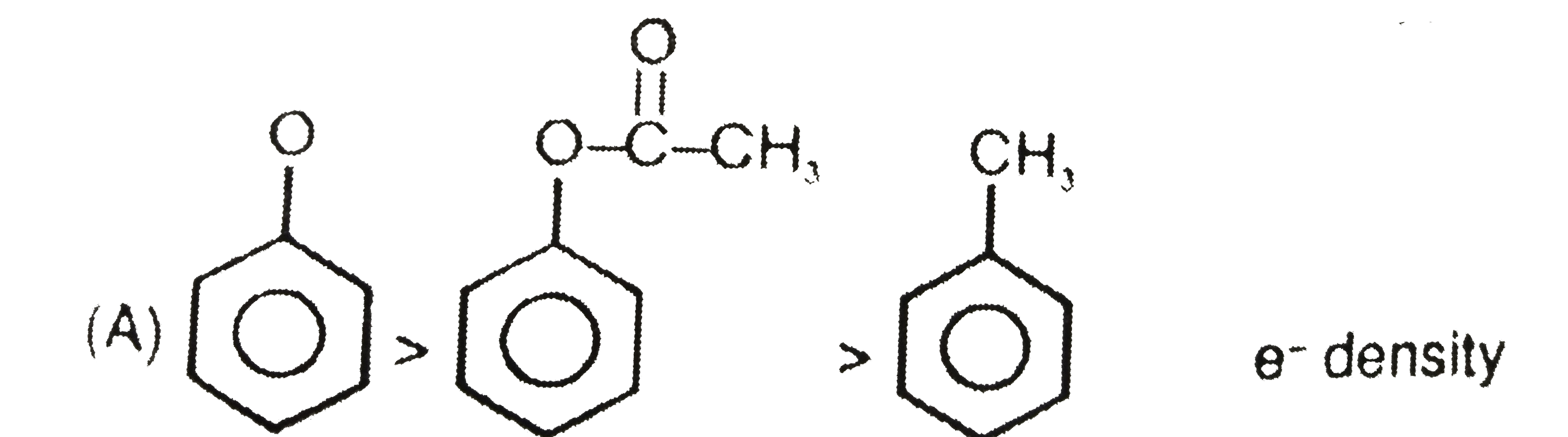
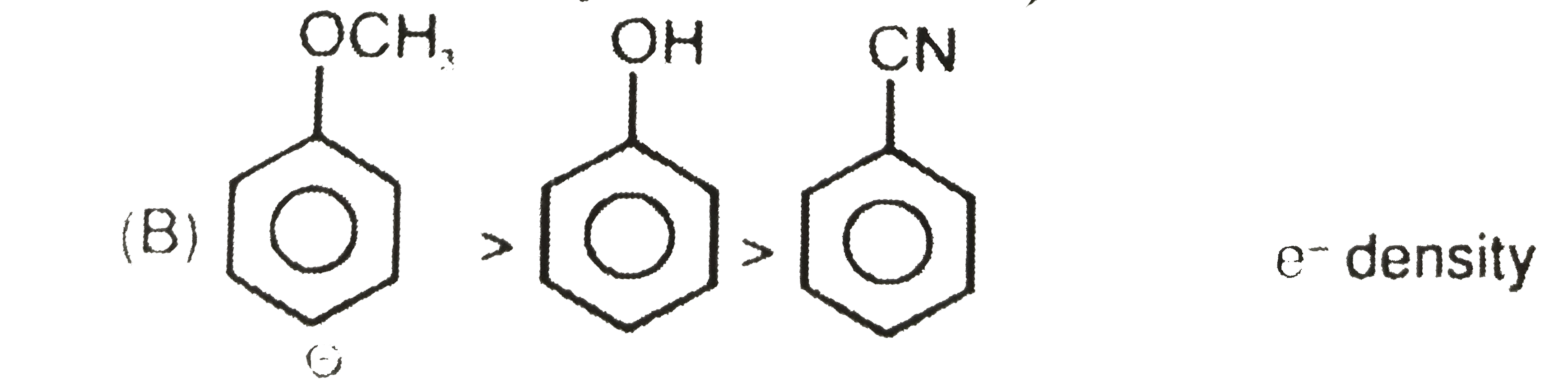
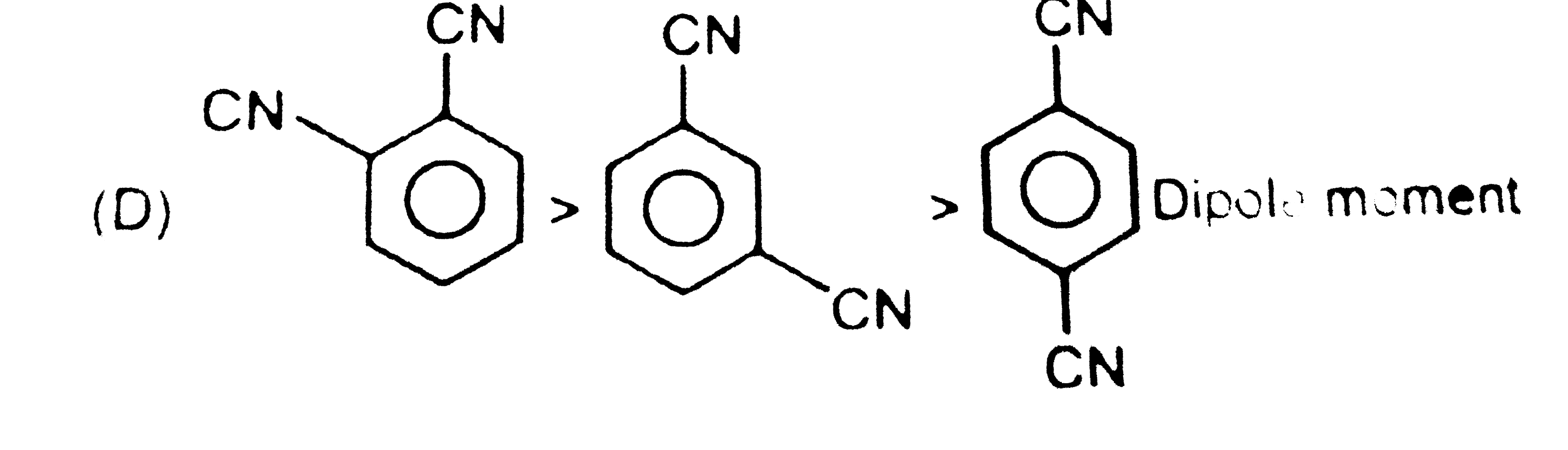
Answer»
|
|
| 49. |
What is sp^(2) hybridization ? Give characteristics of it . |
|
Answer» Solution :Definition : One ns and two np orbitals of an I atom having less difference in energy combine and FORM there EQUIVALENT orbitals having similar shape is CALLED `sp^(2)` hybridization and form orbitals are called `sp^(2)` hybride orbitals. Characteristics: In each `sp^(2)` orbital 33% s-character and 66.6% p-character is observed. All three `sp^(2)` hybrid orbital arrange in such way so that they experience MINIMUM repulsion and remain at `120^(@)` angle and arrange at three corners of symmetric planar trigonal.  `sp^(2)` hybrid orbitals.s in plane arrange `120^(@)` angle at corner as positive lobe & SMALL negative lobe. Sch all formed all three `sigma` bond arrange at `120^(@)` angle in one plane. |
|