Saved Bookmarks
This section includes 7 InterviewSolutions, each offering curated multiple-choice questions to sharpen your Current Affairs knowledge and support exam preparation. Choose a topic below to get started.
| 1. |
Write the bond line structure for HC=underset(H)underset(|)overset(H)overset(|)(H)-underset(OH)underset(|)overset(H)overset(|)(C)-underset(H)underset(|)overset(H)overset(|)(C)-overset(H)overset(|)(C)-H |
|
Answer» |
|
| 3. |
Which pair of ions cannot be seperated by H_(2)S in dil/HCl |
|
Answer» `Bi^(3+),SN^(4+)` |
|
| 4. |
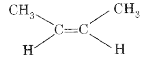
What characteristic property is common to both cis 2-butene, ans trans-2-butene? |
|
Answer» Boiling POINT |
|
| 5. |
Write notes on triads and periods. |
| Answer» Solution :Triads is defined asa the SUM of the first and third elements of the ATOMIC MASSES in the triad is EQUAL to the sum of the SECOND elements atomic masses . The Horizontal rows are also called as periods. | |
| 6. |
Which of the following compounds reacts fastest with Lucas reagent? |
|
Answer» 1-Butanol |
|
| 7. |
The weight of pure NaOH required to prepare 250 mL of 0.1 N solution is : |
|
Answer» 4 g Mass of `NaOH = 0.1 xx 40 xx 0.25 =1g`. |
|
| 8. |
When an electron makes a transition from (n + 1) state to n^(th) state, the frequency of emitted radiations is related to ‘n’ according to ( n gt gt 1) |
|
Answer» `v =(2cRz^2)/(n^3)` |
|
| 9. |
Which of the following transitions involves maximum energy? (1) M^(-) (g) to M(g) (2) M^(2+) (g) to M^(3+) (g) (3) M^(+) (g) to M^(2+) (g) (4) M(g) to M^(+) (g) |
|
Answer» HENCE `M^(2+) to M^(3+)`. i.e, is MAXIMUM |
|
| 10. |
What is the carbon-carbon bond length in benzene? |
|
Answer» 1.20 Å and 1.31 Å |
|
| 11. |
Whichcolourfromvioletand Redis morerefracted ? Why |
Answer» SOLUTION :REDCOLOUR is morerefractedthemvioletbecauseredcolourhas shortwavelength 
|
|
| 12. |
Which of the following series of lines in atomic spectrum of hydrogen appear in visible region ? |
Answer» SOLUTION :
|
|
| 13. |
Which is the suitable method for detection of Nitrogen present in food and fertilizers ? |
| Answer» SOLUTION :Kjeldahls method : This method is carried much more easily than the Dumas method. It is used largely in the analysis of foodsand fretilizers. Kjeldahls method is BASED on the fact that whenan ORGANIC compound containing nitrogen is heated with cone. `H_(2) SO_(4)` , the nitrogen in it is quantitatively converted to ammonium SULPHATE . | |
| 14. |
Which of the following has the lowest dipole moment? |
|
Answer»
|
|
| 15. |
Total number of geometrical isomers possible for |
|
Answer» |
|
| 17. |
Which one of the following has highest Lewis acid strength ? |
|
Answer» `BI_(3)` |
|
| 18. |
Which of the following methods are generally used for purification of organic liquids |
|
Answer» Steam distillation |
|
| 19. |
The strength of an aqueous solution of I_(2) can be determined by titrating the solution with standard solution of |
|
Answer» OXALIC ACID |
|
| 20. |
which of the following on oxidation gives H_(2)O_(2) ? |
|
Answer» 2-Ethylanthraquinol |
|
| 21. |
Which of the following will produce a buffer solution when mixed in equal volumes ? |
|
Answer» 0.1 mol `dm^(-3) NH_4OH` and 0.1 mol `dm^(-3)` HCl `{:(,NH_4OH + , HCl to , NH_4Cl + ,H_2O),("INITIALLY", 0.1M,0.05 M, 0,),("After reaction",0.05 M, 0, 0.05 M,):}` |
|
| 22. |
Which of the following is non-polar ? |
|
Answer» `CH_3Cl` |
|
| 23. |
The volume strength of 1*5 N H_(2)O_(2) solution is |
|
Answer» 4.8 |
|
| 24. |
Which of the following has neither secondary nor tertiary hydrogen ? |
|
Answer» Isobutane |
|
| 26. |
What is the nature of beryllium oxide ? |
| Answer» SOLUTION :AMPHOTERIC | |
| 27. |
What is the maximum number of orbitals that can be identified with the following quantum numbers ? n = 3, l = 1, m_(1) = 0 |
|
Answer» 1 |
|
| 28. |
When electron jumps from higher orbit to lower orbit, then energy is radiated in the form of electro magnetic radiation and these radiations are used to record the emission spectrum Energy of electron may be calculated as E= (2pi^2 m_e Z^2 e^4)/(n^2 h^2) where m_e = rest mass of electron DeltaE = (E_(n_2)- E_(n_1)) = 13.6xxZ^2 xx [1/(n_1^2) - 1/(n_2^2)]eV per atom This equation was also used by Rydberg to calculate the wave number of a particular line in the spectrum. bar(upsilon) = 1/(lambda) = R_H Z^2 [1/(n_1^2) -1/n_2^2] m^(-1) Where , R_H = 1.1 xx 10^7 m^(-1) (Rydberg constant)For Lyman, Balmer, Paschen, Brackett and Pfund series the value of n_1 = 1,2,3,4,5 respectively and n_2 = oo for series limit, If an electron jumps from higher orbit n to ground state than number of spectral line will be ""^nC_2 . Ritz modified the Rydberg equation by replacing the rest mass of electron with reduced mass (mu). 1/(mu) = 1/(m_N) + 1/(m_e) , Here m_N mass of nucleus , m_e = mass of electron. The ratio of the wavelength of the first line to that of second line of Paschen series of H-atom is: |
|
Answer» `256: 175` |
|
| 29. |
Which are heterogenous equilibrium ?(i)H_2O_((l)) hArr H_2O_((g)) (ii)Ca(OH)_(2(s)) + aq hArr Ca_((aq))^(2+) + 2OH_((aq))^(-) (iii)CaCO_(3(s)) hArr CaO_((s)) + CO_(2(g)) (iv)CH_3COOC_2H_(5(l)) + H_2O_((l)) hArr CH_3COOH_((l)) + C_2H_5OH_((l)) (v)Fe_((aq))^(3+) + SCN_((aq))^(-) hArr [Fe(SCN)]_((aq))^(2+) |
| Answer» SOLUTION :(i), (II) and (iii) are heterogenous equilibrium but (iv) and (V) are HOMOGENOUS equilibrium. | |
| 30. |
Which out of Li or Na has greater value for the following properties : (i)Hydration ethalpy (ii) Stability of hydride (iii) Stability of carbonate (iv) Basic character of hydroxide (v) Ionisation enthalpy . |
| Answer» Solution :(i) LI (II) Li (III) NA (IV) Na (v) Li | |
| 31. |
When electron jumps from higher orbit to lower orbit, then energy is radiated in the form of electro magnetic radiation and these radiations are used to record the emission spectrum Energy of electron may be calculated as E= (2pi^2 m_e Z^2 e^4)/(n^2 h^2) where m_e = rest mass of electron DeltaE = (E_(n_2)- E_(n_1)) = 13.6xxZ^2 xx [1/(n_1^2) - 1/(n_2^2)]eV per atom This equation was also used by Rydberg to calculate the wave number of a particular line in the spectrum. bar(upsilon) = 1/(lambda) = R_H Z^2 [1/(n_1^2) -1/n_2^2] m^(-1) Where , R_H = 1.1 xx 10^7 m^(-1) (Rydberg constant)For Lyman, Balmer, Paschen, Brackett and Pfund series the value of n_1 = 1,2,3,4,5 respectively and n_2 = oo for series limit, If an electron jumps from higher orbit n to ground state than number of spectral line will be ""^nC_2 . Ritz modified the Rydberg equation by replacing the rest mass of electron with reduced mass (mu). 1/(mu) = 1/(m_N) + 1/(m_e) , Here m_N mass of nucleus , m_e = mass of electron. What will be the value of modified Rydberg.s constant, if the nucleus having mass m_N and the electron having mass m_e revolve around the centrer of the mass? |
|
Answer» `R_H XX (m_N)/(m_e)` |
|
| 32. |
When electron jumps from higher orbit to lower orbit, then energy is radiated in the form of electro magnetic radiation and these radiations are used to record the emission spectrum Energy of electron may be calculated as E= (2pi^2 m_e Z^2 e^4)/(n^2 h^2) where m_e = rest mass of electron DeltaE = (E_(n_2)- E_(n_1)) = 13.6xxZ^2 xx [1/(n_1^2) - 1/(n_2^2)]eV per atom This equation was also used by Rydberg to calculate the wave number of a particular line in the spectrum. bar(upsilon) = 1/(lambda) = R_H Z^2 [1/(n_1^2) -1/n_2^2] m^(-1) Where , R_H = 1.1 xx 10^7 m^(-1) (Rydberg constant)For Lyman, Balmer, Paschen, Brackett and Pfund series the value of n_1 = 1,2,3,4,5 respectively and n_2 = oo for series limit, If an electron jumps from higher orbit n to ground state than number of spectral line will be ""^nC_2 . Ritz modified the Rydberg equation by replacing the rest mass of electron with reduced mass (mu). 1/(mu) = 1/(m_N) + 1/(m_e) , Here m_N mass of nucleus , m_e = mass of electron. The emission spectrum of He^+ involves transition of electron from n_1 ton_2 such that n_2 + n_1 = 8and n_2 - n_1 = 4 . What will be the total number of lines in the spectrum ? |
|
Answer» 10 `THEREFORE 2n_2 = 12 , n_2 = 6 `, `n_1 = 2 `, spectral lines = 10 |
|
| 33. |
Which of the following is best general electronic configuration of normal element ? |
|
Answer» `NS^(1-2)NP^(0-6)` |
|
| 34. |
When 1.0g of oxalic acid (H_(2)C_(2)O_(4)) is burned in a bomb calorimeter whose heat capacity is 8.75kJ/K, the temperature increases by 0.312K. The enthalpy of combustion of oxalic acid at 27^(@)C |
|
Answer» `-245.7` kJ/mol `Delta u`/mole `= -2.73 xx 90 = 245.7`KJ `Delta H = Delta U = Delta n RT` Reaction for combustion of OXALIC acid is `H_(2)C_(2)O_(4(s)) + (1)/(2) O_(2(g)) rarr 2CO_(2(g)) + H_(2)O_((l))` So, `Delta n = (3)/(2)` `Delta H= - 245.7 + (3)/(2) xx 8.314 xx 10^(-3) xx 300` = -241.9587 |
|
| 35. |
Which of the following is the correct order of stability of bonds? |
|
Answer» Hydrogen BOND < COVALENT bond < Vanderwaals bond |
|
| 36. |
Why boron and aluminium tend to form covalent compounds ? |
| Answer» SOLUTION :Bothboronand aluminium have veru HIGH sum of the first THREE ionization enthalpies. Hence, they cannot lose electronsto form ioniccompounds, INSTEAD they from covalentcompounds. | |
| 37. |
Which one is not Boyle.s formula ? |
|
Answer» `p prop (1)/(V)` |
|
| 38. |
What happens when lead sulphide is reacted with hydrogen peroxide solution ? |
| Answer» SOLUTION :`PbSO_(4)` is formed which is WHITE `PbS+4H_(2)O_(2)toPbSO_(4)+4H_(2)O` | |
| 39. |
Which of the following is/are correct statement/statements ? |
|
Answer» Guanidine `[NH_(2)-UNDERSET(NH)underset(||)C-NH_(2)]` is more BASIC than pyridine because conjugate acid of guanidine has three equal contributing resonating structure. |
|
| 40. |
Which of the following is the strongest -I group : |
|
Answer» `-overset(+)N(CH_(3))_(3)` |
|
| 41. |
Which of the following species has diamagnetic property ? |
|
Answer» `O_(2)^(2+)` |
|
| 42. |
What would have happened if green house gases were totally missing in the atmosphere ? |
| Answer» Solution :Green houses GASES (CO_2, methane, CFC ETC) are responcible for the heating up the ATMOSPHERE NEAR earths surface which keep it warm. This makes the TEMPURATURE of earth's surface constant. These gases promote growth of plants and existanse of life on earth. If these gases were not there, there would have no life on eatrh. | |
| 43. |
You are provided with a solid 'A'and three solutions of A dissolved in water-one saturated, one unsaturated, and one super saturated. How would you determine each solution. |
|
Answer» Solution :(i) Saturated solution: When maximum amount of solute is dissolved in a solvent, any more addition of solute will result in precipitation at a given temperature and pressure. Such a solution is called a saturated solution. (ii) UNSATURATED solution: When minimum amount of solute is dissolved in a solvent at a given temperature and pressure is called an unsaturated solution. (iii) Super saturated solution: It is a solution that holds more solute than it normally could in its saturated form. Example 1. A saturated solution where the addition of more COMPOUND would not dissolve in the solution. 359 g of NaCl in 1 litre of water at `25^(@)C`. 2. An unsaturated solution has the capacity to dissolve more of the compound, 36 g of NaCl in 1 litre of water at `25^(@)C`. 3. A super saturated solution is the solution in which crystals can start growing, 500 g of NaCl in 1 litre of water at `25^(@)C`. |
|
| 44. |
Which is least basic ? SbH_(3),PH_(3), NH_(3),AsH_(3) ? |
| Answer» Solution :A compound which is most acidic is OBVIOUSLY least basic. SINCE `SbH_(3)` is most acidic, therefore, is it least basic.or As the size of the atom INCREASES, electron DENSITY on the central atom DECREASE and hence basicity decreases. Thus `SbH_(3)` is least basic. | |
| 45. |
Using s, p, d, d notations, describe the orbitals with the following quantum numbers n = 2, l =1. |
|
Answer» 2s |
|
| 46. |
Which of thefollowingis notan actinoid ? |
|
Answer» CURIUM (Z =96 ) |
|
| 47. |
What is X in the following sequence of reactions? Xunderset(-(1)/(2)H_(2))overset(Na)rarrYunderset(CaO)overset(NaOH)rarrCH_(4) |
|
Answer» Methanoic acid |
|
| 48. |
What is biodegradable and non-biodegradable waste ? |
|
Answer» SOLUTION :Industrial wastes are divided into two types : Biodegradable waste : Biodegradable wastes are genereted by cotton mills, food processing units, paper mills and textile factories. (ii) Non-biodegradable wastes: Non-biodegradable wastes are generated by thermal power plants which produce fly ash, integrated iron and steel plants which produce blast FURNACE slag and steel melting slag. Industries MANUFACTURING aluminium, zinc and copper produce mud and tailings. Fertilizer industries produce gypsum. Hazardous wastes such as INFLAMMABLES, composite explosives or highly reactive substances are produced by industries dealing in metals, CHEMICALS, drugs, pharmaceuticals, dyes, pesticides, rubber goods etc. |
|
| 49. |
Write the electronic configuration of ._(9)F^(19), ._(16)S^(32) and ._(18)Ar^(38) and then point out the element with : (i) Maximum nuclear charge (ii) minimum number of neutrons (iii) highest mass number (iv) maximum number of unpaired electrons. |
|
Answer» Solution :`._(9)F^(19)=1s^(2) 2s^(2) 2p_(x)^(2) 2p_(y)^(2)2p_(z)^(1), ._(16)S^(32)=1s^(2) 2s^(2) 2P^(6) 3s^(2) 3p_(x)^(2)3p_(y)^(1) 3p_(z)^(1), ._(18)Ar^(38)=1s^(2) 2s^(2) 2p^(6) 3s^(2) 3p^(6)` (i) Max. nuclear charge `=18` in `._(18)Ar^(38)` (ii) Minimum no. of neutrons `=10` in `._(9)F^(19)` (iii) Maximum no. of unpaired electrons `=2` in `._(16) S^(32)` |
|