Saved Bookmarks
This section includes 7 InterviewSolutions, each offering curated multiple-choice questions to sharpen your Current Affairs knowledge and support exam preparation. Choose a topic below to get started.
| 1. |
Let M_(1) and M_(2) be the masses of the nuclei ""_(1)H^(2) and ""_(2)H^(4) respectively. Aslo let m_(p) and m_(n) be the masses of proton and neutron respectively. |
| Answer» ANSWER :B | |
| 2. |
Delta G^(@)(HI, g) ~= + 1.7 kJ. What is the equilibrium constant at 25^(@)C for 2HI(g)hArrH_(2)(g) + I_(2) (g) ? |
|
Answer» `24.0` `1.7 = - 2.303xx8.314xx10^(-3)xx298xxlog K_(p)` `K_(p) = 0.5` |
|
| 3. |
Delta G^(0) for the reaction x + y hArr z is -4.606 kcal. The value of equilibrium constant of the reaction at 227^(@)C |
| Answer» Solution :`K = e^(-(Delta G^(0))/(RT)) = 100` | |
| 4. |
The standard free energy of Cu_((aq))^(+)is 50 kJ mol^(-1) and that of Cu_((aq))^(2+) is 66 kJ. mol^(-1). Calculate the change in free energy for the reaction, Cu_((aq))^(+) to Cu_((aq))^(2+) + e^(-). |
| Answer» ANSWER :D | |
| 5. |
Delta G_(sys) is equal to |
|
Answer» `T Delta S _(sys)` |
|
| 7. |
Delta G^(@) of a reaction is 120 kJ mol^(-1). Calculate the K_(p) at 20^(@)C. |
|
Answer» Solution :`Delta G^(@) = -2.303 RT log_(10) K_(p)` `-120,000 = -2.303 xx 8.314 xx 293 xx log_(10)K_(p)` `log_(10)K_(p) = (-120,000)/(-2.303 xx 8.314 xx 293)` `log_(10)K_(p) = 21.39` `K_(p) = "ANTILOG" 21.39` `- 2.455 xx 10^(21)` |
|
| 8. |
Delta _(C) U^( Theta ) of formation of CH_(4(g)) at certain temperature is -393 "kJ mol"^(-1). The value of Delta_(f) H^( Theta ) is |
|
Answer» <P>zero `CH_(4(g)) + 2O_(2(g)) to CO_(2(g)) + 2H_(2) O_((l))` `Deltan_(g) = (n_(p) - n_(r) )_(g) = 1-3 = -2` `Delta_(f) H^( - Theta )= Delta_(r) U^( Theta ) + Deltan_(g) "RT"` As `Deltan_(g) = -2` `therefore Delta_(f) H^( Theta ) lt Delta_(f) U^( Theta )` |
|
| 9. |
The kind of delocalisation involving sigma bond orbitals is called……. |
|
Answer» Mesomeric EFFECT |
|
| 10. |
Delicate materials like silk, wool and ivory are bleached by |
|
Answer» `H_(2)O_(2)` |
|
| 11. |
Deionised water is prepared by the following method |
|
Answer» Clark's |
|
| 12. |
Dehydrohalogenation reaction is also known as _____. |
|
Answer» ADDITION |
|
| 13. |
Dehydrohalogenation involves removal of the halogenn atom together with a hydrogen atom from carbon adjacent to the one with halogen atom. Alcoholic KOH is used for dehydrohalogenation. According to saytzeff's rule, when two alkenes may be formed, the alkene which is most substituted is the major product. Q. Arrange the following alkyl halides in decreasing order of the rate of beta-elimination reaction with alcoholik KOH. underset((i))(CH_(3)CH_(2)CH_(2)Br) underset((ii))(CH_(3)-underset(CH_(3))underset(|)(C)H-CH_(2)Br) underset((iii))(CH_(3)-CH_(2)-underset(Br)underset(|)(C)H-CH_(3)) |
|
Answer» iigtiiigti |
|
| 14. |
Dehydrohalogenation of alkyl halide is |
|
Answer» Addition reaction |
|
| 15. |
Dehydrohalogenation involves removal of the halogenn atom together with a hydrogen atom from carbon adjacent to the one with halogen atom. Alcoholic KOH is used for dehydrohalogenation. According to saytzeff's rule, when two alkenes may be formed, the alkene which is most substituted is the major product. Q. What are the products of dehydrohalogenation of 2-iodopentane? |
|
Answer» 2-Pentene(major),1-Pentene (minor) `underset("2-Pentene (major)")(CH_(3)CH_(2)-CH=CH-CH_(3))+underset("1-Pentene (minor)")(CH_(3)CH_(2)CH_(2)-CH=CH_(2))` |
|
| 16. |
Dehydrogenation of isobutyl alcohol yields |
|
Answer» Butanone |
|
| 17. |
Dehydration of which of the following alcohols produce alkenes exhibiting cis-trans-isomerism ? |
|
Answer» ISOPROPYL alcohol `UNDERSET(2^@ "Butyl alcohol")(CH_3-CHOH-CH_2CH_3)underset((-H_2O))overset"Dehydration"to underset"2-Butene"(CH_3-CH=CH-CH_3)` `underset"3-Pentanol"(CH_3CH_2-CHOH-CH_2CH_3)underset((-H_2O))overset"Dehydration"to underset"2-Pentene"(CH_3CH_2-CH=CHCH_3)` |
|
| 18. |
Dehydration of hydrates of halides of calcium, barium and strontium i.e., CaCl_(2)*6H_(2)O, BaCl_(2)*2H_(2), SrCl_(2)*2H_(2)Ocan be achieved by heating. These become wet on keeping in air. Which of the following statements is correct about these halides? |
|
Answer» Act as dehydrating agent |
|
| 19. |
Dehydration of hydrates of halides of calcium , barium and strontium i.e, CaCl_(2) . 6 H_(2)O , BaCl_(2) . 2H_(2)O , SrCl_(2) . 2H_(2)O , can be achieved by heating . These become wet on keeping in air . Whichof the following statements is correct about these halides ? |
|
Answer» ACT as dehydrating agent |
|
| 20. |
Dehydration of glycerol gives |
|
Answer» Propane |
|
| 22. |
Dehydration of alcohols to alkenes is always carried out with conc. H_2SO_4 and not with HCl or HNO_3. Explain . |
|
Answer» Solution :Dehydration of ALCOHOLS to alkenes occurs through CARBOCATION intermediate. If HCl is USED , the chloride `(Cl^-)` ion being a good nucleophile brings about substitution reaction to give an alkyl halide. `{:(underset"ALCOHOL"(R-CH_2-CH_2-OH)underset(-H_2O)overset(H^+)to,underset"Carbocation"(R -CH_2-overset+CH_2),underset(-H^+)to underset"(Elimination product)"underset"Alkene"(R-CH=CH_2)),(,underset"(Substitution product)"underset"Alkyl chloride"overset(darr +Cl^-)(R-CH_2-CH_2-Cl),):}` If `H_2SO_4` is used, then the bisulphate `(HSO_4^-)` ion being non-necleophilic cannot bring out the substitution reaction. INSTEAD , the carbocation loses a proton to form an alkene. Conc. `HNO_3` is not used because it being a strong oxidising agent, preferentially brings about the oxidation of alcohols first to aldehydes or ketones and then to carboxylic acids. Thus, dehydration of alcohols to form alkenes is always carried out with such strong acids (e.g., `H_2SO_4 , H_3PO_4,H_3PO_4, KHSO_4`) which have non-nucleophilic anion) |
|
| 23. |
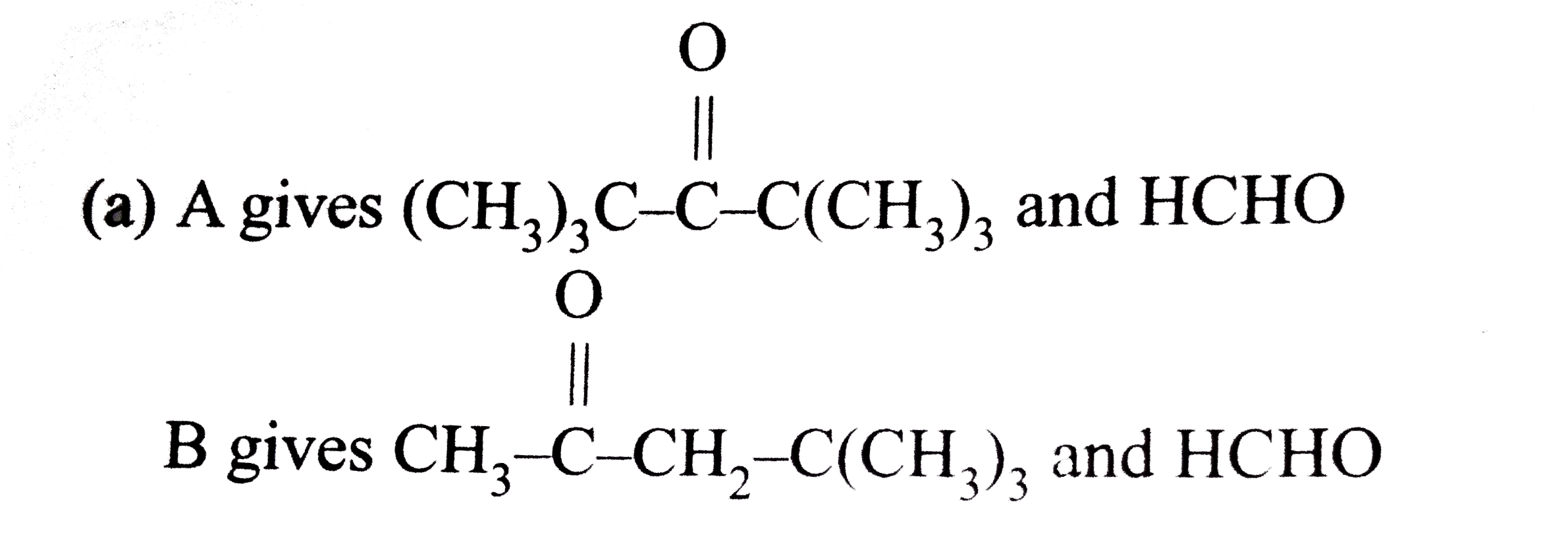
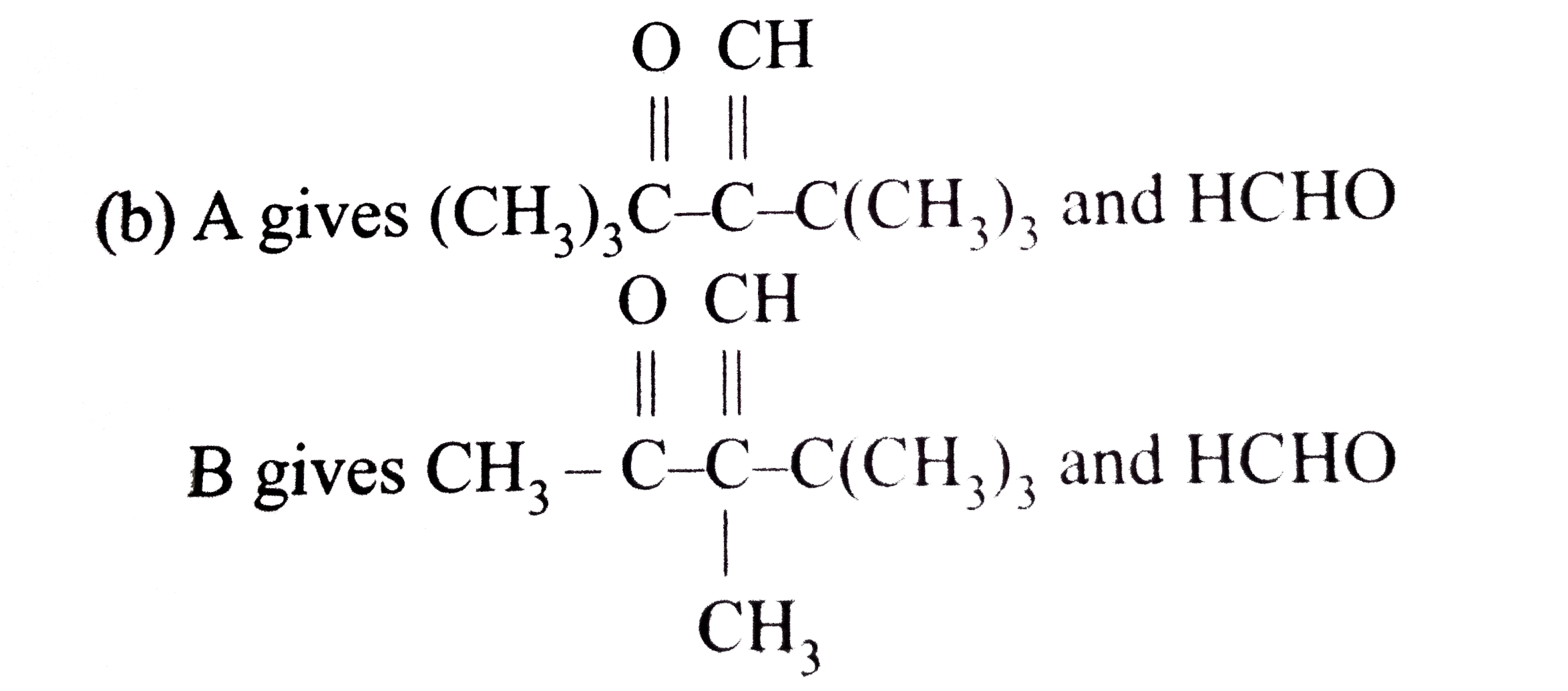
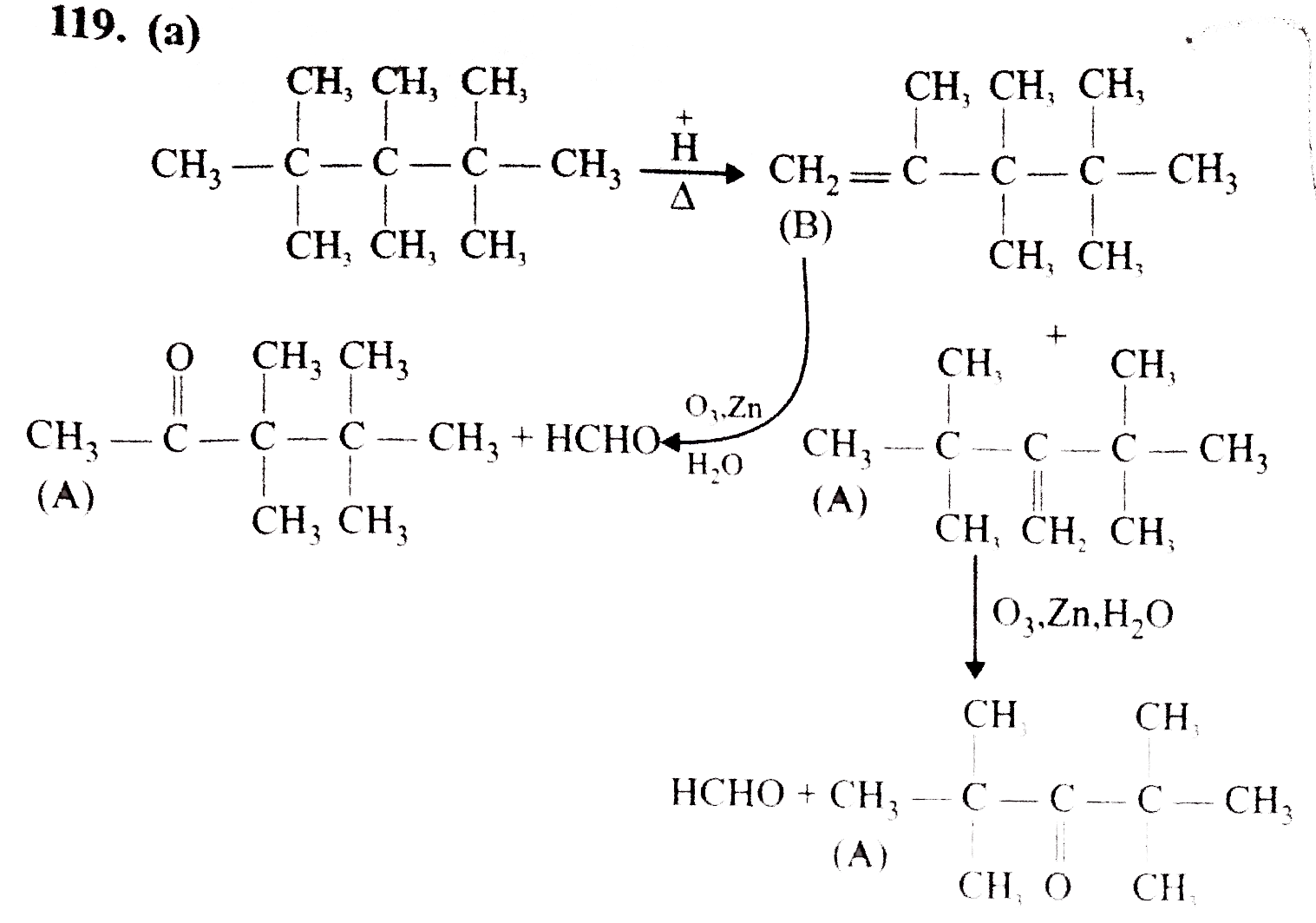
Dehydration of 2,2,3,4,4-pentamethy 1-3-pentanol gave two alkenes A and B. The ozonolysis product of A and B are |
|
Answer»
|
|
| 24. |
Dehydration of 1-butanol or 2-butanol with conc. H_2SO_4 always gives the same mixture of 2-butene (80 %) and 1-butene (20 %) but dehydrohalogenation of 1-bromobutane with alc. KOH gives 1-butene as the major product while that of 2-bromobutane gives 2-butene as the major product . Explain why ? |
Answer» Solution :During dehydration of alcohols , carbocations are the intermediates. In CASE of 1 butanol , first `1^@` carbocation is FORMED which being less stable rearranges to the more stable `2^@` carbocation before losing a proton to form a mixture of 2-butene (80 %) and 1-butene (20%) . 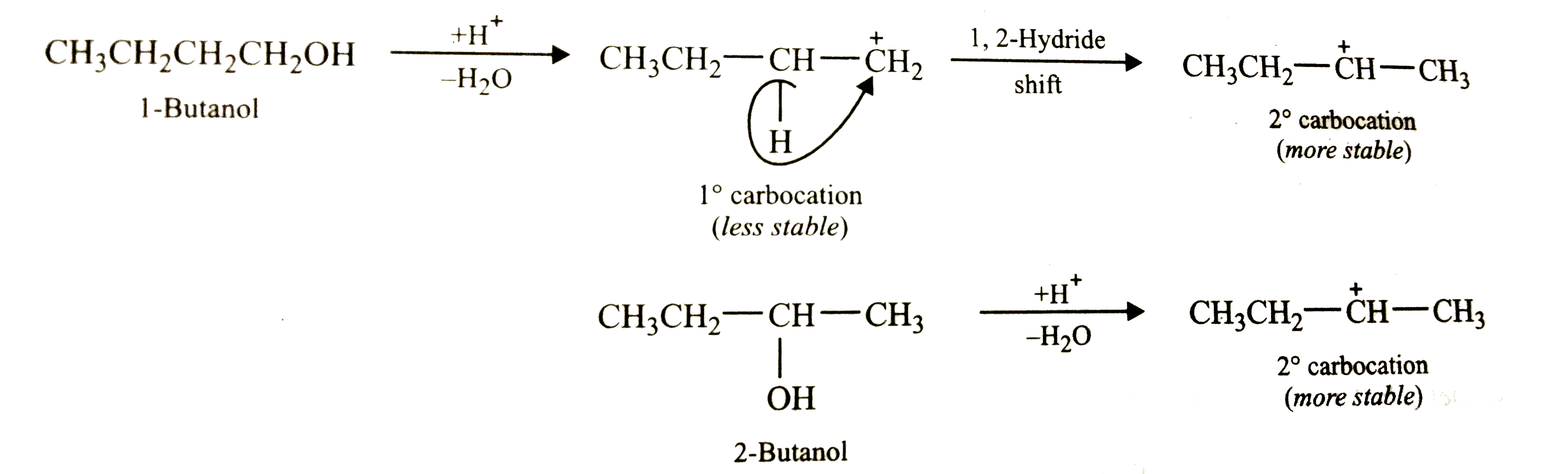 Since 1-butanol and 2-butanol give the same carbocation intermediate, therefore , on losing a proton, both give the same mixture of 2-butene (80%) and 1-butene (20%) in accordance with the Saytzeff's rule. In case of dehydrohalogenation of alkyl halides with alc. KOH , carbocations are not the intermediates. Instead the reaction occurs by a concerted mechanism involving a transition state . Further , since in 1-bromobutane, there is `beta`-H only on left side of `alpha`-carbon carrying the Br atom, therefore , only 1-butene is formed as the major product. however, in 2-bromobutane there are `beta`-H ONE either side of the `alpha`-carbon carrying the Br atom, therefore, elimination of a proton can occur from either `beta`-H leading to the formation of a mixtures of ALKENES . Since according to Saytzeff rule, 2-butene is more stable than 1-butene, therefore, dehydrohalogenation of 2-bromobutane gives 2-butene as the major product. 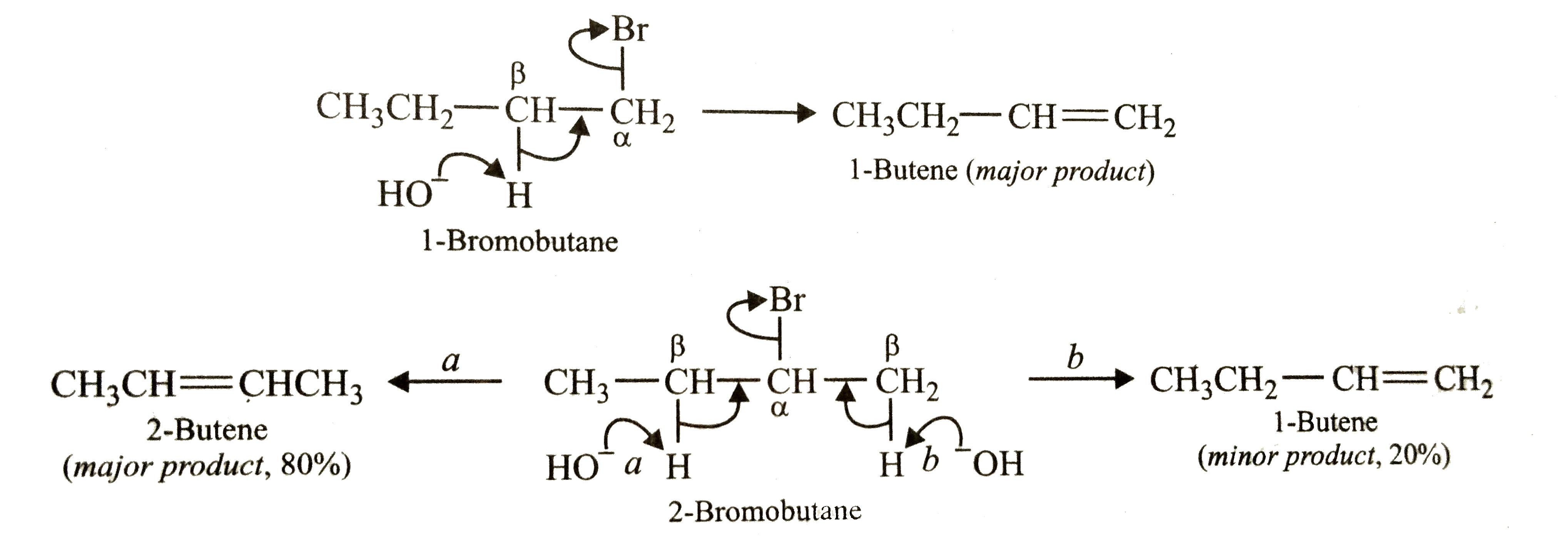 |
|
| 25. |
Dehydration means |
|
Answer» REMOVAL of HYDROGEN molecule from ADJACENT carbons |
|
| 26. |
Degree of ionization depends on which factor. |
| Answer» SOLUTION :It depends on (i) STRENGTH of BOND (II) solution of IONS produced. | |
| 27. |
Degree of liness of water is expressed in terms of ppm of |
|
Answer» CAO |
|
| 28. |
Degree of hardness of a water sample is 100ppm. If that sample contains hardness causing salt Mg(HCO_3)_2,calculate weight of Ca(OH)_2required for the treatment of 10kg of water sample. |
|
Answer» Solution : Degree of hardness is 100ppm. Thus `10^(6)` g of HARD WATER contains 100g of `CaCO_(3)` which is equivalent to 146g of `MG(HCO_(3))_(2)` Weight of `Mg(HCO_(3))_(2)` present in 10kg of water `=(146xx10^(4))/(10^(6))=1.46g` `Mg (HCO_(3))_(2)+2CA(OH)_(2)to2CaCO_(3)+Mg(OH)_(2)+2H_(2)O` 146g of Mg`(148zxx1.46)/(146)=1.48g` |
|
| 29. |
Degensrate atomic orbitals have : |
|
Answer» EQUAL energy in absemce of magnetic FIELD |
|
| 30. |
Deflection back of a few particles on hitting thin foil of gold shows that |
|
Answer» NUCLEUS is heavy |
|
| 31. |
Define'molarheat capacity' |
| Answer» Solution :MOLAR heat capacity of a SUBSTANCE is DEFINED as the amount of heat required to raise the TEMPERATURE of one mole of the substance through the `1^(@)C`. | |
| 32. |
Define Zeroth law of thermosynamics (or Law of thermal equilibrium. |
| Answer» Solution :ZEROTH LAW of thermodynamics states that .If two systems at different temperatures are separately in thermal equilibrium with a third ONE then they TEND to be thermal equilibrium with themselves. . | |
| 33. |
Define Wave number. |
| Answer» Solution :It is the NUMBER of waves present PER meter and is EQUAL to the reciprocal of wavelength. `(1/(LAMDA))=barv` | |
| 34. |
State Zerothlaw of thermodynamic. |
| Answer» Solution :Zeroth law of thermodynamics states that .If TWO SYSTEMS at DIFFERENT temperatures are SEPARATELY in thermal equilibrium with a third one, then they tend to be in thermal equilibrium with themselves | |
| 35. |
Define Walden inversion. |
| Answer» SOLUTION :The attach of nucleophile OCCURS from the back side (i.e., opposite to the side in which the HALOGEN is attacked). The carbon at which substitution occurs has inverted configuration during the course of reaction just as an UMBRELLA has tendency to invert in a WIND storm. this inversion of configuration is called walden inversion. | |
| 36. |
DefineVolumepercentage . |
|
Answer» Solution :Volume PERCENTAGE is defined as the ratio of volume of SOLUTE in ML to the volume of solution in ml multiplied by 100. Volume percentage = `("Volume of solute (in mL)")/("Volume of solution (in mL)") XX 100` |
|
| 37. |
Define visocity of a liquid. |
| Answer» Solution :The INTERNAL resistance to the FLOW of the liquids which one LAYER offers to another layer trying to pass over is called its VISCOCITY. It depends upon the nature of the LIQUID and temperature. | |
| 38. |
Define Van't Hoff factor. |
|
Answer» SOLUTION :van.tHoff FACTOR (i) is defined as the ratio of the actual molar MASS to the ABNORMAL molar mass of the solute. `I = ("Normal (actual) molar mass")/("Abnormal (observed) molar mass")` `I = ("Observed colligative property")/("Calculate colligative property")` |
|
| 39. |
Define vander waals radius. |
| Answer» Solution :It is half the distance between the NUCLEI of NON bonded ATOMS of neighbouring molecules in a solid. | |
| 40. |
Define valency . How is it determined ? |
| Answer» Solution :The valency of an element MAY be defined as the combining capacities of elements. The electrons present in the outermost SHELL are CALLED valence electrons and these electrons determine the valency of the ATOM. | |
| 41. |
Define- Valency. |
| Answer» Solution :Define VALENCY of an ELEMENT MAY be defined as the combining capacities of elements. The electrons present in the outermost shell are CALLED valence electrons and these electrons DETERMINE the valency of the atom . | |
| 42. |
Define - Valency. |
| Answer» SOLUTION :The VALENCY of an element may be defined as the combining capacities of elements. The electrons PRESENT in the outermost SHELL are called valence electrons and these electrons determine the valency of the ATOM. | |
| 43. |
Define torsional strain. |
| Answer» Solution :To CHECK the increased repulsive forces, molecule will have to possess more energy and thus has lesser STABILITY. The repulsive interaction between the electron clouds, which affects stability of a conformation is called torsional STRAIN. | |
| 44. |
Define third law of thermodynamic. |
| Answer» SOLUTION :The entropy of a perfectly CRYSTALLINE solid may be TAKEN as zero at the absolute zeroof TEMPERATURE. | |
| 45. |
Define the terms, Bond length |
| Answer» SOLUTION :BOND length: It is the EQUILIBRIUM DISTANCE between nuclei of two bonded atoms in a molecule. | |
| 46. |
Define the term 'radiation'. |
| Answer» SOLUTION :RADIATION is the emission and TRANSMISSION of ENERGY through SPACE in the form of waves. | |
| 47. |
Define the term osmotic pressure. Describe how the molecular mass of a substance can be determined by a method based on measurement of osmotic pressure ? |
|
Answer» Solution :`PI = CRT` `pi = (n)/(V)RT` `or pi V = n RT` ` or pi V = (W _(B))/(M _(B)) RT` `or M _(B) = (W_(B) RT)/(piV)` OSMOTIC pressure is INVERSELY proportional to the MOLECULAR mass of the solute. |
|
| 48. |
Define the term isotonic solution. |
|
Answer» Solution :(i) Two solutions having same osmotic pressure at a given tempreture are called ISOTONIC solutions. (II) When such solutions are seprated by a semipermeable MEMBRANE, sovlent flow between one to the other on either direction is same , the net solvent flow between two isotonic solutions is zero. |
|
| 49. |
What are isotonic solutions? |
|
Answer» Solution :(i) Two solution having same osmotic pressure at a GIVEN TEMPERATURE are called istonic solutions. (ii) When such solutions are separated by a semipermeable membrane, solvent FLOW between one to the other on either direction is same. i.e., the net solvent flow between two ISOTONIC solutions is zero. |
|
| 50. |
Define the term 'isotonic solution'. |
|
Answer» Solution :(i) TWO solutions having same osmotic PRESSURE at a given temperature are calledisotonic solutions. (ii) When such solutions are separated by a semipermeable membrane SOLVENT flow between one to the other on either DIRECTION is same i.e. the net solvent flow between the two ISOTONIC solutions is zero. |
|