Saved Bookmarks
This section includes 7 InterviewSolutions, each offering curated multiple-choice questions to sharpen your Current Affairs knowledge and support exam preparation. Choose a topic below to get started.
| 1. |
Density of a gas is found to be 5.46 g//dm^(3) at 27^(@)C and at 2 bar pressure. What will be its density at STP ? |
|
Answer» Solution :`d=(MP)/(RT)`. For the same gas at different temperatures and pressure, `(d_(1))/(d_(2))=(P_(1))/(T_(1))XX(T_(2))/(P_(2))`. Here,`"" d_(1)=5.46 g dm^(-3),T_(1)=27^(@)C=300 K,P_(1)=2" bar"`. At STP,`"" d_(2)=? "" T_(2)=0^(@)C=273 K, P_(2)=1" bar"` `:.(5.46 g dm^(-3))/(d_(2))=(2" bar" )/(300 K)xx(273 K)/(1" bar" )` or `"" d_(2)=3 g dm^(-3)` |
|
| 2. |
Density of a gas is found to be 5.46 g//dm_(3) at 27 ^(@)C at 2 bar pressure. What will be its density at STP? |
|
Answer» <P> Solution :The molecular mass of a gas is given by `M=(dRT)/P`Since, molecular mass does not change with temperature or pressure, in two different SETS of conditions, we have `(d_1 RT_1)/P_1 =(d_2 RT_2)/P_2` (given condition) (at S.T.P.) or `(5.46 xx R xx 300)/2 = (d_2 xxRxx 273)/1` or `d_2 =(5.46xx300)/(2xx273)=3 g/dm^3` |
|
| 3. |
Density of a gas is __________ |
|
Answer» DIRECTLY proportional to PRESSURE |
|
| 4. |
Density of a gas is found to be 5.46 g dm^-1 at 27^@C and 2 bar pressure. What will be density at STP? |
|
Answer» Solution :d = PM/RT For the same gas (i.e,, same M) at different temperatures and PRESSURES, we can WRITE `d_1/d_2 = P_1/T_1 XX T_2/P_2` `d_1 = 5.46g dm^-3,P_1` = 2 bar,`T_1` = 300K At STP,`P_2` = 1 bar,`T_2` = 273 therefore `5.46/d_2 = 2xx273/300xx1` ` therefore d_2 = (300xx1xx5.46)/(2xx273) = 3g dm^-1` |
|
| 5. |
Density of a crystal remains unchanged as a result of |
|
Answer» IONIC DEFECT |
|
| 6. |
Density of a gas at one atm pressure is 1.43xx10^(-2)g c c^(-1). Calculate the RMS velocity of the gas. |
|
Answer» Solution :DENSITY`=d= 0.0143g c c^(-1)` Pressure`=P=1atm= 76cmHg= hd g ` ` = 76 XX 13.6 xx 980.6` ` = 1.0133 xx 10^6g cm^(-1) s^(-2)` RMS velocity (C ) `= sqrt(( 3 P)/( d))` Substituting the VALUES, RMS velocity of the gas = ` sqrt((3 xx 1.0133 xx 10^6 )/(0.143 ) ) = 4.16 xx 10^4cms^(-1)` ` =461ms^(-1)` |
|
| 7. |
The density of 3M Na_2S_2O_3 is 1.25 g/cc. Calculate the mole fraction of Na_2S_2O_3 and molality of thiosulphate. |
|
Answer» |
|
| 8. |
Density of a 2.05 M solution of acetic acid in water is 1.02 g/mL. The molality of the solution is: |
|
Answer» `1.14 mol KG^(-1)` M = Molarity, MI = Molecular mass, d = density `therefore m=(2.05)/((1000 xx 1.02)-(2.05 xx 60)) xx 1000` `=2.28 mol kg^(-1)` |
|
| 9. |
Density of 84% pure sulpuric acid in aqueous solution is 1.75 g cc^(-1) . Find the molarity of the acid solution. |
|
Answer» |
|
| 10. |
Densities of diamond and graphic are 3.5 and 2.5 gm/ml. C_("daimond") hArr C_("graphite") , Delta_(t)H = -1.9 KJ/ mole favourable conditions for formation of diamond are |
|
Answer» HIGH PRESSURE and LOW TEMPERATURE |
|
| 11. |
Demericuration allows markownifoff's addition of H,OH without rearrangement. The net result is the addition of H_(2)O. Answer the following question. Q. CH_(3)-underset(CH_(3))underset(|)overset(CH_(3))overset(|)(C)-CH=CH_(2)underset(ii.CH_(3)OH//NaBH_(4)//NaOH)overset(i.Hg(OAc)_(2).THF)toAoverset(HI(conc.))toB, product B is |
|
Answer» `(CH_(3))_(3)C UNDERSET(OCH_(3))underset(|)(C)H-CH_(3)` |
|
| 12. |
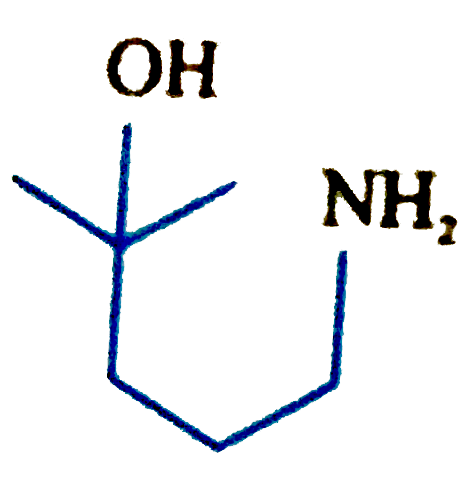
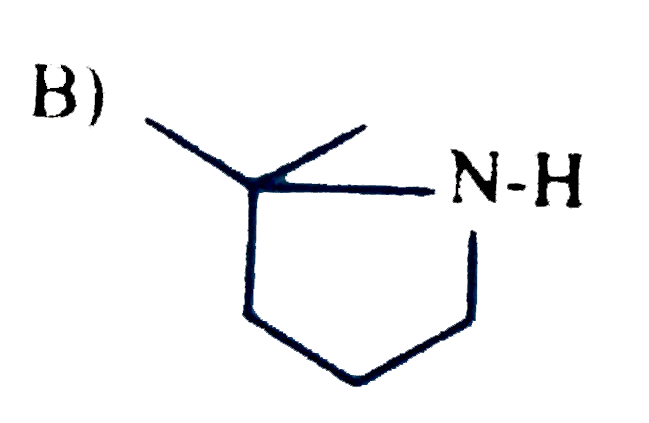
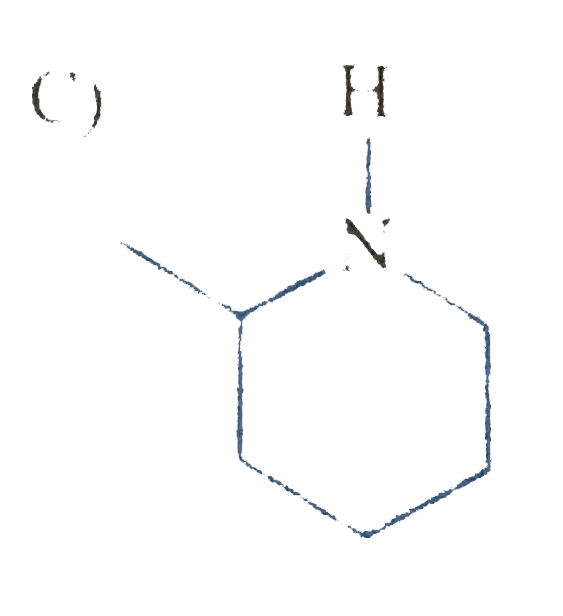
Demericuration allows markownifoff's addition of H,OH without rearrangement. The net result is the addition of H_(2)O. Answer the following question. Q. |
|
Answer»
|
|
| 13. |
Demericuration allows markownifoff's addition of H,OH without rearrangement. The net result is the addition of H_(2)O. Answer the following question. Q. The product 'C' formation from B occurs through |
|
Answer» ENOL formation |
|
| 14. |
DeltaU^(@) of combustion of methane is -X kJmol^(-1). The value of DeltaH^(@) is : (i) = DeltaU^(@)(ii)gt DeltaU^(@)(iii) lt DeltaU^(@)(iv) = 0 |
|
Answer» Solution :The BALANCED equation for combustion of methane will be `CH_(4)(g) + 2O_(2)(g) rarr CO_(2)(g) +2H_(2)O(l)` Thus, `Deltan_(g)= (n_(p) -n_(r))_(g)= 1 -3= -2` `DeltaH^(@) LT DeltaU^(@) + Deltan_(g) RT = - X - 2RT` Thus, `DeltaH^(@)lt DeltaU^(@)` . Hence, (iii) is the correct answer. |
|
| 15. |
DeltaU^(@) of combustion of methane is -X kJ"mol"^(-1).The value of DeltaH is |
| Answer» | |
| 16. |
DeltaU^Ө of combustion of methane is -X "kJ mol"^(-1) . The value of DeltaH^Ө is _____ |
| Answer» SOLUTION :` LT DeltaU^Ө` | |
| 17. |
DeltaU is equal to |
|
Answer» ISOCHORIC work `DeltaU = q + W` or `DeltaU = w` |
|
| 18. |
DeltaU= -10.5 Kj and DeltaS^(@)=-44.2 J/Kelvin for the reaction 2x_((g)) + y_((g)) to 2z_((g)) at 298 K temperature. Find the Delta_(f) G^( @) for the reaction. Reaction will be spontaneous or not ? Why ? |
| Answer» SOLUTION :`Delta_(F) G^(@)=+0.193` KJ/mol | |
| 19. |
DeltaS is expected to be maximum for the reaction…......... |
|
Answer» `Ca_((s))+1//2O_(2(g))toCaO_((s))` |
|
| 20. |
DeltaS is expected to be maximum for the reaction _____ |
|
Answer» `Ca_((s)) + 1//2O_(2(G)) to CaO_((s))` |
|
| 21. |
Delta_(r) G^(@)= - RT " In K. For the same reaction at the same temperature using " K_(p) and K_(p) " the values "Delta _(r)G^(@) "are found to be different . Why ? |
| Answer» Solution :The numerical value of equilibrium constant depends upon the standard state chosen for expressing concentrations or pressures. In CASE of pressures, the standard state chosen is 1 bar wheras in case of concentrations, standard state chosen is `1" MOL "L^(-1). " HENCE " , Delta_(r) G^(@)` VALUES are DIFFERENT. | |
| 22. |
DeltaH_(f)^(@) of water is -285.5 KJ mol^(-1). If enthalpy of neutraliztion of monoacidic strong base is -57.3KJ mol^(-1) then DeltaH_(f)^(@) of OH^(-) ion will be : |
|
Answer» `-285.5KJmol^(-1)` |
|
| 23. |
DeltaH_("neutralisation") is always |
|
Answer» positive |
|
| 24. |
DeltaH for the reaction at 298 K CO(g)+1//2O_(2)(g) is 282.85 KJ mol^(-1). Calculate DeltaU of the reaction. |
| Answer» SOLUTION :`DeltaU=283.85KJmol^(-1)` | |
| 25. |
(DeltaH-DeltaU) for the formation of carbon monoxide (CO) from its elements at 298 K is : (R=8.314 JK^(-1)mol^(-1)) |
|
Answer» 1238.78 J `MOL^(-1)` |
|
| 26. |
DeltaHand Delta Sfor the vaporisation of water at 1 atm pressure are 40.63kJ mol^(-1) and 108 . 8 JK^(-1) mol^(-1) respectively. Calculatethe temperatureat which the freeenergy for this transformation will be zero. Predict, giving reasons, the sign of free energy change (Delta G) above this temperature. |
|
Answer» |
|
| 27. |
DeltaH and DeltaS for certain reaction are -10KJ and - 44J/K, DeltaG^@ is |
|
Answer» `+3112 J`, NON -SPONTANEOUS |
|
| 28. |
deltaG^(o) vs T plot in the Ellingham's diagram slopes downaward for the reaction. |
|
Answer» Mg + `1/2 O_2 rArr` MgO |
|
| 29. |
DeltaG is net energy available to do useful work and is thus a measure of "free energy " . Show mathematically that DeltaG is a meausre of free energy. Find the unit ofDeltaG. Ifa reaction has positive enthalpy change and positive entropy change, under what condition will condition will the reaction be spontaneous ? |
|
Answer» Solution :(i) Referto art (ii)As - `DeltaG = w_("useful"), ` THEREFORE, `DeltaG` has the same units those of work viz. JOULE. (III) `DeltaG = DeltaH- T DeltaS`. If `DeltaH = +ve` and` DeltaS = +ve` , then `DeltaG` will be negative, i.e., process will be spontaneous only when `T DeltaS GT DeltaH`in magnitude , which will be so when temperature T is high. |
|
| 30. |
DeltaG is net energy available to do useful work and is thus a measure of "free energy". Show mathematically that DeltaG is a measure of free energy. Find the unit of DeltaG. If a reaction has positive enthalpy change and positive entropy change, under what condition will the reaction be spontaneous ? |
|
Answer» Solution :Gibbs free energy is that thermodynamic quantity of a system, the decrease in whose value during a process is equal to the maximum POSSIBLE useful work that can be obtained from the system. Mathematically, this results may be derived as follows : The relationship between heat absorbed by a system Q, the change in its internal energy, `DeltaU` and the work done by the system is given by the equation of the first law of thermodynamics, therefore, `q= Delta U + W_("expansion") + W_("non-expansion") ...(i)` Under constant pressure condition, the expansion work is given by `pDeltaV`. `therefore Delta U + p Delta V = W_("non-expansion")` `= Delta H+ W_("non-expansion") ""...(ii)` For a reversible change taking place at constant temperature, `DeltaS= (q_("rev") )/( T) "or" q_("rev") = T Delta S""...(iii)` Substituting the value of q from Eq. (iii) in Eq. (ii), we get `T Delta S =Delta H + W_("non-expansion")` OR `Delta H - T Delta S =- W_("non-expansion") ""...(iv)` Substituting this value in equation (iv), we get `DeltaG= - W_("non-expansion") ""...(v)` THUS, free energy change can be taken as a measure of work other than the work of expansion. For most changes, the work of expansion can not be converted to other useful work, whereas the non-expansion work is convertible to useful work. Rearranging equation (v), it may be WRITTEN as `-Delta G= W_("non-expansion")= W_("useful")` As `- Delta G = W_("useful")` therefore, `Delta G` has the same units as those of work i.e., joule `Delta G = Delta H - T Delta S` If `Delta H = ` positive and `Delta S=` positive, then `DeltaG` will be negative i.e., process will be spontaneous only when `T DeltaS gt Delta H` in magnitude, which will be so when temperature is high. |
|
| 31. |
Delta_(f)U^(@) of formation of CII_(4)(g) at certain temperature is -393 kJ"mol"^(-1).The value of Delta_(f)H^(@) is |
|
Answer» zero For the reaction, `C(s) + 2H_(2)(g) to CH_(4)(g)` `therefore Deltan_(g) = 1 -2 = -1` `therefore Delta_(f)H^(@) = Delta_(f)U^(@) - 1RT` or `Delta_(f)U^(@) = Delta_(f)H^(@) + RT` or `Delta_(f)H^(@) lt Delta_(f)U^(@)`. |
|
| 32. |
Delta_(f)U^(c-) of formationof CH_(4)(g) at certaintemperature is-393kJ mol^(-1) . Thevalue of Delta_(f)H^(c-) is |
|
Answer» zero `Deltan_(g) = ( n_(p)-n_(r))_(g)=1-3= -2` `Delta_(f)H^(@) =Delta_(f)U^(@) + Deltan_(g) RT` As`Deltan_(g) = - 2 , Delta_(f)H^(@)lt Delta_(f) U^(@)` . |
|
| 33. |
DeltaG^(@)for a reactionis 46.06kcal//mole , K_(p) for the reaction at 300K is |
|
Answer» <P>`10^(-8)` `=46.06 xx 1000xx4.184J mol^(-1)` `DeltaG^(@) = - RT lnK_(p)=- 2.303 RT logK_(p)` ` 46.06 xx 1000 xx 4.184 = - 2.303 xx 8.314 xx 300 log K_(p)` or `log K_(p) = - 33.55 `or`K_(p) =10^(-33.55)` |
|
| 34. |
DeltaE is always positive when |
|
Answer» system absorbsheat and work id done on it. |
|
| 35. |
Delta U^( Theta ) of combustion of methane is -X kj mol""^(-1). The value of Delta H^( Theta ) is…. |
|
Answer» `= DELTA U^( Theta )` `therefore Deltan_((g)) = -2` `therefore Delta H^( Theta ) lt DeltaU^( Theta )` |
|
| 36. |
DeltaS_("says") "for" 4Fe_((s)) + 3O_(2) rarr 2Fe_(2) O_(3(s)) " is" -550 J//k//mol at 298K. If enthalpy change for same process is -1600kJ//mol, DS_("total") (in J/mol/K) is |
|
Answer» `[(1600)/(298) XX 10^(3)] + 550 GT 0` `= Delta S+ ((-Delta H)/(T)) = -550 + ((-(-1600))/(298) xx 10^(3))` `= (1600)/(298) xx 10^(3) - 550 gt 0` |
|
| 37. |
DeltaS_("surr") " for " H_(2) + 1//2O_(2) rarr H_(2)O, DeltaH -280 kJ at 400K is |
|
Answer» 700 J/g/K |
|
| 38. |
DeltaS for vapousization of 900 g water (in KJ//K) is [DeltaH_(vap) = 40 KJ//mol] |
|
Answer» `(900 XX 40)` |
|
| 39. |
Delta S for 4Fe _((s)) + 3 O _(2(g)) to 2 Fe _(2) O _(3 (s)) is -550 J/mole/K.The process is found to be spontaneous even at 298K because [Delta H =- 1660kJ] |
|
Answer» `Delta S _("TOTAL ") =- 2000 J ` |
|
| 40. |
Standard entropies ofH_(2)(g),O_(2)(g) " and "H_(2)O(l) are respectively 126.6,201.2 and 68JK^(-1)mol^(-1) Determine DeltaS" for "2H_(2)(g)+O_(2)(g) to 2H_(2)O(l) at 25^(@)C. |
|
Answer» `-574` |
|
| 41. |
Delta molecular orbitals are formed by _________ a |
|
Answer» `d_(xy) and d_(yz)` |
|
| 42. |
Delta HI^(@) of diamond is |
|
Answer» 0 KJ `m o l^(-1)` |
|
| 43. |
Delta H_(f) or BaCO _(3 (s)), CO _(2(g)), HCl _((aq)) and H _(2) O _((l))respectively are -1216, -393, -176 and - 286 KJ//mol. Then Delta H _(f) of BaCl _(2 (aq)) from BCo _(3 (s)) + 2HCl _((aq)) to BaCl _(2 (aq)) + CO _(2 (g)) + H _(2) O_((l))’ Delta H =- QKJ |
|
Answer» `(889-Q)KJ` |
|
| 44. |
The enthalpy of combustion of cyclohexane cyclohexene and H_2 are respectively -3920, -3800 and -241 KJ mol^(-1). The heat of hydrogenation of cyclohexene in KJ mol^(-1) is |
|
Answer» `-205 KJ ` |
|
| 45. |
In which of the following equations Delta H^(0) reaction equal to Delta H_(f)^(0) for the product? |
|
Answer» `2CO _((g)) + O_(2(g)) to 2 CO _(2(g))` |
|
| 46. |
DeltaH of combustion of yellow P and red P are - 11 K.J and -9.78 KJ respectively DeltaH of transition of yellow P to Red P is |
|
Answer» `-20.78 K.J` |
|
| 47. |
Delta Hfor the reaction H-C-= N(g) + 2H_(2)(g) rarr H - underset(H) underset(|)overset(H ) overset(|)(C) - overset(H) overset(|)(N) - H (g) is - 150 kJ . Calculate the bond energy ofC -= Nbond. [ Given bond energies of C-H= 414 kJ mol^(-1), H-H= 435kJ mol^(-1), C-N = 293kJ mol^(-1), N-H =396 kJ mol^(-1)] |
|
Answer» `- 150 = [ B.E. ( C-H) + B.E.(C-=N) + 2B.E.( H-H) ]-[3 xx B.E. (C-H) + B.E.(C-N) + 2 xx B.E. (N-H)]` |
|
| 48. |
Zn_((s)) + Cu_((aq))^(+2) -> Cu_((s)) + Zn_((aq))^(+2), DeltaG = -XKJ, Cu_((s)) + 2Ag_((aq))^(+) rarr 2Ag_((s)) + Cu_((aq))^(+2), DeltaG = -Y KJ, then DeltaG for Zn_((s)) + 2Ag_((aq))^(+) rarr 2Ag_((s)) + Zn_((aq))^(+2) will be (in KJ) |
| Answer» ANSWER :A | |
| 49. |
DeltaH for the formation of XY is -200 kJ mol^(-1).The bond enthalpies of X_2, Y_2, and XY are in the ratio 1:0.5:1. Then determine the bond enthalpies. |
|
Answer» Solution :Let the BOND enthalpy of `X _(2)` is a, `Y_(2)` is (a/2) and XY is `a. (1)/(2) X _(2) + (1)/(T) Y_(2) to XY: Delta H =- 200 KJ` Heat of reaction `, Delta H = ` (Enthlpy ofbond DISSOCIATION ) - (Enthalpy of bond forming) `= ((a)/(2) +(a)/(4)) - (a) =- 200 kJ =- (a)/(4) (or) a =800 kJ` The bond enthalpy of `X _(2) = 800 kJ mol ^(-1), Y_(2) = 400 kJ mol ^(-1) and XY = 800 kJ mol ^(-1)` |
|
| 50. |
In the conversion of lime stone to lime, CaCO_(3(s)) rarr CaO_((s)) + CO_(2(g)), the values of Delta H^(@) and Delta S^(@) are + 179.1 kJ mol^(-1) and 160.2 JK^(-1) mol^(-1) respectively at 298K and 1 bar. Assuming, Delta H^(@) and Delta S^(@) do not change with temperature, temperature above which conversion of lime stone to lime will be spontaneous is |
|
Answer» `+2734` |
|