

Saved Bookmarks
This section includes 7 InterviewSolutions, each offering curated multiple-choice questions to sharpen your Current Affairs knowledge and support exam preparation. Choose a topic below to get started.
| 1. |
Derive the equation of ionization constant (K_b) of weak base. |
|
Answer» Solution :The general EQUATION of weak base is MOH. The ionization of base MOH can be REPRESENTED by equation. `{:("Equilibrium:",MOH_((AQ))+(aq)HARR, M_(aq)^(+)+,OH_((aq))^(-)),("CONCENTRATION M:",C M, 0,0),("Change in conc.:", -C alpha, +C alpha, +C alpha),("Concentration at equili. in molarity:",C-Calpha,(0+Calpha),(0+Calpha)),(,=C(1-alpha),=Calpha,=Calpha):}` where , C=Initial concentration of base in molarity . `alpha`= The ionization degree of base `therefore` Amount of ionization MOH = `Calpha` `therefore` The concentration decrease in base when equilibrium is reached =`Calpha M` `therefore` At equilibrium concentration of MOH= `(C-Calpha)=C(1-alpha)` Equilibrium `[M^+]=[OH^-]=Calpha M` On equilibrium reaction in solution of MOH base. `K=([M^+][OH^-])/([MOH])`=[Ionization constant `K_b` of weak base ] `therefore K_b=([M^+][OH^-])/"[MOH]"=([OH^-]^2)/([MOH])` ....(Eq.-i) `[OH^-]=sqrt(K_b. [MOH])` ...(Eq. ii) So, `K_b=((Calpha))/(C(1-alpha))=(Calpha^2)/(1-alpha)` ...(Eq.-iii) This equation -(i,ii) and (iii) are ionization constant equations of ionic equilibrium of weak base. |
|
| 2. |
Derive the equation for calculation of pH of acidic buffer solution. |
|
Answer» Solution :Acetic acid and sodium acetate mixture act as acidic buffer solution. And its pH is APPROXIMATE 4.75 The relation between pH, `K_a` , HA and `A^-` is given as follows : The equilibrium of ionization of weak acid HA in water. `HA+H_2O hArr H_3O^(+) + A^(-)` `K_a=([H_3O^+][A^-])/([HA])` `therefore [H_3O^+]=K_a ([HA])/([A^-])` taking log both the side log `[H_3O^+]=log K_a+ "log" "[HA]"/([A^-])` taking minus sign both the side, `-log [H_3O^+]=-log K_a-log ([HA])/([A^-])` `therefore pH=pK_a + "log" ([A^-])/([HA])`....(Eq.-i) `pH=pK_a + "log" "[Conjugate base]"/"[Acid [HA]]"`....(Eq.-ii) This EQUATION -(ii) is called Hendrson-Hasselbalch equation In this equation of value : (i)`([A^-])/([HA])` is the ratio of concentration of conjugate base concentration of weak acid (negative ION). (ii)[HA] is weak acid . So, it UNDERGO very less ionization so the concentration of [HA] is negligible compare to initial concentration . (iii) The around of conjugate base is due to ionization of salt . So the concentration of conjugate base is also differ from of initial concentration . So equation can be , pH=`pK_a+"log" "[Salt]"/"[Acid]"`.....(Eq.-iii) |
|
| 3. |
Derive relationb between density and pressure of gas by using of Boyle.s law. |
|
Answer» Solution :Prove d = k.p : density of GAS `(d)=("mass of gass (m)")/("volume of gas (V)")` `THEREFORE V=(m)/(d) ""`….(EQ. - VI) According to Boyle.s law, `pV=k_(1)` Put `V=(m)/(d)` in `pV=k_(1)` `therefore p ((m)/(d))=k_(1) ""`.....(Eq. - vii) `therefore d=("pm")/(k_(1))` `therefore d=((m)/(k_(1)))p=k. p ""`....(Eq. - viii) where, `(m)/(k_(1))=k.` ..Equation - viii INDICATED that at (a) constanst temperature (T) pressure (p) of fixed amount (n) of any gas is directly proportional to density (d)... |
|
| 4. |
Derive relation of pH and pOH. |
|
Answer» Solution :The ionic EQUILIBRIUM of dissociation of WATER at 298 K temperature is as under. `H_2O_((l)) + H_2O_((l)) hArr H_3O_((aq))^(+) +OH_((aq))^(-)` `K_W=[H_3O^+][OH^-]=1.0xx10^(-14)` Take negative logarithm at both side, -log `K_W=-{log {[H_3O^+][OH^-]}=-log (1xx10^(-14))}` `therefore -log K_W= - log [H_3O^+] -log [OH^-]=-(-14)` but -log `[H_3O^+]=pH` -log `[OH^-]`=pOH So, -log `K_W=pK_W` So, `pK_W=pH+pOH`=14.0 `pK_W`is a very important QUANTITY for aqueous solutions and CONTROLS the relative concen trations of HYDROGEN and hydroxyl ions as their product is a constant. |
|
| 5. |
Derive relation between equilibrium constant K, Reaction quotient Q and Gibbs energy change (DeltaG). |
|
Answer» Solution :According to equilibrium the mathematical THERMODYNAMIC equation is as follow. `DELTAG=DeltaG^(ө)+RT` ln Q ….(Eq.-i) where , `DeltaG^(ө)` = Standard Gibbs force energy change `DeltaG`=Non-standard gibbs energy change R=Gas constant = 8.314 J `"MOL"^(-1) K^(-1)` T = Temperature in Kelvin at equilibrium Q = Reaction quotient Reaction at equilibrium, `DeltaG = 0` and `Q = K_c`. According to equation 7.30 as below, `therefore 0=DeltaG^(ө)+RT` ln K `therefore DeltaG^(ө)`=-RT ln K `therefore` ln K= `-(DeltaG^ө)/(RT)`...(Eq.-ii) In equation taking antilog of both SIDES `K=e^(-DeltaG^(ө//RT))`...(Eq-iii) Reaction of spontaneity and Value of `DeltaG^(ө)` : If `DeltaG lt0`, then `-DeltaG^(ө)//RT` is positive and `e^(-DeltaG^(ө)//RT) gt 1`, making K `gt`1. Which implies a spontaneous reaction or the reaction which proceeds in the forward direction to such an extent that the products are present PREDOMINANTLY. If `DeltaG^(ө) gt 0` , then `DeltaG^(ө)//RT` is negative and `e^(-DeltaG^(ө)//RT) lt 1`, that is `K lt 1`. Which implies a non-spontaneous reaction or a reaction which proceeds in the forward direction to such a small degree that only a very minute quantity of product is formed. |
|
| 6. |
Derive relation between density (d) and molar mass. |
|
Answer» Solution :According to ideal gas equations, pV = nRT `therefore (p)/(RT)=(n)/(V) ""`…..(Eq. -i) but, Mole `(n) = ("MASS (m)")/("Molecular mass (M)") ""`…..(Eq. -II) Put value of `n =(m)/(M)` in equation -(i) `(p)/(RT)=((m)/(V))(1)/(M)` But, `("Mass (m)")/("Volume (V)")=` gas of density (d) Thus, `(p)/(RT)=(d)/(M) ""` ....(Eq. - iii) By the rearrangement of equation, `therefore d=(PM)/(RT)` and `M=(DRT)/(p) ""` .....(Eq. -iv) This (Eq. -iv) is indicate that molecular mass (M) is directly proportional to density (d)... |
|
| 7. |
Derive relation between density of gases and molecular mass by using of Avogadro.s law. |
|
Answer» Solution :CALCULATION of moles of gas : Gaseous mole `(n)=("Weight of gas (gm)n")/("MOLECULAR mass of gas (M)")` `therefore n = (m)/(M) ""`…..(Eq. - i) where, m = weight of gas M = molecular mass of gas According to Avogadro law of formula : `V = k_(4) n ""`.....(Eq. - ii) `therefore V = k_(4)(m)/(M) ""`...(Eq. - iii) Thus, `M=k_(4)((m)/(V)) ""`......(Eq. -iv) but, `(m)/(V)=` density of gas = d `therefore M = k_(4)d ""`.....(Eq. -v) DERIVATION : ..Density of gas is directly proportional to its molecular mass... |
|
| 8. |
Derive K_w=K_axxK_b and K_w=pK_a+pK_b for weak base B and its conjugate acid BH^+. |
|
Answer» Solution :If weak base B, so equilibrium in its solution is, `B_((aq))+H_2O_((l)) hArr BH_((aq))^(+) + OH_((aq))^(-)` …(i) In above ionic equilibrium of base , the constantis `K_b` and `H_2O_((l))`is taken as constant….. `K_b=([BH^+][OH^-])/"[B]"`...(ii) If this expression is multiplied & DIVIDED by `[H^+]`, `K_b=([BH^+][OH^-][H^+])/([B][H^+])=([OH^-][H^+][BH^+])/([B][H^+])` In it `[OH^-][H^+]=K_w` and `([BH^+])/([B][H^+])=1/K_a` Because , `BH^+` (acid) `hArr B_((aq)) + H_((aq))^(+)` So, `K_b=K_w/K_a` and `K_w=(K_a)(K_b)` According to above, `K_bxx K_a = K_w = 1xx10^(-14)` taking log both the SIDE `THEREFORE (-log K_b)+(-log K_a)=-log K_w= log (1xx10^(-14))` `thereforepK_b+pK_a = pK_w=+14`.....(Eq.-iii) |
|
| 9. |
Derive name of element having 106 atomic number. |
Answer» SOLUTION : REMEMBER : USE SUFFIX " IUM". |
|
| 10. |
Derive K_a xx K_b=K_w equation. |
|
Answer» SOLUTION :`NH_3` (ammonia) is a weak base and conjugate acid of `NH_3` is `NH_4^+` . Following equilibrium is ESTABLISHED in `NH_3`. (i)`NH_(3(AQ)) + H_2O_((l)) hArr NH_(4(aq))^(+) + OH_((aq))^(-)` `K_b=([NH_4^+][OH^-])/([NH_3])` (Suppose `K_b=1.8xx10^(-5)` ) `NH_4^+` is a conjugate acid of `NH_3`.Its equilibrium in aqueous solution act as acid is following (ii)`NH_(4(aq))^(+) + H_2O_((l)) hArr H_3O_((aq))^(+) + NH_(3(aq))` Take ionization constant of weak acid `NH_4^+` is `K_a`, `K_a=([H_3O^+][NH_3])/([NH_4^+])` (Suppose `K_a=5.6xx10^(-10)`) Addition of reaction (i) and (ii) and net reactionis, (i)+(ii) = `2H_2O_((l)) hArr H_3O_((aq))^(+) + OH_((aq))^(-)` This reaction is self equilibrium of water, `K_w=[H_3O^+][OH^-]=1.0xx10^(-14)` `K_b` reaction of (i) x `K_a` reaction of (ii) , `THEREFORE K_axxK_b=([H_3O^+][NH_3])/([NH_4^+])xx([NH_4^+][OH^-])/([NH_3])` `therefore K_a xx K_b= [H_3O^+] [OH^-]= K_w` ....(Eq.-i) e.g., `(5.8xx10^(-10))(1.8xx10^(-5))= 1.0xx10^(-14)` This can be extended to make a generalisation . Thus, one reaction equilibrium constant =`K_1` and SECOND reaction equilibrium constant = `K_2` and reaction (1) + reaction (2) = reaction (3) So, Reaction (iii) `K_3=K_1xxK_2`....(Eq.-ii) |
|
| 11. |
Derive IUPAC name of following: |
Answer» Solution :(i) Decide substituent order in compound-(i)  The (c ) is not comes in lowest order because second no. is 3. In (a) and (b) the third no, `4 lt 5` so, correct lowest locant order is 1, 2, 4. In these, 1- Methoxy, 2-Chloro, 4-METHYL are SUBSTITUENTS in which 1-Methoxy means anisole. It is common name so, name is 2-chloro-4-methyl anisole. (ii) Decide substituent order in compound (ii)  The order of (c ) is not lowest order because second no. `3 gt 2`. In (a) and (c ), the lowest no. of (a) is 1, 2, 4 because in (a) the third no. `4 lt 5`. `:.` Substituents 1 (amino), 2 (methyl) and 4(ethyl). 1-amino i.e. common name in aniline Name : 4-ethyl-2-methylaniline Always, the substituents name are WRITTEN in alphabetical order. (iii) To decide substituents order, the no-1 is given to `-OH` according to common name  In (a) not lowest order but according to common name it is PHENOL and no.-1 is given to `-OH`. Name : 3, 4-dimethyl phenol |
|
| 12. |
Derive ionic product of water. Also find its value at 25^(@)C. |
|
Answer» Solution :When HIGH current is passed through water, it UNDERGOES partial dissocitaion. `H_(2)OhArrH^(+)+OH^(-)` Applying law of mass ACTION, `K=([H^(+)][OH^(-)])/([H_(2)O]),K[H_(2)O]=[H^(+)][OH^(-)]` But `K[H_(2)O]=Kw""thereforeKw=[H^(+)][OH^(-)]` Where, `K_(w)` is the ionic product of water. Value of `K_(w)" at "25^(@)C` : It is found at `25^(@)C[H^(+)]=[OH^(-)]=10^(-7)"mol"//dm^(3)` `therefore" "Kw=[H^(+)][OH^(-)]=10^(-7)xx10^(-7)=10^(-14)("mol"//dm^(3))^(2)` At `25^(@)C` the value of Kw is `10^(-4)("mol"//dm^(3))^(2)` |
|
| 13. |
Derive ideal gas equation from gas laws. |
|
Answer» Solution :Ideal gas EQUATION is obtained by combining all the three like Boyle.s law, `v prop (1)/(P)` at constant T and N. Charles.s law, `v prop T` at constant P and n Avogadro.s law `v prop T` at constant P and When P and T VARY simultaneously, `v prop (nT)/(P) or v=R*(nT)/(P) or (PV= nRT)` Where R is gas constant. This value is same for all gases. so it is also universal gas constant or ideal gas equation. |
|
| 14. |
Derive ideal gas equation. |
|
Answer» SOLUTION :The gaseous state is described completely using the FOLLOWING four variables T, P, V and n. Each gas law relates one variable of a gaseous sample to another while the other two variables are held constant. Therefore, combining all equations into a single equation will enable to account for the CHANGE in any or all of the variables. Boyle.s law : `V PROP 1/P` Charles.s `V prop T` Avogadro .s law `V prop n` We can combine these equations into the following general equation that describes the physical behaviour of all gases. `V prop (nT)/(P)` `V=(nRT)/(P)`, where R = Proportonately constant. The above equation can be rearranged to give PV = nRT - Ideal gas equation. Where, R is ALSO known as Universal gas constant. |
|
| 15. |
Derive defination and explain common ion effect by example . |
|
Answer» Solution :EXAMPLE of common ion effect : Consider an example of acetic acid dissociation EQUILIBRIUM REPRESENTED as : `CH_3COOH_((aq)) hArr H_((aq))^(+) + CH_3COO_((aq))^(-)` `Hac_((aq)) hArr H_((aq))^(+) + Ac_((aq))^(-)` `therefore` Ionization constant `K_a=([H^+][Ac^-])/([HAc])` Addition of acetate ions to an acetic acid solution results in decreasing the CONCENTRATION of Hydrogen ions `[H^+]`. The equilibrium shifts towards the formation of dissociate acid. If the `H^+` ions are added from an external source then the equilibrium moves in the direction of undissociated acetic acid i.e., in a direction of reducing `[H^+]` . This phenomenon is an example of common ion effect. Definationof common ion effect :"It can be defined as a shift in equilibrium on adding a substance that provides more of an ionic SPECIES already present in the dissociation equilibrium. Thus, we can say that common ion effect". The common ion effect is a phenomenon based on the Le-Chatelier.s principle. |
|
| 16. |
Derive de Broglie equation and give its significance. |
|
Answer» Solution :(1)Louis de Boglie extended the concept of dual nature of light to all form of matter.To quantufy this relation,he derived an equation for the wavelength of a matter WAVE. (2)He combined the following two equations of energy of which one represents wave charater(hv) and the other represents the particle nature `(MC^(2))`. Planck.s quantum hypothesis: E=hv.......(1) Einsteins mass-energy relationship: `E=mc^(2)`...............(2)From (1) and (2) hv=`mc^(2)` `hc/gamma=mc^(2)` `therefore gamma=mc^(2)`...........(3) THe equation (3) represents the wavelength of photons whose momentum is given by mc.(Photons have zero rest mass.) (3)For a particle of mater with mass m and moving with a VELOCITY v,the equation(3) can be written as`gamma=h/(MV)`...........(4) (4)This is valid only when the particle travels at speed much less than the speed of light. (5)This equation implies that a moving particle can be considered as wave and a wave can exhibit the properties of a particle(i.e.momentum). (6)Significance of de BROGLIE equation: For a particle with high liner momentum,the wavelength will be too small cannot be observed,For a microscpic particle such as an electron,the mass is `9.1xx10^(-31)`kg.Hence the wavelength is much larger than the size of atom and it becomes significant. |
|
| 17. |
Derive de-Broglie equation. |
|
Answer» Solution :De- Broglie combined the following two equations of ENERGY of which one represents wave character(hu)and the other represents the particle nature `(MC^(2))` . (i)Planck's quantum hypothesis : E = hv (II)Einsteins mass-energy relationship : E = `mc^(2)` From (i) and (ii) hn` = mc^(2)` `hc//lambda= mc^(2)` `lambda = H //mc` The equation represents the wavelength of photons whose momentum is given by mc (Photons have zero rest mass) For a particle of matter mass m and moving with a velocityv, the equation can be written as ` lambda = h //mv ` This is valid only when the particle travels at speeds muchless than the speed of light . |
|
| 18. |
Derive Boyle.s formula according to his law. |
|
Answer» Solution :This Isothermal curve is according to high TEMPERATURE. Boyle.s law :..At constant temperature, the pressure of a FIXED amount (i.e., number of moles n) of gas VARIES inversely with its volume.. Mathematically, it can be written as `p prop (1)/(V)` (at constant T and n) .....(Eq. -i) `therefore p = k_(1)(1)/(V)`.....(Eq.-ii) where, `k_(1)=`PROPORTIONALITY constant, its value depends upon the amount of the gas temperature of the gas and the units in which p and V are EXPRESSED. `pV=k_(1)` (at constant T and n) .....(Eq. -iii) Derivation of `p_(1)V_(1)=p_(2)V_(2)` : Suppose fixed amount of gas at constant temperature (T) occupying volume `V_(1)` at pressure `p_(1)` undergoes expansion , so that volume becomes `V_(2)` and pressure becomes `p_(2)`. According to Boyle.s law at constant T and n, then `p_(1)V_(1)=k_(1)` and `p_(2)V_(2)=k_(1)` `therefore p_(1)V_(1)=p_(2)V_(2)=` constant ......(Eq. -iv) `therefore (p_(1))/(p_(2))=(V_(2))/(V_(1))`.....(Eq. -v) |
|
| 19. |
Derive a general expression for the equilibrium constant K_(P) and K_(C) for the reaction. 3H_(2)(g)+N_(2)(g)hArr2NH_(3)(g) |
|
Answer» Solution :Synthesis of ammonia : `square`Let us consider the formation of ammonia in which, 'a' moles nitrogen and 'b' moles HYDROGEN gas are allowed to react in a container of volume V. Let 'x' moles of nitrogen react with 3x moles of hydrogen to give 2x moles of ammonia. `N_(2)(g)+3H_(2)(g)hArr2NH_(3)(g)`  `square` Applying law of mass ACTION, `K_(C)=([NH_(3)]^(2))/([N_(2)][H_(2)]^(3))` `=(((2x)/(V))^(2))/(((a-x)/(V))((b-3x)/(V))^(3))` `(((4x^(2))/(V^(2))))/(((a-x)/(V))((b-3x)/(V))^(3))` `K_(C)=(4x^(2)V^(2))/((a-x)(b-3x)^(2))` The equilibrium constant `K_(p)` can also be calculated as FOLLOWS : `K_(P)=K_(C)(RT)^((Deltan_(g)))` `Deltan_(g)=n_(P)-n_(r)=2-4=-2` `K_(P)=(4x^(2)V^(2))/((a-x)(b-3x)^(3))(RT)^(-2)` Total number of moles at equilibrium, `n=a-x+b-3x+2x=a+b-2x` `K_(P)=(4x^(2)V^(2))/((a-x)(b-3x)^(3))xx[(PV)/(n)]^(-2)` `K_(P)=(4x^(2)V^(2))/((a-x)(b-3x)^(3))xx[(n)/(PV)]^(2)` `K_(P)=(4x^(2)V^(2))/((a-x)(b-3x)^(3))xx[(a+b-2x)/(PV)]^(2)` `K_(P)=(4x^(2)(a+b-2x)^(2))/(P^(2)(a-x)(b-3x)^(3))` |
|
| 20. |
Derive a general expression for the equilibrium constant K_P and K_C for the reaction. 3H_2(g)+ N_2(g) hArr 2NH_3(g) |
|
Answer» Solution :In the formation of ammonia, .a. moles of Nitrogen and .b. moles of hydrogen gas are allowed to react in a CONTAINER of VOLUME of .V.. Let .x. moles of nitrogen react with 3x moles of hydrogen to give 2x molesof ammonia. `N_2(g)+ 3H_2(g)hArr 2NH_3(g)` 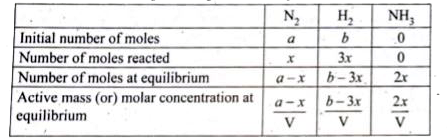 Applying law of mass action `K_C = ([NH_3]^2)/([N_2][H_2]^3) = (((2x)/V)^2)/(((a-x)/V)((b-3x)/(V))^3) = (((4x^2)/(V^2)))/(((a-x)/V)((b-3x)/(V))^3)` `K_C = (4x^2.V^2)/((a-x)(b-3x)^3)` The equilibrium constant `K_P` can be calculated as follow : `K_P = K_C. (RT)^(Deltan_g)` `Deltan_g = n_p - n_r = 2 -4 =-2` `K_P=(4x^2.V^2)/((a-x)(b-3x)^3)(RT)^(-2)` TOTAL number of moles at equilibrium `n = a-x+ b - 3x + 2x = a +b - 2x` `K_P = (4x^2.V^2)/((a-x)(b-3x)^3) xx ((PV)/n)^(-2)` `K_P=(4x^2V^2)/((a-x)(b-3x)^3) xx (n/(PV))^2` `K_P = (4x^2V^2)/((a-x)(b-3x)^3) xx (n/(PV))^2` `K_P = (4x^2V^2)/((a-x)(b-3x)^3) xx ((a+b-2x)/(PV))^2` `K_P = (4x^2 (a + b-2x)^2)/(P^2(a-x)(b-3x)^3)` |
|
| 21. |
Derivce the sturcture of (i) 2-Chlorohexane (ii) Pent -4-en-2-ol (iii) 3-Nitrocyclohexene (iv) Cyclohex-2-en-1-ol (v) 6-Hydroxyheptanal |
|
Answer» Solution :(i) 2-Chlorohexane : .hexane. indicates the PRESENCE of 6 carbon atoms in the chain. The functional group chloro is present at carbon 2. Hence, the structure of the compound is: `CH_(3)CH_(2)CH_(2)CH_(2)CH(Cl)CH_(3)` (ii) Pent -4-en-2-ol: .pent. indicates that parent hydrocarbon contains 5 carbon atoms in the chain. .en. and .ol. correspond to the functional groups C=C and `-OH` at carbon atoms 4 and 2 respectively. Thus, the structure is: `CH_(2) = CHCH_(2) CH (OH)CH_(3)` (iii) 3-Nitrocyclohexene : Six MEMBERED ring containing a carbon-carbon double bond is implied by cyclohexene, which is numbered as shown in (i). The prefix 3-nitro MEANS that a nitro group is present on C-3. Thus, complete structural formula of the compound is (ii). Double bond is suffixed functional group whereas `NO_(2)`is prefixed functional group therefore double bond GETS perference over `-NO_(2)` group:  (iv) Cyclohex-2-en-1-ol: .1-ol. means that a `-OH` group is present at `C-1` Oh is suffixed functional group and gets perference over C=C bond. Thus the structure is as shown in (II).  (v) 6-Hydroxyheptanal: .heptanal. indicates the compound to be an aldehyde containing 7 carbon atoms in the parent chain. The .6-hydroxy. indicates that -H group is present at carbon 6. Thus, the structural formula of the compound is: `CH_(3)CH (OH)CH_(2)CH_(2)CH_(2)CH_(2)CHO` carbon atom of -`CHO` group is included while numbering the carbon chain |
|
| 22. |
Prove that the depression in freezing point is a colligative property. |
|
Answer» Solution :(i) The electrolyte NaCl DISSOCIATES COMPLETELY into its constituent ions in their aqueous solution. This causes an increase in the total NUMBER of particles present in the solution. (ii) When we dissolve 1 mole of NaCl in water. It, dissociates and gives 1 mole of `NA^(+)` and 1 mole of `Cl ^(-).` Hence the solution will have 2 moles of particles. But when we dissolve 1 mole of urea (non electrolyte) in water it appears as 1 mole only. So the colligative property value would be double in NaCl than in urea. |
|
| 23. |
Depression in freezing point for 1 M urea , 1 M NaC1 and 1 M CaCL_2 are in the ratio of |
|
Answer» `1 : 2 : 3` |
|
| 24. |
Depletion of ozone layer over Antarctica takes place during |
|
Answer» NOVEMBER, i.e., arter spring |
|
| 25. |
Depletion of ozone layer causes |
| Answer» Solution :Skin cancer | |
| 26. |
Depletion of ozone layer cause |
| Answer» Answer :C | |
| 27. |
Depict the galvanic cell in which the rection Zn (s) +2 Ag^(+)Ag(aq)rarrZn^(2+)(aq)+2 Ag(s) takes plac further show : (i) which of the electrodie is negatively charged (ii) the carriers of current in the cell and (iii) individula rection at each electrode |
|
Answer» Solution :The given redox reaction is `Zn(s)+2Ag^(+)(aq)rarrrZn^(2+)(aq)+AG(s)` SINCE Zn gets oxidised to `An^(2+)` ionsand `Ag^(+)` gets reduced to Ag metal therefore oxidation occurs at the zinc electrode and reduction occurs at the silver electrode THUS galvanic cell corresponding to the above redox reactionmay be diepiceted as `Zn|Zn^(2+)(aq)||Ag^(+)(aq)|Ag` (i) since oxidation occurs at the zinc electode therefore electrons accumulates on the zinc electode and hence ZIN electrode is negative charged (ii) The ion carry current the electrons FLOW from to Ag electrode while the current flows from Ag to Zn electrode (iii) The reaction occuring at the two electrodeare `Zn(s)rarrZn^(2+)(aq)+21E^(-)` `Ag^(+)(aq)+e^(-)rarrAg(s)` |
|
| 28. |
Depict the galvanic cell in which the reaction Zn_((s))+2Ag_((aq))^(+)toZn_((aq))^(2+)+2Ag_((s)) takes place, Further show : (i) Which of the electrode is negatively charged, (ii) The carriers of the current in the cell, and (iii) Individual reaction at each electrode. |
|
Answer» Solution :Redox reaction : `Zn_((s))+2Ag_((AQ))^(+)toZn_((aq))^(+2)+2Ag_((s))` Here Zn reduced to `Zn^(+2)andAg^(+)` oxidised to AG. Therefore on Zn there is reduction. `Zn|Zn_((aq))^(+2)||Ag_((aq))^(+)|Ag` (i) On Zn electrode their is OXIDATION, therefore on Zn rod the electrons are gathered. Therefore Zn rod is positively charged. (II) Electron flows Zn to Ag electrode and electricity flows Ag to Zn electrode. (iii) Reaction on electrodes : `Zn_((s))toZn_((aq))^(+2)+2e^(-)Ag_((aq))^(+)+2e^(-)toAg_((s))` |
|
| 29. |
Depict the galvanic cell in which the reaction Zn(s) +2Ag^(+)(aq)rarr Zn^(2+)(aq) + 2Ag(s) takes place . Further show : (i) which of the electrode is negatively charged, (ii) the carriers of the current in the cell, and (iii) individual reaction at each electrode. |
|
Answer» Solution :The cell MAY be DEPICTED similar to Fig . The cell may be represented as `Zn(s) |Zn^(2+)(AQ) ||Ag^(+)(aq) |Ag(s)` (i) Zinc electrode (anode) (II) Current will flow from silver to zinc in the external ci+rcuit. (iii) At anode : `Zn(s) RARR Zn^(2+) (aq) +2e^(-)` At cathode : `Ag^(+) (aq) +e^(-) rarr Ag(s)` |
|
| 30. |
Depict the galvanic cell in which the reaction Zn(s)+2Ag^(+)(aq)toZn^(2+)(aq)+2Ag(s) takes place. Further show: (i) which of the electrode is negatively charged? (ii). The carriers of the current in the cell. (iii). Individual reaction at each electrode. |
|
Answer» Solution :`ZN(s)|Zn^(2+)(AQ)||Ag^(+)(aq)|Ag(s)` (i) `Zn//Zn^(2+)` electrode is negatively charged. (ii) Carriers of current in the outer CIRCUIT are electrons which FLOW from Zn electrode to silver electrode. At anode : `Zn(s)toZn^(2+)(aq)+2e^(-)` At cathode : `2AG^(+)(aq)+2e^(-)to2Ag(s)` |
|
| 31. |
Depending on the net charge on the species, there can be migration of the amino acids. Consider the following cases of amino acids and answer the following questions On passing current, ionic species in set M migrates to |
|
Answer» SIDE A |
|
| 32. |
Depending on the net charge on the species, there can be migration of the amino acids. Consider the following cases of amino acids and answer the following questions Consider following equilibrium CH_(3)underset(NH_(2))underset(|)(C)HCO OH hArr CH_(3)-underset(NH_(3))underset(|+)(C)HO O^(-) and select the correct statements (s) |
|
Answer» it is INTERMOLECULAR LEWIS acid BASE reaction |
|
| 33. |
Depending on the net charge on the species, there can be migration of the amino acids. Consider the following cases of amino acids and answer the following questions On passing current ionic species in set up K migrates to |
| Answer» Answer :B | |
| 34. |
dentify the group and valency of the element having atomic number 119. Also predict the outermost electronic configuration and write the general formula of its oxide |
|
Answer» Solution :GROUP ,1 Valency :1 OUTERMOST electronic configuration `8s^(1)` Formula of OXIDE `=M_(2)O` |
|
| 35. |
Density ratio of O_(2) " and " H_(2) is 16 : 1. The ratio of their rms velocities will be : |
|
Answer» `4 : 1` |
|
| 36. |
Density of water is maximum at 4^(@)C. |
| Answer» Solution :Along with covalent bond and hydrogen bond, `H_(2)O` molecule EXISTS in best form from tetrahydral from state by leaving vacant space. When heated from `O^(@)C-4^(@)C` the hydrogen bond breaks and `H_(2)O` molecule comes closer. As a result density increases to MAXIMUM at `0^(@)C`. From `4^(@)C` above, due to heat examples TAKES place by breaking the density decreases. | |
| 37. |
Density of metal is 7.42 ""gcc""^(-1). If the radius of metal atom is 1.43xx10^(-10)m. Calculate the atomic weight of metal. |
|
Answer» |
|
| 38. |
Density of Neon gas at 350 K temperature is 0.9 g L^(-1) then calculate its pressure ? |
|
Answer» <P> SOLUTION :`1.303 " BAR"(p=(DRT)/(M),R=8.314xx10^(2))` |
|
| 39. |
Density of neon will be highest at |
|
Answer» STP |
|
| 40. |
Density of Li atom is0.53 " g/cm"^(3), the edge length of Li is 3.5 Å . Find out the number of Li atoms in a unit cell( N_(0)= 6.023 xx 10^(23) , M = 6.94) |
|
Answer» <P> Solution :The aim is to find Z in the formula ` p = ( Z xx M)/ (a^(3) xx N_(0)) `` Z= ( p xx a^(3) xx N_(0)) /M = ( 0.53 g cm ^(-3) xx ( 3.5 xx 10^(-8) cm)^(3) xx ( 6.023 xx 10^(3) mol^(-1)))/(6.94 " g mol"^(-1))= 1.97 = 2 ` |
|
| 41. |
Density of Li atom is 0.53 g//cm^3 . The edge length of Li is 3.5 Å.Find out the number of Li atoms in a unit cell (N_0=6.023xx10^23 , M=6.94) |
|
Answer» SOLUTION :The aim is to FIND Z in the FORMULA `rho=(ZxxM)/(a^3xxN_0)` `therefore Z=(rhoxxa^3xxN_0)/M=(0.53 "G cm"^(-3)XX(3.5xx10^(-8) cm)^3xx(6.023xx10^3 "mol"^(-1)))/(6.94 "g mol"^(-1))=1.97 =2` |
|
| 43. |
Density of Hg is 13.6"gcc"^(-1) .Report the mass of 21cc in significant figures. |
|
Answer» |
|
| 44. |
Density of dioxygen gas at STP is 1.43 g L^(-1) then calculate density at 17^(@)C and 800 torr pressure ((d_(2)T_(2))/(p_(2))=(d_(1)T_(2))/(p_(1))). |
|
Answer» |
|
| 45. |
Density of heavy water is maximum at |
|
Answer» `3.82^(@)C` |
|
| 46. |
Density of air is 0.001293g/cc. Its vapour density is |
|
Answer» 0.001293 |
|
| 47. |
Density of a solution containing x% by mass of H_(2)SO_(4) is y. The normality is |
|
Answer» `(XY xx 10)/(98)` |
|
| 48. |
Density of a gas relative to air is 1.17. What is the molar mass of gas? |
|
Answer» |
|
| 49. |
Density of a given quantity of gas will be maximum at ……….. conditions. |
|
Answer» `273^(@)C`, 2 BAR |
|
| 50. |
Density of a gas is found to be 5.46 g//dm^(3) at 27^(@)C at 2 bar pressure. What will be its density at STP ? |
|
Answer» Solution :where, `T_(1)=27^(@)C=(273+27)=300 K` `p_(1)=2 " bar," d_(1)=5.46 g//dm^(3)` STP is `T_(2)=273 K` Pressure `p_(2)=1.0` bar (New in method) Density `d_(2)=(?)` (In OLD method, STP means 1 atm = 1.01325) relation between density and pressure according to 5.32 equation. pM = dRT `therefore (p)/(td)=(R )/(M)=K` constant (`because` if there is only one gas value of R and M is not changed) `therefore (p_(1))/(T_(1)d_(1))=(p_(2))/(T_(2)d_(2))` `therefore ("2 bar")/((300 K)(5.46 g//dm^(3)))=("1.0 bar")/((273 K)(d_(2)))` `therefore d_(2)=("1.0 bar")/("2 bar")XX(300 K)/(273 K)xx5.46 g//dm^(3)` `= 2.029999 g//dm^(3)~~ 3.0 g//dm^(3)` |
|