

Saved Bookmarks
This section includes 7 InterviewSolutions, each offering curated multiple-choice questions to sharpen your Current Affairs knowledge and support exam preparation. Choose a topic below to get started.
| 1. |
Explain applications of Redox Reactions? |
|
Answer» Solution :Extration of Metals: By using a suitable reducing agent, metal oxides can be reduced to metals. For example `Fe_2O_3` is reduced to iron in the blast furnace, using coke as the reducing agent. `Fe_2O_(3(a))+3CO to2Fe_((s))+3CO_((s))` Similarly, `Al_2O_3` is reduced to aluminium by cathodic reduction in an electrotic cell. Other metals such as lithium, sodium, potassium, magnesium,calcium etc. are ALSO obtained commerically by electrolytic methods. Electrochemical cells or batteries: Electrochemical cells or batteries based on redox reactions are widely used in our day-to-day. life to run a number of small and big gadgets and equipments, For example, storage cells are used to supply all the electrical needs of our cars. truck,buses , train aeroplanes etc. SImilarly electrical energy needed in the space capsule is obtained by the reaction of hydrogen and oxygenin fuel cells which are electro CHEMICAL cells using oxygen and hydrogen electrodes. 3. Photosynthesis: Green plants convert carbon dioxide and water into carbohydrates in the presence of sunlight. This reaction is called photosynthesis and is sensitized by chlorophyll. `6CO_(2(G))+6H_2O_((1)) underset(chlorophyll)overset(sunlight)to underset(carbohydrate) (C_6H_12O_(6(sq)))+6O_(2(sq))` During this reaction, `CO_2` is reduced to carbohydrates while water is oxidized to oxygen. The energy needed for the reaction is provided by sunlight. THis reaction is a source of food for plants and animals . IT also maintains a constant supply of 21% of `O_2` by volume in the atmosphere needed for combustion of fuels and breathing of its living creatures in the world. Supply of energy: The energy required for our daily needs is obtained by oxidation of fuels. For example, oxidation of fuels such as wood, gas , kerosene, petrol etc. produces a large amount of energy which we need for various purposes in our daily life. Fuels (wood, petrol , kerosene, gas) `+O_2 to CO_2 +H_2O`+ other products + Energy Human body also needs energy for proper functioning . THis is obtained by oxidation of glucose in our body to `Co_2` and water `C_6H_12O_(6(sq))to6CO_(2(g))O_((1))+En ergy` 5. Production of chemicals: MANY chemicals of our daily needs such as caustic soda, chlorine, fluorine etc, are produced by electrolysis which is based on redox reaction. Quantative analysis: Redox reactions are very useful in quantative analysis by redox titrations. These titrations involve the reactions between oxidizing and reducing agents and help in estimating the amount of unknown substances in solutions. |
|
| 2. |
Explain anomalous property of Lithium. |
| Answer» Solution :Lithium is the first member of group 1 but show digger from other members is some group because (A) Lithium atom and its ION are very small atom. (b) It has high polarsing power. (c ) It has high ionization ENTHALPY and low electropositive character. (d) d-orbitals is ABSENT in its valence shell (e) Metallic bonds are strong. | |
| 3. |
Explain anomalous behavior of beryllium. |
|
Answer» Solution :Beryllium, the first member of the Group-2 metals, shows anomalous behaviour as compared to magnesium and rest of the members. Further, it shows diagonal relationship to aluminium which is discussed subsequently. (i) Beryllium has exceptionally small atomic and IONIC sizes and THUS does not compare well with other members of the group.Because of high ionisation enthalpy and small size it forms compounds which are largely covalent and get easily hydrolysed. (ii) Beryllium does not exhibit coordination number more than four as in its valence shell there are only four orbitals. The remaining members of the group can have a coordination number of six by making use of d-orbitals. (iii) The oxide and hydroxide of beryllium, unlike the HYDROXIDES of other ELEMENTS in the group, are amphoteric in nature. |
|
| 4. |
Explain anomalous behavious of Beryllium. |
| Answer» Solution :BERYLLIUM is the first member of the GROUP 2 ELEMENTS which shows different from other members of same group because. (a) It has small atomic and ionic size (b) It has high ionization enthalpy (c ) It is harder (d) has high MP and BP (E ) d-orbital and absent in its valence shell. | |
| 5. |
Explain and give examples of following : (i) Aromatic (ii) Arene (iii) Benzenoid (iv) non-benzenoid |
|
Answer» Solution :These hydrocarbons are also known as .arenes.. Since most of them posses pleasant odour Greek, aroma meanng pleasant smelling), the CLASS of compounds was named as .AROMATIC compounds.. Most of such compounds were FOUND to contain benzene ring. Benzene ring is HIGHLY unsaturated but in a majority of reactions of aromatic compounds, the usaturation of benzene ring is retained. Aromatic compounds containing benzene ring are known as benzenoids and those not containing a benzene ring are known as non-benzenoids. Some examples of arenes are given below : 
|
|
| 6. |
Explain an example for a extensive property. |
|
Answer» |
|
| 7. |
Explain an example for covalent bond. |
|
Answer» Solution :Two CHLORINE atoms FORM one COVALENT bond to GIVE a molecule of chlorine `:underset(..)overset(..)Cl.+.underset(..)overset(..)Cl:to:underset(..)overset(..)Cl:orCl-Cl` |
|
| 8. |
Explain , among benzene, m-dinitrobenzene and toluene whose nitration is easier ? |
Answer» Solution :Among benzene , m - dinitrobenzene and toluene, NITRATION of toluene is easier.  In toluene, `-CH_(3)` GROUP is activator so nitration of toluene become easier. (i) In toluene : `-CH_(3)` group of toluene donates its electron towards benzene ring according to its +I EFFECT. So the electron density found to be more in bensene ring of toluene ascompared to both benzene and m-dinitrobenzene.  (II) Resonance effect :  `-CH_(3)` group donates electron pair towards benzene ring so electro negativity in benzene ring of toluene increases with respect to electron. While in m-dinitrobenzene `-NO_(2)` group attract electron pair towards itself and increases electron density on itself. In benzene, there is no functional group. So due to resonance and inductive effect benzene ring to toluene is more active towards ELECTROPHILIC reactants, and hence in toluene electrophilic reaction of toluene is easier. |
|
| 9. |
Explain ammonolysis of haloalkanes. (or) How excess of haloalkane react with alcoholic ammonia? |
|
Answer» Solution :With excess of HALOALKANES, AMMONIA react to GIVE primary. Secondary. tertiary amines along with quarternary ammonium SALT: `underset("Ethyl bromide")(CH_3 -CH_2Br + NH_3) underset(-HBr)overset("Alcohol")to underset("ETHYLAMINE"(1^@"))(CH_3-CH_2NH_2) + HBr` 
|
|
| 10. |
Explain addition reaction of hydrogen in alkynes. |
|
Answer» Solution :When alkynes react with hydrogen in presence, of pt, pd or Ni catalyst initially GIVES alkens and then ALKANES. ` underset("alkyne")(R - C EQUIV C ) - H + H_(2) underset( ""Delta" ")overset(" "Ni " ")(rarr) R - CH = underset("Alkene")(CH_(2)) + H_(2) underset(" " Delta" " )overset(" " Ni"")(rarr) R - underset("alkene")(CH_(2)) - CH_(3)` |
|
| 11. |
Explain acyclic or open chain compounds with examples |
|
Answer» Solution :Definition: ..These compounds are also called as aliphatic compounds and consist of straight or BRANCHED chain compounds... (a) Examples of acyclic or straight chain compounds. (i) `underset("ethane")(CH_(3)CH_(3))` (ii) `underset("PROPANE")(CH_(3)CH_(2) CH_(3))` (iii) `underset("n-butane")(CH_(3)CH_(2)CH_(2)CH_(3))` (iv) `underset("acetaldehyde")(CH_(3) - underset(underset(O)(||))(C )- H)` (v) `underset("acetic acid")(CH_(3) -overset(overset(O)(||))(C )- OH` (vi) `underset("1-chlorobutane")(CH_(3) CH_(2) CH_(2) CH_(2) Cl)` (b) Acyclic or branched chain compounds: (i) `underset("isobutane")(CH_(3) - overset(overset(CH_(3))(|))(C H) - CH_(3))` (ii) `underset("neopentane")(CH_(3) - underset(underset(CH_(3))(|))overset(overset(CH_(3))(|))(C )- CH_(3))` (iii) `underset("iso pentane")(CH_(3) - overset(overset(CH_(3))(|))(C H)- CH_(2) - CH_(3))` (iv) `underset("iso BUTYL chloride")(CH_(3) - overset(overset(CH_(3))(|))(C H) - CH_(2)Cl)` |
|
| 12. |
Explain acidic nature of ethyne. |
Answer» Solution : s-orbit is more negative than p-orbit, so electronegativity increases as s-orbit increases. So electronegativity order : `sp C gt sp^(2) C gt sp^(3) C` DUE to this reason, sp carbon attract mximum bonded electron towards itself. And thus, hydrogen attached directly to the sp carbon has more acidity than hydrogen of alkane and alkene. `underset("Acidic H " larr "Neutral H")(-=C-H gt =C-H gt- C-H)` "H attached to the carbon having triple bond of alkyne is more acidic and rest hydrogens are not acidic in nature". Only H attached to triple bond of `HC -= CH, CH_(3)C-=CH, CH_(3)CH_(2)C-=CH` is acidic in nature. So in `R-C-=C-H` only terminal H is of acidic natured. And H of R is not acidic in nature. Also, `R-C-=C-R` no H is of acidic nature. Chemical reaction of acidic hydrogen or reaction which shows acidic nature of H attached to Carbon having triple bond : Both terminal H of acetelene is WEAK acidic in nature. Ethyne on reaction o with strong base of sodium metal at high temperature and sodamid `(NaNH_(2))` it gives ethynide (acetelide) product. `underset("ETHYN")(H-C-=C-H)+Na overset(475 K)rarr underset("etheynide")underset("Monosodium")(H-C-=C^(-)Na^(+))+ (1)/(2)H_(2)`(Eq. (i)) `H-C-=C^(+)Na+Na overset(475 K)rarr underset("Disodium ethynide")(Na^(+)C^(-)-=C^(-)Na^(+))+(1)/(2)H_(2)`(Eq. (ii)) `H-C-=C-H+underset("Sodamide")(NaNH_(2)) overset(NH_(3))rarr H-C-=CNa + (1)/(2)H_(2)`(Eq. (iii)) `H-C-=C-H+2NaNH_(2)overset(NH_(3))rarr ""(+)NaC^(-) -=C^(-)Na^(+)+H_(2)` (Eq. (iv))  Acidic order of hydrogen attached with carbon : (i) `underset(~10^(-25))(HC-=CH) gt underset(~10^(-85))(H_(2)C=CH_(2)) LT underset(~10^(-40))(H_(3)C-CH_(3))` (ii)`HC-=CH gt CH_(3)C-=CH gt CH gt gt CH_(3)C-=C CH_(3)` There is no acidic hydrogen present in `R-C-=CR, CH_(3)C-=C-CH_(3)`, so they do not SHOW any reaction with Na or `NaNH_(2)` |
|
| 13. |
Explain acid-base and its type according (A) Arrhenius and (B) Bronsted-Lowry by examples. |
|
Answer» SOLUTION :(A) According to Arrhenius acid-base: As per this law strength is determine by ionization. "The acid or base which undergo complete ionization in its AQUEOUS solution is called strong acid or strong base." Strong Acids : Perchloric acid `(HClO_4)`,Hydrochloric acid (HCI), Hydrobromic acid (HBr), Hydroiodic acid (HI), Nitric acid (`HNO_3`), Sulphuric acid (`H_2SO_4`) are termed strong acid. Its are acting of proton donor and almost not present as a atom in solution. Strong Bases : Lithium hydroxide (LiOH), Sodium hydroxide (NaOH), Potassium hydroxide (KOH), Caesium hydroxide (CsOH), Barium hydroxide `(BA(OH)_2)` are strong base according to Arrhenius. These bases are almost not present as a non ionised atom in aqueous solution. Weak Acid-Base : According to Arrhenius its ionization is much LESS in aqueous solution. This type of acid-base remain as an unionized molecule in solution. e.g. `Mg(OH)_2`, `Ca(OH)_2`, are weak base and HCN, `H_2S, H_3PO_4`,.... are weak acid. (B) According to Bronsted-Lowry Acid and Base : According to Bronsted-Lowry concept of acids and bases, where in a strong acid means a good proton donor and a strong base means a good proton acceptor. Strong Acid : Strong acid donate proton to strong base. The complete dissociation of strong acid in to water. So, conjugate base of strong acid is more weak. Perchloric acid `(HClO_4)`, Hydrochloric acid (HCI), Hydrobromic acid (HBr), Hydroiodic acid (HI), Nitric acid `(HNO_3)`, Sulphuric acid `(H_2SO_4)` are strong acids because they are good proton donor. Its conjugate base `ClO_4^(-) , Cl^(-) , Br^(-), I^(-), NO_3^(-), HSO_4^(-)`are much weak bases respectively. They are much weak bases than water. Strong Base: NaOH, KOH, LIOH, CsOH, `Ba(OH)_2` are good proton acceptor, so they are strong bases. They from completely `OH^-` in solution. These strong bases give conjugate acid in solution. Weak Acid : According to Bronsted, weak acids are weak proton donor and partially dissociated in aqueous medium and thus the solution mainly contains undissociated HA molecules. Weak acid are `HNO_2, HF, CH_3COOH`. Its conjugate base `NO_2^(-), F^(-) , CH_3COO^-` are very strong bases. These conjugate bases are good proton acceptor. They are much proton acceptor them `H_2O`. So, strong bases than water. Certain water SOLUBLE organic compounds like phenolphthalein and bromothymol blue behave as weak acids and exhibit different colour in their acid (HIn) and conjugate base `(In^-)` forms. `{:(HIn_((aq))+H_2O_((l)) hArr, H_3O_((aq))^(+)+, In_((aq))^(-)),("acid indicatorcolour A", "conjugate acid colour-B","conjugate base") :}` Such compounds are useful as indicators in acid-base titration and finding out `H^+` ion concentration. |
|
| 14. |
Explain acidic character of ethyne. |
|
Answer» SOLUTION :Terminal ALKYNES react with sodium metal to form sodium acetylides with `H_(2)` is liberated `UNDERSET("ethyne(Acetylene)")(HC equiv CH + 2Na) RARR underset("disodium acetylide")(Na - C equiv ) C - Na + H_(2)` |
|
| 15. |
Explainaccordingto Bohr.smodelof hydrogen(1)principalquantum number (ii)Readingofstationaryorbit(r ) (iii) Energyof stationarystate(iv)isoelecronicionof h (v ) Velocityofelectron |
|
Answer» Solution :(i) Principalquantumnumber : The stationarystatesfor ELECTRONARE numberedn = 1,2,3Theseintegralnumberare knowas principalquantumnumbers. (ii) Stationaryorbitradili (r ) : The radil of thestationarystatesareexpressed as : `r_(n) = n^(2) a_(0) ` where`a_(0)= 52.9 pm` Theradiusof the firststationary(n-1)statecalledthe Bohr.sorbitis 52.9 pm Normallythe elecrronin thehydrogenatomis foundin thisorbit(thatis n=1) (iii)energyof stationarystate: Themostimportantpropertyassociatedwith theelectronis the energyofits stationarystateit is GIVENBY the expression. Whenthe ELECTRONIS freethe influence ofnucleusthe energyis takenas zero. Theelectronin thissituationis associatedwith thestationarystateof principalQuantumnumber =in thissituation electronis FREE from Hatomand become`(H^(+))` hydrogen ion. Whenthe electron isattracted by thenucleusand itsenergyis lowered . Thatis thereason for the presenceof negativesighin equationanddepicts itsstabilityrelativeto thereferencestateof zeroenergyand n=soEnergyof electronsin atomis lessthan thefreeelectron. `E_(prop)= 0`  (iv)boh.stheoryforisoelectronicion ofhydrogen Bohr.stheorycan also appliedto theionscontainingonlyone electronsimilar to thatpresent in hydrogenatom. Theenergiesof thestationarystatesknownas hydrogenlikespecies) are givenby theexpression. `E_(n)= - 2 .18 xx10^(-18).(z^(2))/( n^(2)) 1` Wherez=atomicnumber=2,3,4for theheliumlithium berylliumrespectively Fromtheaboveequationsit isevident thatthevalue ofenergybecomesmorenegativeand that ofradiusbecomessmaller withincreaseof Z (v )VELOCITYOF electron It is alsopossibleto calculateteh velocitiesofelectronsmovingin theseorbits , Althoughthe preciseequationis notgivenherequalitativelythemagnitudeof velocitypositivechargeon thenucleusanddecreaseswithincreaseof principalquantum number |
|
| 16. |
Explain absolute temperature scale. |
|
Answer» SOLUTION :Absolute zero TEMPERATURE : The temperature `- 273.15^(@)C` approximate `- 273^(@)C` is called absolute zero temperature. It is DENOTED by (T) and its unit is K (Kelvin) degree sign is not used. Absolute temperature = (273.15 + Temperature in celsius) T in Kelvin `= (273.15+ t^(@)C)` `therefore` T in Kelvin `~~ (273 + t^(@)C)` Definition : The method writing the temperature in kelvin is called kelvin scale of temperature of thermodynamic scale. |
|
| 17. |
Explain the bond formation of hydrogen molecule. |
|
Answer» Solution :(i) Two hydrogen atoms `H_(a) and H_(b)` areseparated by infinite distance. At this stage, there is no interaction between these two atoms and the potential energy of this system is arbitrarly taken as zero. (ii) As these two atoms approach each other, in addition to electrostatic ATTRACTIVE forces between the nucleus and its own ELECTRONS, the following new forces begins to operate:  (iii) The new attractive forces(arrows) arise BETWEE : (a) nucleus of `H_(a)` and valence electron of `H_(b)` (b) nucleus of `H_(b)` and the valence electron of `H_(a)` (iv) The new repulsive forces ( arrows) arise between: (a)the nucleus of `H_(a) and H_(b)` (b) the valence electrons of `H_(a) and H_(b)` (v) The attractive forces tend to bring `H_(a) and H_(b)` together WHEREAS the repulsive forces tenas to push them apart (vi) At the initial stage, as the two hydrogen atoms approach each other, the attractive torces are stronger than repulsive forces and the potential energy deereases. (vii) Astage +s reached where the net attractive forces are exactly balanced by repulsive forcesand the potential energy of the system. ACQUIRES a minimum energy. (viii) At this stage, there is a maximum overlap between the atomic orbitals of `H_(a) and H_(b)` and atoms `H_(a) and H_(b)`are now said to be bonded together by a covalent bond. |
|
| 18. |
Explain about thin layer chromatography. |
|
Answer» Solution :A sheet of glass is coated with a thin layer of ADSORBENT (cellulose, silica gel (er) Alumina). This sheet of glass is called chromplate or thin layer chromatography plate. After drying the plate, a drop of the MIXTURE is placed just above one edge and the plate is then placed in a closed jar containing eluant (solvent). The eluant is drawn up the adsorbent layer by capillary action. The components of the mixture move up along with the cluent to DIFFERENT distances depending upon their degree of adsorption of each component of the mixture. It is EXPRESSED in terms of its retention factor (`R_(f)`) value. `R_(f)=("Distance moved by the substance from the baseline (X)")/("Distance moved by the solvent from the base line (Y)")` The spots of COLOURED compounds are visible on TLC plate due to their original colour. The colourless compounds are viewed under UV light or in another method using lodine crystals or by using appropriate reagent. |
|
| 19. |
Explain about theory of electromagnetic radiation. |
|
Answer» Solution :(i) The theory of ELECTROMAGNETIC RADIATION states that a moving charged particle should continously loose its ENERGY in the ofrm of radiation. (ii) Therefore, the moving electron in an atom should continously loose its energy and finally collide with nucleus resulting in the collapse of the atom. |
|
| 20. |
Explain about the uses of hydrogen compounds. |
|
Answer» Solution :( i) The hydrogen COMPOUNDS such as sodium borohydride `(NaBH_(4))` and lithium aluminium hydride (LiAIH) are commonly USED as reducing agents in organic chemistry. (ii)HYDRIDES such as sodium hydride (NaH) and potassium hydride (KH) are used as strong bases in organic synthesis. (iii) Calcium hydride is used as desiccant to remove moisture from organic solvents. (iv) Hydride complexes are CATALYSTS. (v) Atomic hydrogen and oxy-hydrogen torches for cutting and welding. (vl) Hydrogen is used in fuel cells for generating electrical energy. (vii) Liquid hydrogen is used as a rocket fuel as well as in space RESEARCH. (viii) Metallic hydrides are used in battery applications. |
|
| 21. |
Explain about the type of bonding present in hydrogen fluoride? |
Answer» Solution :In hydrogen FLUORIDE (HF), for example, one molecule is strongly ATTRACTED to the fluorine on its neighboring hydrogen. In both liquid and solid, hydrogen fluoride forms long hydrogen bonded zig-zag CHAINS as a consequence of the orientation of the LONE pairs on the fluorine atoms.
|
|
| 22. |
Explain about the test for phosphorous in an organic compound. |
|
Answer» SOLUTION :(i) A solid organic compound strongly heated with a MIXTURE of `Na_(2)CO_(3)` and `KNO_(3)` . Phosphorous present in the compound is oxidised to sodium phosphate. (ii) The residue is extracted with water and boiled with conc. `HNO_(3)` . A solution of ammonium molybdate is added to this solution (iii) A CANARY yellow PRECIPITATE SHOWS the presence of phosphorous. |
|
| 23. |
Explain about the structure of CuSO_(4).5H_(2)O |
Answer» Solution :COPPER sulphate pentahydrate `CuSO_(4).5H_(2)O`. In this compound, 4 water molecules form coordinate bonds while the fifth water molecule present outside the COORDINATION can form intermolecular hydrogen BOND with another molecule as `[Cu(H_(2)O)_(4)SO_(4)H_(2)O]`.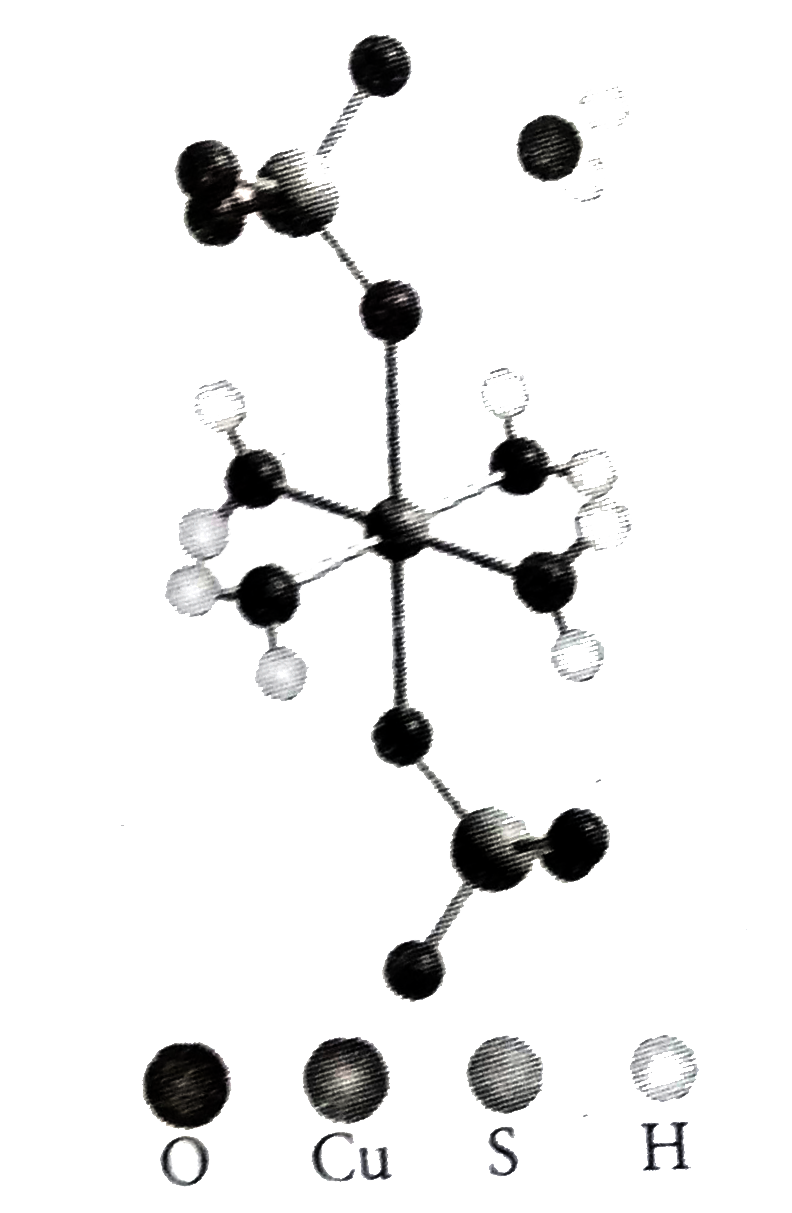
|
|
| 24. |
Explain about the structural features of Moseley's long form of periodic table. |
|
Answer» Solution :(i) The long form of periodic table of the elements is constructed on the basis of modern periodic law. The arrangement resulted in repeating electronic configurations of atoms at regular intervals. (ii) The elements placed in horizontal rows are CALLED periods and in vertical columns are called groups. (iii) According to IUPAC, the groups are numbered from 1 to 18. (iv) There are 18 vertical columns which constitute 18 groups or families. All the members of a particular group have similar OUTER shell electronic configuration. (v) There are 7 horizontal rows called periods. 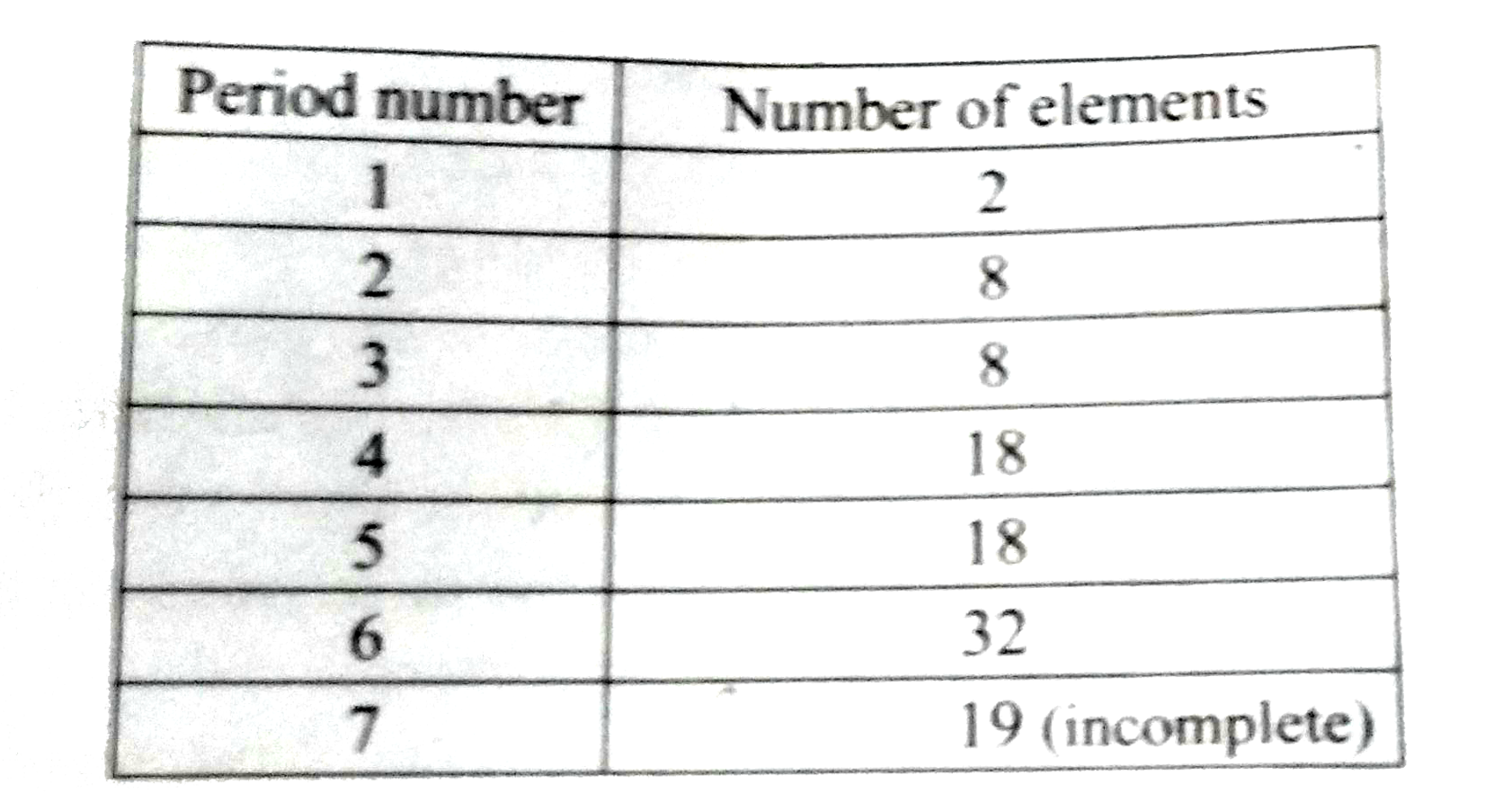 The elements are shown in the above table along with its atomic number. (vi) The atomic number also INDICATES the number of electrons in the atoms of an element. (vii) This periodic table is important and useful because we can PREDICT the properties of any element using periodic trend, EVEN though that element may be unfamiliar to us. |
|
| 25. |
Explain about the shape of orbitals. |
|
Answer» Solution :The solution to Schrodinger equation gives the PERMITTED energy values called eigen values and the wave functions corresponding to the eigen values are callled atomic orbitals For 1s orbital,l=0,m=0.f`(theta)`=`(1)/sqrt(2)` and `G(varphi)`=`(1)/(sqrt(2pi))`THerefore,the angular distribution function is equal to `(1)/(2sqrt(pi))`.i.e. it is INDEPENDENT of the ANGLE`theta` and `varphi`.Hence ,the probability of finding the electron is independent of the direction from the nucleus.So,the shape of the s orbital is spherical. 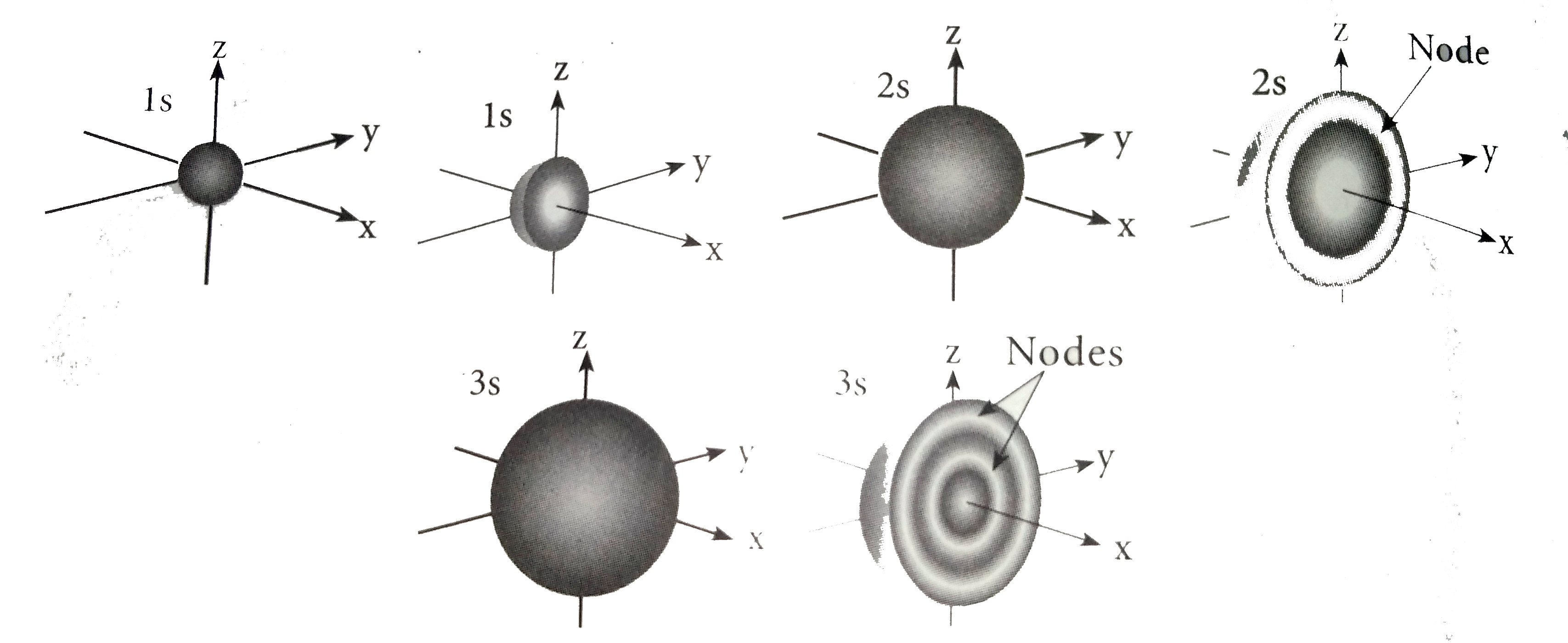 , ,p-orbital: For p orbitals l=1 and the corresponding m values are-1,0 and +1 . The THREE different m values indicated that there are three different orientations possible for p orbitals,These orbitals are designated as `p_x,p-y` and `p_z`,The shape of p orbitals are dumb bell shape. 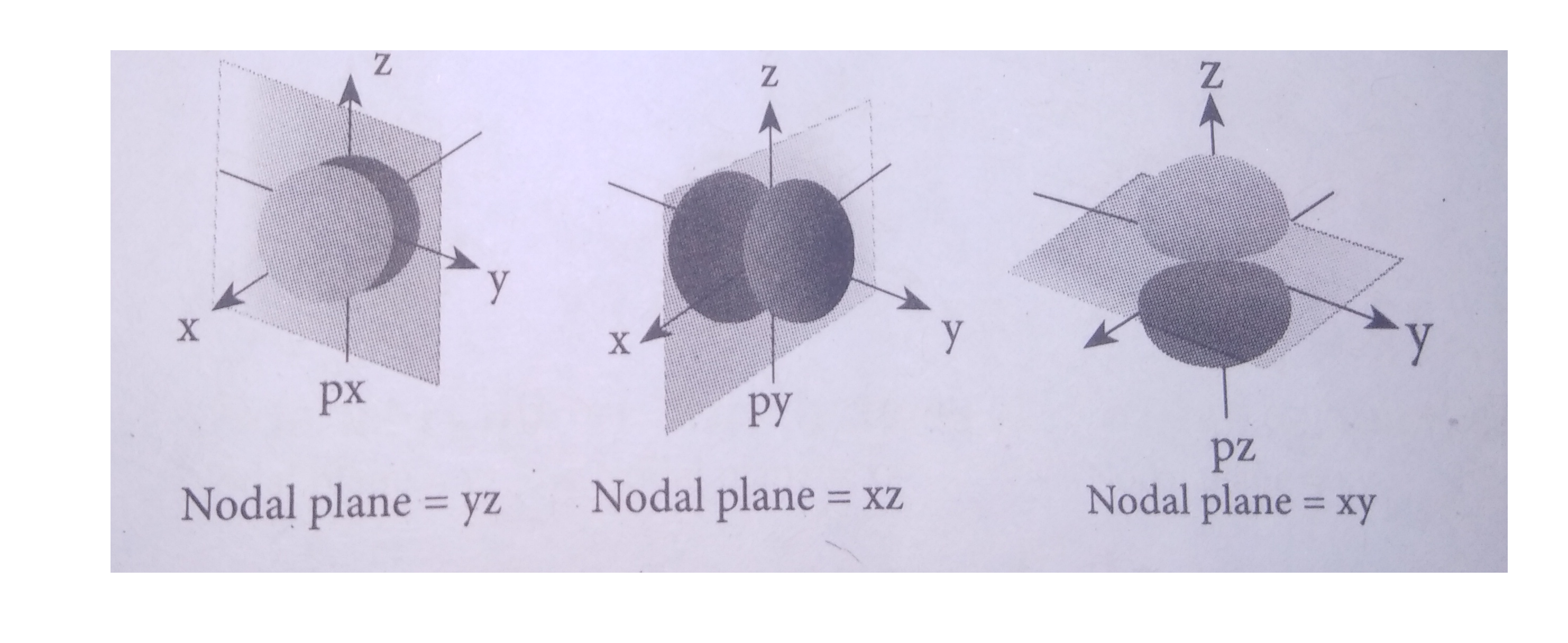 , , D-orbital: For.d. orbital l=2 and the corresponding m values are -2,-1,0,=1,+2. the shape of the d orbital looks like a .clover leaf..The five m values give rise to five d orbitals namely`d_(xy),d_(yz),d_(zx),d_(x^(2)-y^(2))` and `d_z^(2)`.The 3d orbitals contain two nodel planes. 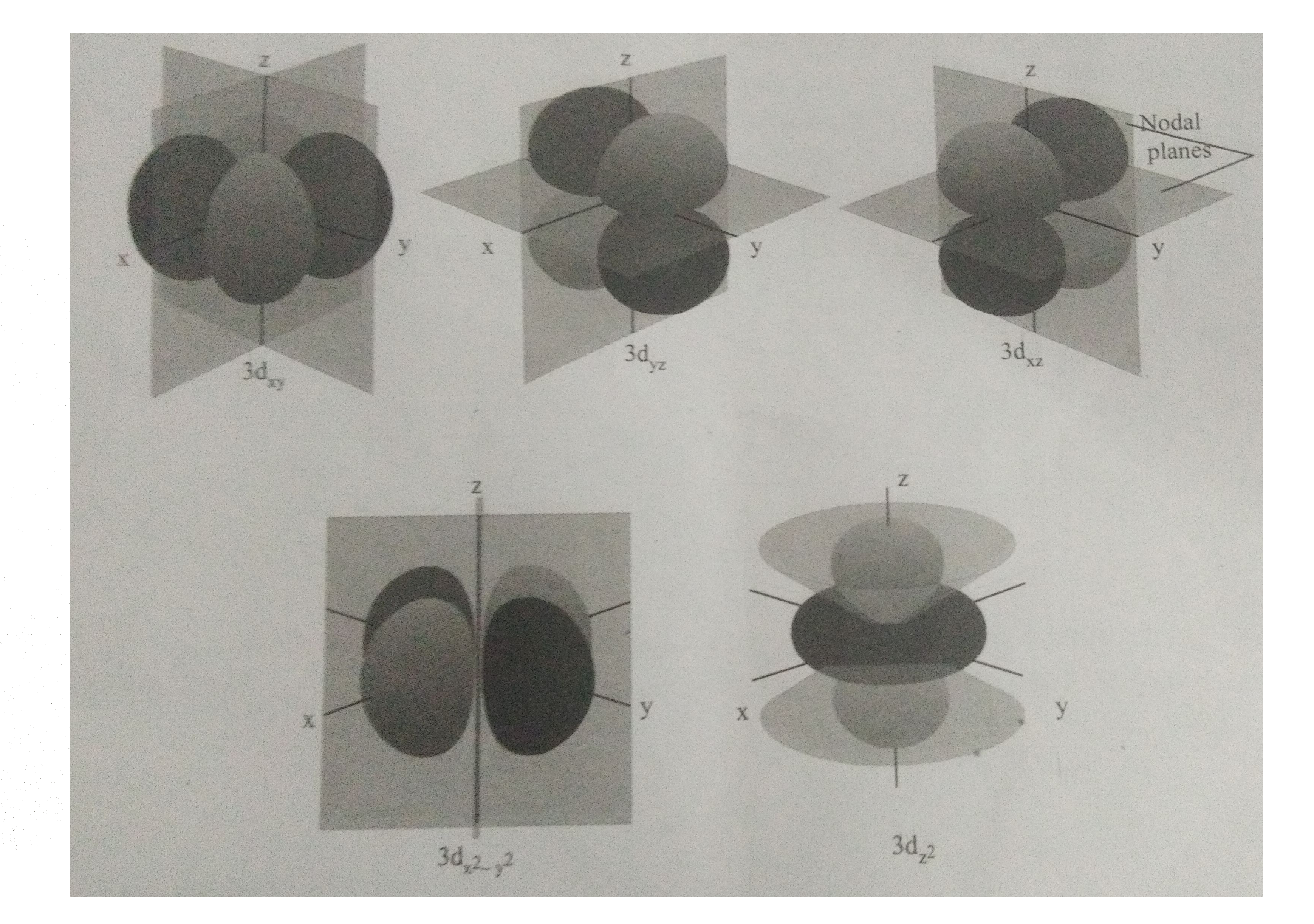 , ,f-orbitals: For .f. orbitals,l=3 and mvalues are -3,-2,-1,0,+1,+2,+3 corresponding to seven f orbitals `fz^(3),f_(xz^(2)),f_(yz^(2)),f_(xyz),f_(z(x^(2)-y^(2)),f_(x(x^(2)-3y^(2)),f_(y(3x^(2)-y^(2))`.They contain 3 nodal planes. 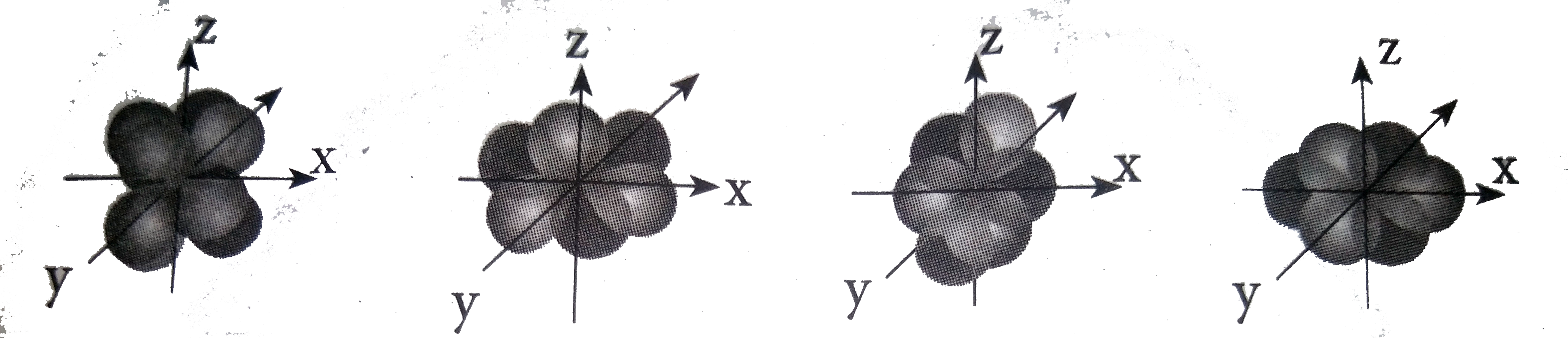 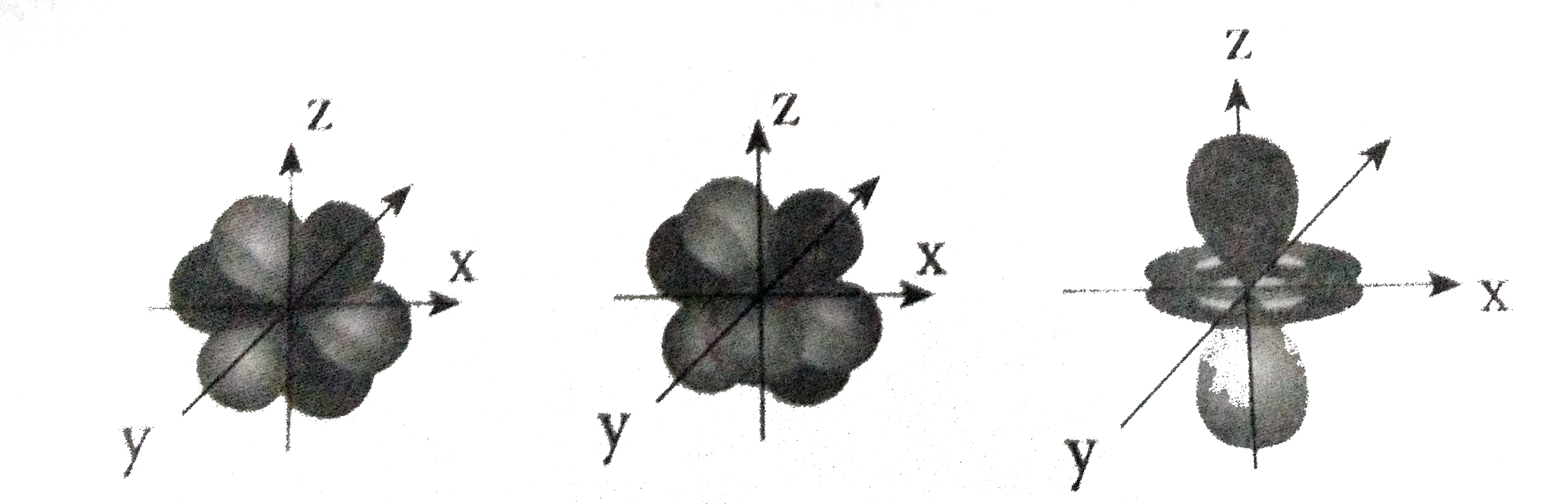
|
|
| 26. |
Explain about the significance of de-Broglie equation. |
|
Answer» Solution :`lambda=(h)/(mv)` This equation implies that a moving particle can be considered as a wave and a wave can exhibit the PROPERTIES of a particle. (ii) For a particle with high LINEAR momentum (mv) the WAVELENGTH will be so small and cannot be observed. (iii) For a microscopic particle such as an electron, the mass is of the order of 10-kg, hence the wavelength is much larger than the size of atom and it becomes significant (iv) For the electron, the DE Broglie wavelength is significant and measurable while for the iron ball it is too small to MEASURE, hence it becomes insignificant. |
|
| 27. |
Explain about the significance of de Broglie equation |
|
Answer» Solution :(i) `gamma =h/mv` . This equation implies that a MOVING particle can be considered as a wave and a wave can exhibit the properties of a particle. (ii) For a particle with highlinear momentum (mv) the wavelength will be so small and cannot be observed. (iii) For a microscopic particle such as an electron ,the mass is of theorder `10^(-31)`KG,hence the wavelength is MUCH larger than the SIZE of atom and it becomes significant. (iv) For the electron ,the de Broglie wavelength is significant and MEASURABLE while for the iron ball it is too small to measure , hence it becomes insignificant. |
|
| 28. |
Explain about the steps involved in naming an organic compound as IUPAC nomenclature. |
|
Answer» Solution :The following steps should be followed for naming an organic compound as per IUPAC NOMENCLATURE. (i) Choose the longest CARBON chain (Root word). CONSIDER all other groups attached to this chain as substituents. (ii) Numbering of the longest carbon chain. (iii) Naming the substituents (prefixes) or (suffixes). (iv) Arrange the substituents in the alphabetical order. (V) Write the NAME of the compound as below. Prefix + Root word + Primary suffix + Secondary suffix |
|
| 29. |
Explain about the salient features of metals. |
|
Answer» Solution :(i) Metals comprise more than 78% of all known elements. They are present on the LEFT side of the periodic table. (ii) They are usually solids at ROOM temperature. [Mercury is an EXCEPTION (Hg-liquid), gallium (303K) and cesium (302K) also have very low melting points). (iii) Metals usually have high melting and boiling points. (iv) They are good conductors of heat and electricity. (v) They are malleable and ductile, and also can be flattened into thin sheets by hammering and drawn into thin wires. |
|
| 30. |
Explain about the relationship between the atomic number of an element and frequency of the X-ray emitted from the elements. |
|
Answer» Solution :HENRY Moseley studied the X-ray spectra of several elements and determined their atome numbers (Z). He noticed that the frequencies of X-ray emitted from the elements CONCERNED could be correlated by the EQUATION `sqrtsigma=a(Z-b)` Where, `SIGMA` = Frequency of the X-ray emitted by the ELEMENT. a and b = Constants and have same values for all the elements. Z-Atomic number of the element. |
|
| 31. |
Explain about the salient features of groups. |
|
Answer» Solution :(i)NUMBER of electrons in outermost shell: The number of electrons present in the outermost shells does not CHANGE on moving down in a GROUP, i.e remains the same. Hence, the valency, also remains same within a group. (ii) Number of shells: In going down a group the number of shells increases by one at can step and ultimately becomes equal to the period number to which the element belongs. (III) Valency: The valencies of all the elements of the same group are the same. The valency an element with respect to oxygen is same in a group. (iv) Metallic CHARACTER: The metallic character of the elements increases in moving to bottom in a group |
|
| 32. |
Explain about the preparation of phenyl magnesium chloride . |
| Answer» Solution :`underset("Chloro BENZENE") (C_(6) H_(5) Cl) + Mg overset("THF") underset("TETRAHYDROFURAN") (to) underset("Ethylidene DICHLORIDE") (CH_(3) - CHCl_(2))` | |
| 33. |
Explain about the procedure and calculation behind the carius method of estimation of sulphur. |
|
Answer» Solution :CARIUS method (i) Procedure: A known mass of the organic compound is taken in a clean carius tube and few mL of fuming `HNO_(3)` is ADDED and then the tube is sealed. It is then placed in an iron tube and heated for 5 hours. The tube is allowed to cool and a hole is made to allow gases to escape. The carius tube is broken and the content collected in a beaker. Excess of `BaCl_(2)` is added to the beaker. `H_(2)SO_(4)` formed is converted to `BaSO_(4)` (white ppt.) The precipitate is filtered, washed, dried and weight. From the mass of `BaSO_(4)` percentage of S is calculated. (ii) Calculation: Mass of organic compound = Wg Mass of BaSoformed= x g 233 g of `BaSO_(4)` contains 32 g of sulphur `:.` x g of `BaSO_(4)` contain `(32)/(233) xx x g` of sulphur `"Percentage of sulphur"= ((32)/(233) xx (x)/(w) xx 100)%` |
|
| 34. |
Explain about the principle involved in chromatography. Give its types. |
|
Answer» Solution :(i) The principle behind chromatography is selective distribution of the MIXTURE of organic substances between TWO phases-a stationary phase and a moving phase. The stationary phase can be a solid or liquid while the moving phase is a liquid or a gas. (II) If the stationary phase is solid, the basis is adsorption and when it is a liquid, the basis is partition. (III) Chromatography is defined as technique for the separation of a mixture brought about by differential movement of the individual compound through porous medium under the influence of moving solvent. (iv) The various methods of chromatography are: 1. Column chromatography (CC) 2. Thin layer chromatography (TLC) 3. Paper chromatography (PC) 4. Gas liquid chromatography (GLC) 5. Ion exchange chromatography |
|
| 35. |
Give the general variation of electron gain enthalpies in the periodic table. |
|
Answer» Solution :(i) The electron gain enthalpy increases as we move from left to right in a period due to the increase of nuclear charge. However, Be, Mg, N and noble gases have almost zero value of electron gain enthalpy due to EXTRA stability of completely and half FILLED orbitals. (ii) When we move in a group of periodic table, the SIZE and nuclear charge increase. But the effect of increase in atomic size is much more PRONOUNCED than that of nuclear charge and thus the ADDITIONAL electron feels less attraction by the large atom. Consequently, electron gain enthalpy decreases. |
|
| 36. |
Explain about the oxidation test for sulphur. |
|
Answer» Solution :(i) Oxidation test: The organic SUBSTANCES are fused with a mixture of `KNO_(3)` and `Na_(2)CO_(3)`. The sulphur if present is oxidised to sulphate. `Na_(2)CO_(3)+S+3(O) rarr Na_(2)SO_(4) + CO_(2)` (ii) The fused mass is extracted with WATER, acidified with HCl and the `BaCl_(2)` solution is added to it. A white PRECIPITATE indicates the presence of sulphur. `BaCl_(2) + Na_(2)SO_(4) rarr underset("white ppt.")(BaSO_(4)DARR) + 2NaCI` |
|
| 37. |
Explain about the period variation of electronegativity along a group. |
| Answer» Solution :As we MOVE down from TOP to bottom in a group, electronegativity decreases due to increase atomic RADIUS. FLUORINE has the highest value of electronegativity among all the elements. | |
| 38. |
Explain about the Newmann projection formula with an example. |
|
Answer» Solution :(i) In this method, the molecules are VIEWED from the front along the carbon-carbon bond axis. (II) The two carbon atom forming the `sigma` bond is represented by two circles. One behind the other so that only the front carbon is SEEN. The front carbon atom is SHOWN by a point where as the carbon lying farther from the eye is represented by the origin of the circle. (iii) Therefore the C-H bonds of the front carbon are depicted from the circle while the C bonds of the back carbon are drawn from the circumferance of the circle with an angle of `120^(@)` to each other. 
|
|
| 39. |
Explain about the importance of hydrogen bonding in proteins. |
|
Answer» Solution :(i) Hydrogen bonds occur in complex biomolecules such as proteins and in BIOLOGICAL systems (ii) For example, hydrogen bonds play an important role in the structure of deoxyribonucleic acid (DNA), since it holds together the two helical nucleic acid chains (III) In these systems, hydrogen bonds are formed between specific pairs, for example, with a thymine UNIT in one chain bonding to an adenine unit in another similarly, a cytosine unit in one chain bonds to a GUANINE unit in another. (iv) Intramolecular hydrogen bonding ALSO plays an important role in the structure of polymers, both synthetic and natural. |
|
| 40. |
Explain about the geometrical isomerism possible in oximes. |
|
Answer» Solution :(i) Restricted ROTATION around C = N (oximes) gives rise to geometrical isomerism in oximes. Here syn and anti are used INSTEAD of cis and trans respectively. (ii) In the syn isomer the H ATOM of a doubly bonded CARBON and -OH group of doubly bonded nitrogen LIE on the same side of the double bond, while in the anti isomer, they lie on the opposite side of the double bond. (iii) for e.g., 
|
|
| 41. |
Explain about the formation of solid-liquid equilibrium with suitable example. |
|
Answer» Solution :(i) Consider melting of ice in a closed container at 273K. This system REACH a state of physical equilibrium in which the AMOUNT of water in the solid phase and LIQUID phase does notchange with time. (ii) In this process, the total number of water molecules leaving from and returning to the solid phase at any INSTANT are equal. (iii) If some ice CUBES and water are placed in a thermos flask (at 273K and 1 atm) then there will be no change in the mass of ice and water. (iv) At equilibrium: Rate of melting of ice Rate of freezing of water. `H_(2)O(s) hArr H_(2)O(l)` |
|
| 42. |
Explain about the general characteristics of periods. |
|
Answer» Solution :(i) Number of electrons in outermost shell: The number of electrons present in the outermost shell increases from 1 to 8 as we proceed in a period. (ii) Number of shells: As we move from left to right in a period the shells remains the same. The number of shells present in the elements corresponds to the period number. For exampleall the elements of 2nd period have on `2^(nd)` shells (K, L) (iii) VALENCY: The valency of the elements increases from left to right in a period. With respect to hydrogen, the valency of period elements increases from 1 to 4 and then falls to one. With respect to oxygen, the valency increases from 1 to 7. (iv) Metallic character: The metallic character of the elements DECREASES across a period. For example : `3^(rd)` period`ubrace(Na Mg AL)_("Metals")ubrace(SI P S Cl)_("Non-metals")` |
|
| 43. |
Explain about the factors that affect electronegativity? |
|
Answer» Solution :(i) Effective nuclear CHARGE: As the nuclear charge INCREASES, electronegativity also increases along the periods. (ii) ATOMIC radius: The atoms in smaller size will have larger electronegativity. |
|
| 44. |
What are the factors influencing ionization enthalpy. |
|
Answer» Solution :Factors influencing ionization ENTHALPY: (i) SIZE of the atom: If the size of an atom is larger, the outermost electron shell from the nucleus is also larger and hence the outermost electrons experience lesser force of attraction. Hence it would be more easy to remove an electron from the outermost shell. Thus, ionization ENERGY decreases with increasing atomic sizes. `"Ionization enthalpy" prop (1)/("Atomic size")` (ii) Magnitude of nuclear CHARGE: As the nuclear charge increases, the force of attraction between the nucleus and valence electrons also increases. So, more energy is required to remove a valence electron. Hence I.E increases with increase in nuclear charge. Ionization enthalpy `prop` nuclear charge (iii) Screening or shielding effect of the inner electrons: The electrons of inner shells form a cloud of negative charge and this shields the outer electron from the nucleus. This screen reduces the coulombic attraction between the positive nucleus and the negative outer electrons. If screening effect increases, ionization energy decreases. `"Ionization enthalpy" prop (1)/("Screening effects")` (iv) Penetrating power of subshells s, p, d and f: The s-orbital penetrate more closely to the nucleus as compared to p-orbitals. Thus, electrons in s-orbitals are more tightly held by the nucleus than electrons in p-orbitals. Due to this, more energy is required to remove a electron from an s-orbital as compared to a p-orbital. For the same value of .n., the penetration power decreases in a given shell in the order. sgtpgtdgtf. (v) ELECTRONIC configuration: If the atoms of elements have either completely filled or exactly half filled electronic configuration, then the ionization energy increases. |
|
| 45. |
Explain about the factors that affect electronegativity. |
|
Answer» Solution :(i) EFFECTIVE NUCLEAR CHARGE: As the nuclear charge INCREASES, electronegativity also increases along the PERIODS. (ii) Atomic radius: The atoms in smaller size will have larger electronegativity, |
|
| 46. |
Explain about the estimation of halogens by carius method. |
|
Answer» Solution :Carius method: A known mass of the substance is taken along with fuming `HNO_(3)` and `AgNO_(3)` TAKE in a clean carius tube. The open end of the carius tube is sealed and placed in a iron tube for 5 hours in a range at 530 to 540 K. Then the tube is allowed to cool and a small hole is made in the tube to allow the gases excape. The tube is broken and the precipitate is filtered, washed, dried and weighed. From the mass of AGX produced percentage of halogen in the organic compound is calculated. `Xoverset("Furning" HNO_(3))underset(AgNO_(3))rarrAgXdarr` Calculation: Weight of the organic compound=Wg Weight of AgCl = a g 143.5g AgCl contains 35.5g of CI `:.` a g of AgCl contain `(35)/(143.5) xx 9g` of CI Wg of organic compound contains `(35)/(143.5) xx a g` of Cl `:. % "of chlorine"=((35)/(143.5) xx (a)/(w) xx 100)%` Weight of silver bromide= b g 188 g of AgBr contains 80 g of Br `:. "bg of AgBr contain"=(80)/(188) xx b "g of Br"` `:. "% of Bromine"= ((80)/(188) xx (b)/(w) xx 100)` Weight of silver iodide=c g 235 g of Agl contains 127 g of I `:. "EG of Agl contain"=(127)/(135) xx c "g of I"` `:. "% of lodine" =((127)/(135) xx (c)/(w) xx 100)` |
|
| 47. |
Explain about the exchange reactions of deuterium oxide. |
|
Answer» Solution :When compounds containing hydrogen are treated with `D_2`O, hydrogen undergoes an exchange for Deuterium. `underset("Sodium hydroxide")(2NAOH) + underset("HEAVY water")(D_2 O) to underset("Sodium deutroxide")(2NaOD) + HOD` `underset("Hydrogen chloride")(HCL) + D_2 O to underset(Deuterium chloride")(DCl) + HOD` `underset("AMMONIUM chloride")(NH_4Cl) + 4D_2 to underset("Deutero Ammonium Chloride")(ND_4 CL + 4HOD)` |
|
| 48. |
Explain about the estimation of carbon and hydrogen. |
|
Answer» Solution :(i) Principle: A known weight of organic substance is brunt in excess of oxygen and the carbon and hydrogen present in it are oxidised to `CO_(2)` and `H_(2)O` respectively. `C_(x)H_(y) + underset("excess")(O_(2))rarr xCO_(2) +(y)/(2)H_(2)O` The weight of carbon dioxide and water thus FORMED are determined and the amount of carbon and hydrogen in the organic substance are calculated. (ii) Description of the apparatus  (a) The oxygen supply (b) combustion tube (c) Absorption tube Oxygen supply: To remove the moisture from oxygen, it is allowed to bubble through sulphuric acid and then passed through a U-tube containing sodalime to remove `CO_(2)` . The oxygen gas free from moisture and `CO_(2)` enters the combustion tube. Combustion tube: A hard glass tube open at both ends USED for the combustion. It contains (i) an oxidized copper gauze to prevent the hackward diffusion of the products of combustion (ii) a porcelain boat containing a known weight of the organic substance (iii) coarse copper oxide on either side and (iv) an oxidised copper gauze placed towards the END of the combustion tube. The combustion tube is heated by a gas burner. Absorption apparatus: The combustion products containing moisture and `CO_(2)` are then passed through the absorption apparatus which consists of (i) a weighed U-tube packed with pumice soaked in conc. `H_(2)SO_(4)` to ABSORB Water (ii) a set of bulbs containing a strong solution of KOH to absorb `CO_(2)` and finally (iii) a guard tube filled with anhydrous `CaCl_(2)` to prevent the entry of moisture from atmosphere. (iii) Procedure: The combustion tube is heated strongly to dry its content. It is then cooled and connected to absorption apparatus. The other end of the combustion tube is open for a while and the boat containing weighed organic substance is introduced. The tube is again heated strongly till all the substance in the boat is burnt AWAY. This takes about 2 hours. Finally a strong current of oxygen is passed. Then the U-tube and potash bulbs are then detached and increase in weight of each of them is determined. (iv) Calculation: Weight of organic substance = Wg Increase in weight of `H_(2)O` = xg Increase in weight of `CO_(2)` = yg 18g of `H_(2)O` contains 2g of hydrogen `:.` xg of `H_(2)O` contain `(2)/(18) xx x g` of hydrogen `:. "Percentage of hydrogen"= ((2)/(18) xx (x)/(w) xx 100)%` 44g of `CO_(2)` contains 12g of carbon `:.` y g of `CO_(2)` contain `(12)/(44) xx y` g of carbon `:. "Percentage of carbon"=((12)/(44) xx (y)/(w) xx 100)%` |
|
| 49. |
Explain about the equilibrium involving dissolution of solid in liquid with suitable example, |
|
Answer» Solution :When sugar is added to WATER at a particular temperature, it dissolves to form sugar solution. When more sugar is added to that solution, a particular stage sugar remains as solid and results in the FORMATION of SATURATED solution. Here a dynamic equilibrium is established between the solute molecules in the solid phase and in the solution phase. `"Sugar "_("sold") hArr "Sugar" _("solution")` |
|
| 50. |
Explain about the environmental impacts of ozone depletion. |
|
Answer» Solution : (i) The FORMATION and destruction of ozone is a regular natural process, which never disturbs the equilibrium level of ozone in the STRATOSPHERE. Any change in the equilibrium level of ozone in the atmosphere will ADVERSELY affect the life in biosphere in the following ways. (ii) DEPLETION of ozone layer will allow more UV rays to reach the earth surface and would cause skin cancer and also decreases the immunity level in human beings. (iii) UV radiations affects plant proteins which lead to harmful mutation in plant cells. (IV) UV radiations affect the growth of phytoplankton and as a result ocean food chain is isturbed and it even damages the fish productivity. |
|