

Saved Bookmarks
This section includes 7 InterviewSolutions, each offering curated multiple-choice questions to sharpen your Current Affairs knowledge and support exam preparation. Choose a topic below to get started.
| 1. |
Explain about the effect of catalyst in an equilibrium reaction ? |
| Answer» Solution :ADDITION of catalyst does not affect the state of equilibrium, The catalyst increases the rate of both the forward and REVERSE reactions to the same extent . HENCE it does not change the equilibrium COMPOSITION of the reaction mixture . | |
| 2. |
Explain about the electronegativity and non-metallic character across the period and down the group. |
|
Answer» Solution :ELECTRONEGATIVITY `PROP` Non-metallic CHARACTER (i) As the electronegativity is directly PROPORTIONAL to the non-metallic character, thus across the period, with an increase in electronegativity, the non-metallic character also increases. (II) As we move down the group, decrease in electronegativity is accompanied by a decrease in non-metallic character. |
|
| 3. |
Explain about the different layers of Earth's atmosphere |
Answer» SOLUTION :Earth.s ATMOSPHERE can be divided into DIFFERENT layers with characteristic altitude and TEMPERATURE. 
|
|
| 4. |
Explain about the different industrial preparation of hydrogen. |
|
Answer» Solution :In the large SCALE, hydrogen is produced currently by steam reforming of hydrocarbons. Steam and METHANE reacts with each other in the PRESENCE of nickel catalyst at 35 atm and at a temperature of `800^(@)C` gives hydrogen. `CH_(4(g))+H_(2)O_((g))toCO_((g))+3H_(2(g))` Steam is passed over a red hot coke to produce carbon monoxide and hydrogen. `C_((s))+H_(2)O_((g))tounderset(water)underbrace(CO_((g))+H_(2(g))` Water gas Water is reduced to hydrogen with carbon monoxide by passing over iron oxide catalyst at `400^(@)C` .`CO_((g))+H_(2)O_((g))toCO_(2(g))+H_(2(8))` Hydrogen is produced as a by-product in oil refining industry during the cracking of long chain hydrocarbons. `C_(6)H_(12(g))toC_(6)H_(6(g))+3H_(2(g))` Hydrogen is also obtained in the manufacture of chlorine and sodium hydroxide via ELECTROLYSIS of a concentrated solution of sodium chloride. |
|
| 5. |
Explain about the classification of elements based on electronic configuration. |
|
Answer» Solution :(i) The distribution of electrons into orbitals, s, p, d and f of an atom is called its electronic configuration. The electronic configuration of an atom is characterized by a set of four quantum numbers, n, l, m and s. Of these the principal quantum number (n) defines the MAIN energy level known as SHELLS. (ii) The position of an element in the periodic table is related to the configuration of that element and thus reflects the quantum numbers of the last orbital filled. (iii) The electronic configuration of elements in the periodic table can be studied along the periods and GROUPS SEPARATELY for the best classification of elements. (iv) Elements placed in a horizontal row of a periodic table is called a period. There are seven periods. (v) A vertical column of the periodic table is called a group. A group consists of a series of elements having similar configuration of the outermost shell. There are 18 groups in periodic table. |
|
| 6. |
Explain about the characteristics of work. |
|
Answer» Solution :Characteristics of work: (i)Work is defined as the force (F) multiplied by the displacement (x ). -W=F.x …(1) The -ve sign is introduced to indicate that the work has been done by the system by spendinga part of its internal energy. (ii)Work is a path function. (iii) Work appears only at the BOUNDARY of the system . (iv) Work appears during the change in the state of the system . (v)Work brings a permanent effect in the surroundings . (vi)Units of work:The SI unit of work is the joule (J) or Kilojoule (KJ). (VII)if work done by the system , the energy of the system decreases , hence by convention work is TAKEN to be negative (-w). (viii) If work done by the system , the energy of the system increases , hence by convention work is taken to be positive (+w). |
|
| 7. |
Explain about the characteristic of non - metals. |
|
Answer» Solution :NON - metals are located at the top right hand side of the periodic table. (ii)In a period , and we move from left to right the non - metallic character INCREASES while the metallic character increases as we go down a proup. (iii)They are poor conductors of HEAT and electricity . Most of the non - metallic solids are BRITTLE and NEITHER malleable nor ductile. |
|
| 8. |
Explain about the salient features of molecular orbital theory. |
|
Answer» Solution :(i) ACCORDING to molecular orbital theory the ATOMIC orbitals of large number of atoms in a crystal overlap to form numerous bonding and anti-bonding molecular orbitals without any BAND gap. (ii) The bonding molecular orbitals are completely filled with an electron pair in eaçh and the anti-bonding molecular orbitals are empty. (iii) Absence of band gap accounts for high electrical conductivity of metals. (iv) High thermal conductivity is due to thermal excitation of many electrons trom the valence band to the conduction band. (v) With an increase in temperature, the electrical conductivity decreases due to VIGOROUS thermal MOTION of lattice ions that disrupts the uniform lattice structure. that is required for free motion of electrons within the crystal. |
|
| 9. |
Explain about the applications of Graham's law of diffusion. |
|
Answer» SOLUTION :(I ) Graham.s LAWOF diffusionis usefulto determinethemolecularmassof thegasif themolecularmassof the gasif therateof diffusionis KNOWN. (ii )Graham.s lawformsthe basis of theprovessofenrivhingthe isotopesof `U^(235 )`fromotherisotopesand alsousefulin isotopicseparationof deuteriumand PROTIUM . |
|
| 10. |
Explain about the application of reverse osmosis in water purification. |
|
Answer» Solution :(i) Reverse osmosis is used in the desalination of sea water and also in the PURIFICATION of drinking water. (ii) When a pressure higher than the osmotic pressure is applied on the solution SIDE (sea water) the water molecules moves from solution side to the SOLVENT side through semi permable membrane (opposite to osmotic flow). The pure water can be COLLECTED. (iii) Cellulose acetate (or) POLYMIDE membranes are commonly used in commerical system. 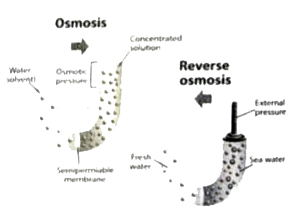
|
|
| 11. |
Explainabout the anomalous behaviour of lithium among the alkali metals |
|
Answer» Solution :Lithium is extremely SMALL (ii) It has GREAT polarizing power. It has LEAST electropositive character In lithium, non-availability of d-orbitals is observed |
|
| 12. |
Explain about steam distillation (or) How is essential oils are recovered from plants and flowers. |
|
Answer» Solution :Steam DISTILLATION: This method is applicable for solids and liquids. If the COMPOUND to be steam DISTILLED and it should not decompose at any steam temperature should have a FAIRLY high vapour pressure at 273K, it should be insoluble in water and the impurities present should be non-volatile. The impure liquid along with little water is taken in a round bottomed flask which is connected to a boiler on one side and water condenser on the other side, the flask is kept in a slanting position so that no DROPLETS of the mixture will enter into the condenser on the brisk boiling and bubbling of steam.  The mixture in the flask is heated and then a current of steam passed into it. The vapours of the compound mix up with the steam and escape into the condenser. The condensate obtained is a mixture of water and organic compound which can be separated. This method is used to recover essential oils from plants and flowers also in the manufacture of aniline and turpentine oil. |
|
| 13. |
Mention Anomalies of Mendeleev 's periodic table. |
|
Answer» Solution :Anomalies of Mendeleev.s periodic table (i) Some elements with similar PROPERTIES were placed in different groups whereas some elements having dissimilar properties were placed in same group, but iodine (127) was placed in VII group. Example: Tellurium (127.6) was placed in VI group. (ii)Some elements with higher atomic weights were placed before lower atomic MASSES in order to maintain the similar chemical nature of elements. This concept was called inverted pair of elements concept. Example: `""^(59)"_(27)Co` and `""^(58.7)"_(28)Ni` (iii) Isotopes did not find any place in Mendeleev.s periodic table. (iv) Position of hydrogen could not be made clear. (V) He did not leave any space for lanthanides and actinides which were discovered later on. (vi) Elements with different nature were placed in one group, Example: Alkali metals and coinage metals were placed together. (vii) DIAGONAL and horizontal relationships were not explained. |
|
| 14. |
Explain about sp^(3)d^(2) hybridisation with an example. |
|
Answer» Solution :(i) In sulphur hexafluoride `SF_(6),` the central atom sulphur EXTEND its octet to UNDERGO `sp^(3)d^(2)` hybridisation to generate six `sp^(3)d^(2)` hybridised orbitals which accounts for six equivalent S - F bonds. (ii)he ground state electronic configuration of sulphur is `[Ne]3s^(2)" "3p_(x)^(1)" "3p_(x)^(1)" "3p_(x)^(1)" "3p_(z)^(1)`  (iii) One electron cach form 3s ORBITAL and 3p orbital of sulphur is promoted to its two vacant 3d orbitals `d_(z)2 and d_(x)2_(-y)2` in the excited state.  (iv) A toal of six valence orbitals from sulphur (one 3s orbital. three 3p orbitals and two 3dorbitals) `(d_(z2)and d_(x)2_(-y)2)` which MIXES to give six equivalen `sp^(3) d^(2)` hybridised orbitals. The orbital geometry is octahedral. (v) The six`sp^93)d^(2)` hybridised orbitals of sulphur overlaps LINEARLY with `2p_(z)` orbital of six fuorine atoms to form the six S-F bonds in sulphur hexafluoride. 
|
|
| 15. |
Explain about sp hybridisation with suitable example. |
|
Answer» Solution :(i) Bond FORMATION in Berylium chloride takes place by sp hybridisation. (ii) The valence shell of Beryllium has the electronic contiguration as follows:  (iii) In `BeCl_(2)` both the Be-Cl Bonds are EQUIVALENT and it was observed that the molecule is near. VB theory explains this observed behaviour by sp hybridisation. ONE of the paired electrons in the 2S orbital gets excited to 2p orbital. (iv) Now the 2s and 2p ORBITALS hybridise and produce two equivalent sp hybridised orbitals which have 50% s-character and 50% p-characte. These sp hybridised orbitals are oriented in opposite direction. (v) Each of the sp hybridised orbitals linearly overlap with `p_(z)` orbital of the chlorine to form a 
|
|
| 16. |
Explain about principle and reactions involved in carius method of estimation of sulphur. |
|
Answer» Solution :Carius METHOD: (i) PRINCIPLE: A known mass of the organic substance is HEATED strongly with fuming `HNO_(3)`. C and H GET oxidized to `CO_(2)` and `H_(2)O` while sulphur is oxidised to sulphuric acid as follows. `Cunderset(ΗΝΟ_(3))OVERSET("Fuming")rarrCO_(2)` `2Hunderset(ΗΝΟ_(3))overset("Fuming")rarrH_(2)O` `SrarrSO_(2)overset(O+H_(2)O)rarrH_(2)SO_(4)` (ii) The resulting solution is treated with excess of `BaCl_(2)` solution, `H_(2)SO_(4)` present in the solution is converted into `BaSO_(4)` . From the mass of `BaSO_(4)`, the percentage of sulphur can be calculated. |
|
| 17. |
Explain about periodic variation of electronegativity across a period. |
|
Answer» Solution :As we MOVE from LEFT to right in a period, electronegativity INCREASES. This is due to the following reasons: (a) Nuclear charge increases in a period (b) Atomic size decrease in a period. Halogens have the highest value of electronegativity in their respective PERIODS. |
|
| 18. |
Explain about metals, non-metals and metalloids. |
|
Answer» Solution :The elements can be divided into metals, nonMetals and metalloids based on their properties. Metals: Metals comprise more than 78% of all known elements and appear on the left side of the Periodic Table. Metals are usually solids at room temperature. MERCURY is an exception gallium and caesium also have very low melting points (303K and 302K, respectively). Metalic Properties : Metals usually have high melting and boiling points. They are good conductors of heat and electricity. They are malleable (can be FLATTENED into thin sheets by hammering) and ductile (can be drawn into wires). We go left to RIGHT in periodic table metallic properties increase. We go top to bottom in periodic table metallic properties increases. Non-metalic properties : Non-metals are SITUATED at the top right hand side of the Periodic Table. Non-metals are usually solids or gases at room temperature with low melting point and boiling points (boron and carbon are exceptions). They are poor conductors of heat and electricity. (Graphite are exceptions) Most non metallic solids are brittle and are neither malleable nor ductile. Periodicity: When we left to right non-metallic properties increases but top to bottom in group metallic property increases. Semi-metals: Elements which act as metals and nonmetal both then it is known as semi-metals. Si, Ge, As, Sb, Te elements bordering line and running diagonally across the periodic table show properties that are characteristic of both metals and non-metals and non metals. |
|
| 19. |
Explain about metallic bonding. |
|
Answer» Solution :(i) The forces that KEEP the atoms of the metal so closely in a METALLIC crystal constitute what is known as metallic bond. (ii) According to Drude and Lorentz, metallic crystal is an assemblage of positive ions immersed in a gas of free electrons. The free electrons are due to ionisation of the valence electrons of the atoms of the metal. (iii) As the valence electrons of the atoms are freely shared by all the ions in the crystal, the metallic bonding is referred to as electronic bonding. (iv) The electrostatic attraction between the metal ions and the free electrons yield a three dimensional close packed crystal with a large number of nearest metal ions. So metals have high density. (v) As the close packed structure contains many slip planes along which movement can occur during mechanical LOADING, metal ACQUIRES ductility. (vi) As metal ion is surrounded by electron cloud in all directions, the metallic bonding has no directional properties. (vii) As the electrons are free to more around the positive ions, the metals exhibit highelectrical and THERMAL conductivity. (viii) The metallic lustre is due to the reflection of light by the electron cloud. (ix) As the metallic bond is strong enough, the metal atoms are reluctant to break apart into a liquid or gas, so the metals have high melting and boiling points. (x)High thermal conductivity of metals is due to thermal excitation of many electons from the valence bond to the conduction band. |
|
| 20. |
Explain about lassaigne's test for detection of nitrogen in an organic compound. |
|
Answer» Solution :I step: Preparation of sodium fusion extract: A small piece of Na dried by pressing between the folds of filter paper is taken in a fusion tube and it is heated. When it melts to a shining globule, a pinch of organic compound is added to it. The tube is then heated till the reaction ceases and becomes red hot. Then the test tube is plunged in about 50 ml of distilled water taken in a china dish and break the bottom of the tube by striking against the dish. The contents of the dish is boiled for about 10 minutes and then filtered. This filtrate is known as lassaigne.s extract (or) sodium fusion extract. II step : Test for NITROGEN: If Nitrogen is present, it gets converted to sodium cyanide which reacts with freshly prepared ferrous sulphate and ferric ion followed by conc. HCI and gives a Prussian blue colour (or) green coloured precipitate. It confirms the presence of nitrogen. HCI is added to dissolve the greenish precipitate of ferrous hydroxide PRODUCED by the action of NaOH on `FeSo_(4)` which would otherwise MARK the Prussian blue precipitate. Reactions involved: `Na+C+NrarrNaCN` `FeSO_(4) + 2NaOH rarr Fe(OH)_(2) + Na_(2)SO_(4)` `6NaCN + Fe(OH)_(2) rarr underset("Sodium ferrocyanide")(Na_(4)[Fe(CN)_(6)])+ 2NaOH` `3Na_(4)[Fe(CN)_(6)] +4FeCl_(3) rarr underset(underset("(Prussian blue)")("Ferris ferrocyanide"))(Fe_(4)[Fe(CN)_(6)]) + 12NaCl` If both N & S are present, a blood red colour is OBTAINED due to the following reactions `Na +C+N+S overset(Delta)rarrunderset("Sodium sulphocyanide")(NaCNS)` `3NaCNS+FeCl_(3)rarrunderset(underset("(Blood red colour)")("Ferric sulphocyanide"))(Fe(CNS)_(3)+3NaCl)` |
|
| 21. |
Explain about Kossel-Lewis approach to chemical bonding. |
|
Answer» Solution :(i) Kossel and Lewis approach to chemical BONDING is BASED on the inertness of the noble gases which have little or no tendency to combine with other atoms. (ii) They proposed that noble gases are stable due to their completely filled outer electronic configuration. (ii) lements other than noble gases try to attain the completely filled outer electronic configuration by losing, gaining or sharing one or more ELECTRONS from their outer shell. (iv) For e.g., sodium loses one electron to form `Na^(+)`ion and chlorine accepts that electron to give CHLORIDE ion, `Cl^(-).` These two ions are held together by electrostatic ATTRACTIVE forces, a bond known as an electrovalent bond. `underset([Ne]3s)(Na)rarrunderset([Ne])(Na)^(+)+e^(-)` `underset([Ne]3s^(2)3p^(5))(Cl)+e^(-)rarr underset([Ar])(Cl)^(-)` `Na^(+)+Cl^(-)rarrNaCl` (v) In diatomic molecules such as nitrogen and oxygen, they achieve the stable noble gas electronic configuration by mutual sharing of electrons. (vi) Lewis introduced a scheme to represent the chemical bond and the electrons present in the outer shell of the atom called Lewis dot structure. (vii) outer example, the electronic configuration of nitrogen is `1s^(2)2s^(2)2p^(3)`. It has 5 elevtrons in its outer shell. The lewis structure of nitrogen is `.underset(.)N.` (viii) In `N_(2)`molecule, equal sharing of 3 electrons each nitrogen atom takes place as follows: `:NvdotsvdotsN (or)N-=N` |
|
| 22. |
Explain about (i)Magnetic quantum number (ii)Spin number (iii)Magnetic quantum number] |
|
Answer» SOLUTION :(i) Magnetic quantum number ltbtgt(1)It is DENOTED by the letter `(m_l)`, it takes integral value ranging from -l to +l through 0. (2) Different values of m 8for a given l value,represent different orientation of orbitals in space. (3)The Zeeman Effect (the splitting of spectral LINES in a magnetic field)provides the ex[ermimental justification for this qutanum number. (4)The magnitude o the angular momentum is determined by the quantum numbr l while its direction 8is given by magnetic quantum number. (ii) Spin quantnum number (1)The spin quantum number represents the spin of the ELECTRON and is denoted by the letter `(1m_s)`. (2)The electron in an atom revolves not only around the nucleus but spins.It is USUAL to twite this as electron spins about its own axis either in a clockwise direction or in anti-clockwise dr=irection. (3) Correspondin g to the clockwise and anti-clockwise spinning of the electorn,maximum two values of `(m_s)` is eqaul to `-1//2 and +1//2.` |
|
| 23. |
Explain about IUPAC nomenclature method in short |
|
Answer» Solution :(A) FOLLOWING three steps are important in the IUPAC NOMENCLATURE of organic compound: (i) PARENT hydrocarbon (II) FUNCTIONAL group attach to compounds (iii) By further using prefixes or suffixes  (B) The alkyl group present in carbon chain (branch) are write as a prefixes: (i) According to the number of carbon the suffixes .ane.. (ii) To write this name, obey specific rules |
|
| 24. |
Explain about gravitational work. Give its unit. |
|
Answer» SOLUTION :(i)When an object is raised to a certain height against the GRAVITATIONAL field, gravitation WORK is DONE on the object (ii) For example, if an object of mass .m. is raised through a height.h. against acceleration DUE to gravity .., then the gravitational work carried out is .mgh. w=m.g.h `w=kg.ms^(-2) m` `w=Kg m^2 s^(-2)` w=Joule |
|
| 25. |
Explain about green chemistry in day-to-day life. |
|
Answer» Solution :(i )Dry cleaning of clothes: Solvents like tetrachloroethylene USED in dry cleaning of clothes. pollute the groundwater and are carcinogenic. In place of tetrachloro ethylene. liquefied `CO_2` with suitable detergent is an alternate solvent used. Liquefied `CO_2` is not HARMFUL to the ground water. Nowadays `H_2O_2` is used for bleaching clothes in laundry, gives better result and utilises less water. (ii) Bleaching of paper: Conventional METHOD of bleaching was done with chlorine Nowadays `H_2O_2` can be used for bleaching paper in the presence of catalyst. (iii) Synthesis of chemicals: Acetaldehyde is commercially PREPARED by one step oxidation of ethene in the presence of ionic catalyst in aqueous medium with 90% yield. `underset ("Ethylene")(CH_(2) = CH_(2)) overset("Catalyst")underset(underset([O])"Pd(II)//Cu(II)")rarr underset("Acetaldehyde")(CH_(3)CHO)` (iv) Instead of petrol, methanol is used as a fuel in AUTOMOBILES. (v) Neem based pesticides have been synthesised, which are more safer than the chlorinated hydrocarbons. |
|
| 26. |
Explain about Hydrogen sponge. |
|
Answer» Solution :(i) Hydrogen sponge (or) metal hydride E.G. palladium hydrogen system is a binary hydrid (PdH) (ii) Upon heating, H atoms diffuse through the metal to the surface and recombine to from molecular hydrogen. Since no other gases behaves this way with palladium, this process has been used to separate hydrogen gas from other gas `2Pd_((s))+H_(2(g))  (iv) Technically the formation of metal hydride is by chemical reaction but it behaves likes a physical STORAGE method. |
|
| 27. |
Explain about differential extraction. |
|
Answer» SOLUTION :(i) The process of removing a substance from its aqueous solution by shaking with a suitable organic solvent is termed EXTRACTION. (ii) When an organic substance present as solution in water can be recovered from the solution by means of a separating funnel. (iii) The aqueous solution is taken in a separating funnel with LITTLE quantity of ether or chloroform (`CHCI_(3)`). The organic solvent immiscible with water will form a separate layet and the contents are SHAKEN gently. (iv) The solute being more soluble in the organic solvent is transferred to it. (v) The solvent layer is then SEPARATED by opening the tap of separating funnel and the substance is recovered. |
|
| 28. |
Explain about dash line structure with a suitable example. |
|
Answer» SOLUTION :The LINE bond STRUCTURE is OBTAINED by representing the two electron covalent bond by a DASH or line (-) in a lewis structure. A single line or dash represents a single covalent bond. e.g., n-propanol: `H-overset(H)overset(|)underset(H)underset(|)C-overset(H)overset(|)underset(H)underset(|)C-overset(H)overset(|)underset(H)underset(|)C-OH` |
|
| 29. |
Explain about azimuthal quantum number. |
|
Answer» SOLUTION :It is respresent by the letter.l. and can take integral values from zero to n-1,where n is the principal quantum number. (ii)Each l value represents a subshell (orbital).l=0,1,2,3 and 4 represents the s,p,d,f and g orbitals respectively. (iii)The maximum number of electrons that can be ACCOMMODATED in a GIVEN subshell (orbital)is 2(2l+1). (iv)It is used calculate the orbitla angular MOMENTUM using the EXPRESSION Angular mometnum=`sqrt(l(l+1))h/(2pi)` |
|
| 30. |
Explain about azeotropic distillation. |
|
Answer» Solution :The mixture of liquids that cannot be separated by fractional DISTILLATION can be purified by azeotropic distillation. The mixture are called azeotropes. These azeotropes are constant boiling mixture which DISTILL as a single component at a fixed temperature for example ethanol and water in the RATIO of 95.87: 4.13. In this method, the presence of a third component `C_(6)H_(6)`, `C CI_(4)` ether, glycol glycerol which act as dehydrating agent DEPRESS the partial pressure of one component of azeotropic mixture and raises the boiling point that component and THUS the other component will distil over. Substance like `C_(6)H_(6)`, `C CI_(4)` have low b.pt. and reduce the partial vapour pressure of alcohol more than that of water while substance like glycerol and glycol have high boiling point and reduce the partial vapour pressure of water more than that of alcohol. |
|
| 31. |
Explain about Andrew's Experimental isotherms of CO_(2) gas. |
|
Answer» Solution :(i) Andrew's isotherms of carbon dioxide at different temperactures is SHOWN in FIGURE From the plots we can infer the following. (II) Atlow temperature isotherms, for example, at `13^(@)C` as te pressure increases, the volume decreases along AB and is a gas until the point B is reached. (iii) At B, a liquid separates along the line Bc,Both the liquid and gas co-exist and the pressure remains constant. (iv) The volume range is which the liquid and gas coexist becomes SHORTER. (vi) At the temperature of `31.1^(@)C` the length of the shorter portion is reduced to zero at point P. (vii) The `CO_(2)` gas is liquefied completely at this point. This temperature is known as the liquefaction temperature or critical temperature of `CO_(2)` at this point the pressure is 73 atm. (VIII) Above this temperature `CO_(2)` remains as a gas at all pressure values. 
|
|
| 32. |
Explain : (a) The basis of similarities and differences between metallic and ionic crystals ,(b) Ionic crystals are hard and brittle. |
|
Answer» Solution :(a) SIMILARITIES. (i) Both ionic and metallic crystals have electrostatic forces of attraction. In ionic crystals these are between the oppositely charged ions. In metals, these are among the valence electrons and the kemels. That is why both have high melting point (ii) In both CASES, the bond is non-directional. Diferences.(i) in ionic crystals, the ions are not free to MOVE. Hence, they cannot conduct electricity in the solid state. They can do so only in the MOLTEN state or in aqueous solution. In metals, the valence electrons are free to flow Hence, they can conduct electricity in the solid state (ii) ionic bond is strong due to electrostatic forces of attraction. Metallic bond may be weak or strong depending UPON the number of valence electrons and the size of the kernels (b) Ionic crystals are hard because there are strong electrostatic forces of attraction among the oppositely charged ions. They are brittle because ionic bond is non-directional |
|
| 33. |
Explain a test for unsaturation. |
| Answer» Solution :HALOGENS like `Cl_(2)` or `Br_(2)` react with alkenes in the presence of inert solvent like `"CCl"_(4)` to form dihaloalkanes.`R - CH = CH_(2)+ Br_(2) overset("CCl"_(4))(rarr)R " "- underset("dibromoalkane")(underset(BR)underset(|)(CH)- underset(Br)underset(|)(CH_(2)))` | |
| 34. |
Explain : (a)The basis of similarities and differences between metallic and ionic crystals. (b)Ionic crystals are hard and brittle. |
|
Answer» Solution :(a) Similarities . (i) Both ionic and metallic crystals have electrostatic forces forces of attraction. In ionic crystalstheseare between the oppositely charged ions. In metals, these are among the VALENCE electrons and the kernels. That is why both have high melting point. (ii) In both CASES, the bond is non-directional. Difference . (i) In ionic crystals , the ions are not free to move. HENCE,they cannot conduct electricity TEH soild state.They can do so only in the molten state or in aqueous solution. In metals, the valence electrons are free to flow. Hence, they can conduct electricity in the solidstate. (ii)Ionic bond is strong due to electrostatic forces of attraction. Metallic bond may be weak or strongdepending upon the number of valence electrons and the size of the kernels. (b)Ionic crystals arte hard becausethere are strongelectrostatic forces of attraction among the oppositelycharged ions. they are brittle because ionic bond is non-directional. |
|
| 35. |
Explain a suitable method for purifying and separating liquids present in a mixture having very close boiling point |
| Answer» Solution :Fractional distillation: This method is used to purify and separate liquids present in the mixture having their BOILING POINT close to each other. The process of SEPARATION of the components in liquid mixture at their respective boiling points in the form of vapours and the SUBSEQUENT condensation of those vapours is called fractional distillation. This method is applied in distillation of petroleum, coal tar and crude oil. | |
| 36. |
Explain a general step-wise approach to evaluate the pH of the weak electrolyte. |
|
Answer» Solution :Step-1: The species present before dissociation are identified as Bronsted-Lowry acid/base. Step-2: BALANCED equations for all possible reaction. i.e. with a species acting both as acid as well as base are written. Step-3 : The reaction with the higher `K_a` is identified as the primary reaction whilst the other is a subsidiary reaction. Step-4 : Enlist in a TABULAR form the following values for each of the species in the primary reaction. (i) Initial concentration C, (ii) Change in concentration on proceeding to equilibrium in term of (a), degree of ionization. (iii) Equilibrium concentration. Step-5 Substitute equilibrium concentrations into equilibrium CONSTANT equation for principal reaction and solve for `alpha`. Step-6: Calculate the concentration of species in principal reaction. Step-7: Calculate pH = -LOG `[H_3O^+]` . |
|
| 37. |
Explain a closed system with an example. |
|
Answer» Solution :(i)A system which can exchange only energy but not matter with its surroundings is called a closed system (ii) Here the boundary is sealed but not INSULATED. (iii) Hot water contained in a closed beaker is an example for a closed system. (IV) In this system heat is transferred to the surroundings but no water vapour this system (v) A GAS contained in a cylinder fitted with a PISTON constitutes a closed system |
|
| 38. |
Explain a change in internal energy on the base of work. |
|
Answer» Solution :(a) Work: We TAKE a system containing some quantity of water in a thermos flask or in an insulated beaker. This would not allow exchange of heat between the system and surroundings through its boundary and we call this type of system as adiabatic. The wall separating the system and the surroundings is called the adiabatic wall (Fig). Let us call the initial state of the system as state A and its temperature as `T_(A)`. Let the internal energy of the system in state A be called `U_(A)`. We can change the state of the system in two different ways. The wall separating the system and the surroundings is called the adiabatic wall.  Let us call the initial state of the system as A and its temperature as `T_(A)` and internal energy of the system is `U_(A)`. Change the state of system in two ways : One way : We do some mechanical work, say 1 kJ, by rotating a set of small paddles and thereby churning water. Let the new state be called B state and its temperature, as `T_(B)`. It is found that `T_(B) gt T_(A)` and the change in temperature, `Delta T= T_(B) - T_(A)`. Let the internal energy of the system in state B be `U_(B)` and the change in internal energy, `Delta U= U_(B)- U_(A)`. Second way : We now do an equal amount 1 kJ electrical work with the help of an immersion rod and note down the temperature change. We find that the change in temperature is same as in the earlier case, say, `T_(B)- T_(A)`. J. P. Joule was ABLE to show that a given amount of work done on the system, no matter how it was done (irrespective of path) produced the same change of state. The adiabatic work, `w_(ad)` required to bring about a change of state is equal to the difference between the value of U in one state and that in another state, `Delta U`. The positive sign expresses that `w_(ad)` is positive when work is done on the system. Similarly, if the work is done by the system, `w_(ad)` will be negative. (b) Heat: We can also change the internal energy of a system by transfer of heat from the surroundings to the system or vice-versa without expenditure of work. This exchange of energy, which is the RESULT of temperature difference is called heat `q`.  The heat absorbed by the system (water), q can be measured in terms of temperature difference, `T_(B) - T_(A)`. In this case change in internal energy, `Delta U= q`. The `q` is positive, when heat is transferred from the surroundings to the system and `q` is negative when heat is transferred from system to the surroundings. (c) The General Case : Change in internal energy with reference to work and heat. `Delta U= q+w` `q+ w = DeltaU` will depend only on initial and final state. If there is no transfer of energy as heat or as work `i.e.`, if `w=0 and q=0`, then `Delta U=0`. First LAW of Thermodynamics : ..The energy of an isolated system is constant." It is commonly stated as the law of conservation of energy i.e., energy can neither be created nor be destroyed. Mathematical statement is : `Delta U = q+w` |
|
| 39. |
Explain2porbitals |
|
Answer» <P> Solution :if n=1and l=1 than itis 2porbitalno oforibital: 2l+ 1 =3thesethree 2porbitalshavemagneticquantumnumbe`(m_(1)) =+ 1 ,0, 1` Thesevaluecan begivento anyorbitaland `p_(x )` can begivenany ofthe value As per THIR axestheseorbitals are KNOWN as  No . fo radial nodein 2porbitals are zeroas per(n-2)but thenodalplaneis one . Wherethe twolobescombinethereelectrondensityiszero. |
|
| 40. |
Explain : 2-butene has 2-isomers ? |
Answer» Solution :`CH_(3)CH=CHCH_(3)` is but-2-ene. C=C has `pi` bond, there is restricted ROTATION, there are cis and trans isomers.  For BREAKING of `pi`-bond `284 kJ` energy is used. It `pi`-bonds is broken, then but-2-ene structure is not there. These AMOUNT of energy is not OBTAINED at room temperature. (Due to restriction rotation .C=C., their are cis and trans isomers. |
|
| 41. |
Explai why the following molecules are non-polarr: (i) C Cl_(4), (ii) CS_(2), (iii) BF_(3), (iv) 1,3,5-trinitrobenzene, (v) trans-2,3-dichlorobut-2-ene. |
|
Answer» Solution :(i), (ii) & (iii) (iv) In 1,3,5-trinitrobenzene, the three `NO_(2)` groups are bonded to 3 alternate `sp^(2)` hybridised C ATOM of the benzene RING. The three `C-NO_(2)` bond moments act at an ANGLE of `120^(@)` to each other. Therefore, the net dipole moment of the molecule is zero `(mu=0)` and the molecules isnon-polar.  ltBrgt (V) In trans-2,3-dichlorobut-2-ene, the two C-Cl and the two `C-CH_(3)` bond moments act in upposite direction to balance each other. because of this, the molecule possesses no net dipole moment. hence, trans-2,3-dichlorobut-2-ene is non-polar. ltBrgt (V) In trans-2,3-dichlorobut-2-ene, the two C-Cl and the two `C-CH_(3)` bond moments act in upposite direction to balance each other. because of this, the molecule possesses no net dipole moment. hence, trans-2,3-dichlorobut-2-ene is non-polar.
|
|
| 42. |
Expl ain the consequences of high enthalpy of H-H bond in terms of chemical reactivity of dihydrogen. |
| Answer» Solution :The high enthalpy of H-H bond makes it a UNREACTIVE GAS at ROOM TEMPERATURE. However at high temperature or in the presence of catalyst it combines with metals and non metals to form the RESPECTIVE metal hydrides. | |
| 43. |
Experimentally it was found that a metal oxide has formula M_(0.98)O. Metal M ispresented as M^(2+) and M^(3+) in its oxide. Fraction of the metal which exists as M^(3+) would be |
|
Answer» `5.08%` `x(+3)times(98-x)TIMES2=(100)times2` `3x+196-2x=200therefore x=2` `therefore % "of "M^(3+)=4/98times100=4.08%` |
|
| 44. |
Experimentally it was found that a metal oxide has formula M_(0.98)O.Metal M^(2+) and M^(3+)is present as M^(3+)in its oxide. Fraction of the metal which exists as M^(3+) would be |
|
Answer» `6.05%`  `2X +(98-x)3=200` `M^(2+)=x=93.02%` `M^(3+)=4.08%` |
|
| 45. |
Experimentally it was found that a metal oxide has formulaM_(0.98)O. Metal M is present asM^(2+) and M^(3+) in iyts oxide. Fraction of the metal which exists asM^(3+)would be |
|
Answer» 0.0508 total charge on `M^(3+) and M^(2+)`= Total charge on ` 100 O^(2-) ` ions x (+3)+ ( 98-x) (+2) = 100 `xx`2 or 3 x + 19 6- 2 x = 200 or x = 4 % of ` M^(3+) = 4/98 xx 100 = 4.08 %` |
|
| 46. |
Expess 9.8 g H_(2)SO_(4) in mole (Molecular mass of H_(2)SO_(4)=98) |
| Answer» Solution :9.8 G `H_(2)SO_(4)=0.1` MOLE or 0.1 mole ………1 | |
| 47. |
Experimentally it was found that a metal oxide has formula M_(0.98) O. Metal M present as M^(2+) and M^(3+) in its oxide. Fraction of the metal which exists as M^(3+) would be: |
|
Answer» 0.0701 |
|
| 48. |
Experimentally it was found that a metal oxide has formula M_0.98 O. Metal M is present as M^(2+) and M^(3+) in its oxide. Fraction of the metal which exists as M^(3+) would be |
|
Answer» `5.08%` x (+3) + (98-x) (+2)=100 x 2 or 3x + 196 - 2x =200 or x=4 `THEREFORE` % of `M^(3+)=4/98xx100`=4.08 % |
|
| 49. |
Experimental determination of molar mass of compounds may be made by the following methods. Match them. {:("Column-I","Column-II"),("A) Gases","P) Victor meyer.s method "),("B) Volatile solids","Q) Hofmann.s method"),("C) Non-volatile solids","R) Duma.s method"),("D) Solids of low molar mass","S) Ebullioscopy or cryoscopy"),("E) solids of high molar mass such as polymers","T) Osmotic pressure"),(,"U) Raoult.s law"):} |
|
Answer» B) For volatile solids, victor meyer and Raoult.s law can be used C) For non-volatile solids, colligative properties are used D) For solids of low M, EBULLIOSCOPY or cryoscopy WORK E) For polymers of HIGH M, `pi` is used |
|
| 50. |
Expansion of a gas in vacuum is called free expansion. Calculte the work done and the change in internal energy when 1 L of ideal gas expands isothermally into vacuum until its total volume is 5L ? |
|
Answer» Solution :WORK done of a gas in vacuum, `W = -p_('ext") (V_(2) - V_(1))`. As `p_("ext") = 0` so `W = - 0 (5 - 1) = 0` As internal energy of an ideal gas depends only on temperature, therefore, for isothermal expansion of an ideal gas, internal energy remains constant. i.e., `Delta U = 0` It is to be remember that as `H = U + PV, Delta H = (U + pV) = Delta U + p Delta V = Delta U + NR (Delta T)`. For isothermal PROCESS. `Delta T = 0` and also `Delta U = 0`, as stated above, therefore, `Delta H = 0` |
|