

Saved Bookmarks
This section includes 7 InterviewSolutions, each offering curated multiple-choice questions to sharpen your Current Affairs knowledge and support exam preparation. Choose a topic below to get started.
| 1. |
Explain : 'Hydrogen attached with carbon having triple bond is acidic in nature'. And write appropriate reaction for it. |
Answer» Solution : s-orbit is more negative than p-orbit, so electronegativity increases as s-orbit increases. So electronegativity order : `sp C gt sp^(2) C gt sp^(3) C` Due to this reason, sp carbon ATTRACT mximum bonded electron TOWARDS itself. And thus, hydrogen attached directly to the sp carbon has more acidity than hydrogen of alkane and alkene. `UNDERSET("Acidic H " larr "Neutral H")(-=C-H gt =C-H gt- C-H)` "H attached to the carbon having triple bond of alkyne is more acidic and rest hydrogens are not acidic in nature". Only H attached to triple bond of `HC -= CH, CH_(3)C-=CH, CH_(3)CH_(2)C-=CH` is acidic in nature. So in `R-C-=C-H` only terminal H is of acidic natured. And H of R is not acidic in nature. Also, `R-C-=C-R` no H is of acidic nature. Chemical reaction of acidic hydrogen or reaction which shows acidic nature of H attached to Carbon having triple bond : Both terminal H of acetelene is weak acidic in nature. Ethyne on reaction o with strong base of sodium metal at high temperature and sodamid `(NaNH_(2))` it gives ethynide (acetelide) product. `underset("Ethyn")(H-C-=C-H)+Na overset(475 K)rarr underset("etheynide")underset("Monosodium")(H-C-=C^(-)Na^(+))+ (1)/(2)H_(2)`(Eq. (i)) `H-C-=C^(+)Na+Na overset(475 K)rarr underset("Disodium ethynide")(Na^(+)C^(-)-=C^(-)Na^(+))+(1)/(2)H_(2)`(Eq. (II)) `H-C-=C-H+underset("Sodamide")(NaNH_(2)) overset(NH_(3))rarr H-C-=CNa + (1)/(2)H_(2)`(Eq. (iii)) `H-C-=C-H+2NaNH_(2)overset(NH_(3))rarr ""(+)NaC^(-) -=C^(-)Na^(+)+H_(2)` (Eq. (iv))  Acidic order of hydrogen attached with carbon : (i) `underset(~10^(-25))(HC-=CH) gt underset(~10^(-85))(H_(2)C=CH_(2)) lt underset(~10^(-40))(H_(3)C-CH_(3))` (ii)`HC-=CH gt CH_(3)C-=CH gt CH gt gt CH_(3)C-=C CH_(3)` There is no acidic hydrogen present in `R-C-=CR, CH_(3)C-=C-CH_(3)`, so they do not show any reaction with Na or `NaNH_(2)` |
|
| 2. |
Explain hydration of sodium chloride. |
|
Answer» Solution :Sodium chloride (common salt) is an important component of our diet and is formed by reaction between hydrochloric acid and sodium hydroxide. `NaOH + HCl HARR NaCl + H_2O` It exists in solid state as a cluster of positively charged sodium IONS `(Na^+)` and negatively charged chloride ions `(Cl^-)` which are held together due to electrostatic interactions between oppositely charged species.  The electrostatic forces between two charges are inversely proportional to dielectric constant of the medium. Water, a universal solvent, possesses a very high dielectric constant of 80. Thus, when sodium chloride is dissolved in water, the electrostatic interactions are reduced by a factor of 80 and this FACILITATES the ions to move FREELY in the solution. Also, they are well-separated due to hydration with water molecules. |
|
| 3. |
Explain hydration of alkynes. |
|
Answer» Solution :When water is added to alkynes in PRESENCE of 60% `H_(2) SO_(4)` and mercuric SULPHATE as catalyst at `60^(@)`C gives an aldehyde or ketone. `underset("Ethyne ")(HC equiv CH ) + H_(2)O underset(60^(@)C//HgSO_(4))overset(dilcdot H_(2)SO_(4))(rarr) CH_(2) - underset(OH)underset(|)(CH) rarr underset("acetaldchyde (ethanel)")(CH_(3)- CHO)` |
|
| 4. |
Explain hybridization of carbon and bond structure of ethene (C_(2)H_(4))OR Explain: Ethene is planar molecule. Sub. Que. Explain sp^(2) hybridization of carbon in ethene. |
|
Answer» Solution :Ground carbon: [He]` 2s^(2) 2P^(2)` Excited carbon : [He] `2s^(1) 2p_(x)^(1) 2p_(y)^(1) 2p_(z)^(1)`  In `sp^(2)` hybridization the ONE half filled 2s and two 2p orbitals of excited carbon combine and FORM three `sp^(2)` orbitals. Three sp2 orbitals are planar at `120^(@)` angle. In this planar ARRANGEMENT one 2py orbital is per-pendicular to the plane. 
|
|
| 5. |
Explain hybridization of carbon and bond structure in ethyne (C_(2)H_(2)) molecule. Sub Que, : Explain sp hybridization in ethyene. |
Answer» SOLUTION : In excited state carbon has 2s orbital and perpendicular half FILLED `2p_(z) bot 2p_(x) bot 2p_(y)`orbital form that 2sand `2p_(z)` orbital overlap and SP hybridization TAKE PLACE.  In sp hybridization two sp orbital are linear at `180^(@)` angle. Further more two non hybride perpendicular `2p_(x) and 2p_(y)` orbitals with internuclear axis of sp orbital . |
|
| 6. |
Explain hybridization and bond structure of ethane (C_(2) H_(6)) molecule. |
|
Answer» Solution :`sp^(3)` HYBRIDIZATION of carbon: The ground state of carbon [He] `2s^(2) 2p^(2) 2s^(2)` the one electron of `2s^(2)` is go in empty ORBITAL of 2p and form exicted carbon (C*).C* [He] `2s^(1) 2p_(x)^(1) 2p_(y)^(1) 2p_(z)^(1)` The four half filled orbitals of excited carbon overlap & form `sp^(3)` hybrid orbital arrange in tertahydron at `109.5^(@)`ANGLE so repulsion between them remain minimum.  Bonding in `C_(2)H_(6)`: From the four `sp^(3)` hybrid orbitals of the carbon and form an C- H sigma bond still both carbon has three half filled `sp^(3)` orbital which axially overlap with ls orbital of hydrogen and form C-H 6 sigma bond. In this way total SIX C- H sigma bond and one C- C sigma bond total seven sigma bond from in `C_(2)H_(6)`. In ethane all carbon has tetrahedral geometry.  In ethane all carbon has tetrahedral geometry . |
|
| 7. |
ExplainHund.srule of maximum multiplicity . |
|
Answer» SOLUTION : Thisruledealwith thefillingof electronsintothe orbitalbelongingto thesamesubshell . Rule :Pairingof ELECTRONIN theorbitalsnot takepalceuntileachorbitalbelongingto thatoccupied. Insubshelllfirstoneelectronarrangeand thanafter pairingwill takepalce. Thereare THREE p fived andsevenf orbitalsthereforethe pairingof electronswill startin the p , da and f orbitalswith theentryof `4^(th), 6^(th)`and `8^(th)`electronrespectively. Example: N (Z =7)in `1s^(2) 2s^(2)2p_(x)^(1) 2p_(x)^(1)2p_(z)^(1)` and ` O (z = 8)` in`1s^(2)2s^(2) 2p_(x)^(2)2p_(y)^(1)2p_(z)^(1)` typeelectronconfigurationoccurs. |
|
| 8. |
Explain how will you predict the direction of a equilibrium reaction. |
|
Answer» Solution :(i) A LARGE value of `K_(C)` indicates that the reaction REACHES equilibrium with high product yield (ii) A low value of `K_(C)` indicate that the reaction reaches equilibrium with low product formed. (iii)In general if the `K_(C)` is greater than `10^(3)`, the reaction proceeds nearly to COMPLETION. If it is less than `10^(-3)` the reaction rarely processd. (iv) If `K_(C)lt10^(-3)`, reverse reaction rarely PROCEED. IF `K_(C)lt10^(3)`, FORWARD reaction is favoured. |
|
| 9. |
Explain how will you predict the direaction of an equilibrium reaction. |
|
Answer» SOLUTION :(i) A large value of `K_C` indicates that the reaction reaches equilibrium with high product yield. (ii) A low value of `k_C` indicate that the reaction reaches equilibrium with low product formed. (III) In general, if the `K_C` is greater than `10^3`, the reaction PROCEEDS nearly to completion. If it is less than `10^(-3)`, the reaction rarely proceeds. (IV)If `K_C lt 10^(-3)`, REVERSE reaction is favoured. If `K_C gt 10^3`, forward reaction is favoured. |
|
| 10. |
Explain how VB theory differs from Lewis concept. |
|
Answer» Solution :(i) According to LEWIS concept, a covalent bond is formed by mutual sharing of electrons whereasaccording to BV theory ,a covalent bond is formed by the overlap of half-filled atomic orbitals containing eletrons with opposite SPIN (ii) VB theory can explain the SHAPES of molecules whereas Lewis conceptcannot (iii) VB theory can explain the STRENGTH of bonds whereas Lewis concept cannot . |
|
| 11. |
Explain how vacancies are introduced in an ionic solid when a cation of higher valence is added as an impurity in it. |
| Answer» Solution :Two or more cations of lower valency are replaced by a CATION of higher valency to maintain electrical neutrality. HENCE, some cation vacancies are created. For example, if in the ionic solid, `Na^+ Cl^-`, impurity of `Sr^+` is added (as `SrCl_2`), two `Na^+` lattice sites will BECOME VACANT and one of these will be occupied by `Sr^(2+)` ion and the other will remain vacant | |
| 12. |
Explain how to obtain hydroxides of alkaline earth metal elements ? Also discuss properties of these hydroxides. |
|
Answer» Solution :Oxides of alkaline earth metals react with water to form sparingly SOLUBLE hydroxides. `MO+H_(2)O to M(OH)_(2)` The SOLUBILITY, thermal stability and the basic character of these hydroxides increase with increasing atomic number from `Mg(OH)_(2)` to `Ba(OH)_(2)`. The alkaline earth metal hydroxides are, however, less basic and less stable than alkali metal hydroxides. BERYLLIUM hydroxide is amphoteric in nature as it reacts with acid and alkali both. `Be(OH)_(2)+2HO^(-) to underset("Beryllate ion")([Be(OH)_(4)]^(2-))` `Be(OH)_(2)+2HCL +2H_(2)O to [Be(OH)_(4)]Cl_(2)` |
|
| 13. |
Explain how to drawthe structural formula for 3 ethyl 2,3 dimethylpentane |
|
Answer» SOLUTION :3-ethyl 2,3- dimethylpentane STEP -1 the parenthydrocarbonis pentane .Drawthe chainof fivecarbonatomsand numberit . Step :2Completethe carbonskelectionby attachingthe alkylgroupas theyare specifieldcarbonatoms2 and 3. step :3addhydrogenatomsto thecarbonskeletonso thateachcarbonatomshavefourbonds. `CH_(3) -CH _(2) - underset( CH_(2)) underset(|) overset(CH_(2) ) overset(|)(C ) -CH_(2)-CH_(2)` |
|
| 14. |
Explain how the valence bond theory accounts for (i) a carbon-carbon double bond(C = C ) (ii) a carbon-carbon triple bond(C-=C) |
| Answer» SOLUTION :EXPLAIN with EXAMPLESOF ETHYLENE and ACETYLENE | |
| 15. |
Explain how the oxides of sulphur pollute the atomospheric air? Give its harmful effects |
|
Answer» Solution : (i) SULPHUR dioxide and sulphur trioxide are produced by burning sulphur CONTAINING fossil fuels and by ROASTING of sulphide ores. (ii) `SO_(2)` is a poisonous gas for both animals and plants.`SO_(2)`causes eye irritation, coughing and respiratory diseases like asthma, bronchitis. (III)`SO_(2)`is oxidised to more harmful `SO_(3)`, gas in the presence of PARTICULATE matter present in the polluted AIR: `2SO_(2)overset(Pärticulate )to2SO_(3)` combines with atmospheric water vapour to form H,SO, which comes down along with rain in the form of acid rain: `SO_(3)+H_(2)OtoH_(2)SO_(4)`, (iv) Acid rain causes stone leprosy, affect aquatic ecosystem, corrode water pipes and causes respiratory ailment in humans and animals. |
|
| 16. |
Explain how the hybrid structure is related to the structures of each of the following pairs of contributing resonance structures? (a) overset(oplus)(C )H_(2) underset((i))- underset(..)overset(Θ)C H_(2) harr CH_(2) underset((ii))= CH_(2) (b) H_(2)C underset((iii))= overset(..)(O): harr H_(2)C underset((iv))- underset(..)overset(..)O:^(-) (c ) R_(2) overset(+)C- underset(underset(underset((v))(R ))(|))C= overset(..)O: harr underset((vi))(R_(2)C = underset(underset(R )(|))(C) - overset(..)O:^(+)) (d) underset((VII)) (R-C^(+) = overset(..)(O): )harr underset((VIII))(R-C-= O:^(+)) (e ) underset((IX))(R- underset(underset( :O: )(||))(C)- underset(..)overset(..)OH) harr underset((IX))(R- underset(underset( :underset(..)(O): )(|))(C) - ""^(oplus")underset(..)OH) |
|
Answer» Solution :(a) Since the charged STRUCTURE I has high energy, the hybrid is the same as II and has practically no DELOCALIZATION energy. Factors responsible for the high energy of I are: fewer number of covalent bonds, less than an octet on the `C^(+)`, and charge SEPARATION. (b) Even though IV show charge separation, this is reasonable because .O. is much more electronegative than C and strongly attracts the `pi` electrons. THe hybrid is a good blend of both. (c ) The hybrid more resembles V, the major contributor, because VI has a higher energy. A + charge on an atom with less than an octet is better on the less electronegative atom, in this CASE C. (d) The hybrid more resembles VIII, the principal contributing structure, because both C and O have an octet and there is one more covalent bond. A + charge on an electronegative atomis not bad if the atom has an octet. VII is possible, but has high energy because C has only SIX electrons. (e ) Both have the same number of covalent bonds and make significant contribution to the hybrid. The hybrid more resembles IX because X exhibits charge spearation and has higher energy. |
|
| 17. |
Explain how the oxides of sulphur pollute the atmospheric air. Give its harmful effects. |
|
Answer» Solution :(i) Sulphur dioxide and sulphur trioxide are produced by burning sulphur containing fossil fuels and by roasting of sulphide ores. ) `SO_2` 1S a POISONOUS gas for both animals and plants. `SO_(2)` causces eye irritation, coughing and respiratory discases like asthma, bronchitis. (iii) `SO_(3)`, is oxidised to more harmful `SO_3` gas in the presence of particulate matter PRESENT in the polluted air. `SO_(3)+H_(2)O rarr H_(2)SO_(4)` (iv) Acid rain causes stone leprosy, affect aquatic ecosystem, corrode WATER pipes and causes respiratory ailment in HUMANS and animals. |
|
| 18. |
Explain how the following mixtures may be separated: (i) A mixture of two miscible liquids. (ii) A mixture of benzoic acid and sodium chloride (solid mixture) (iii) A mixture of plant pigments. (iv) Ether and water. (v) Benzic acid-water mixture. (vi) A mixture of benzoic acid and camphor, (vii) A mixture of iodine (I_(2)) and KCI. (viii) A mixture of toulene and phenol. (ix) A mixture of toulene and aniline. (x) A mixture of ethanol and ethanol. |
|
Answer» |
|
| 19. |
Explain how the ionic character in a covalent bond is related to electronegativity? |
|
Answer» Solution :(i) The extent of ionic character in a COVALENT bond can be related to the electronegativity ditference of the bonded atoms. (ii) In a typical polar molecule `A^(DELTA-)-B^(delta+),` the electronegativity difference `(X_(A)-X_(B))` can be used to predict the percentage of the 1onic character as follows: (iii) If the electronegativity difference `(X_(A)-X_(B))` is EQUAL to 1.7, then the bond A - B has 50% ionic charecter. (iv) Ifit is greater than 1./. then the bond A - B has more than 50% ionic charecter. |
|
| 20. |
Explain how the equilibrium constant K_(c) predict the extent of a ronction (ii) Explain about the effect of catalyst in an equilibrium reaction? |
|
Answer» Solution :The value of equilibrium constant `K_(c)` tells us the extent of the reaction i.c., it indicatchow far the reaction has proceeded towards product formation at a given temperature. 2. A LARGE value of `K_(c)` indicates that the reaction reaches equilibrium with high productyield on the other hand, lower value of `K_(c)` indicates that the reaction reaches equilibrium with low product yield. 3. If`K_(c) gt 10^(3)`, the reaction PROCEEDS nearly to completion. 4. If`K_(c) lt10^(-3)`the reaction rarely proceeds. 5. It the K, is in the RANGE `10^(-3)` to `1^(3)` significant AMOUNT of both reactants and products are present at equilibrium. (ii) Addition of catalyst does not affect the state of equilibrium. The catalyst increases the RATE of both the forward and reverse reactions to the same extent. Hence it does not change the equilibrium composition of the reaction mixture |
|
| 21. |
Explain how the equilibrium constant K_c predict the extent of a reaciton. |
|
Answer» SOLUTION :The value of equilibrium constant `K_C` tells us the extent of the raction i.e, it indicateshow FAR the reaction has proceeded to wards product formation at a given TEMPERATURE. (ii) A large value of `K_C` indicates that the reaction reaches equilibrium with high product yield on the other hand, LOWER value of `K_C` indicates that the reaction raches equilibrium with low product yield. (iii) If `K_(c) lt 10^(-3)` the reaction rarely to competion. (iv) If `K_(c) lt 10^(-3)` the reaction rarely proceeds (v) If the `K_C` is the range `10^(-3) to 10^(3)` , significant amount of both reactants and products are PRESENT at equilibrium . |
|
| 22. |
Explain how the equilibrium constant K_(C) predict the extent of a reaction. |
|
Answer» Solution :(i) The value of EQUILIBRIUM constant K tells us the extent of the reaction i.e., it indicates how FAR the reaction has proceeded TOWARDS product formation at a given temperature. (ii) A large value of `K_(C)` indicates that the reaction reaches equilibrium with HIGH product yield on the other hand, lower value of indicates that the reaction reaches equilibrium with low product yield. ) If `K_(C)gt10^(3)`, the reaction proceeds nearly to completion. (iv) IF `K_(C)lt10^(3)` the reaction rarely proceeds. (V) It the K is in the range 10 to 10, significant amount of both reactants and PRODUCTS are present al equilibrium. |
|
| 23. |
Explain how styrene is produced by traditional and greener routes? |
|
Answer» Solution :(i) Traditional route: This method involve two steps- CARCINOGENIC benzene reacts with ethylene to form ethyl benzene. After that ethyl benzene undergoes dehydrogenation using `Fe_2O_3// Al_2O_3` to give styren. (ii) Greener route: To avoid carcinogenie benzene, greener ROUTES to start with CHEAPER and environment friendly XYLENE |
|
| 24. |
Explain how oxygen deficiency is caused by carbon monoxide in our blood? Give its effect. |
|
Answer» Solution :(i)Carbon monoxide binds with haemoglobin and form carboxy the haemoglobin which impairs normal oxygen TRANSPORT by blood and hence the oxygen carring capacity of blood is REDUCED . (ii) This oxygen deficiency RESULT in headache, dizziness , tension, loss of CONSCIOUSNESS, blurring of eyesight and cardiac arrest |
|
| 25. |
Explain how oxygen deficiency is caused by carbon monoxide in our blood? Give its effect |
|
Answer» Solution :(i) Carbon monoxide binds with haemoglobin and form carboxy the haemoglobin which impairs normal oxygen transport by blood and hence the oxygen carrying capacity of blood is REDUCED. (ii) This oxygen DEFICIENCY results in headache, dizziness, tension, loss of consciousness, blurring of eyesight and CARDIAC ARREST. |
|
| 26. |
Explain how oxides of nitrogen are introduced directly into the stratosphere? |
|
Answer» Solution : (i) Nitrogen oxides are introduced DIRECTLY into the stratosphere by the supersonic jet aircraft ENGINES in the FORM of exhaust gases. (ii) These oxides are released by combustion of fossil fucls and nitrogen fertilisers. Inert nitrous ovide in the stratosphere is photochemically converted into more reactive nitric Oxide. (iii) Oxides of nitrogen catalyses the decomposition of ozone and are themselves regenerated. Ozone gets depleted as FOLLOWS: `NO+ O_(3) RARR NO_(2) + O_(2)` `O_(2) overset( hv) rarr O + O` `NO_(2) + o rarr NO + 2O` Thus NO is regenerated in the chain reaction |
|
| 27. |
Explain how nitrobenzene and benzene are separated and purified. (or) How will you separate the mixture of diethyl ether and ethanol? |
|
Answer» Solution :Distillation: (i) The process of distillation involves the impure liquid when boiled gives out vapour and the vapour so formed is collected and CONDENSED to give back the pure liquid in the receiver. (ii) This method is to purify LIQUIDS from non-volatile impurities and USED for separating the constituents of a liquid mixture which differ in their boiling points. (III) In In this simple distillation process, liquids with large difference in boiling point (about 40K) and do not decompose under ordinary pressure can be purified. (iv) e.g., the mixture of `C_(6)H_(5)NO_(2)` nitrobenzene (b.p. 484 K) and `C_(6)H_(6)` benzene (b.p. 354 K) can be purified and separated. Similarly the mixture of diethyl ETHER (b.p. 308K) and ethyl alcohol (b.p. 351 K) can be purified and separated. |
|
| 28. |
Explain how much portion of an atom at (i) corner and (ii) body-centre of a cubic unit cell is part of its neighbouring unit cell. |
|
Answer» Solution :(i)An ATOM at the CORNER is shared by eight adjacent unit CELLS Hence, portion of the atom at the corner that belongs to one unit cell=`1/8`. (ii) The atom at the body CENTRE of a CUBIC unit cell is not shared by any other unit cell. Hence, it belongs fully to the unit cell |
|
| 29. |
Explain how much portion of an atom at(i)corner and (ii) body - centre of a cubic unit is part of its neighbouring unit cell. |
| Answer» Solution :An atom at the corner is shared by EIGHT adjacent unit CELLS. Hence, portion of the atom at ethe corner that belongs to ONE unit cell`= 1/8`(II) The atom at the body centre of a cubic unit cell is not shared by any other unit cell. Hence , it belongs fully to the unit cell. | |
| 30. |
Explain how matter has dual character. |
|
Answer» Solution :(i) ALBERT Einstein proposed that light has dual NATURE. i.e. like photons behave both like a particle and as a wave. (ii) Louis de BROGLIE extended this concept and propossed that all forms of matter SHOWED dual CHARACTER. (iii) He combined the following two equations of energy of which one presents wave character (hu) and the other represents the particle nature(mc2) |
|
| 31. |
Explain how matter has dual character? |
|
Answer» SOLUTION : I . AlbertEinsteinproposedthat LIGHT has dualnaturei.e,likephotonsbehavebothlikea PARTICLEAND asa wave iil=Louisdebroglieextendedthisconceptandproposedthat allformsof mattershoweddualcharacter. iii .Hecombinedthe followingtwoequations ofenegyof whichone REPRESENTS wavecharacter`( h upsilon)`and the otherrepresentstheparticlenature`( mc^2)` |
|
| 32. |
Explain, how is the electronegative of carbon atoms related to their state of hybridisation in an organic compound? |
|
Answer» SOLUTION :There are 2s and 2P orbitals present in valence shell of CARBON. The 2s orbital is spherical and more near to nucleus so, it is strongly attracted therefore, electronegativity of 2s orbital is LESS than 2p. The .s. character of HYBRIDIZED orbital increase than increase its electronegativity 
|
|
| 33. |
Explain, how is the electronegativity of carbon atoms related to their state of hybridisation in an organic compound ? |
| Answer» SOLUTION :Since s-electrons are more STRONGLY attached by the nucleus than p-electrons, THEREFORE, electronegativity INCREASES as the s-character of the hybridized orbital increases, i.e., in the order : `sp^(3) lt sp^(2) lt sp`. | |
| 34. |
Explain how industrial production of sodium hydroxide is carried out by Castner-Kellner cell ? |
|
Answer» Solution :Sodium hydroxide is generally prepared commercially by the electrolysis of sodium chloride in Castner-Kellner cell. A brine solution is electrolysed using a MERCURY cathode and a carbon anode. Sodium metal discharged at the cathode combines with mercury to form sodium amalgam. Chlorine gas is evolved at the anode. Cathode : `Na^(+)+e^(-) overset(Hg)to Na` - amalgam Anode : `CL^(-) to (1)/(2)Cl_(2)+e^(-)` The amalgam is TREATED with water to give sodium hydroxide and hydrogen gas. 2Na-amalgam `+2H_(2)O to 2NaOH +2Hg+H_(2)` PROPERTIES : Sodium hydroxide is a white, translucent solid. It melts at 591K. It is readily soluble in water to give a strong alkaline solution. CRYSTALS of sodium hydroxide are deliquescent. The sodium hydroxide solution at the surface reacts with the `CO_(2)`in the atmosphere to form `Na_(2)CO_(3)`. |
|
| 35. |
Explain how industrial waste affects the soil. |
|
Answer» Solution :(i) INDUSTRIAL activities have been the biggest contributor to soil pollution ESPECIALLY the MINING and manufacturing activities. (ii) Industrial wastes include cyanides, chromates, acids, alkalis and metals like mercury. copper, zinc, cadmium and lead. (iii) These industrial wastes in the soil surface lies for a long time and makes it UNSUITABLE for use. |
|
| 36. |
Explain how hydrocarbons pollute the atmospheric air. |
|
Answer» SOLUTION : (i) The COMPOUNDS composed of carbon and hydrogen only are called hydrocarbons. They are mainly produced naturally and also by incomplete combustion of automobile fuels. (II) They are POTENTIAL CANCER causing (carcinogenic) agents. (iii) For example polynuclear aromatic hydrocarbons (PAH) are carcinogenie, they cause irritation in eyes and mucous membranes. |
|
| 37. |
Explain how heat absorbed at constant pressure is measured using coffee cup calorimeter with neat diagram. |
|
Answer» <P> Solution :.(i) Measurement of heat change at CONSTANT pressure can be done in a coffee CUP calorimeter.(ii) We know that `DeltaH=q_(p)`,(at constant P) and therefore, heat ABSORBED or evolved, `q_(P)` at constant pressure is also called the heat of reaction Insulated or enthalpy of reaction, `DeltaH_(r)` (iii) In an exothermic reaction, heat is evolved, and system loses heat Nested to the surroundings. Therefore, `q_(p)` will be negative and `DeltaH_(r)` will Reaction also be negative. (iv) Similarly in an endothermic reaction, heat is absorbed, `q_(p)` Is positive and `DeltaH_(r)` will also be positive. 
|
|
| 38. |
Explain how heat absorbed at constant volume is measured using bomb calorimeter with neat diagram. |
|
Answer» Solution :(i) For chemical reactions, HEAT absorbed at constant volume, is measured in a bomb calorimeter. (ii)Description of the apparatus and procedure: insolating The inner vessel and its cover are made of strong STEEL. The cover is fitted tightly to the vessel air by means of metal lid and screws. A weighed amount of the substance is taken in a platinum cup connected with electrical wires for striking Water an are instantly to kindle combustion. The bomb is then tightly CLOSED and pressurized with excess oxygen. The bomb is lowered in water, which is placed inside the calorimeter, A TIE is placed in the bomb to stir the water uniformly. The reaction is started by strikin substance through electrical heating. (iii)During burning, the exothermic heat generated inside the bomb raises the temperature of the surrounding water bath. Temperature change can be measured accurately using Beckmann thermometer. Since the bomb calorimeter is sealed, its volume does not change, so the be mem measurements in this case corresponds to the heat of reaction at constant volume. (iv)In a bomb calorimeter experiment, a weighed sample of benzoic acid (w) is placed in the bomb which is then filled with excess oxygen and sealed. IGNITION is brought about electrically. The rise in temperature (`Delta`T) is noted. Water equivalent or calorimetry equivalent of the calorimeter is known from the standard value of enthalpy of combustion of benzoic acid. (v)`DeltaH_C(C_6H_5COOH)=-3227 "kJ mol"^(-1)` `omega_e =(DeltaH_C(C_6H_5COOH))/(DeltaT)xxW/M_2` (vi)By knowing `omega_e` value, the enthalpy of combustion of any other substance is determined adopting the similar procedure and using the substance in place of benzoic acid. By this experiment , the enthalpy of combustion at constant volume `(DeltaU_C^@)` is known, `DeltaU_C^@=omega_e.DeltaT` (vii) Enthalpy of combustion at constant pressure of the substance is calculated from the equation `DeltaH_(C"(pressure)")^@=DeltaH_(C"(volume)")^@+Deltan_g RT` 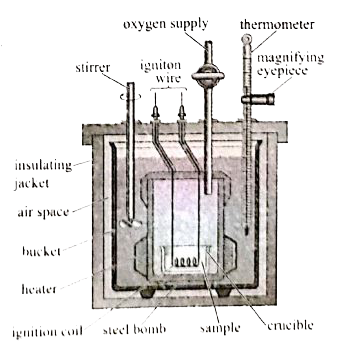
|
|
| 39. |
Explain how heat absorbed at constant pressure ismeasured using coffee calorimeter with neat diagram. |
|
Answer» Solution :(i) Heat evolved at constant Volume is measured in a bomb calorimeter. (ii) Apparatus step : The inner vessel (the bomb) and it's cover are made of strong Steel. The cover is fitted tightly to the vessel by means of METAL lid and screws. (III) Experiment : A weighed amount of the substance is taken in a platinum cup connected with electrical wires for striking an arc instantly to kindle combustion. The bomb is then tightly closed and pressurized with excess oxygen . The bomb is immersed in WATER, in the inner volume of the calorimeter. A stirrer is placed in the space between the wall of the calorimeter . A stirrers is placed in the space between the wall of the calorimeter and the bomb, so that water can be stirred, UNIFORMLY. The reaction is started by striking the substance through electrical heating.  (iv) Calculation : A know amount of combustible substance is burnt in oxygen in the bomb. Heat evolved during the reaction is absorbed by the calorimeter as well as the water in which the bomb is immersed. The CHANGE in temperature is measured using a Backman thermometer. Since the bomb is sealed its volume does not change and hence the heat measurements is equal to the heat of combination at a constant volume `(DeltaU)_(c)` The amount of heat produced in the reaction `(DeltaU)_(c)` is equal to the sum of the heat absorbed by the calorimeter and water. Heat absorbed by the calorimeter `q_(1)=k.DeltaT` where k is a calorimeter constant equal to `m_(c)C_(c)(m_(c)`is mass of the calorimeter and is mass of the `C_(c)`is heat capacity of calorimeter) Heat absorbed by the water `q_(2)=m_(W)C_(W)DeltaT` Were `m_(W)` is molar mass of water `C_(W)` is molar heat capacity of water `(75.29JK^(-1)mol^(-1))` Therefore `DeltaU_(c)=q_(1)+q_(2)` `=k.DeltaT+m_(W)C_(W)DeltaT` `=(k+m_(W)C_(W))DeltaT` |
|
| 40. |
Explain how effective nuclear charge is related with stability of the orbital? |
|
Answer» Solution :(i) In a multi-electron atom, in addition to the electrostatic attractive force between the clect and nucleus, there exists a repulsive force among the electrons. (ii) These two forces are operating in the opposite direction. This results in the decrease in its NUCLEAR force of attraction on electron. (iii) The net CHARGE EXPERIENCED by the electron is called effective nuclear charge. (iv) The effective nuclear charge DEPENDS on the shape of the orbitals and it decreases wit INCREASE in azimuthal quantum number I. (v) The order of the effective nuclear charge felt by a electron in an orbital within the give shell is s>p>d>f. (vi) Greater the effective nuclear charge, greater is the stability of the orbital. Hence, within given energy level, the energy of the orbitals are in the following order s |
|
| 41. |
Explain how effective nuclear change is related with stability of the orbital. |
|
Answer» Solution :(i) In a multi-electronatom,in addition to the electrostatic attractive force between the electron and nucleus,there exists a repulsive force among the ELECTORNS. (ii) These TWO forces are operating in the opposite direction.This results in the decreease in the nuclear force of attraction on electron. (iii)The net charge experienced by the electron is called effective nuclear charge. (IV) The effective nuclear charge depends on the shape of the orbitals and it decreases with increase in azimuthal quantum NUMBER l. (v) The order of the effective nuclear felt by a electron in an orbital within the given shell is sgtpgtdgtf. (vi) Greater the effective nuclear charge,greater is the stability of the orbital.Hence,within a given energy level,the energy of the orbitlas are in the FOLLOWING order sltpltdgtf. |
|
| 42. |
Explain how does green house effect cause global warming. |
|
Answer» Solution :(i) The earth.s atmosphere allows most of the visible light from the sun to pass through and reach the earth.s surface. As earth.s surface is heated by SUNLIGHT, it radiates a part of this energy back towards the space as longer IR wavelengths. (ii) Some of the heat is trapped by `CH_(4)CO_(2)CFCS` and water vapour present in the atmosphere.They absorb IR radiations and block a large portion of earth.s emitted radiations. (iii) The radiations thus absorbed is partly REMITTED to the earth.s surface. Therefore the earth surface gets heated up by a phenomenon called greenhouse effect. (IV) Thus greenhouse effect is defined as the heating up of the earth surface due to trapping infrared radiations reflected by earth.s surface by `CO_(2)` layer in the atmosphere. The calme up of the earth through the greenhouse effect is called global warming. |
|
| 43. |
Explain how bromoethane reacts with (i) alcoholic KCN (ii) alcoholic AgCN |
|
Answer» Solution :(i) Bromoethane REACTS with alcoholic KCN to form ETHYL cyanide. `underset("Bromoethane")(CH_3-CH_2Br) + KCN overset("ALCOHOL")to underset("Ethyl cyanide")(CH_3-CH_2CN) + KBR` (ii) Bromoethane reacts with alcoholic AgCN to form alkyl isocyanide. CH `CH_3 - CH_2Br + AgCN overset("alcohol")to underset("Ethyl isocyanide")(CH_3-CH_2NC) + AgBr` |
|
| 44. |
Which of the following shows negative deviation from Raoult's law ? |
Answer» SOLUTION :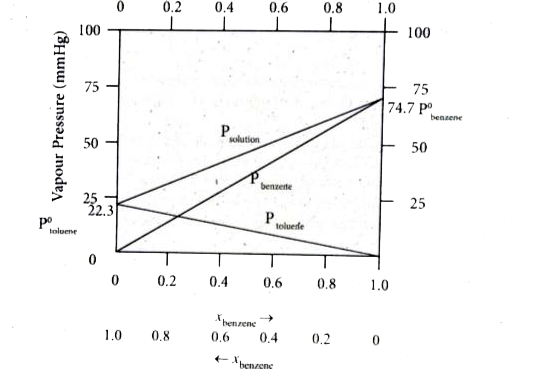 The variation of vapour pressure of pure benzene and toluene with its mole fraction is given in the GRAPH. (i) The vapour pressure of pure toluene and pure benzene are `22.3 and 74.7` MM Hg respectively. (ii) The graph SHOWS the partial vapour pressure of pure components increase linearly with the increase of the mole fraction of the respective components. The TOTAL pressure at any composition of the solute and solvent is given by the straight line. `P _("solution") =P_("toluene") ^(0) + x_("benzene") (P_("benzene")^(0) -P_("toluenc")^(0))` |
|
| 45. |
Explain how alkali metal oxide reacts with water? |
|
Answer» SOLUTION :Alkali metal oxides `M_(2)O, M_(2)O_(2)` and `MO_(2)` are EASILY hydrolyzed by water to form the HYDROXIDES according to the following reactions: ` M_(2)O + H_(2)O to 2M^(+) + 2OH^(-) ` `M_(2)O_(2)+2H_(2)Oto2M^(+)+2OH^(-)+H_(2)O_(2)` 2MO_(2)+2H_(2)to`2M^(+)+2OH^(-)+H_(2)O_(2)+O_(2)` |
|
| 46. |
Explainhow 2 butyne reacts with (a)lindlar 's catalyst and (b) sodium in liquid ammonia |
Answer» SOLUTION :(a)2-butyne reactswithLindlarcatalyst-2butynecan bereduced tocis 2-buteneusingThisreactionis sterospecificgivingonly thecis -2 - butene (b ) 2- butynereacts withsodiumin liquidammonia2-butynecan ALSOBE reducedtotrans -2buteneuusingsodiumin liquidammonia.Thisreactionis sterospecificgivingonlythe TRANS 2-butene. 
|
|
| 47. |
Explain Homogeneous equilibria. |
|
Answer» Solution :A system in which DIFFERENT substances in EQUILIBRIUM REMAIN in a SINGLE PHASE is called a homogeneous equilibrium. Example : `N_(2(g))+O_(2(g))hArr2NO_((g))` |
|
| 48. |
Explain heterolytic cleavage of organic compound (b) Carbanions by examples |
|
Answer» Solution :Definition: When a covalent bond breaks in such a way that both the electrons of the covalent bond (i.e. shared pair) are taken away by one the bonded atoms, the mode of bond cleave is called heterolytic fission. After heterolysis, one atom has a sextet electronic structure and a positive charge and the other, a valence octet with at least one lone pair and a negative charge. Heterolytic fission producing carbocation: e.g. Heterolytic CLEAVAGE of bromoethane will give `overset(+)(C )H_(3)` (positive ion) and `B overset(-)(r )` (negative ion).  Both electron of C-Br bond are transfer on Br. So, the non-bonding electron pair, octet and negative charge on Br. A species having carbon atom POSSESSING sextet of electron and +1 positive charge is called a carbocation. This `overset(+)(C )H_(3)` ion is known as a methyl cation or methyl carbonium ion. Positively charged carbon of `overset(+)(C )H_(3)`possessing `sp^(2)` hybridisation  These carbocations have trigonal planar shape because it derived from the overlap of three equivalent C `(sp^(2))` hybridised orbitals with is orbital of each of the three hydrogen atoms. Each bond may be represented as `C (sp^(2))`, H(IS) sigma bond. The REMAINING carbon orbital is perpendicular to the molecular PLANE and contains on electron. (b) Heterolytic fission producing carbanion: The heterolytic cleavage can also give species in which carbon gets the shared pari of electron and obtain negative charge containing species. e.g., When group Z attached to the carbon leaves without electron pair, the methyl anion `(H_(3)C^(-))` is formed  Carbon species carrying a negative charge on carbon atom is called carbanion. On carbanion carbon the octet and non-bonding `e^(-)` pair present and it possessing `sp^(2)` hydridisation, so its shape is tetrahedral  Carbanions are also unstable and reactive species. (c ) Heterolytic cleavage and reaction mechanism: The organic reactions which proceed through heterolytic bond cleavage are called ionic or heteropolar or just polar reactions |
|
| 49. |
Explain Heterogeneous equilibria. |
|
Answer» SOLUTION :A system in which the different substances in equilibrium form more than one phase is CALLED heterogeneous equilibrium. Example : `H_(2)O_((G))hArrH_(2)O_((L))` |
|
| 50. |
Explain heat of neutralisation with an example. |
|
Answer» Solution :Heat of neutralisation is the change in enthalpy produced when ONE gram equivalent weight of an ACID is neutralised by one gram equivalent weight of a base in a dilute solution. EXAMPLE : `HCl(AQ) + NaOH(aq) rarr NaCl(aq) + H_(2)O , Delta H = -57.3 kJ`. |
|