

Saved Bookmarks
This section includes 7 InterviewSolutions, each offering curated multiple-choice questions to sharpen your Current Affairs knowledge and support exam preparation. Choose a topic below to get started.
| 1. |
Explain mechanical work. OR Explain pressure volume work. |
Answer» Solution :Consider a cylinder which contains one mole of an ideal gas fitted with a frictionless piston. Total volume of the gas is `V_(i)` and pressure of the gas inside is p. If External pressure is `p_(ex)` which is greater than p.  Figure-(a) : Work done on an ideal gas in a cylinder when it is compressed by a constant external pressure, `p_(ex)` (in single step) is equal to the shaded area. Piston is moved inward till the pressure inside becomes equal to `p_(ex)`. The final volume be `V_(f)`. During this compression, suppose piston moves a distance `l`, and cross-sectional area of the piston is A [Fig. (a)]. Volume change `=l xx A = Delta V = ( V_(f) - V_(i) )""...(i)` force on the piston `= p_(ex) . A` If w is the work done on the system by movement of the piston then, `w= ` force `xx` distance `= p_(ex) . A. l` `= p_(ex) (- Delta V) = - p_(ex) ( Delta_(f) - Delta_(i) )` It INDICATES that in case of compression work is done on the system. Here `(V_(f) - V_(i) )` will be negative and negative multiplied by negative will be positive. Hence the sign obtained for the work will be positive. If the pressure not constant at every stage of compression, but changes in number of finite steps, work done on the gas will be SUMMED over all the steps and will be equal to `- sum p Delta V`. [Fig.(b)].  Figure- (b) : PV-plot when pressure is not constant and changes in finite steps during compression from initial volume, `V_(i)` to final volume, `V_(f)`. Work done on the gas is represented by the shaded area. If the pressure is not constant but changes during the process such that it is always infinitesimally greater than the pressure of the gas, then, at each stage of compression, the volume decreases by an infinitesimal amount, dV. In such a case we can calculate the work done on the gas by the relation. ` w= 0 underset(V_i)overset(V_f)int p_(ex) dV""...(ii)` Here, `p_(ex)` at each stage is equal to `Ip_("in" + d_(p) )` in case of compression [Fig. (c)]. In an expansion process under similar conditions, the external pressure is always less than the pressure of the system i.e., `p_(ex) = (p_(.in" - d_(p) )`. In general case we can write, `p_(ex) = (p_("in") pm d_(p) )`. Such PROCESSES are called reversible process. In this type of process, the equilibrium is established between system and surrounding at each microscopic level. Processes other than reversible process are known as irreversible processes.  Figure - (c) pV-plot when pressure is not constant and changes in infinite steps (reversible conditions) during compression from initial volume, `V_(i)` to final volume, `V_(f)`. Work done on the gas is represented by the shaded area We can relate work to internal pressure of the system under reversible conditions by writing equation 6.3 as follows : `w_("rev") = -underset(V_i)overset(V_f) int p_("ex") dV= - underset(V_i)overset(V_f)int ( p_("in") + dp) dV` Since `dp . dV` is very small we can write `w_("rev") = - underset(V_i)overset(V_f) int p_("in") dV""...(iii)` Now, the pressure of the gas can be expressed in terms of its volume through gas equation. For n mol of an ideal gas i.e., `pV= nRT` `p= (nRT)/( V)` Therefore, at constant temperature `w_("rev") =- underset(V_i)overset(V_f)int p dV""(p_("in") = p)` `=- underset(V_i)overset(V_f)int nRT (dV)/( V) ""(because pV= n RT)` `=- n RT "ln" (V_f)/( V_i) = -2.303 nRT log"" (V_f)/( V_i) ""...(iv)` |
|
| 2. |
Explain measurement methods of atomic radius. |
|
Answer» Solution :There is no method to measure atomic radius. Size of an atom `(~1.2 Å i.e. 1.2 XX 10^(-10)m)` is very small. The electron cloud SURROUNDING the atom does not have a sharp boundary, the DETERMINATION of the atomic size can.t be precise. In other words, there is no practical was by which the size of an INDIVIDUAL atom can be measured. Atomic radius is covalent or METALLIC radius which is measured by X-ray method spectroscopic methods. |
|
| 3. |
Explain Maxwell and Boltzman law with Graph. |
|
Answer» Solution : ..At constant speed, fraction of molecules will be remains constant.. which is known as distribution curve which is known as Maxwell and Boltzman.s distribution Curve. Maxwell and Boltzman indicated that ..distribution of molecules at gases and depend upon temperature and MOLECULE mass of gases... Maxwell derive formula of number of molecules having certain speed. Graph of Maxwell Boltzman speed distribution : The curve is speed of molecules against number of molecules. This curve is known as speed distribution of Maxwell Boltzman.  Information of Graph : (i) The fraction of molecules with very low or very high speeds is very small. (ii) The fraction of molecules POSSESSING higher and higher speeds goes on increasing till it REACHES the peak and then it starts decreasing. (iii) The maximum fraction of molecules possesses a speed correcponding to the peak in the curve. The speed correcponding to the peak in the curve is called most probable speed `(u_(mp))`. |
|
| 4. |
Explain mathematical formula, graph and absolute zero temperature. |
|
Answer» Solution :Charles. law and Formula : Charles. and Gay LUSSAC performed several experiments on gases independently to imporove upon hot air balloon technology. Simple Gay Lussac.s law : Their investigations showed that for a fixed mass of a gas at constnat PRESSURE, volume of a gas increases on increasing temperature and decreases on cooling. Charles and Gay Lussac they found that - ..for each degree RISE in temperature, volume of a gas increases by `(1)/(273.15)` of the original volume `(V_(0))` of the gas at `0^(@)C`. .. Thus, temperature volume `0^(@)C=V_(0)` and temperature volume `t^(@)C=V_(t)` then, `V_(t)=V_(0)+((t)/(273.15))V_(0)` `therefore V_(t)=V_(0)(1+(t)/(273.15)) ""` ......(Eq. -i) `therefore V_(t)=V_(0)((273.15+t)/(273.15)) ""`....(Eq. -ii) But `(273.15+t)""^(@)C=T_(1)k` So, `273.15^(@)C=T_(0)=273.15k` Thus `V_(t)=V_(0)((T_(1))/(T_(0))) ""`....(Eq. -III) `therefore (V_(t))/(V_(0))=(T_(1))/(T_(0)) ""`....(Eq. -iv) OR`(V_(2))/(V_(1))=(T_(2))/(T_(1)) ""`....(Eq. - v) So, `(V_(2))/(T_(2))=(V_(1))/(T_(1))""`...(Eq. - vi) Thus `(V)/(T=` constant `k_(2) ""` .....(Eq. -vii) `therefore V=k_(2)T ""`.....(Eq. - viii) This (Equation - viii) is the mathermatical expression for Charles. law. Charles. law : He states that pressure remaining constant, the volume of a fixed mass of a gas is directly proportional to its absolute temperature. Characteristics and Graph of Charle.s Law : For all gases, at any given pressure, graph of volume vs remperature (in celsius) is as under.  the graph is a straight line. the graph extending to zero volume. Slopes of lines obtained at different pressure are differnt `(p_(1), p_(2), p_(3),.....)`. Each line intercepts the temperature axis at `- 273.15^(@)C`. But at zero volume all the lines MEET the temperature axis at `- 273.15^(@)C`. All the lines are isobar because pressure is constant. |
|
| 5. |
Explain Markovnikoff's rule with suitable example . |
|
Answer» Eg : Addition HBr to unsymmetrical alkene : In the addition of hydrogen halide to an unsymmetrical alkene, two products are obtained . `(##SUR_CHE_XI_VO2_S_MQP_02_E01_052_A01##)` |
|
| 6. |
Explain Markanikov hydrohalogenation of alkene. |
|
Answer» Solution :Propene reacts with HBr, gives product by 2-Bromo propane has electrophilic addition reaction. Alkene reacts with hydrogen halide (HCl, HBr, HI) give product alkyl halide. This reaction is electrophilic addition reaction. (a) "Rule of markonikov" or give the addition reaction of alkene with HBr (HX) : Markovnikov gave rule as 1869. These generalisation in Markovnikov to frame a rule is called Markovnikov rule. The rule states that negative part of the addendum (adding molecule) gets attached to that carbon atom which possesses lesser number of hydrogen atoms. example :(a) Addition reaction of propene to HBr, product (I) and (II) is obtained but as per Markovnikov.s rule, product (I) b is only obtained. Addition of propene to HBr gives product (I) and (II).  (b) As per Markovnikov.s rule, `Br^(-)` is reactant HBr, attaches with LESS number of hdyrogen and forms double donded product. It is a main product.  Information of product formed by Markovnikov.s rule in reaction : In any reaction, product is obtained in major amount. Series of carbocation in `3^(@) gt 2^(@) gt 1^(@) overset(+)(C)H_(3)`. In `pi`-bond, `pi`-ELECTRON having -ve charge, `H^(+)` is attarcted and `pi`-bond is broken, formation of `sigma` -bond stable carbocation is formed.  (ii) First `Br^(-)` attaches FAST with (y) and forms below product.  Note : In unsaturated alkene C=C, both carbon can have different substitution but has same number of substitution. REACTIVITY of HX in alkene is `HI gt HBr gt HCl`. Reactivity of carbocation is `3^(@)-C^(+) gt 2^(@) -C^(+) gt 1^(@) - C^(+) gt overset(+)(C)H_(3)`. |
|
| 7. |
Explain markovnikoff's rule witjh suitable example |
|
Answer» SOLUTION :Markovnikoff.srule :Whenan unsymmetricalalkenereactswithhydrogenhalidethehydrogenaddsto thecarbonatomthat hasmorenumberof HYDROGENAND halogenaddsto thecarbonatomhavingfewerhydrogenatoms EXAMPLE of HBR to PROPENE 
|
|
| 8. |
Explain Liquifaction of CO_(2) gas by Thomas Andrews plot graph and different effect of temperature and pressure and critical constant. |
|
Answer» <P> SOLUTION :First complete data on pressure - volume - temperature relations of a substance in both gaseous and liquid state was obtained by Thomas Andrews on carbon dioxide. From graph derivations of Andrews: (iii) Explanation of `T_(C )`, (E point) `P_(C )` and `V_(C )` : At `30.98^(@)C` carbon dioxide remains gas upto 73 atmospheric pressure. (Point E in Figure). At 73 atmospheric pressure, liquid carbon dioxide appears for the first time. Critical temperature `(T_(C )) : 30.98^(@)C` temperature is known as critical temperasture of `CO_(3)` gas. While firct pressure of `CO_(2)` gas becomes liquid at 73 atoms. Higher than `30.98^(@)C CO_(2)` gas is in gaseous from `(T_(C ))`. At critical temperature volume of 1 MOLE gas is known as critical volume `(V_(C ))` and pressure is known as critical pressure `(P_(C ))`. Critical pressure : The critical temperature `(T_(C ))`, critical pressure `(P_(C ))` and critical volume `(V_(C ))` are called critical constants. `30.98^(@)C` further increase in pressure simply compresses the liquid carbon dioxide and the curve represents the compressibility of the liquid. The steep line represents the isotherm of liquid. Even a slight compression results in steep rise in pressure indicating very low compressibility of the liquid. Below `30.98^(@)C (T_(C ))` or (`21.5^(@)C` point B) and BC : Below `30.98^(@)C` the behasviour of the gas on compression is quite different. At `21.5^(@)C`, carbon dioxide remains as a gas only upto point B. Further compression does not chage the pressure. - Liquid and gaseous carbon dioxide COEXIST and further application of pressure results in the condensation of more gas until the point C is reached. At point C, all the gas has been condensed and further application of pressure merely compresses the liquid as shown by steep line. A slight compression from volume `V_(2)` to `V_(3)` results in steep rise in pressure from `P_(2)` to `P_(3)`. Below `30.98^(@)C` (criticasl temperature) each curve shows the similar trend and only length of the horizontal line INCREASES at lower temperatures. (At E point, after BC line length is increases.) At critical point horizontal portion of the isotherm merges into one point. In figure : (i) Point A : Represents gaseous state (ii) Point D :Represent liquid state. (iii) Dome shaped area represents existence of liquid and gaseous carbon dioxide in equilibrium. |
|
| 9. |
Explain Liquifaction gas with isothermal graph. |
|
Answer» Solution :First complete data on pressure - volume - TEMPERATURE relations of a substance in both gaseous and liquid state was obtained by Thomas Andrews on carbon dioxide. From graph derivations of Andrews: (iii) Explanation of `T_(C )`, (E point) `P_(C )` and `V_(C )` : At `30.98^(@)C` carbon dioxide remains gas upto 73 atmospheric pressure. (Point E in Figure). At 73 atmospheric pressure, liquid carbon dioxide appears for the first time. Critical temperature `(T_(C )) : 30.98^(@)C` temperature is known as critical temperasture of `CO_(3)` gas. While firct pressure of `CO_(2)` gas becomes liquid at 73 atoms. Higher than `30.98^(@)C CO_(2)` gas is in gaseous from `(T_(C ))`. At critical temperature volume of 1 mole gas is known as critical volume `(V_(C ))` and pressure is known as critical pressure `(P_(C ))`. Critical pressure : The critical temperature `(T_(C ))`, critical pressure `(P_(C ))` and critical volume `(V_(C ))` are called critical CONSTANTS. `30.98^(@)C` further increase in pressure simply compresses the liquid carbon dioxide and the curve represents the compressibility of the liquid. The steep line represents the isotherm of liquid. Even a slight compression results in steep rise in pressure indicating very low compressibility of the liquid. Below `30.98^(@)C (T_(C ))` or (`21.5^(@)C` point B) and BC : Below `30.98^(@)C` the behasviour of the gas on compression is quite different. At `21.5^(@)C`, carbon dioxide remains as a gas only upto point B. Further compression does not chage the pressure. - Liquid and gaseous carbon dioxide coexist and further application of pressure results in the condensation of more gas until the point C is reached. At point C, all the gas has been condensed and further application of pressure merely compresses the liquid as shown by steep line. A slight compression from volume `V_(2)` to `V_(3)` results in steep rise in pressure from `P_(2)` to `P_(3)`. Below `30.98^(@)C` (criticasl temperature) each curve shows the similar trend and only length of the horizontal line increases at LOWER temperatures. (At E point, after BC line length is increases.) At critical point horizontal portion of the isotherm merges into one point. In figure : (i) Point A : Represents gaseous state (ii) Point D :Represent liquid state. (iii) Dome shaped area represents existence of liquid and gaseous carbon dioxide in equilibrium. |
|
| 10. |
Explain liquid-vapour equilibrium. |
|
Answer» Solution :Process : We consider the example of a transparent box carrying a U-tube with mercury (manometer). Drying agent like anhydrous calcium chloride (or PHOSPHORUS penta-oxide) is PLACED for a few hours in the box. By doing this air in the box is free from vapour (moisture). (see fig.) Now, after removing the drying agent by tilting the box on one side, a watch glass (or petri dish) containing water is quickly placed inside the box.  Observation : It will be observed that the mercury level in the right limb of the manometer slowly increases and finally ATTAINS a constant value. Assumption : The observation shows that (i) In the beginning the pressure inside the box increases. (ii) After some time pressure inside the box becomes constant. (iii) The volume of water in the watch glass decreases.  Description : Initially there was no water vapour (or very less) inside the box. As water evaporated the pressure in the box increased due to addition of water molecules into the gaseous phase inside the box, [`H_2O to H_2O_"(vapour)"`] So, the rate of evaporation is constant. The rate of increase in pressure decreases with time due to condensation of vapour into water.`[H_2O_((g)) to H_2O_((l))]`While water is converting from gases to liquid form, atoms are increasing. After some time pressure BECOME constant. There is equilibrium in box as rate of evaporation and rate of condensation become equal. Rate of evaporation `(H_2O_((l)) to H_2O_((g)))` = Rate of condensation `(H_2O_((g)) to H_2O_((l)))`.....(i) `therefore` at the equilibrium stage `H_2O_((l)) hArr H_2O_"(vapour)"` At equilibrium the pressure exerted by the water molecules at a given temperature remains constant and is called the equilibrium vapour pressure of water (or just vapour pressure of water), vapour pressure of water increases with temperature. Water and water vapour are in equilibrium position at ATMOSPHERIC pressure (1.013 bar) and at `100^@C` in a close vessel. The boiling point of water is `100^@C` at 1.013 bar pressure. For any pure liquid at one atmospheric pressure the temperature at which the liquid and vapours are at equilibrium is called normal boiling point. |
|
| 11. |
Explain Liquefaction of Real Gas and Permanent Gas. |
|
Answer» SOLUTION :Liquefaction of Real Gases : All the gases upon COMPRESSION at constant temperature (isothermal compression) show the sasme behaviour as shown by carbon dioxide. That gases should be cooled below their critical temperature for liquification. ..Critical temperature of a gas is highest temperature at which liquifaction of the gas first occurs... Liquefaction of Permanent Gases : Permanent gases (i.e., gases which show continuous positive deviation in Z value) requires cooling as well as considerable compression. Compression brings the MOLECULES in close VICINITY and cooling slows down the movement of molecules. Therefore, intermolecular interactions may hold the closely and slowly MOVING molecules together and the gas liquifies. |
|
| 12. |
Explain Linear combination of atomic orbitalsby suitable example OR Exaplain H_(2) molecule by molecular orbitals theory. |
|
Answer» Solution :LCAO Method of molecular ORBITALS : Molecular orbital is not obtained by Schrodinger want equation but it can be obtain by LCAO. LCAO method for Hydrogen Molecule `(H_(2))` : drogen is homonuclear diatomic molecule consider the hydrogen molecule `(H_(2))` consisting of two atoms `H_(A)` and `H_(B)`. Mathematically, the formation of molecular orbitals may be described by the linear COMBINATION of atomic orbitals that can take place by addition an by subtraction of wave functions of INDIVIDUAL atomic orbitals as shown below. `Psi_(MO) = Psi_(A) + Psi_(B) "OR " Psi_(MO)^(**) = Psi_(A) - Psi_(B)` following fig. depicted the formation of `H_(2)` molecule from `H_(2)` atom and its energy.  Bonding molecular orbital `(Psi_(MO))` e.g. `sigma`: the molecular orbital `sigma` formed by the addition of atomic orbitals is called the bonding molecular orbital `(Psi_(MO))`. Here `sigma` type molecular orbital . `Psi_(MO) = sigma (H_(2)) = Psi_(2) + Psi_(B)` Antibonding molecular orbital `(Psi_(MO)^(**)) ` e.g `sigma^(**)` : The molecular orbital `sigma ` formed by the SUBSTRACTION of atomic orbital `(Psi_(A) and Psi_(B))` is called antibonding molecular orbital. Here `sigma^(**)` type anitbonding molecular orbital. `Psi_(MO)^(**) (H_(2)) = sigma^(**)` type antibonding molecular orbital, `Psi_(MO)^(**) (H_(2)) = sigma^(**) (H_(2)) = Psi_(A) - Psi_(B)` |
|
| 13. |
Explainlinearand angularmomentum. |
|
Answer» Solution :Linearmomentum :Linearmomentum is theproductof mass andvelocity Linearmomentum =`m xx v` Angular momentum : ANGULARMOMENTUM istheproductof momentof INERTIA(i) andangularvelocity( w ) Angularmomentum`=(1 xx w )` `(m_(e ))((v )/( r ))` Angularmomentum = `m_( ) V r ....` |
|
| 14. |
Explain : Lewis dots Representation. OR State the points require in Lewis dot representation. |
|
Answer» Solution :Number of total electron in neutral molecule : The total number of electrons required for wmting the structures are obtained by adding the valence electrons of the combining atoms. For example, in the `CH_(4)` molecule there are eight valence electrons available for bonding (4 from carbon and 4 from the four hydrogen atoms) Number of electron in negative ion : Each negative charge would mean addition of one electron from the total number of valence electrons. e.g. For the `CO_(3)^(2-)` ion. In Lewis representation total 24 electron in which 4 `e^(-)` of one carbon 18 `e^(-)` of three oxygen and 2 additional `e^(-)` of two negative ions. `({:("Number of "),("electron in"),("negative ion"):})= ({:("Total valence"),("electron"),("of all atoms"):})+ ({:("number of"),("negative"),("charge"):})` `({:("Number of "),("electron in"),("positive ion"):})= ({:("Total valence"),("electron"),("of all atoms"):})- ({:("number of"),("positive"),("ion"):})` e.g., `({:("Total"),("electrons"),("in"NH_(4)^(+)):})=({:("Valence"),("electron of "),("N and 4 H"):})-1` = (5 + 4) - 1 = 8 Distribution of electron : Knowing chemical symbols of the combining atoms and having KNOWLEDGE of the skeletal structure of the compound (know or guessed intelligently), it is easy to distribute the total number of electrons as bonding shared pairs between the atom in proportion to the total bond. Position of electrons : After accounting for the shared pairs of electrons for single bonds, the remaining electron pairs are either utilized for multiple bonding or remain as the lone pairs. The basic requirement being that each bounded atom GETS an octet of electrons. `F - underset(H)underset(|)(N) -F "" O - underset(O)underset(|)(C) - O` |
|
| 15. |
Explain Lewis electron acid - base concept with an example. |
|
Answer» SOLUTION :According to Lewi's theory, acid is a substance which accepts a pair of electrons and base is a substance which donates a pair of electrons. `{:("Lewis base","BOND","Lewis acid","Compound"),(H_(3)N,to,BF_(3),H_(3)NBF_(3)),(CaO,to,CO_(2),CaCO_(3)),(H_(2)O,to,H^(+),H_(3)O^(+)):}` |
|
| 16. |
Explainlinespectraand itsuses. |
|
Answer» Solution :Linespectra(atomicspectra ) : Thespectrumof thevisiblelight are representedin thespectra. Theemission spectraof atoms in thegas phaseon theotherhanddo notshow acontinuousspread ofidentifiedby the appearanceof brightlinesin thespectra. An EMISSION andabsorptionspectrumis aphotographicrecordingof thewavelengthis CALLEDAS linespectrum.  Uses : Line emissionspectra are of GREAT INTEREST in thestudyof electronicstructure . Thecharacteristicoflinesof the EMISSIONSPECTRUM of the atomof a knownelementwith thelinesfrom an unknownWhentheirmineralywereanalysedby spectroscopicmethod. |
|
| 17. |
Explain Lewis acid base concept with an example. |
|
Answer» SOLUTION :Lewis ACID `-BF_(3) :'` It accepts a PAIR of electrons Lewis BASE `-NH_(3) :'` It donates a pair of electrons. |
|
| 18. |
Explain Law of Octaves given by Newland. |
|
Answer» Solution :John Alexander Newland in 1865 profundad the Law of octaves. Law : "Every eight element had properties SIMILAR to the FIRST element." The relationship was just like every eight note that RESEMBLES the first in octaves of music.  For his work, was later awarded DAVY Medal in 1887 by the Royal Society, London. |
|
| 19. |
Explain Law of Multiple Proportions : |
|
Answer» According to this law, if two elements can combine to form than one compound, the MASSES of one element that combine with a fixed mass of the other element, are in the ratio of small whole numbers. For example, hydrogen combines with oxygen to form two COMPOUNDS, namely, water and hydrogen peroxide. For example hydrogen combines with oxygen to form two compounds, namely water and hydrogen peroxide. `{:("Hydrogen",+,"Oxygen",rarr,"Water",),(2g,,16g,,18g,),("Hydrogen",+,"Oxygen",rarr,"Peroxide",),(2g,,32g,,34g,):}` Here, the masses of oxygen (i.e. 16 G and 32 g ) which combine with a fixed mass of hydrogen (2g) bear a simple ratio, i.e. 16 : 32 or 1 : 2. |
|
| 20. |
Explain Law between pressure and temperature. |
|
Answer» Solution :Pressure in WELL inflated tyres of automobiles is almost constant, but on a hot summer day tyre may burst if pressure is not adjusted properly. During winters on a cold morning one may find the pressure in the tyres of a vechicle decreased considerably. Law :At constant volume, pressure of a fixed AMOUNT of a gas varies directly with the temperature. The rule as mathematically : `p prop T` (at constant V) ....(Eq. - i) and `p=K_(3)T` (at constant V) ....(Eq. -ii) So, `(p)/(T)=K_(3)=` constant.....(Eq.-iii) Law : ..At constant volume ratio of pressure and absolute temperature of gas is constant... Formula of changes of temperature and pressure at constant volume : Suppose, at constant volume INITIAL pressure is `p_(1)` and initial temperature `T_(1)` and final pressure is `p_(2)` and final temperature is `T_(2)`. According to Gay Lussac.s Law, `(p_(1))/(T_(1))=k_(3)=(p_(2))/(T_(2))` Thus, `(p_(1))/(T_(1))=(p_(2))/(T_(2)) ""`....(Eq. -iv) and `(p_(1))/(p_(2))=(T_(1))/(T_(2)) ""` ....(Eq. -v) and `p_(1)T_(2)=p_(2)T_(2) ""`.....(Eq. - vi) Isocore Graph : Pressure vs temperature (Kelvin) graph at constant molar volume is shown in Fig.  The graph is a strait line with positive slope. Each line of DIFFERENT volume `(V_(1),V_(2),V_(3),V_(4))` are isochore. All the isohores expanded to low temperature are gathered at origin point. `therefore` At zero K temperature, PRESSUREIS zero therefore at zero K temperature there is no gaseous state. We can get Gay Lussac.s law by using Boyle.s and Charle.s law. |
|
| 21. |
Explain Law of Definite proportions by examples. |
|
Answer» Proust worked with two samples of CUPRIC carbonate - one of which of natural origin and the other was synthetic one. He found that the composition of elements present in it was same for both the samples as shown below:  Thus, IRRESPECTIVE of the source, a given compound always contains same elements in the same proportion. The validity of thislaw has been confirmed by various experiments. It is sometimes also referred to as Law of definite composition. |
|
| 22. |
Explain Laplace-Lavoisier law. |
|
Answer» Solution :The quantity of HEAT that must be SUPPLIED to decompose a COMPOUND into its elements is equal and opposite to the evolved when the same compound is formed its elements. `C_((s)) + O_(2(G)) rarr CO_(2(g)) ""Delta H = -393.5 kJ ml^(-1)`. `CO_(2(g)) rarr C_((s)) + O_(2(g)) ""Delta H = +393.5 kJ ml^(-1)` |
|
| 23. |
Explain Laboratory Preparation of Dihydrogen. |
|
Answer» Solution :It is usually prepared by the REACTION of granulated zinc with dilute hydrochloric ACID. `Zn+2H^(+) to Zn^(2+) + H_2` It can also be prepared by the reaction of zinc with AQUEOUS alkali. `Zn+2NaOH to underset"SODIUM zincate"(Na_2ZnO_2+H_2)` |
|
| 24. |
Explain Kjeldahl's method. |
|
Answer» Solution :Principle: This method is based on the fact that an organic compound containing nitrogen is heated with cone, `H_(2)SO_(4)` , the nitrogen is CONVERTED to ammonium sulphate. The resultant liquid is heated with excess of alkali and then LIBERATED ammonia gas is absorbed in excess of standard acid. The amount of ammonia (nitrogen) is determined by finding the amount of acid neutralised by back titration with same standard alkali. Procedure: A weighed quantity of the substance 0.3 to 0.5g is placed in a special long necked Kjeldahl flask made of pyrex glass. About 25 ml of conc. `H_(2)SO_(4)` together with a little `K_(2)SO_(4)` and `CuSO_(4)` (catalyst) are added to it, the flask is loosely stoppered by a glass bulb and heated gently in an inclined position. The heating is continued till the brown colour of the liquid disappears leaving the content clear as before. At this point all the nitrogen is converted to ammonium sulphate. The kjeldahl flask is cooled and its contents are diluted with distilled water and carefully transferred into a 1 litre rund bottom flask. An excess NaOH is poured down the SIDE of the flask and it is fired with a kjeldhals trap and a water condenser. The lower end of the condenser dips in a measured volume of excess of `(N)/(20)H_(2)SO_(4)` solution. The liquid in the round bottom flask is heated and 20 liberated ammonia is distilled to sulphuric acid. When no more ammonia passes over test the distillate with red litmus) the receiver is removed. The excess of acid is then determined by titration with alkali, using phenolphthalein as the indicator.  Calculation Weight of the substance = Wg Volume of `H_(2)SO_(4)` required for the complete neutralisation of evolved `NH_(3)` = V ml Strength `H_(2)SO_(4)` used to neutralise `NH_(3)` = N. LET the volume and strength of `NH_(3)` formed are `V_(1)` and `N_(1)` respectively. `V_(1)N_(1) = VN` `"The amount of nitrogen present in W g of organic compound"=(14 xx NV)/(1 xx 1000 xx w)` `"Percentage of nitrogen"=(14 xx NV)/(1000 xx w) xx 100=(1.4NV)/(w)%` |
|
| 25. |
Explain kinetic energy and average translation kinetic and average square speed. |
|
Answer» Solution :KINETIC energy : Kinetic energy of molecule is represent as follow. Kinetic energy `=(1)/(2)mu^(2) ""` ……(Eq. -i) Average translation kinetic energy : `(1)/(2)m u^(2)`is known as translation kinetic energy. where,`bar(u)^(2)=`Average SPEED of root of all molecules in molecules in MOTION in straight line. Average square speed `(bar(u)^(2))` : Average square speed is measurement of average kinetic speed of gaseous molecules. If VELOCITY of n molecules are`u_(1), u_(2), u_(3)`, .... than its quare `u_(1)^(2), u_(2)^(2), u_(3)^(2), ...... u_(n)^(2)` so, `bar(u)^(2)=(u_(1)^(2)+u_(2)^(2)+u_(3)^(2).....u_(n)^(2))/(n)` `bar(u)^(2)=(u_(RMS))^(2)=(3RT)/(M)` |
|
| 26. |
Explain K How does the extent of reaction depend on K_(C) ? |
Answer» SOLUTION :
|
|
| 27. |
Explain Isotopes of Hydrogen in short. |
|
Answer» Solution :Hydrogen has three isotopes: protium, `(._1^1H)`, Deuterium, (`._1^2H` or D) and tritium, (`._1^3H` or T). These isotopes DIFFER from one another in respect of the presence of neutrons. Ordinary hydrogen, protium, has no neutrons, deuterium (also known as heavy hydrogen) has one and tritium has two neutrons in the nucleus. In the year 1934, an American scientist, Harold C. Urey, got Nobel Prize for separating hydrogen ISOTOPE of mass number 2 by physical methods. The predominant form is protium. Terrestrial hydrogen contains 0.0156% of deuterium mostly in the form of HD. The tritium concentration is about one atom per `10^18` atoms of protium. Of these isotopes, only tritium is radioactive and emits low energy B- particles. Its half life period is (`t_(1/2)`=12.33 years) Since the isotopes have the same electronic configuration, they have ALMOST the same chemical properties. The only difference is in their rates of reactions, mainly due to their different enthalpy of bond DISSOCIATION. However, in physical properties these isotopes differ considerably due to their large mass differences. 
|
|
| 28. |
Explain isomerism of alkane having more than three carbon by the two examples of alkane. |
|
Answer» Solution :* STRUCTURAL ISOMERS : Compounds having same molecular formula but DIFFERENT structural ARRANGEMENT is known to be structural isomers. This phenomenon is known as structural isomerism. * Branched isomers (Chain isomers) : If two or more compounds having same molecular formula but the carbon chain structures are different such compounds are known as chain isomers and this is known as chain isomers and this is known as chain isomerism. Having more than three carbon alkanes havechain isomerism. Example -1 : Butane has 2 structural isomers. (i) n-butane can be joined either in a continuous chain or with a branched chain. (ii) ISOBUTANE shows branched structure. (i) n-butane : `H-underset(H)underset(|)overset(H)overset(|)(C)-underset(H)underset(|)overset(H)overset(|)(C)-underset(H)underset(|)overset(H)overset(|)(C)-underset(H)underset(|)overset(H)overset(|)(C)-H` (ii) 2-Methylpropane :  Example - 2: Penane `(C_(5)H_(12))` has 3 isomers. (i) Normal pentane has chain like structure. (ii) Isopentane and (iii) Neopentane has branched like structure. (i) Pentane : `underset("n-pentane")(H-underset(H)underset(|)overset(H)overset(1|)(C)-underset(H)underset(|)overset(H)overset(2|)(C)-underset(H)underset(|)overset(H)overset(3|)(C)-underset(H)underset(|)overset(H)overset(4|)(C)-underset(H)underset(|)overset(H)overset(5|)(C)-H)` In short `CH_(3)CH_(2)CH_(2)CH_(2)CH_(3)` 
|
|
| 29. |
Explainionizationenthalpy and electronegativity for elements of Boron family. |
|
Answer» Solution :Ionization enthalpy : The ionisation enthalpy values as expected from the GENERAL trends do not decrease smoothly down the group . The decrease from B to AL is associated with increased in size. The observed discontinuity in the ionisation enthalpy values between Al and Ga and between In and Tl are due to inability of d- and f- ELECTRONS, which have low SCREENING effect, to compensate the increase in NUCLEAR charge. The order of ionisation enthalpies , as expected , is `Delta_i H_1 lt Delta_i H_2 lt Delta_i H_3`. Electronegativity :Down the group , electronegativity first decreases from B to Al and then increases marginally. This is because of the discrepancies in atomic size of the elements. |
|
| 30. |
Explain ionization and ionization constant in di and polyprotic acid . |
|
Answer» SOLUTION :As a example , the ionization of dibasic acid `H_2X` in aqueous solution is represented in TWO step . (i)`H_2X_((aq))+aq hArr H_((aq))^(+) + HX_((aq))^(-)` (ii)`HX_((aq))^(-) + aq hArr H_((aq))^(+) + X_((aq))^(2-)` If EQUILIBRIUM constant of `K_a` (i) and `K_a` (ii) of this both equilibrium (i) and (ii) then, `therefore K_a (i)= ([H^+][HX^-])/([H_2X]) , K_a (ii)= ([H^+][X^(2-)])/([HX^-])` So, `K_a (i) xx K_a (ii) = ([H^+]^2 [X^(2-)])/([H_2X])` but Reaction (i) + Reaction (ii) `H_2X_((aq))+aq hArr 2H_((aq))^(+) + X_((aq))^(2-)` For this , equilibrium constant `K_a` (iii) is, `K_a (iii) = ([H^+]^2[X^(2-)])/([H_2X])` So, For dibasic acid, `K_a (iii) = K_a (i) xx K_a` (ii)..... (Eq. -i) where , `K_a` (i)=FIRST ionization constant , `K_a` (ii) is second ionization constant. For any polybasic and RESPECTIVELY `K_a (i) , K_a (ii)`..... than `K_a = K_a (i) xx K_a (ii) xx` ....(Eq.-ii) Generally `K_a(i) gt K_a(ii) gt K_a (iii)`....as the after formation ion the remove of proton is difficult. |
|
| 31. |
Explain ionisation enthalpy of group 14 elements . |
| Answer» Solution :The first ionisation enthalpies of the ELEMENTS of GROUP 14 are higher than those of the corresponding group 13 elements DUE to greater NUCLEAR charges and smaller atomic sizes . The variation in the first ionisation enthalpy of the elements of group 14 moving down the group is `C GT Si gt Sn lt Pb.` | |
| 32. |
Explain Ionic Hydrides (Saline Hydrides) covalent (molecular hydrides), Metal (hydrides) or (non stoichiometric hydrides) by Examples. |
|
Answer» Solution :Dihydrogen, under certain reaction CONDITIONS, combines with almost all elements, except NOBLE GASES, to form binary compounds, CALLED hydrides. If .E. is the symbol of an element then hydride can be expressed as `EH_X` (e.g., `MgH_2`) or `E_mH_n` (e.g., `B_2H_6`). The hydrides are classified into three CATEGORIES: (i) Ionic or saline or saltlike hydrides (ii) Covalent or molecular hydrides (iii) Metallic or non-stoichiometric hydrides |
|
| 33. |
Explain ionic bond in NaCl. |
|
Answer» Solution :NACL is lormed by the combination of sodium and chlorine. An atom of sodium transfer an electron to chlorine and form sodium ION (positive ion.) `Noverset(dot)atoNa^(+)+e^(-)` The chlorine atom GAIN, ONE electron from sodium and form chloride ion (negative ion) `:underset(..)overset(..)Cl+e^(-)to:underset(..)overset(..)Cl:^(-)` Thus both `Na^(+)andCl` ions are held by electrosatic force of attraction to form ionic MOLECULE NaCl. |
|
| 34. |
Explain internal energy as a state function. |
|
Answer» Solution :Internal energy depends only on the state VARIABLES P, V, T and n. When the system is changed from the initial state to the final state, the change in interal energy is same for the different paths taken. (a) In a cyclic process, the net change in U is zero. (b) In an isothermal process, the change in U of an ideal gas is zero. (c ) In an adiabatic process, U of a system decreases if WORK done by the system. (d) If heat is absorbed by the system, its U INCREASES. (e) If heat is RELEASED from the system, its U decreases. |
|
| 35. |
Explain inter molecular redox reaction with example. |
Answer» Solution :In such TYPE of redox reaction ONE element from OXIDATION while other element form reduction. 
|
|
| 36. |
Explain inductive effect with suitable example. |
|
Answer» Solution :(i) It is defined as the change in the polarization of a covalent bond due to thepresence ofadjacent BONDED atoms or groups in the molecule.It is denoted as I - effect. (II) Atoms or groups which lose electron towards a carbon atom are said to have a `+I` effect. Example, `CH_(3)-`, `(CH_(3))_(2)` `CH-`, `(CH_(3))_(2)C-` etc. (iii) Atoms or groups which draw electrons away from a carbon atom are said to have a `-I` effect. Example, `-NO_(2)`, `-I`, `-Br`,`-OH`, `C_(6)H_(5)` etc. (iv) For example, consider ethane and ethyl chloride. The `C-C` bond in ethane is non-polar while the `C-C` bond in ethyl chloride is polar.We know that chlorine is more electronegative than carbon and hence it ATTRACTS the shared pair of electrons between `C-CI` in ethyl chloride towards itself. ` (##FM_CHE_XI_V02_C12_E02_004_S01.png" WIDTH="80%"> This develops a slight negative charge on chlorineand a slight positive charge on carbon towhich chlorine is attached.To compensate it, the `C_(1)`draws the shared pair of electron between itself and `C_(2)`. This polarization effect is called INDUCTIVE effect. |
|
| 37. |
Explain intensive properties with two examples |
| Answer» Solution :The PROPERTY that is independent of the mass or the size of the SYSTEM is called an intensive property. EXAMPLES : Refractive index, Surface tension, DENSITY, temperature, BOILING point, Freezing point, molar volume, etc., | |
| 38. |
Explain intensive properties with two examples . |
| Answer» SOLUTION :The PROPERTY that is independent of the mass or size of the system is called as intensive property eg, REFRACTIVE index and SURFACE tension. | |
| 39. |
Explain 'Inductive effect' and electomeric effect. Which electron displacement explains the following correct orders of acidity of caboxylic acids? Cl_3CCOOH gr Cl_2CHCOOH gr ClCH_2COOH |
|
Answer» |
|
| 40. |
Explain 'Inductive effect' and electomeric effect. Which electron displacement explains the following correct orders of acidity of caboxylic acids? CH_3CH_2COOH gr (CH_3)_2CHCOOH gr (CH_3)_3CCOOH |
|
Answer» |
|
| 41. |
Explain inductive effect with suitable example |
|
Answer» Solution :Inductive effect: (i) It is defined as the charge in the polarization of a covalent bond DUE to the presence ofadjacent bonded atoms or groups in the molecule . It is denoted as 1 effect (ii) Atoms or GROUP which LOSE electrons towards a corbon atom are said to have a carbon atom are said to have a + 1 effect Example : ` CH_(3) - (CH_(3))_(2) CH_(3) (CH_(3))_(2)C `- etc. (iii) For examples consider ethane and ethyl chloride . The C-C bond in ethane is non-polar while the C-C bond in ethyl chloride is polar . Weknow that chloride is more electronegative than carbon and hence it attracts the shared pair of electrons between C-C is ethyl chloride towards itself `underset(2) overset(sigma)Coverset(sigma^(+))H_(3) - underset(1)overset(sigma)(C)H_(2)- overset(sigma^(-))Cl ` |
|
| 42. |
Explain in short: Pollution of troposphere done by hydrocarbon. |
|
Answer» SOLUTION :HYDROCARBONS are composed of hydrogen and carbon only and are formed by incomplete combustion of fuel USED in automobiles. Hydrocarbons are CARCINOGENIC, i.e., they cause CANCER. They harm plants by causing ageing, breakdown of tissues and shedding of leaves, flowers and twigs. |
|
| 43. |
Explain in what respects lithium is different from other metals of the same group. |
Answer» SOLUTION :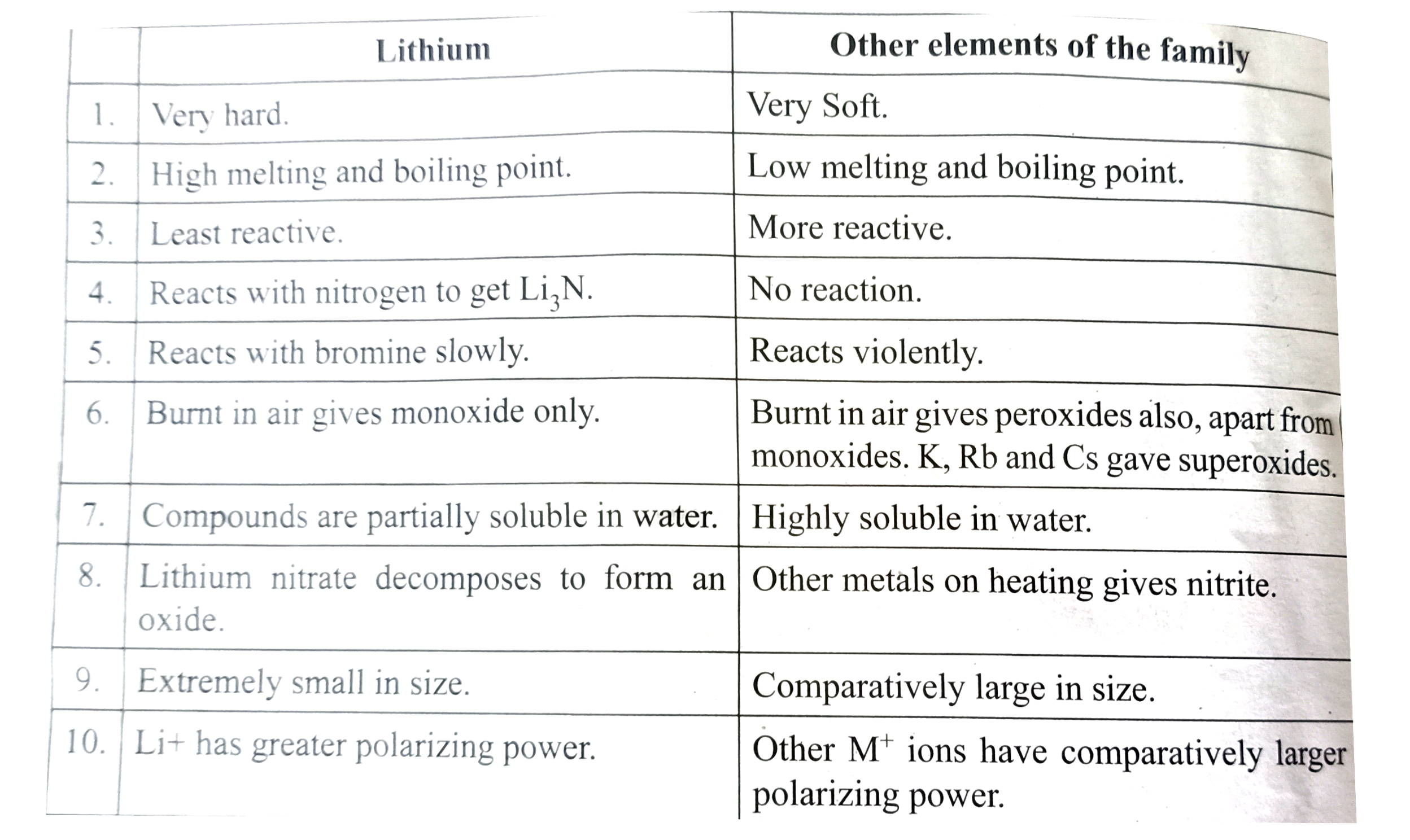
|
|
| 44. |
Explain in Short : MO occupancy and molecular properties forB_(2) , C_(2) , N_(2) , O_(2), F_(2), Ne_(2). |
Answer» SOLUTION :The SEQUENCES of MO occupancy and MOLECULAR properties appear in below the table. 
|
|
| 45. |
Explain in short : Effect of ozone depletion on environment . |
|
Answer» Solution :With the depletion of ozone layer, more UV radiation filters into troposphere. UV radiations lead to ageing of skin, cataract, sunburn, skin cancer, killing of MANY phytoplanktons, damage to fish productivity ETC. Plant proteins get easily affected by UV radiations which leads to the harmful mutation of cells. It also increases evaporation of surface water through the stomata of the leaves and DECREASES the moisture content of the soil. Increase in UV radiations damage paints and fibres, CAUSING them to FADE faster. |
|
| 46. |
Explain in detail about the addition of hydrogen halide to an unsymmetrical alkene. |
|
Answer» Solution :Addition `HBr` to unsymmetrical alkene : In the addition of hydrogen halide to an unsymmetrical alkene, two products are obtained.  Mechanism : Consider addition of `HBr` to propene Step `1` : Formation of electrophile : In `H-Br`, `Br` is more electronegative than `H`. When bonded electron moves toward `Br`, POLARITY is developed and creates an electrophile `H^(+)` which attaches the double bond to form carbocation , as shown below.  Step `2` : Secondary carbocation is more stable than primary carbocation and it predominates over a the primary carbocation. Step `3` : The `Br`-ION attack the `2^(@)` carbocation to from `2-` Bromobutane, the major product. Consider addition of `HBr` to `3`-methyl -`1`- butene. Here the expected product according to Markovnikoff's rule is `2`-BROMO-`3`-methyl butane but the actual major product is `2`-Bromo- `2`-methyl butane. This is because, the secondary carbocation formed during the reaction rearranged to more stable tertiary carbocation. attack of `Br`-on this tertiary carbocation gives the major product `2`-bromo-`2` methyl butane.  Carbocation reaarangement  Anti-Markovnkoff's Rule (Or) Peroxide Effect (Or)Kharasch Addition : The addition of `HBr` to an alkene in the presence of organic peroxide, gives the anti Markovniko's product. This effect is called peroxide effect. `underset("PROPANE")(CH_(3)-CH=CH_(2))+HBr`  Mechanism : The reaction proceeds via free radical mechanism. Step `1` : The weak `O-O` single bond linkages of peroxides undergoes homolytic cleavage to generate free radical.  Step `2` : The radicals abstracts a hydrogen from `HBr` thus generating bromine radical. `overset(.)(C_(6))H_(5)+HBrtoC_(6)H_(6)+overset(.)Br` Step `3` : The bromine radical adds to the double bond in the way to form more stable alkyl free radical.  Step `4` : Addition of `HBr` to secondary free radical  The `H-Cl` bond is stronger `(430.5 kJ mol-1)` than `H-Br` bond `(363.7kJmol^(-1))`, thus `H-Cl` is not cleaved by the free radical. The `H-I` bond is weaker `(296.8kJmol-1)` , than `H-Cl` bond. Thus `H-I` bond breaks easily but iodine free radicals combine to form iodine molecules instead of adding to the double bond and hence peroxide effect is not observed in `HCl` & `HI`. |
|
| 47. |
Explain hyperconjugation or no bond resonance withexample |
|
Answer» Solution :Like resonance hyperconjugation ALSO increases stability. In which without writing the bond of `C-H` of alkyle group, different structures are represented. Definition: ..It involves delocalisation of `sigma` electrons of C-H bond of an alkyl group directly attached to an atom of unsaturated system or to an atom with an unshared p-orbital. (a) Hyperconjugation effect in `CH_(3)overset(+)(C )H_(2)` (ETHYL cation) and its structure: In this `CH_(3) overset(+)(C )H_(2)`, the positively charge carbon atom has an empty p-orbital one of the C-H bonds of the METHYL group can align in the plane of this empty p-orbital and the electrons constituting the C-H bond in plane with this p-obital can then be delocalised into the empty p-orbital  In such arrangement, hydrogen of alkyle group is other than `H^(+)` bond. The hyperconjugation structure of `CH_(3) overset(+)(C )H_(2)` are as under  All the three hydrogen of `CH_(3), ""^(1)(H, ""^(2)H and ""^(3)H` becomes `H^(+1)` in structure (I) (II),(III) in these, there is no bond with `H^(+)`. e no `sigma` bond. The positive charge (+) displace and delocalised by these structure and the stability of cation is increase. (b) Relative comparisons of different alkyle cation: Because of the positive (+) charge of carbon, if no of alkyle group attach with the carbon increases then interaction in hyperconjugation is increases so, displacement of positive (+) charge increases hence, stability of carbocation increases `CH_(3)- underset(underset(CH_(3))(|))overset(overset(CH_(3))(+|))(C ) gt (CH_(3))_(2) overset(+)(C )H gt CH_(3) overset(+)(C )H_(2) gt overset(+)(CH_(3)) larr` Stability of carbocation `uarr` as `larr` (c ) Hyperconjugation in alkene: Alkene e.g. in propene displacement of `PI` electron in propene.  Orbital diagram showing hyperconjugation in propene. There are various ways of looking at the hyperconjugative effect. One of the way is to reagrd C-H bond as possessing partial ionic character due to resonance. The hyperconjugation (no bond) resonance structure of propene are as under `H - underset(underset(H)(|))overset(overset(H)(|))(C )- overset(overset(H)(|))(C )= overset(overset(H)(|))(C )- H harr H- underset(H^(+))overset(overset(H)(|))(C )= overset(overset(H)(|))(C )- underset(ul(..))overset(overset(H)(|))(C )- H harr` `H^(+) underset(underset(H)(|))overset(overset(H)(|))(C )= overset(overset(H)(|))(C )- underset(ul(..))overset(overset(H)(|))(C )- H harr` `H- underset(underset(H)(|))overset(H^(+))(C )= overset(overset(H)(|))(C )- underset(ul(..))overset(overset(H)(|))(C )-H` |
|
| 48. |
Explainhydrogenspectrumby Bohr'smodel |
|
Answer» Solution :Linespectrumobserved incase of hydrogenatomcan beexplainedquantiativelyusingBoth.smodel Emitted energyin THESPECTRUM `(Delta E ) ` :Accordingif the electronmovesfrom the orbit The energygapbetweenthe twoorbitsis GIVENBY equation but `E_(N )= R_(H)(1)/( n^(2))` wheren= 1,2,3, putvalueof `E_(n ) ` `Delta E= (R )/(n )= (R )/(n )` `deltaE =R_(H).(1)/( n_(f ) ) - (1)/(n_(f ))` Frequencyof linespectrum ( v) : `DeltaE = hv ` and`V = (Delta E)/(h )` Putthisvaluein equation2.27 `V= (Delta E )/( h )` `=(2.18 xx 10^(-18))/( 6.626 xx 10^(34))(1)/( n_(1)^(2)) - (1)/( n_(f ) )` Wavenumberof spectrumline ( v) `v= (c )/(lambda) ` but`VEC( v) = (1)/(lambda)` `vec( v )1.09677 xx10^(7)((1)/( n^(2)) - (1)/( n^(2)))m^(-1)` withthe helpequation2.29no ofspectralline forhydrogencan becalculate. in caseofemissiionspectrum `n_(1) lt n_(i )`and thetermin theparentheticnegativeand energyisreleased Thebrightness or intensityof spectral linesdependsupon thenumberof photonsofsamewavelength of freequencyabsorbed oremitted. |
|
| 49. |
Explain : Hydrogen Bond. |
|
Answer» Solution :Attraction force present between partially positive `n^(+)` ion and partially negative molecules like N - H, O - H or H - F is Known as HYDROGEN Bond. Example :(i) N - H of `NH_(3)`, (ii) O - H of `H_(2)O, C_(2)H_(5)OH, C_(6)H_(5)OH`(iii) H - F of H - F,(iv) O - chloro PHENOL formation of H - Bond in H - F. `overset(delta+)(H)-overset(delta-)(F).....overset(delta+)(H)-overset(delta-)(F)` Characteristics : Although hydrogen bonding is regarded as being limited to N, O, F , but species such as `Cl^(-)` MAY also participate in hydrogen bonding. Energy of hydrogen bond varies between 10 to 100 kJ `mol^(-1)`. This is quite a significant amount of energy , therefore hydrogen bonds are powerful force in determining the structure and properties of many compounds, for example proteins and nucleic acids. STRENGTH of the H-bond is determined by coulombic interaction between the lone pair electrons of the electronegative atom of one molecule and the hydrogen atom of other molecule. Energy of hydrogen Bond varies between 10 to 100 kJ `mol^(-1)` This is quite a significant amount of energy , therefore, hydrogen bonds are powerful force in determining the structure and properties of many compounds, for example proteins and nucleic acids. Distance between molecules in same substance increases, strength of H - Bond decreases. ex. : Solid `to` Liquid `to` Gas |
|
| 50. |
Explain hydrogen economy. |
|
Answer» SOLUTION :It refers to the use of dihydrogen as an alternative source of energy. The basic principle of Hydrogen economy is storage and transportation energy in the form of dihydrogen, instead of fossil FUEL or electric power. Obstacles of hydrogen economy The PROBLEMS faced in considering hydrogen as fuel are i. Availability of dihydrogen since hydrogen is not found in FREE state in abundance. II. Storage and transportation : Hydrogen gas being highly inflammable its storage and transportation causes many problems. A better solution for this problem is to use liquid hydrogen as fuel. A still better and safe way of storage and transportation of hydrogen is, making the use of metal alloys like Fe- Ti, `Na-Ni_(5)` to absob hydrogen. Hydrogen absorbed by these alloys can be released on heating. |
|