

Saved Bookmarks
This section includes 7 InterviewSolutions, each offering curated multiple-choice questions to sharpen your Current Affairs knowledge and support exam preparation. Choose a topic below to get started.
| 1. |
Explain the formula of calcium oxide in terms of the configuration of calcium and oxygen. |
| Answer» Solution :Calcium (Z=20) has `1s^(2)2s^(2)2P^(6)3s^(2)3P^(6)4S^(2)` configuration. It loses two ELECTRONS to forms `Ca^(+2)` ion. OXYGEN atom gains both of these electorons to form oxide ion `O^(2-)`. Therefore, the formula of calcium oxide is `Ca^(2+)O^(2-)`. | |
| 2. |
Explain the mechanism of Friedel craft alkylation of benzene. |
Answer» SOLUTION :When BENZENE is treated with an alkylalide in presence of ANHYDROUS ALUMINIUM Chloride, ALKYLATION takes place to given alkyl benzene 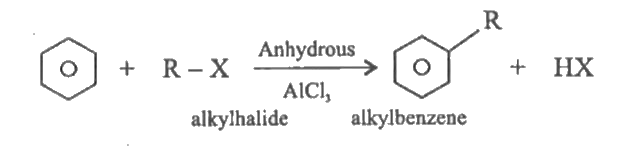
|
|
| 3. |
Explain the formation of photochemical smog with reactions. |
|
Answer» Solution :When fossil fuels are burnt, a variety of pollutants are emitted into the earth.s troposphere. Two of the hydrocarbons and NITRIC oxide build up sufficiently HIGH level. A chain reaction occurs from their interaction with sunlight in which NO is converted into nitrogen dioxide `(NO_2)`. This `NO_2` in turn absorbs energy from sunlight and breaks up into nitric oxide and free oxygen atom.  Oxygen atoms are very reactive and combine with the `O_2` in air to produce ozone. `O_((g)) + O_(2(g)) hArr O_(3(g))"".........(ii)` The ozone formed in the above reaction (ii) reacts rapidly with the `NO_((g))` formed in the reaction (i) to regenerate `NO_2. NO_2` is a brown gas and at sufficiently high levels can contribute to haze. `NO_((g)) + O_(3(g)) to NO_(2(g)) +O_(2(g)) ......... (iii)` Ozone is a toxic gas and both `NO_2` and `O_3` are strong OXIDISING agents and can react with the unburnt hydrocarbons in the polluted air to produce chemicals such as formaldehyde, acrolein and PEROXYACETYL nitrate (PAN). `3CH_4 + 2O_3 to underset("Formaldehdye")(3CH_2 =O) + 3H_2 O` `CH_2 = underset("Acroline")(CHCH)=O "" underset("Peroxyacetyl nitrate (PAN)")(CH_3underset(O)underset(||)C OO NO_2)` |
|
| 4. |
Explain the formation of ozonolysis products of 2-butyne. |
Answer» SOLUTION :
|
|
| 5. |
Explain the formation of molecule orbital by LCAO method. |
|
Answer» Solution :Linear COMBINATION of atomic (LCAO): Molecular orbitals can be formed by the linear combination of atomic orbitals (LCAO). Let us consider the combination of two atomic orbitals of two hydbrogen atom. Each hydrogen atom 1s atomic orbitals containig one electrons `(1s^(1))`. Two atomic orbitals combine linearly in two ways i.e.,SYMMETRIC combination and asymmetric combination. During symmetric combination, the wave functions of the two stomijc orbitals are added. If `y_(A) and y_(B)` are the wave functions of the two atomic orbitals, `Psi_(A)+Psi_(AB)"".....(1)` Where YAB squaring the equation (1) on both sides, `(Psi_(A)+Psi_(B))^(2)= `Psi_(AB)^(2)` `Psi_(A)^(2)+Psi_(B)^(2)+2Psi_(A)Psi_(B)=Psi_(AB)^(2) or Psi_(AB)^(2) gt Psi_(A)^(2)+Psi_(B)^(2)` The above expression indicates that hte probablity of finding electrons between the nuclei is greaterthanthe probability electrons away from the NUCLIE. 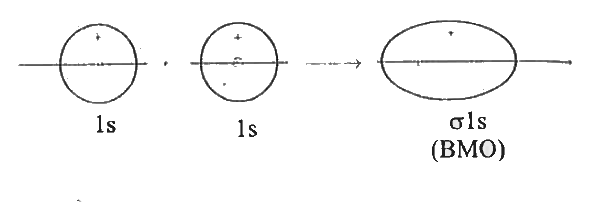 Such a molecular orbital has lower energy than the energy of the atomic orbitals. Hence it fevours the bond formationand this orbitals is called bonding molecuar orbital (s1s). The formation of bonding molecular orbitals orbitals s1s is represented in the fig. Asymmetric combination: During asyymetric combinatin of atomic orbitals, the wave FUNCTION are substrated. `Psi_(A)-Psi_(B)=Psi_(AB) ""....(2)` where `Psi_(AB)` is the wave of the molecular orbitals, formed by the asymmetric combination of atomic orbitals. By squring the equation (2) on both sides, `(Psi_(A)-Psi_(B))^(2)= Psi_(AB)^(+2)` or `Psi_(A)^(2)+Psi_(B)^(2)-2Psi_(A)Psi_(B)= Psi_(AB)^(+2) or Psi_(A)^(2)+Psi_(B)^(2) gt Psi_(AB)^(+2)`  Such a molecular orbitals has higher energy than the energy of the amotic orbitals. Hence it does nor favour the bond formation and this orbitals called anitbonding molecular orbitals `(S**1s)`. |
|
| 6. |
Explain the formation of methane using VB theory? |
|
Answer» Solution :(i) Methane is formed by `sp^(3)` hybridisation. In `CH_(4)` molecule, the central carbon atom is bounded to four hydrogen atoms. (ii) The ground STATE VALENCE shell ELECTRONIC configuration of carbon is `[He]2s^(2)" "2p_(x)^(2)" "2p_(y)^(1)" "2p_(z)^(0).` In ORDER to form four covalent bonds with the four hydrogen atoms, one of the paired ELECTRONS in 2s orbital of carbon is promoted to its `2p^(z)`, orbital in the excited state. (iv) The one 2s orbital and three 2p orbitals of carbon atom mixes to give four equivalent `sp^(3)` hybridised orbitals. The angle between any of the two `sp^(3)` hybridised orbitals is `109^(@).28.`  (v) The 1s orbital of the four hydrogen atoms overlap linearly with the four `sp^(3)` hybridised orbitals of carbon to form four `C - H sigma` bonds in the methane molecule as follows: 
|
|
| 7. |
Explain the formation of Ionic bond in NaCl. |
|
Answer» Solution :Sodium has elecrtronic configuration `, 1s^(2), 2s^(2) 2p^(6) 3s^(1)` whenit loosed one electron, attains stability where as chlorine `,1s^(2)2s^(2)2p^(6)3s^(2)3P^(5)` it gain one electron to get stability. `:.` The electron LOST by Na is gained by the chlorine FORMING ionic BOND. `(1) underset((1s^(2)2s^(2)2p^(6)3s^(1)))(Na) to underset((1s^(2)2s^(2)2p^(6)))(Na^(+)+E^(-))` (2) `: overset( * *)underset(* *)Cl* +e^(-) to : overset( * *)underset(* *)Cl:^(-)` `Na^(@)+: overset( * *)underset(* *)Cl* to Na^(+)[: overset( * *)underset(* *)Cl:^(-)]` |
|
| 8. |
Explain the formation of ionic bond in terms of atomic orbitals.Discuss the factors that favour the ionic bond formation. |
|
Answer» |
|
| 9. |
Explain the formation of (i) water gas (ii) producer gas. Give their uses. |
|
Answer» SOLUTION :(i) `C+ H_(2)overset (473-1273 K) rarr UNDERSET (("Water gas")) (CO + H_(2))` (ii) ` 2C+O_(2) + 4N_(2) overset (1273 K) (rarr) underset (("Producer gas "))ubrace(2CO+ 4N_(2)) ` Water gas and producer gas are used as FUELS . |
|
| 10. |
Explain the formation of H_(2) molecule on the basis of valence bond Theory. |
|
Answer» Solution :Consider two hydrogen atoms A and B approaching each other having nuclei `N_(A) and N_(B)` and electrons present in them are represented by `e_(A) and e_(B)` . When the two atoms are at large distance from each other, there is no interaction between them. At this time the energy of system is equal to energy of both H atom in th.is stage in each atom • nucleus and electron has ATTRACTION with such other `N_(A) - e_(A) and N_(B) - e_(B)`. When both atoms `H_(A) and H_(B)` come near to each other: When two atom `H_(A) and H_(B)` come near to each other the attractive and repulsive forces are produced between them. (i) Attractive forces : The attractive forces produced between nucleus of the atom itself and its own electron or `N_(A) - e_(A) N_(B) - e_(B)` . The attractive force produced between nucleus of the one atom and electron of other atom `N_(A) - e_(B) and N_(B) - e_(A)`  (ii) Repulsive forces : Repulsive force producedbetween electron-electron or two atoms `e_(A) - e_(B)` . Repulsive force produced between nucleus of two atom `N_(A) - N_(B)` .  Attractive forces try to take both the atom near to each other while repulsive force try to PUSH each other. It is proved from the experiments that the MAGNITUDE of attractive forces is more than that of repulsive forces. As a result both the atoms go near to each other and their potential energy decreases. `H_(2)`formation : (i) Both the atoms go near to each other to such an extent that attractive forces are balanced by repulsive forces and (ii) system attain minimum energy. (iii) At this stage both hydrogen atoms combine with each other. (iv) Stable hydrogen molecule is form (v) Bond length is 74 pm. Energy change : (i) When both hydrogen are away form each other their energy is taken zero. (ii) As they come near energy decrease (iii) At definite distance (bond length) when forces are balanced and bond form 435.8 kg/mol energy molecule. It is minimum energy (iv) If both atom are more CLOSER than this than energy increase + bond break. `H_(2(g)) + 435.8 kg mol^(-1) = H_((g)) + H_((g))` Here the given energy is bond enthalpy of `H_(2)`. the energy change is given in following diagram.  Supplementary Question : Explain energy change in `H_(2)` molecule. Supplementary Question : Bond length of `H_(2)` and at this length what is between two H ? Supplementary Question : When two H come near to each other which attraction and repulsive force observed? Supplementary Question : When the bond form between two H atom ? |
|
| 11. |
Explain the following with suitable examples :(i)ferromagnetism (ii)paramagnetism (iii)ferrimagnetism(iv)antiferromagnetism (v) 12-16 and 13-15 group compounds. |
|
Answer» |
|
| 12. |
Explain the following with relevant examples. Solid-vapour equilibrium |
|
Answer» Solution :Solid-VAPOUR equilibrium `square`Consider a system in which the solid sublimes to vapour. In this process also, equilibrium can be established between these two phases. When solid iodine is placed in a closed transparent vessel, after sometime, the vessel gets FILLED up with VIOLET vapour due to sublimation of iodine. The following equilibrium is attained. `I_(2)(s)hArrI_(2)(G)` |
|
| 13. |
Explain the following with relevant examples. Solid-liquid equilibrium |
|
Answer» Solution :Solid-liquid EQUILIBRIUM `square`Let us consider the melting of ice in a closed container at 273 K. In the PROCESS the total number of water molecules leaving from and returning to the solid phase at any INSTANT are equal. `{:(square" At equilibrium"),("Rate of meltingRate of FREEZING"),("="),("of iceof water"),(""H_(2)O(s)hArrH_(2)O(l)):}` `square` The temperature at which the solid and liquid phases of a substance are at equilibrium is called the melting point or freezing point of that substance. |
|
| 14. |
Explain the following with relevant examples. Liquid-vapour equilibrium |
|
Answer» Solution :Liquid-VAPOUR equilibrium `SQUARE` There exists an equilibrium between the liquid PHASE and the vapour phase of a substance. For example, liquid water is in equilibrium with its vapour at 273 K and 1 atm pressure in a closed vessel. `H_(2)O(l)hArrH_(2)O(g)` `square` Here Rate of evaporation = Rate of condensation `square` The temperature at which the liquid and vapour phase are at equilibrium is CALLED the boiling point and consensation point of the liquid. |
|
| 15. |
Explain the following with proper reasoning : (a) Although benzene is highly unsatureted, it does not undergo addition reactions. (b) Benzene though unsaturated, undergoes substitutions reactions easily reather than addition. ( c) All m-directors are deactivating. (d) The halogens, as exceptions, are o-p-directors but are deactivating. ( e) Most o- p-directing substituents are activating. |
|
Answer» Solution :(a) `PI="electrons"` of benzene RING are dilocali-zed throughout the molecule. This makes the molecule very stable. The ADDITION reactions would result in the breaking of this delocalization, i.e., the stability of the molecule which is resisted. (b) Resonace is present in benzene molecule. This makes the benzene molecule stable. As the substitution reactions do not disturb the resonance stabilization or aromatic CHARACTER, thus, there reactions are resisted. ( c) The meta-directing substituents withdraw electrons form the benzene ring and thus, deactivate the benzene ring for further substitution. (d) In the case of halogens, two opposing effects operate simultaneously. A halogen substitument releases electrons due to resonance but withdraw wlwtrons also due to high electronegativityt, i.e., -I (inductive) effect. The inductive effect dominates more than the resonance effect. The inductive effect dominates more than the resonance effect and the net result is that the benzene ring is redered electron deficient and thus deactivated for further substitution. ( e) the o-, p-directing substituents release ELETRONS into the benzene ring and thus, activate the banzene ring for further substitution. |
|
| 16. |
Explain the following : Tl(NO_3)_3 acts as an oxidizing agent. |
| Answer» Solution :Due to inert pair effect, Tl is more stable in +1 oxidation state than that of +3 oxidation state. Therefore , Tl `(NO_3)_3`acts as strong OXIDIZING AGENT. | |
| 17. |
Explain the following : Why does the element silicon, not form a graphite like structure whereas carbon does. |
| Answer» Solution :In GRAPHITE , CARBON is `sp^2` HYBRIDIZED. Carbon has a tendency to form multiple `ppi-ppi` bonds due to its small size and highest electronegativityin group 14. Silicon due to its large size and LESS electronegativity cannot form multiple bonds. THUS, silicon cannot form graphite like structure. | |
| 18. |
Explain the following:The tyre of an automobile is inflated to a lesser pressure in summer than in winter. |
| Answer» Solution :The ATMOSPHERIC TEMPERATURE in summer is much higher than that in winter. If the TYRES are INFLATED to the same extent in summer, the volume of the gas will be much larger. Hence, the pressure exerted on the tyre will also be more. This may BURST the tyre. | |
| 19. |
Explain the following:The size of a weather balloon becomes larger and larger as it ascends into higher altitudes. |
| Answer» SOLUTION :At higher altitudes, the atmospheric PRESSURE is less. Therefore, the gas filled in the BALLOON expands more and more (Boyle.s law) as the balloon GOES higher. This MAKES the balloon larger and larger. | |
| 20. |
Explain the following statement with reason . Fullerene is considered as the allotrope of carbon. |
| Answer» SOLUTION :It is because it does not have EDGES THEREFORE , IMPURITIES cannot be ABSORBED on it. | |
| 21. |
Explain the following : Silicon forms SiF_6^(2-)ion whereas corresponding fluoro compound of carbon is not known. |
| Answer» Solution :Silicon has vacant d-orbital in its valence shell due to which it can accommodate 6 electrons from 6 FLUORINE ATOMS whereas carbon does not have d orbital and cannot EXPAND its COVALENCE beyond four. | |
| 22. |
Explain the following reactions. Wurtz Fitting reaction |
|
Answer» Solution :Wurtz FITTING REACTION : Halo ARENES reacts with halo alkanes when heated with sodium in ether solution to form alkyl benzene. Is reaction is called Wurtz Fitting reaction. `underset("CHLOROBENZENE")(C_(6)H_(5)Cl+2Na)+underset("Chloroethane")(ClC_(2)H_(5))overset("Ether")underset(DELTA)rarrunderset("Ethyl benzene")(C_(6)H_(5)C_(2)H_(5))+2NaBr` |
|
| 23. |
Explain the following reactions : Silicon is heated with methyl chloride at high temperature in the presence of copper. |
|
Answer» Solution :Mixture of MONO, DI and TRI methyl chlorosilane and tetra methylsilane is produce in less quantity. `CH_3Cl +Si underset"373 K"OVERSET"Cu powder"to CH_3SiCl_3 + (CH_3)_4 Si + (CH_3)_2SiCl_2 + (CH_3)_3SiCl` |
|
| 24. |
Explain the following reactions : Silicon dioxide is treated with hydrogen fluoride. |
|
Answer» Solution : When SILICON dioxide `(SiO_2)` is heated with hydrogen fluoride (HF), it forms silicon tetrafluoride `(SiF_4)`. Usually, the Si- O bond is a STRONG bond and it resists any attack by halogens and most acids, EVEN at a HIGH temperature. However, it is attacked by HF. `SiO_2 + 4HF to SiF_4 + 2H_2O` The `SiF_4` formed in this reaction can further react with HF to form hydrofluorosilicic acid. `SiF_4 + 2HF toH_2SiF_6` |
|
| 25. |
Explain the following reactions: Wurtz fitting reaction. |
|
Answer» Solution :(i) Wurtz Fitting REACTION: Halo ARENES reacts with halo alkanes when heated with sodium in ether solution to FORM alkyl benzene. This reaction is called Wurtz Fitting reaction. `underset("Chlorobenzene")(C_(6)H_(5)+2Na)+underset("Chloroethane")(ClC_(2)H_(5)) underset(Delta)overset("Ether")to underset("Ethyl benzene")(C_(6)H_(5)C_(2)H_(5))+2NaCl` |
|
| 26. |
Explain the following reactions : Hydrated alumina is treated with aqueous NaOH solution. |
|
Answer» Solution :When hydrated alumina is added to sodium HYDROXIDE, the former DISSOLVES in the latter because of the formation of sodium meta aluminate. `UNDERSET"HYDROUS alumina"(Al_2O_3 . 2H_2O)+2NaOH_((AQ)) oversetDeltato underset"Sodium meta-aluminate"(2NaAlO_2)+ 3H_2O` |
|
| 27. |
Explain the following reactions. Fitting Reaction |
|
Answer» Solution :Fitting REACTION : HALOARENES react with sodium metal in DRY ether, two ARYL groups combine to give biaryl products. This reaction is called fitting reaction. `underset("Chlorobenzene")(C_(6)H_(5)Cl+2Na)+Cl-C_(6)H_(5)underset(Delta)overset("Ether")rarrunderset("Biphenyl")(C_(6)H_(5)-C_(6)H_(5))+2NaCl` |
|
| 28. |
Explain the following reactions : CO is heated with ZnO. |
|
Answer» Solution : When CO REACTS with ZnO, it reduces ZnO to Zn. CO ACTS as a reducing agent. ZnO + CO `to` Zn + `CO_2` |
|
| 29. |
Explain the following reactions: Fitting Reaction. |
|
Answer» Solution :Fitting reaction: Haloarenes react with sodium metal in DRY ether, two ARYL groups combine to give biaryl products. This reaction is called fitting reaction. `underset("CHLOROBENZENE")(C_(6)H_(5)Cl+2Na)+C-C_(6)H_(5) underset(Delta)overset("Ether")to underset("Biphenyl")(C_(6)H_(5)-C_(6)H_(5))+2NaCl` |
|
| 30. |
Explain the following reactions. Dow's process |
|
Answer» Solution :DOW's PROCESS : `underset("CHLOROBENZENE")(C_(6)H_(5)Cl)+NaOHunderset("300 atm")OVERSET(350^(@)C)rarrunderset("Phenol")(C_(6)H_(5)OH)+NACL` |
|
| 31. |
Explain the following reactions (a) Silicon is heated with methyl chloride at high temperature in the presence of copper. (b) Silicon dioxideis treated with hydrogenfluoride. (c ) CO is heatedwith ZnO. (d) Hydrated alumina is treated with aqueous NaOH solution. |
|
Answer» Solution :(a) A mixture of mono-, di - and trimethlychlorosilanes along with a small amount of tetramethylsation is formed. `underset(" Methyl chloride ")(CH_(3)CL) + SI underset(570K)overset("Cu powder ") rarr CH_(3)SiCl_(3) + (CH_(3))_(2)SiCl_(2) + (CH_(3))_(3)SiCl + (CH_(3))_(4)Si` (b) The INITIALLY formed silicontetrafluoride dissolves in `HF` to form hydrofluorosilicic acid `SiO_(2) + 4 HF rarr SiF_(4) + 2H_(2)O` , `SiF_(4) + 2HF rarr H_(2)SiF_(6)` (c ) `ZNO` is reducedto zinc metal. `ZnO + CO rarr Zn + CO_(2)` (d) Alumina dissolves to form sodium meta-aluminate `underset("or Bauxite ")underset(" Hydrated aluminia ")(AlO_(3).2H_(2)O(s)) + 2NaOH(aq) overset("Heat")rarrunderset(" Sod. meta-aluminate ")(2NaAlO_(2)) + 3H_(2)O` or `Al_(2)O_(3).2H_(2)O(l) + 2NaOH (aq) + H_(2)O(l) overset("Heat")rarrunderset(" Sod. tetrahydroxoaluminate (III)")(2Na[Al(OH)_(4)](aq))` |
|
| 32. |
Explain the phenomena of itching of glass |
|
Answer» SOLUTION :When `SiO_2` is TREATED with HF, SILICON TETRAFLUORIDE is formed which dissolves in HF to form hydrofluorosilicic acid . `SiO_2 + 4HF to SiF_4 + 2H_2 O` `SiF_4 + 2HF to underset("Hydrofluorosilicic acid")(H_2 SiF_6)` |
|
| 33. |
Explain the following reaction: a. Silicon is heated with methyl chloride at high temperature in the presence of copper. b. Silicon dioxide is treated with hydrogen fluoride. c. CO is heated with ZnO. d. Hydrated alumina is treated with aqueous NaOH solution. |
|
Answer» Solution :a. A mixture of mono-and di-acid trimethylchloro silanes alongwith a small amount of tetramethyl silance is formed. `Si+CH_(3)Clunderset("373 K")overset("Cu powder")to CH_(3)SiCl_(3)+(CH_(3))_(2)SiCl_(2)+(CH_(3))_(3)SiCl+(CH_(3))_(4)Si` b. `SiO_(2)`, reacts with `HF` on heating to form silicon TETRAFLUORIDE which DISSOLVES in HF to form hydroflourosilicic acid. `SiO_(2)+4HFto underset("tetrafluoride")underset("Silicon")(SiF_(4))+H_(2)O` `SiF_(4)+2HFto underset("(SOLUBLE)")underset("Hydrofluorosilicic acid")(H_(2)SiF_(6))` c.`CO+ZnOoverset(Delta)toZn+CO_(2)uarr` d. Hydrated alumina dissolves in aqueous `NaOH` solution to form sodium meta-aluminate. `underset("or bauxite")underset("alumina")underset("Hydrated")(Al_(2)O_(3).2H_(2)O_((s)))+NaOH_((aq))overset(Delta)tounderset("(soluble)")underset("meta-aluminate")underset("Sodium")(2NaAlO_(2))+3H_(2)O or Al_(2)O_(3).2H_(2)O_((s))+2NaOH_((aq))+H_(2)O_((l))overset(Delta)tounderset("Sodium tetrahydro-aluminate(III)")(2Na[Al(OH)_(4)]_((aq)))` |
|
| 34. |
Explain the following reactions (a) Silicon is heated with methyl chloride at high temperature in the presence of copper, (b) Silicon dioxide is treated with hydrogen fluoride, (c) CO is heated with ZnO, (d) Hydrated alumina is treated with aqueous NaOH solution. |
|
Answer» SOLUTION :When HYDRATED alumina is heated with aqueous NaOH solution, sodium tetrahydroxoaluminate (III) is formed. `Al_2 O_3 . 2 H_2 O(s) + 2NaOH (AQ) + H_2 O (I)overset(DELTA)to underset("tetrahydroxoaluminate(III)")underset("Sodium")(2Na[Al(OH)_4 ] (aq))` or`Al_2 O_3. 2H_2 O (s) + 2NaOH (aq) overset(Delta)to underset("Sodium mataaluminate")(2NaAlO_(2) (aq) + 3H_2 O (l))` |
|
| 35. |
Explain the following reaction : CO is heated with ZnO |
|
Answer» Solution :When carbon MONOXIDE is HEATED with zinc OXIDE, the latter reduces to metallic zinc. `CO + ZNO overset(Delta)to ZN + CO_2` |
|
| 36. |
Explain the following percentages of meta electrophilic substitutions. (a) underset(4.4%)(C_(6)H_(5)CH_(3)),underset(15.5%)(C_(6)H_(5)CH_(2)CI),underset(33.8%)(C_(6)H_(5)CHCI_(2)),underset(64.6%)(C_(6)H_(5)C CI_(3)) (b) underset(100%)(C_(6)H_(5)N(CH_(3))_(3)),underset(88%)(C_(6)H_(5)CH_(2)N(CH_(3))_(3)),underset(19%)(C_(6)H_(5)CH_(2)overset(+)N(CH_(3))_(3)) |
|
Answer» Solution :(a) Successive replacement of hydrogen ATOMS in electron releasing group `(-CH_(3))` by electronegative chlorine atoms makes the group INCREASINGLY electron attracting and meta-directing. (b) The +ve charge on N makes the substituent electron attreacting and meta-directing. The positive charge decreases succuessively by inserting electron releasing `-CH_(2)` groups and thus o-, p-orientation dominates in `C_(6)H_(5)CH_(2)CH_(2)overset(+)N(CH_(3))_(3).` |
|
| 37. |
Explain the following : PbX_2 is more stable than PbX_4 |
| Answer» SOLUTION :Due to INERT PAIR effect , +2 oxidation state is more stable than +4 oxidation state. | |
| 38. |
Explain the following : Pb^(4+) acts as an oxidizing agent but Sn^(2+) acts as a reducing agent . |
|
Answer» Solution :`Pb^(4+)` by gaining 2 electrons changes into `Pb^(2+)` which is more STABLE due to inert pair effect .`Sn^(2+)`is less stable than `Sn^(4+)` by losing electrons. Therefore , `Pb^(4+)` acts as an oxidizingagent while `Sn^(2+)` acts as a reducing agent. `Sn^(2+) to Sn^(+4) + 2E^(-)` `Pb^(4+) + 2e^(-) to Pb^(2+)` |
|
| 39. |
Explain the following order of thermal stability of the carbonates of the alkaline earth metals: BaCO_(3) gt SrCO_(3) gt CaCO_(3) gt MgCO_(3) |
| Answer» Solution :As the ionic POTENTIAL `(PHI)` of the metal ion increases, its attraction for the electron of the O-atom of `CO_(3)^(2-)` ion increases. As a consequence, the tendency of thermal decomposition of the metal carbonate (`MCO_(3))` to produce metal oxide (MO) and carbon dioxide `(CO_(2))` increases. as the ionic potential increases progressively from `Ba^(2+)` to `Mg^(2+)`, the thermal stability of the CARBONATES follows the given ORDER. | |
| 40. |
Explain the following observations The tyre of an automobile is inflated to slightly lesser pressure in summer than in winter |
|
Answer» SOLUTION :The tyre of an automobile is inffated to slightly lesser pressure in summner than in WINTER : Air pressure is DIRECTLY proportinal to temperature. During summer, increase in temperature increases pressure of air in the tube which causes the tube to burst. So tyres are inflated to leasser pressure in summers than in winters. |
|
| 41. |
Explain the following observations The size of a weather ballonn becomes larger and larger as it asecnds up into larger altitude |
|
Answer» Solution :The size of a weather balloon becomes larger and larger as it ascends up inot larger altitude : According to BOYLE's law the VALUME of a gas is INVERSELY proportional to the pressure at a GIVEN TEMPERATURE. As the weather balloon ascends, atmospheric pressure is less, pressure of the gas tends to decrease and so valume as well as the size of the balloon increase. |
|
| 42. |
Explain the following observations Liquid ammonia bottle is cooled before opening the seal |
|
Answer» Solution :Liquil AMMONIA bottle is cooled before opening the seal : At room TEMPERATURE, VAPOUR pressure of liquid ammonia is very high and so will evaporate. If the bottle is opened, the sudden decrease in pressure will lead to INCREASE in VOLUME of the gas and cause breakge of the bottle. Cooling decreases the vapour pressure and maintains the liquid in the same state. Hence, the bottle is cooled before opening. |
|
| 43. |
Explain the following observations : (i) CO_(2) and SO_(2)are not isostructural. (ii) O_(2) ^(-)is paramagnetic but O_(2)^(2-) is not . |
| Answer» Solution :(i) C in `CO_(2)`is SP hybridized , S in `SO_(2)`in `sp^(2)` hybridized . `CO_(2)`is linear, `SO_(2)` is bent molecule. | |
| 44. |
Explain the following observations Aerated water bottles are kept under water during summer |
|
Answer» Solution :Aerated WATER bottles are kept under water during summer : In aerated water bottles. `CO_(2)` gas is passed through the aqueous solution under PRESSURE since solubility of the gas in water is not very HIGH. In summer, the solubility of the gas in water is likely to decrease since RISE in temperauture decreases solubility. Pressure becomes too high for the GLASS bottle to with stand and so explodes. To avoid this, bottes are kept under water. |
|
| 45. |
Explain the following observations: (1) H_(2)^(+) ion is more stable than H_(2)^(-) ion even though the bond orders of both the ions are the same. (2) When a magnet is dipped in a jar containing liquid oxygen, some oxygen molecules cling to it. |
|
Answer» SOLUTION :(1) The antibonding `sigma_(1s)^(**)` molecular orbital of `H_(2)^(-)` ion contains ONE electron but the antibonding `sigma_(1s)^(**)` molecular orbital of `H_(2)^(+)` ion contains no electron. Therefore `H_(2)^(+)` ion is more stable than `H_(2)^(-)` ion, even though their bond order are the same. (2) The electronic configuration of oxygen of oxygen molecule `(O_(2))` shows the presence of two unpaired ELECTORNS this suggests that the molecule is paramagneticin nature. thus, when a BAR magnet is dipped in a jar off liquid oxygen, some molecule cling to it. |
|
| 46. |
Explain the following: (i)Out of diamond and graphite, which has greater entropy? Why? (ii) From thermodynamic point of view, in which system the animals and plants belong? |
|
Answer» SOLUTION :(i)Graphite has GREATER ENTROPY, because it is loosely PACKED. (ii) Animals and plants belong to OPEN system. |
|
| 47. |
Explain the following in one or two sentence only. (a). Magnesium oxide is used for the linging of steel making furnace. (b). The molecule of beryllium chloride is linear, whereasthat of stannous is angular. |
|
Answer» Solution :(a). `MgO` is used for the lining of steel MAKING furnance because it is stable at very high temperatures and it forms slag with impurities. In this manner, it helps in removing the impurities.(b).`BeCl_(2)impliesH=(1)/(2)(V+M)=(1)/(2)(2+2)=2=sp` Where `V` is the number of valence electrons and `M` is the number of monovalent atoms attached to the CENTRAL atom. Therefore, `BeCl_(2)` is `sp` hybridised and has linear shape. 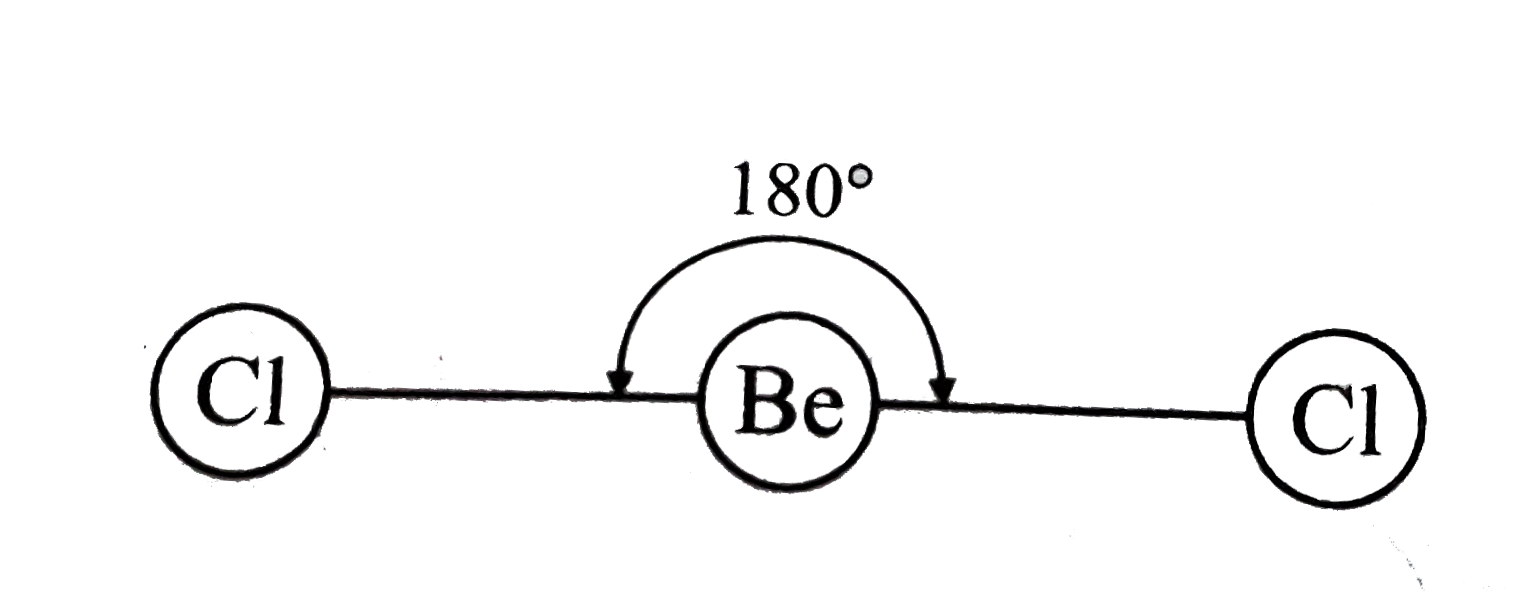 `SnCl_(2)impliesH=(1)/(2)(V+M)=(1)/(2)(4+2)=3=sp^(2)`or hybridisaton =number of bond pairs+number of LONE pairs `=2+1=3=sp^(2)` Therefore,`SnCl_(2)` is `sp^(2)` hybridised, has PLANAR geometry and the ions are `V-`SHAPED or angular in shape. 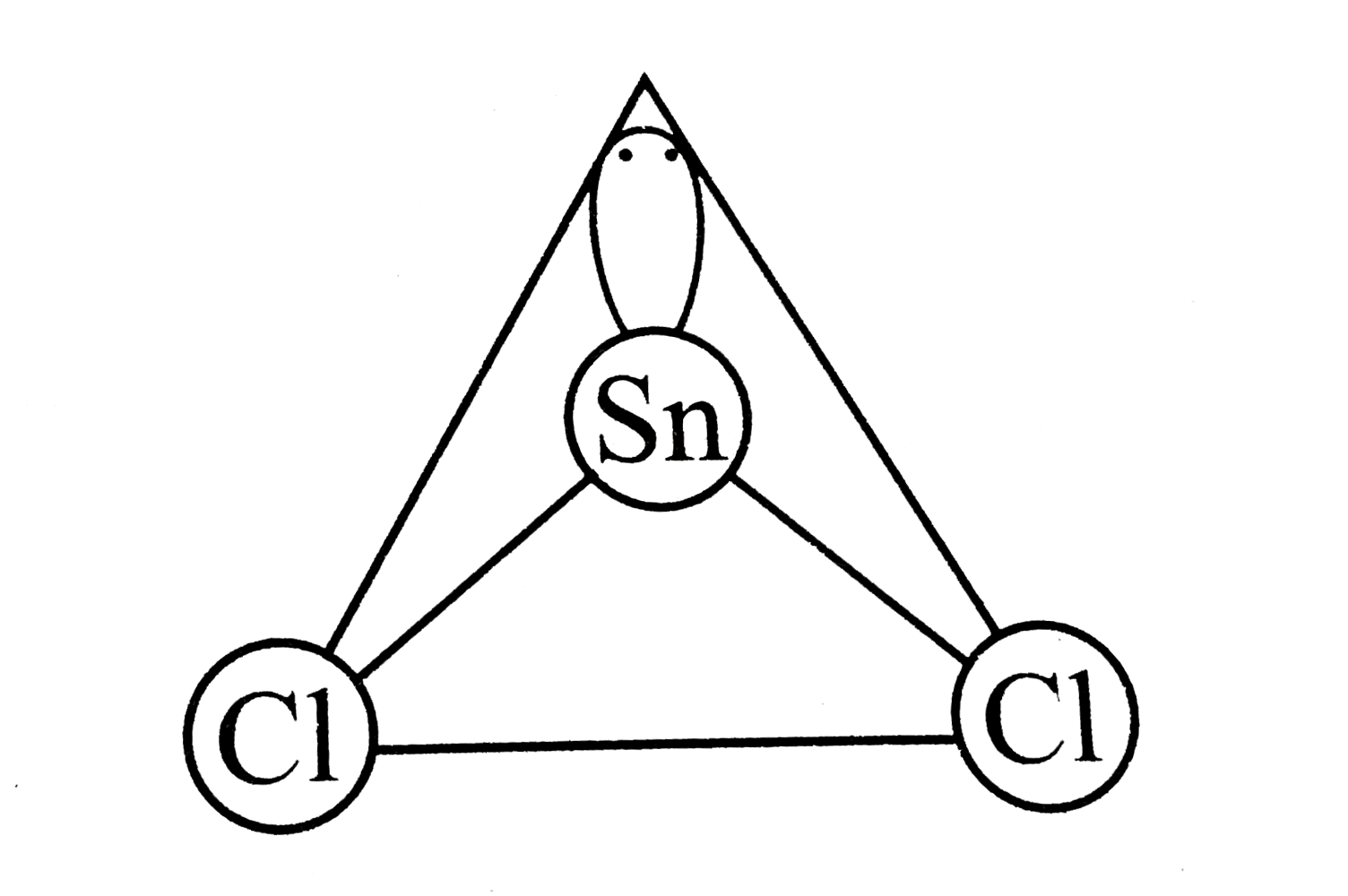
|
|
| 48. |
Explain the following: (i) Why is ethylene a planar molecule and acetylene a linear molecule? (ii) Why does bond length decrease in the order? C -C gt C=C gt C-=C (iii) The boiling point of methanol is 66^(@)C and that of methyl mercaptan is 6^(@)C whereas the boiling points of diethyl ether an diethyl sulphide are 35^(@)C and 92^(@)C respectively. (iv) ethanol boils at higher temperature than ethylamine inspite of the fact that both have nearly same molecular masses. (v) What effect should the following resonance of vinyl chloride have on its dipole moment? CH_(2)=CH-CI harr overset(-)(CH_(2))-CH=overset(+)(CI) (vi) The central carbon-carbon bond in 1,3-butadiene is shorter than that of n-butane. (vii) What property of carbon accounts for the occurrence of large number of its compounds? (viii) The C-CI bond is polar while C CI_(4) is non-polar. (ix) Explain the factor on which polarity of bond depends. (x) The CI atom has same electronegativity as nitrogen but it does not form effective hydrogen bonding. |
|
Answer» |
|
| 49. |
Explain the following: (i) Temporary hard water becomes soft on boiling. (ii) Water can extinguish most fires but not petrol fire. (iii) Hard water is softened before being used in boilers. |
|
Answer» Solution :(I) Upon boiling, the hydrogen carbonates of calcium and magnesium decompose to form corresponding carbonates. They, being water insoluble, get precipated and can be removed by filtration. Thus, temporary hard water BECOMES soft on boiling `Ca(HCO_(3))_(2) overset("Boil")to underset("ppt")(CaCO_(3))+H_(2)O+CO_(2)` `Mg(HCO_(3))_(2) overset("Boil")to underset("ppt")(MgCO_(3))+H_(2)O+CO_(2)` (ii) When water is added to petrol fire in order to EXTINGUISH it, petrol lighter floats over water. As a RESULT, the fire flares up rather than getting extinguished. (iii) When hard water slowly form an insoluble deposit all along insdie the BOILER. This is called boiler scale. As the scale is poor conductor of heat, there is wastage of fuel. Morever, it also redcues the life of the boiler. Therefore, hard water has to be softened before being used in boilers. |
|
| 50. |
Explain the following (i) It isnot possible to determine the absoulte value of singel electrode potential (ii) Iron undergoes oxidation more readily than copper (iii)In an electrochemical cell anelectrode with lower electrode potential acts as the reductin agent (iv)When a coper rod is placed in silver nitrate solutoion the solution becomes hot but the revrse not true (v) Iron reacts with dilute H_(2)SO_(4) to evolve H_(2) gas but Ag does not (vi) The colour of KI solution containg starch turns blue when it is shaken with cold CI_(2) water Explain why? |
|
Answer» Solution :(i) The potential difference between two electrodes can be determined by connecting them to a voltmeter therefore it is not possible to determine thepotential of a single electrode because a single electro constitiues a HALF cell and a half cell reaction cannot TAKE place independely An electrode in a half cell cannot lose or gain electrons by itself for transfer of electrons one half cell to beconnected to some other half cel thus we cannot determine the absolute value of electrode potential ofa single eletrode the half cell with some STANDARD electrode as the reference electrode (ii) The electrode potential of iron `(E_(Fe^(2+)//Fe)^(@)=-0.44)` is lower than that of copper and henceFe has greater tendency to get CONVERTED in to `Fe^(2+)` ions than Cu in other words UNDERGOES oxidation more readily than copper (iv) copper has lower electrode potential than silver therefore Cu releases electrons and tets oxidised to `Cu^(2+)` ions while `Ag^(+)` ions accept these electrons and get reduced to Ag metal `Cu(s)+2Ag^(+)(aq)rarrCu^(2+)(aq)+2Ag(s)` (v) Fe has lower electrode potential `(E_(Fe^(2+)//Fe)^(@)=-0.44)` than that of hydrogen therefore Fe is a better reducing agent than `H_(2)` and hence reduce `H^(+)` ions to produce `H_(2)` gas `Fe(s)+2H^(+)(a)rarrFe^(2+)(Aq)+H_(2)(g)` In contrast s has higher electrode potential than hydrogen therefore `H_(2)` is a better reducing agent than ag in other words Agcannot reduce to colourless `CI^(-)` ions while `I^(-)` ions get oxidised to violet coloured iondine `CI_(2)(aq)+2I^(-)(aq)rarr2CI^(-)(aq)+I_(2)` (s) |
|