

Saved Bookmarks
This section includes 7 InterviewSolutions, each offering curated multiple-choice questions to sharpen your Current Affairs knowledge and support exam preparation. Choose a topic below to get started.
| 1. |
Explain the ozonolysis of 2-butene. |
Answer» SOLUTION :
|
|
| 2. |
Explainthe ozonoluysis of (a) Acetylene (b) proyne |
Answer» SOLUTION :Ozoneadds tocarbon -carbontriplebond ofalkynes to formozonides.theozonides are hydrolysedby WATERTO formcarbonyl COMPOUND. Thehydrogenperoxideformedin thereactionmayoxidinethe CARBONYL compoundto CARBOXYLICACID.
|
|
| 3. |
Explain the origin of term magnetic quantum number ? |
|
Answer» |
|
| 4. |
Explain the non linear shape of H_(2)S and non planar shape of PCl_(3)using valence shell electron pair repulsion theory . |
|
Answer» Solution :In `H_(2) O ` atomic number of central atom (S) = 16 ELECTRONIC arrangment of S = 2, 8, 6 Out of 6 valence eletrons , TWO electrons are shared with two H atoms and the REMAINING four electrons are present as two lone pairs . Thus, we hgave  i.e., it is a molecule of the type `AB_(2)L_(2)` . Due to repulsions between bond pairs and lone pairs the shape is bent (non-linear). In `PCl_(3)` atomic number of central atom (P) = 15 Electronic ARRANGEMENT of P = 2, 8, 5 Out of 5 valence eleectrons , three electrons are shared with three Cl atoms and the remaining 2 electrons are Present as one lone pair. thus, we have 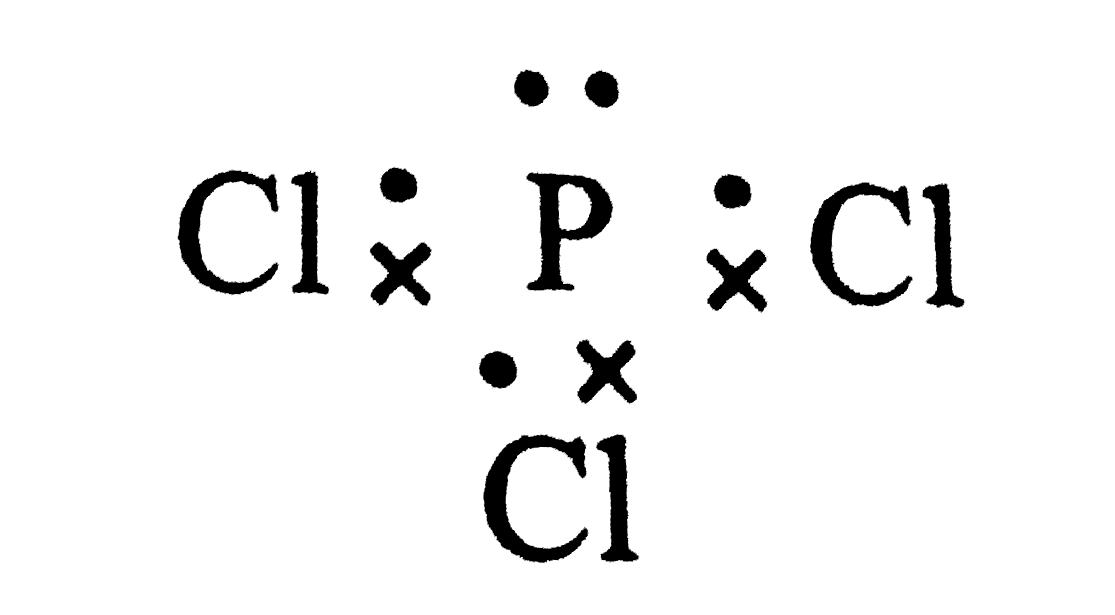 i.e., it is a molecule of the type `AB_(3) L `. To minimiserepulsions between lone pairs bond pairs, the shape becomes pyramidal (non-planar). |
|
| 5. |
Explain the non-linear shape of H_(2)S and a non-planer shape of PCl_(3) using valence shell elecilron pair repuJsion theory. |
|
Answer» Solution :Central atom do this is S. There are 6 electrons in its valence shell `(""_(16)S = 2, 8, 6 )`. From this two electrons are shared with two H-atoms and the remaining four electrons are present as two lone pairs.  So, total pairs of electrons are four (2 bonding pairs and 2 lone pairs). As the presence of 2 lone pairs the shape becomes distorted tetrahedral or angular or BENT(non-linear).  `PCl_(3)` : Central atom is PHOSPHORUS. There are 5 electrons in its valence shell (`""_(15)`P = 2, 8, 5). Three electrons are shared with three 0 -atoms and the remaining two ELECIRONS are present as one lone pair. So, total pairs of electrons are four (1 lone pair and 3 bond pajrs). Due to the presence of one lone pair, the shape becomes pyramidal (non- planar). |
|
| 6. |
Explain the nitration of benzene. |
Answer» SOLUTION :Benzene on TREATING with NITRATING mixture, nitrobenzene is FORMED. 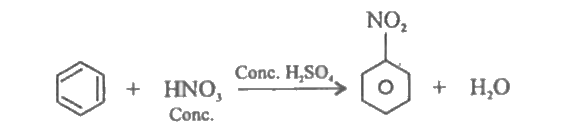
|
|
| 7. |
Explain the nature of C- X bond in haloarenes and its resonance structure. |
|
Answer» <P> Solution :(i) In haloarenes, the carbon atom is `sp^2` hybridised. The` sp^2` hybridised orbitals are SHORTER and holds the electron pair bond more.(ii) Halogen atom contain p - orbital with LONE pair of electrons which interacts with `pi` orbitals of benzene RING to form extended conjugated system of `pi`-orbital. (III) The delocalisation of these electrons give double bond character to C - X bond. The resonance structure of halobenzene are give as : 
|
|
| 8. |
Explain the nature of boric acid as a Lewis acid in water. |
|
Answer» Solution :Boric acid acts as Lewis acid in WATER by accepting a PAIR of electrons from a hydroxyl ION : `B(OH)_3 + 2HOH to [B(OH)_4]^(-)+ H_3O^(+)` |
|
| 9. |
Explain the merits of Moseley's long form of periodic table. |
|
Answer» Solution :Merits of Moseley.s LONG form of periodic table: (i) As this classification is based on atomic number, it RELATES the position of an element to its electronic configuration. (II) The elements having similar electronic configuration fall in a group. They also have similar physical and chemical properties. (iii) The completion of each period is more logical. In a period as the atomic number increases, the energy SHELLS are gradually filled up until an inert gas configuration is reached (iv) The position of zero group is also justified in the table as group 18. (v) The table COMPLETELY separates metals and non-metals. (vi) The table separates two sub groups, lanthanides and actinides, dissimilar elements do not fall together (vii) The greatest advantage of this periodic table is that this can be divided into four blocks namely s, p, d and f-block elements. (viii) This arrangement of elements is easier to remember, understand and reproduce. |
|
| 10. |
Explain the Mechanism or working of a basic buffer. |
|
Answer» Solution :Consider a basic buffer solution, `NH_(4)OHhArrNH_(4)^(+)+OH^(-),NH_(4)Cl toNH_(4)^(+)+Cl^(-)` Here, ammonium hydroxide is a weak electrolyte, in solution there exist equilibrium between it is ions and molecules, whereas ammonium chloride completely DISSOCIATES into its ions. Therefore, this basic buffer solution contains a large number of `NH_(4)^(+)` ions followed by `Cl^(-),OH^(-)andNH_(4)OH`. Case (i) When a base is added to this solution: `OH^(-)` ion of the base combines with the `NH_(4)^(+)` ion of the buffer solution and MAINTAINS equilibrium forming ammonium hydroxide. `NH_(4)^(+)+OH^(-)hArrNH_(4)OH`, As a result POH remains constant Case (ii) When an acid is added to this solution : `H^(+)` ion of the acid combines with the `OH^(-)` ion of the buffer solution and forms a water molecule. `H^(+)+OH^(-)toH_(2)O` As a result pOH remains constant. |
|
| 11. |
Explain the mechanism of sulphonation of benzene? |
Answer» Solution :Sulphonation : Benzene reacts with CONCENTRATED sulphuric acid at `80^(@)`C to form benzene sulphuric acid. Mechanism: This INVOLVES the following steps. Step 1: Generation of electrophile `SO_(3)` `""2H_(2)SO_(4) hArr SO_(3) + H_(3)O^(+) + HSO_(4)^(-)` Step 2: The electrophile `SO_(3)` attacks the benzene ring to form a carbocation which is resonance STABILIZED.  Step 3: Loss of a proton to give introbenzene. The proton is removed by `HSO_(4)^(-)`  Step 4: Addition of proton to give benzene sulphonic acid. 
|
|
| 12. |
Explain the mechanism of S_(N^1) reaction by highlighting the stereochemistry behind it. |
|
Answer» Solution :(i) `S_(N^1)` stands for unimolecular nucleophilic substitution reaction of first order reaction. (ii) The rate of the following `S_(N^1)` reaction depends UPON the concentration of alkyl halide (RX) and it is independent of the concentration sof the nucleophile `(OH^(-))` used. (iii) `R - Cl+ OH^(-) to R- OH + Cl^(-)` (iv) This `S_(N^1)` reactionfollows first order kinetics and it occurs in two steps: (v) `S_(N^1)` reaction mechanism takes place in tertiary BUTYL BROMIDE with aqueous KOH as follows: `CH_3-underset(CH_3)underset(|)overset(CH_3)overset(|)C-Br underset(Br)overset(OH(aq))tounderset("Tert. butyl alcohol")(CH_3- underset(CH_3)underset(|)overset(CH_3)overset(|)C-OH)` (vi) The 2 steps of the reaction are: Step 1: Formation of carbocation: The polar C-Br bond breaks first forming a carbocation and bromide ION. This step is slow and hence it is the rate determining step.  The carbocation has two equivalent lobes of the vaccant 2P orbital, So it can react equally fast form either face. Step 2: The nucleophile immediately reacts with the carbocation. This step is fast and hence does not affect the rate of the reaction.  The nucleophile OH can attack carbocation from both the sides. |
|
| 13. |
Explain the mechanism of S_(N)1 reaction by highlighting the stereo chemistry behind it |
|
Answer» Solution :The rate of the following `S_(N)1` reaction depends upon concentration of alkyl halide (RX) and is independent of the concentration of the nucleophile `(OH^(-))`. Hence Rate of the reaction=k [alkyl halide] `S_(N)1` reaction mechanism by taking a reaction between tertiary butyl bromide with aqueous KOH. `underset("Tert-Butyl bromide")(CH_(3)-underset(CH_(3))underset(|)overset(CH_(3))overset(|)(C)-Br) underset(Br)overset(OH^((aq))) to underset("Tert Butyl ALCOHOL")(CH_(3)-underset(CH_(3))underset(|)overset(CH_(3))overset(|)(C)-OH)` This reaction takes place in two STEPS as shown below Step-1 FORMATION of carbocation * The polar C-Br bond breaks forming a carbocation and bromide ion. this step is slow and hence it is the rate determining step.  * The carbocation has 2 equivalent lobes of the vacant 2p orbital, so it can react equally rapidly from either face. Step-2: * The nucleophile immediately reacts with the carbocation. this step is fast and hence does not affect the rate of the REACTIONS.  * As shown above, the nucleophilic reagent `OH^(-)` can ATTACK carbocation from both the sides. |
|
| 14. |
Explain the mechanism of nitration of benzene . |
Answer» Solution :NITRATION BENZENE reacts with a mixture of concentrated nitric acid and concentrated sulphuric acid at `50^(@)`C to form nitrobenzene. Mechanism: This involves the following steps. STEP 1 : GENERATION of electrophile nitronium ion `NO_(2)^(+)` `HNO_(3) + 2H_(2)SO_(4) rarr NO_(2)^(+) + H_(2)O^(+) + 2HSO_(4)^(-)` Step 2 : The electrophile `NO_(2)^(+)` attacks the the benzene ring to form a carbocation which is resonance stabilized.  Step 3: Loss of a proton to give nitrobenzene. The proton is removed by `HSO_(4)^(-)`. 
|
|
| 15. |
Explain the mechanism of halogenation or chlorination of benzene. |
Answer» Solution :Halogenation : Benzene reacts with chlorine in the PRESENCEOF `FeCl_(3)` or `AlCl_(3)` to form chlorobenzene. Mechanism : this involvesthe following steps: steps 1 : Generation of ELECTROPHILE `Cl - Cl + FeCl_(3) rarr Cl^(+) + FeCl_(4)^(-)` Steps 2 : The electrophile `Cl^(+)` attacks benzene ring to form a carbon CATION which is resonance stabilised.  Loss of proton to give chlorobenzene. The proton is removed by `FeCl_(4)`. 
|
|
| 16. |
Explain the mechanism of Friedel craft's acylation reaction. |
Answer» Solution :Benzene REACTS with acetyl chloride in presence of anhydrous `AlCl_(3)` to form acetophenone. Mechanism Step 1 : GENERATION of electrophile `CH_(3)CO^(+)` `CH_(3) - CO - Cl + AlCl_(3) rarr CH_(3) - CO^(+) + AlCl_(4)^(Θ)` Step 2 : The electrophile `CH_(3)CO^(+)` attacks the benzene RING to form a carbocation which is reasonance stabilized. 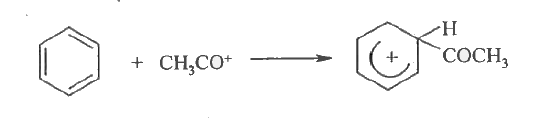 Step 3: Loss of proton to GIVE acetophenone. 
|
|
| 17. |
Explain the machanism of chlorinantion of methane. |
|
Answer» Solution :Mechanism of chlorination of METHANE involves three types. (1) Initiation: Chlorine absorbs ENERGY and undergoes homolysis to give chlorine free radicals. `Cl - Cl overset(""hy"")(rarr) 2Cl^(.)` Step 2 : Propagation: Chlorine free RADICAL reacts with methane to give methyl free radical. `Cl^(.) CH_(4) rarr CH_(3)^(.) + HCl` The methyl free radical reacts with chlorine to form methyl chloride and chlorine free radical. `CH_(3)^(.) + Cl_(2) rarr CH_(3)Cl + Cl^(.)` Step 3: Termination: Free radials combine to form stable products. `Cl^(.) + Cl^(.) rarr Cl_(2) ("Chlorine")` `CH_(3)^(.)+ CH_(3)^(.) rarr C_(2) H_(6)` (Ethane) `CH_(3)^(.) + Cl^(.) rarr CH_(3) Cl` (Methyl Chloride) |
|
| 18. |
Explain the mechanism of addition of hydrogen bromide to propene. |
|
Answer» SOLUTION :The mechanism of addition of hydrogen bromide to propene takes place in three step. Step 1: Hydrogen bromide dissociates into `H^(+)` and `Br^(-)` `H- Br rarr H^(+) + Br^(-)` Step 2:the electrophile `H^(+)` attacks propene to form CARBOCATION.  of the two carbocations (I) and (II), carbocations (I) is more stable and is FORMED more READILY. Step 3: The nucleophile Br attacks the carbocation (I) to GIVE 2 - Bromopropane. `CH_(3) - overset(+)(CH) - CH_(3) + overset(-)(Br) rarr CH_(3) - underset(Br)underset(|)(CH) - CH_(3)` |
|
| 19. |
Explain the mechanism of additionof HBr to propene |
Answer» SOLUTION :Step :1 FORMATIONOF electrophile.In HBrBrismoreelectrogative than H. WhenbondedelectronmovetowardsBr,polyarity isdeveloped and itcreates electrophil `H^(+)` whichattacks Step :2Secondarycarbocationis morestablethanprimarycarbocationand itpredominatesover theprimarycarbocation Step :3the `Br^(@)`ion attackthe `2^(@)` carboctionto form 2- bronopropaneas the majorproduct 
|
|
| 20. |
Explain the mechanism involved n bimolecular nucleophilic substitution reaction. |
|
Answer» Solution :`S_(N)2` MECHANISM: (i) The rate of `S_(N)2` reaction depends upon the concentration of both alkyl halide and the nucleophile. (ii) Rate of reaction `=k_(2)` [alkylhalide] [nucleophile]. If follows second order kinetics and occurs in one step. (iii) This reaction involves the formation of a transition state in which both the reactant molecules are partially bonded to each other. the ATTACH of nucleophile occurs from the back side (i.e., opposite to the side in which the halogen is attacked). (iv) The carbon at which substitution occurs has inverted CONFIGURATION durig the course of reaction just as an umbrella has tendency to invert in a wind storm. this inversion of configuration is called walden inversion, after paul walden who RST discovered the inversion of configuration of a COMPOUND in `S_(N)2` reaction. (v) `S_(N)2` reaction of an optically active haloalkane is always accompanied by inversion of configuration at the asymmetric centre. |
|
| 21. |
Explainthe mechanisim of the reaction betweeen methane and chlorine |
|
Answer» SOLUTION :Methanereacts withchloridein THEPRESENCE of lightwhichproceeds through the freeradicaltermination (i) Chaininitiation: Thechainis initiatedby UVleadingto homolyticflssionofchlorinemolecules intoradicals.  Harewe choose`Ci- CI` bondfor flssionbecauseC-C andC-Hbondsare strongerthanCi- CI bond. (a)Chlorinefree radials attackmoleculeand breaksC- Hbondresulting inthegenerationof methylfreeradicals  (b)Themethylfreeradicalthusobtainedattackssecondmolecule of chlorineto givechloromethane`(cH_(3)CI)`and achlorinefreeradicalfollows  (c ) This chlorinefree radicalthento step(a) andboth9a) and (b)arerepeted manytimes anda chainreactionis SET up (III)Chaintermination: Aftersometimethe reactionstopsdue to theconsumption ofreactan and thechain isterminatedby thecombinationof treeradicals 
|
|
| 22. |
Explain the measurement ofDelta U calorimetery |
|
Answer» Solution :(a) `DeltaU` measurements : For chemical REACTIONS, heat absorbed at constant volume, is measured in a bomb calorimeter (Fig.). Here, a steel vessel is immersed in a WATER bath. The whole device is called calorimeter. The steel vessel is immersed in water bath to ensure that no heat is lost to the SURROUNDINGS. A combustible substance is burnt in pure dioxygen supplied in the steel bomb. Heat evolved during the reaction is transferred to the water around the bomb and its temperature is MONITORED. Since the bomb calorimeter is sealed, its volume does not change 
|
|
| 23. |
Explainthe mechanis of addtion of HBr to 3 methyl 1- butene |
Answer» SOLUTION :Considerthe additionof HBrto 3- methyl1-buteneHerethe EXPECTED productaccordingtoMarkovanikoff.srule is 2- bromo3-methylbutanebut theactualmajorproductis 2-bromo2-methylbutane . Thisis because the secondarytehsatbletertiarycarbocationattackof `BR^(@) `on this teritiarycarbocationgivesthe majorproduct2 - bromo 2-methylbutane 
|
|
| 24. |
Explain the measurement of Delta U and Delta H by calorimetry. |
|
Answer» Solution :We can measure energy CHANGES associated with chemical or PHYSICAL processes by an experimental technique called calorimetry. In calorimetry, the process is carried out in a vessel called calorimeter, which is immersed in a known volume of a liquid. KNOWING the heat capacity of the liquid in which calorimeter is immersed and the heat capacity of calorimeter, it is possible to DETERMINE the heat EVOLVED in the process by measuring temperature changes. Measurements are made under two different conditions: (i) at constant volume, `q_v` (ii) at constant pressure, `q_p` |
|
| 25. |
Explain the measurement of Delta H calorimetetry |
|
Answer» Solution :The energy changes associated with reactions are measured at constant volume. Under these conditions, no work is done as the reaction is CARRIED out at constant volume in the bomb CALORIMETER. Even for reactions involving gases, there is no work done as `Delta V=0` therefore `w=0`. Temperature change of the calorimeter produced by the completed reaction is then converted to `q_V`, by using the known heat capacity of the calorimeter with the help of `=q= C Delta T` . (b) `Delta H` measurement of: Measurement of heat change at constant PRESSURE can be done in a calorimeter shown in Fig. We know that `Delta H =q_(p)` at constant pressure and, therefore, heat absorbed or evolved, `q_(p)` at constant pressure is also called the heatof reaction or enthalpy of reaction, `Delta_(r) H`. In an exothermic reaction, heat is evolved, and system loses heat to the surroundings. Therefore, `q_p` will be negative and `Delta _(r) H` will also be negative. Similarly in an endothermic reaction, heat is absorbed, `q_(p)` is positive and `Delta _(r) H` will be positive.  FIGURE : Calorimeter for measuring heat changes at constant pressure (atmospheric pressure). At constant pressure heat changes `Delta H = pm q_(p)` For endothermic reaction `q_(p) = pm ve "and" Delta H = +ve` For exothermic reaction `q_(p) = - ve and Delta H= - ve` The heat absorbs or produced `q_(p)` at constant pressure is called energy of reaction `Delta_(r) H`. |
|
| 26. |
Explain the meaning of the symbol 4f^(2).Write all the four quantum numbers these electrons. |
|
Answer» Solution :`4F^(2)`:It means that the element has 2 ELCTRONS in outermost 4f shell. QUANTUM number VALUES are,  n=principle quantum number=4 l=azimuthal quantum number=3lt brgtm=magnetic quantum number=-3,-2 s=spin quantum number =+1/2,-1/2 |
|
| 27. |
Explain the meaning of the symbol 4f^(2). Write all the four quantum mumbers for these electrons. |
|
Answer» Solution :`4f^(2)`: It means that the ELEMENT has 2 electrons in outermost 4f shell. QUANTUM number values are,  n = principal quantum number = 4 l = AZIMUTHAL quantum number = 3 m = magnetic quantum number = `-3, -2` s = SPIN quantum number = ` +½, -½` |
|
| 28. |
Explain the list of major water pollutants and their sources |
Answer» SOLUTION :
|
|
| 29. |
Explain the "Law of Triads" with examples ? |
|
Answer» Solution :The German Chemist, Johann DOBEREINER was first to consider the idea of trends among properties of elements. He noted a similarity among the physical and chemical properties of elements (Triads). "Law of Triads" : "The MIDDLE element of each of the Triads had an atomic weight about half way between the atomic weights of the other TWO."  Conclusion : "Average weight of first and third elements is ALMOST equivalent to weight of 2nd element." |
|
| 30. |
Explain the laboratory preparation of chloroform. |
|
Answer» Solution :Haloform reaction: Chloroform is prepared in the laboratory by the reaction between ethyl alcohol with bleaching powder followed by the distillation of the final product chlorolorm Bleaching powder acts as a source of chlorine and calcium hydroxide. The reaction take PLACE in 3 steps. STEP 1: OXIDATION- `underset("Ethyl alcohol")(CH_3 - CH_2OH) + Cl_2 to underset("Acetaldehyde")(CH_3CHO) + 2HCl` Step 2 : CHLORINATION- `underset("Acetaldehyde")(CH_3CHO + 3Cl_2) to underset("Chloral")(Cl_3CHO) + underset("Calcium formate")((HCOO)_2Ca)` |
|
| 31. |
Explain the isothermal and free expansion of an ideal gas |
|
Answer» <P> SOLUTION :For ISOTHERMAL (T = CONSTANT) expansion of an ideal gas into vacuum, `w=0` since `p_(ex) = 0`. Also, Joule determined experimentally that `q=0`, THEREFORE, `Delta U=0``Delta U= q+w` can be expressed for isothermal irreversible and reversible changes as follows: 1. For isothermal irreversible change `q=- w = p_(ex) (V_(f) - V_(i) )` 2. For isothermal reversible change `q=-w = nRT "ln" (V_f)/( V_i) = -2.303 nRT log "" (V_f)/( V_i)` 3. For adiabatic change, `q=0` `sigma Delta U= W_("ad")` |
|
| 32. |
Explain the isomerization reaction of alkane. |
|
Answer» Solution :n-alkanes on heating in the presence of anhydrous aluminium chloride and HYDROGEN chloride gas INCOMPLETE to branched CHAIN alkanes. Major products are given below. Some other minor products are also possible which you can think over. Minor products are generally not reported in ORGANIC reactions. 
|
|
| 33. |
Explain the ionic bond formation in MgO and CaF_(2) (ii) What is bond angle? |
|
Answer» Solution : (i) Magnesium oxide (MgO): Electronic configuration of Mg – `1s^(2)2s^(2)2p^(5) 3s^(2)` Electronic configuration of O- `1s^(2)2s^(2)2p^(5) 3s^(2)3p^(4)` Magnesium has two electrons in its valence shell and oxygen has six electrons in its valence shell. By LOSING two electrons, Mg acquires the INERT gas configuration of Neon and becomes a dipositive cation, `Mg^(2+)`: `MgtOMg^(2+)+2r^(-)` • Oxygen accepts the two electrons to become a dinegative oxide anion, O. thereby attaining the inert gas configuration of Neon: `O+2e^(-)toO^(2-)` • These two ions, Mg and o combine to form an ionic crystal in which they are held together by ELECTROSTATIC attractive forces. . During the formation of magnesium oxide crystal 601.6 kJ mol energy is released. This favours the formation of magnesium oxide (MgO) and its stabilisation. `CAF_(2)`, Calcium fluoride : • Calcium, `Ca: [Ar]4s^(2)` Fluorine, `F:(He)2s^(2)2p^(5)` • Calcium has two electrons in its valence shell and fluorine has seven electrons in its valence shell . By losing two electrons, calcium attains the inert gas configuration of Argon and becomes a dipositive cation, Can • Two fluorine atoms, each one accepts one electron to become two uninegative fluoride ions (F) thereby attaining the STABLE configuration of Neon. These three ions combine to form an ionic crystal in which they are held together by electrostatic attractive force. During the formation of calcium fluoride crystal 1225.91 kJ mol of energy is released. This favours the formation of calcium fluoride, `CaF_(2)`, and its stabilisation. (ii) Covalent bonds are directional in nature and are oriented in SPECIFIC direction in space. This directional nature creates a fixed angle between two covalent bonds in a molecule and this angle is termed as bond angle. |
|
| 34. |
Explain the ionic bond formation in MgO and CaF_(2) : |
|
Answer» Solution :Electronic configuration of `MG -1s^(2)" "2s^(2)" "2p^(6)" "3s^(2)" "3s^(2)` Electronic configuration of `O - 1s^(2)" " 2s^(2)" "2p^(6)" "3s^(2)" "3p^(4)` (i) Magnesium has two electrons in its valence shell and oxygen has sIx electrons in its valence shell. (ii) By losing two electrons, Mg acquires the inert gas configuration of Neon and becomes a dipositive cation, `Mg^(2+)`: `MgrarrMg^(2+)+2e^(-)` Oxygen accepts the two electrons to become a dinegative oxide anion, `O^(2-)` thereby attaining the inert gas configuration of Neon: `O + 2e^(-) rarr O^(2-)` (IV) These two ions, `Mg^(2+) and O^(2-)` combine to form an ionic crystal in which they are held together by electrostatic attractive FORCES. (v) During the FORMATION of magnesium oxide crystal 601.6 kJ `mol^(-1)` energy is RELEASED. This Tavours the formation of magnesium oxide (MgO) and its stabilisation. `CaF_(2),` Calcium fluoride Calcium. Ca : [Ar] `4s^(2)` Fluorine, F: [He] `2s^(2)" "2p^(5)` (ii) alcium has two electrons in its valence shell and fluorine has seven electrons in its valence shell. (iii) By losing two clectrons, calcium attains the inert gas configuration of Argon and becomes a dipositive cation, `Ca^(2+)` (iv) Two tiuorine atoms, each one accepts one electron to become two uninegative fluoride ions `(F^(-))` thereby attaining the stable configuration of Neon. (v) These three ions combine to form an ionic crystal in which they are held together by electrostatic attractive force. (iv) During the formation of calcium fluoride crystal 1225.91 kJ `mol^(-1)` of energy is released. This favours the formation of calcium fluoride. `CaF_(2)` and its stabilisation. |
|
| 35. |
Explain the ionic bond formation in (MgO) . |
|
Answer» Solution :MAGNESIUMOXIDE `(MgO)` : Electronic configuration of Mg ` - 1s^(2) 2s^(2) 2p^(5) 3s^(2)` Electronic configuration of `O - 1s^(2) 2s^(2) 2p^(6) 3s^(2) 3p^(4)` (i) Magnesium has two electrons in its valence shell and oxygen has six electrons in its valence shell (ii) By losing two electrons Mg acquires the inert gas configurationof Neon and become a dipositive cation `Mg^(2+) : Mg to Mg^(2) + 2e^(-)` (iii) Oxygen ACCEPTS the two electrons to become a dinegative oxide anion `O^(2-)` there by attaining the inert gas configuration of Neon. `O + 2^(-) to O^(2-)` (iv) These two inons `Mg^(2+) " and " O^(2-)` combine to form an ionic crystal in which they are held together by electrostatic attractionforces. (v) During the FORMATION of magnesium oxide crystal `601.6` KJ `MOL^(-1)` energy is reduced , Thisfavours the formation of magnesium oxide `(MgO)` and its stabilisation . |
|
| 36. |
Explain the ionic bond formation in CaF_(2). |
|
Answer» Solution :`CaF_(2)` , calcium fluoride : (i) Calcium , `CA : AR - 4s^(2)` Fluorine , `F - [He] 2s^(2) 2p^(5)` (ii) Calcium has two electrons in it valence shell and fluorine has seven electrons in its valence shell (iii) By losing two electrons , calcium attcium the INERT gas configuration of ARGON and dipositive cation `Ca^(2+)` (iv) Two fluorine atoms, each one electrons to become two uninegative fluoride ions `(F^(-))` there by attaining the stable configuration of Neon. (v) These three ions combine to form an ionic crystal in which they are helped together by electrostatic attractive force. (vi) During the formation of calcium fluoride crystal `1225.91" Kj mol"^(-1)` of ENERGY is released . This favours the formation of calcium fluoride, `CaF_(2)` and PtS stabilisation . |
|
| 37. |
Explain the internal energy as a state function. |
|
Answer» SOLUTION :A quantity while represents the total energy of the system, it may be chemical, electrical MECHANICAL or any other TYPE. The sum of all these is the energy of the system. In thermodynamics it is called the internal energy. which may change, when heat passes into or out of the system, work is done on or by the system, MATTER ENTERS or leaves the system. |
|
| 38. |
Explain the industrial and laboratory preparation of benzene and toluene. |
|
Answer» Solution :Preparation of benzene : `(i)` Industrial preparation of benzene from coal tar : Coal tar is a viscous liquid obtained by the pyroluysis of coal . During fractional distillation , coal tar is heated and distills away its volatile compounds namely benzene, toluene, xylene in the TEMPERTURE range of `350` to `443K`. These vapours are collected at the upper PART of the fractionating column `(ii)` From acetylene : Acetylene on PASSING through a red- hot tube trimerises to give benzene. `underset("Acetylene")(3CH-=CH)overset("Red Hot Iron tube")underset(873K)(to)`  `(iii)` Laboratory methods of preparing benzene and toluene `(A)` Decarboxylaation of aromatic acid. When SODIUM benzoate in heated with sodalim, benzene vapours distil over. `underset("Sodium benzoate")(C_(6)H_(5)COONa)+NaOHoverset(CaO)(to)underset("Benzene")(C_(6)H_(6))+Na_(2)CO_(3)` `(b)` Preparation of benzene from phenol When phenol vapours are passed over zinc dust, then it is reduced to benzene. `underset("Phenol")(C_(6)H_(5)OH)+Zntounderset("Benzene")(C_(6)H_(6))+ZnO` `(c )` Wurtz -Fittig reaction : When a solution of bromo benzene and iodo methane in dry ether is treated with METALLIC sodium, toluene is formed. `underset("Bromo benzene")(C_(6)H_(5)Br)+2Na+underset("Iodo methane")(ICH_(3)overset("ether")(to))underset("Toluene")(C_(6)H_(6)CH_(3))+NaBR+NaI` `(d)` Friedel Craft's reaction : When benzene is treated with methyl chloride in the presence of anhydrous aluminium chloride,toluene is formed. `underset("Benzene")(C_(6)H_(6))+underset("Chloromethane")(CH_(3)Cl)overset("anhydrous"AlCl_(3))(to)underset("Toluene")(C_(6)H_(5)CH_(3))+HCl` |
|
| 39. |
Explaintheindustrial perpartion of benzene from coal tar |
Answer» Solution :COALTAR isvisocusliquidobtainedby thepyrolysisof coal . Duringfractionaldistiliationin THETEMPERATURE rangeof `350 K ` to443 K.Thesevapoursare collectedat theupperpartofthe fractioncolumn. 
|
|
| 40. |
Explain the increasing order of acidic strength of following acids. HF, NH_3 , H_2O and CH_4. |
|
Answer» Solution :`CH_4 lt NH_3 lt H_2O lt HF` `to` Acidic strength INCREASE `to` (`because` ELECTRONEGATIVITY of A is increases) In these acid the element A = C, N, O and F, All are in same PERIOD (Second period) and its electronegativity is in INCREASING ORDER. Therefore the strength of A -H bond is decrease and strength as a acid is increase. |
|
| 41. |
Explain the hydrolysis of 2-bromobutane with aqueous KOH. |
|
Answer» Solution :(i) 2-bromobutane is OPTICALLY active and it undergoes Si reaction with aqueous KOH. (II) The product obtained will be an optically inactive racemic mixture. (ii) As nucleophilic reagent OH ion can ATTACK the carbocation from both sides to FORM equal proportions of dextro and levo ROTATORY optically active isomers, it results in the formation of optically inactive racemic mixture. |
|
| 42. |
Explain the important common features of Group 2 elements |
|
Answer» Solution :(i) Group 2 ELEMENTS except beryllium are common their oxides and hydroxides are alkaline in nature and Earth.s crust. (ii) Many alkaline earth metals are used in CREATING colours and used in fireworks (iii) Their general electronic configuration is `ns^(2)` Atomic and ionic radii of alkaline earth metals are smaller than alkali metals, on moving down the group, the radii increases. (v) These elements exhibit +2 oxidation state in their compounds. (vi) Alkaline earth metals have higher ionizatoin enthalpy values than alkali metals and the are less electropositive than alkali metals. (vii) Hydration enthalpies of alkaline earth metals decreases as we go down the group. (viii) Electronegativity values of alkaline earth metals decrease down the group. (IX) Alkaline earth metal SALTS moistened with concentrated hydrochloric acid GAVE a characteristic coloured flame, when heated on a platinum wire in a flame |
|
| 43. |
Explain the hybridization involved in PCl_(5) molecule. |
| Answer» SOLUTION :`SP^(3)d` for EXPLANATION SEE the TEXTBOOK | |
| 44. |
Explain the hybridisation involved is SF_(6). |
| Answer» SOLUTION :`SP^(3)d^(2)` for explanation see the TEXTBOOK | |
| 45. |
Explain the homolytic fission of a covalent bond? |
|
Answer» Solution :(i) Homolytic cleavages is the PROCESS in which a covalent bond breaks symmetrically in such way that each of the bonded atoms retains one electron. (ii) This type of cleavage occurs under HIGH temperature or in the presence of UV LIGHT. (iii)In a compound containing non-polar covalent bond formed between atoms of similarelectronegativity, in such molecules the cleavage of bonds RESULTS into free radicals. (iv) For example, ethane undergohomolytic fission to produce, two METHYL free radicals. 
|
|
| 46. |
Explain the homolytic fission. |
|
Answer» |
|
| 47. |
Explain the hetrolytic fission of a covalent bond? |
|
Answer» Solution :(i) Hetrolytic cleavage is the process in which a covalent bond breaks unsymmetrically such that one of the bonded atom retains the bond PAIR of ELECTRON. (ii)It RESULTS in the formation of a cation and an anion of the two bonded atoms the most electronegative. (iii) For EXAMPLE in tert-butylbromide, the C-Br bond is polar as bromine is more electronegative than carbon.Hence the C-Br undergoes hetrolytic cleavage to FORM a tert-butyl carbocation and bromide anion. 
|
|
| 48. |
Explain the harmful effects of (i) lead (ii) Nitrate in drinking water |
|
Answer» Solution :(i) Drinking water CONTAINING lead contamination above 50 ppm can cause damage to liver, kidneys and reproductive system. (ii) USE of drinking water having concentration of nitrates higher than 45 ppm may cause (blue baby syndrome) methemoglobinemia DISEASE in childrens. |
|
| 49. |
The largest and the shortest distance of the earth from the sun are r_1 and r_2 . Its distance from the sun when it is at pependicular to the major-axis of the orbit drawn from the sun is ......... |
|
Answer» Solution :(r )wavefunction`to ` (r )graph : Thisgraph is curve.for eachorbitalthecurveis definiteadd as the orbitalchangecurve alsochange . FORS orbital n=1zerotrough n=2arethrough is fomred. (r ) wavefunction`to ` ( r) ` graph : It isalsocurve.As theorbitalchangecurvealsochange It givesprobability of electrondensityaroundnucleus .As rincreaseit decrease WHENTHE wis zerothat knowas noseornodalplane .in graph no of CREST= no oftrough =n-1nodal |
|
| 50. |
Explain: The geometry of NH_(3) molecule is trigonal pyramidal. |
|
Answer» Solution :This reason is explain by `sp^(3)` hybridization of N in `NH_(3)` and VSEPR theory. In `NH_(3)` the VALENCE shell (outer) electronic CONFIGURATION of Nitrogen in the ground state is `2s^(2)2p_(x)^(1) 2p_(x)^(1) 2p_(z)^(1)` having three unpaired electrons in the sp hybrid orbitals and alone pair of electrons is present in the fourth one. This three hybrid orbitals overlap with is orbitals of hydrogen atoms to FORM three N - H sigma bonds. And one non bonding electron pair containing `sp^(3)` orbital is REMAINING. The force of repulsion between a lone pair and a bond pair is more than the force of repulsion between two bond pair electrons. The molecular thus gets distorted and the bond angle is reduced to `107^(@)` from `109.5^(@)`. The geometry of such a MOLECULES will be pyramidal. 
|
|