Saved Bookmarks
This section includes 7 InterviewSolutions, each offering curated multiple-choice questions to sharpen your Current Affairs knowledge and support exam preparation. Choose a topic below to get started.
| 1. |
Explain the significance of the van der Waals parameters ? |
| Answer» Solution :a' is a measure of the magnitude of the INTERMOLECULAR forces of attraction while B is a measure of the EFFECTIVE size of the GAS molecules. | |
| 2. |
Explain the significance of sodium, potassium, magnesium and calcium in biological fluids. |
|
Answer» Solution :(a) Sodium (Na): Sodium ions are found primarily in the blood PLASMA. They are also found in the interstitial fluids surrounding the cells. Uses : (i) Sodium ions help in the transmission of nerve SIGNALS. (ii) They help in regulating the flow of water across the cell membranes. (iii) They also help in transporting sugars and amino acids into the cells. (b) Potassium (K): Potassium ions are found in the highest QUANTITY within the cell fluids. Uses : (i) K ions help in activating many enzymes. (ii) They also participate in oxidising glucose to produce ATP. (iii) They also help in transmitting nerve signals. (c) Magnesium (Mg) : Magnesium is referred to as macro-minerals. This term indicates their higher abundance in the human body SYSTEM. Uses : (i) Mg helps in relaxing nerves and muscles. (ii) Mg helps in building and strengthening bones. (iii) Mg maintains normal blood CIRCULATION in the human body system. (d) Calcium (Ca) : Calcium is referred to as macro minerals. Uses : (i) Ca helps in the coagulation of blood (ii) Ca also helps in maintaining homeostasis. |
|
| 3. |
Explain the significance of Psi and Psi^(2) ? |
|
Answer» Solution :A MOVING electron is ASSOCIATED with a wave and wave function `Psi` gives the amplitude of electron wave. It has got no physical significance. THEREFORE the square of `Psi` i.e., `Psi^(2)` has a physical significance. In electron wave, `Psi^(2)` gives the intensity of electron at any point. In other words `Psi^(2)` helps in assessing the PROBABILITY of electron in particular region, Thus `Psi^(2)` is called probability density and Y is called probability amplitude. |
|
| 4. |
Explain the significance of compressibility factor. |
Answer» Solution : (a) In case of ideal GAS, `PV= nRT` thus 2=1 . In this cse the graph of 2 vs P will be straight line with slope =O and its is parallel to pressure axis. (b) In case of real gas `Pv ne nRT` thus, `Z ne1` `{:("Case 1", "Case2"),("If" Z LT 1("NEGATIVE deviation"), "If" Zgt 1("POSITIVE deviation")),(**"Here" PV lt nRT...(1),**"Here" PV gt nRT...(2)),("Relapce nRT by" PV_("ideal") "in eq."(1), "Replace nRT by" PV_("ideal")"in eq"(2)),(":." PV_("real") lt PV_("ideal")or,":." PV_("real")gt PV_("ideal")or),(**"It means gas is more compressibile than expected from ideal behaviour",**"It means gas 1s less compressibile than expected from ideal behaviour"),(**"Attractive forces", **" Repulsive forces"):}` |
|
| 5. |
Explain the side effects of use of herbicides on living things. |
|
Answer» Solution :These days, the pesticide industry has shifted its attention to herbicides such as sodium chlorate `(NaClO_3)`, sodium arsinite `(Na_3 AsO_3)` and many others. The shift from mechanical to chemical weed control had provided the industry with flourishing economic market but these are also not environment friendly. Most herbicides are toxic to mammals but are not as persistent as organo-chlorides. Like organo-chlorides these are not stable so they decompose in the food WEB. Some herbicides cause birth defects. CORN fields sprayed with herbicides are more prone to insect attack and plant disease than fields that are weeded manually. PESTICIDES and herbicides represent only a very SMALL portion of widespread chemical pollution. A large number of other compounds that are used regularly in chemical and industrial processes for manufacturing activities are finally released in the ATMOSPHERE in one or other form. |
|
| 6. |
Explain the shapes of BF_3 and BH_4^-. Assign hybridisation of Boron in these species. |
|
Answer» |
|
| 7. |
Explain the shape of p orbitals. |
|
Answer» Solution :p-orbitals : For p orbitals 1 = 1 and the corresponding m value are `-1, 0 and + 1`. The angular distribution functions are quite complex. Three different m VALUES indicates that there are three different orientations possible for p orbitals. These orbitals are designated as `p_x, p_y and p_z` and the angular distribution for these orbitals SHOWS that the LOBES are along the x,y and z axis respectively. The 2P orbitals have one nodal plane. 
|
|
| 8. |
Explain the shape of I_(3)^(-) ion . |
|
Answer» Solution :The CENTRAL I atom has the outer shell electronic configuration in the ground state as ` 5s^(2) 5p_(x)^(2) 5p_(y)^(2) p_(z)^(1) 5D^(0) ` . It undergoes` sp^(3)` d hydridisation . Out of the five ` sp^(3) d`hydrid ORBITALS , ONE in half-filled , one is empty and the remaining there are fully-filled . The half-filled froms covalent bond with iodine atom The empty orbital accepts electron pair from `I^(-)` ion to from a coordinate bond The remaining three fully-filled occupy equatorial positions. Thus , the geometry of three lone pairs and two bond pairs is TRIGONAL bipyramidal and the shape of `I_(3)^(-)` is linear as shown in the Fig . Similarly , the shapes of `ICl_(2)^(-) and [I Br F]^(-)` are also linear . 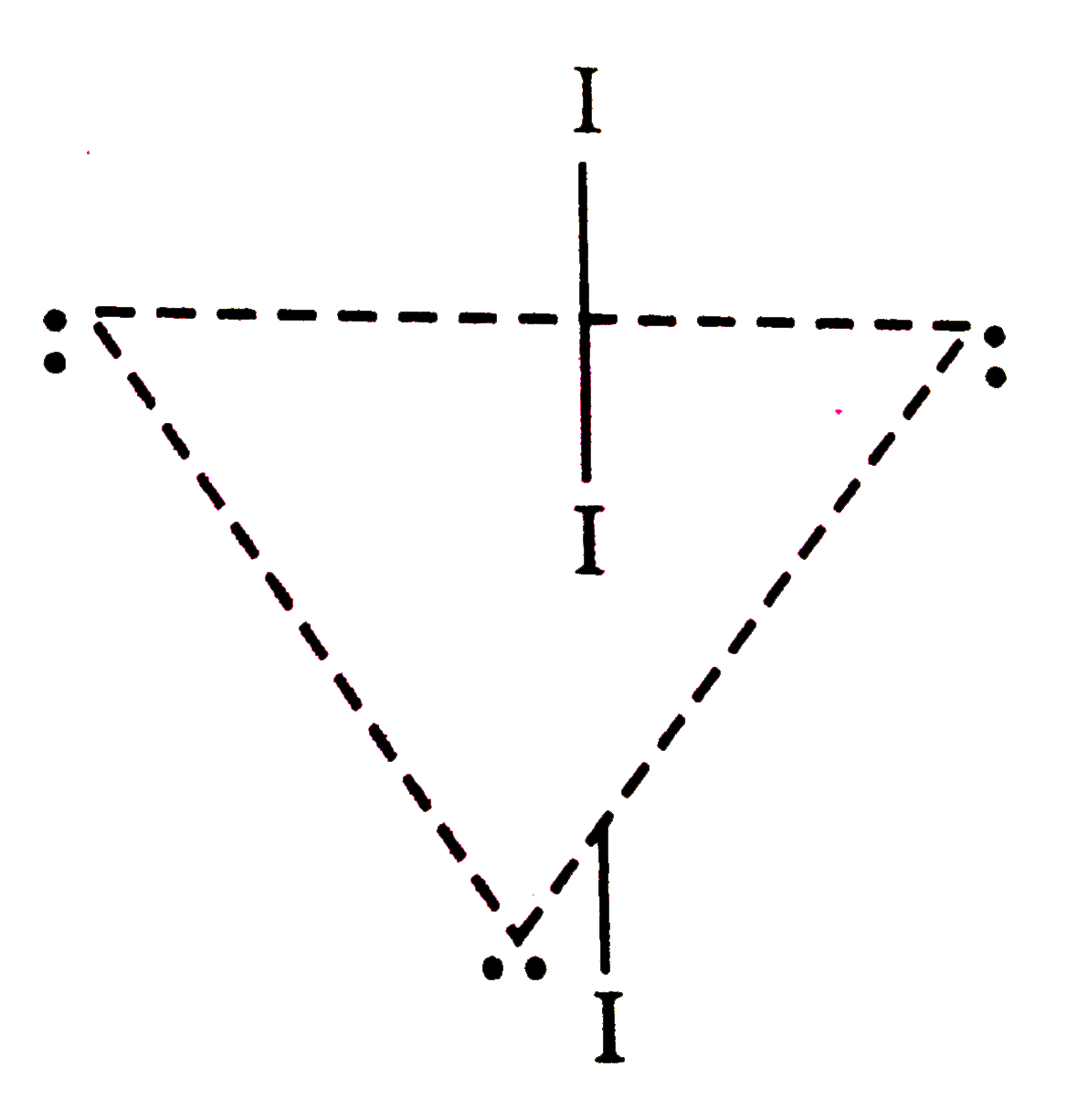
|
|
| 9. |
Explain : The shape of H_(2)Ois V (angular). |
|
Answer» Solution :The structure of `H_(2)O`is molecule can be EXPLAINED with the help of sps hybridization of oxygen and VSEPR theory. In `H_(2)O`the valence shell (outer) electronic configuration of oxygen in ground state is `2s^(2) 2p_(x)^(1) 2p_(y)^(1) 2p_(z)^(1)`having TWO paired electron and two half filled orbital. These four orbitals undergo `sp^(3)` hybridization in which two orbital are half filled & other two orbitals are completion filled. Two half filled `sp^(3)` orbital overlap with is orbital of H and form two O-H sigma bond. Two `sp^(3)` orbital are non bonding. As per VSEPR principle the repulsion between IONE pair is more than bonding pair. So due to this excess repulsion two O-H bond come closer so bond angle decrease from `104.5^(@)`to `104.5^(@)`. In this way `H_(2)`O has V shape & bond angle is `104.5^(@)` . 
|
|
| 11. |
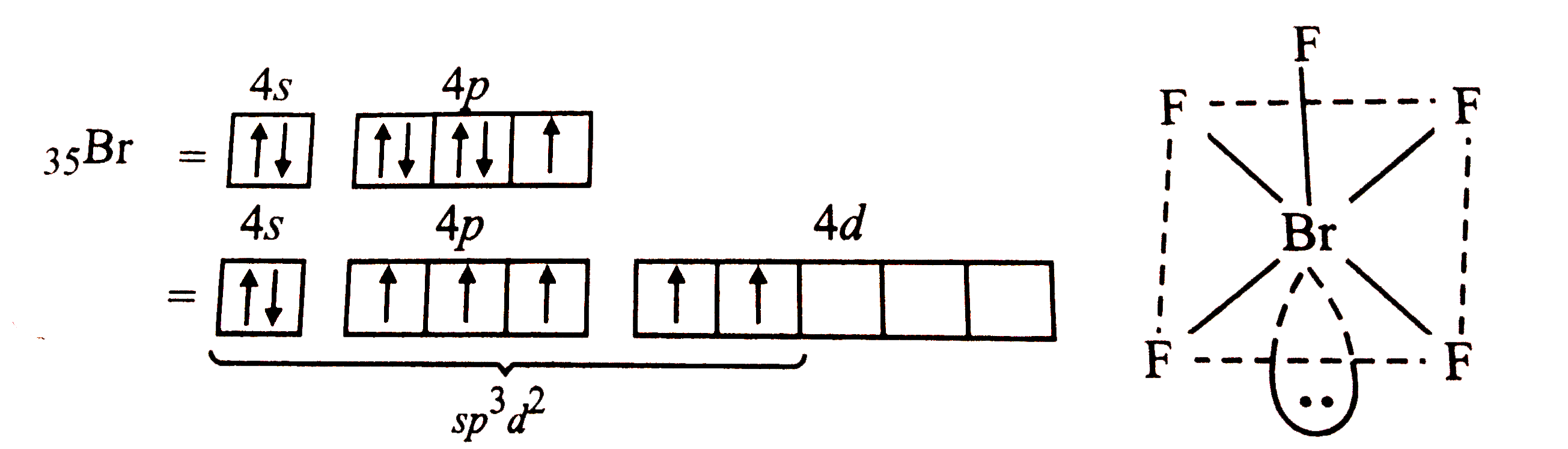
Explain the shape of BrF_(5). |
|
Answer» SOLUTION :The central atom Br has seven electrons in the valence SHELL. Five of these will form BONDS with five fluorine atoms and the remaining two electrons are present as one LONE pair. So, total pairs of electrons are six (5 bond pairs and 1 lone pair). To decrease repulsion between lone pairs and bond pairs, the shape becomes square PYRAMIDAL, in `BrF_(5)` . 
|
|
| 12. |
Explain the shape and bond angle in BCl_(3) molecule in terms of Valence Bond Theory. |
Answer» SOLUTION :
|
|
| 13. |
Explain the role of H_(2)O_(2) in green chemistry. |
|
Answer» |
|
| 14. |
Explain the relationship between free energy and equilibrium constant. |
|
Answer» Solution :Let US consider a general equilibrium reaction `A+BhArrC+D` The free ENERGY change of the above reaction in any state `(DeltaG)` is related to the STRANDED free energy change of the `(DeltaG^(@))` according to following equation `DeltaG= DeltaG^(@)+RT "In " Q` where Q is reaction quotient . When equilibrium is attained , there is no further free energy change i.e. `DeltaG=0` and Q becomes equal to equilibrium constant. Hence the above equation becomes. `DeltaG^(@)=-RT "In"K_(eq)` This equation is KNOWN as Van 't Hofff equation `DeltaG^(@)=-2.303RTlogK_(eq)` We also know that `DeltaG^(@)=DeltaH^(@)-TDeltaS^(@)=-RT " In " K _(eq)` |
|
| 15. |
Explain the relation of change in heat at constant pressure and constant temperature. |
|
Answer» SOLUTION :At CONSTANT TEMPERATURE thermal change `d_V = Delta U` At constant pressure thermal change `q_(p) = Delta U` At constant pressure `H Delta U + p Delta V` where, `Delta V=` Change in volume `V_1 = ` Initial volume `V_2=` Final volume `Delta H = Delta U + p(V_(2) + p(V_(2) - V_(1) ) = Delta U + (pV_(2)- pV_(1) ) ""...(i)` According to ideal gas equation `pV = nRT` `pV_(1) = n_(1) RT ""...(II)` `pV_(2) =n_(2)RT""...(iii)` Where, `n_1 =` Moles of gaseous reactions. `n_2=` Moles of gaseous products. Put the volume of eq. (ii) and (iii) into eq. (i) `Delta H = Delta U + (n_(2) RT - n_(1) RT) ` `therefore Delta U = Delta U + (n_(2) - n_(1) ) RT` `DeltaH= Delta U + Delta n_(g) RT` Where, `Deltan_(g)=` Difference between moles of gaseous product and gaseous reactants. If `Delta n_(g) =0` than `Delta H= Delta U` If `Delta n_(g) gt 0` than `Delta H gt Delta U` If `Delta n_(g) lt 0` than `DeltaH lt Delta U` |
|
| 16. |
Explain the relation between time of equilibrium and thermodynamics. |
|
Answer» Solution :The value of `K_c` gives the proportion of PRODUCT and reactant at EQUILIBRIUM, but the value `K_c` does not change with rate of reaction. The value of `K_c` can.t explain the time when the equilibrium is attain, it can be explain by thermodynamics. By USE of Gibbs force ENERGY spontaneity of reaction can be predicted. (i) `DeltaG` is negative (`DeltaG lt 0`) : `DeltaG` is negative, then the reaction is spontaneous. Reaction proceed in forward direction and product will form from reactant equilibrium energy decreases. (ii) `Delta`G is positive (`DeltaG gt 0`) : `DeltaG` is positive, then reaction is considered non-spontaneous. So, forward reaction will not take place, So, product convert in to reactant. (iii) `DeltaG = 0`: If `DeltaG = 0` than the reaction is in equilibrium. The reaction will not be continue in any direction. There will be not much energy left for this PROCESS. |
|
| 17. |
Expain the reason for the fusion of an organic compound with metallic sodium for testing nitrogen, sulphur and phosphorus. |
|
Answer» |
|
| 18. |
Explain the redox reaction in galvanic cells. |
|
Answer» Solution :Galvanic cell is a device in which electricity is produced using a SPONTANEOUS redox reaction . Any galvanic cell consist of two .single electrodes. which are also known as .half cells. or .redox couples.. Single electrode is a system in which reduced and oxidised species of the same substance remain in equilibrium. For example, Daniel cell contains the following electrodes, (i) A zinc ROD dipped in `ZnSO_4` solution It is represented as `Zn|Zn_(sq)^(2+)`. (ii) A copper rod dipped in `CuSO_4` solution. It is represented as `Cu|Cu^(2+)`. SINCE the tendency of Zn to lose electrons is greater than that of Cu, the reaction at the `Zn|Zn_(sq)^(2+)` electrode is as follows: `ZntoZn^(2+)+2e^(-)`(OXIDATION)  Reaction at the `Cu|Cu_(sq)^(2+)` electrode is as follows: `Cu^(2+) +2e^(-) to Cu` (reduction). The net cell reaction is `Zn+Cu^(2+)toZn^(2+)+Cu.` The electrons lost by zinc externally flow from zinc to copper. |
|
| 19. |
Explain the reason for the fusion of an organic compound with metallic sodium for testing nitrogen, sulphur and halogens |
| Answer» Solution :The ORGANIC compound is fused with sodium metal to convert these elements which are PRESENT in the covalent form to IONIC. So the ionic compoundformed like NaCN from N, `Na_(2)S` from S, and NaX from halogen. | |
| 20. |
Explain the reason for the fusion of an organic compound with metallic sodium for testing nitrogen, sulphur and halogens. |
| Answer» Solution :Organic COMPOUND is fused with sodium metal so as to convert organic compounds into NaCN, `Na_(2)S` , NaX and `Na_(3)PO_(4)` . Since these are IONIC compounds and become more reactive and thus can be easily TESTED by suitable reagents. | |
| 21. |
Explain the reason for the fusion of an organic compound with metallic for testing nitrogen sulphur and halogens. |
| Answer» Solution :The organic compound is FUSED with sodium METAL to convert these ELEMENTS which are PRESENT in the covalent form to ionic form. | |
| 22. |
Explain the reaction SiO_2 is treated with HF |
|
Answer» |
|
| 23. |
Explain the reaction of CO_(2 on photosynthesis. |
|
Answer» SOLUTION :Plants absorb `CO_(2)` . In the presence of chlorophyll and sunlight the absorbed `CO_(2)` combines with `H_(2)O` to form glucose andstarch. This process is CALLED PHOTOSYNTHESIS. `6 CO_(2) +12H_(2)O underset("sunlight")overset("chlorophyll") (rarr)C_(6)H_(12)O_(6)+6CO_(2)+6H_(2)O` |
|
| 24. |
Explain the reaction Si is heated with methyl chloride at high temperature in prsence of copper |
|
Answer» |
|
| 25. |
Explain the reaction of borax on heating . |
|
Answer» Solution :Borax on heating loses water of crystallisation and swells to form a puffy mass which further heating melts to give a clear liquid which solidifies to a transparent glass LIKE BEAD consist of sodium METABORATE `( NaBO_(2))` and boric anhydride `B_(2) O_(3)` . `Na_(2) B_(4)O_(7) : 10H_(2)O overset ("heat") to Na_(2) B_(4) O_(7) +10H_(2)O` `Na_(2) B_(4) O_(7) overset("heat")(RARR) underset ("Sodium META borate ") (2NaBO_(2))+ underset("boric anhydride ") (B_(2)O_(3))`. |
|
| 26. |
Explain the reaction of benzene with n-propyl chloride. |
Answer» Solution : MAIN PRODUCT isopropyl BENZENE is obtained because `2^(@)` carbocation is obtained by rearrangement of intermediate carbocation.  `1^(@)`-carbocation of product is converting into more stable `2^(@)`-carbocation so on reaction of benzene with `CH_(3)CH_(3)CH_(2)Cl` the main product 1-phenyl PROPANE is not formed. |
|
| 27. |
Explain the reaction Hydrated alumina is mixed with aqueous NaOH |
|
Answer» |
|
| 28. |
Explain the reaction CO is heated with ZnO |
|
Answer» |
|
| 30. |
Explain the propene reacts with HBr. |
|
Answer» SOLUTION :Propene reacts with HBr, gives product by 2-Bromo propane has electrophilic addition reaction. Alkene reacts with hydrogen halide (HCl, HBr, HI) give product alkyl halide. This reaction is electrophilic addition reaction. (a) "Rule of markonikov" or give the addition reaction of alkene with HBr (HX) : Markovnikov gave rule as 1869. These generalisation in Markovnikov to frame a rule is CALLED Markovnikov rule. The rule states that negative part of the ADDENDUM (adding molecule) gets ATTACHED to that carbon atom which possesses lesser number of hydrogen atoms. example :(a) Addition reaction of propene to HBr, product (I) and (II) is obtained but as per Markovnikov.s rule, product (I) b is only obtained. Addition of propene to HBr gives product (I) and (II).  (b) As per Markovnikov.s rule, `Br^(-)` is reactant HBr, attaches with less number of hdyrogen and forms double donded product. It is a main product.  Information of product formed by Markovnikov.s rule in reaction : In any reaction, product is obtained in major amount. Series of carbocation in `3^(@) gt 2^(@) gt 1^(@) overset(+)(C)H_(3)`. In `pi`-bond, `pi`-electron having -ve charge, `H^(+)` is attarcted and `pi`-bond is broken, FORMATION of `sigma` -bond stable carbocation is formed.  (ii) First `Br^(-)` attaches fast with (y) and forms below product.  Note : In unsaturated alkene C=C, both carbon can have different substitution but has same number of substitution. Reactivity of HX in alkene is `HI gt HBr gt HCl`. Reactivity of carbocation is `3^(@)-C^(+) gt 2^(@) -C^(+) gt 1^(@) - C^(+) gt overset(+)(C)H_(3)`. |
|
| 31. |
Explain the process of oogenesis. |
| Answer» Solution :The separation of different COLOURED constituents of chlorophyll is done by CHROMATOGRAPHY by M.S. Tswett. He ACHIEVED it by passing a petroleum ether solution of chlorophyll present in leaves through a column of `CaCO_(3)` firmly packed into a narrow glass tube. Different components of the PIGMENTS got separated and LANDS to form zones of different colours. | |
| 32. |
Explain the principle of paper chromatography |
| Answer» Solution :Paper chromatography is a simple chromatography. In this paper is a stationary PHASE. Paper is make up of cellulose and in this mobile phase easily migrate. Pure liquid migrat with equal rate on paper, If the spot of mixture of COMPONENT is kept on paper than it become mobile phase in SOLVENT. This component is absorbed. According to the principle of capillary, component ABSORB on paper and migrate above but their separation is different at different height so the component SEPARATED from mixture | |
| 33. |
Explain the principle of paper chromatography. |
| Answer» SOLUTION :For ANSWER, CONSULT SECTION 12.40. | |
| 34. |
Explain the principle and estimation method for carbon and hydrogen in organic compound |
|
Answer» Solution :Carbon and hydrogen are estimated in one experiment. Procedure: Apparatus are arrange according to FIGURE. A known mass (m) of an organic COMPOUND taken in platinum boat is burnt in the presence of excess of oxygen and copper (II) oxide.  Reaction: carbon and hydrogen in the compound are oxidised to carbon dioxide and water respectively. `C_(x) H_(y) + (x + (y)/(4)) O_(2) rarr x CO_(2) + (y)/(2) H_(2)O` Determine the amount of carbon and hydrogen:(i) The mass of water produced is determined by passing the mixture through a weighed U-tube containing anhydrous calcium chloride. (ii) Then after, carbon dioxide is absorbed in another U-tube containing concentrated solution of potassium hydroxide These tubes are connected in series (fig). The increases in masses of calcium chloride potassium hydroxide gives the amounts of water and carbon dioxide from which the percentage of carbon and hydrogen are calculated. `(2H)/((2)) overset(CuO)rarr (H_(2)O)/((18)) rarr CaCl_(2) rarr CaCl_(2) (H_(2)O)` where, `m_(1) = H_(2)O` in gram m= weight of compound `:.` Percentage of hydrogen `= (2 xx m_(1) xx 100)/(18 xx m)` Carbon dioxide ABSORB in potassium hydroxide, so based on increase of weight `(m_(2))` percentage of carbon calculated. `:.` Percentage of carbon `= (m_(2) xx 12 xx 100)/(44 xx m)` where, `underset(12 gm)(C )+ O_(2) rarr underset(44 gm)(CO_(2))` `m_(2)`= mass of produced `CO_(2)` in gram m= mass of taken compound in gram |
|
| 35. |
Explain the pressure - volume isotherms of Carbon dioxide Andrew's isotherm. |
|
Answer» Solution :(i) Andrew's ISOTHERMS of carbon DIOXIDE at different temperactures is shown in figure From the plots we can infer the FOLLOWING. (ii) Atlow temperature isotherms, for example, at `13^(@)C` as te pressure increases, the volume decreases along AB and is a gas until the point B is reached. (iii) At B, a liquid separates along the line Bc,Both the liquid and gas c-oexist and the pressure remains constant. (iv) The volume range is which the liquid and gas coexist becomes shorter. (vi) At the temperature of `31.1^(@)C` the length of the shorter portion is reduced to zero at point P. (vii) The `CO_(2)` gas is liquefied completely at this point. This temperature is known as the LIQUEFACTION temperature or critical temperature of `CO_(2)` at this point the pressure is 73 atm. (viii) Above this temperature `CO_(2)` remains as a gas at all pressure values. 
|
|
| 36. |
Explain the preparation of the following compounds: (i) DDT (ii) Chloroform (ii) Biphenyl (iv) Chloropicrin (v)Freon-12 |
Answer» Solution :(i) DDT  (ii) Chloroform: (a) `underset("Ethanol")(CH_3 - CH_2OH) + Cl_2 to underset("Acetaldehyde")(CH_3CHO) + 2HCL` (b) `underset("Acetaldehyde")(CH_3CHO) + 3Cl_2 to underset(("Chloral"))underset("Trichloroacetaldehyde")(C Cl_3 CHO) + 3HCl` (c ) `underset("Chloral")(C Cl_3 CHO) + Ca(OH)_2 to underset("Chloroform")(2CHCl_3) + underset("Calcium formate")((HCOO)_2Ca)` (iii) Biphenyl: Fittig reaction : `C_6H_5Cl + 2Na + ClC_6H_5 to underset("Biphenyl")(C_6H_5-C_6H_5) + 2NaCl` (IV) Chloropicrin. `underset("Chloroform")(CHCl_3) + underset("Nitric ACID")(HNO_3) to underset("Chloropicrin")(C Cl_3 NO_2) + H_2O` (v) Freon - 12. `C Cl_4 + 2HF overset(SbCl_2)to underset("Freon - 12")(C Cl_2F_2) + 2HCl` |
|
| 37. |
Explain the presence of fluoride in water and its hazardous effects? |
|
Answer» Solution :(i) Fluoride ion deficiency in drinking water causes tooth decay. (II) The fluoride IONS MAKE the enamel on teeth much harder by converting hydroxyapatite `[3(Ca_(3)(PO_4). Ca(OH)_2]`the enamel on the surface of the teeth into much harder fluorapatite `[3(Ca_(3)(PO_4)_2. CaF_2]` (ii) Fluoride ion concentration above 2 ppm causes brown mottling of teeth. Excess fluoride causes damage to bones and teeth. |
|
| 38. |
Explain the preparation of the following compounds (i) DDT (ii) Chloroform (iii) Biphenyl (iv) Chloropicrin (v) Freon-12. |
Answer» Solution :(i) DDT: DDT can be prepared by heating a mixture of chlorobenzene with chloral (Trichloro acetaldehyde) in the presence of con. `H_(2)SO_(4)`.  (ii) Chloroform: The reaction of methane with excess of CHLORINE in the presence of SUNLIGHT will give carbon tetrachloride as the major product. `underset("Methane")(CH_(4)+4Cl_(2)) overset(h GAMMA)to +underset("Carbon tetrachloride")(4HC l)`. (iii) Biphenyl: `underset("Chlorobenzene")(C_(6)H_(5)Cl+2Na)+Cl-C_(6)H_(5) underset(DELTA)overset("Ether")to underset("Biphenyl")(C_(6)H_(5)-C_(6)H_(5))+2NaCl` (iv) Chloropicrin: Chloroform REACTS with nitric acid to form chloropicrin. (Trichloro nitro methane) `underset("Chloroform")(CHCl_(3))+HNO_(3) overset(Delta) to underset("Chloroform")(C Cl_(3)NO_(2))+H_(2)O` (v) Freon-12: Freon-12 is prepared by the action of hydrogen fluoride on carbon tetrachloride in the presenc eof catalylic amount of antimony pentachloride. this is called swartz reaction. `underset("Carbon tetrachloride")(C Cl_(4))+2HF overset(SbCl_(5))to underset("Freon-12")(2HCl)+C Cl_(2)F_(2)`. |
|
| 39. |
Explain the preparation of sodium fusion extract . |
|
Answer» `Na +ubrace(C+N)_("from organic compounds")toNaCN` |
|
| 40. |
Explain the positive deviation exhibited by non-ideal solution with prefernce to a solution of ethyl alcohol and water. |
|
Answer» Solution :The nature of the deviation from the Rauolt's law can be explained in terms of the intermolecular interactions between solute (A) and solvent (B). CONSIDER a case in which the intermolecular attractive forces between A and B are weaker than those between the molecules of A(A-A) and molecules of B(B-B) .The molecules present in such a solution have a greater tendency to escape from the solution when compared to the ideal solution formed by A and B in which the intermoleculr attractive forces (A-A,B-B.A-B) are almost similar .Consequently the vapour pressure of such non-ideal solution increases and it is greater then the sum of the RAOULT's law This type of deviation is called positive deviation Here , `P_A gt P_A^(@) X_A and P_B gt P_B^(@) X_B ` Hence ` P_("total ")lt P_A^(@) X_A + P_B^(@) X_B ` Let us understand the positive deviation by considering a solution of ethyl alcohol and water . In this solution the hydeogen bonding interaction between ethanol and water is weaker than those hydrogen bonding interactions amongst themselves (ethyl alcohol -ethyl alcohol and water-water interactions ) .This results in the increased evaporation of both COMPONENTS from the aqueous solution of ethanol .Consequently .the vapour pressure of the solution is greater than the vapour pressure predicted by Raoult's law .Here the mixing process is endothermic i.e `Delta H_("mixing " )lt 0 ` and there will be a slight increase in volume `(Delta V_("mixing ")lt 0.) ` Examples for non-ideal solution showing positive DEVIATIONS : Ethyl alcohol & cyclohexane . Benzene & acetone Carbon tetrabhloride& chloroform . Acetone & ethyl alcohol , Ethyl alcohol & water ` (##SUR_CHE_XI_V02_C09_E05_003_S01.png" width="80%"> |
|
| 41. |
Explain the positive and negative electromericeffect? |
Answer» Solution :(i) When an electrophile such as `H^(+)` approaches an alkene molecule, the `pi` electrons are instantaneously shifted to the electrophile and a new BOND is FORMED between carbon and hydrogen.This makes the other carbon electron deficient and hence it acquires a positivecharge.  (ii) When the `pi` electron is transferred towards the attacking REAGENT, it is called positive electromeric `(+E)` effect.  (III) When the `pi` electron is transferred awayfrom the attacking reagent it is called negative electromeric `(-E)` effect.  For example: The attack of `CN^(oplus)` on a carbonyl carbon. 
|
|
| 42. |
Explainthe polymerisation of acetylene molecues |
|
Answer» Solution :Acetyleneundergoes TWOTYPES ofpolymerisationreactionthey are (i)Linearpolymerisation(ii) Cyclicpolymerisation (i) Linearpolymerisation: Acetylene formslinearwhenpassedintoa SOLUTIONOF cuprouschlorideand ammoniumchloride .  (ii)Cyclicpolymerisation :Acetylene UNDERGOES cyclicpolymerisationon passingthroughredhotirontube. THREE moleculesof accetylenepolymerisesto formbenzene. 
|
|
| 43. |
Explain the polarity of Borontrifluoride molecule. |
|
Answer» Solution :In `BF_(3)` there are 3 DIPOLE. Its dipole moment is zero. This is possible only when the MOLECULE is symmetric, `BF_(3)` has trigonal PLANAR shape. The BOND angle is `120^(@)`. The resultant m of any two dipoles is EQUAL and opposite to the third dipole. So the net dipole moment is zero. |
|
| 44. |
Explain the polarity in H_(2)O molecule. |
|
Answer» SOLUTION :Water molecule also consists of the dipoles. But water has a dipole moment of 1.85D. So water molecule is not linear. It has a bent SHAPE. The MAGNITUDES of two dipoles (two O-H bonds) are EQUAL but they are not acting in opposite DIRECTIONS. So dipole moments donot cancel each other. |
|
| 45. |
Explain the physical significance of van der Waals parameters. |
|
Answer» Solution : .a. and .b. are constant in Van DER waal equation. Vaslue of a is related intermolecular FORCES of gas. Value of a INCREASES with intermolecular force and real pressure shows more ideal pressure. Vasn der waal.s constant .b. shows correction observed in value (V). Value of b increases with volume of molecule. Value of .b. shows more DEVIATION in volume than volume of Ideal gas. |
|
| 46. |
Explain the periodic trend of ionization potential. ins. |
|
Answer» Solution :(a) The energy required to remove the most LOOSELY held electron from an ISOLATED gaseous ATOM is called as ionization energy. (B) Variation in a period. Ionization energy is a periodic property. On moving across a period from left to right, the ionization enthalpy value increases. This is due to the following reasons. • Increase of nuclear charge in a period • Decrease of atomic size in a period Because of these reasons, the valence ELECTRONS are held more tightly by the nucleus. Therefore, ionization enthalpy increases. (c) Variation in a group As we move from top to bottom along a group, the ionization enthalpy decreases. This is due to the following reasons. • A gradual increase in atomic size • Increase of screening effect on the outermost electrons due to the increase of number of inner electrons. Hence, ionization enthalpy is a periodic property.. |
|
| 47. |
Explain the periodic trend of ionisation potential. |
|
Answer» Solution :Variation along a period , Ionisation energy usually increases along a period . Thisis DUE to increase of nuclear change and decrease in size as we MOVE from left to right in a period. Periodic variation in GROUP : Ionisation energy decrease down a group. As we move down a group , the valence electron occupies NEW SHELLS, the distance between the nucleus and the valence electron increases . So the nuclear forces of attraction on valence electron decreases and hence ionisation energy also - decreases down a group. |
|
| 48. |
Explain the periodic nature of ionization enthalpy in the alkali group. |
|
Answer» Solution : Alkali metals have the lowest ionization enthalpy in each period. (ii) Within the group, as we go down, the ionization enthalpies of alkali metals DECREASES due to the increase in atomic size. (iii) In large atoms, the valence electrons are LOOSELY HELD by the nucleus and are easily leading them to have low ionization enthalpy and acquiring stable noble gas configu (iv) On moving down the group, the atomic size increases and the NUMBER of inner Snen.increases, which in TURN increases the magnitude of screening effect. So, the ionization enthalpies decreases down the group |
|
| 49. |
Explain the pauling method for the determination os ionic radius. |
|
Answer» Solution :Ionic radius of uni - univalent crystal can be calculated using Pauling's method from the inter ionic distance between the nuclei of the CATION and anion. (ii) Pauling assumed that ions present in a crystal lattice are perfect spheres , and they are in CONTACT with each other therefore, `d=r_(C)^(+)+r_(A)^(-)` ...... (1) Where d is the distance between the centre of the nucleus of cation `C^(+)"and anion"A^(-)andr_(C)^(+),r_(A)^(-)`are the radius of the cation and anion respectively. Pauling also assumed that the radius of the ion having noble gas electronic configuration is inversely PROPORTIONAL to the effective nuclear CHARGE . `r_(C)^(+)alpha(1)/((Z_("eff"))_(C),)`......(2) `r_(A)^(-)alpha(1)/((Z_("eff"))_(A))`......(3) `Z_("eff")` is the effective nuclear charge and `Z_("eff")=Z-S` Dividing the equation 1 by 3 `(r_(C))/(r_(A)^(-))=((Z_(eff))_(A)^(-))/((Z_("eff"))_(C)^(+))`...... (4) On solving equation and (1)and (4)the values of `r_(C)^(+)andr_(A)^(-)` |
|
| 50. |
Explain the particle nature of EMR (Electromagnetic Radiation] |
|
Answer» Solution :The main point, of the theory are:- a) Radiant energy is emitted or absorbed not CONTINUOUSLY but DISCONTINUOUSLY in the FORM of small packets of energy called quanta. b) The amount of energy associated with a QUANTUM of radiation is proportional to the frequency of radiation. `EpropvthereforeE=hv` where h = planck's constant i.e. `6.635xx 10^(-34)` joule-secE = n h V where n = 1, 2, 3, 9 ..... |
|