

Saved Bookmarks
This section includes 7 InterviewSolutions, each offering curated multiple-choice questions to sharpen your Current Affairs knowledge and support exam preparation. Choose a topic below to get started.
| 1. |
Explain the following : (i) Gallium has higherionisation enthalpy than aluminium. (ii) Borondoes notexistsas B^(3+) ion. (iii)Aluminium forms [AlF_(6)]^(3-) ion butboron does notform [BF_(6)]^(3-) ion. (iv) PbX_(2) is more stablethan PbX_(4). (v) Pb^(4+)acts as an oxidisingagent but Sn^(2+)acts as a reducingagent. (vi) Electron gain enthalpy of chlorineis more negative as compared to fluorine. (vii) Tl(NO_(3))_(3) acts as an oxidising agent. (viii) Carbonshows catenationproperty but leaddoes not. (ix) BF_(3) does nothydrolysecompletely (modified). (x) Why does the elemnet silicon, not forma graphitelike structurewhereas carbondoes. |
|
Answer» Solution :(i) Due toineffectiveshieldingof valence electronsby the inventing 3d-electrons, the effectivenucleuschargeon Gais slightly higher thanthat onAl and hence the`DeltaH_(i)` of galliumis slightly higher than theAl. (ii) N/A . (iii) Al hasvacantof d-orbitalsand hence can expand its coodination numberfrom 4 to 6 and hence for octahedral `[AlF_(6)]^(3-)`ion in whichAl undergoes `sp^(3) d^(2)`hybridization . in contrast,B does not have d-orbital. Therefore. It canhave a maximumcoordinationnumber of 6.Therefore, B forms `[BF_(4)]^(-)`(in which B is `sp^(3)` hybridized) but not `[BF_(6)]^(3-)`. (iv) Due to inert effect,+2 oxidationstate of Pb is more stablethan its +4 oxidation state.Consequently `PbX_(2)` in whichthe oxidationstate of Pbis +2 is more stablethan `PbX_(4)` in whichthe oxidation state is `+4`. (v) Inert pair effectis less prominentin Sn than it Pb.Therefore +2 oxidation of Sn is less stable the `+4` oxidation state. In otherwords, `Sn^(2+)` can easily lose two electrons to form `Sn^(4+)` and hence`Sn^(2+)` acts acts a reducing agent. `Sn^(2+) rarr Sn^(4+) +2e^(-)` In contrast, the inert pair effectis more prominant in Pb than in Sn. Therefore `+2` oxidation state of Pb in more stablethan its+4 oxidationstate. In other words , `Pb^(4+)` can easily accept two electronsto form `Pb^(2+)` and hence`Pb^(4+)`acts as an oxidisingagent. `Pb^(4+) + 2e^(-) rarr Pb^(2+)` (vi) Due to small size, theelectron-electronrepulsionsin the relatively compact `2p`-subshell of F are quite strong and hence the incomingelectron is not accepted with the same ease as in case of bigger Cl atom where repulsionsare comparatively weak. Thus, electron gain enthalpy of chlorineis more negative as comparedto that of fluorine. (vii) Due tostrong inert paireffect, the +3 oxidation state of Tl is less stable than its +1 oxidation state. Since in `Tl(NO_(3))_(3)`,oxidation state of `Tl`is `+3`, therefore, it caneasily gain twoelectronsto form `TlNO_(3)` in which inoxidationstate of `Tl` is `+1`.Consequently, `Tl(NO_(3))_(3)` acts as an oxidisingagent. (VIIII) Property of catenationdepends upon the strengthof element-elementbond which, in turn,dependsupon the sizeof the element . Since the atomic size of carbonis MUCH smaller than that of lead, therefore, carbon -carbonbond strength is much higher than that of lead-lead bond. Due to stronger C-Cthan `Pb-Pb`bonds,carbon has a muchhigher tendency for catenation than lead. (ix) UNLIKE other boron halids, `B_(3)` does not hydrolysecompletely, Instead, it hydrolysesincompletely to form boric acidand fluoroboric acid. This is because the HF FIRST formed reacts with `H_(3)BO_(3)`. `{:([BF_(3)+3H_(2)OrarrH_(3)BO_(3)+3HF]xx4),([H_(3)BO_(3)+4HFrarrH^(+)+[BF_(4)]^(-)+3H_(2)O]xx3):}/(4BF_(3)+3H_(2)OrarrH_(3)BO_(3)+3[BF_(4)]^(-)+3H^(+))` (x) N/A |
|
| 2. |
Explain the following, give appropriate reasons.(i) Ionization potential of N is greater than that of O(ii) First ionization potential of C-atom is greater than that of B-atom, where as the reverse is true for second ionization potential.(iii) The electron affinity values of Be and Mg are almost zero and those of N (0.02 eV) and P (0.80 eV) are very low(iv) The formation of F^(-). (g) from F(g) is exothermie while that of O^(2-)(g) from O (g) is endothermic. |
|
Answer» Solution :(i) N(Z =7) `1s^2 2s^2 2p_x^1 2p_y^1 2p_z^1`. It has exactly half filled electronic configuration and it is more stable. Due to stability, ionization energy of nitrogen is high. `O (Z =8) 1s^2 2s^2 2p_x^2 2p_y^1 2p_z^1`. It has incomplete electronic configuration and it requires less ionization energy. `IE_1NgtI.E_1O` (ii) C(Z=6) `1s^2 2s^2 2p_x^1 2p_y^1`. 1. The electron removal from p orbital is very difficult. So carbon has highest first ionization potential. B `(Z=5) 1s^2 2s^2 2p^1`. In boron nuclear charge is less than that of carbon, so boron has lowest first ionization potential. `I.E_1 CgtI.E_1 B` But it is reverse in the case of second ionization energy. Because in case of B the electronic configuration is `1s^2 2s^2`, which is completely filled and it has high ionization energy. But in C the electronic configuration is `1s^2 2s^2 2p^1`, one electron removal is easy so it has LOW ionization energy. `I.E_2BgtI.E_2C` (iii) Be (Z =4) `1s^2 2s^2` `Mg (Z-12) 1s^2 2s^2 2p^6 3s^2` Noble gases has the electronic configuration of nsa NP. All these are completely filled and are more stable. For all these elements Be, Mg and noble gases, addition of electron is unfavorable and so they have zero electron affinity. Nitrogen `(Z =7) 1s^2 2s^2 2p_x^1 2p_y^1 2p_z^1`. It has halffilled electronic configuration. So addition of electron is unfavorable and it has very low electron affinity value of 0.02 eV. Phosphorus (Z = 15) `1s^2 2s^2 2p^6 3s^2 3p_x^1 3p_y^1 3p_z^1`. It also has half filled electronic configuration. Due to the SYMMETRY and more stability, it has very low electron affinity value of 0.80 eV. (iv)`F_((g)) +e^(-) to F_((g))^(-)` exothermic F (Z = 9) `1s^2 2s^2 2p^5` . It is ready to gain one electron to attain the nearest inert gas configuration. By gaining one electron, energy is released, so it is an exothermic reaction. `O_((g))+2e^(-) to O_((g))^(2-)`endothermic O (Z=8) `1s^(2) 2s^(2) 2p_(x)^(2), 2p_(y)^(1) 2p_(z)^(1)`. It is the small atom with high electron density. The first electron affinity is negative because energy is released in the process of adding one electron to the neutral oxygen atom. Second electron affinity is always endothermic (positive) because the electron is added to an ion which is already negative, therefore it must overcome the repulsion. |
|
| 3. |
Explain the following : Gallium has higher ionisation enthalpy than aluminium . |
| Answer» SOLUTION :The ionization enthalpyvalue of Ga is higher than Al due to INABILITY of d- and f- electrons, which have SCREENING effect, to compensate the increase in NUCLEAR charge. | |
| 4. |
Explain the following : Electron gain enthalpy of chlorine is more negative as compared to fluorine. |
| Answer» SOLUTION :The size of F atom is very small and incoming electrons feel interelectronic REPULSION and ELECTRON gain ENTHALPY of F is less negative as COMPARED to Cl. | |
| 5. |
Explain the following diagrams. |
|
Answer» Solution :(i) As the concentration of the products increases, more products collide and react in the backward DIRECTION. (ii) As the rate of the REVERSE reaction increases, the rate of the forward reaction decreases. (iii) Eventually the rate of both reactions becomes EQUAL. 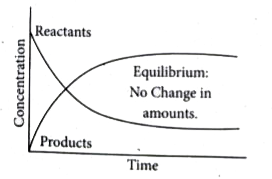 (i) Concentration of reactants decreases with time initially and concentration of products increases with time, (ii) After sometime, equilibrium is reached i.e., concentration of reactants and products REMAINS CONSTANT |
|
| 6. |
Explain the following : CO_2is a gas whereas SiO_2 is a solid. |
|
Answer» Solution :In `CO_2`, carbon atom undergoes sp hybridization. Two sp hybridized ORBITALS of carbon atom overlap with two p-orbitals of oxygen atoms to make two sigma bonds while other two electrons of carbon atom are involved in `ppi- ppi` BONDING with oxygen atom. This results in its linear shape with both C-O bonds of equal length (115 pm)] with no dipole moment. `O=C=O hArr .^(-)O- C-=O^(+) hArr O^(+)-=C-O^-` Silicon dioxide is a covalent, three dimensional network solid in which each silicon atom is covalently bonded in a tetrahedral manner to four oxygen atoms. Each oxygen atom in turn covalently bonded to another silicon atoms as SHOWN in diagram. Each comer is shared with another tetrahedron. The entire crystal may be considered as giant molecule in which eight membered rings are FORMED with alternate silicon and oxygen atoms. 
|
|
| 7. |
Explain the following : BF_3 does not hydrolyze. |
|
Answer» Solution :`BF_3` does not hydrolyze COMPLETELY . It FORMS boric acid and fluoroboric acid this is because the HF formed reacts with `H_3BO_3`. `BF_3+ 3H_2O to H_3BO_3 + 3HF xx 4` `H_2BO_3 + 4HF to H^(+)[BF_4]^(-) + 3H_2O + 3` `4BF_3 + 3H_2O to H_3BO_3 + 3[BF_4]^(-) + 3H^(+)` |
|
| 8. |
Explain the following : Carbon shows catenation property but lead does not. |
|
Answer» Solution :Carbon atoms have the tendency to link with one another through covalent BONDS to FORM chains and rings. This property is called CATENATION. This is because C-C bonds are very strong. Down the group the size increases and electronegativity decreases and there by , tendency to show catenation decreases. This can be clearly seen from BOND enthalpies values . The ORDER of catenation is `C gt gt Si gt Ge approx Sn`.Lead does not show catenation. |
|
| 9. |
Explain the following : Boron does not exist as B^(3+) ion. |
| Answer» SOLUTION :Boron has SMALL size and sum of `Delta_iH_1 + Delta_iH_2 + Delta_iH_3`is very high. Boron does not FORM `B^(3+)` ion THEREFORE , give covalent compounds. | |
| 10. |
Explain the following : Aluminium forms [AlF_6]^(3-) ion but boron does not form [BF_6]^(3-) ion. |
| Answer» Solution :Al has vacant .d. orbitals and can EXPAND its co-ordination no. and forms `[AlF_6]^(3-)` . On the other hand, BORON does not have .d. orbitals and cannot form `[BF_6]^(3-)` and cannot expand its covalence beyond 4 and thus , GIVES `[BF_4]^-` | |
| 11. |
Explain the following: (a) In sodium fusion test, why excess of sodium is taken? (b) acetals give positive test with 2,4 dinitrophenylhydrazine.. (c) A polyhydroxy alcohol has the molecualr weight of 168. On acetylation, the molecular weight increases to 294. Determine the number of (-OH) groups present in the alcohol. (d) Chlorobenzene when treated with enhanilic AhNO_3 does not give white precipate. |
Answer» Solution :`RCH(OR)_(2) + H_(2) O overset(H^(+))(to) underset("Gives positive result")(RCHO + 2ROH)` 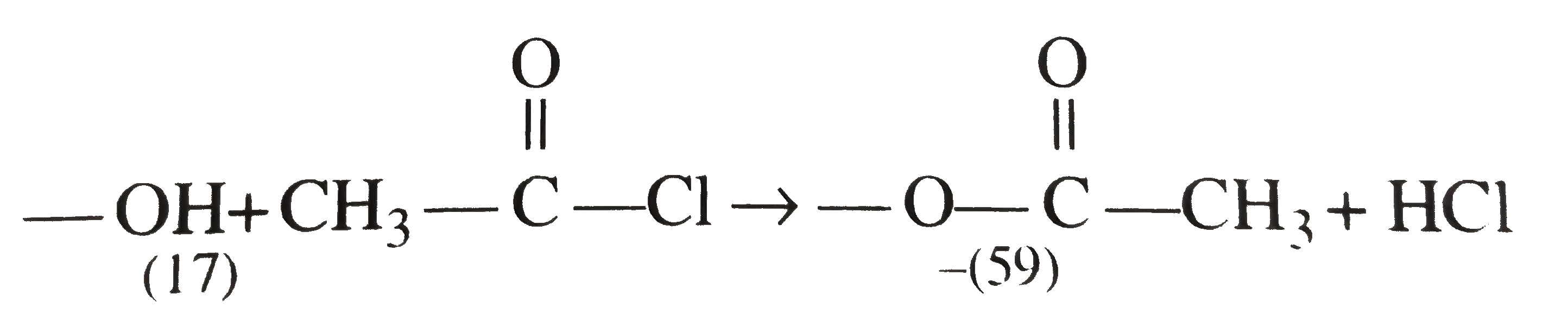 (a) IF sulphar and nitrogen both are present, sodium thiocynate `(NaCNS)` may be produced. This may GIVE a red colouration with `Fe^(3+)` but will not respond to tests for cyanide or sulphide ions. With EXCESS of sodium, the thiocynate, if formed, will be decomposed line this: `NaCNS+2NararrNaCN+Na_2S` (b) `2,4-` Dinitrophenylhydrizine reagent is prepared as follows. It is suspended in methanol and then conc. `H_2SO_4` is added. The mixture becomes warm and the solid usually dissolves completely. IF this reagent is added to acetals, the acetals get readily hydrolysed by acids, and give a positive with 2-4 DNP. (c) So when one (`-OH)` group is replaced by an ecetyl group, the molecular weight increases by `59-17=42`. Here the total increase in the molecular weight `=294-168=126` So the NUMBER of `(-OH)` groups present`=(126)/(42)=3` (d) Aromatic compounds in which halogen is attached directly to the aromatic nucleus (e.g., chlorobenzene do not react with ethanolic `AgNO_3` even on heating due to the high bond energy of the `(C---Cl)` bond which has partial double bond charactor. |
|
| 12. |
Explain the following: (a) Lithium iodide is more covalent than lithium fluoride (b) Lattice enthalpy of LiF is maximum among all the alkali metal halides. |
|
Answer» Solution :According to Fazan.s rule, `Li^(+)` ION can polarise `I^(-)` ion more than the `F^(-)`ion due to bi size of the anion. Thus `Lil^(-)` has more COVALENT character than Lif. (b) SMALLER the size (internuclear DISTANCE), more is the value of lattice enthalpy since internuclear distance is expected to be least in the LiF. |
|
| 13. |
Explain the following. a. Hydrated barium peroxide is used in the preparation of H_(2)O_(2) instead of anhydrous barium peroxide. b. Phosphoric acid is preferred to sulphuric acid in the preparation of H_(2)O_(2) from barium peroxide. c. Hydrogen is not prepared by action of concentrated sulphuric acid on zinc. d. A solution of ferric chloride is unaffected when hydrogen is bubbled through it, but gets reduced when zinc is added to the same acidified solution. |
|
Answer» Solution :a. If anhydrous barrium peroxide is used in the preparation of `H_(2)O_(2),` the `BaSO_(4)` formed during the reaction forms an insoluble protective COATING on the surface of solid barium peroxide. `BaO_(2(s))+H_(2)SO_(4(aq))toBaSO_(4(s))+H_(2)O_(2(aq))` This presents further action of the acid and ultimately the reaction stops. if however, hydrated barium peroxide (in the form of thin paset) is used, the water of crystallisation does not allow `BaSO_(4)` to deposit on the surface of `BaO_(2)` and the reaction goes to completion. b. the AQUEOUS solution of `H_(2)O_(2)` PREPARED by the action of dil `H_(2)O_(2)` on hydrated `BaO_(2)`has impurities of heavey metals ionssuch as a `Ba^(2+),Pb^(2+)` etc. which catalyse the decomposition of `H_(2)O_(2)`. hence, the `H_(2)O_(2)` does not have good keeping quality. if phospheric acid, `H_(3)PO_(4)`, is used, the impurities of heavy metals are percipitated as insoluble phosphates. As a results, the resulting solution of `H_(2)O_(2)` has good keeping qualities. c. Conc `H_(2)SO_(4)` reacts with zinc to form `SO_(2)` rather than `H_(2)`. `Zn+underset("conc")(H_(2)SO_(4))toZnSO_(4)+SO_(2)+2H_(2)` d. Dihydrogen, `H_(2)` is less reactive and hence it does not reduce acidified `FeCl_(3)` solution. however, when zinc is added to acidified `FeCl_(3)` solution, nascent hydrogen thus produced is ASSOCIATED with more ENERGY. consequently, it is more reactive and hence acidified `FeCl_(3)` solution. `FeCl_(3)+H_(2)toNo reaction` `Zn+H_(2)SO_(4)toZnSO_(4)+2[H]` `2[H]+underset("Yellow")(FeCl_(3))tounderset("Green")(FeCl_(2))+2HCl` |
|
| 14. |
Explain the following (a) Gallium has higher ionisation enthalpy than aluminium (b) Boron does not exist as B^(3+) ion (c) Aluminium forms [AlF_(6)]^(3-) ion but boron does not form [BF_(6)]^(3-) ion. |
|
Answer» Solution :(a) In gallium, due to poor shielding of valence electrons by the intervening 3d electrons. The nuclear charge becomes effective, thus, atomic radius decreases and hence, the ionisation enthalpy of gallium is higher than that of aluminium. (b) Due to small size of boron, the sum of its firstthree ionisation ethalpies is very high. This prevent it to FORM +3 ions and force it to form only COVALENT compound. That's why boron does not exist as `B^(3+)` ION (C) Aluminium forms `[AlF_(6)]^(3-)` ion because of the presence of vacent d-orbitals so it can expant its coordination number from 4 to 6. In this complex. Al undergoes `sp^(3)d^(2)` hybridisation On the other hand, boron does not form `[BF_(6)]^(3-)` ion, because of the unavailability of d-orbitals as it cannot expand its coordination number beyond four. Hence, It can form `[BF_(4)]^(-)` ion (`sp^(3)` hybridisation) |
|
| 15. |
Explain the following : (a) Hydrogen is not prepared by action of concentrated sulphuric acid on zinc. (b) A solution of ferric chloride is unaffected when hydrogen is bubbled through it, but gets reduced when zinc is added to the same acidified solution. |
|
Answer» Solution :(a) Conc. `H_(2)SO_(4)` REACTS with zinc to form `SO_(2)` rather than `H_(2)` `Zn + 2H_(2)SO_(4)(conc.) overset("Heat")to ZnSO_(4) +SO_(2) + 2H_(2)O` (b) Ordinary `H_(2)` is less reactive and hence it does not REDUCE acidified `FeCl_(3)` solution. However, when zinc is added to acidified `FeCl_(3)` , nascent hydrogen thus produced is associated with more energy.Consequently, it is more reactive and hence reduces acidified `FeCl_(3)` solution. `FeCl_(3) + H_(2) to ` No reaction `Zn+ H_(2)SO_(4)to ZnSO_(4) + H_(2)^(**)` (nascent hydrogen) `underset("Yellow")(2FeCl_(3) )+ H_(2)^(**) to underset("GREEN")(2FeCl_(2))+ 2HCl` |
|
| 16. |
Explainthefollowing: (a)Electronegativityof elements increaseson movingfrom leftto rightin theperiodictable . (b)Ionisationenthalpy decreases in agroup fromtop tobottom ? |
|
Answer» Solution :(a) As a wemovefrom leftto rightacrossa periodthe nuclearchargeincreasesand theatomicradiusdecreases . A ARESULT, thetendencyof the atomof a elementto attractshared pairof electrons towards itselfincreasesand hencethe electronegativityof the ELEMENT increases. Forexampleelectronegativityof theelements of 2ndperiodincreasesregularlyfromleftto right as FOLLOWS: `Li (1-0) , Be (1.5), B( 2.0)` C (2.5)N (3.0), O (3.5)` andF (4.0) Theionizationenthalpydecreasesregularly as we movefrom topto bottomas explainedbelow . ( b)(i) Onmovingdown a groupfrom topto bottomthe atomicsizeincreases gradually to the additionof a newprincipalenergyshell at eachsucceedingelement . As aresultthe DISTANCEBETWEEN thenucleusand the valenceshellincreases. In otherwordstheforceof attractionof thenucleus for thevalenceelectrons decreases and hencethe ionizationenthalpyshoulddecrease. (ii) With theaddition of newshells the numberof inner shell which shieldthe valence electronsfrom thenucleusincreases. Inother words the shieldingeffect or thescreeningeffectincreases. Asa resulttheforce of attractionof the nucleus for thevalenceelectronsfurtherdecreasesand hencetheionizationenthalpyshoulddecrease. (iii) Furtheras wemovefromtop to bottomin a groupnuclearchargeincreaseswithincreases in ATOMICNUMBER .As a resultthe forceofattraction of thenucleus of thevalenceelectrons increasesand hencetheionizationenthalpyshouldincrease. Thecombinedeffect of the increase inatomic sizeand screening effectmore thancompensatesthe effectof the increased nuclearcharge. Consequentlythe valenceelectrons becomesless and lessfirmly heldbythenucleusand hencethe ionizationenthalpygradually decreasesas we movedown thegroup. |
|
| 17. |
Explain the following: (a) Be(OH)_2 dissolves in sodium hydroxide but Mg(OH)_2 does not. (b) Beryllium halides are polymeric in nature. |
|
Answer» SOLUTION :(a) `Be(OH)_2` is amphoteric and therefore, it dissolves in NaOH forming sodium beryllate : `Be(OH)_2 + 2NaOH to Na_2BeO_2 + 2H_2O` On the other hand, `Mg(OH)_2` is basic and does not dissolve in NaOH. (B) The BERYLLIUM halides are electron deficient COVALENT compounds because they have only FOUR electrons in the valence shell. Therefore, to complete their octets, they undergo polymerisation. |
|
| 18. |
Explain the factors which are responsible for the deviation of solution from Raoult's law. |
|
Answer» Solution :Factors RESPONSIBLE for deviation from Raoult's law The deviation of solution from ideal behavior is attributed to the following factors. (i) Solute -solvent interactions : For an idealsolution ,the interaction between the solent molecules (A-A) the solute molecules (B-B) and between the solvent & solute molecules(A-B) are expoected to be similar . If theseinteractions are dissimilar ,then there will be a deviation from ideal behavior. (ii) Dissociationof solute : When a solute present in a solution dissociates to give its contituent ions. the resultant ions interact strongly with the solvent and cause deviation from Raoult's law A solution of potassium chloride in water deviates form ideal behaviour because the solute dissociates to give ` K^(+) and Cl^(-) ` ion which form strong ion-dipole interaction with water molecules ` KCl(s) +H_2O(I) to K^(+) (aq) Cl^(-) (aq) ` (iii) Association of solute : Association of solute molecules can ALSO cause deviation from ideal behaviour . For example, in solution, ACETIC , acid exists as a dimer by forming intermomlecular hydrogen bonds , and hence deviates from Raoult's law ` (##SUR_CHE_XI_V02_C09_E05_006_S01.png" width="80%"> (IV) Temperature: An increase in temperature of the solution increases the average kinetic energy of the molecules present in the solution which causes decrease in the attractive force between them As result the solution deviates from ideal behaviour (v) Pressure : At high pressure the molecules tend to stay close to each other and therefore there will be an increase in their intermolecular attraction. US a solution deviates from Raoult's law at high pressure (vi )Concentration : It a solution is suffciently dilute there is no pronounced solvent-solute interaction because the number of solute molecules are very low compared to the solvent . When the concentration is increased by adding solute , the solvent-solute interaction becomes significant .This causes deviation from the Raoult's law. |
|
| 19. |
Explain the factors affecting solubility of salts in solution. |
|
Answer» Solution :The solubility of ionic solids in water differs to a great extent. Some of the ionic solids like `CaF_2` are so soluble that they are hygroscopic in nature and absorb even water from the atmosphere on the other extreme there are substances which have so little solubility , like LiF (lithium fluoride ) , that these are regarded of insoluble . There are some ionic solids which have solubility in between these extreme cases. The solubility depends on a number of feeling. (i)Lattice enthalpy of the SALT. (ii) Solvation enthalpy of ions in the solution . (i)Lattice enthalpy : Lattice enthalpy is the AMOUNT of energy required to break one no. of solid salt into its ions.Greater the lattice enthalpy , more will be the energy required to break the lattice of the salt . (ii)Solvation enthalpy : Solvation enthalpy is the amount of energy RELEASED when one mole ofa solid salt gets dissolved in a solvent the for a salt to dissolve in a solvent, the STRONG forces of attraction between its ions (i.e. lattice enthalpy ) must be overcome by the ion- solvent INTERACTION. Therefore a salt will be soluble in a solvent only when solvation enthalpy is more than lattice enthalpy . It solvation enthalpy is less than lattice enthalpy , the salt will be insoluble . |
|
| 20. |
The functionf(x) = {{:(2, x lt=1),(x , x gt 1 ):}is not differentiable at ……….. |
|
Answer» Solution :(i) For a SOLUTE that foes not dissociate or associate the vant.s Hoff factor is equal to `1 (i=1)` and the molar mass will be close to the actual molar mass. (II) For that solute that associate to form higher OLIGOMERS in solution, the van.t Hoff factor will be less than `(i lt 1)` and the obserbved molar mass will be GREATER than the actual molar mass. (iii) For solute that DISSOCIATES into their constituent ions the van.t Hoff factor will be more that one `(i gt 1)` and the observed molar mass will be less than the normal molar mass. |
|
| 21. |
Explain the experimental set up and different series of emission spectrum of hydrogen. |
|
Answer» Solution :Hydrogen Spectrum: Hydrogen spectrum is obtained by exciting electrons present in hydrogen gas using a discharge tube under low pressure and high voltage of current. The electrons present in VARIOUS atoms of Hydrogen absorb energy and jumps to higher energy levels. Later they return back to the lower energy levels by emitting excess of energy in the form of PHOTONS. When these electrons are coming to the lower energy state a series of lines were formed called Hydrogen spectrum. Denoted as `H_(alpha),H_(beta),H_(GAMMA),H_(delta),H_(EPSILON)`........ (a) Lyman Series: This series is formed when the electron jumps from 2nd, 3rd, 4th, .... Higher energy level to FIRST (K shell) level by emitting excess of energy in UV region. (b) Balmer Series: This series is formed when the electron jumps from 3rd, 4th, 5th, ... higher energy level to 2nd (L shell) level by emitting excess of energy in visible region. (c) Paschen Series: This series is formed when the electron jumps from 4th, 5th, 6th ..... higher energy level to 3rd (M Shell) level by emitting excess of energy in Infra Red (IR Region). (d) Brackett Series: This series is formed when the electron jumps from 5th, 6th .... higher energy level to 4th (N shell) level by emitting excess of energy in Infra Red (IR) region. (e) Pfund Series: This series is formed when the electronjumps from 6th, 7th higher energy level to 5th (0 shell) level by emitting excess of energy in Infra Red (IR) region .. |
|
| 22. |
Explain the experimental verification of Boyle's law along with the graphical representations of PV relationship. |
|
Answer» <P> Solution :Robert Boyle performed a series of experiments too study the relation between the pressure and volume of GASES. (i) Mercury was added through the open end of the apparatus such that the mercury level on both ends are equal as show in the figure. (ii)More mercury is added until the volume of the trapped air is reduced to half of its original volume as shown in figure. (iii) The pressure exerted on the gas by the addition of excess mercury is given by the difference in mercury LEVELS of tube. (iv) Initially the pressure exerted by the gas is equal to 1 atm as the difference in height of the mercury levels is zero. (v) When the volume is reduced to half, the difference in mercury levesl increases to 760 mm. Now the pressure exerted by the gas is equal to 2 atm. (vi) It led him to conclude that at a given temperature the volume occupied by a fixed mass of a gas is inversely proportional to its pressure. Mathematically, the Boyle's law can be WRITTEN as `V prop (1)/(P) "" ....(1)` (T and n are fixed, T-temperature, n-number of moles) `V=kxx(1)/(p) "".....(2)` k-proportionality constnat when we rearrenge equation (2). PV= k at constant temperature and mass. For a given mass of a gas under two different sets of conditions at constant temperature we can write `P_(1)V_(1)=P_(2)V_(2)=k` 
|
|
| 23. |
Explain the existence of hydronium ion in aqueous solution. |
|
Answer» Solution :Hydrogen ion `(H^+)` by itself is a bare (i) PROTON with very small size (~`10^(-15)`m radius) (ii) proton intense ELECTRIC field. So, proton binds itself with the water molecule at one of the two available LONE pairs on it by coordinate bond and giving `H_2O^+`.  This hydronium ion is `H_3O^+`SPECIES and contain trigonal pyramidal geometry. This `H_3O^+` species has been detected in many compounds like `H_3O^(+)Cl^-`in solid state. Similarly the hydroxyl ion is hydrated to give several ionic species like `H_5O_2^(+), H_7O_3^(+) , H_9O_4^(+)` etc. `H_2O overset(H^+)to H_3O_((aq))^(+) overset(+H_2O)to H_5O_2^+ overset(+H_2O)to H_7O_(3(aq))^(+) overset(+H_2O)to H_9O_(4(aq))^(+)`  So, proton does not exist independent in aqueous solution, but it exist as hydronium ion or oxonium ion. |
|
| 24. |
Explain the exchange reactions of deuterium |
|
Answer» SOLUTION :Deuterium can replace reversible hydrogen in compounds either partially or completely DEPENDING upon the reaction conditions. `CH_(4) + 2d_(2) to CD_(4) + 2H_(2)` ` 2 NH_(3) + 3D_(2) to 2 ND_(3) + 3H_(2)` |
|
| 25. |
Explain the equal bond lengths of C - O bonds in CO_(3)^(2) ion . |
|
Answer» SOLUTION :ACCORDING to experimental observations, the C - O bonds in `CO_(3)^(2-)` equivalent. Resonance is mainly RESPONSIBLE for the equal bond lengths of C -O bonds in `CO_(3)^(2-)` 
|
|
| 26. |
Explain the equilibrium when sublimation of solid take place in close vessel. |
|
Answer» Solution :At constant temperature in closed vessel the systems where solids SUBLIME to VAPOUR phase, this situation is known as solid-vapour equilibrium. `"Matter"_((s)) hArr "Matter"_((g))` (constant T) ….(i) Ex.-1 : If we place solid iodine (`I_2`) in a closed vessel, after sometime the vessel gets filled up with VIOLET vapour and the intensity of colour increases with time. After certain time the intensity of colour becomes constant and at his stage equilibrium is ATTAINED. Hence solid iodine sublimes to give iodine vapour and the iodine vapour condenses to give solid iodine. Properties, colours etc. becomes constant. The equilibrium can be represented as, `underset"violet solid"(I_(2(s))) hArr underset"violet vapour"(I_(2(g)))`....(constant T) Other examples showing this kind of equilibrium are, (i)`"Camphor"_((s)) hArr` Camphor ....(constant T) (II)`NH_4Cl_((s)) hArr NH_4Cl_((g))` ....(constant T) |
|
| 27. |
Explainthe energyorder or orbitalsin multielectron atoms. |
|
Answer» SOLUTION :The energyof an electronin amultielectronatom DEPENDSON principalquantumnumberand angularquantumnumber Reason - 1 : inmultieletronatom the attractionadditionandnucleusis presentact inadditiondo thatrepulsion betweenelectronelectron is alsothere Reason - 2 :Outmostelectron areprotectedbychange. As the shieldingeffectincreasingteh nucleus chargedecreaseso the distance of electronis more . BOTHTHE attractly and repulsiveinteractin dependsupon the shelland shapeof orbital in whichthe electronis present. The capacityof SCREENING isrespectivelydecreasein s,p, d So thir ENERGY`3s lt 3p lt3d` |
|
| 28. |
Explain the enthalpy of dilution. |
|
Answer» SOLUTION :Enthalpy of dilution is the enthalpy change observed with the addition of a specified amount of solute to the specified amount of SOLVENT at a constant temperature and pressure. e.g., enthalpy change for dissolving 1 mol of gaseous hydrogen CHLORIDE in 10 mol of water can be represented by the following equation : `HCI_((g)) + 10_(aq) to HCI . 10_("aq") ., Delta H = -69.01` kj/mol Let us consider the following set of enthalpy change `(S-1) HCI_((g)) + 25_("aq") to HCI.25_("aq") Delta H= -72.03` kj/mol `(S-2) HCI_((g)) + 40_("aq") to HCI.40_("aq") Delta H= -72.79` kj/mol `(S-3) HCI_((g)) + oo_("aq") to HCI.oo_("aq") Delta H= -74.85` kj/mol The value of `DeltaH` show general dependence of the enthalpy of solution on amount of solvent. As more and more solvent is used, the enthalpy of solution approaches a limiting value, i.e., The value in infinitely DILUTE solution for NCl this value of `DeltaH` is given above in eq. (S-3) If we substrate the (S-1) from (S-2), `HCI.25_("aq")+ 15_("aq") to HCI.40_("aq")` `DeltaH= [-72.79 - (-72.03)]=-0.76` kj/mol This is enthalpy of dilution. It is the heat withdrawn from the surroundings. Other additional solvent is added to the solution. The enthalpy of dilution of a solution is dependent on the original concentration of the solution and amount of solvent added. |
|
| 29. |
Explainthe energyof orbitaland extent ofshielding in sameshelldependson shapeoforbitals. |
|
Answer» Solution :Both theattractiveand repulsive interactionsdependsupon the SHELL and shapeof the orbitalin whichthe electronis present . Reasonare asfollows : (i)s orbitalshieldsthe OUTER electronfrom the nucleusmoreeffectivelyas compared toelectronspresentin porbital (II) Duesphericalshapeof sorbitalthe s orbitalelectronspendsmoretime closetoelectronwhichspendsmoretimein thevicinityof nucleusincomparison tod- orbitalelectron. (iii)Effectivenucleuscharge: As the angularso s-orbitalis moretightlybond TOTHE nucleusthe p- orbitalelectrond-orbitalelectron . Result : The ENERGYOF `s ltp ltd lt f` |
|
| 30. |
Explain the effect on value of Q_c by decrease the volume of CO_((g)) + 3H_(2(g)) hArr CH_(4(g)) + H_2O_((g))reaction vessel. |
|
Answer» Solution :If the VOLUME is decrease so pressure is increase and gaseous mol decrease (2 out of 4) therefore reaction is forward. To increase the pressure, the PARTIAL pressure of reactions `([CO] + [H_2])_((g))` increase and it is in DOMINATOR in the formuly of `Q_c` so `Q_c` decreases. `Q_c=([CH_4][H_2O])/([CO][H_2]^3) GT K` |
|
| 31. |
Explain the effect of temperature on the following equilbrium reaction . N_(2)(g)+3H_(2)(g) hArr 2NH_(2)(g)Delta H =- 92.2Kj. |
|
Answer» Solution :In this equilibrium, `N_(2)(g)+3H_(2) hArr 2NH_(3)(g)DELTA H =- 92.2 KJ` Forward reaction is exothermic while the reverse reaction is endothermic. If the temperature of the system increased, the system responds by decomposing some of ammonia molecules to nitrogen and HYDROGEN by absorbing the SUPPLIED heat.energy. Similarly, the system responds to a drop in the temperature by forming more ammonia molecule from nitrogen and hydrogen which release heat energy. |
|
| 32. |
What happen in case of gaseous solute in liquid solvent the solibility with increase in temperature? |
|
Answer» SOLUTION :In the case of gaseous solute in LIQUID solvent, the solubility decreases with INCREASES in temperature. When a gaseous solute dissolves in a liquid solvent, its molecules interact with solvent molecules with weak INTER molecular forces when the temperature increase, the AVERAGE kinetic energy of the dissolved gas molecules to gaseous state. The dissolution of most of the gases in liquid solvent is an endothermic process, the increase in temperature decreses the dissolution of gaseous molecules. |
|
| 33. |
Explain the effect of temperature and pressure on the equilibrium equation. |
| Answer» Solution :When TEMPERATURE INCREASED at equilibrium. Reaction proceeds in forward DIRECTION pressure has no effect on equilibrium. Since equal number of gaseous molecules ONE present at equilibrium. | |
| 34. |
Explain the effect of increasing the temperature of a liquid, on intermolecular forces operating between its particles, what will happen to the viscosity of a liquid if its temperature is increased ? |
| Answer» Solution :As the temperature of a liquid INCREASED, kinetic ENERGY of the molecules are ALSO increased which can overcome intermolecular FORCES. So, the liquid can flow easily, which then RESULTS in decrease in viscosity of the liquid. | |
| 35. |
Explain the effect of pressure on the solubility. |
|
Answer» SOLUTION :Effect of pressure: Change in pressure does not have any significant effect in the solubility of solids and liquids as they are not compressible .However the solubility of GASES genrally increases with increase of pressure Consider a saturated solution of a GASEOUS solute dissolved in a LIQUID solvent in a closed containerl.In such a system, the followingequilibrium exists. Gas ( in gaseous state ) ` hArr ` Gas ( in solution ) According to Le-Chatelier principle, the increase in pressure will shift the equilibrium in the direction which will reduce the pressure .THEREFORE more number of gaseous molecules dissolves in the solvent and the solubility increase. |
|
| 36. |
Explain the effect of increasing the temperature of a liquid, on intermolecular forces operating between its particles. What will happen to the viscosity of a liquid if its temperature is increased ? |
| Answer» Solution :On increasing the temperature of a liquid, the kinetic energy of the MOLECULES increases so that it can OVERCOME the intermolecular forces of ATTRACTION and hence the liquid can flow more easily, i.e., VISCOSITY of the liquid decreases. | |
| 37. |
What is the effect of increase in temperature for the reaction? |
|
Answer» Solution :`N_(2(9))+3H_(2(9))hArr2NH_(3(9))` As the pressure INCREASES RATE of FORWARD reaction increases. As the concenration of reactant increases the rate of forward reactions increases. As the TEMPERATURE increases the rate of BACKWARD reactions increases. |
|
| 38. |
Explain the effect of concentration, pressure, temperature, catalyst and inert gas on equilibrium. |
Answer» SOLUTION :
|
|
| 39. |
Explain the effect of concentration in an equilibrium state? |
|
Answer» Solution :At equilibrium, the CONCENTRATION of the reactants and products does not change. The addition of more reactants or products to the reacting system at equilibrium causes an increase in their respective concentration. According to Le-Chatelier.s principle, the effect of increase in concentration of a substance is to SHIFT the equilibrium in a direction that consumes the added substance. For example `H_2(g) + I_(2)(g) hArr 2HI(g)` The addition of `H_2` or `I_2` to the euilibrium mixture, disturbs the equilbrium . In order or minimize the stress, the sytem shifts the reaction in direction where `H_2` and `I_2` are consumed i.e, FORMATION of addition HI would balance the effect of added RECTANT. Hence the euilibrium shifts to the right (forward direction) i.e the equilbrium is re-established. Similarly , removal of HI (Product ) also favours forward reaction.If HI is added to the equilibrium misture, the concentration of HI is incrased and system proceeds in the reverse direction to nullify the effect of increase in CONCENTATION of HI. |
|
| 40. |
Explain the dynamic nature of chemical equilibrium with suitable reaction of example. |
|
Answer» Solution :Chemical equilibrium is also dynamic in nature. This fact is prove by synthesis of ammonia by use of `H_2` and `D_2`. After equilibrium is attained, these two MIXTURES (i) `H_2, N_2, NH_3` and (ii) `D_2, N_2` and `ND_3` are mixed together and LEFT for a while. Later, when this mixture is analysed it is found that the concentration of ammonia is just the same as before. When this mixture is analysed by a mass spectrometer, it is found that ammonia and all deuterium containing forms of ammonia (`NH_3, NH_2D, NHD_2` and `ND_3`) and dihydrogen and its deutrated forms (`H_2, HD` and `D_2`) are present. So it is clear that, scrambling of H and D atoms in the MOLECULES must result from a continuation of the forward and reverse reaction in the mixture. Use of ISOTOPE (deuterium) in the FORMATION of ammonia clearly indicates that, chemical reactions reach a state of dynamic equilibrium in which the rates of forward and reverse reactions are equal and there is no net change in composition. |
|
| 41. |
Explain the different types of redox reactions with example. |
|
Answer» Solution :Redox reactions are classified into the following types: (i) Combination reactions: When two or more substances combine to form a single substance, the reactions are called combination reactions. Example: 2Mg + `O_(2) rarr` 2MgO (ii) Decomposition reactions: CHEMICAL reactions in which a compound splits up into two or more simpler substances are called decomposition reaction. Example: `2KClO_(3) rarr` 2KC1 + `3O_(2)` (iii) DISPLACEMENT reactions: The reactions in which one ion or atom in a compound is replaced by an ion or atom of the other element are called displacement reactions. Example: `CuSO_(4)` + Zn `rarr ZnSO_(4)` + Cu (/v) Disproportionation reactions: The reactions in which an element undergoes SIMULTANEOUSLY both oxidation and reduction are called as disproportionation reactions. Example 2HCHO+`H_(2)OrarrCH_(3)OH`+HCOOH (v) Competitive Electron transfer reactions: These are the reactions in which redox reactions TAKE place in different vessels and it is an indirect redox reaction. There is a competition for the release of electrons among different metals Example `Zn_((s))+Cu^(2+)rarrZn_((aq))^(2+)+Cu_((s))` Here Zn - oxidation, `Cu^(2+) - reduced` |
|
| 42. |
Explain the difference in properties of diamond and graphite on the basis of their structures . |
Answer» SOLUTION :
|
|
| 43. |
Explain the different method used for liquefaction of gases. |
|
Answer» Solution :(i) Linde's method : Joule-Thomson effect is used to get liquid air or any other GAS. (ii) Claude's process : In addition to Joule- Thomson effect,the gas is allowed to PERFORM MECHANICAL work that more cooling is produced. (iii) Adiabatic process : This method of cooling is produced by removing the magnetic property of magnetic material EG. Gadolinium sulphate. By this method, a temperature of `10^(-4)`K i.e., as low as Zero Kelving can be achived. |
|
| 44. |
Explain the difference between the system and surrounding. |
|
Answer» Solution :A SYSTEM in thermodynamics refers to that part of universe in which observations are made and remaining universe constitutes the SURROUNDINGS. The surroundings include everything other than the system. The entire universe other than the system is not AFFECTED by the changes taking place in the system. Therefore, for all practical purposes, the surroundings are that portion of the remaining universe which can interact with the system. Usually, the region of space in the NEIGHBOURHOOD of the system constitutes its surroundings.  For example, if we are studying the REACTION between two substances A and B kept in a beaker, the beaker containing the reaction mixture is the system and the room where the beaker is kept is the surroundings. |
|
| 45. |
Explain the different methods of preparation of Tritium with equation. |
|
Answer» Solution :At occurs naturally as a result of nuclear reactions induced by cosmic rays in the upper atmosphere. •`"_(7)^(14)N+_(0)^(1)nto_(6)^(12)C+_(1)^(3)H` • `"_(1)^(2)H+_(1)^(2)Hto_(3)^(3)H+_(3)^(1)H` •`"_(3)^(6)Li+_(0)^(1)ntoHe+_(3)^(3)H` |
|
| 46. |
Explain the difference between the boiling point of branched structures of pentane (C_(5)H_(12)). |
Answer» Solution :Alkane e.g. in the isomers of pentane `(C_(2)H_(12))` gas the BRANCH increases as the boiling point decreases.  EXPLANATION : With increase in number of branched chains, the molecule attains the shape of a sphere. THis results in smaller area of contact and THEREFORE weak intermolecular forces betwen spherical moelcules there is decreases in boiling point. |
|
| 47. |
Explain the difference between covelency and oxidation state by taking the example of N_(2)O_(5. |
|
Answer» Solution :Covalency and oxidation stats are TWO different concepts and should not be used interchangebly. Although N cannot have a covalency of 5, it can have an oxidation state of +5 in its compounds with oxygen, i.e., `N_(2)O_(5)` In `N_(2)O_(5)`, each N atom shares two of its valence electrons with an oxygen atom to forom a N=O BOND, one electron with the second oxygen atom to form a N-O bond and the lone pair of electrons with the THIRD oxygen atom to from a coordinate bond `(NtoO)`. For a coordinate bond in which donor atom is less ELECTRONEGATIVE (e.g., N in `N_(2)O_(5)`) and the acceptor atom is moer eletronegative (e.g., O in `N_(2)O_(5)`), the donor atom (i.e., N atom) is assigend an oxidation state of `+2`. Thus, the total oxidation state of N in `N_(2)O_(5)` is +5 as caluclated below: `{:((+2),+,(+1),+,(+2),=+5),((N=O),,(N-O),,(NtoO),):}` But for a coordinate bond irrespctive of the nature of donor atom whether more or less electronegative, covalency is always 1 (for each shared pair of electrons, covalency is conuted as one). Thus, N can have an oxidation state of +5 but cannot have a covalency of 5. At the maximum, it can have a covalency of 4. 
|
|
| 48. |
Explain the diagrammatic expression about the direction of reaction. |
|
Answer» Solution :In (i) `Q LT K_C` the REACTION will proceed in forward direction In (ii) `Q=K_C` , the reaction is in equilbirium state. Ill (iii) `Q gt K_C`, the reaction will proceed in the reverse direction |
|
| 49. |
Explain the damage of troposphere by CO and CO_2. |
|
Answer» Solution :(i) Effacts of carbon MONOXIDE : Carbon monoxide (CO) is one of the most serious air pollutants. It is a colourless and odourless GAS. It has ability to block the delivery of oxygen to the organs and tissues so it is also HIGHLY poisonus for the living organisms. Because of incomplete combustion of carbon, carbon monoxide (CO) is produced. Automobile exhaust also released carbon monoxide into the air. Incomplete combustion of coal, firewood, petrol, etc. are also responsible for the PRODUCTION of carbon monoxide. Carbon monoxide binds hemoglobin to from carboxyhemoglobin. This complex is 300 times more stable than oxygen-hemoglobin complex. In blood, when the concentration of carboxyhemoglobin REACHES about 3-4% than the oxygen carrying capacity of blood is greatly reduced and because of this headche weak eyesight nervousness and cardiovascular disorder take place. So people are advised not to smoke. If pregnant women who have the habit of smoking the increased CO level in blood may induce premature birth, spontaneous abortions and deformed babies. (ii) Effect of carbon dioxide : Carbon dioxide `(CO_2)` is released into the atmosphere by respiration, burning of fossil fuels for energy, and by decomposition of limestone during the manufacture of cement. It is also emitted during volcanic eruptions. Carbon dioxide gas is confined to troposphere only. Normally it forms about 0.03 per cent by volume of the atmosphere. With the increased use of fossil fuels, a large amount of carbon dioxide gets released into the atmosphere. Excess of `CO_2` level in the air maintains by planting green plants. Green plants require `CO_2` for photosynthesis and they emit oxygen, during this process. Because of this the level of `CO_2` and `O_2` is maintained. Deforestation and burning of fossil fuel increases the `CO_2` level and disturb the balance in the atmosphere. The increased amount of `CO_2` in the air is mainly responsible for global warming |
|
| 50. |
Explain the covalent character in ionic bond. |
|
Answer» Solution :(i) lonic compounds like lithium chloride shows covalent character and it is soluble in organic solvents such as ethanol. (ii) (i) The partial covalent character in ionic compounds can be EXPLAINED on the BASIS of a phenomenon called polarisation. (iii) In an ionic compound, there is an electrostatic attractive force between the cation and ANION. The positively charged cation attract the VALENCE electrons of anion while repelling the nucleus. This cause a distortion in the electron cloud of the anion and its electron density drifts TOWARDS the cation, which results in some sharing of valence électrons between these ions. Thus, a partial covalent character is developed between them. This phenomenon is called polarisation. (iv) Thus due to polarisation, ionic compounds shows covalent character. |
|