Saved Bookmarks
This section includes 7 InterviewSolutions, each offering curated multiple-choice questions to sharpen your Current Affairs knowledge and support exam preparation. Choose a topic below to get started.
| 2. |
For an exothermic reaction, what happens to the equilibrium constant if temperature is increased? |
| Answer» Solution :`K=K_(f)//K_(b)`. In exothernic REACTION, with increases of TEMPERATURE, `K_(b)` increases much more than `K_(f)`. Hence `K` DECREASES. | |
| 3. |
For an exothermic reaction, what happens to the equilibrium constant if temperature is incresed ? |
| Answer» Solution :`K= k_(f)//k_(B)." In EXOTHERMIC reaction, with increase of TEMPERATURE , " k_(b)" increases much more than " k_(f) " Hence".` | |
| 4. |
For an equilibrium reaction, the rate constants for the forward and the backward reaction are 2.38 xx 10^(-4) and 8.15 xx 10^(-5)respectively . Calculate the equilibrium constant for the reaction. |
| Answer» Solution :Equilibrium CONSTANT `K= (k_(f))/(k_(b)) = (2.38 xx10^(-4))/(8.15 XX 10^(-5))=2.92` | |
| 5. |
For an equilibrium reaction K_(p) = 0.0260 at 25^(@)C and DeltaH = 32.4 kJ mol^(-1) . Calculate K_(p) at 37^(@)C. |
|
Answer» <P> Solution :`T_(1) = 25 + 273 = 298 K , T_(2) = 37 + 273 = 310 K` ,`Delta H = 32.4 KJ mol^(-1) = 32400 J mol^(-1) , R = 8.314 JK^(-1) mol^(-1) , K_(P_(1)) = 0.0260 , K_(P_(2)) = ?` `log (K_(2))/(0.0260)= (Delta H^(@))/(2.303 xx 8.314) [(T_(2) - T_(1))/(T_(2) T_(1))]` `log (K_(2))/(0.0260) = (32400)/(2.303 xx 8.314) ((310 - 298)/(310 xx 298))` `= (32400 xx 12)/(2.303 xx 8.314 xx 310 xx 298) = 0.2198` log `(K_(2))/(0.0260)` = anti log 0.2198 = 1.6588 `K_(2) = 1.6588 xx 0.026 = 0.0431` |
|
| 6. |
For an equilibrium H_(2)O (s) hArrH_(2)O (l) which of the following statement is true: |
|
Answer» the pressure changes do not affect the equilibrium |
|
| 7. |
For an endothermic reaction energy of activation is E_(a) and enthalpy of reaction is DeltaH (both in kJ "mol"^(-1) ) Minimum value of E_(a) will be |
|
Answer» LESS than `DELTA H ` |
|
| 8. |
For an electron v= 300 ms^(-1) andcertaintyin velocityis 0.001 % whatis theuncertainty in position |
|
Answer» `5.76xx 10^(2) m` `Delta x= (h)/(4pim Delta v )` `Delta v = 0.001 %of300 ` `=(300 xx0.001)/(100)` `m=9.1 xx 10^(31) kg` `=(6.626 xx 10^(34))/(4xx 3.14 xx 9.1xx 10^(31)xx 300 xx 0.001 xx 10^(2))` `=1.932 xx 10^(2) m` |
|
| 9. |
For an electrophilic substitution reaction, the presence of a halogens atom in the benzene ring. |
|
Answer» Deactivates the ring by inductive EFFECT 
|
|
| 10. |
For an electron to have the same de Broglie wave length as that of a Deutron, its velocity should be times that Deutron |
|
Answer» 1836 |
|
| 11. |
For an electron to have the same de Broglie wave length as that of a Deuteron, its velocity should be --- times that of Deuteron |
|
Answer» |
|
| 12. |
For an e in a hydrogen atom, the wave function Psi is proportional toe^(-r//a_0) where a_0 as Bohr.s radius, what is the ratio of probability of finding the e^(-) at the nucleus to the probability of finding it at a_0, the wave function is Psi = 1/(sqrt(pi)) ((1)/(a_0))^(3/2) e^(-r//a_0) |
|
Answer» e At nucleus `R=0` and in `1^(st)` orbit `r= a_0` `Psi^2 = 1/(pi) (1/(a_0))^3 e^(-3) , (Psi_n^2)/(Psi_0^2) = e^2` |
|
| 13. |
For an aqueous solution of NH_(4)Cl, provethat [H_(3)O^(+)]=sqrt(K_(h)C). |
|
Answer» Solution :For salt of STRONG acid and weak BASE, `[H_(3)O^(+)]=sqrt((K_(w)C)/(K_(b)))` SUBSTITUTING `(K_(w))/(K_(b))=K_(h)`, we get `[H_(3)O^(+)]=sqrt(K_(h)C)`. |
|
| 14. |
For alkali metals, which one of the following trends is incorrect ? |
|
Answer» Hydration energy : `Li GT Na gt K gt Rb` |
|
| 15. |
For alkali metals, which one of the following trends is incorrec |
|
Answer» Hydrogen ENERGY : LI gt NA gt K gt Rb |
|
| 16. |
For alkali metals, which one of the following trends is incorrect? |
|
Answer» Hydration ENERGY: `LigtNagtKgt Rb` Potassium is lighter than sodium. The correct order of density is `Li lt Na ltK ltRb ltCs` `0.54lt0.86lt.0.97lt1.53lt1.90(in G CM^(-3))` |
|
| 17. |
For alkali metal , which of the following trends is incorrect ? |
|
Answer» Hydration energy : `LI gt Na gt K gt Rb` |
|
| 18. |
For ag, Cp (JK^(-1mol^(-1) is given be 24+0.006 T//K. Calculate DeltaH (in KJ) if 3 mole of silver are raided from 27^(@)C to its meltiong point 927^(@)C under 1 atm pressure. |
|
Answer» |
|
| 19. |
For the reaction at 298K:A_((g))+B_((g)) hArr C_((g)) + D_((g)) Delta H^(@) + 29.8kcal and Delta S^(@) = 100cal K^(-1). Find the value of equilibrium constant. |
|
Answer» |
|
| 20. |
For Ag^(+)(aq) + 2NH_(3(aq)) harr Ag(NH_(3))_(2(aq))^(+) k = 1.7 xx 10^(7) at 25^(@)C, for this equilibrium state, which is correct? |
|
Answer» `DeltaG^(@) = 4-1.2KJ` |
|
| 21. |
For adsorption of a gas on a solid, the plot of log x/m vs log P is linear with slope equal to: (n being whole number ) |
|
Answer» k |
|
| 22. |
For adiabatic expansion of an ideal gas |
|
Answer» `PV ^(GAMMA) =`constant |
|
| 23. |
For acidic buffer pH and pK_a an same? Why ? |
|
Answer» SOLUTION :For BUFFER solution PH `APPROX pK_a` because, `pH=pK_a + "log" "[Salt]"/"[Acid]"` Here [Salt]=[Acid] e.q., `[CH_3COONa] approx [CH_3COOH]` For preparation of buffer solution such acid is used WHOSE `pK_a` and pH are almost same. |
|
| 24. |
For adiabatic change .......... |
|
Answer» `Delta U NE w_(AD)` |
|
| 25. |
For acetic acid and sodium acetate buffer, addition of which of the following increases the P^(H)? |
|
Answer» `CH_3 COONA` |
|
| 26. |
For above transitions in hydrogen like atoms, select the incorrect relation(s). |
|
Answer» `v_3 = v_1 + v_2` `C/(lambda_3) =c/(lambda_2) , 1/(lambda_3) , 1/((lambda_1) , 1/((lambda_2) , lambda_3 = (lambda_1 lambda_2)/(lambda_1 + lambda_2)` |
|
| 27. |
For above transition in hydrogen like atoms, select the correct relations(s). |
|
Answer» `v_(3) = v_(1) + v_(2)` |
|
| 28. |
For a van der Waal's gas with a = 0.2463 atm lit^(2) mol^(-1) and b=0.01 lit mol^(-1) subjected to adiabatic free exapansion at an initial temperature of 650 K will show which of the following characterstics? |
|
Answer» `q=0, w=0, DeltaT=0` |
|
| 29. |
For a water gas reaction, C_((s)) + H_(2)O_((g)) hArr CO_((g)) + H_(2(g)) at 1000 K, the standard Gibb's energy change is -8.1 kJ mol^(-1). Calculate the value of equilibrium constant. |
|
Answer» SOLUTION :`Delta G^(@) = -2.303 RT log K` `log K = (-Delta G^(@))/(2.303 xx RT)` `= (-(-8.1 xx 10^(3)J))/2.303 xx 8.314 xx 1273 = 0.3323` , TAKING antilogs of both sides. `:. K = "ANTILOG" (0.3323) = 2.14 g` |
|
| 30. |
For a van der Waal's gas, determine Boyle Temperature (given a = 4.5 atmL^2 mol^(-2) , b = 0.9 L mol^(-1)and R = 0.082 L atm K^(-1)mol^(-1)] |
|
Answer» `609.8 K` |
|
| 31. |
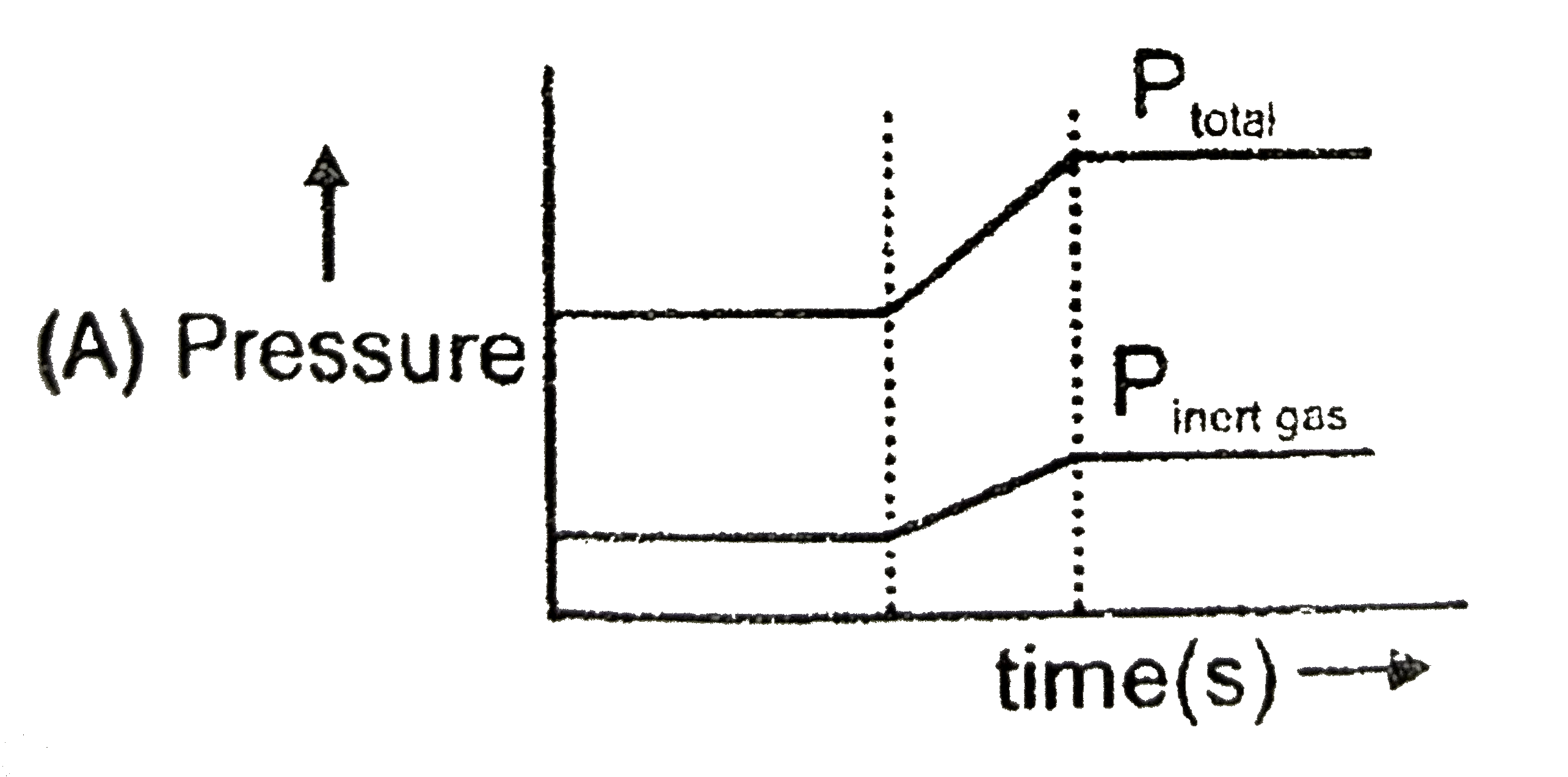
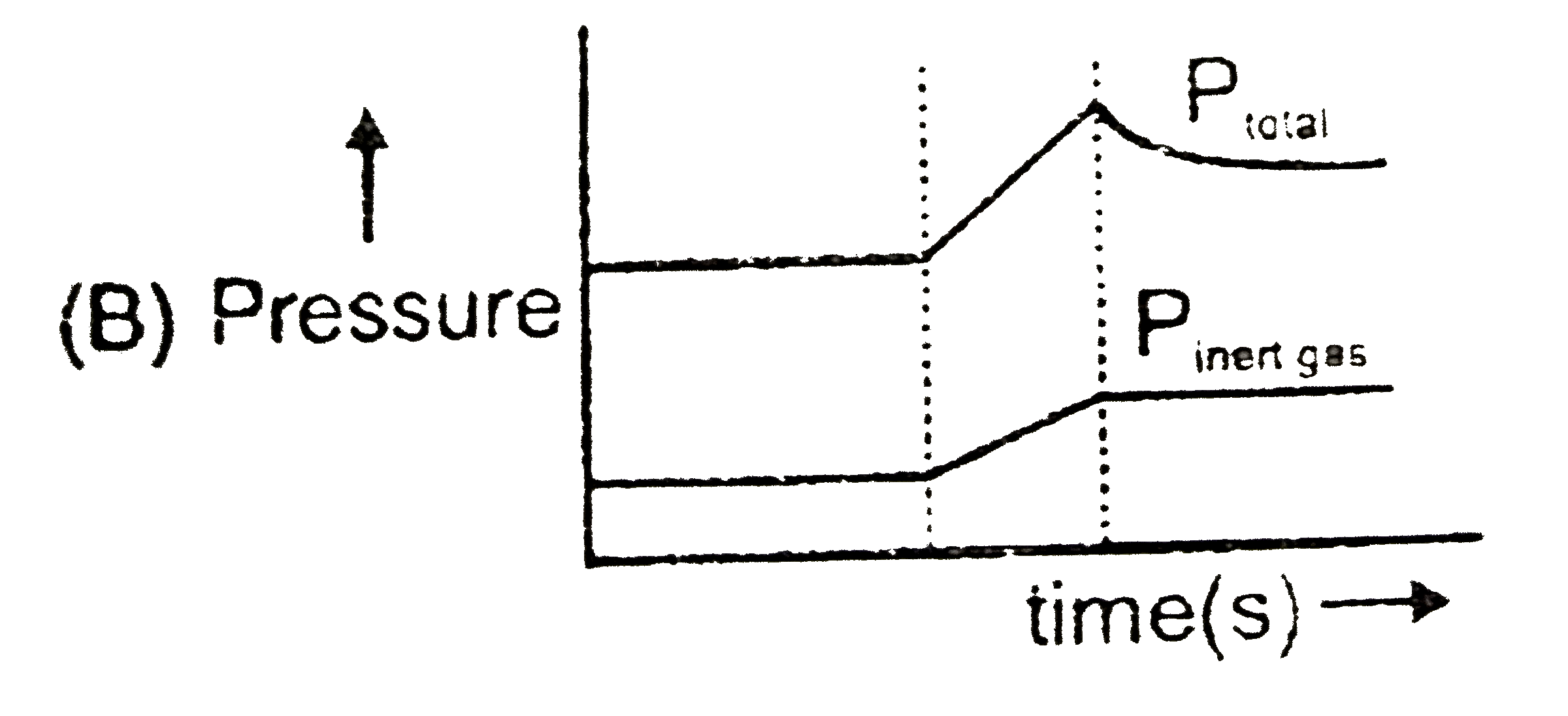
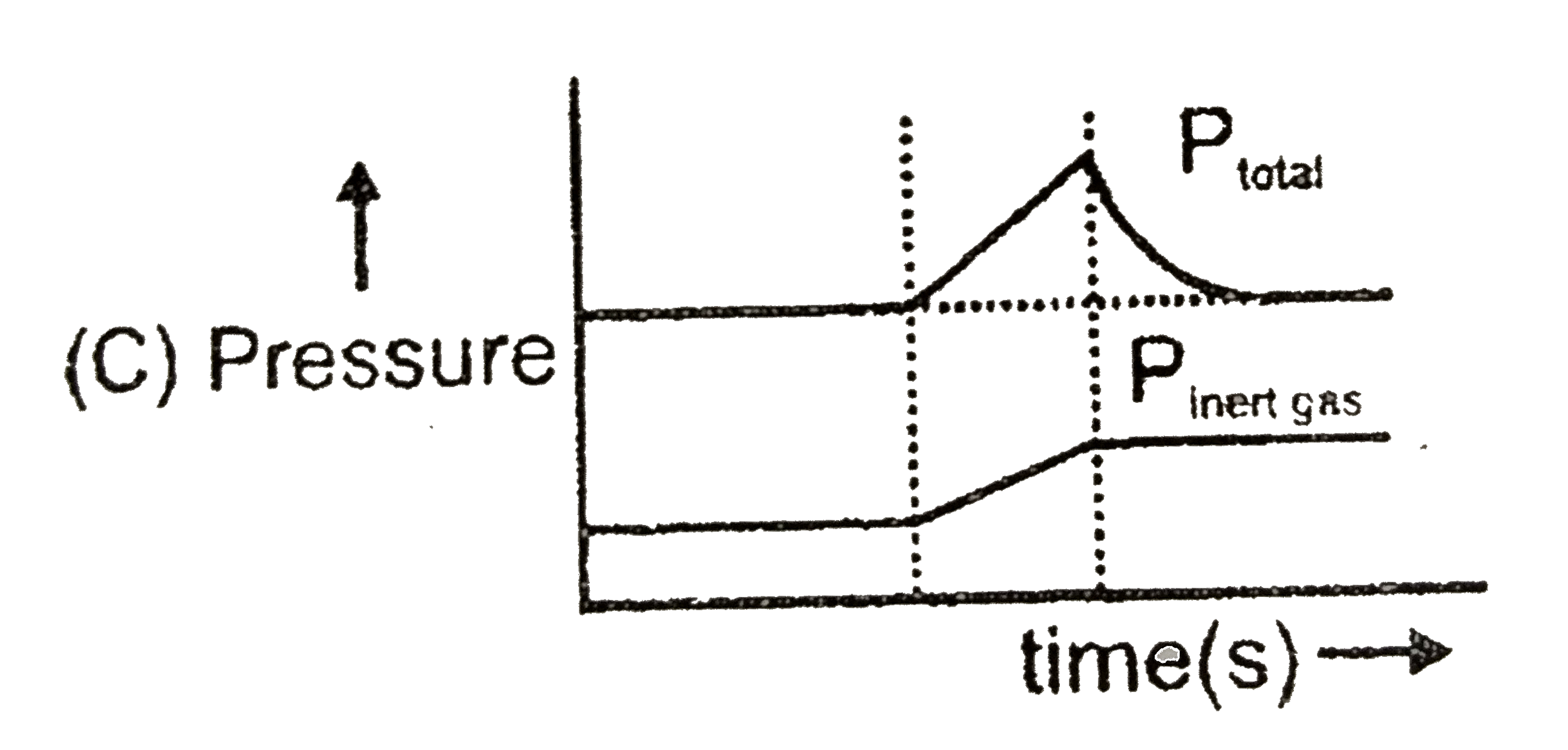
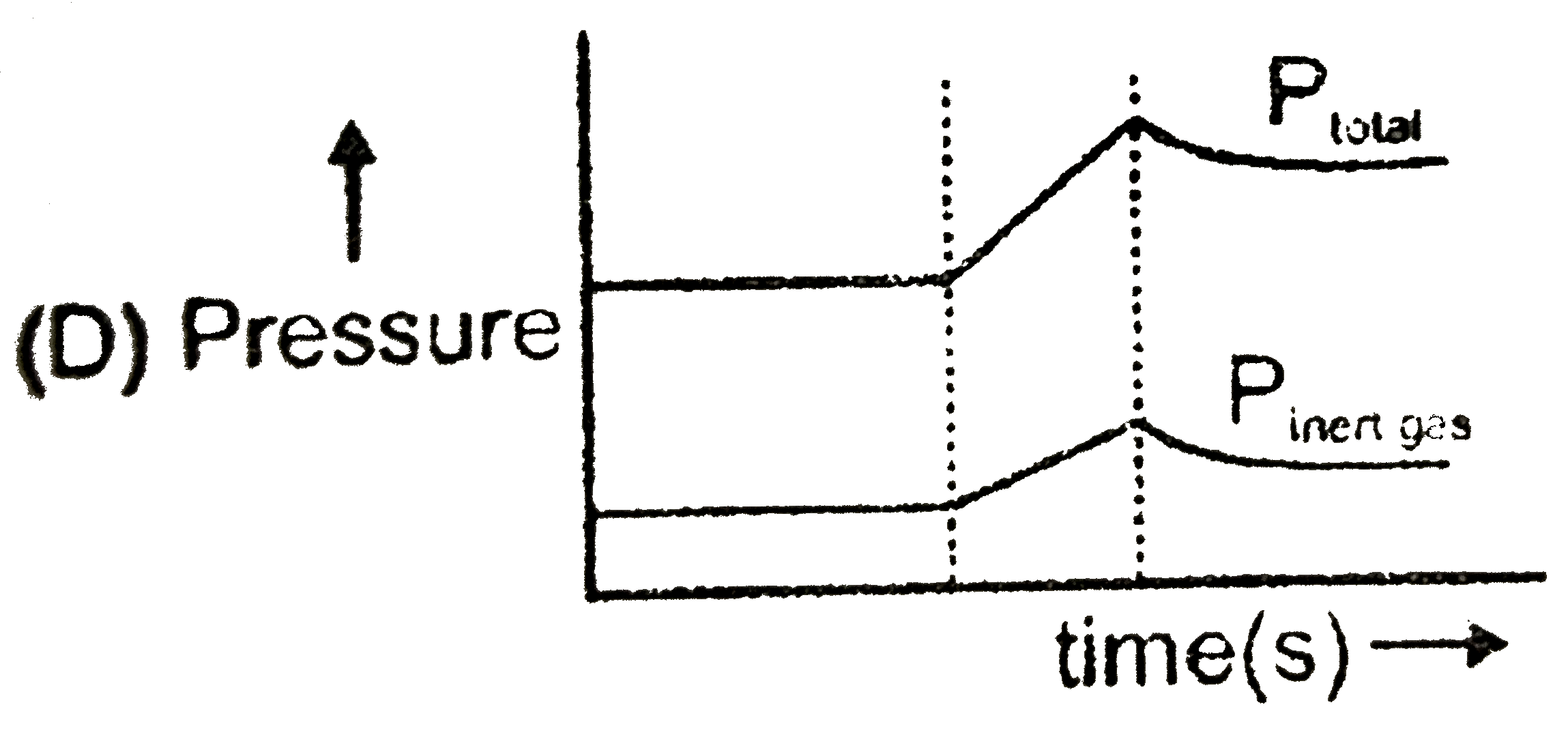
For a system at equilibrium some changes are made which is reported by a graph (shown below). Changes has been made at constant temperature. Choose the correct options: |
|
Answer»
|
|
| 32. |
For a substance more internal energy is observed in [ same quantity ] |
| Answer» Answer :C | |
| 34. |
For a spontaneous reaction, the DeltaG, equilibrium constant (K) and E_(cell)^(@) will be respectively, |
|
Answer» `- ve, gt 1, + ve` `DELTAH = -ve K gt 1 and E_("cell")^(@)= + ve` |
|
| 35. |
For a solution the plot of osmotic pressure(pi )verses the concentration( c "in" mol L^(-1)) gives a straight line with slope 310 R where 'R' is the gas constant The temperature at which osmotic pressure measured is |
|
Answer» `310 XX 0.082 K ` `310 R = RT` `THEREFORE T = 310 K = 37^(@)C` |
|
| 36. |
For a solution formed by mixing liquids L and M, the vapour pressure of L plotted against the mole fraction of M in solution is shown in the following figure, Here x_(L) and x_(M) represent mole fraction of L and M, respectively in the solution, the correct statement(s) applicable to this system is (are) : |
|
Answer» ATTRACTIVE intramolecular interactions between L-L in pure liquid L and M-M in pure liquid M are stronger than those between L-M when MIXED in solution `F_(L-L),F_(M-M)gt F_(L-M)` (SEQUENCE of intermolecular force) At point Z `p_(L) = p_(L)^(0)x_(L)` When `x_(M)=0`, then `x_(L)=1` `:. p_(L) = p_(L)^(0)`= pure liquid L] |
|
| 37. |
For a series of indicators the following colours and pH range over which colour change takes place are as follows : Indicator W would be suitable for use in the determination of the concentration of acetic acid in white vinegar by base titration : (a)True (b) False |
|
Answer» |
|
| 38. |
For a series of indicators the following colours and pH range over which colour change takes place are as follows : Indicator U could be used to distinguish between 0.1 M and 0.01 M solution of sulphuric acid : (a)True (b) False |
|
Answer» |
|
| 39. |
For a series of indicators the following colours and pH range over which colour change takes place are as follows : Indicator X could be used to distinguish between the solution of ammonium chloride and sodium acetate solution : (a)True (b) False |
|
Answer» |
|
| 40. |
For a sequential reaction. NH_(3) rightarrow N_(2) + H_(2) H_(2) + O_(2) rightarrow H_(2)O What will be the amount of water which will be obtained if 5 moles of NH_(3) is mixed with 3 moles of O_(2) and % yield of 1^(st) and 2^(nd) reaction is 50% and 80% respectively ? |
|
Answer» 3 moles |
|
| 41. |
For a series of indicators the following colours and pH range over which colour change takes place are as follows : Indicator V could be used to find the equivalence point for 0.1 M acetic acid and 0.1 M ammonium hydroxide solution : (a) True (b) False |
|
Answer» |
|
| 42. |
For a series of indicators the following colours and pH range over which colour change takes place are as follows : Indicator Y could be used to distinguish between the solutions of ammonium chloride and sodium acetate solution : (a)True (b) False |
|
Answer» |
|
| 43. |
For a sample of perfect gas when its pressure is changed isothermally from p_(i) to p_(f) , the entropy change is given by |
|
Answer» `DeltaS= nRln((p_(F))/( p_(i)))` `DeltaS = n C_(p) ln. (T_(2))/(T_(1)) + nRln. (P_(1))/(P_(2)) ` ( Refer to page)or `DeltaS = nC_(p)ln. (T_(f))/(T_(i))+ nRTln. (p_(i))/(p_(f))` For isothermal expansion, `T_(i) = T_(f)` so that `ln. (T_(f))/(T_(i)) = ln 1= 0`. Hence, `DeltaS = nR ln. (p_(i))/( p_(f))` |
|
| 44. |
For a sample of perfect gas when its pressure is changed isothermally from P_(i) to P_(f) the entropy change is given by |
|
Answer» `DELTA S = NRT "In" ((P_f)/( P_i))` For isothermal `T_i = T_f, "In" 1=0` `therefore Delta S = nR "In" (P_i)/( P_f)` |
|
| 45. |
For a sample of perfect gas when its pressure is changed isothermally form p_(i) to p_(p) the entropy change is given by |
|
Answer» `DeltaS = nR in ((p_(f))/(p_(i)))` `DeltaS = nC_(p) In((T_(f))/(T_(i))) + nR"In((p_(i))/(p_(f)))` SINCE the process is isothermal , `T_(i) = T_(f)` and In 1 = 0 `THEREFORE DeltaS = nR"In ((p_(i))/(p_(f)))` |
|
| 46. |
For a salt AB_(2)(s) solution if Ionic product (I.P) gt K_("sp"),then precipitation will take place. |
|
Answer» |
|
| 47. |
For a reversible reaction alphaA+betaBhArr^.cC+^.dD,the variation of K with temperature is given by log(K_(2))/(K_(1))=(-DeltaH^circ)/(2.303R)[(1)/T_(2)-(1)/T_(1)]then, |
|
Answer» `K_(2) GT K_1if T_2 gt T_1` for an endothermic CHANGE |
|
| 48. |
For a reversible reaction at 298 K, if the concentration of reactants is doubled, the value of equilibrium constant will be ……… |
| Answer» Answer :C | |
| 49. |
For a reversible reaction aA+bBhArrcC+dD, the variation of K with temperature is given by log (K_(2))/(K_(1))=(-DeltaH^(@))/(2.303R) [(1)/(T_(2))-(1)/(T_(1))] then, |
|
Answer» `K_(2)gtK_(1) "if" T_(2)gtT_(1)` for an endothermic change |
|
| 50. |
For a reversible reaction A underset(K_(2))overset(K_(1))(hArr) B rate constant K_(1) (forward) = 10^(15)e^(-(200)/(T)) and K_(2) (backward) = 10^(12)e^(-(200)/(T)). What is the value of (-Delta G^(@))/(2.303 RT) ? |
|
Answer» Equilibrium constant `(K_(P))=(K_(1))/(K_(2))` `K_(1)=10^(15)e^((-2000)/(T)), K_(2)=10^(12)e^((-2000)/(T))` Thus `(K_(1))/(K_(2))=10^(3), DELTAG^(@)= -2.303 RT log K_(P)` `-((DeltaG^(@))/(2.303 RT))=log KP=(K_(1))/(K_(2))=log 10_(10)^(3)=3` |
|