Saved Bookmarks
This section includes 7 InterviewSolutions, each offering curated multiple-choice questions to sharpen your Current Affairs knowledge and support exam preparation. Choose a topic below to get started.
| 1. |
For decolorisation of 1 mole of KMnO_(4), the moles of H_(2)O_(2) required is : |
|
Answer» `(1)/(2)` |
|
| 2. |
For Dalton's law of partial pressure derive the expression P_("gas")= X_("gas")* P_("total"). |
|
Answer» <P> SOLUTION :`P_(CH_4)=1.23 ATM, P_(H_2)=3.079 atm,P_(" TOTAL ")=4.31 atm` |
|
| 3. |
For d-electron,the orbital angular momentum is ………………… |
|
Answer» `sqrt(2h/(2PI))` Ford orbital`=sqrt(2XX3)4/2pi=sqrt((6h)/(2pi))` |
|
| 4. |
For coordination number-4, the limiting radius ratio is |
|
Answer» 0.414 |
|
| 5. |
For complete description of an electron in an atom, the number of quantum numbers required is |
|
Answer» ONE |
|
| 6. |
For complete combustion of ethanol, C_(2)H_(5)OH(l) + 3O_(2)(g) to 2CO_(2)(g) + 3H_(2)O(l), the amount of heat produced as measured in bomb calorimeter, is 1364.47 kJ mol^(-1) at 25^(@)C. Assuming ideality the enthalpy of combustion, Delta_(c)H for the reaction will be (R = 8.314 J mol^(-1)) |
|
Answer» `-1350.50 kJ"MOL"^(-1)` `R = 8.314 xx 10^(-3)kJK^(-1) "mol"^(-1)` `Deltan_(g) = 2 -3 =-1` `DeltaH = DeltaU + Deltan_(G) Rt` ` = -1364.47 + (-1) (8.314 xx 10^(-3))(298)` ` = -1366.95 kJ"mol"^(-1)` |
|
| 7. |
For complete combustion of ethanol, C_(2) H_(5) OH_((l)) + 3O_(2(g)) to 2CO_(2(g)) + 3H_(2) O_((l)), the amount of heat produced as measured in bomb calorimeter is 1364.47 "kJ mol"^(-1) at 25°C. Assuming ideality the Enthalpy of combustion, Delta_(C) H, for the reaction will be : (R= 8.314 "kJ mol"^(-1) ) |
|
Answer» `-1460.50 "kJ mol"^(-1)` `Delta U = - 1364.47 "kJ mol"^(-1)` `Deltan_(g) = -1` `DeltaH = Delta U + Deltan_(g) RT` `= -1364.47 - (1xx 8.314 xx 298)/( 1000)` `=-1366.93 "kJ mol"^(-1)` |
|
| 8. |
For Cl_(2)to2Cl Assign the sigans for DeltaG and DeltaS. |
|
Answer» SOLUTION :`DeltaH=+ve `(ENDOTHERMIC REACTION) `DeltaS=-ve` (ENTROPY INCREASES) |
|
| 9. |
For change in entropy, units are |
|
Answer» MOL/lit |
|
| 10. |
For CH_(3)CHOHCH_(2)CH_(2)CH_(2)CH_(2)CHO the main group and second priority group is…..and …… |
| Answer» SOLUTION :`-CHO, -OH` | |
| 11. |
For cationic hydrolysis, pH given by |
|
Answer» `PH=(1)/(2)pK_(w)+(1)/(2)pK_(a)+(1)/(2)log C` `[H^(+)] = ((K_(w).C)/(K_(b)))^(1//2)` `pH= - log[H^(+)]= -"log" ((K_(w).C)/(K_(b)))^(1//2)` `= (-1)/(2)[log K_(w)-logK_(b)+log C]` `= (1)/(2)[pK_(w)-pK_(b)-logC]` |
|
| 12. |
For CaCO_(3)(S) hArr CaO(s) + CO_(2) (g), Delta H = + Q at equilibrium. to shift equilibrium towards right, |
|
Answer» `[CO_(2)]` should be INCREASED |
|
| 13. |
For Ca_3(PO_4) give formula of K_(sp) . |
|
Answer» Solution :`Ca_3(PO_4)_2 hArr underset"3s"(3Ca^(2+)) + underset"2S"(2PO_4^(3-))` `K_(SP)=(3s)^3 (2s)^2 =108 s^5` |
|
| 14. |
For CaCO_(3) hArr CaO + CO_(2) , at equilibrium log K_p = 8 - (6400)/(T(k)) . Then temperature at which K_(p) = 1 ? |
|
Answer» `427^(@) C` |
|
| 15. |
for Br_(2)(g),DeltaH_(vap)^(@)=31Kjxxmol^(-1). If S^(@) values for Br_(2)(g)and Br_(2)(l)are 245J.mol^(-1).K^(-1)and 153 J mol^(-1).K^(-1) respectively , what is the normal boiling point for Br_(2)(l)? |
|
Answer» 340K |
|
| 16. |
For BOD, the sample of liquid waste kept for 5 days at ......... temp. |
| Answer» Solution :293 K | |
| 17. |
Forboth 2pand 3sorbitalvalueof(n+l)is sameie 3. thanwhichone hasless energyfrom both? Why ? |
| Answer» SOLUTION :The ENERGYOF 2porbitalis LESS . Becauseif`(n+1)` is samethen ndetermineenergy . | |
| 18. |
For best quality cement the ratio between Silica and Alumina and the ratio of total other oxide is near as - |
|
Answer» 5.2 to 6 and 3 |
|
| 19. |
For Balmer series in the spectrum of atomic hydrogen, the wave number of each line is given by bar(v) = R_(H) ((1)/(n_(1)^(2)) - (1)/(n_(2)^(2))) where R_(H) is a constant and n_(1) and n_(2) are integers. Which of the following statement (s) is (are) correct ? 1. As wavelength decreases, the lines in the series converge 2. The integer n_(1) is equal to 2 3. The ionization energy of hydrogen can be calculated from the wave numbers of these lines 4. The line of longest wavelength corresponds to n_(2) = 3 |
|
Answer» 1, 2 and 3 |
|
| 20. |
For bleaching powder which is incorrect ? |
|
Answer» It is highly soluble in water |
|
| 21. |
For benzene…….. (i) Benzene does not give addition reaction. (ii) Benzene gives characteristic electrophilic substitution reaction. (iii) Benzene is planner molecule. (iv) There is no double bond or single bond present in benzene. |
|
Answer» |
|
| 22. |
For BCl_(3), AlCl_(3) and GaCl_(3) the increasing order of ionic character is |
|
Answer» `BCl_(3) LT AlCl_(3) lt GaCl_(3)` |
|
| 23. |
For associative solutes |
|
Answer» ` I LT 1 and ALPHA lt 1` |
|
| 24. |
For are reaction at 298 K is K_p=1.7xx10^12, So "J mol"^(-1) a find DeltaG^ө.(R=8.314 J mol^(-1) K^(-1) ) |
| Answer» SOLUTION :`DeltaG^ө=-6.9785xx10^4 "J MOL"^(-1) = -69.78 "KJ mol"^(-1)` | |
| 25. |
For any given series of spectral lines of atomic hydrogen, let Deltavecv = Deltavecv_("max") - vecv_("min") be the difference in maximum and minimum frequencies in cm^(-1). The ratio Deltavecv_("Lyman")//Deltavecv_("Balmer") is: |
|
Answer» `4:1` |
|
| 26. |
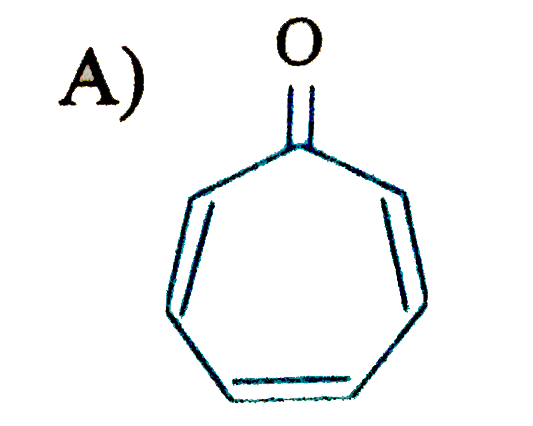
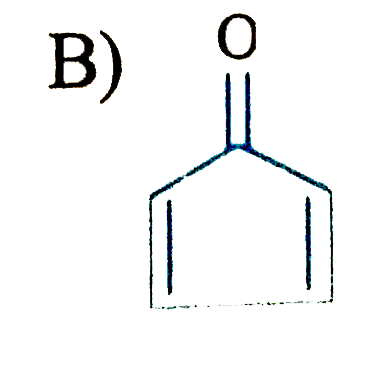
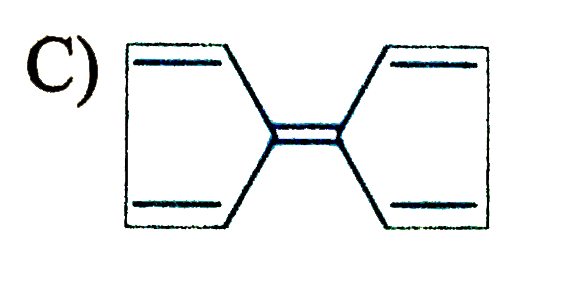
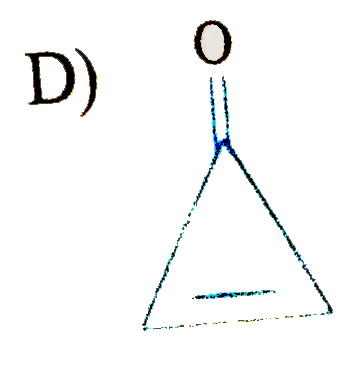
For any compound to be aromatic, compound should follow a cartain rule known as Huckel's rule. According to Huckel's rule of aromaticity a). Compound should be cyclic b). Compound should be planar and conjugated c). Compound should have (4n+2)pie^((-)) where n=0,1,2,3, . . . . integer number. Q. Identify the compound while have maximum dipole moment. |
|
Answer»
 More NUMBER of POLAR RESONANCE stractures. |
|
| 27. |
For an organic monoprotic acid solution of concentration Co mole litre^(-1), if K_(a) has a value comparable to K_(w), show that the hydronium ion concentration is given by : [H^(+)]= [(K_(w))/(H(+)]+(K_(a).Co)/([K_(a)+H^(+)])] If [H^(+)]=10^(-3)M and Co=10^(-1)M in a solution of some organic monoprotic acid, what according to the above equation must be the order of magnitude of K_(a) ? |
|
Answer» |
|
| 28. |
For an optically active compound specific rotation ([alpha]_(D)^(25)) depends on a) Length of the polarimeter tubeb)Concentration of solution c) Polarimeter instrumentd) Nature of the compound |
|
Answer» All |
|
| 29. |
For an optically active compound alpha_(obs) depends on |
|
Answer» Concentration of the solution |
|
| 30. |
For an isothernal free expansion of an ideal gas correct question option is: |
|
Answer» `Q=0,W=0, DELTAH NE 0` |
|
| 31. |
For an isothermal reversible phase transition process , Delta S is |
|
Answer» `T// DELTA H` |
|
| 32. |
Foran isolated system, DetlaU = 0, what will beDeltaS? |
| Answer» Solution :`DeltaU=0` means that energy factor has no mole role to PLAY. Hence for the process to be spontaneous , entropyfactor should favour the process, i.e., `DeltaS`MUT be `+ve` (i.e., `DeltaSgt 0)`. ( Considert the example of twogases CONTAINED separately in two bulbs connnected by a stop-cock, and ISOLATED from the SURROUNDINGS as an example of an isolated system. On opening the stocp - cock, the two gases mix up, i.e., the system becomes more disordered. This implies that `DeltaS gt 0` But`DeltaU = 0` for the process ) | |
| 33. |
For an isolated system ,DeltaU=0 What will bs DeltaS ? |
| Answer» Solution :`DELTAU` for an isolated SYSTEM is zero because it does not EXCHANGE any ENERGY with the surrounding.But the spontaneous change will occurs only if`DeltaSgt0` THEREFORE `DeltaSgt0` | |
| 34. |
For an isolated system, DeltaU=0. What will be the value of DeltaS? |
| Answer» Solution :Consider the example of TWO gases contained separately in two BULBS CONNECTED by a stop-cock and isolated from the SURROUNDINGS as an example of an isolated system. On OPENING the stop-cock, the two gases mix up, i.e., the system becomes more disordered. This implies that `DeltaS gt 0`. | |
| 35. |
For an isolated system , DeltaU=0 what will be DeltaS? |
|
Answer» |
|
| 36. |
For an isolated system, Delta U = 0, what will be Delta S? |
|
Answer» Solution :`DELTA U = 0` means thermody parameter doesn.t TAKE part in REACTION. `q=0` therefore reaction is spontaneous `therefore Delta S GT 0 therefore Delta S = +ve` |
|
| 37. |
For an isolated system, Delta U=0. What will be DeltaS? |
| Answer» SOLUTION :CONSIDER an EXAMPLE of TWO gasses contained separately in two bulbs connected by a stop-cock and isolated from the surroundings. On opening the stop-cock, the two gases mix up. i.e., `DELTAS>0` | |
| 38. |
For an irreversible process, the value of [DeltaS_("(system)") + DeltaS _("(surroundings)") ] is |
|
Answer» `gt 0` |
|
| 39. |
For an ideal monoatomic gas, an illustration of three different paths A,(B+C) and (D+E) from an initial state P_(1),V_(1),T_(1)toa final state P_(2),V_(2),T_(1) is shown in the given figure . Path A represents a reversible isothermal from P_(1)V_(1)" to "P_(2),V_(2), path (B+C)represent a reversible adiabatic expansion (B) from P_(1),V_(1),T_(1)" to " P_(3),V_(2),T_(2) followed by reversible heating of the gas at constant volume (C) from P_(3),V_(2),T_(2) " to " P_(2),V_(2),T_(1). Path (D+E) represents a reversible expansion at constant pressure P_(1)(D) from P_(1),V_(1),T_(1) " to "P_(1),V_(2),T_(3) followed by a reversible cooling at constant volume V_(2)(E) form P_(1),V_(2),T_(3) " to "P_(2),V_(2),T_(1) What is DeltaS for (D+E)? |
|
Answer» ZERO |
|
| 40. |
For an ideal monoatomic gas, an illustration of three different paths A,(B+C) and (D+E) from an initial state P_(1),V_(1),T_(1)toa final state P_(2),V_(2),T_(1) is shown in the given figure . Path A represents a reversible isothermal from P_(1)V_(1)" to "P_(2),V_(2), path (B+C)represent a reversible adiabatic expansion (B) from P_(1),V_(1),T_(1)" to " P_(3),V_(2),T_(2) followed by reversible heating of the gas at constant volume (C) from P_(3),V_(2),T_(2) " to " P_(2),V_(2),T_(1). Path (D+E) represents a reversible expansion at constant pressure P_(1)(D) from P_(1),V_(1),T_(1) " to "P_(1),V_(2),T_(3) followed by a reversible cooling at constant volume V_(2)(E) form P_(1),V_(2),T_(3) " to "P_(2),V_(2),T_(1) What is q_("rev") for path (A)? |
|
Answer» ZERO |
|
| 41. |
For an ideal monoatomic gas, an illustration of three different paths A,(B+C) and (D+E) from an initial state P_(1),V_(1),T_(1)toa final state P_(2),V_(2),T_(1) is shown in the given figure . Path A represents a reversible isothermal from P_(1)V_(1)" to "P_(2),V_(2), path (B+C)represent a reversible adiabatic expansion (B) from P_(1),V_(1),T_(1)" to " P_(3),V_(2),T_(2) followed by reversible heating of the gas at constant volume (C) from P_(3),V_(2),T_(2) " to " P_(2),V_(2),T_(1). Path (D+E) represents a reversible expansion at constant pressure P_(1)(D) from P_(1),V_(1),T_(1) " to "P_(1),V_(2),T_(3) followed by a reversible cooling at constant volume V_(2)(E) form P_(1),V_(2),T_(3) " to "P_(2),V_(2),T_(1) What is DeltaS for path (A)? |
|
Answer» `NR" In"(V_(2))/(V_(1))` |
|
| 42. |
For an ideal solution |
|
Answer» `Delta V_("MIX")=0` |
|
| 43. |
For an idealgas undergoingexpansion compression process . The relationships whichholdgood are: |
|
Answer» <P>`((delU)/(DELP))_(T)=0` |
|
| 44. |
For an idealgas, the work of reversible expansion under isothermal condition can be calculated by using the expression w= - nRT ln . (V_(f))/( V_(i)0 . A sample containig 1.0 molof an ideal gas is expanded isothermally and reversibly to ten times of its original volume in two separate experiments . The expansions is carried out at 300 K and at600 K respectively. Choose the correct option. |
|
Answer» WORK done at 600 K is 20 times at the work done at 300K As each case involves ISOTHERMAL expansion of an ideal gas, there is no change in internal energy, i.e., `DeltaU =0` |
|
| 45. |
For an ideal gas, the work of reversible expansion under isothermal condition can be calculated by using the expression W=n RT "L"n (V_f)/( V_i). A sample containing 1.0 mol of an ideal gas is expanded isothermally and reversibly to ten times of its original volume, in two separate experiments. The expansion is carried out at 300 K and at 600 K respectively. Choose the correct option. |
|
Answer» Work done at 600 K is 20 times the work done at 300 K. `W= - "nRT In" (V_f)/( V_i)` `V_f = 10 V_i` `T_2 = 600 K` `T_1 = 300 K` Putting these values in above expression `W_(600 K) = 1 XX R xx 600 K "In" (10)/(1)` `W_(300K) = 1 xx R xx 300 K "In" (10)/(1)` RATIO `= (W_(600k) )/( W_(300k) ) = (1 xx R xx 600 K "In"(10)/(1) ) /( 1 xx R xx 300K "In" (10)/(1) ) = (600 )/( 300)` For isothermal expansion of ideal gases, `Delta U = 0`. This MEANS there is no change in internal ENERGY. Therefore, `Delta U =0` |
|
| 46. |
For an ideal gas, the work of reversible expansion under isothermal condition can be calculated by using the expression w = "-nRT" In (V_(f))/(V_(i)) A sample containing 1.0 mol of an ideal gas is expanded isothermally and reveribly to ten times of its original volume, in two separate experimentsThe expansion is carried out at 300 K and at 600 K respectively.Choose the correct option |
|
Answer» Work done at 600K is 20 times the work done at 300 K `(w_(2))/(w_(1)) = (T_(2))/(T_(1))` or `(w(600 K))/(w(300 K)) = (600 K)/(300 K) = 2` i.e. Work done at 600 K is twice the work done at 300K.Since each case involves isothermal expansion of an ideal gas, there is no change in internal energy i.e. `DeltaU = 0`. |
|
| 47. |
For an ideal gas the graph between PV/RT and T is |
|
Answer»
|
|
| 48. |
For an ideal gas, number of moles per lit in terms of pressure (P), gas constant (R) and temperature (T) is |
|
Answer» PT/R |
|